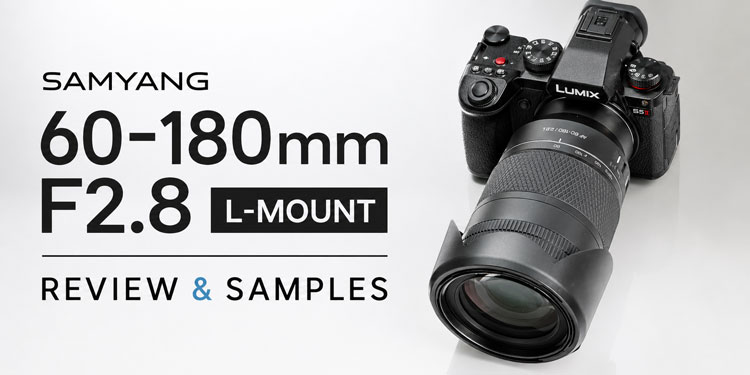
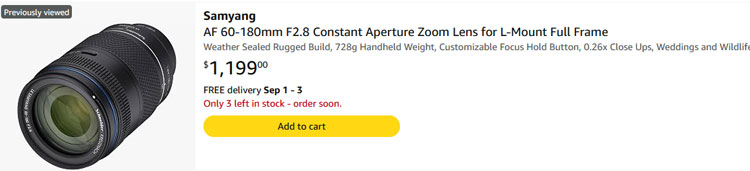
L-Mount shooters have been stuck with a bad choice: pay up and wear a 3-pound 70-200, or pretend a 28-70 can do telephoto work. Before Begin Let me clarify this is a non-sponsored post. LK Samyang’s new AF 60-180mm F2.8 L is the first lens that actually breaks that stalemate.It is a constant F2.8 zoom. It weighs 728g — 1.6 pounds. It sells for $1,199 in the U.S., $100 more than the Sony E-mount version and hundreds less than Sigma, Panasonic, or Leica’s 70-200s. No optical stabilization. The barrel extends when you zoom. And after one afternoon on a Panasonic S5II, it already made the frame that answers the only question most people have: can a cheap, light tele zoom isolate a face in a crowd at 180mm?
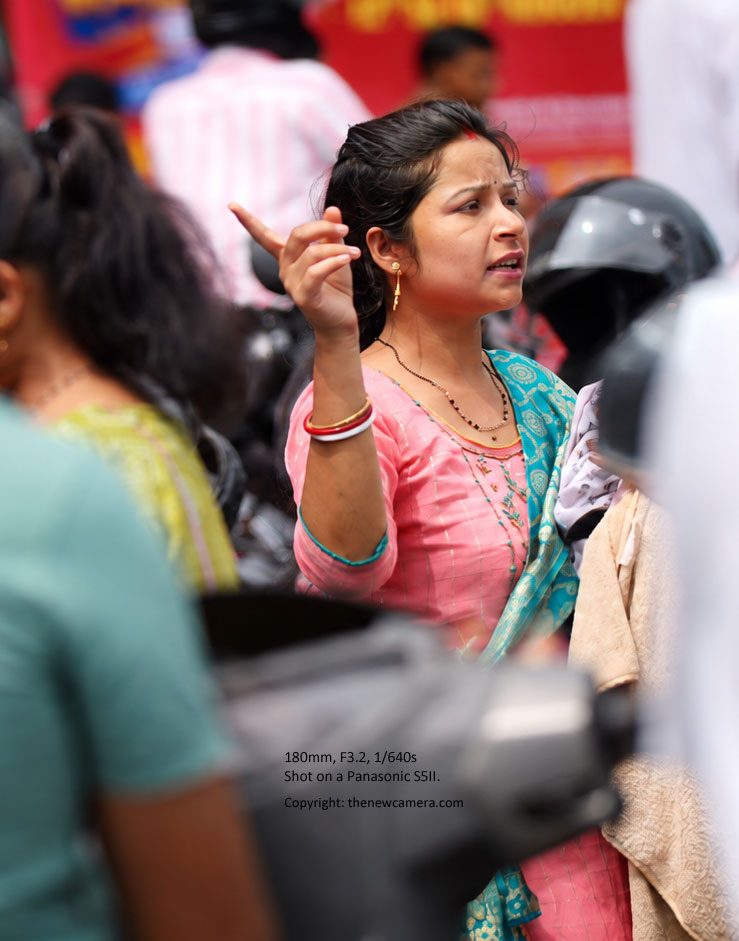
Yes. Look at this.
Caption: Samyang 16-180mm F2.8 – @180mm, F3.2, 1/640s on a Panasonic S5II. This is the sample image. Lens AF lock speed is amazingly fast while capturing faces during street shoot
Quick specs (so you can keep scrolling)
Lens: LK Samyang / Schneider-Kreuznach AF 60-180mm F2.8
Mount: L-Mount full frame (also Sony E)
U.S. price: $1,199 L-Mount / $1,099 E-Mount (B&H)
Weight: 728g L / 730g E — 1.6 lb
Aperture: F2.8 constant, 9 blades
Optics: 17 elements / 14 groups (7 ED, 2 aspherical, 1 HR)
Min focus: 13.8 in / 0.35m at 60mm; 31 in / 0.79m at 180mm
Max magnification: 0.26×
Filter: 77mm
OIS: none (use IBIS)
Weather sealing: yes
Camera for these samples: Panasonic Lumix S5II
These are field samples, not lab charts. They were shot at Maithon, a reservoir in eastern India – think lake town, rental boats, haze, and a street that never empties. Flat light until evening. That is a better test than a brick wall in an air-conditioned studio.
What you’re actually buying
Everybody writes “70-200” on a press release. In the hand, the extra 10mm at the short end is the more useful number. Sixty millimeters is still an environmental lens. You can stand on a boat landing, keep a hull, a ramp, and three people in life jackets in the same frame, and not feel like you stepped into a longer prime. At the other end, 180mm is enough to pull a face out of traffic or a flag off a moving boat.
The spec sheet is honest about the compromises. Linear stepping motor. Floating focus. USB-C on the barrel for firmware. Weather seals at the moving parts. No OIS.
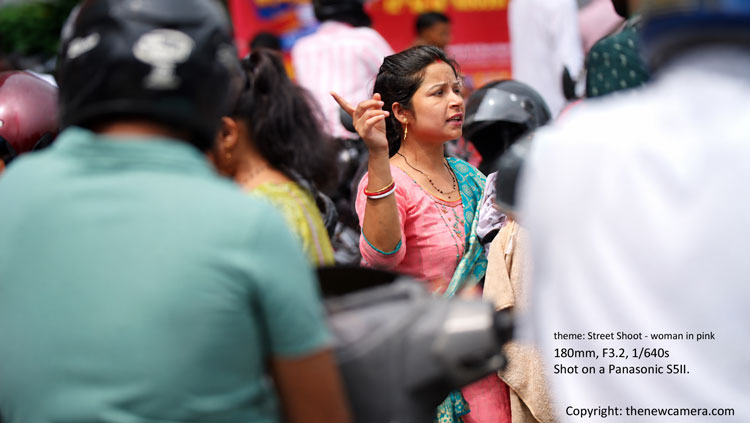
On an S5II that last point matters. The body has good in-body stabilization, but at 180mm you are still asking a sensor-shift system to tidy up a long, slightly front-heavy zoom. The street frame that opens this review was 1/640 at F3.2. That is not heroic. It is the correct way to use a lens that does not stabilize itself.
Sample images: sharpness, isolation, and that 180mm street shot
The woman in pink is the picture I would send anyone who asked what this lens does. She is not posed. She is mid-sentence, finger up, jewelry catching the only decent light on the block. The mint-green shirt and the white sleeve in the foreground are not mistakes. They are what 180mm does to a crowd: it turns other people into weather.
Look at the jewelry before you look at the bokeh. The chain, the earring, the red-and-white bangles – those edges are where a mid-priced zoom usually goes soft first when you shoot through heat and dust. Here they hold. The fabric of the blouse keeps its grid. The teal border of the scarf does not smear into the pink.
This frame is F3.2, a third of a stop down from wide open, and the subject is not at minimum focus. That is how most people will actually use 180mm: a person, a little distance, a mess behind them.
Autofocus did the unglamorous job. The S5II’s subject detection had a face to lock, and the lens did not hunt in a way the file records. You cannot judge tracking from one still. You can only say the still is sharp where it needed to be sharp.
Flat light is a mean test for color. Everything wants to go olive. The two tourist boats — “Babu Boat,” Ghat 3 and Ghat 8, “I Love Maithon” painted on the seats like a joke that became a brand – are useful because they are loud on purpose. Green hull, red bench, yellow stern, sunflower decals.
The lens does not hype them. That is a compliment. Oversaturated greens are the usual sin of contrasty telephotos on overcast water. They turn grass fluorescent and leave the hulls looking like toys. Here the paint stays in the world. You can read the lettering without leaning in.
If you are shopping this zoom as a cheaper 70-200, this is the file that answers the sharpness-at-normal-distance question better than the street shot. Nothing is moving. The subject is a set of straight lines and hard colors. They survive.
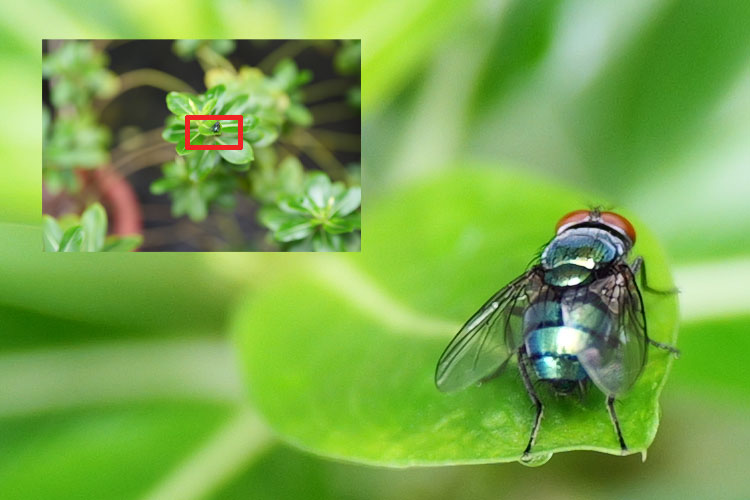
Captred Housefly on a Leaf, @60mm F2.8 S5 II, Scaled at 100%
Caption: Mid-range color test. If the lettering goes, the lens has already told you what it is.
Sample images: telephoto compression
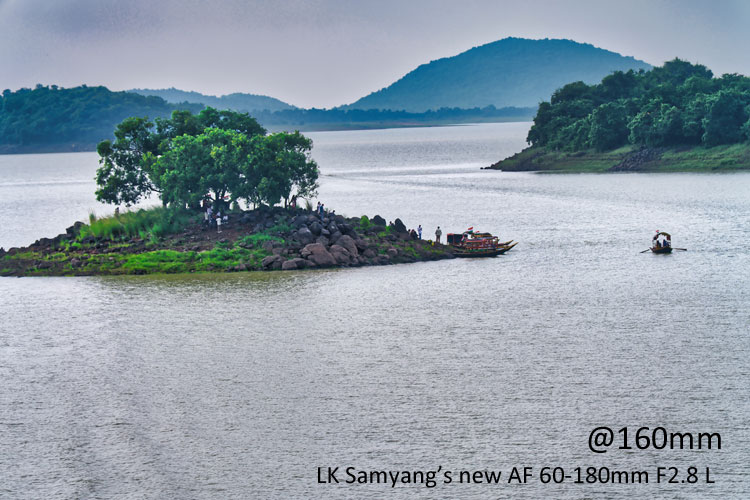
The small rocky spit in the reservoir is the most “this is why you buy a zoom” picture in the set. A wide lens would have made a postcard: water, a lump of land, some sky. At the long end of 60-180 the trees sit on the rocks, the people become a scale marker, the moored boat tucks into the shore, a second boat crawls away, and the hills behind them step forward.
That stacking is what you pay for. Not bokeh. Not the word professional. The ability to make distance feel arranged.
The haze is honest – humid-country air, not a mist filter. The far ridge goes blue-gray the way it should. Contrast falls off with distance instead of being punched back by in-camera Clarity. If you like crunchy landscapes, add that later. The file does not force the decision.
One frame has to move, or this is only a review of parked things. The speedboat with the Indian flag is that frame: orange and green hull, Yamaha on the transom, seven people, a white wake that has not yet decided to be elegant. The lens kept the boat together. Faces in the seats are small, but they are faces, not smudges. The flag is a sharp rectangle, which is harder than it looks when the thing is fluttering.
This is not a sports-AF test. It is one still, not a burst. What it shows is that an S5II and this zoom can freeze a rental boat at lake speed without the file feeling nervous. If you shoot football or birds, you will want a longer test. If you shoot the kind of life that happens on water — hired boats, flags, someone standing up when they should not — this is already relevant.
This is 60-180mm used as a notebook, not a portrait lens. You need enough reach to stand on the bank and not become part of the boarding. You need enough width that the ramp, the boat, and the people still belong to each other. You need the colors of cheap steel and rental life jackets to stay ugly in the correct way. The file does that.
Then the weather finally did something. Cloud opened enough for a strip of sun to lay itself on the water. A small boat sat in the glitter like a period. The dock became a silhouette. Two figures on the rocks were doing the only sensible thing, which was looking at the light.
Tele zooms are often poor at this hour. They crush the sky into plastic or leave the land as a black step. This frame keeps both. The highlight on the water has a shape. The far trees are a line, not a smudge. The little boat is dark enough to read as a boat.
Dynamic range here is more camera than lens — the S5II’s sensor is doing the heavy lifting — but a bad optic would have already veined the bright water with purple or washed the midtones. It does not.
What these pictures cannot tell you
It would be dishonest to turn a handful of frames into a full optical scorecard. There is no brick wall. There is no focus-shift test at F2.8 through the zoom. There is no video AF pull. There is no rain, even though the barrel is sealed. There is no night street with point lights to judge coma. Some E-mount reviewers have already called the zoom ring stiff; these files do not speak to that. They were made by someone who had already decided to take pictures instead of taking notes.
What they do say, with some confidence:
At 180mm, subject isolation in a crowd is the real feature, not a marketing line.
Color holds on loud, painted subjects without going sour in haze.
The long end compresses a landscape the way you hope a 70-200 will.
AF on the S5II is trustworthy on people and on a boat that is not trying to escape.
You will want shutter speed at the long end. This lens will not save a 1/80 handheld hero shot.
Samyang 60-180mm F2.8 vs Sigma 70-200 (and the rest) L-Mount does not get a Tamron 70-180. The comparison that actually matters is Sigma’s 70-200mm F2.8 DG DN OS Sports, with the Panasonic and Leica 70-200s in the next chair.
Those lenses internally zoom, have optical stabilization, and feel like tools you throw in a wet bag. They also weigh about 2.9 to 3.7 pounds. The Samyang is half that weight class. You feel it at the end of a staircase.
What you give up is not mysterious:
No OIS, so video walk-and-talks and dusk handheld work depend on the body
Extending barrel, so more moving surface area than an internal-zoom design
180mm, not 200mm
In stills at Maithon, none of those absences showed up as a missing photograph. They will show up if your work is indoor ceremony aisles at 1/100, or if you live on a monopod at a football game.
Against primes, the math is simpler. An 85mm and a 135mm will usually be sharper and prettier wide open. They will not give you the spit of land, the speedboat, and the dock without walking a mile and missing the light. This zoom is a coverage argument, not a bokeh argument.
Who should buy the Samyang 60-180mm F2.8 L
Buy it if:
You shoot Panasonic S5II / S9, Leica SL, or Sigma L-Mount bodies
You want F2.8 reach without wearing a 70-200
You travel, shoot people, or work events where weight is the real enemy
$1,199 is the number that makes the lens leave the store
Skip it if:
You already own the Sigma 70-200 Sports
You need built-in stabilization for video or slow shutter work
You need internal zoom and 200mm for sports
You want a lab-perfect optic more than a lens you will actually carry
Field scorecard
Treat these as notes from one afternoon, not laboratory marks.
Handling / weight: 9 — this is the reason to buy it
Isolation at 180mm: 9 — the street file is the evidence
Color: 8 — natural in haze, no neon grass
Landscape compression: 9 — exactly what a short tele zoom is for
AF with S5II stills: 8 — trustworthy on people and a hired boat
Stabilization: 4 — none in the lens; plan shutter speeds
Value on L-Mount: 9 — the best part of the product
Verdict
The LK Samyang AF 60-180mm F2.8 is not the best F2.8 tele zoom you can put on an L-Mount body. It is the one you will actually take to a lake on a gray day, and then into a street where nobody is waiting for you to change lenses.
The Maithon files are modest pictures. That is why they are useful. They show a lens that keeps faces, paint, distance, and a little weather in the same afternoon without asking to be treated like laboratory equipment.
On the S5II, at 180mm, in a crowd, it already made the photograph I would keep. The rest of the set is the walk back to the car. For a 1.6-pound zoom at $1,199, that is a decent day’s work.
The article “Don’t Buy a 3-Pound L-Mount 70-200 Until You See These Samyang 60-180mm F2.8 Samples” was written by thenewcamera.com team on 4:22 pm, Thursday, 27 August 2026, Greenwich Mean Time (GMT). | You can also follow us on Our Official Social Media HandlesFACEBOOK | TWITTER | INSTAGRAM> get live news — > DJI Rumors | Insta360 News
The DJI Pocket 3 camera has created a gold standard in terms of solo content creation, with its 1-inch sensor, 4K/120fps capabilities, buttery-smooth 3-axis gimbal stabilization, rotatable touchscreen, and advanced tracking features—making it a go-to tool for vloggers, travelers, and content creators, and we are not just saying this. The stats also say the same. As we have seen in the previous year, the Pocket 3 camera has covered more than 50% of the video camera market sales in Asian countries, so the Pocket camera, with each new version, is becoming excessively popular among content creators.
A true competitor, Xtra Muse – a powerhouse gimbal camera that’s strikingly similar in design and performance but comes at a fraction of the cost.
So let’s dive deep into the details and explore why Xtra Muse is better for you or why you should pick the DJI Pocket 3. We are talking about the cameras from different perspectives, putting all the facts in front of you so that you can decide the best one for yourself. And if you’re looking for an alternative, obviously the Xtra Muse is not going to disappoint, so let’s go through the details first before making a quick decision.
Whether you’re a vlogger, traveler, or content creator, this article breaks down the key factors to help you choose. We’ll cover build quality, video performance, battery life, and more, backed by the latest reviews and specs from 2026.
What Makes the DJI Osmo Pocket 3 So Popular (And Why People Seek Alternatives)
The DJI Pocket 3 camera was released back in 2023, and just after its announcement, due to its larger sensor and high-quality video recording, it became aggressively popular among content creators. Because of that, people became more inclined toward the Pocket camera, especially when comparisons were made with the latest iPhone 16 at that time. The results were surprisingly good with the Pocket 3, and specifically, the AI tracking was also enabled.
With the DJI ecosystem, you can also connect a microphone directly with the camera. There is no need for an extra receiver module — you just need a microphone. Trust me, it fits right in your pocket.
So overall, the Pocket 3 became extremely impressive, gained a lot of popularity in a short time, and became one of the market leaders in terms of solo content creation worldwide, not only in the United States of America.
Creators love it for vlogging, travel diaries, product reviews, and even professional B-roll. However, drawbacks include its higher cost, potential regional restrictions or supply chain issues for DJI products in some markets (like the US in recent years)
Introducing the Xtra Muse: The Closest DJI Pocket 3 Clone in 2026
If someone is extra concerned about the DJI ban, then for sure the Xtra Muse pocket gimbal is the best solution for you since specification-wise both the Xtra Muse and Pocket 3 exactly match each other. That clearly indicates… obviously DJI is trying to hide the Xtra Muse gimbal too.
Now take a look at the core specifications of the Xtra Muse. After we discuss the specifications, we are going to compare the gimbal with the Pocket 3. Yes, we do have some differences, and we are going to explain them after the comparison so you have a very clear idea before you make your purchase about what the differences are and how they are going to affect your content creation.
A 1-inch CMOS sensor (same size as the Pocket 3) for superior image quality over smaller-sensor competitors.
4K video recording at up to 120fps, enabling smooth slow-motion and detailed footage.
Advanced 3-axis gimbal stabilization for shake-free walking shots, pans, and handheld cinematography.
Fast autofocus with face and object tracking.
A rotatable touchscreen interface for intuitive control.
Support for log profiles (X-Log, comparable to DJI’s D-Log M) for color grading flexibility.
$499 or less someimes
Priced around $449 (often lower during sales), it’s positioned as a budget-friendly rival. Reviews and side-by-side tests from creators show it delivers remarkably close performance in real-world scenarios like vlogging, travel, and everyday content creation.
DJI Pocket 3 vs Xtra Muse: Detailed Specs Comparison
To help you decide, here’s a side-by-side comparison based on official specs and reviews. We’ve focused on core differences while highlighting similarities.
Feature
DJI Osmo Pocket 3
Xtra Muse
Sensor
1-inch CMOS
1-inch CMOS
Video Resolution
4K/120fps (Slow Motion), 10-bit D-Log M
4K/120fps, HLG and LOG profiles
Stabilization
3-Axis Mechanical Gimbal
3-Axis Mechanical Gimbal
Screen
2-inch Rotatable OLED (556×314 pixels)
2-inch Articulating OLED
Battery Life
Up to 166 min (1080p/24fps)
Up to 161 min
Charging Time
32 min full (with 65W charger)
35 min full
Weight/Dimensions
179g / 5.5 x 1.7 x 1.3″
180g / 5.5 x 1.7 x 1.7″
Audio
Stereo, DJI Mic 2 Compatible
AAC 16-bit, USB-C Mic Support (no DJI Mic)
Storage
microSD (up to 512GB)
microSD (up to 512GB)
App Compatibility
DJI Mimo (Android/iOS)
Xtra App (limited features)
Price (2026)
$519+
$449
Other
ActiveTrack 6.0, Webcam Mode
Smart Tracking, Time-Lapse
Data sourced from official sites and comparisons. As seen, the hardware is nearly identical, with the Xtra Muse saving on cost by skipping DJI’s ecosystem perks.
Pros and Cons: DJI Pocket 3
Let’s discuss the pros and cons of the cameras, which one is better, and why. As we all know, the core specifications of both cameras remain the same. Both carry a 1-inch sensor and approximately the same hardware that we have already seen in the DJI Pocket 3, so technically, you will be getting the same video quality as well as hardware performance as the Pocket 3 camera with the Xtra Muse.
Now, the limitation is actually the integration of DJI’s native microphones with the Pocket 3 camera, which is easily possible, and that’s why we call it a cohesive DJI ecosystem. But in the Xtra Muse, we do not have any dedicated mic — yes, I am talking about the wireless mic from Xtra. So you have to use an external receiver with the gimbal if you want to add high-quality audio from a distance.
All the internal mics from both cameras are very good, but yes, this is the key difference we have with the DJI Pocket 3. You don’t have to use any additional external receiver; you just need the transmitter part of the microphone, and the work is done.
Pros
Ecosystem Integration: Seamless with DJI Mic 2 for pro audio;
Cons
High Price: Starts at $519, plus accessories push it over $700.
Pros and Cons: Xtra Muse
Pros
Affordable Pricing: At $449, it’s $70-200 cheaper than the Pocket 3, making it accessible.
Identical Core Performance: Same sensor and gimbal for stunning 4K footage and stabilization.
US-Friendly: No trade restrictions; easy availability on Amazon and B&H.
Cons
Limited Ecosystem: No DJI Mic compatibility; relies on wired mics via USB-C.
App and Software: Xtra’s app lacks the polish of DJI Mimo; fewer advanced features.
Accessory Availability: Fewer official add-ons compared to DJI.
Why Xtra Muse is the Best Alternative to DJI Pocket 3
If cost is a barrier but you crave Pocket 3-level quality, the Xtra Muse wins hands-down. Reviews show side-by-side footage is nearly identical, with the Xtra Muse excelling in value – especially for solo creators who don’t need wireless audio all the time. It’s particularly appealing in 2026 amid DJI’s pricing hikes and availability woes.
For advanced users, DJI might edge out, but for 99% of vloggers, the Xtra Muse delivers “insane value” without compromise.
Other DJI Pocket 3 Alternatives Worth Mentioning
While Xtra Muse is our top pick, consider these:
Insta360 Ace Pro 2: Waterproof, AI editing; great for action but bulkier ($449).
Sony ZV-1F Vlogging Camera with Accessory Kit (Black)
Canon PowerShot V10 Vlog Camera
Final Verdict: Switch to Xtra Muse for Savings and Similarity
The Xtra Muse isn’t just an alternative – it’s the best DJI Pocket 3 alternative for most users in 2026, offering near-identical specs at a lower price. If you prioritize affordability and core performance over brand ecosystem, grab it now. For die-hard DJI fans, stick with the original, but expect to pay more.
Ready to buy? Check the latest deals on Amazon or B&H. What are your thoughts on this matchup? Share in the comments!
The article “DJI Pocket 3 Best Alternative: Why Xtra Muse Tops the List in 2026” was written by thenewcamera.com team on 4:43 pm, Saturday, 31 January 2026, Greenwich Mean Time (GMT) | You can also follow us on Our Official Social Media HandlesFACEBOOK | TWITTER | INSTAGRAM to get live news — > DJI Rumors
If you are a beginner looking for the best entry-level drones in 2025 and live in the United States of America, then this is the best time to act, as the deadline set by the FY25 National Defense Authorization Act (NDAA) is just 11 days away, on December 23, 2025. The DJI products will get banned in the United States of America, so if you already having/own a DJI product, then there is no issue, but yes, new product announcements/registrations at the FCC may get halted after this date. A positive aspect is that the ban is not affecting flying or existing DJI drones, so if you’re considering stocking up on the latest model, this is an ideal time to buy them at a reasonable price.
Here we have sorted out the best entry-level beginner-friendly drones for you made by DJI. And this time, we’re not talking about any DJI alternatives for now, since DJI itself is the best drone maker in the world, and if you can get your hands on their drones before December 23, then why think of alternatives right now?
Keep in mind that the drones that we have selected in this buying guide are under 250g,. Just jump into the list below and sort the best drone as per your own set of requirements and the budget range you have.
Key Factors for Beginners When Choosing a DJI Drone
Don’t just grab the shiniest one—focus on what matters for new pilots. Here’s a quick rundown:
Weight: Always prefer an underweight drone >250g, since those underweight drones are trouble-free drones and don’t require extra paperwork/permission while taking off. Stick to under 250g (all our picks qualify) to avoid FAA registration and fly freely in most areas.
Camera Quality: All the drones we have listed record crisp smooth 4K footage;
Flight Time: 20-30 minutes per battery—get a combo pack for all-day sessions.
Ease of Use: App integration (DJI Fly app), GPS return-to-home, and beginner modes like auto-hover.
Portability & Price: Foldable designs under $500 for starters; wind resistance up to Level 5 for outdoor adventures.
We have selected some of the best and latest DJI drones for you, so before it’s too late, grab them as soon as possible, and all these drones are available at Amazon.com at a very reasonable price. The recently announced DJI Neo 2 is available at 35% off the MSRP pricing.
Based on 2025 reviews and current stock, here are our vetted picks across budgets. We’ve prioritised models with strong cameras, long batteries, and holiday discounts. (Prices as of Dec 11; affiliate links via Amazon/DJI Store for easy grabs.)
Budget Picks (Under $500: Perfect for First-Timers)
DJI Neo 2 – Finally, the DJI Neo 2 drone is now available at Amazon USA for $259. But if you apply the offer (mentioned below), the overall price goes down to $199 on Amazon USA. That’s a solid discount on the DJI Neo 2, a newly announced drone. Keep in mind that all these offers and rules are available until December 23, 2025, so hurry up. The new Neo 2 drone is perfect for beginners, content creators, and solo filmmakers who love having an aerial cinematographer with them who understands their gestures and follows them wherever they move.Buy DJI Neo 2 on Amazon for $239 and thank us later. The DJI Neo 2 is getting a positive response. Initial review scoring 4.5/5 stars from 269 reviews. ALERT: Stock running out FAST. ACT quickly to get the deal
DJI Mini 4K – The DJI Mini 4K Drone is the latest best-selling Amazon.com drone, and when we have seen almost 10,000 units sold in the past month alone of this drone, it was really a big surprise, and it is now available at $249 with a $50 discount from its usual $299 price. DJI Mini 4K is the best budget 4K drone in 2025 available for creators, vloggers, and hobbyists that offer professional-level features without any FAA registration. But as usual, we know that DJI is potentially facing a lot of bans, and stock shortages are everywhere. Price: $299 + Additional Discount $60 off with an Amazon card
Compact Solo Performer ($250-500: Solo Creativity)
DJI Flip –The drone features a 1/1.3-inch sensor, which is the same sensor as the pricey DJI Mini 4 Pro – so you are getting professional quality video up to 4K 60 FPS HDR, and the ability to capture still images of 48 megapixels. The DJI Flip also supports 10-bit internal video recording and D-Log with manual colour modes, which allows professional-level editing and very high latitude / DR range in your videos for working later on in shadows and highlights. It also has a slow-motion mode where you can capture 4K videos up to 100 frames per second, which will add a kind of cinematic flair to your entire footage. The DJI Flip also offers vertical shooting mode for Instagram Reels, YouTube Stories, as well as TikTok videos..Buy DJI Flip (affiliate).
DJI Mini 3 – Now, specifically for those creators who need extra airtime, the DJI Mini 3 arrives at $419 and shines as one of the best DJI drones under $500 for marathon-type sessions. The DJI Mini 3 was announced in 2022 but is still in demand even in 2025, offering unbeatable battery life for its price. You get a total flight time of up to 38 minutes in standard mode and approximately 51 minutes with the Plus battery (sold separately).1/1.3-inch sensor for 12MP photos and perfect 4K HDR videos. This DJI Mini 3 is capable of true vertical shooting, rotating the gimbal up to 90 degrees – perfect for creating social media content. Buy Now: Amazon ($419)
The 2025 DJI ban deadline is a wake-up call, but it’s also a golden window for beginners to score deals on world-class gear like the Neo or Flip. Don’t wait—stock up, fly safe, and capture those holiday memories in 4K glory. Questions? Drop a comment below
A lot of new generation content creators do not want to hold the camera in their hand in the traditional way, so we have selected the best POV Camera 2026 for capturing raw and immersive footage (POV = Point of View) without the need to hold the camera in your hand. So if you’re looking for the best hands-free camera or the best camera for daily live vlogging, then for sure, these POV tiny action cameras and smart glasses are the perfect choices for you. Apart from all this, the hands-free/POV camera demand is exploding and is projected to hit $1.5B in sales this year alone.
Our list is composed of multiple of and best hands-free devices/cameras that help you capture your daily life vlogs without putting physical effort into recording your videos. The list includes the ultra-light beast, the DJI Osmo Nano. We also have AI-powered wearable sunglasses like the Ray-Ban Meta Generation Three and more, so let’s dive in details to explore the best POV camera for you.
We’ve rounded up the top contenders, blending modular beasts like the DJI Osmo Nano with AI-powered wearables like the Ray-Ban Meta Gen 3. This guide dives deep into camera specs, pros, cons, and real-world performance (aggregated from expert reviews and user tests), so you can snag the ultimate hands-free POV camera for vlogging without the guesswork. All picks are under 60g for true all-day wearability.
Why POV Cameras Are a Must-Have in 2026
The POV / point-of-view cameras are not just simple cameras. They act like a third eye, silently recording all your stuff—the activities that you are doing—in the highest possible quality. At the very same time, what you get is all the raw footage that is a kind of gold mine if you are a content creator or vlogger, so you can easily narrate your words and story over the footage and seamlessly integrate it into your day-to-day life vlogs.
Upgrades this year focus on 4K/60fps stabilisation, AI low-light fixes, and seamless app integration, making them ideal for TikTok creators and pros alike.
1. Insta360 Go Ultra: The Ultimate Tiny Action Cam for Versatile POV
Insta360 Go Ultra is one of the best and most powerful tools for creating content, specifically keeping most of the operations hands-free. It gets simply attached to your clothes or accessories with a magnetic clip and starts recording high-quality 4K videos up to 60 frames per second. The best part of this camera that content creators really appreciate is its low-light video recording capability, with its sensor and superior AI processing of recorded videos. You get ultra-low-light, high-quality footage on the go. Launched in August 2026, the Insta360 Go Ultra redefines compact POV cameras with its thumb-sized form and pro-grade upgrades.
Key Camera Specs
Sensor: 1/1.28-inch CMOS for superior low-light and detail.
Video: 4K/60fps with Active HDR; 1080p/240fps slo-mo for epic action replays.
Photo: 12MP stills with AI noise reduction.
FOV: 156° ultrawide for immersive perspectives.
Stabilization: FlowState gyro-EIS—handles shakes like a gimbal.
Storage/Battery: Swappable microSD (up to 1TB); 70min standalone (170min with Action Pod dock).
Weight/Price: 39g camera unit; $449 (includes Pod with flip touchscreen).
Pros
Blurs lines between wearable and traditional action cam—magnetic mounts stick to helmets, chests, or even pets for endless angles.
Killer low-light performance via AI upgrades; colours pop in dim gyms or dusk hikes.
Action Pod’s 2.2-inch flip screen edits on the fly .
Cons
Internal storage is limited without SD swap; high-res modes chew battery faster outdoors.
No built-in mic wind reduction—pair with an external for windy POVs.
Users rave about its “lifestyle-action” vibe for travel vlogs, earning 4.5/5 on PCMag for stabilisation alone. The best part that I personally like about the Insta360 Go Ultra is its seamless transfer of videos from the Go Ultra to the iPhone 17 Pro. So if you have any generation of iPhone, it doesn’t matter, simply install the app and the videos will transfer to your smartphone.
2. DJI Osmo Nano: Best Modular POV for Dynamic Sports and Vlogs
The DJI Osmo Nano is a recent edition by DJI, which is also able to capture 4K videos up to 60 frames per second and has 120GB onboard memory. The camera houses features like the next-generation 1/1.3-inch sensor, and DJI claims that Nano can deliver 13.5 stops of dynamic range, perfectly capturing shadow and highlight details. And obviously, the DJI ecosystem helps you to easily integrate microphones with the camera. Again, it is more lightweight than the Insta360 Go Ultra and weighs only 52g – perfect for creators who love to have a hands-free camera with the highest quality possible.
Key Camera Specs
Sensor: 1/1.3-inch CMOS for 10-bit color depth and wide dynamic range.
Video: 4K/60fps standard (up to 4K/120fps in burst mode); 1080p/240fps.
Photo: 35MP RAW/JPEG for poster-worthy stills.
FOV: 145° adjustable wide-angle.
Stabilization: RockSteady 3.0+ with horizon lock—ultra-smooth even at speed.
Storage/Battery: 64GB internal + microSD; up to 200min in 1080p (shorter in 4K).
Weight/Price: 52g; $399 (bundles with extra batteries/mounts).
Pros
Modular design integrates with DJI’s Osmo ecosystem
Vivid colours and DR is really good, Best outdoor POV.
Ultra Compact to carry
Cons
Battery drains quick in 4K/60fps (expect 30-45min continuous); overheating in hot climates.
TechRadar calls it “ideal for on-the-go vlogging,” with WIRED adding it to their 2026 best action cams list for its punchy output.
check out recent offers at DJI osmo Nano
3. Ray-Ban Meta Gen 3: Top Smartglasses for Discreet AI-Enhanced POV
The new series of Meta was recently announced in September, and they started to roll out in the first and second weeks of November. Still not widely available for pre-orders in the United States of America. Initially, the Meta lenses do not have the best cameras, like we have mentioned in the above POV cameras, but at the very same time, the best thing that I personally like about the Meta glasses is the battery backup. In the Gen 3 Glasses, you are getting approximately 2-3 hours of battery backup uninterruptedly while you’re recording your videos.
Yes, we are getting a limited resolution up to 3K in 30 FPS, as well as the lowlight performance also has some limitations due to the smaller sensor used inside the meta glasses. you can record up to 5 minutes in HD resolution (1080p/30fps or 1080p/60fps). That’s, a step up from the previous 3-minute cap. However, this extended limit is exclusive to 1080p; the higher 3K Ultra HD mode remains capped at 3 minutes due to increased processing and battery demands. Although these caps don’t apply to Live streaming, you can do it for an hour or so, in low res.
These Rayban Meta Gen 3 Glasses are more inclined towards having an enhanced user experience, that includes hands-free operation of having a video call or sending a chat message, but apart from all this set of features, yes, you can use these Meta glasses as your POV camera for seamless video recording without putting any sort of hard effort, like holding a camera and recording all the time.
Meta’s September 2025 Gen 3 Ray-Bans blend stylish shades with a futuristic camera, making them the best wearable POV camera 2026 for everyday creators who want AI smarts without bulk.
Key Camera Specs
Sensor: 12MP ultrawide for crisp captures.
Video: 3K/30fps (upgraded from prior gens; 3-min clips max).
Photo: 3024×4032 resolution with auto-HDR.
FOV: Ultrawide ~120° for natural eye-level views.
Stabilization: Basic EIS with AI post-processing.
Storage/Battery: 32GB internal; 4hrs audio/1hr video (full day mixed use).
Weight/Price: 48g; $299 (base), $799 (with heads-up display for previews).
Pros
Looks like regular Ray-Bans—discreet for “incognito” street vlogs or events.
AI features like live transcription and object recognition elevate raw POV into smart edits.
Longer battery than Gen 2; waveguide display (premium model) lets you preview shots hands-free.
Cons
Video clips cap at 3 minutes in 3K, frustrating for longer takes.
Camera quality dips in low light; not pro-level detail compared to dedicated cams.
PCMag praises the 3K video leap, while users note it’s “futuristic yet low-impact” for daily wear.
4. Ray-Ban Meta Gen 2: Affordable Smartglasses Alternative for Everyday POV
RayBan Gen 2: If you’re not interested in investing much in Gen 3 smart glasses by Ray-Ban, then the Gen 2 is the best option as an entry-level smart glass that uses exactly the same 12MP sensor which is being used inside the Gen 3 smart glasses. Apart from this, the upper video resolution recording limit is the same as 3K, and the video capping of the Gen 2 has been upscaled with the firmware update. So we are getting the 3K video recording cap limit of three minutes, as well as full HD up to 5 minutes. Maybe in the near future, we may have an extended period of recordings in the Gen 3. But as of now, we do not have much difference in the recording time limit between the.
The Gen 3 is much more devoted to a user-friendly experience by adding personalised messaging with gesture controls as well as one-on-one video chat, which is exclusive to Gen 3 smart glasses. So if you want to experience only how the smart glasses work and how you can use them as your POV camera, then for sure, the N2 is more than enough and you can start with investing a bit less amount, and if you are comfortable with it, then for sure you can upgrade later to 3 or 4, whichever you like.
Key Camera Specs (vs. Gen 3)
Sensor: Same 12MP ultrawide as Gen 3 for consistent sharpness.
Video: 1080p/30fps (vs. Gen 3’s 3K/30fps—noticeable drop in detail for larger screens, but fine for social clips).
Photo: Identical 3024×4032 resolution with auto-HDR.
FOV: Ultrawide ~120°—matches Gen 3 for eye-level immersion.
Stabilization: Basic EIS (slightly less refined AI tweaks than Gen 3).
Storage/Battery: 32GB internal; 3hrs audio/45min video (shorter than Gen 3’s 4hrs/1hr, but doubles Gen 1’s life).
Weight/Price: 48g; $199-$299 (half the price of Gen 3 display model).
Pros (vs. Gen 3)
Way more affordable—saves $200-300 without sacrificing core design or AI basics like voice commands and live streaming.
Proven reliability; same stylish frames and open-ear audio that users love for all-day wear.
Budget entry to Meta’s ecosystem—upgradable via firmware for minor 2025 tweaks like better noise cancel.
Cons (vs. Gen 3)
Lower video res (1080p vs. 3K) means softer footage in post-edits or 4K upscales.
No heads-up display for shot previews—rely on the app; battery edges out quicker during extended video.
Misses Gen 3’s refined low-light AI, so indoor/dusk shots can look noisie
5. Insta360 GO 3S: Compact Tiny Cam Powerhouse for High-Quality Action POV
Budget oriented POV camera, available at best price and specifically For a non-glasses wearable that punches above its weight in camera fidelity, the Insta360 GO 3S (2024 refresh, thriving into 2026) is my personal favorite budget alternative—its 1/2.3-inch sensor delivers pro-like detail in a 35g thumb-drive form, ideal for helmet or chest mounts without the “techy” glasses look.
Key Camera Specs
Sensor: 1/2.3-inch CMOS for Low-noise performance is acceptable.
Video: 4K/30fps with HDR; 2.7K/50fps for smoother action (up from GO 3’s 2.7K max).
Photo: 8MP with AI scene detection.
FOV: 140° wide for dynamic views.
Stabilization: FlowState EIS—gimbal-smooth for runs or rides.
Storage/Battery: microSD up to 1TB; 45min standalone (170min with Action Pod).
Weight/Price: 35g; $399 (kit with magnetic pendant and pod).
Pros
Exceptional value upgrade over GO 3—4K punches close to Ultra’s quality at $50 less.
Waterproof to 16ft and magnetic versatility for creative POV angles (e.g., bike handlebars or pet collars).
Compact enough to forget you’re wearing it; app’s AI edits turn raw clips into TikTok-ready gold.
Cons
Lower frame rates than Ultra (no 60fps in 4K)—feels less fluid in fast sports.
Smaller sensor means, means for better low light performance, invest in GO3 S
Pod screen is tiny (1.2-inch)—frustrating for quick reviews without a phone.
These are the set of all POV cameras based on budget and performance, and you can buy any of them you wish to buy, but just believe we are comparing the specifications of all five recommended cameras here, so you can get an idea of the core differences of all the listed cameras..
POV Camera Comparison Table: Quick Specs at a Glance
Camera Model
Video Max
Sensor/FOV
Battery (Standalone)
Weight
Price
Best For
Insta360 Go Ultra
4K/60fps
1/1.28″ / 156°
70 min
39g
$449
Versatile vlogs & low-light
DJI Osmo Nano
4K/60fps
1/1.3″ / 145°
45 min (4K)
52g
$399
Modular sports setups
Ray-Ban Meta Gen 3
3K/30fps
12MP / 120°
1 hr (video)
48g
$299-$799
AI daily discreet POV
Ray-Ban Meta Gen 2
3K/30fps
12MP / 120°
1 hr (video)
48g
$199-$299
Budget AI glasses
Insta360 GO 3S
4K/30fps
1/2.3″ / 140°
45 min
35g
$399
Tiny action versatility
Buyer’s Guide: How to Choose Your Best POV Camera 2026
For Pro Vloggers: Go Ultra or Osmo Nano—prioritise 4K/60fps and stab for buttery footage. If ur dealing with more lowlight situations, go Ultra; otherwise, Nano is an rounder.
Discreet Wearables: Ray-Ban Meta Gen 3 for cutting-edge AI; drop to Gen 2 if saving cash (now with confirmed 3K video for sharper clips)..
Low-Light Priority: As we have said the Insta360 duo’s AI edges out; test in your environment. Pro tip: Check Black Friday deals—Gen 2 Meta’s dipping to $179, and GO 3S bundles hit $349. Always pair with a waterproof case for adventure-proofing.
Final Verdict: Level Up Your POV Game Today
The Insta360 Go Ultra takes the crown as the best overall POV camera 2026 for its tiny size and massive upgrades. Just after that, we have the DJI OSMO Nano, which also offers incredible updates in core specs and an excellent ecosystem. In wearables, the Gen 3 Meta glasses are best in overall user experience.
Best POV Cameras 2026: Top Hands-Free Picks for Vloggers and Action Creators Update Log
Article update on 6:15 pm, Sunday, 11 January 2026, Greenwich Mean Time (GMT) by thenewcamera.com Team
Main post image of Best Cameras Under $50 in 2025: Top 4 Picks for Beginners, Vloggers & Everyday Snaps
Now are you searching for the best cameras under $50 that’s really a bit hard to find But believe us we have find some of the good options out there those who are highly popular among users at the very same time the look absolutely retro style vintage compact cameras, yes we have included 4 camera in our list but the favourite one of mine is the number one we have mentioned in the list
Sincere beginner and looking for a super budget camera that shoots HD videos as well as gives you budget-friendly control of settings, and specifically, if you are a blogger or creating a YouTube channel, these can be really helpful during the start. Obviously, later on, you can appreciate your equipment as per your budget and requirements.
We have selected some of the highest-rated Amazon.com USA compact cameras that are specifically priced under $50. Obviously, the price cancelled it since we are creating these guides near the Amazon Prime day, but at the very same time, if you love to try compacts, then the Under $50 range of cameras gives you a real compact experience without breaking the bank
Quick Comparison: Best Cameras Under $50
Let’s have a quick look at the list of cameras we have selected. These cameras are the best cameras under $50 for 2025. We have sorted out these cameras based on price, user feedback and features of the camera.
Rank
Model & Title
Key Features
Price (as of Sept 2025)
Avg. Rating
Best For
Buy Link
1
Retro Dual Screen Compact Digital Camera – Best Overall Under $50
Retro design, Dual display, 64 Mp camera module with AF, HD video, basic zoom, compact design, easy point-and-shoot
We have created this list on September 23, 2025, so the price can fluctuate with time. All the cameras that we have mentioned in the list are under $50. They give the value of money as well as simplicity.
How We Selected the Best Cameras Under $50
To rank these best cameras under $50, we considered:
Price vs. Features: Must stay under $50 with at least HD/4K video and basic zoom.
User-Friendliness: Autofocus, flip screens, and included accessories for beginners.
Portability & Durability: Compact builds for on-the-go use.
Potential Feedback: Drawing from comparable budget cameras (e.g., 4+ star averages on 100+ reviews for similar specs).
The most important thing is how a consumer feels after purchasing the camera, and the best part of the sky is we have selected only those cameras that have the highest positive feedback at the Amazon.com USA store under $50 price category, so all these four cameras are the best in their category with the highest scoring.
Detailed Reviews: Top Best Cameras Under $50
1. Retro Dual Screen Compact Digital Camera – Best Overall Under $50
Retro Dual Screen Compact Camera: Our top pick for the best cameras under $50 is this Retro compact model. The look is fantastic, and it features a dual display screen for instant composition grab. Ideal for beginner photographers who want to try a compact on a budget.
Key Features:
64 MP Camera module with AF
Basic HD photo/video modes.
8x digital zoom for closer captures.
USB charging for quick top-ups.
Anti-scratch lens for durability.
Pros:
Ultra-affordable entry point.
Intuitive controls—no learning curve.
Long battery for all-day use (up to 2 hours continuous).
Cons:
No advanced video (sticks to 720p max).
Limited low-light capabilities.
User Ratings & Appreciation: The camera got a 4.4 Star rating from more than 80 customers. Those who have tried and tested the Retro compact camera. All this positive feedback from users is a clear indicator of high satisfaction for budget buyers.
If you’re new to photography, this is your gateway to the best cameras under $50.
2. Ultra-Compact Digital Camera for Photography Beginners with Autofocus & Anti-Shake – Best for Steady Shots
Ultra compact Dual Display camera: Slightly pricier than our retro compact camera, honestly, do not run for resolution. Personally, I love the retro camera design. But, if you want something ultra compact for your hands, then for sure this is highly suitable, this tiny compact cam earns its spot among the best cameras under $50 with the tech inside that punches above its weight.
Key Features:
80MP photos and 5K video resolution.
Dual 2.8″ screens (front for selfies, rear for review).
WiFi connectivity for instant sharing.
Fill light for better low-light performance; 16x zoom; 32GB card + 2 batteries included.
Pros:
Exceptional resolution for the budget.
Fill light saves edits in dim settings.
Extra battery extends runtime to 4+ hours.
Cons:
WiFi setup can be finicky for non-techies.
Bulkier than ultra-compacts.
User Ratings & Appreciation: More than 220 users have given a 4.2 Star rating to this product. The perfect dual-screen camera is an excellent beginner photography tool for those who love to have a compact under $50. The camera is positioned as the 2nd-best camera under $50 upgrade.
3. Digital 4K Camera for Photography & Vlogging for YouTube Beginners – Best for Content Creators
Now, the third camera in our list is a different camera from the DUAL display setups. It’s a 4K video recording camera with a vari-angle display screen. That’s a super budget camera available under $50, and now let’s explore the features, pros and cons of the camera
Key Features:
50MP stills and 4K video at 30fps.
2.8″ 180° Vari-angle LCD for selfies.
16x digital zoom with face detection.
Includes a 32GB SD card
Pros:
High-res output rivals pricier models.
Flip screen ideal for TikTok/YouTube.
Lightweight for extended shoots.
Cons:
Audio is basic (use an external mic for better quality).
Plastic build feels entry-level.
User Ratings & Appreciation: The Digital 4K camera has received a 4.9 Star rating from more than 200+ customers on Amazon.com, so people who are buying the camera for its price point are highly satisfied with the features they are getting. Users also appreciate the included SD card for creative freedom, making it a favourite vlog cam among the best cameras under $50 for beginners.
4. 5K 80MP Compact Digital Camera with Fill Light & 18X Zoom – Dual Screen Vlogging Camera– Best for Low-Light Vlogging
The ultra-compact 80MP camera features a very unique bar-style design, which looks very unique and innovative. This dual-screen beast brings pro touches like built-in lighting and continuous LED light for video and still shooting.
Key Features:
80MP photos and 5K video resolution.
Dual 2.8″ screens (front for selfies, rear for review).
WiFi connectivity for instant sharing.
Fill light for better low-light performance;
16x zoom;
32GB card + 2 batteries included.
Pros:
Exceptional resolution for the budget.
Fill light
Extra battery 4+ hours.
Cons:
WiFi setup can be finicky / non-stable
Bulkier than ultra-compacts.
User Ratings & Appreciation: We have selected only the highest-rated camera on our list, the 5K 80MP Compact Digital Camera with Fill Light & 18X Zoom, which has received a 4.7-star rating from 124 customers at Amazon.com USA
In the world of the best cameras under $50, we have selected some of the best compact cameras available at Amazon.com under $50. All these cameras in our list are being loved by the users, those who are purchasing the camera. If you want to have a retro-looking compact for photography or a vari-angle compact for vlogging, specifically those who love to try super budget models, they should try at least once.
The article “Best Cameras Under $50 in 2025: Top 4 Picks for Beginners, Vloggers & Everyday Snaps” was written on 1:01 am, Sunday, 21 September 2025 (GMT-4), Time in Washington, DC, USA
DJI Osmo 360 was announced on July 31, 2025, and believe me, it is one of the best 8K 360 cameras I have ever seen. The reason is DJI Osmo 360 camera uses dual 1-inch square HDR sensors that boost the entire video performance of the camera in terms of dynamic range, low-light performance, color reproduction – everything. The camera records 8K videos up to 50 frames per second and captures still images as high as 120-megapixel resolution.
So, either you are a professional filmmaker or you are a content creator, in this particular guide we will guide you to get the best possible accessories to elevate your content creation or filmmaking to the next level. From lens protectors to selfie sticks, everything is listed here. Let’s explore the list—but even before that, why accessories matter to the DJI Osmo 360, and why you need to buy them—first, understand this:
Why Accessories Matter to the DJI Osmo 360
We all know it’s a powerhouse camera with 8K video capability and dual fixed fisheye lenses for vibrant 8K video—we all know that. But at the very same time, if you are not going to protect those lenses, even a minor scratch will bring some anomaly in the video that you have recorded, and later on, in post, you will have to fix it, and that will be a big mess. So, having proper accessories is highly recommended.
Eventually, we have listed some of the best invisible selfie sticks + powerbank selfie sticks that will hold your camera rock solid and will not be visible in the entire footage + it will increase ur recording time, creating a kind of drone-like footage. And finally, the camera is IP68 waterproof—it can handle 10m of water. At the same time, we are listing here some of the best waterproof cases for long underwater shoots, since even DJI advises against prolonged water submersion.
Recommended DJI Osmo 360 Accessories and Lens Protectors
1. Lens Protectors for the DJI Osmo 360
These lens protectors are highly recommended. Protecting Osmo 360’s oval dual fisheye lenses is highly important. So, in the lens protection category, we have two options:
DJI Transparent Lens Protector ($12.99) – The DJI Transparent Lens Protector is available at a very reasonable price of $12. These lenses are multi-coated optical glasses which actually protect your camera while in use from scratches and impact. So, these are the must-have daily-use lenses for your Osmo 360 camera.
Rubber Lens Protector – The rubber lens protector is generally what you get in the combo boxes, and it protects the lenses when they are not in use. These are a kind of translucent protector.
2. DJI Osmo 360 Best Selfie Sticks
The main objective of the 360 selfie sticks is to get completely invisible while shooting 360-degree footage. At the very same time, it should hold the camera rock solid.
DJI Osmo Invisible Selfie Stick + Quick Release Mount Kit (3.9′, $59.99) This stick disappears in 360° shots, ideal for vloggers seeking drone-like footage. The quick-release mount simplifies setup, making it perfect for dynamic shoots. Preorder at B&H.
DJI Invisible Selfie Stick (27.6″, $29.99) Collapsing to 7.1 inches, this budget-friendly option is ideal for travelers needing a compact, invisible stick for 360° shots. Preorder at B&H.
3. DJI Osmo 360 Mounts
To enable hands-free filming of videos without any worries, you must have a perfect magnetic quick release system that will also ensure the safety of the camera.
DJI Osmo Dual Heavy-Duty Clamp for Motorcycle ($54.99) – While riding motorcycles, it is highly essential to ensure the safety of your camera. That’s why the dual ball head and crab-style clamp are highly essential while riding the motorcycle.
DJI Osmo Third-Person Helmet Mount Kit ($39.00) Excellent tool – Perfect for skiers or bikers, this kit includes a carbon fiber rod and quick-release adapter for third-person helmet shots. Preorder at B&H.
DJI Osmo Hanging Neck Mount Max ($24.99) This hands-free mount fits around your neck for chest-level vlogging, with a chest strap for security. Preorder at B&H.
DJI Osmo Motorcycle Heavy-Duty Mount ($39.99) – A tilting mount with a 1/4″-20 screw, ideal for motorcyclists. Pair with the Dual Heavy-Duty Clamp for enhanced stability. Preorder at B&H.
4. DJI Osmo 360 Battery and Power
While you are out—specifically when you are traveling—it is always necessary to have power extension kits along with you.
Multifunctional Battery Case (Included in Adventure Combo) – This allows you to charge 3 separate batteries simultaneously. It comes with the Adventure Combo.
5. Other Accessories That You Must Look After
DJI Osmo Tripod Selfie Stick – The DJI Osmo Tripod Selfie Stick, as the name says, is a multifunctional item. It’s a selfie stick but it with three legs so you can easily put it on the ground.
DJI Invisible Waterproof Case – That’s highly required when you want to create the invisible effect while shooting 360° underwater videos.
If you are going to compare Insta360 X5 accessories compared to the DJI Osmo 360, then the lens guards that we are talking about are set at $12.99, whereas X5 lens guards cost $29 to $49. So that’s the major difference we have in lens protection. Otherwise, the selfie stick prices are almost the same.
But one noticeable thing is that you can use DJI Osmo Audio, like the DJI Mic, without any receiver since the Osmo 360 has a built-in transmitter ready. So, you don’t need to invest much more in external mics—it’s already made for you. So the audio quality via DJI Mic provides a better option compared to the X5’s built-in mic.
In 2025, mirrorless cameras significantly outperformed DSLR cameras in both photography and videography. Mirrorless Cameras offer cutting-edge technology in their specs as well as in their design. The guide that we have made is composed of the top 20 mirrorless cameras of 2025, which have been hand-picked for their performance, features, and value for money. And if you are searching for the best mirrorless camera for a beginner, or the best DSLR camera in 2025, or even the top full-frame cameras, or you may consider the best vlogging camera, the list that we have made covers all these across different budgets and use cases. So whether you are looking for an entry-level model or a flagship camera, you will find your camera here. For lens recommendations, you can explore our website, thenewcamera.com.
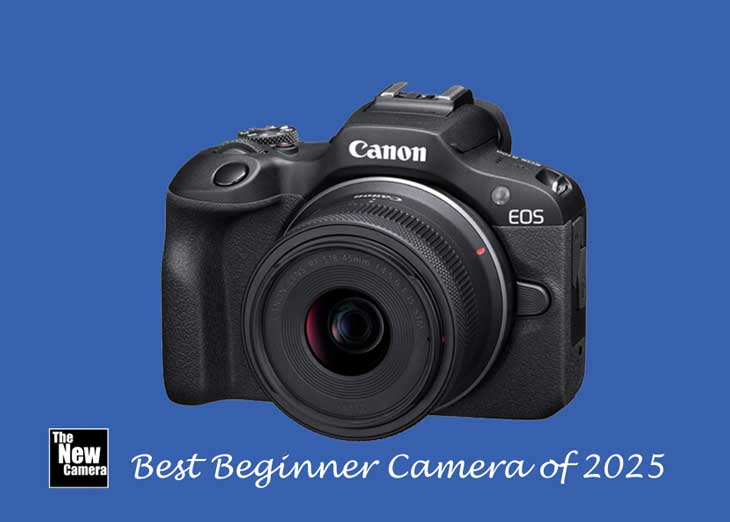
1. Canon EOS R100: Best Budget Mirrorless for Beginners
Major Specs: 24.1MP APS-C Sensor, 6.5fps Burst, 4K 24p, Dual Pixel AF, ISO 100-12,800
The Canon R100 is one of the best entry-level budget mirrorless cameras for beginner photographers. The camera features Canon’s trusted 24-megapixel Dual Pixel CMOS autofocus sensor. The overall body design is very compact and easy to carry. The price of the camera is one of the most appealing factors here, and it’s available at under $500 only with the kit lens. Although it does have a fixed screen and limited 4K, which has a very limited appeal to vloggers.
Pros: Affordable, great for beginner photographers, solid autofocus Cons: Fixed screen, cropped 4K not ideal for video, limited lens options
2. Sony ZV-E10: Best for Beginner Vloggers
Major Specs: 24.2MP APS-C Sensor, 11fps Burst, 4K 30p, ISO 100-32,000, Real-time Eye AF
The Sony ZV-E10 camera offers a very usable display screen and a 3-capsule microphone. Although apart from the design part, that 24MP BSI CMOS sensor and ability to record 4K videos up to 30fps with excellent autofocusing capability and a lot of dedicated modes for content creators make this camera a perfect choice for beginner vloggers. And not to forget, we have the E-mount that provides two lens options at various budgets.
Pros: Top choice for vlogging, great autofocus, vast lens selection Cons: No IBIS, rolling shutter in fast motion, basic stills performance
3. Nikon Z30: Best Budget Vlogging Camera
Major Specs: 20.9MP APS-C Sensor, 11fps Burst, 4K 30p (30-min limit), ISO 100-51,200, 209 AF points
Nikon Z30, I have personally used it for many days. If you are a content creator and looking for a super budget solution other than the Canon R100, then the next best option is the Nikon Z30. Specifically in the USA, the price of the Nikon Z30 is even lower than the Sony ZV-E10 and very similar to the Canon R100. So, if you are not able to spend that much to get the ZV-E10 camera and are not even interested in the Canon R100 since it is not able to vlog properly due to a fixed screen and crop 4K problem, then the Nikon Z30 is the best solution.
Pros: Great for budget vlogging, sharp 4K video, compact design Cons: 30-min 4K limit, no EVF, fewer lenses than Sony
4. Canon EOS R50V: Best Mini Cinema Camera
Major Specs: 24.2MP APS-C Sensor, 12fps Burst, 4K 60p (10-bit), ISO 100-32,000, Dual Pixel AF II
Canon R50 V is an avatar of the Canon R50 cinema version. It’s a video-focused mirrorless camera with a box-style body specifically made for professional content creators and wedding cinematographers who love to shoot 10-bit 4K videos at 60 frames per second. The Dual Pixel autofocus sensor focuses and tracks the subject very fast. But the limited amount of RF lenses is a real drawback. Although there are a lot of new lenses available from Tamron and Sigma, none of them are kind of budget-friendly.
Pros: Ideal for video creators, 4K 60p with 10-bit, intuitive controls Cons: Limited native lenses, small body can feel cramped, no IBIS
5. Sony ZV-E10 Mk II: Best for Pro Vlogging
Major Specs: 26MP APS-C Sensor, 11fps Burst, 4K 60p (10-bit, 1.1x crop), ISO 100-32,000, Real-time Eye AF
Sony ZV-E10 Mark IIis the best semi-professional vlogging mirrorless camera upgraded with 10-bit 4K 60FPS, uncropped recording mode, full-time autofocus support with high autofocus tracking and subject tracking. We are also getting gyro-based image stabilisation for a smooth handheld shooting experience. The E-mount lens system offers a range of lenses starting from budget to pro. The only issue the camera doesn’t have an EVF, so we can’t recommend it as a perfect HYBRID camera for photographers.
Pros: Pro-level vlogging, excellent autofocus, compact, and versatile Cons: No IBIS, small crop in 4K 60p, pricey for APS-C
6. Nikon Z50 II: Best APS-C Hybrid Camera
Major Specs: 20.9MP APS-C Sensor, 30fps Burst, 4K 60p (cropped), ISO 100-51,200, Expeed 7 AF
The Nikon Z50 II is the best APS-C hybrid mirrorless camera Nikon has ever made. Excellent in capturing still images with 20.9 MP BSI CMOS sensor, paired with Expeed 7 image processor. Continuous capturing speed up to 30 frames per second. The Nikon Z50 II is an all-rounder camera, recommended for wedding, portraits, street, and Wildlife photography purposes. You can record 10 BIT 4K 30FPS video as well as 60FPS as an option, also available, but with a 1.5x crop. Yes, that’s the drawback we have with this camera. Although the design is very robust, the build quality is awesome, and the camera doesn’t overheat while recording 4K 30FPS videos for more than an hour.
Pros: Top APS-C hybrid, fast autofocus, great handling Cons: No IBIS, limited native lenses, cropped 4K 60p
7. Canon EOS R10: Affordable Hybrid Option
Major Specs: 24.2MP APS-C Sensor, 15fps Burst, 4K 30p, ISO 100-32,000, Dual Pixel AF II
The Canon R10 is a versatile mirrorless camera for beginners that offers continuous mechanical shutter speed up to 14.7 frames per second and electronic shutter speed up to 23 frames per second while utilising the 24MP DPAF sensor’s advanced tracking algorithms. It’s an ideal beginner camera for sports and wildlife photography, but it lacks IBIS. The camera features a compact design and a budget-friendly price. Although it has now been almost 4 years since its announcement, we are waiting for a decent upgrade this year.
Pros: Affordable hybrid, fast burst shooting, reliable autofocus Cons: Aging sensor, no IBIS, limited lens ecosystem
8. Canon EOS R8: Best Entry-Level Full-Frame
Major Specs: 24.2MP Full-Frame Sensor, 40fps Burst, 4K 60p, ISO 100-102,400, Dual Pixel AF II
The Canon R8 is the most affordable full-frame mirrorless camera, which offers a full-frame 24.2 megapixel CMOS sensor of the Canon R6 Mark II camera. You get continuous shooting speed up to 40 frames per second and 4K video recording up to 60 frames per second, completely uncropped. The readout speed of the sensor is also somewhere around 12.4 milliseconds, so this camera becomes an ideal camera for sports and wildlife photography. The only drawback associated with this camera is the absence of IBIS and a beginner-level body.
Pros: Cheapest full-frame, excellent AF, great video specs Cons: No IBIS, limited battery life, few native lenses
9. Nikon Z5 II: Best Budget Full-Frame
Major Specs: 24.5MP Full-Frame Sensor, 10fps Burst, 4K 30p, ISO 100-51,200, 273-point AF
The Nikon Z5 II camera is the best budget full-frame camera, which delivers exceptional image quality due to the 24 megapixel BSI CMOS sensor. The camera packs under a professional body with a weather-sealed design. You also get an option to use dual card slots and a very good battery life. Overall, the autofocus is now way much improved and the camera is now able to track and recognise 9 different types of objects. One of the only entry-level cameras that offers complete RAW video recording. You get 4K 30FPS 10-bit recording option, RED camera LUT profile, as well as waveform and timecode functionality. But the camera lacks 4K 60P mode.
Pros: Top budget full-frame, great image quality, weather-sealed Cons: No 4K 60p, slower AF than Z6 III, basic video specs
10. Sony A6700: Best APS-C Flagship
Major Specs: 26MP APS-C Sensor, 11fps Burst, 4K 120p (10-bit), ISO 100-32,000, AI-powered AF
Sony A6700camera is the best APS-C flagship mirrorless camera made by Sony, offering a 26-megapixel APS-C BSI CMOS sensor, professional-level features with AI-powered autofocus that not only automatically tracks different types of subjects, it also reframes your shot while you are shooting videos with the auto-framing mode. And yes, of course, you also can record 4K 120 frames per second video, and cherry on the top is the vast E-mount lens support you get with Sony E-mount.
Pros: Top APS-C performance, superb autofocus, versatile video Cons: Pricey for APS-C, no dual card slots, complex menus
11. Nikon Zf: Best Retro-Style Camera
Major Stylish design, great hybrid performance, weather-sealed
Nikon Zf is one of the best retro-style full-frame cameras present in the market today, offering extensive manual control and a 24MP full-frame BSI CMOS sensor that performs exceptionally well in low light, as well as the support of AI IBIS feature, so you can link your VR with the autofocus points of the camera. So instead of investing your hard-earned money in an APS-C sensor, if you love to have a retro-style camera, better to invest in the Nikon Zf body.
Pros: Major Stylish design, great hybrid performance, weather-sealed Cons: No 4K 60p, ergonomics not for everyone, pricey for features
12. Fujifilm X-M5: Best for Content Creation
Major Specs: 26.1MP APS-C Sensor, 8fps Burst, 4K 60p, ISO 160-12,800, Film Simulation Modes
The Fuji X-M5, my favourite camera from Fuji that offers a very reasonable specification for the price they are asking. You are getting their ultra-tested 26MP BSI X-Trans sensor. The camera can also record 4K 60fps uncropped video, as well as you can continuously shoot up to 8 frames per second with the camera. The camera lacks IBIS and EVF; more or less, it is made for content creators who still love to go with the Fuji brand.
Pros: Great for vlogging and stills, beautiful colors, compact design Cons: No IBIS, smaller lens selection, no EVF
13. Sony FX30: Best Budget Pro Filmmaking
Major Specs: 26MP APS-C Sensor, 4K 120p (10-bit), ISO 100-32,000, Dual Base ISO, S-Cinetone
Sony FX30, Sony FX30 is the best budget mirrorless camera for professional filmmaking. The camera features 26 megapixels, 4K videos up to 120 frames per second, and a built-in fan to record continuously without any interruption. You have 10-bit internal recording as S-Log2, S-Log3, S-Cinetone, and a system to back up your creativity. So the FX30 is built for professional workflow. If you are interested in having a budget professional filmmaking camera, the FX30 is the best.
Pros: Top for pro filmmaking, excellent video specs, vast lenses Cons: No EVF, complex for beginners, pricey for APS-C
14. Nikon Z6 III: Best Hybrid Mirrorless
Major Specs: 24.5MP Full-Frame Sensor, 20fps Burst, 6K 60p RAW, ISO 100-64,000, Partially Stacked Sensor
Nikon Z6 Mark III is the best hybrid mirrorless camera of 2025. It captures amazing still images with its 24MP partially stacked CMOS sensor. The camera also features deep learning AI autofocus and video recording capability up to 6K 60 frames per second and an option to record complete RAW videos. The camera also features a bright electronic viewfinder, a very robust build for professional use. And now the Z-mount lens system is also open, and you have a huge range of lens options. So, more or less, it is an excellent choice for hybrid mirrorless photographers in 2025.
Pros: Top hybrid performance, fast AF, excellent video specs Cons: Pricey, fewer lenses than Canon/Sony, complex menus
15. Canon EOS R6 Mark II: Excellent Hybrid Contender
Major Specs: 24.2MP Full-Frame Sensor, 40fps Burst, 4K 60p (10-bit), ISO 100-102,400, Dual Pixel AF II
Canon R6 Mark II features a continuous capture speed of 40 frames per second, video recording up to 6K 60 frames per second. The sensor readout is also somewhere around 12.4 milliseconds. The only visible drawback is the use of FSI sensor technology, which reduces the dynamic range of the camera a bit. And the other thing that you may miss is the range of lenses available with the Z-mount or the RF-mount — we have very limited lenses in the RF-mount.
Pros: Excellent hybrid, fast burst, great autofocus Cons: Awaiting update, limited lens options, no 8K
16. Sony A7 IV: Versatile Full-Frame Option
Major Specs: 33MP Full-Frame Sensor, 10fps Burst, 4K 60p (10-bit), ISO 100-51,200, Real-time AF
Sony A7 IV camera is the most versatile full-frame mirrorless camera ever made by Sony. It features a 33-megapixel full-frame BSI CMOS sensor, limited continuous shooting speed up to 10 frames per second only, 4K recording up to 60 frames per second with crop. The Sony A7 IV is being used by a lot of wedding photographers out there, and it is an excellent option, but now that its upgrade is overdue, people are waiting for the next generation A7 V camera, which is about to arrive this year.
Pros: Great all-rounder, high resolution, strong autofocus Cons: Update overdue, rolling shutter issues, complex menus
17. Nikon Z8: Perfect Hybrid Beast
Major Specs: 45.7MP Full-Frame Sensor, 30fps Burst, 8K 30p RAW, ISO 64-25,600, 493-point AF
Nikon Z8, a wolf in sheep’s clothing — the Nikon Z8 is a powerhouse mirrorless camera for professionals. It offers massive 8K @ 60fps video recording capability, complete RAW video, extremely fast autofocus speed, and tracking due to the presence of a stacked CMOS sensor. It’s a complete flagship camera under the Z8 body. It inherits all the specifications of the Nikon Z9 and even with more power, since now we have the latest firmware 3.0 update in it, and it enhances the performance of the camera to the next level.
Pros: Perfect hybrid beast, high resolution, pro video specs Cons: Expensive, large body, fewer lenses than Sony
18. Sony A7R IVa: Best High-Resolution Camera
Major Specs: 61MP Full-Frame Sensor, 10fps Burst, 4K 30p, ISO 100-32,000, Real-time AF
Sony A7R IVis the best high-resolution mirrorless camera of 2025. It is an ideal camera for capturing landscapes, architecture photography, as well as for professional portrait shoots and wedding photography. The 61-megapixel sensor delivers an exceptional amount of detail when used with the right lenses. Also, we have a vast number of E-mount lenses in front of us. If you are a hybrid shooter and wish to also have excellent 8K video recording capability in your high-resolution camera, you have to spend a bit more and buy the Sony A7R V.
Pros: Class-leading resolution, great autofocus, vast lens options Cons: No 4K 60p, large files, pricey
19. Sony A1 II: Flagship Performance
Major Specs: 50.1MP Full-Frame Sensor, 30fps Burst, 8K 30p, ISO 100-32,000, Global Shutter AF
Sony Alpha A1 Mark IIcamera, ultimately the best full-frame flagship camera Sony has ever built. The camera features a 50-megapixel ultra-fast stacked BSI CMOS sensor, 8K video recording up to 30 frames per second, and 4K videos up to 120 frames per second, continuous shooting up to 30 FPS in RAW with full-time AF and AE support, and a very high-quality 9.4-megapixel EVF with 240 frames per second refresh rate, highly robust design so you can use it in adverse conditions, and dual CFexpress Type A card slots.
Pros: Top-tier performance, global shutter, versatile hybrid Cons: Very expensive, overkill for most, complex menus
20. Canon EOS R5 II: Flagship Hybrid
Major Specs: 45MP Full-Frame Sensor, 30fps Burst, 8K 60p RAW, ISO 100-51,200, Dual Pixel AF II
The Canon R5 Mark II camera features Canon’s 45-megapixel full-frame stacked CMOS sensor. Although the Canon flagship camera R1 is designed specifically for sports and wildlife photography, the R5 Mark II, in my perspective, is a true flagship mirrorless camera. You can record 8K videos up to 60 frames per second as well as record 12-bit RAW files in 30 frames per second continuous shooting mode. The camera also features Eye Control Autofocus, which was first introduced in the Canon R3 camera. We have a very robust and rugged body design and dual card slots—one for CFexpress Type B and the other for UHS-II SD card.
Pros: Pro-grade hybrid, high resolution, excellent video Cons: Pricey, limited lens ecosystem, overheating in 8K
Choosing the best mirrorless camera in 2025 depends on your needs, whether you’re a beginner photographer, professional videographer, or content creator. From the budget-friendly Canon EOS R100 to the high-resolution Sony A7R IVa and flagship Nikon Z8, this guide offers options for every use case. Explore our Best Lenses Guide and Camera Comparisons on thenewcamera.com to find the perfect camera and accessories for your creative journey.
Buy Canon Lenses, Buy Music CD or Digital Camera at amazon it helps this site, and you do not pay anything extra, it is just a way to help support this site.
New Camera Website, we list all type of new camera information, price review and all type camera rumors, subscribe us or follow us via twitter or facebook.
Disclaimer: We have attempted to select useful information to include on New Camera, and to ensure that the resources we have included on the site -- as well as the way we have described them -- are accurate, fair, and balanced. However, we make no claims, warranties, or other representations concerning the accuracy, completeness, or utility of the information provided, or concerning the abilities or performance of the organizations, agencies, companies, and other resources presented through New Camera