We have created a list of best-selling drones and pocket cameras for October 2026. These cameras are among the most popular with users over the past 30 days on Amazon.com in the United States of America.
Yes, we do know that DJI is facing issues with new products launched after December 22, 2025, but there is a huge list of drones that are fully eligible to buy, and people are buying them without any issues. Other than that, a lot of gimbal cameras, including newer ones, are being listed by third-party sellers on Amazon. Specifically, yes, we are talking about the Pocket 4P, which is among the most popular and best-selling cameras over the past 30 days. So, have a look at the list if you are interested in getting one.
This list focuses on products that actually sell in volume and remain legal to buy in the US. Cheap toy drones dominate raw unit sales and have been excluded. Prices are approximate street prices seen on Amazon US around mid-October 2026 and can change. Rankings were checked around October 14–15, 2026.
Top 10 Best-Selling Drones and Pocket Cameras on Amazon US (October 2026)
Consistent Best Seller in action/360. Full US warranty, 8K 360.
8
Antigravity A1 (Standard / Explorer Bundle)
360 Drone
1,199–1,519 on sale
Selling well as the only true 8K 360 drone with full US support and goggles.
9
DJI Osmo Pocket 4P (third-party / gray)
Pocket
650–950+
Appearing in Camcorder Bundles and New Releases. Dual-lens, high dynamic range.
10
Insta360 Luna Ultra
Pocket / Vlog
~$770
Ranking in Camcorders. Dual Leica lenses, 1″ sensor, official US availability.
Quick Takeaways
Volume winners: DJI Mini 4K and Neo dominate pure unit sales.
Best imaging under $1,000: Mini 5 Pro Fly More Combo and Pocket 3.
Best official 360: Insta360 X5 (camera) or Antigravity A1 (drone).
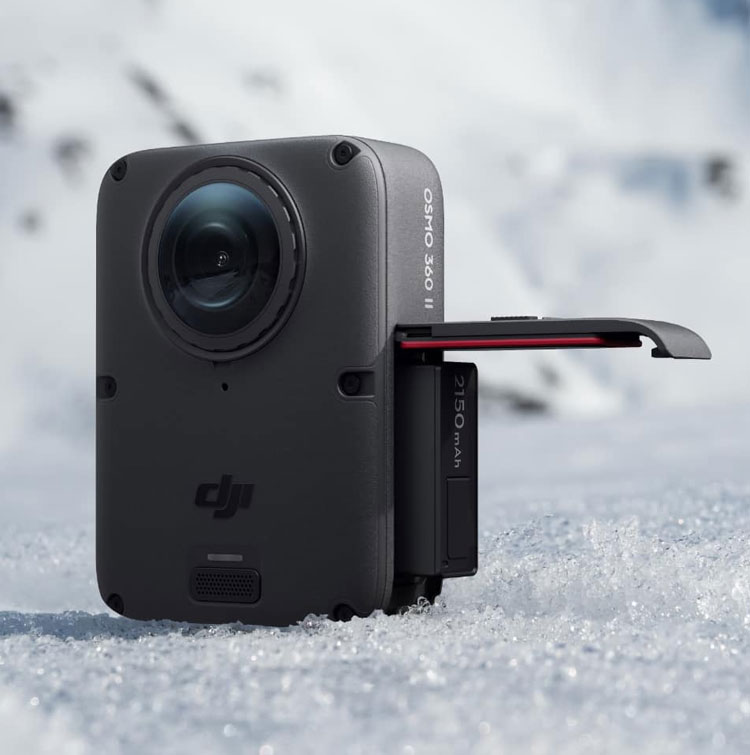
Avoid or flag: Any “official” Osmo 360 II, Neo 3, Pocket 4/4P, or Action 7 listings — these are either gray-market, blocked, or not yet real.
What We Left Out
Toy and kids drones still occupy many of the highest ranks by raw units sold, but they were excluded because they are not serious imaging products. Pure gray-market placeholders and any new DJI models that never received pre-December 22, 2025 FCC authorization were also left out. Those newer models remain blocked from official US sale.
Buying Advice
Mini 4K vs Mini 5 Pro: Choose the Mini 4K if you want the safest, highest-volume option with the least regulatory friction. Step up to the Mini 5 Pro only if you specifically want the 1-inch sensor and better obstacle sensing and are comfortable with the ongoing LiDAR-related proposal risk.
Neo vs Neo 2: The original Neo is the volume leader and cheaper. The Neo 2 Fly More Combo is the better choice if you want a proper controller and improved flight feel.
Pocket 3 vs Luna Ultra: Pocket 3 remains the top official-channel pocket camera with warranty. Luna Ultra is the strongest fully supported alternative if you want dual lenses and official US availability without gray-market risk.
Action 4 vs Action 6: Action 4 is the better value and higher-volume seller right now. Action 6 makes sense if you specifically want the larger square sensor.
360 options: Insta360 X5 is the safest high-quality 360 camera. Antigravity A1 is the clear choice if you want an 8K 360 drone with goggles and full US support.
FCC Note
All DJI models on this list that appear as Best Sellers were authorized before the December 22, 2025 Covered List cutoff. Newer unannounced models remain blocked. The Mini 5 Pro carries LiDAR, so the ongoing proposal covering certain capability categories (including LiDAR) remains a future supply and parts risk. Flying already-purchased units is unaffected.
Prices and rankings checked mid-October 2026. Rankings and prices change frequently – always verify the current Amazon listing before buying.
The article “Top 10 Best-Selling Drones and Pocket Cameras on Amazon US – October 2026” was written by thenewcamera.com team at 6:54 pm, Sunday, 18 October 2026, Greenwich Mean Time| You can also follow us on Our Official Social Media HandlesFACEBOOK | TWITTER | INSTAGRAM> get live news — > DJI Rumors | Insta360 News
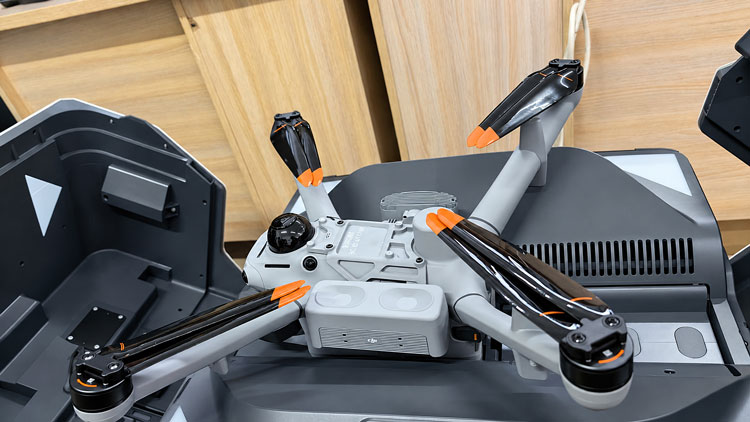
A new set of images leaked today, including one of the clearest images of the DJI Matrice 5TD Drone, ahead of the official October 14 “Always There, Always Ready” announcement.
DJI’s next PRO Enterprise dock system is days away from its official reveal, and a clear new photo of the Matrice 5TD sitting on the dock has just appeared. Obviously, one of the most advanced DJI drones ever made. The leak is coming from one of the most trusted sources, Igor and yes, we have seen the Matrice 5D before in our previous post.
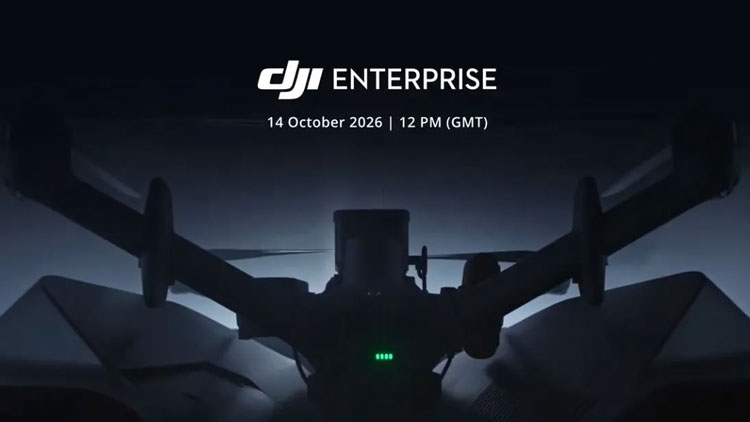
The timing is deliberate. DJI Enterprise has locked an official announcement for October 14, 2026, at 8 AM EDT / 12 PM GMT under the campaign title “Always There, Always Ready.” The six-second teaser DJI released on October 8 shows something previous docks never did: automated battery swapping.
What the New Matrice 5TD Dock Photo Shows
The photo shows the Matrice 5TD randomly resting on the dock with its arms folded. Visible details include:
Community users replies noted the V-shaped dock design and compared it to earlier Matrice docks as well as Skydio’s robotic-arm approach
.
Battery Swapping Confirmed in Official Teaser
The biggest functional and welcome upgrade is now visible in DJI’s own teaser. The clip shows a battery pack traveling along rails into a rotating carousel, then being lifted into the empty rear battery bay of a folded-arm quadcopter.
This is a significant change. Current DJI docks (including Dock 3) only charge the battery that is already installed in the aircraft. Dock 3 needs roughly 27 minutes to take a Matrice 4TD from 15% to 95%. A proper battery-swap system can put a charged pack into the aircraft in a fraction of that time, enabling much faster turnaround for inspection, public-safety, and monitoring missions.
The teaser does not name the product, but the combination of the China registry entry, earlier labeled photos, and the dock form factor strongly points to the expected Dock 4 + Matrice 5TD pairing.
What We Already Know About the Matrice 5TD
China registry: Listed as DJI Matrice 5TD, model code M5TD. Empty weight 2.6 kg, maximum takeoff weight 3.05 kg (approximately 750 g heavier than the Matrice 4TD).
Intended use: Power-line and oil-pipeline inspection (light class).
Naming: Follows the established pattern (Dock 3 with Matrice 4D/4TD → expected Dock 4 with Matrice 5D/5TD). The “TD” suffix indicates the thermal, dock-ready version.
Earlier leaks: July prototypes showed a top-mounted dome consistent with integrated LiDAR and a cylindrical element consistent with built-in RTK. The multi-sensor gimbal appears denser than the Matrice 4 series.
Pricing estimate (outside the US): Planning range of roughly $27,000–$33,000 for the dock + aircraft pair before installation. This is an estimate based on current Dock 3 + Matrice 4 pricing and is not official.
Full flight time, thermal resolution, IP rating, and exact camera specifications remain unconfirmed.
US Availability
New DJI hardware cannot receive FCC authorization under the current Covered List designation that took effect in late 2025. As a result, the Matrice 5TD and its new dock are not expected to be sold or imported into the United States. Operators who need an automated dock solution in the near term should continue with authorized Dock 3 + Matrice 4D/4TD systems.
What to Expect on October 14
DJI has not yet printed the product names on any official material. The announcement will almost certainly confirm the dock + aircraft pairing, battery-swap capability, and the full specification sheet. Watch for details on:
Exact battery-swap time
Flight time and payload capacity
Sensor suite (thermal, LiDAR, RTK)
Dock weight, IP rating, and operating temperature range
Pricing and regional availability
TNC Take
The new photo and the battery-swap teaser together make the October 14 launch one of the more meaningful enterprise updates of the year. Faster redeploy times address one of the biggest practical limitations of current docking systems. For markets outside the US, this is the system to watch. For US operators, the practical advice remains the same: plan around currently authorized hardware.
We will update this article with official details as soon as DJI publishes them on October 14.
Image source: Igor Bogdanov / @Quadro_News, October 10, 2026. This article is independent analysis and is not affiliated with DJI. Specifications not confirmed by DJI should be treated as unconfirmed until the official announcement.
The article “New Clear Look at DJI Matrice 5TD on Dock Days Before Oct 14 Launch” was written by thenewcamera.com team at 4:20 pm, Friday, 2 October 2026, Greenwich Mean Time | You can also follow us on Our Official Social Media HandlesFACEBOOK | TWITTER | INSTAGRAM> get live news — > DJI Rumors | Insta360 News
Finally, we have the unboxing video of the DJI Neo 3. At the very same time, this particular combo also very clearly shows the original remote control that we are getting with DJI. So now there is no issue installing the DJI app from the Play Store or syncing the drone camera with the smartphone.
So DJI has resolved one of the major issues of the drone that can be used in any part of the world with its solo remote control; therefore, users are completely free to capture their moves instantly.
A 49-second unboxing of the unannounced DJI Neo 3 Fly More Combo is now public. The clip shows the aircraft, the DJI RC Mini, a charging hub, and three flight batteries. It does not show a price, a launch date, or a flight.
Watch the unboxing on TheNewCamera (below)
The footage first circulated as a short TikTok unboxing. Jasper Ellens posted a copy on X on October 6, 2026. That is the source of the clip.
What the DJI NEO 3 unboxing shows
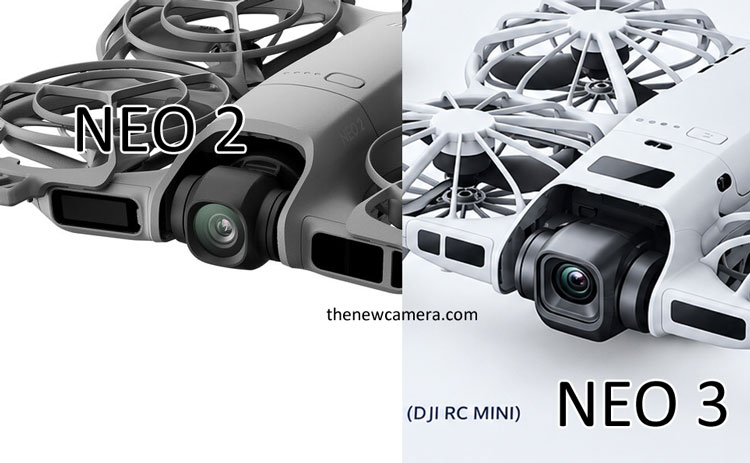
The DJI Neo 3 drone that we can clearly see has a proper cage over each propeller, which protects it from accidental falls by new users. Other than that, from the top and bottom, you can also clearly see that the cage is now protecting the propellers, which is a kind of Apex design compared to the Neo 2 propeller protector.
The rest of the visible kit is a charging hub, a USB-C cable, and two small sealed bags. The hub holds two flight batteries. A third battery is already in the drone. The bags are never opened. The earlier retail panel listed two spare propellers and a screwdriver, which is the likely contents, but the video does not confirm that.
Palm takeoff and landing, one-hand gesture control
High-speed ActiveTrack with automatic camera moves
Advanced omnidirectional obstacle sensing
DJI RC Mini
SelfieShot 2.0, fast startup, quick file transfer
There is no clip-on Digital Transceiver in the box. On the Neo 2, that module is a separate part and adds about 9 g. Its absence here matches the September box panel, which also left it off the in-the-box list.
The airframe also shows extra sensing hardware: a round lens on the rear of the fuselage, a sensor in the vented underside, a slit above the camera, and dark windows on the arms beside the lens. The leaked feature panel calls this advanced omnidirectional obstacle sensing. The video confirms the windows. It does not confirm the range or the behavior.
Fly More Combo, from the box panel and the video
What’s inside the Creator Combo + box
1x DJI Neo 3
1x charging hub
3x flight batteries
1x DJI RC Mini
1x RC Mini expansion cover
1x RC Mini anti-loosening pad
2x spare propellers
1x screwdriver
1x USB-C cable
The video shows the drone, the RC Mini, the hub, three batteries, and the cable. The cover, pad, props, and screwdriver are not opened on camera.
DJI NEO 3 USA Availability
As we all know, DJI / Chinese drones are banned in the USA; the ban is effective from Dec 25, 2026.
But, as we can see, major products like the Pocket 4P are still available and have become one of the best-selling pocket gimbal cameras on Amazon USA. That also suggests that if the Neo 3 officially arrives, it will likely become available for online sale via third-party sellers.
For US flying rules, 192.7 g still sits under the 250 g line. A recreational flight of a sub-250 g drone does not require FAA registration. A commercial flight does, at any weight. Registration is not the same thing as permission to sell the aircraft. That is the FCC problem below.
The Neo 2 was already absent from DJI’s US store, but somehow you can order from Amazon.com. The Neo 3 follows that pattern, with the Covered List now making a late official launch even harder.
source: Tiktok vis Jasper Ellan
The article “DJI NEO 3 Unboxing Video ” was written by thenewcamera.com team at5:03 pm, Wednesday, 7 October 2026, Greenwich Mean Time | You can also follow us on Our Official Social Media HandlesFACEBOOK | TWITTER | INSTAGRAM> get live news — > DJI Rumors | Insta360 News
A DJI contact claims both will be on sale next month, which means October 2026. China’s drone registry already lists the aircraft at a 3.05 kg max takeoff weight. There is no leaked price tag. Based on Dock 3 and Matrice 4 pricing, plan 27,000–33,000 for the pair outside the US, before installation. Working number: about $30,000.
Let’s talk about the new upcoming pro drone from DJI: China’s registry lists the Matrice 5TD at 2.6 kg without a load and 3.05 kg max takeoff, about 750 g heavier than the 4TD. The interesting claim is indoor flight where GNSS does not reach. DJI has not confirmed the date, the feature, or a price.
October 2026 arrival
If you are buying in America, stop there. New DJI models cannot get FCC authorization. Docks are covered. October will not put this on a US shelf.
A DJI contact told a Japanese infrastructure account the M5TD and Dock are scheduled for next month. Written on September 27, that means October 2026. DJI usually announces this class and opens dealer orders the same day. Expect a China announcement in October if the claim is real. Do not expect an American one.t.
What an American buyer should do this month
Need a dock for a commercial site, and you are not spending federal money.
As a USA buyer, you still have an option: Buy the authorised Dock 3 and Matrice 4TD if your dealer still has them (since the new Bill will eliminate all new drones with LiDAR sensors). Do not wait for October. The 5TD’s indoor claim, even if true, does not create a US product. The 4TD already has a published 54-minute forward flight, a 640 × 512 thermal camera, an 1,800 m laser rangefinder, and IP55. Dock 3 charges it from 15% to 95% in about 27 minutes and is rated from −30 °C to 50 °C.
Initial Specs of Upcoming Drone
DJI has not announced a Matrice 5TD or a Dock 4. What exists is a registry entry, photos, and one dated claim.
July photos showed a dome on the upper body and a dense multi-window gimbal. September 25 photos were a labeled 5TD, dome still there, plus Dock 4 hardware Bogdanov said would be used in stores soon. The weight plus that dome is the case for integrated LiDAR. It is not a sensor spec. Flight time, thermal resolution, IP rating, and charge time are unpublished. Do not invent them
What to expect on the 5T / 5TD Camera Module
Same six Modules in front: wide, mid-tele, long tele, thermal, laser, NIR
Taller housing, bigger glass
Two optical lenses on the upper face
Two much larger circular windows below
Likely a larger wide and a stronger NIR lamp
Thermal and laser still there, probably improved
China’s UOM system, the civil drone registry under the CAAC, lists a DJI Matrice 5TD, model code M5TD, from SZ DJI Technology. Igor Bogdanov (@Quadro_News) posted the screenshot. The fields:
2.6 kg without a load
3.05 kg maximum takeoff weight
Light class, 250 g to 4 kg
Listed uses: high-voltage lines and oil pipelines
The Matrice 4TD is 1,850 g with battery, propellers, and a microSD card, and 2,090 g max takeoff. The new aircraft is about 750 g heavier, roughly 40% more drone. DJI’s 1,850 g figure and the registry’s “without a load” line are not identical measurements. The gap is too large to be a clerical error.
DJI’s last two launches in this class were announced and opened to dealers the same day: Matrice 4 on January 8, 2025, Dock 3 on February 27, 2025. Dock 2 was China-first by about five months. So October, if real, is a China announcement and a China store date in the same window. Global can lag. The US does not get a date.
What it should cost – overseas, not here
No leaked price. This is a planning range from DJI’s own steps. It is what a non-US buyer should hold. It is not a US MSRP, and a legal US landing is not available to apply a tariff to.
Last generation
Launch
US street now
Matrice 4T
$7,299 (Jan 8, 2025)
about $7,849
Dock 3 + Matrice 4TD
$23,409 (Feb 27, 2025)
about $26,400
Dock 3 only
not split at launch
$15,890
That box went from 34 kg to 55 kg and gained vehicle launch. Dock 4 photos do not show another class change. The cost step is the heavier aircraft, and LiDAR if that dome is real.
Configuration
Overseas planning range
Matrice 5TD alone, if sold alone
8,500–11,000
Dock 4 alone
16,500–20,500
Dock 4 + Matrice 5TD
27,000–33,000
Number to remember
about $30,000, before install
Under $25,000 means DJI ate the heavier airframe. Over $35,000 before anyone pours a pad means they are selling a new category. Neither is the base case.
If this pair ever became a legal US import, the 100% Section 232 rate on docks and thermal aircraft would sit on top of that number. The Covered List blocks the authorization before the tariff ever gets a product to tax.
TNC Take – DJI has not announced the Matrice 5TD or Dock 4, but China’s drone registry already lists the 5TD at 2.6 kg empty and 3.05 kg max takeoff – about 750 g heavier than the Matrice 4TD – and a DJI-contact claim puts both on sale in October 2026, including indoor flight where GNSS does not reach. There is no leaked price; based on Dock 3 and Matrice 4 pricing, plan about $30,000 for the pair outside the US, before installation. US buyers cannot order either product: new DJI models have been blocked from FCC authorization since December 2025, docks are covered, and October will not put this on a US shelf. American commercial operators who need a dock this year should buy authorized Dock 3 and Matrice 4TD stock instead of waiting.
Update, September 29, 2026: DJI Enterprise has set the date. A teaser titled “Always There, Always Ready” points to 14 October 2026 at 12:00 GMT. The video shows a dock nest and a drone inside it. DJI has not printed Matrice 5TD or Dock 4 on the card. Given the registry, the labeled 5TD photos, and last week’s Dock 4 leak, that is the product this event is built for. US buyers can watch the stream. They still cannot order the hardware.
Change the first line of the piece from “a DJI contact claims next month” to “DJI has now put a clock on it: 14 October 2026.” Keep the price as a planning range. Keep the US no-sale line. The date is no longer a rumor. The name on the box still is.
The article “DJI Matrice 5TD and Dock 4: October Arrival, Price and More” was written by thenewcamera.com team on 7:51 pm, Monday, 28 September 2026, Greenwich Mean Time (GMT) | You can also follow us on Our Official Social Media HandlesFACEBOOK | TWITTER | INSTAGRAM> get live news — > DJI Rumors | Insta360 News
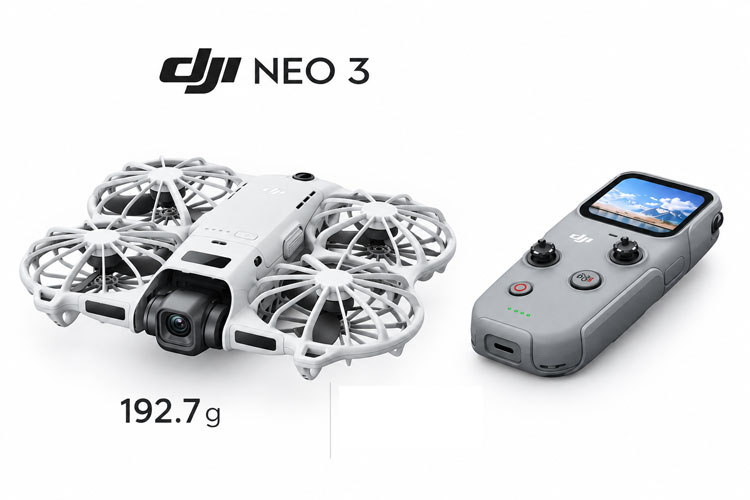
So we have more details about the upcoming DJI Neo 3 drone. The DJI Neo 3 remains under 200g but does have a noticeable weight increase and more… On 22 September 2026, Igor Bogdanov / @Quadro_News posted a screenshot from China’s civil unmanned-aircraft product system. The card names DJI Neo 3, Model CODE DEN326, production date 21 September 2026, and lists both empty weight and maximum takeoff weight as 0.1927 kg.
That is not another rumour; we do have a confirmed set of information via authentic sources. It is the intake screen for China’s unique product identification system — 唯一产品识别码 — the same “one aircraft, one code” regime now being locked in as GB 46860-2025. Manufacturer, model, unique ID, factory date, category, type and mass are the fields a factory fills when an airframe exists.
We have already covered what the 15-19 September retail box prints and other vital information: the product name, the Fly More Combo with DJI RC Mini, the hub-and-spoke guards, the extra vents, the top dome, and the 2025 GB standard codes. This piece does not repeat that carton. It only adds what the filing adds.
Empty weight and maximum takeoff weight being identical is not a glitch. On a sealed beginner whoop there is no spare payload. The number the factory files is the ready-to-fly mass. Read 192.7 g as takeoff weight, not as a body-only figure with the battery left off the scale.
192.7 g against the two drones people already own
Model
Official / leaked mass
Delta
DJI Neo (2024)
~135 g takeoff
—
DJI Neo 2 (2025)
151 g bare / ~160 g with Digital Transceiver
+16 g, then +9 g radio
DJI Neo 3 (registry, 2026)
192.7 g empty and MTOW
+41.7 g vs Neo 2 bare (+28%)
42 g of weight increase is not just an error. We can clearly see that the advancement in technology brings that increase. But despite the fact that the drone remains under the Light drone category (Not Micro), see, the overall weight of the drone remains 250 g.
So even the DJI Neo 3 is a perfect candidate for flying in the sky of the United States of America, since, based on the physical characteristics, it should get an EU C0 certificate. Moreover, at the same time, due to the recent conflicts, we do know that DJI drones are being banned in USA specifically to promote the sales of their native American drones. The United States of America isn’t interested in doing scrutiny tests of the drones to make sure they are actually transmitting data or not. The clear intention is to promote the sales of US-made drones, although they are 10 to 20 times more expensive than what we have to pay for DJI and other Chinese-manufactured drones.
Another thing that is clearly visible in the Package is 21Sep, as the production date of the unit
DJI NEO 3 Arrival Date
21 September is a factory date, not the announcement date.
On that form, 生产日期 means the airframe — or that batch — was manufactured on that day. It is the same kind of date printed on a DJI box or encoded in a serial number. It answers “when was this unit made?” It does not answer “when does DJI run the keynote?”
DJI’s usual order is pilot units, then Not For Sale review boxes, then early production dates on registry cards, then a China announcement, then a global wave about one to two weeks later when they still do a global wave.
Put the three clocks together and the working window stays China announcement in October – November 2026.
Late November or early December is still possible if stock or a last certification slips. An announcement on 21 September is already dead. A slide into mid-2027 is unlikely after a finished box and a factory date in the same week.
The United States problem has not moved
A Chinese registry entry does not create an FCC grant. Neo and Neo 2 cleared the United States before the December 2025 Covered List cutoff. Neo 3 did not. RC Mini as a name exists in an older FCC record; the aircraft does not. Until the political stack changes, the honest US advice is the same as it was on 19 September: buy Neo 2 if you need a legal new unit on a US shelf. Do not wait for Neo 3 to appear in a domestic DJI store. Grey-market units will show up. They will not come with a US support contract.
Quick verdict / TNC Take
The story is no longer “is Neo 3 real?” The Retail BOX leak already fixed that. The registry now settles the two numbers people actually needed: 192.7 g, and already being dated on a production line.
That production date is a factory stamp, not a keynote. Neo 2 launched in China on 30 October 2025 and worldwide on 13 November. A finished box in mid-September plus a 21 September manufacture date points at the same kind of window: October–November 2026, China first.
This article is independent analysis and is not affiliated with DJI. Image source: Igor Bogdanov / @Quadro_News, 22 September 2026.
The article “DJI Neo 3 is Heavier than Neo 2, Production Date Revealed and More” was written by thenewcamera.com team at 5:26 pm, Wednesday, 23 September 2026, Greenwich Mean Time (GMT) | You can also follow us on Our Official Social Media HandlesFACEBOOK | TWITTER | INSTAGRAM to get live news — > get live get live Camera News + Insta360 Drone Rumors 24X7
By the NEW CAMERA desk · 20 September 2026 · Updated after the second-batch box photos
A retail carton is not a teaser render. It is a production object. Once DJI prints a multilingual IN THE BOX panel, a Chinese product name, GB execution standards dated 2025, a 2026 copyright line and a red NOT FOR SALE sticker, the argument is no longer “is Neo 3 real?” The argument is what the carton is allowed to say in public before the launch event, and what DJI is still holding back.
The photographs now in circulation — first shared by Igor Bogdanov / Quadro_News on 15 September, then expanded with a second batch on 19 September — show both faces of a Fly More Combo box and a grey display airframe on a stand. This article treats those photographs as primary evidence and separates three layers: what is printed, what can be inferred from industrial design, and what remains rumour.
Why this leak is late-stage, not early rumour
Early DJI leaks are usually FCC IDs, blurry test-flight clips, or CAD-like prototypes. A finished retail box is different for four reasons.
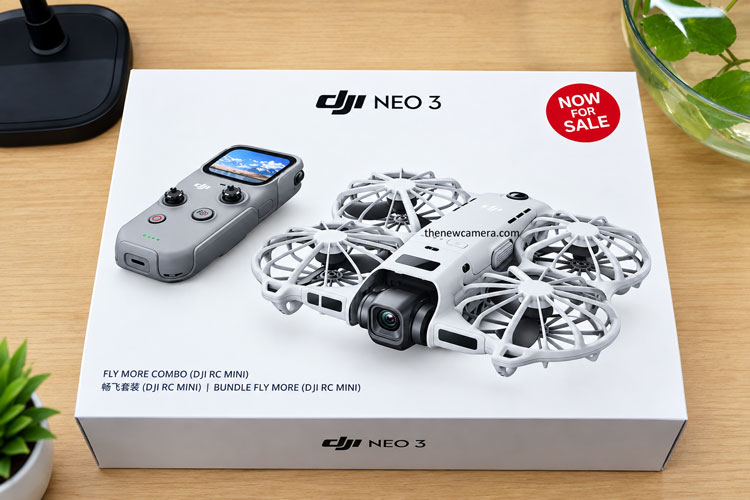
The front face already carries the commercial name DJI NEO 3 and the commercial bundle line FLY MORE COMBO (DJI RC MINI), in English and Chinese.
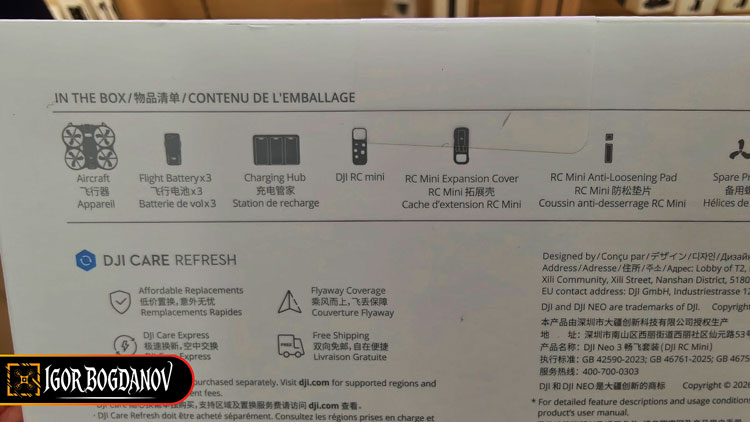
The rear face carries a full IN THE BOX icon row. That artwork is locked by packaging engineering, not by a concept team.
The regulatory block prints 产品名称:DJI Neo 3 畅飞套装 (DJI RC Mini), plus GB 42590-2023, GB 46761-2025 and GB 46750-2025. Those 2025 standard codes are not something a fan mock-up casually invents.
The red NOT FOR SALE sticker is the tell for a store dummy or reviewer sample. DJI does not print that sticker on vapour.
Treat the box as evidence that tooling, SKU naming and accessory kits are frozen. Do not treat it as evidence that the camera pipeline is frozen in the way YouTube thumbnails claim. DJI’s own footnote on the carton says feature descriptions live in the user manual and on dji.com — which is another way of saying the spec sheet is still embargoed.
Box Details of DJI NEO 3 Drone – Credit Igor Twitter
What the carton actually prints
The back panel is a contents list plus legal text. It is not a spec sheet. That distinction matters, because most of the traffic around this leak is being driven by claims the cardboard never makes.
IN THE BOX / 物品清单 / CONTENU DE L’EMBALLAGE
#
English
Chinese
What it tells us
1
Aircraft
飞行器
One airframe. Caged whoop layout retained.
2
Flight Battery ×3
飞行电池 ×3
Classic Fly More kit. Not a one-battery SKU.
3
Charging Hub
充电管家
Three-bay hub, same combo logic as Neo 2.
4
DJI RC Mini
—
New screened remote. Replaces RC-N3 in this kit.
5
RC Mini Expansion Cover
RC Mini 拓展壳
Protective / grip sleeve for the new radio.
6
RC Mini Anti-Loosening Pad
RC Mini 防松垫片
Hardware unique to this controller.
7
Spare Propellers
备用螺旋桨
Consumable set in-box.
8
Screwdriver
螺丝刀
Cage / prop service tool.
9
USB-C Cable
USB-C 快充线
Charge path for hub / radio / airframe.
Two accessories exist only because the radio changed: the expansion cover and the anti-loosening pad. That is the strongest packaging proof that RC Mini is not a sticker rename of RC-N3. DJI does not tool unique foam-and-plastic parts for a controller it is not shipping.
The same panel also sells DJI Care Refresh as a separate purchase — affordable replacements, flyaway coverage, Care Express and free shipping — with the usual “visit dji.com for supported regions” disclaimer. Care is not bundled. That is consistent with every recent Neo / Mini kit.
The one sentence that names the product
Buried in the Chinese statutory block is the cleanest primary source in this entire leak:
产品名称:DJI Neo 3 畅飞套装 (DJI RC Mini)
That translates, without spin, to DJI Neo 3 Fly More Combo (DJI RC Mini). The airframe name is Neo 3. The kit name is the RC Mini Fly More. There is no Avata 3 ambiguity left on this carton. Whatever dual-guard prototype footage circulated in April 2026, this box is not that debate. This is the third Neo.
DJI NEO 3 Coming with DJI RC Mini REMOTE Controller
RC Mini is the real product story
Neo and Neo 2 Fly More kits shipped the RC-N3: a phone-clamp radio with no built-in display. Live view lived on the phone. That was cheap, and it was also the most beginner-hostile part of an otherwise beginner drone. You needed a mount, a cable or clamp, a charged phone, and a pocket large enough for the sandwich.
The leaked box art shows a compact grey remote with its own screen, two sticks, a DJI wordmark and a status LED row. Multiple outlets have mapped that silhouette to the DJI RC Mini AG that launched in late 2025 with DJI’s T-series agricultural aircraft. If the consumer RC Mini is the same hardware generation, the working assumption — still unprinted — is a roughly 1.97-inch panel, about 410 × 494, up to around 800 nits, OcuSync 4-class transmission and roughly three hours of remote runtime. Those numbers are inherited from RC Mini AG. They are not on the Neo 3 carton.
Even without those numbers, the product logic is clear. The hero combo no longer requires a phone on the transmitter. That is a bigger day-one change for the Neo line than another 1 fps on the same 1/2-inch chip would have been. It also explains why this Fly More SKU will cost more than Neo 2’s RC-N3 Fly More. You are paying for a display radio, not just three batteries.
Neo 2 Fly More (shipped)
Neo 3 Fly More (box)
Remote in the hero kit
RC-N3, phone clamp, no screen
DJI RC Mini, built-in screen
Need a phone to fly FPV-style?
Yes, for live view on the radio
No — radio has its own display
Unique radio accessories
None of this type
Expansion cover + anti-loosening pad
Battery kit
3 × flight battery + hub
3 × flight battery + hub
Cage style on box art
Closed rings
Hub-and-spoke / bicycle-wheel guards
What the airframe design is doing
The Neo family is a palm-launch cine-whoop: non-folding arms, full propeller cages, a single front camera, and a weight target that keeps it in the unregistered / C0 conversation in most markets. Neo 3 does not abandon that brief. It revises the industrial design around cooling, airflow and sensing.
Three visual changes are consistent across the box art and the grey dummy on the stand.
Propeller cages switch from concentric closed rings to a hub-and-spoke pattern. The functional claim is better airflow and slightly less solid-block turbulence, while keeping the “hit a wall and bounce” beginner contract.
The fuselage shows extra vent slots along the sides and rear. Extra vents usually mean extra heat — a faster processor, a brighter onboard status panel, a denser battery, or all three. They are not proof of a larger image sensor.
A dome or window sits on top of the fuselage. Coverage so far treats this as an upward sensing element. Neo 2 already added forward LiDAR plus omnidirectional monocular vision and downward IR. An upward node would close the last cheap crash path: ceilings, branches, indoor fixtures. Again: visible on artwork, not specified in text.
The camera module on the box art is blockier and more proud of the nose than Neo 2’s small chin gimbal. That is the detail rumour sites have stretched into a 1-inch sensor. A larger housing can mean a stronger 2-axis (or 3-axis) gimbal, more glass, a slightly larger chip, or simply a new cosmetic bezel. The honest reading is “larger camera assembly.” It is not a published sensor size.
The sensor question, handled cleanly
This is the part most posts will get wrong, so it is worth being blunt.
Model
Sensor (status)
What actually changed
Neo (Sept 2024)
12MP 1/2-inch — official
1-axis gimbal, f/2.8, 4K/30
Neo 2 (Oct–Nov 2025)
Same 1/2-inch 12MP — official
2-axis gimbal, f/2.2, 4K/60–100, OA
Neo 3 (box leak)
Not printed
Larger-looking module. Chip TBA.
Neo 2 already taught the lesson. DJI reused the 1/2-inch die and spent the generation budget on gimbal, lens speed, processing, obstacle sensing and storage. That is the default pattern for a sub-160 g caged drone. A jump to 1/1.3-inch is possible and would be the conservative upgrade if DJI wants a headline. A jump to 1-inch inside this body, at this price band, with full cages still attached, is the least likely of the circulating claims. No GB line, no icon and no footnote on the leaked carton supports it.
Until DJI prints the sensor size, the TNC spec is: bigger-looking camera unit, sensor TBA. Default assumption remains 1/2-inch. Upside case is 1/1.3-inch. Discard 1-inch headlines.
What is missing on purpose
The carton withholds every number a buyer uses to compare Neo 3 with Neo 2:
Sensor size and megapixels
Video resolution and frame rate
Take-off weight
Flight time and battery mAh
Internal storage
Transmission standard and range
Obstacle-sensing coverage map
That omission is not a failure of the leak. It is DJI’s launch discipline. A finished box can ship to a display counter weeks before the keynote. The spec sheet cannot. Anyone publishing “Neo 3 1-inch 4K/60 10-bit” from this carton is writing fiction on top of a real photograph.
Release window
Two clocks are running, and they now disagree less than they did in April.
Model
China launch
Global launch
Gap from previous Neo
Neo
5 September 2024
5 September 2024
—
Neo 2
30 October 2025
13 November 2025
~14 months
Neo 3
Unannounced
Unannounced
Cycle math: Dec 2026–Jan 2027
Cycle math alone pointed at December 2026 or January 2027. A NOT FOR SALE retail carton in mid-September pulls that window forward. DJI does not usually leave finished packaging sitting in a public-facing display for a full quarter. The practical band is October–November 2026 for an announcement, with China possibly a few days earlier, following the Neo 2 pattern. A December slide is still possible if the radio or the aircraft is waiting on a last certification. A June 2026 launch, which some blogs treated as fact earlier this year, is already dead.
Price — estimates, not leaks
No price is printed. The following band is inferred from Neo 2 street pricing and from the fact that this hero kit now includes a display radio instead of RC-N3.
Kit
Likely launch range
TNC single guess
Aircraft only
€269–289 / £239–259
€279
Batteries + hub, no radio
€359–389 / £319–349
€369
Fly More + DJI RC Mini
€449–499 / £389–449
€469
Motion / goggles combo, if it returns
€599–649 / £529–579
€629
If Neo 3 is only a cooling-and-cage refresh on the same 1/2-inch camera, expect the low end of each band. If the camera module is a real sensor step, expect the high end and a sharper jump on the drone-only SKU. The RC Mini is the item that forces the Fly More kit above a simple +€50 bump.
The United States problem
The controller name “DJI RC Mini” already exists in the FCC record from a grant issued before the December 2025 cutoff. That is interesting, and it is also not the same thing as an approved Neo 3 aircraft. Neo 2 did not get an official US storefront launch. There is no evidence in this carton that Neo 3 reverses that. American buyers should assume grey-market or third-party import risk until DJI says otherwise. An FCC-cleared remote with no cleared drone is a very 2026 outcome.
What Neo 2 owners should actually do
Wait if you have not bought yet and you specifically want a screen on the radio. That is the one change this box makes undeniable, and it is the change that makes the current Neo 2 RC-N3 Fly More feel dated.
Do not wait for a fantasy 1-inch sensor. If you already own Neo 2, the leaked carton does not prove a camera leap large enough to retire a working 151 g drone. Obstacle sensing, 4K/60–100, 2-axis gimbal and 49 GB onboard storage are already on the aircraft in your bag. Neo 3’s case, today, is: better cages, more vents, a possible upward sensor, a nicer camera housing, and a proper mini display remote in the bundle.
Quick verdict / TNC Take
The story is not “DJI put a cinema camera in a toy whoop.” The story is that DJI’s cheapest flying camera is graduating from a phone-clamp radio to a self-contained screen remote, while the company keeps the imaging headline in the embargoed manual. That is a launch, not a rumour, and it is now a matter of weeks rather than seasons.
Image sources: Igor Bogdanov / Quadro_News display-unit photographs, 15–19 September 2026. This article is independent analysis and is not affiliated with DJI. Specifications not printed on the carton are labelled as estimates or inherited assumptions and should be treated as unconfirmed until DJI publishes an official spec sheet.
The article “DJI Neo 3 Retail Box Leak: What the Carton Confirms, What It Hides” was written by thenewcamera.com team at
7:56 pm, Saturday, 19 September 2026 ,Greenwich Mean Time (GMT) | You can also follow us on Our Official Social Media HandlesFACEBOOK | TWITTER | INSTAGRAM to get live news — > get live get live Camera News + Insta360 Drone Rumors 24X7.
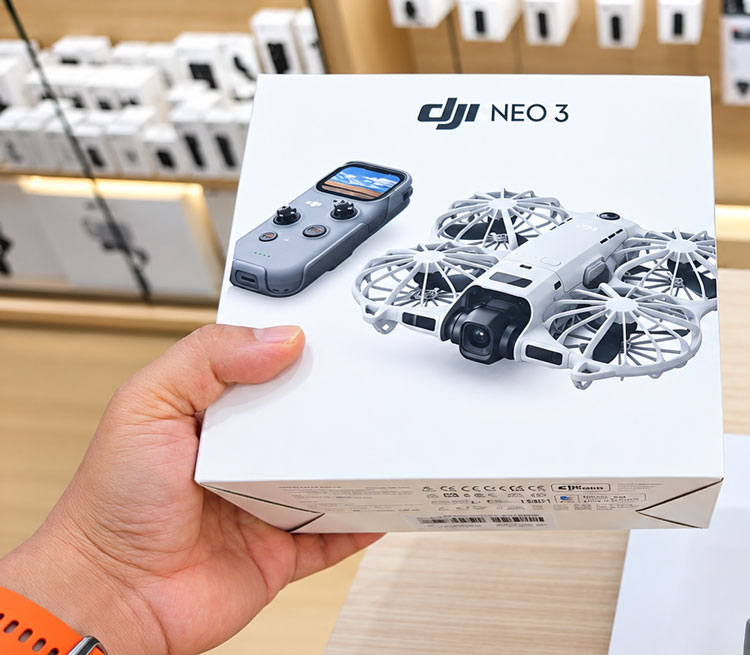
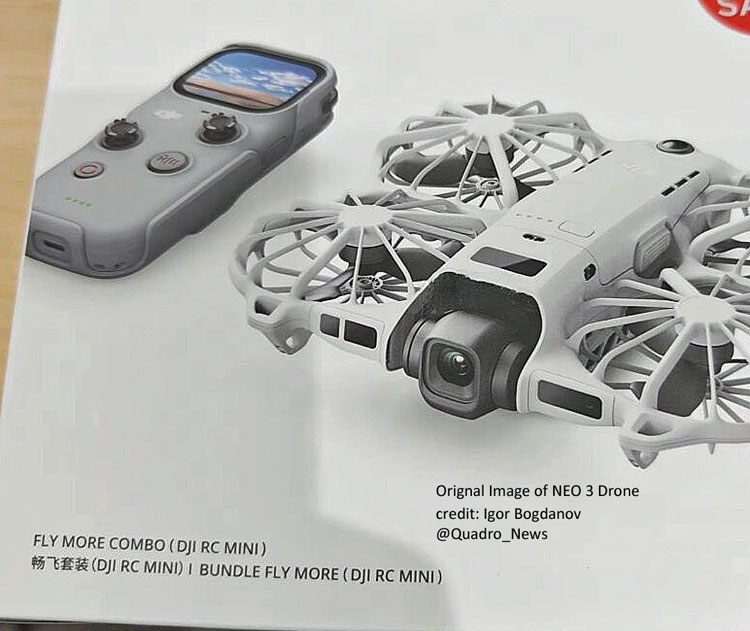
So, finally, we have the official retail packaging box of the upcoming DJI NEO 3 Drone. One of the most trusted and reputed drone leakers, Igor Bogdanov (@Quadro_News) posted a photo of retail packaging labelled DJI Neo 3. The carton is a Fly More Combo with DJI RC Mini, and it carries a red NOT FOR SALE sticker. That clearly indicates that the drone samples have already been sent to influencers to create content prior to the announcement of the drone.
That is the strongest evidence so far that Neo 3 is real, named, and close to its official announcement.
What the leaked box shows
The front of the box prints:
Product name: DJI NEO 3
Bundle: Fly More Combo (DJI RC Mini)
A compact white drone with full propeller-guard cages
A small remote with a built-in screen
Multilingual text, including English and Chinese
BTW, this is not the first time we are looking at the NEO 3 drone, in April month we published a post DJI Avata 3 or DJI Neo 3? Mysterious Dual-Guard Prototype Leaked
And that time we were a little bit confused about the drone, but now this clear image answers all our questions.
Second, the controller is new. Neo and Neo 2 Fly More kits used the RC-N3, a phone-clamp remote. This box shows DJI RC Mini, a smaller controller with its own display. If that holds, the main combo will not need a phone clipped to the remote.
The drone itself still looks like a Neo: palm-sized, caged props, single front camera. The camera unit on the artwork looks more prominent than the original Neo, which is consistent with Neo 2’s visible gimbal — but the box does not print sensor size, video mode, weight or flight time.
When should DJI Neo 3 arrive?
Since the Sample package is already being distributed for review.purpose, and that does mean the announcement is not too far from us. This should happen within next 2 – 3 Months
And even if we go through the DJI scheduled announcement timeline of NEO series drones then we have the following inputs .
The Neo generation cycle is about 14 months.
Model
China launch
Global launch
Gap
DJI Neo
5 September 2024
5 September 2024
—
DJI Neo 2
30 October 2025
13 November 2025
13.8–14.3 months
On that cycle alone, Neo 3 would land in December 2026 or January 2027.
A finished carton with a NOT FOR SALE sticker usually means units are already produced and moving to reviewers. That is a about to be announced type of Situation and, not early rumour.
Best current window: October–November 2026.
If DJI sits on it, December is the slip month. After this leak, a 2027 launch looks less likely.
Estimated DJI Neo 3 price
These are estimates, not leaked figures. The new RC Mini screen remote is the reason the Fly More guess sits above a plain +€50 step.
Bundle
Likely launch range
Best single guess
Drone only
€269–289 / £239–259 / $249–279
€279
Batteries + hub, no RC
€359–389 / £319–349
€369
Fly More + DJI RC Mini
€449–499 / £389–449
€469
Motion / FPV combo
€599–649 / £529–579
€629
If Neo 3 is only a small refresh, expect the low end. If it adds a better camera and the new screen remote, expect the high end.
A return to $199 at launch is unlikely. Mini 4 Pro / Mini 5 Pro pricing is also unlikely. Neo stays the door-price drone. Street prices will fall later — the original Neo later sold near $139.
Neo 3 Bigger Camera module vs Neo 2
The leaked Neo 3 carton shows a heavier-looking camera unit than Neo 2. That is visible on the box. Treat it as a larger camera assembly, not a published sensor size.
On the artwork, the Neo 3 module:
sits in a deeper nose bay
sticks out farther from the body
has a wider-looking front glass than Neo 2’s small round lens
That usually means a stronger gimbal, more glass, or a slightly larger sensor. It does not by itself confirm 1/1.3-inch or 1/1.1-inch.
Item
Neo 2 (official)
Neo 3 (from box art)
Camera housing
Small 2-axis chin gimbal
Larger, blockier, more forward
Front element
Small circular lens
Wider-looking front glass
Sensor
1/2-inch, 12MP, f/2.2
Not printed on the box
Vertical / horizontal
4K 16:9 + 2.7K 9:16 crop
Unknown
Best sensor guesses
Confirmed 1/2-inch
Same 1/2-inch, or a step to 1/1.3. 1/1.1 square is possible but unproven
A 1/1.1-inch square sensor would be the clean way for Neo 3 to do proper horizontal and vertical from one chip — the same idea DJI used on Osmo Action 6. The leaked unit looks larger than Neo 2, but not large enough to confirm that sensor.
Until DJI prints the sensor size, the honest spec is: bigger-looking camera unit, sensor TBA. The more conservative upgrade is 1/1.3-inch. The default is still Neo 2’s 1/2-inch.
What DJI RC Mini likely means
If RC Mini is a built-in-screen controller, the Neo 3 Fly More Combo becomes a better travel kit. You fly without parking a phone on the remote. That is the clearest product change visible so far. DJI will almost certainly still sell a cheaper drone-only kit for palm takeoff and phone-app flyers. The leaked box is just one combo, not the whole lineup.
Quick verdict / TNC Take
DJI Neo 3 looks real. The 15 September 2026 packaging leak is late-stage evidence, not a wild rumour.
Arrival: October–November 2026
Price: modest step up from Neo 2 — about €279 for the drone, about €469 for the RC Mini Fly More Combo
Specs: name, combo and controller are confirmed by the carton. Sensor size, flight time and video modes are not
Until DJI publishes a spec sheet, ignore the loudest 1-inch headlines.
Image credit: Igor Bogdanov / @Quadro_News. This article is independent analysis and is not affiliated with DJI
The article “DJI Neo 3 Price, Specs and Release Date” was written by thenewcamera.com team at 7:42 pm, Tuesday, 15 September 2026, Greenwich Mean Time (GMT)
| You can also follow us on Our Official Social Media HandlesFACEBOOK | TWITTER | INSTAGRAM to get live news — > get live get live Camera News + Insta360 Drone Rumors 24X7.
Buy Canon Lenses, Buy Music CD or Digital Camera at amazon it helps this site, and you do not pay anything extra, it is just a way to help support this site.
New Camera Website, we list all type of new camera information, price review and all type camera rumors, subscribe us or follow us via twitter or facebook.
Disclaimer: We have attempted to select useful information to include on New Camera, and to ensure that the resources we have included on the site -- as well as the way we have described them -- are accurate, fair, and balanced. However, we make no claims, warranties, or other representations concerning the accuracy, completeness, or utility of the information provided, or concerning the abilities or performance of the organizations, agencies, companies, and other resources presented through New Camera


 .
.