Join More Than 50,000+ Subscribers and get latest camera news and rumors
NEW CAMERA VIDEOS ON YOUTUBE
|
By admin, on October 4th, 2026

The FCC may pull LiDAR DJI drones from US shelves around January 30, 2027. That ban is not signed. The Neo 2 and Avata 360 are the two models buyers are pricing right now. They are not the whole list.
The list includes all possible sets of drones that carry LiDAR sensors inside, since, as we all know, the FCC now considers any drone with a LiDAR sensor a military drone. Now they plan to stop the supply of already approved FCC DJI drones, including the recently announced DJI Neo 2, DJI Avata 360, and other older models.
But the most important part is why Jan 30, 2027 will be one of the most important dates for Drone buyers, explained later in the article.
Stores can still sell an authorised unit. A drone already in hand still flies. The open question is the next import, not the aircraft in the bag.
The models that actually carry LiDAR
On July 21, 2026, the FCC’s Public Safety and Homeland Security Bureau and Office of Engineering and Technology released DA 26-758 in PS Docket No. 26-189. The notice sets seven military-grade categories for foreign-produced drones already on the Covered List. Category 4 is any aircraft that contains or integrates a LiDAR sensor. Use does not matter. A crash-avoidance laser counts.
We have already covered the update in a very detailed way here “DJI vs FCC: Big Ban Risk on Already Approved Models – August 2026 Update”
We have also added DJI Response to this issue
DJI has publicly characterized the move as a “total reversal” of the FCC’s previous position. In its ViewPoints response, the company stated:
“Although the proposal is framed as targeting ‘military-grade’ drones, the FCC’s definition could include drones with thermal imaging or LiDAR capabilities… It could even include consumer models used by hobbyists simply because they use LiDAR to improve positioning and obstacle avoidance – a safety feature, not a military capability.”
These five are the consumer DJI models with forward-facing LiDAR that still turn up in US listings. Stock is reseller-heavy. A listing today is not a promise of stock next month.
| Model |
What DJI says is on the aircraft |
| Neo 2 |
Forward-facing solid-state LiDAR, 0.3–8 m, 60° by 60°. FCC ID SS3-DEN225, granted July 16, 2025. |
| Avata 360 |
Omnidirectional vision, supplemented with forward-facing LiDAR and a bottom infrared sensor. FCC ID SS3-DVN3NT, granted November 19, 2025. |
| Air 3S |
Omnidirectional binocular vision, forward-facing LiDAR, bottom infrared. Night LiDAR range 0.5–25 m at reflectivity over 10%, 60° by 60°. |
| Mini 5 Pro |
Omnidirectional vision plus forward-facing LiDAR. |
| Mavic 4 Pro |
Omnidirectional binocular vision, forward-facing LiDAR, bottom infrared. Night LiDAR range 0.5–25 m at reflectivity over 10%. |
Not this fight: Mini 4K, Mini 4 Pro, original Neo, Avata 2. Those use vision or infrared, not LiDAR. Enterprise aircraft such as the Matrice 4 series and Matrice 400 also carry LiDAR. They are a different buyer and a different shelf.
Lito X1 has forward LiDAR, and UAV Coach lists an FCC grant before the cutoff. It is not a current US-shelf drone.
Where January 30 comes from
DA 26-758 says importation and marketing would stop 180 days after Federal Register publication, if the prohibition is adopted. The notice was published August 3, 2026, at 91 FR 48870. August 3 plus 180 days is January 30, 2027.
That is a count, not an order. As of October 4, 2026, PS Docket No. 26-189 has no adopting order. A final notice could also start the 180 days from its own publication date. “Around January 30” holds only if the bureaus adopt the July text as written and keep the August 3 clock.
Comments closed September 2. DroneXL’s tally of the docket was about 3,770 opposed and 16 in favor. That is a filing count, not an FCC score. DJI’s September 2 comment, signed by counsel at Cooley, asked the bureaus to rescind the notice and said the seven categories were not in the national-security determination. The notice had already tentatively concluded that a sales stop serves the public interest. Prior Covered List actions were not stopped by industry filings.
What a buyer can still do
Buy on the rule in force. An authorized DJI LiDAR is still legal to sell. DA 26-758 does not ground aircraft already purchased, and it does nothing until it is adopted.
Avata 360 and Air 3S are the cleaner retail cases, because each has a pre-cutoff grant and US listings. Neo 2, Mini 5 Pro, and Mavic 4 Pro are mostly reseller stock, so the seller and the warranty matter as much as the docket. If the ban lands, new imports and new marketing of these LiDAR models are what stop.
October 13 is a different rule. FCC 26-50 refuses new equipment authorizations for devices that contain a DJI or Autel logic-bearing part. It does not pull a Neo 2 or an Air 3S off a shelf.
This is not a use ban. The notice says continued operation of equipment already in users’ hands would stay authorized.
This is not a Mini 4K deadline. That model is not in the LiDAR table.
A US buyer looking at a DJI Neo 2, Avata 360, Air 3S, Mini 5 Pro, or Mavic 4 Pro is looking at a forward-LiDAR drone. The FCC may stop sales of that class around January 30, 2027. The order has not been issued. The sensor label is already written.
The article “FCC May Pull LiDAR DJI Neo 2, Avata 360 by Jan 30, 2027” was written by thenewcamera.com team at 6:50 pm, Sunday, 4 October 2026, Greenwich Mean Time | You can also follow us on Our Official Social Media Handles FACEBOOK | TWITTER | INSTAGRAM > get live news — > DJI Rumors | Insta360 News
By admin, on October 2nd, 2026
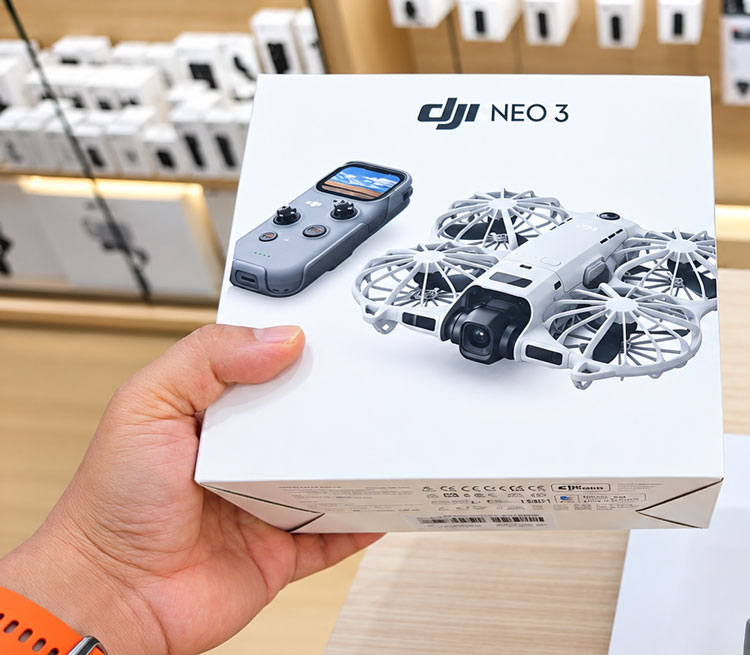
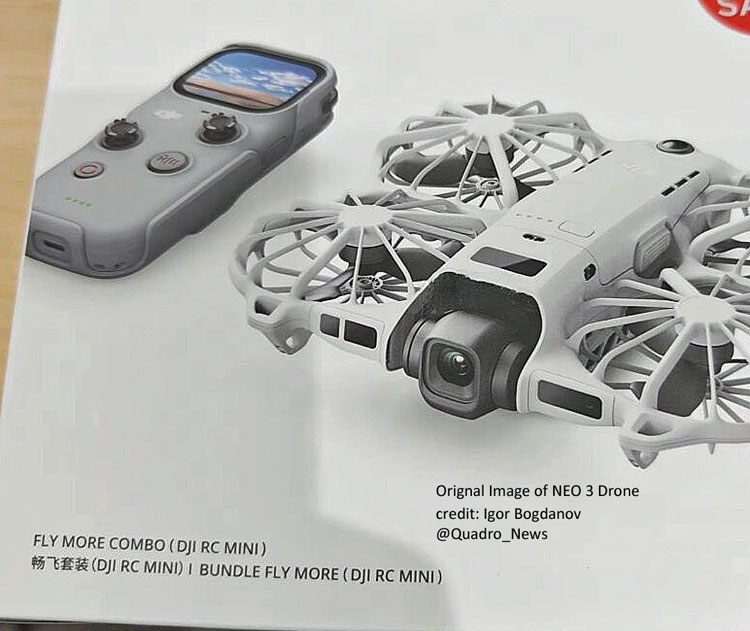
DJI Neo 3 specifications are now available, and the retail box clearly shows the major specs of the upcoming drone, including a larger camera sensor that is now confirmed.
We’ve been covering DJI Neo 3 details over the past few weeks, and we already published the retail box a while ago, where you can clearly see images of the drone and the new smart controller that comes with it.
In our previous post, we clearly mentioned that the Neo 3 is pretty heavy compared to the Neo 2, but at that time we were not sure what the reason was, and now we are confirmed that it is due to the larger sensor, which is already being used in the Osmo 360 Mark II camera and is now going to be used in the Neo 3 to scale the overall quality and experience of the user. Not only that, but software-based upgrades have also been noticed, and we will be getting ActiveTrack 2.0 with other small updates in the Neo 3, specifically developed/made for content creators on the go.
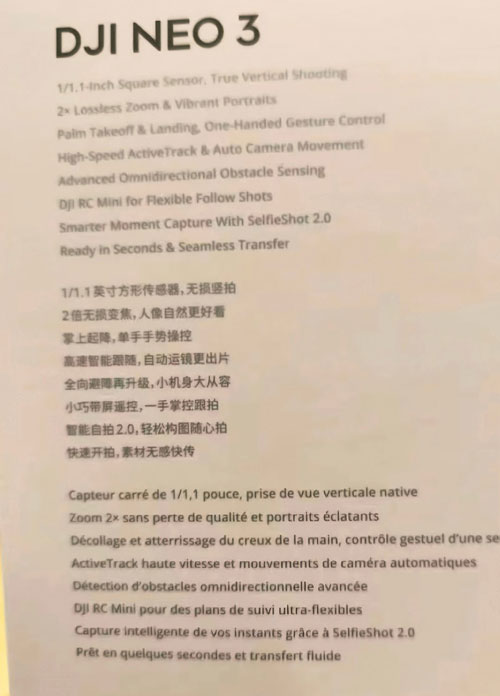
The headline line is a 1/1.1-inch square sensor with true vertical shooting. Neo 2, launched on 13 November 2025, uses a 12MP 1/2-inch CMOS. A 1/1.1-inch chip is a large step for this class and a major upgrade. The panel also lists 2x lossless zoom and “vibrant portraits.” It does not print megapixels, aperture, video resolution, bitrate or a 10-bit mode.
What the retail panel actually prints
The English lines, matched by the Chinese and French text on the same sheet, are: DJI Neo 3 key characteristics, transcribed from the packaging text in the image
Sensor and image
-
- 1/1.1-inch square sensor, true vertical shooting
Zoom and portraits
-
- 2× lossless zoom and vibrant portraits
Takeoff and control
-
- Palm takeoff and landing, one-handed gesture control
Tracking and camera movement
-
- High-speed ActiveTrack and auto camera movement
Obstacle sensing
-
- Advanced omnidirectional obstacle sensing
Remote
-
- DJI RC Mini for flexible follow shots
Selfie mode
-
- Smarter moment capture with SelfieShot 2.0
Startup and transfer
-
- Ready in seconds and seamless transfer
Chinese on the same panel reads 1/1.1英寸方形传感器,无损竖拍 and 2倍无损变焦. French reads “capteur carré de 1/1,1 pouce, prise de vue verticale native” and “zoom 2× sans perte de qualité.” The three languages agree. This is not a single mistranslated caption.
Palm launch, gesture control, ActiveTrack and omnidirectional sensing are Neo 2 features carried forward, with the box calling tracking “high-speed” and sensing “advanced.” SelfieShot is already on Neo 2. The panel marks the new version SelfieShot 2.0 and pairs it with automatic camera moves. “Ready in seconds and seamless transfer” points at the same quick-start, phone-transfer idea as Neo 2’s Wi-Fi offload, without a stated transfer speed.
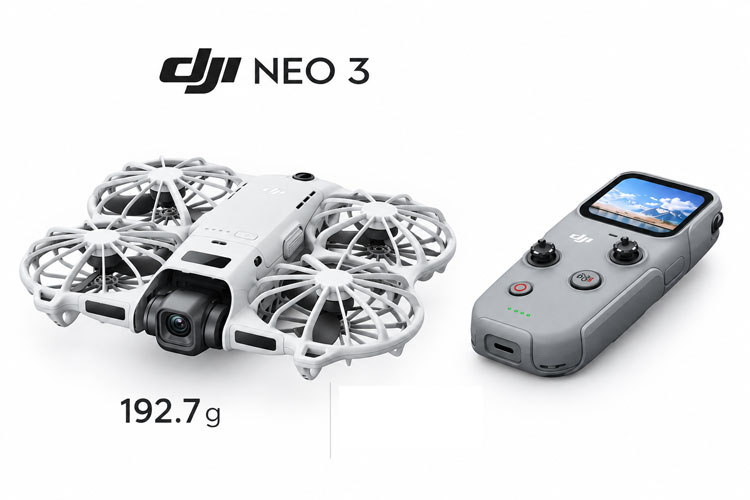
The weight jump is the easiest hardware clue. A larger sensor, a screened remote in the standard bundle, and that extra sensing hardware are the plausible reasons for the added grams. The Digital Transceiver was a separate Neo 2 accessory. Fly More Combo photos of Neo 3 have not shown that module, which has led to speculation that the link is built in. The feature panel does not say that.
RC Mini and the US split
The panel’s most practical change is the DJI RC Mini for follow shots. Neo 2’s standard remote, the RC-N3, needs a phone. Earlier Neo 3 box art showed a pocket remote with its own screen. Reporting has tied that remote to the RC Mini AG hardware: about a 1.97-inch panel, roughly 410×494, up to 800 nits, and OcuSync 4-class range claims. Those remote figures are inferred from the agricultural RC Mini, not printed on this Neo 3 sheet.
For US readers the split matters. The controller received an FCC grant in December 2025, just before DJI was added to the FCC Covered List. A controller grant is not an aircraft grant. Nothing in this leak puts the Neo 3 aircraft itself through that cutoff. Availability in the United States should be treated as blocked until DJI or the FCC says otherwise.
What to wait for
The retail panel is enough to report the feature set DJI has printed for the box. It is not enough to publish a full specification table. The next useful confirmations are resolution, flight time, whether the 192.7 g figure is the shipping weight, and whether the RC Mini is in the base kit or only the Fly More Combo. Until DJI posts the product page, those stay open.
Source: Igor Bogdanov (@Quadro_News), 1 October 2026 retail feature panel. Related: DEN326 registry image, mid-September Neo 3 box photos. Neo 2 figures from DJI’s 13 November 2025 launch specifications
The article “DJI Neo 3 Promises a Bigger Sensor: Full Specification Leaked” was written by thenewcamera.com team at 4:20 pm, Friday, 2 October 2026, Greenwich Mean Time | You can also follow us on Our Official Social Media Handles FACEBOOK | TWITTER | INSTAGRAM > get live news — > DJI Rumors | Insta360 News
By admin, on September 26th, 2026
Okay, we have some fresh information about the upcoming DJI Dock 4 for the DJI Matrice 5TD. Not only that, but we also have a fresh set of images of the upcoming drone, Neo 2 as well as the DJI Matrice 5TD.
DJI Matrice 5TD image leaked earlier too, back on July 26th, 2026. We shared highly detailed images in high res of the drone; obviously, at that time it was in the testing phase, and now it’s almost ready for announcement in Q4 of 2026.
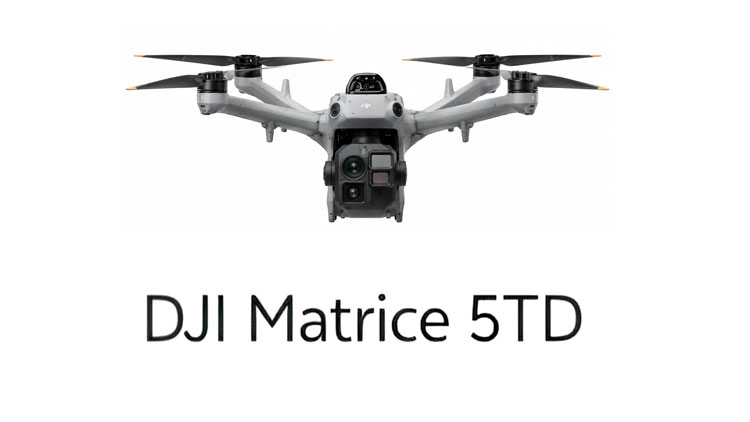
 DJI Matrice 5 On 25 September 2026, Igor Bogdanov / @Quadro_News posted three labelled images and one line that actually moves the story: there will be a DJI Dock 4, and it will be used in stores soon.
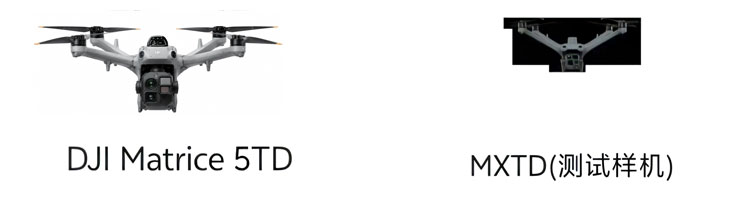 Matrice 5TD is the product name. It is printed under the clean white photo, and it was already on the 22 September card as DJI Matrice 5TD, model code M5TD. That is the name built like Matrice 4TD: a dock-ready thermal aircraft. MXTD is the test label. The darker photo is marked MXTD (测试样机), and 测试样机 means test prototype. It is an internal or filing code, not the name DJI would put on a box. What the recent post says about the upcoming products
The 25 September image is a front, in-flight style shot on white, watermarked by Igor Bogdanov, with the words DJI Matrice 5TD under the drone. What is visible:
- A white compact enterprise quad, arms out, not a Matrice 400-class airframe.
- A multi-window gimbal under the nose.
- A small dark dome on top of the body. That could be RTK, an obstacle sensor, or both. The photo does not say which.
- The same general size class as the Matrice 4 series, not the heavy Matrice 300 / 350 / 400 line.
This is a different kind of image from the 26 July Matrice 5 set. Those July frames were taped prototypes with manufacturing labels. This one is a finished-looking, named product shot. That is why it matters.
The Neo 3 frame in the same post is the drone we already covered from the retail box and the 21 September production filing. It is context. It is not the story.
DJI’s dock naming is already a pattern, not a guess we invented.
| Generation |
Dock |
Aircraft |
| 2024 |
Dock 2 |
Matrice 3D / 3TD |
| Feb 2025 |
Dock 3 |
Matrice 4D / 4TD |
| Now, unconfirmed |
Dock 4 |
Matrice 5TD is the name on the leak |
On the current line, D is the dock-ready aircraft and T is the thermal version. Matrice 4TD is the thermal drone that lives in Dock 3. Matrice 5TD is the same kind of name, one generation on.
That does not prove Dock 4 only flies the 5TD. Dock 3 launched with both a 4D and a 4TD. A non-thermal Matrice 5D is possible and not shown here.
What is confirmed, and what is not
DJI Dock 4 is planned and will be used in stores soon. The igor same post shows the first labeled DJI Matrice 5TD photo and an MXTD airframe marked as a test prototype. The 5TD name and model code M5TD were already on his 22 September card; flight time, sensors, and weight are still unconfirmed. For US buyers this is not a purchase path – new DJI docks remain blocked from fresh FCC authorization, and “stores soon” does not mean a US shelf.
What would move the story from a name to a product is a photo of the dock, a charge-time or IP figure, or a dealer listing. Until one of those appears, the record is this: Dock 4 is confirmed by the leak, it is described as store-bound, and the aircraft shown beside that claim is a labeled Matrice 5TD, with an MXTD airframe marked as a test prototype.
The article “DJI Dock 4 Confirmed for Stores – First Labelled Matrice 5TD Photo Also Leaks” was written by thenewcamera.com team on 4:54 pm, Saturday, 26 September 2026, Greenwich Mean Time (GMT) | You can also follow us on Our Official Social Media Handles FACEBOOK | TWITTER | INSTAGRAM > get live news — > DJI Rumors | Insta360 News
By admin, on September 24th, 2026
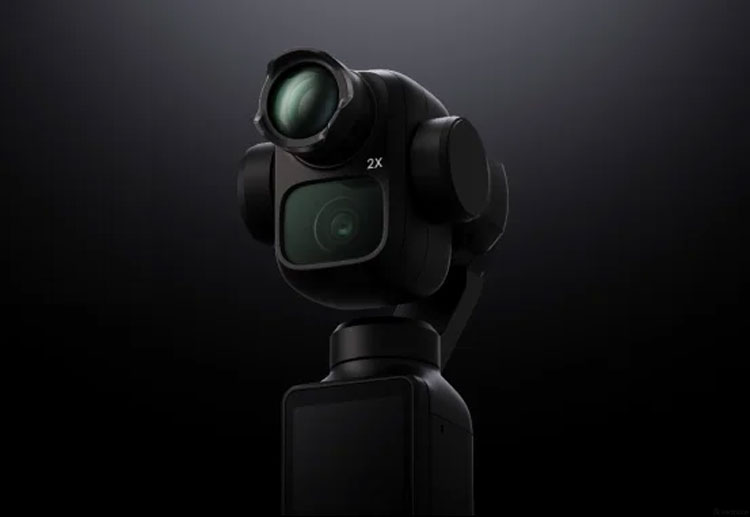
A new accessory leak dropped on September 24, 2026. It is a 2x teleconverter for the already-released DJI Osmo Pocket 4P, mounted on the upper telephoto module rather than the wide-angle lens. The timing is the real headline. Insta360 launched the Luna Ultra Ultra Telephoto Lens on September 21 – a $49.99 magnetic add-on that sits on Luna’s tele module and pushes reach to a claimed 450mm / 22.5x. Three days later, this Pocket 4P render appears doing the same job on DJI’s rival body.
Magnetic 2x converters already existed for DJI’s single-lens Pockets. NEEWER’s LS-84 has been selling for Pocket 3 and Pocket 4. DJI did not invent clip-on zoom last week.
What the Leak Image Actually Shows
The render is a clean black-background product shot, not a warehouse photo or dummy-unit snapshot. That matters. It looks closer to official accessory marketing than a workshop prototype.
Visible details in the image:
- Dual-lens Pocket 4P head — wide module below, telephoto module above, matching the production 4P gimbal layout.
- A 2X-marked converter sitting on the upper (telephoto) lens only, not covering the wide camera.
- The converter sits directly on the front of the 60mm module, which matches the caption.
- No DJI logo is readable on the converter itself in this crop, and there is no packaging, SKU, or price tag.
Did DJI Just Copy Insta360’s Homework?
It looks like they did this time. Three days before this leak, Insta360 officially launched the hardware and firmware for Luna Ultra. That accessory is not a rumor. It is on sale. Pocket 4P vs Luna Ultra has been a copy-and-raise fight all year: dual cameras, 60mm tele, 1-inch wide, log profiles, tracking. When one brand ships a tele converter, the other cannot leave a 120mm hole in the comparison chart.
Why a 2x on the Pocket 4P Tele Module Would Matter
The Pocket 4P already solved the biggest complaint about the standard Pocket 4: the lack of real optical reach. It ships with two cameras.
| Camera |
Pocket 4P Wide |
Pocket 4P Telephoto |
| Sensor |
1-inch CMOS |
1/1.28-inch CMOS |
| Focal length |
20mm equiv., f/2.0 |
60mm equiv., f/1.8 |
| Optical step |
1x |
3x optical |
| Zoom ladder |
2x lossless crop on wide |
6x lossless / 12x digital |
| Log profile |
D-Log 2 (17-stop claim) |
Standard D-Log only |
A true 2x converter on the 60mm module would theoretically push that lens to about 120mm equivalent — a 6x optical step from the 20mm wide camera, before any digital crop. That is a different tool from the 12x digital zoom DJI already advertises. Digital zoom on the 4P starts to soften after 6x. An optical converter, if the glass is decent, would keep more detail at portrait-to-short-tele distances.
Existing third-party 2x converters for Pocket 3 and Pocket 4 clip onto a single wide lens. They cannot sit on the 4P’s separate telephoto barrel without a new mechanical design. If this render is real, it is not just a rebadge of the NEEWER LS-84.
DJI Pocket 4P in USA
United States: The Pocket 4 and Pocket 4P remain blocked from official US sale under the FCC Covered List / NDAA rules. An official DJI accessory would almost certainly follow the same restriction. Luna Ultra and its $50 tele lens are available in the US. That is another reason the “official vs aftermarket” question matters for US readers.
Bottom Line
This is a fresh, single-source leak and not a 100% confirmed DJI announcement. The render is specific enough to take seriously, and the date stamp is impossible to ignore: Insta360 shipped a tele converter on September 21, and a Pocket 4P 2x render appeared on September 24. If it ships and the glass holds up, Pocket 4P owners would get a compact path from 20mm to roughly 120mm without leaning on digital zoom.
Sources: @D2Help / Xdrones Studio (September 24, 2026); Insta360 Luna Ultra Ultra Telephoto Lens announcement (September 21, 2026); DJI Osmo Pocket 4P official specs; NEEWER LS-84 product listing; Indian retailer prices as of September 24, 2026.
The article “DJI Pocket 4P 2x Teleconverter Leak Surfaces 3 Days After Insta360’s Luna Ultra Lens” was written by thenewcamera.com team on 4:06 pm, Thursday, 24 September 2026, Greenwich Mean Time (GMT) | You can also follow us on Our Official Social Media Handles FACEBOOK | TWITTER | INSTAGRAM > get live news — > DJI Rumors | Insta360 News

The article “DJI Pocket 4P Launches in China Today – What It Means for US Buyers” was written by thenewcamera.com Team on 5:38 am, Monday, 15 June 2026, Greenwich Mean Time (GMT) | You can also follow us on Our Official Social Media Handles FACEBOOK | TWITTER | INSTAGRAM | get live news — > DJI Rumors
By admin, on September 14th, 2026

Thenewcamera.com Press desk – Antigravity used IFA 2026 in Berlin to announce the Cellular Module for the A1, the Insta360-backed 8K 360 drone already on sale in the United States.
If you fly in US cities, around trees, or anywhere OmniLink starts to sparkle, this is the first A1 accessory that changes the flight — not just the bag. The pitch is simple: keep the 2K goggle feed alive when the regular radio link dies.
Price is still missing. US store listing is still missing. The advantage over a normal drone link is already clear.
What US buyers are actually getting
This is not a new aircraft. It is a two-piece 4G kit for the A1 you can already buy at the official US store, Amazon, Adorama and B&H.
- One module mounts on the drone
- One module mounts on the Vision Goggles
- Both use a built-in eSIM — no Nano-SIM tray, no airport SIM hunt
They run next to OmniLink 360 (2.4 / 5.2 / 5.8 GHz). When buildings, trees or Wi-Fi noise chew the primary link, the system can fail over or split packets onto LTE so control and live view stay up.
That is the whole point versus a regular drone.
Cellular / eSIM vs a regular drone link — the real US advantage
A normal camera drone (Mini, Air, Avata, even the stock A1) lives and dies on one private radio pipe. In an open field that pipe is fine. In the places most American creators actually fly — downtown, suburbs, parks with trees, stadium lots, festival grounds — that pipe is the first thing that fails.
| Situation |
Regular drone (RF only) |
A1 + Cellular / eSIM |
| Open field, no obstacles |
Strong OmniLink / OcuSync-style link |
Same primary link, 4G sitting idle |
| Building, hill or tree line between you and the aircraft |
Live view breaks or goes blocky; you fly blind or RTH |
4G keeps the 2K goggle feed and stick inputs alive |
| Dense 2.4 / 5 GHz Wi-Fi (apartments, campuses, events) |
Interference on the drone band |
LTE sits on a different network; less “everybody’s router is screaming” |
| Travel city to city |
New country / new venue, same RF limits |
eSIM profile in software — no physical SIM swap |
| “Can I legally fly BVLOS now?” |
No |
Still no. 4G is backup, not a FAA waiver |
Three advantages US pilots will actually feel:
- The feed does not die behind a building.
Stock A1 already streams a full 360 view into the goggles. Lose OmniLink and that immersive view is gone. Cellular is the spare tire. You are not getting a second 8K downlink over LTE — live view stays 2K@30fps — but you keep seeing something instead of a frozen frame.
- eSIM is built for travel, not for a drawer full of SIM cards.
Both modules have eSIM inside. Add a US or roaming data plan in software. That is the difference versus older cellular drones that wanted a physical Nano-SIM and a carrier that may or may not like drones. AT&T / T-Mobile / Verizon support is not published yet. Until that list drops, treat “works on any US network” as a hope, not a spec.
- Urban range becomes usable range.
On paper the A1 already quotes 10 km FCC. That number is an empty-field number. In a real US city the useful OmniLink distance is much shorter. 4G does not magically give you 10 km through Manhattan. It does let you keep the aircraft when you duck behind a garage, a stand of trees, or a parking garage wall — the exact moment regular drones go mute.
What it does not give you:
- Legal BVLOS. Recreational US rules still want visual line of sight. Goggles still mean a spotter.
- Better 8K files. Those still record on the drone.
- Proof that latency over LTE will feel as tight as OmniLink. Antigravity has not published the lag number.
Price — still blank
Antigravity did not put a dollar figure on the module at IFA. European list price and eSIM plan costs were promised “in the coming weeks.” End of September 2026 is the ship window.
Until the US product page goes live, ignore random Twitter numbers.
Current A1 drone street pricing in the US (module not included):
| Bundle |
List |
Street (mid-September 2026) |
| Standard |
$1,599 |
about $1,199–$1,359 |
| Explorer |
$1,899 |
about $1,519–$1,609 |
| Infinity |
$1,999 |
about $1,599–$1,699 |
Buy the aircraft today if you want the 360 rig. Do not pay a scalper for a 4G kit that is not in the US catalog yet.
US availability
Cellular Module: not listed anywhere in the US yet. IFA was a Europe-first reveal. The module is its own radio, so it needs its own FCC grant plus working eSIM profiles on US carriers. That is why it will not show up on Amazon the morning after Berlin.
Watch:
- antigravity.tech/us
- Amazon / Adorama / B&H accessory pages
- pr@antigravity.tech for the carrier list
Should a US buyer wait?
Wait for three things before you click buy:
- USD price
- Confirmed AT&T / T-Mobile / Verizon eSIM support
- Extra weight — two modules plus antennas may push a standard-battery A1 closer to the 250 g line that triggers registration and Remote ID
If you already own the A1 and fly around buildings, this is the accessory that matches how Americans actually use the drone. If you only fly open parks, OmniLink is enough and you can skip the monthly data bill.
We will update this page the minute the US SKU, price and carrier list land.
The article “Antigravity A1 4G Cellular Module at IFA 2026: Price, eSIM and US Availability” was written by the thenewcamera.com team on 4:59 pm, Monday, 14 September 2026, Greenwich Mean Time (GMT). You can also follow us on Our Official Social Media Handles FACEBOOK | TWITTER | INSTAGRAM to get live news — > get live get live Camera News + Insta360 Drone Rumors 24X7
By admin, on September 6th, 2026
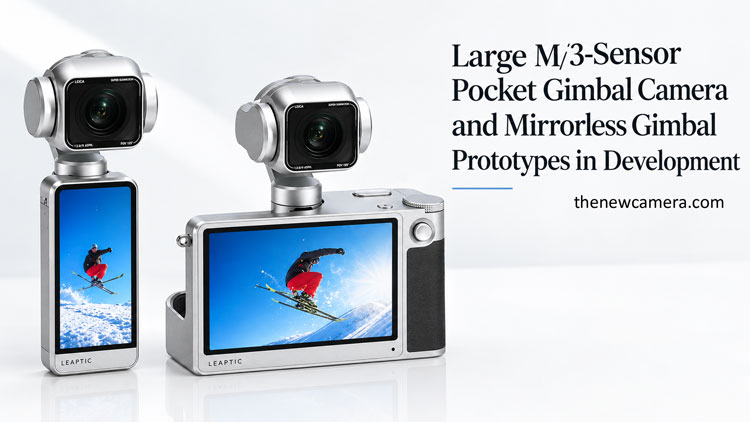
How about a pocket gimbal camera with a 100MP Micro Four Thirds format sensor to access as much quality as possible at the same time, with the same 100MP Micro Four Thirds sensor camera with a gimbal head that not only stabilises your shot in a very unique way, but is primarily built for content creators to solve their quality and mobility issues.
Well, the world is about to change dramatically since after the popularity of DJI Pocket gimbal cameras, a lot of camera makers as well as smartphone makers have entered into the race, and now we have cameras like Insta360 Luna Ultra, which is obviously one of my favourite gimbal cameras as of now, and I am using it for more than two months, creating content for my channel. At the same time, not only DJI, but other brands like HONOR have also entered the smartphone pocket gimbal camera world; based on the latest set of information, HONOR is also interested in announcing a standalone gimbal camera like the DJI Pocket. Other than that, based on the previous year’s report, OPPO has been intensively testing their prototypes of pocket gimbal cameras, and they are about to release them next year.
LEAPTIC (Leptic) is Dreame’s camera brand. President Yuan Qian, formerly P&G and vivo, built it with CTO Yang Sheng, Dreame employee No. 23. Parent: Dreame, founder Yu Hao.
They already sell one working camera — LEAPTIC Cube, a 56 g 8K thumb cam in China since May 2026, West from October at €399 / $449.
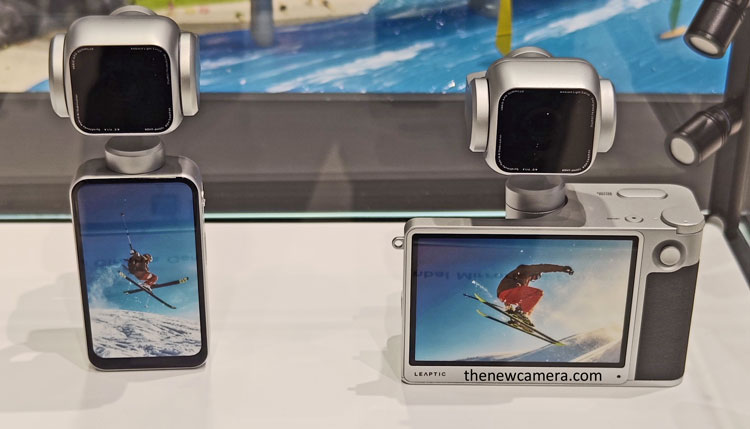
That is the short intro. The IFA 2026 story is the upcoming gimbal line: a pocket gimbal that claims a large Micro Four Thirds sensor, and a retractable mirrorless gimbal.
Same clock as Cube, one year later. Cube was first shown at IFA 2025 and went on sale in China in 2026. These IFA concepts were first shown in 2026. If they keep that gap, the gimbals go on sale in China in 2027.
When the gimbals could actually reach shops
| Stage |
Cube (done) |
IFA gimbals (this week’s prototypes) |
| First booth |
IFA 2025 |
IFA 2026 |
| Named debut + price |
CES Jan 2026 |
CES Jan 2027 — if they copy the script |
| China sale |
2026 |
2027 |
| West sale |
Oct 2026 |
late 2027 |
So the planning line is simple. Timeline here:
- 2026 = show year for the pocket / M/3 / mirrorless gimbals
- 2027 = first year you might buy one in China
- West usually follows China by a few months → autumn 2027 abroad
That is best case. A physical gimbal is harder than Cube (motors, heat, claimed MFT glass). If CES 2027 is still unnamed mock-ups, China slips to late 2027 and the West to 2028. There is no gimbal SKU in 2026.
Watch CES Las Vegas, January 2027.
The upcoming cameras M4/3 Gimbal Cameras
Four concept bodies were on the Berlin stand. All use a physical gimbal. Three are tall-handle Pocket clones. One hides the gimbal inside a compact body. None have a price. PCMag treated them as concepts that may never all ship.
Pocket gimbal with large M/3 sensor — Cinema model
Stand card:
- Micro Four Thirds compatible
- 100 megapixels
- 3nm AI chip
- Variable aperture
- Single large lens, ProRes promised
If the M/3 chip is real, this is not another phone-sensor Pocket. If is doing a lot of work. Dreame has not named the sensor. Xiaomi showed a 100MP Type 4/3 “Light Fusion X” phone module in 2025 – same format class, not a confirmed shared chip. Do not write that LEAPTIC is using Xiaomi’s sensor.
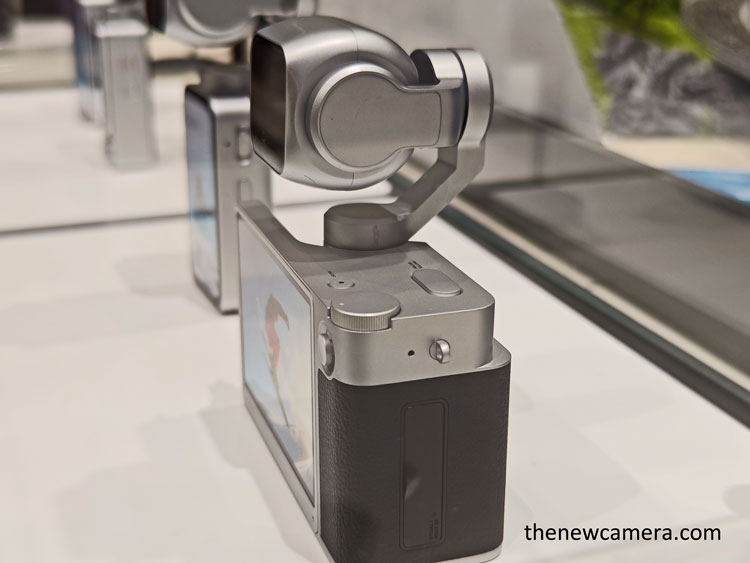
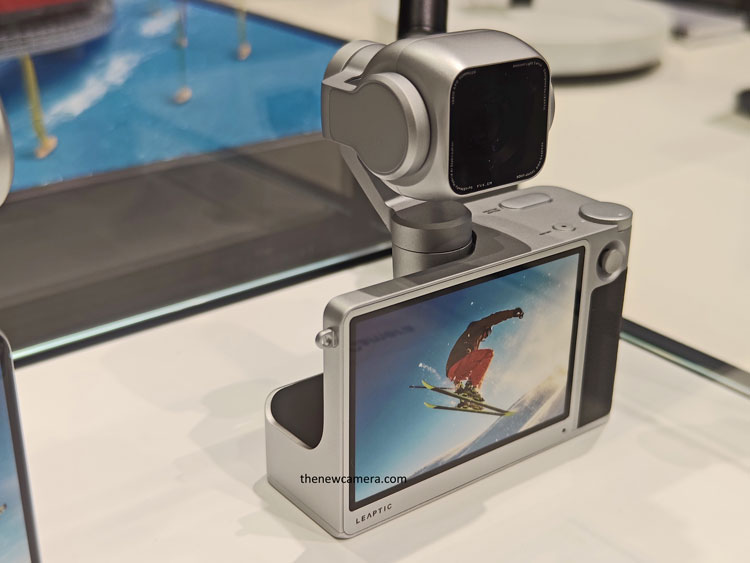
Mirrorless gimbal prototype
Same claimed internals, different shell.
- Compact “mirrorless” body
- Same M/3 + 100MP + 3nm + variable aperture claims
- Gimbal retracts into the body
This is the screenshot prototype. It is also the hardest to manufacture.
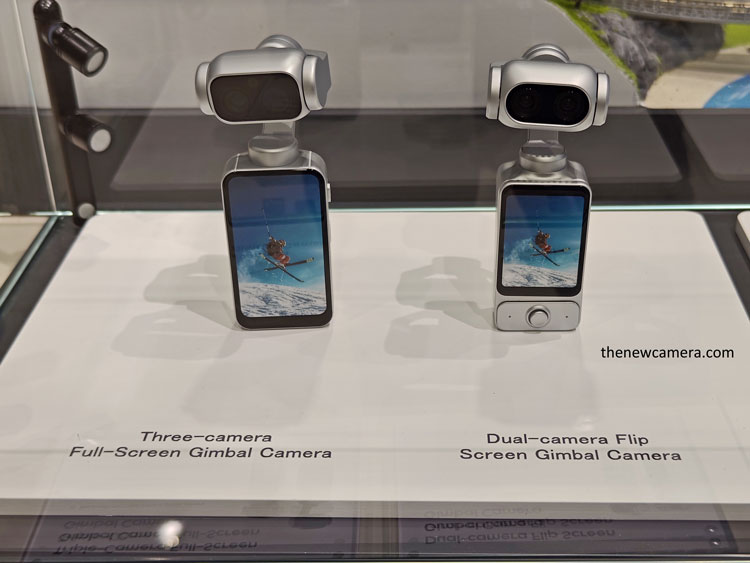
Three-lens pocket gimbal
- Ultra-wide to super-tele on one handle
- 16–800mm equivalent claimed
- Tele module 200MP claimed
- AI ambient light sensor, large display
Luna Ultra silhouette. The 16–800mm and 200MP tele lines are booth numbers until a production chart exists.
Two-lens entry gimbal
- Compact dual camera
- 4nm chip
- Two lenses, wide range
If only one prototype becomes a 2027 product, this is the likely one.
Yuan Qian has already said handheld gimbals / 云台微单 are on the roadmap, on the same app as Cube. The category is intended. These four shells are not a catalogue.
LEAPTIC Cube is the only finished product and already available for sale
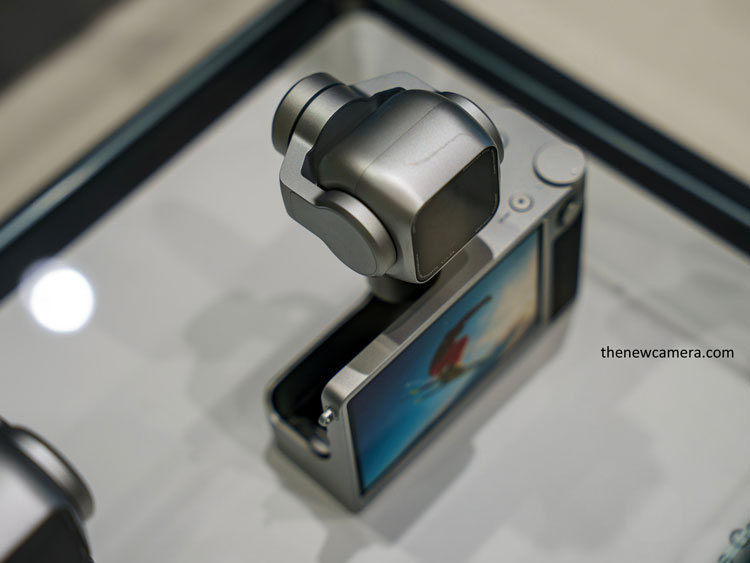
Bottom line
Shown 2025 → sold China 2026 was Cube.
We do personally believe this is not just a show-off. Since the founder of the company has already launched a working camera in China, and now they are planning to introduce a series of pocket gimbal cameras to hit the core of the market where the maximum consumer base exists, with the highest quality possible and with a nominal price range. Since the manufacturing unit/production line will remain in China to cut down the production cost.
CES 2027 event will bring more live details to the topic at the very same time. Canon, Nikon, and Sony scale/upgrade their approach and reconsider and rethink about what consumers are actually looking for in a camera right now, specifically for content creation, we have seen Canon is actively working on their pocket series, gimbal camera, and they have applied a patent for it also, but as usual, Canon moves at its own pace and it will take approximately 2 to 3 years that their pocket gimbal camera is coming now earlier than 2027.
Other than that, it would be highly interesting to see what LEAPTIC makers can offer us out of the box.
The article “Pocket Gimbal Camera With Large M/3 Sensor and Mirrorless Gimbal Prototypes Coming” was written by thenewcamera.com team on 3:22 pm, Sunday, 6 September 2026, Greenwich Mean Time (GMT) | You can also follow us on Our Official Social Media Handles FACEBOOK | TWITTER | INSTAGRAM to get live news — > get live get live Camera News + Insta360 Drone Rumors 24X7
By admin, on September 3rd, 2026
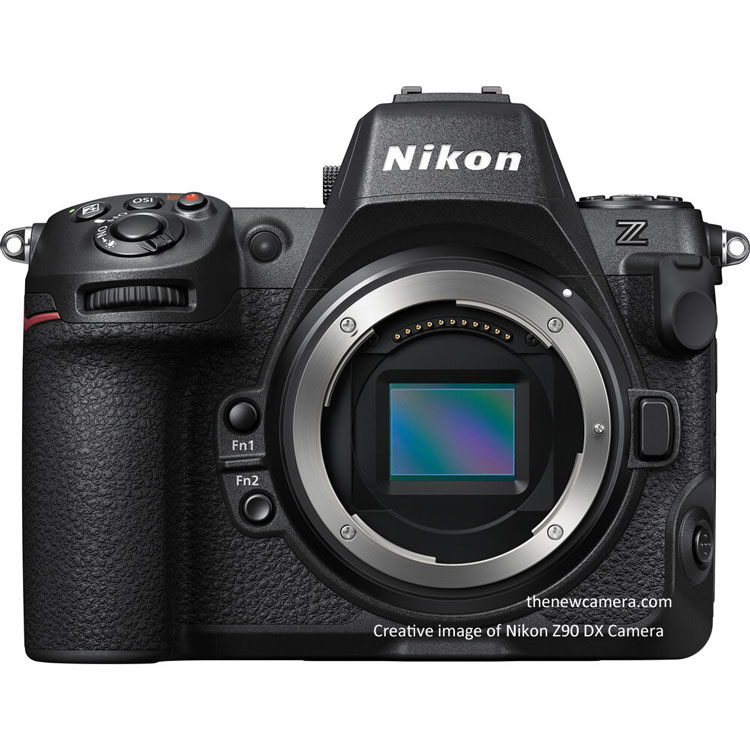 We have just received a fresh confirmation from a source regarding Nikon’s long-rumoured professional APS-C camera. We have just received a fresh confirmation from a source regarding Nikon’s long-rumoured professional APS-C camera.
According to the latest information shared with us, Nikon’s pro-level APS-C / DX camera is now lined up for a September 2026 announcement. The same source also said that no other Nikon camera announcement is expected this year besides this one.
That last part is important. Nikon has already gone through 2026 without launching a new interchangeable-lens body; they are too busy in … (yes, we do have information that will be revealed soon).
This update is 100% accurate; the professional APS-C camera is the one product Nikon is holding back for later this month. Production Line body sent to pros, and more bodies are about to be sent to infulencers before the 2nd week of Sep.
The source was hesitant about the name
The source used the name. Keep the name Nikon Z90. As usual, since he is also deeply connected with Nikon, hesitated before sharing details.
That matches what we have been seeing for months.
For a long time, this camera has been circulating under different names:
- Nikon Z90
- Nikon Z70
- Nikon Z80
- Nikon Z500
- Mini-Z9 / Mini-ZR / D500 successor
As we all know, that the Z70 name became much stronger after Apple briefly listed an unreleased Nikon Z70 on its official ProRes / ProRes RAW authorised products page in August. That listing was later removed.
So we are treating this as a professional APS-C Nikon Z-mount body coming in September-October 2026, not as a locked official name. Z90 is the name the source used. Z70 is still the name with the strongest public leak so far.
What kind of camera is this?
This is not another Z50 II or Z30-class body.
The camera being described is Nikon’s flagship APS-C / DX model — the one D500 users have been waiting for since Nikon moved fully into mirrorless.
Based on the current rumor picture, this is expected to sit clearly above the existing DX lineup:
- Professional APS-C body
- High-speed shooting
- Strong autofocus
- Built more like a compact Z8 / mini-Z9 than a beginner DX camera
- Video features closer to the ZR family
Nikon still has no true flagship APS-C mirrorless camera. Canon already has the R7 class, and Sony has the A6700 class. That gap is exactly why this rumor has never died.
Lenses are also in the pipeline
The same source confirmed that lenses are also in the pipeline.
That part is easier to believe. Nikon already added two important DX lenses in late 2025:
- NIKKOR Z DX 16-50mm f/2.8 VR
- NIKKOR Z DX MC 35mm f/1.7
A professional APS-C body only makes sense if Nikon also has more DX glass coming behind it. We expect at least some additional DX lenses to be tied to this launch, even if Nikon does not announce the full lens set on the same day.
Why September makes sense
A September window has already been floating around for this camera. Nikon has also scheduled server maintenance on September 15, which rumor sites usually watch closely because those windows often sit near product announcements.
If the source is right, this could be the first real Nikon body announcement of 2026.
TNC Take
We are more confident about the product than the name.
A professional APS-C Nikon camera in September 2026 now looks very possible. The source saying “this is the only Nikon announcement left this year” also fits Nikon’s unusually quiet 2026 calendar.
Until Nikon publishes the press release, we will keep calling it Nikon’s pro APS-C camera, with Z90 as the name used by the source and Z70 as the strongest leaked designation so far.
Stay tuned. If September is the month, we should not have to wait much longer.
Stay Tuned. Stay Updated.
The article “Nikon Z70 / Z90 – A Pro APS-C Camera Expected Before September 2026” was written by thenewcamera.com team on 1:51 pm, Thursday, 3 September 2026, Greenwich Mean Time (GMT) | You can also follow us on Our Official Social Media Handles FACEBOOK | TWITTER | INSTAGRAM > get live news + Nikon Rumors 24X7

|
KEEP THIS BLOG ALIVE - Support New Camera Buy Canon Lenses, Buy Music CD or Digital Camera at amazon it helps this site, and you do not pay anything extra, it is just a way to help support this site.

|