Join More Than 50,000+ Subscribers and get latest camera news and rumors
NEW CAMERA VIDEOS ON YOUTUBE
|
By admin, on October 12th, 2026
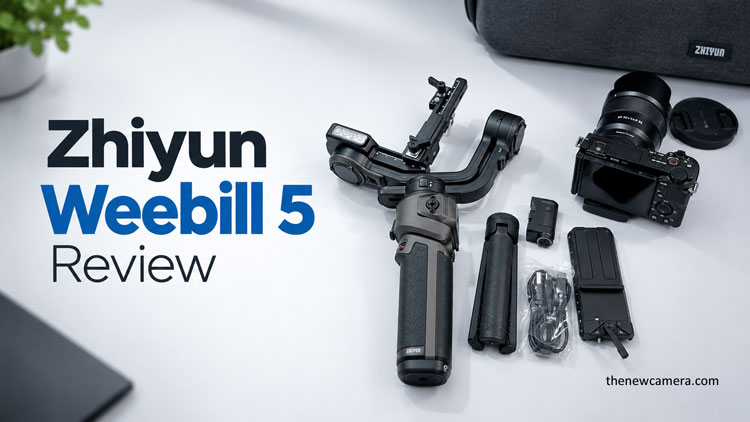
After spending real time with the Zhiyun Weebill 5, I can say it has become one of the more practical compact gimbals I’ve used recently. I specifically tested it with two very different setups that cover much of what creators actually shoot: my Panasonic Lumix S5 II with a 50mm lens and the Sony ZV-E10 with several prime lenses. The results were consistently smooth, and the AI tracking turned out to be the feature I kept going back to.
What the Weebill 5 Is
The Weebill 5 is Zhiyun’s latest compact 3-axis gimbal. The big practical changes are the built-in telescoping handgrip (so you don’t need a separate sling handle for low-angle work) and the optional AI tracking module that comes in the Combo kit. It weighs about 1,080 g, supports up to 3 kg, has a 1.8-inch touchscreen, a built-in fill light, and native portrait switching.
I used the Combo version for testing so I could properly evaluate the AI tracking.
Real-World Testing with the Panasonic S5 II
I mounted my S5 II with a 50mm lens. The body is around 740 g with battery, so with the prime the whole setup stayed comfortably under the 3 kg limit. Balancing was straightforward — nothing frustrating or time-consuming once I got the dual-layer plate sorted.
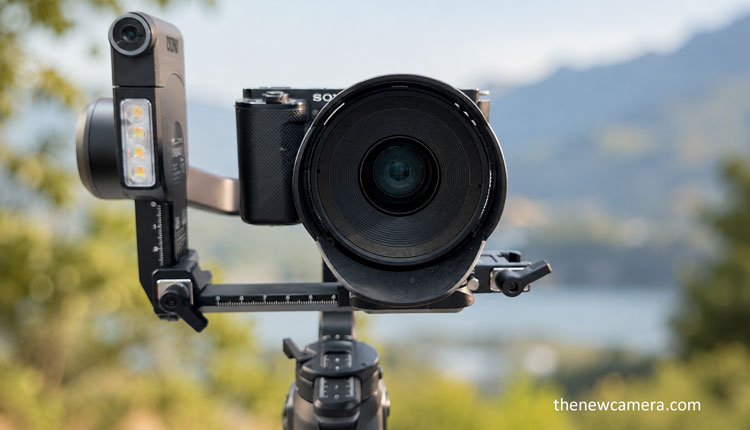
Once balanced, the motors felt confident. Walking shots, slow pans, and moderate movement stayed smooth without the jitter or motor hunting I sometimes see on lighter gimbals. The S5 II’s IBIS and the Weebill 5 worked well together. Low-angle shots were noticeably more comfortable because of the built-in handgrip — I didn’t have to attach anything extra or dig through my bag. Overall, the footage looked clean and usable straight out of camera for most of what I shot.
Testing with the Sony ZV-E10 and Multiple Primes
The ZV-E10 was even easier. It’s a lighter APS-C body, so pairing it with different primes (I switched between a few) required only small balancing tweaks. The whole package felt very portable, and I could carry it for longer sessions without arm fatigue becoming an issue.
Stabilization remained excellent. The footage stayed smooth whether I was walking, doing simple orbits, or just framing talking-head style shots. Switching lenses didn’t introduce problems, and the motors never felt underpowered. For vlogging-style or product work on the ZV-E10, this combination felt natural and reliable.
Across both cameras, the smoothness was the consistent strength. It didn’t feel like I was fighting the gimbal or needing heavy post-stabilization.

AI Tracking – The Best Part for Me
This is what stood out most during my testing. The AI module locks on quickly, holds subjects well at useful distances, and recovers after brief interruptions. I could select a subject on the touchscreen, use the trigger, or rely on gestures.
The gesture control was particularly useful when I was in front of the camera. Being able to start and stop tracking without walking over to the gimbal made solo shooting feel less cumbersome. It tracked people reliably in the scenarios I tried, and the overall system felt more immediate than app-dependent solutions I’ve used before.
For creators who regularly shoot themselves or need to follow a subject while operating alone, this is the feature that makes the Combo kit worth considering.
Other Things I Noticed in Use
- The 1.8-inch touchscreen is clear and responsive. It helped with subject selection and mode changes without always pulling out a phone.
- The built-in fill light is handy for close-range indoor or evening work. Color temperature is adjustable, though I wouldn’t rely on it as primary light outdoors.
- Portrait switching is fast and doesn’t require extra plates.
- Battery life was solid for normal shooting days. Using the light and AI together reduces runtime, as expected, but USB-C PD charging is convenient.
- The built-in handgrip genuinely reduces the amount of gear you carry and speeds up switching between normal and low-angle shooting.
Pros and Cons from My Testing
What worked well
- Excellent smoothness with both the S5 II + 50mm and ZV-E10 + primes
- AI tracking that felt reliable and practical for solo work
- Built-in handgrip that makes low-angle shooting faster and more comfortable
- Good balance of size, weight, and payload for hybrid use
- Useful touchscreen and native portrait mode
What was less ideal
- Dual-layer quick-release plate takes a bit of practice
- Internal battery isn’t user-replaceable
- Fill light is modest for brighter conditions
Who Should Consider It
If you shoot with cameras similar to the S5 II or ZV-E10 and want smooth footage plus practical subject tracking without carrying extra handles, the Weebill 5 is worth a serious look. It suits solo creators, hybrid photo/video work, and small-team shoots where setup speed and reliability matter.
I would recommend the Combo version if AI tracking is important to you. The Standard version is still capable if you mainly need solid stabilization.
Final Thoughts
After using the Zhiyun Weebill 5 with my Panasonic S5 II + 50mm and the Sony ZV-E10 with multiple primes, the experience was consistently positive. The stabilization was excellently smooth on both systems, and the AI tracking stood out as the feature I appreciated most. For the kind of work I do, it feels like a well-rounded, practical gimbal rather than one that only shines in specific situations.
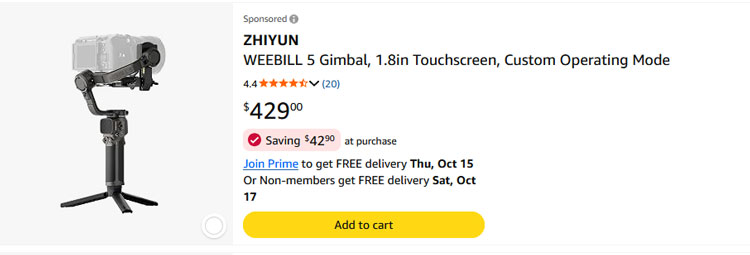
Get the Gimbal from the official website: ZHIYUN Official Store: https://geni.us/ZYR-WB5-thenewcamera
The article “Zhiyun Weebill 5 Review: My Experience with Panasonic S5 II + 50mm and Sony ZV-E10” was written by thenewcamera.com team at 5:04 pm, Monday, 12 October 2026, Greenwich Mean Time | You can also follow us on Our Official Social Media Handles FACEBOOK | TWITTER | INSTAGRAM > get live news — > DJI Rumors | Insta360 News
By admin, on August 27th, 2026
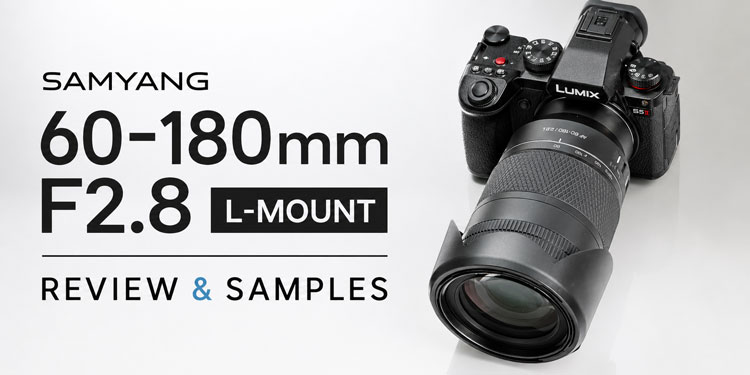
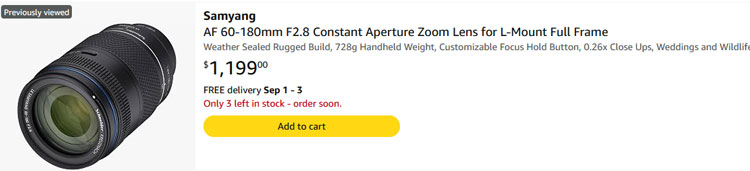
L-Mount shooters have been stuck with a bad choice: pay up and wear a 3-pound 70-200, or pretend a 28-70 can do telephoto work. Before Begin Let me clarify this is a non-sponsored post. LK Samyang’s new AF 60-180mm F2.8 L is the first lens that actually breaks that stalemate. It is a constant F2.8 zoom. It weighs 728g — 1.6 pounds. It sells for $1,199 in the U.S., $100 more than the Sony E-mount version and hundreds less than Sigma, Panasonic, or Leica’s 70-200s. No optical stabilization. The barrel extends when you zoom. And after one afternoon on a Panasonic S5II, it already made the frame that answers the only question most people have: can a cheap, light tele zoom isolate a face in a crowd at 180mm?
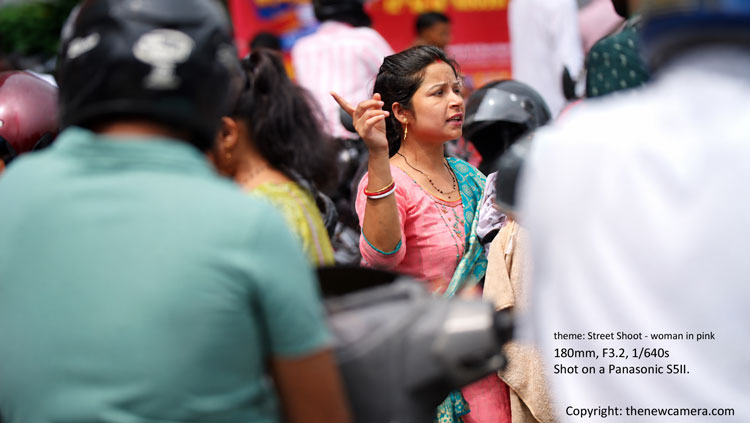
Yes. Look at this.

Caption: Samyang 16-180mm F2.8 – @180mm, F3.2, 1/640s on a Panasonic S5II. This is the sample image. Lens AF lock speed is amazingly fast while capturing faces during street shoot
Quick specs (so you can keep scrolling)
- Lens: LK Samyang / Schneider-Kreuznach AF 60-180mm F2.8
- Mount: L-Mount full frame (also Sony E)
- U.S. price: $1,199 L-Mount / $1,099 E-Mount (B&H)
- Weight: 728g L / 730g E — 1.6 lb
- Aperture: F2.8 constant, 9 blades
- Optics: 17 elements / 14 groups (7 ED, 2 aspherical, 1 HR)
- Min focus: 13.8 in / 0.35m at 60mm; 31 in / 0.79m at 180mm
- Max magnification: 0.26×
- Filter: 77mm
- OIS: none (use IBIS)
- Weather sealing: yes
- Camera for these samples: Panasonic Lumix S5II

These are field samples, not lab charts. They were shot at Maithon, a reservoir in eastern India – think lake town, rental boats, haze, and a street that never empties. Flat light until evening. That is a better test than a brick wall in an air-conditioned studio.
What you’re actually buying
Everybody writes “70-200” on a press release. In the hand, the extra 10mm at the short end is the more useful number. Sixty millimeters is still an environmental lens. You can stand on a boat landing, keep a hull, a ramp, and three people in life jackets in the same frame, and not feel like you stepped into a longer prime. At the other end, 180mm is enough to pull a face out of traffic or a flag off a moving boat.
The spec sheet is honest about the compromises. Linear stepping motor. Floating focus. USB-C on the barrel for firmware. Weather seals at the moving parts. No OIS.
On an S5II that last point matters. The body has good in-body stabilization, but at 180mm you are still asking a sensor-shift system to tidy up a long, slightly front-heavy zoom. The street frame that opens this review was 1/640 at F3.2. That is not heroic. It is the correct way to use a lens that does not stabilize itself.
Sample images: sharpness, isolation, and that 180mm street shot
The woman in pink is the picture I would send anyone who asked what this lens does. She is not posed. She is mid-sentence, finger up, jewelry catching the only decent light on the block. The mint-green shirt and the white sleeve in the foreground are not mistakes. They are what 180mm does to a crowd: it turns other people into weather.
Look at the jewelry before you look at the bokeh. The chain, the earring, the red-and-white bangles – those edges are where a mid-priced zoom usually goes soft first when you shoot through heat and dust. Here they hold. The fabric of the blouse keeps its grid. The teal border of the scarf does not smear into the pink.
This frame is F3.2, a third of a stop down from wide open, and the subject is not at minimum focus. That is how most people will actually use 180mm: a person, a little distance, a mess behind them.
Autofocus did the unglamorous job. The S5II’s subject detection had a face to lock, and the lens did not hunt in a way the file records. You cannot judge tracking from one still. You can only say the still is sharp where it needed to be sharp.

Caption: Mother Love. 180mm, F3.2, 1/640s, Panasonic S5II.
Sample images: color on a gray lake
Flat light is a mean test for color. Everything wants to go olive. The two tourist boats — “Babu Boat,” Ghat 3 and Ghat 8, “I Love Maithon” painted on the seats like a joke that became a brand – are useful because they are loud on purpose. Green hull, red bench, yellow stern, sunflower decals.
The lens does not hype them. That is a compliment. Oversaturated greens are the usual sin of contrasty telephotos on overcast water. They turn grass fluorescent and leave the hulls looking like toys. Here the paint stays in the world. You can read the lettering without leaning in.
If you are shopping this zoom as a cheaper 70-200, this is the file that answers the sharpness-at-normal-distance question better than the street shot. Nothing is moving. The subject is a set of straight lines and hard colors. They survive.
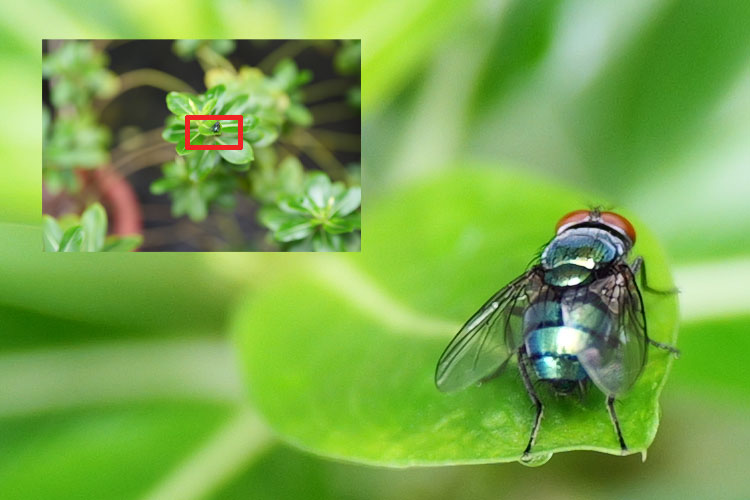
Captred Housefly on a Leaf, @60mm F2.8 S5 II, Scaled at 100%

Caption: Mid-range color test. If the lettering goes, the lens has already told you what it is.
Sample images: telephoto compression

The small rocky spit in the reservoir is the most “this is why you buy a zoom” picture in the set. A wide lens would have made a postcard: water, a lump of land, some sky. At the long end of 60-180 the trees sit on the rocks, the people become a scale marker, the moored boat tucks into the shore, a second boat crawls away, and the hills behind them step forward.
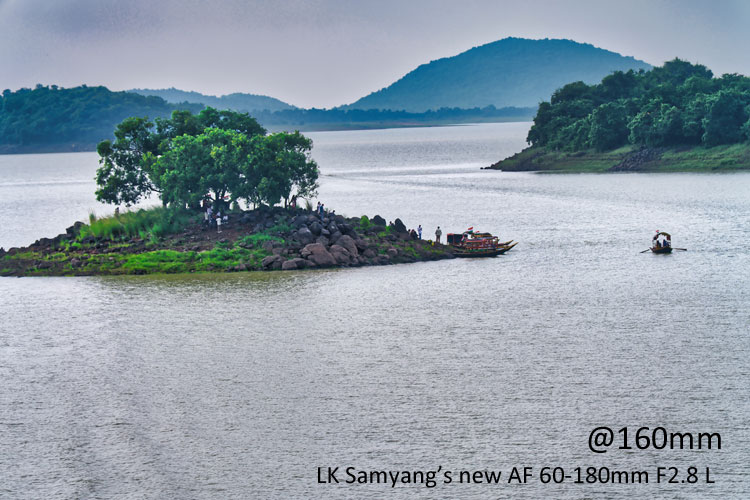
That stacking is what you pay for. Not bokeh. Not the word professional. The ability to make distance feel arranged.
The haze is honest – humid-country air, not a mist filter. The far ridge goes blue-gray the way it should. Contrast falls off with distance instead of being punched back by in-camera Clarity. If you like crunchy landscapes, add that later. The file does not force the decision.
One frame has to move, or this is only a review of parked things. The speedboat with the Indian flag is that frame: orange and green hull, Yamaha on the transom, seven people, a white wake that has not yet decided to be elegant. The lens kept the boat together. Faces in the seats are small, but they are faces, not smudges. The flag is a sharp rectangle, which is harder than it looks when the thing is fluttering.
This is not a sports-AF test. It is one still, not a burst. What it shows is that an S5II and this zoom can freeze a rental boat at lake speed without the file feeling nervous. If you shoot football or birds, you will want a longer test. If you shoot the kind of life that happens on water — hired boats, flags, someone standing up when they should not — this is already relevant.
This is 60-180mm used as a notebook, not a portrait lens. You need enough reach to stand on the bank and not become part of the boarding. You need enough width that the ramp, the boat, and the people still belong to each other. You need the colors of cheap steel and rental life jackets to stay ugly in the correct way. The file does that.
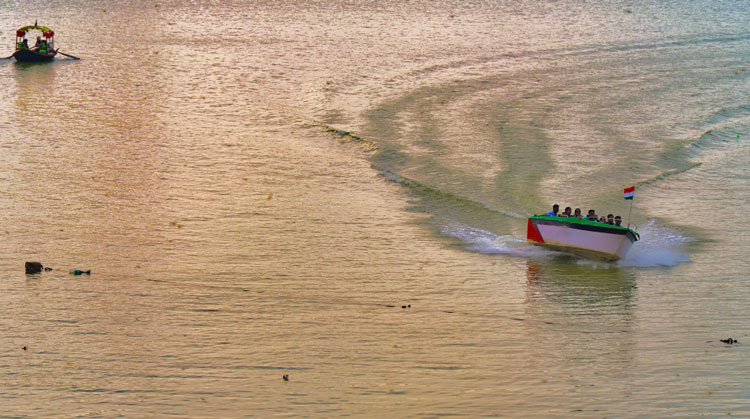
Then the weather finally did something. Cloud opened enough for a strip of sun to lay itself on the water. A small boat sat in the glitter like a period. The dock became a silhouette. Two figures on the rocks were doing the only sensible thing, which was looking at the light.
Tele zooms are often poor at this hour. They crush the sky into plastic or leave the land as a black step. This frame keeps both. The highlight on the water has a shape. The far trees are a line, not a smudge. The little boat is dark enough to read as a boat.
Dynamic range here is more camera than lens — the S5II’s sensor is doing the heavy lifting — but a bad optic would have already veined the bright water with purple or washed the midtones. It does not.
What these pictures cannot tell you
It would be dishonest to turn a handful of frames into a full optical scorecard. There is no brick wall. There is no focus-shift test at F2.8 through the zoom. There is no video AF pull. There is no rain, even though the barrel is sealed. There is no night street with point lights to judge coma. Some E-mount reviewers have already called the zoom ring stiff; these files do not speak to that. They were made by someone who had already decided to take pictures instead of taking notes.
What they do say, with some confidence:
- At 180mm, subject isolation in a crowd is the real feature, not a marketing line.
- Color holds on loud, painted subjects without going sour in haze.
- The long end compresses a landscape the way you hope a 70-200 will.
- AF on the S5II is trustworthy on people and on a boat that is not trying to escape.
- You will want shutter speed at the long end. This lens will not save a 1/80 handheld hero shot.
Samyang 60-180mm F2.8 vs Sigma 70-200 (and the rest) L-Mount does not get a Tamron 70-180. The comparison that actually matters is Sigma’s 70-200mm F2.8 DG DN OS Sports, with the Panasonic and Leica 70-200s in the next chair.
Those lenses internally zoom, have optical stabilization, and feel like tools you throw in a wet bag. They also weigh about 2.9 to 3.7 pounds. The Samyang is half that weight class. You feel it at the end of a staircase.
What you give up is not mysterious:
- No OIS, so video walk-and-talks and dusk handheld work depend on the body
- Extending barrel, so more moving surface area than an internal-zoom design
- 180mm, not 200mm
In stills at Maithon, none of those absences showed up as a missing photograph. They will show up if your work is indoor ceremony aisles at 1/100, or if you live on a monopod at a football game.
Against primes, the math is simpler. An 85mm and a 135mm will usually be sharper and prettier wide open. They will not give you the spit of land, the speedboat, and the dock without walking a mile and missing the light. This zoom is a coverage argument, not a bokeh argument.
Who should buy the Samyang 60-180mm F2.8 L
Buy it if:
- You shoot Panasonic S5II / S9, Leica SL, or Sigma L-Mount bodies
- You want F2.8 reach without wearing a 70-200
- You travel, shoot people, or work events where weight is the real enemy
- $1,199 is the number that makes the lens leave the store
Skip it if:
- You already own the Sigma 70-200 Sports
- You need built-in stabilization for video or slow shutter work
- You need internal zoom and 200mm for sports
- You want a lab-perfect optic more than a lens you will actually carry
Field scorecard
Treat these as notes from one afternoon, not laboratory marks.
- Handling / weight: 9 — this is the reason to buy it
- Isolation at 180mm: 9 — the street file is the evidence
- Color: 8 — natural in haze, no neon grass
- Landscape compression: 9 — exactly what a short tele zoom is for
- AF with S5II stills: 8 — trustworthy on people and a hired boat
- Stabilization: 4 — none in the lens; plan shutter speeds
- Value on L-Mount: 9 — the best part of the product
Verdict
The LK Samyang AF 60-180mm F2.8 is not the best F2.8 tele zoom you can put on an L-Mount body. It is the one you will actually take to a lake on a gray day, and then into a street where nobody is waiting for you to change lenses.
The Maithon files are modest pictures. That is why they are useful. They show a lens that keeps faces, paint, distance, and a little weather in the same afternoon without asking to be treated like laboratory equipment.
On the S5II, at 180mm, in a crowd, it already made the photograph I would keep. The rest of the set is the walk back to the car. For a 1.6-pound zoom at $1,199, that is a decent day’s work.
The article “Don’t Buy a 3-Pound L-Mount 70-200 Until You See These Samyang 60-180mm F2.8 Samples” was written by thenewcamera.com team on 4:22 pm, Thursday, 27 August 2026, Greenwich Mean Time (GMT). | You can also follow us on Our Official Social Media Handles FACEBOOK | TWITTER | INSTAGRAM > get live news — > DJI Rumors | Insta360 News
By admin, on December 27th, 2024
Let’s discuss the best cameras in 2025 for under 500 dollars. The list is composed of the best mirrorless cameras, the best cameras for blogging, the best rugged cameras, and the best zoom cameras. We have tried to compose all the possible sets of cameras available under the 500-dollar price range, and all these cameras are among the best in their class. So just look through the list and select your best camera.
1. The best mirrorless cameras under 500 dollars
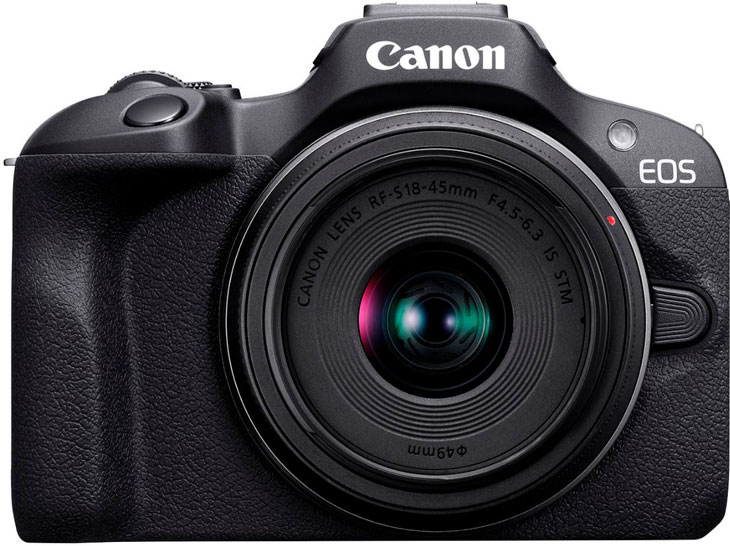
Canon R100 Camera
Price: $499 (approx.)
Deals Available at
Key Features:
- 24.1 MP APS-C CMOS sensor
- Dual Pixel CMOS Autofocus
- Full HD and 4K video recording (with a 1.5x crop)
- Compact and lightweight design
Why It’s Great for Beginners:
- Easy-to-use interface suitable for those new to photography.
- Excellent image quality with Canon’s trusted color science.
- Budget-friendly APS-C mirrorless option.
Cons:
- Limited 4K recording with a significant crop.
- Fixed Display
If you are interested in photography, then without a doubt, the Canon R100 camera is one of the best cameras Canon has ever made. The price range of the camera is 499 dollars, which suits your budget. At the same time, the camera can record high-quality images with its APS-C sensor. The camera is also able to record Full HD videos with full-time Dual Pixel CMOS autofocus support. Additionally, 4K video recording is possible with a 1.5x crop. So, it is recommended for photographers only.
2. Best Budget Hybrid Camera Sony A6100 Camera in 2025
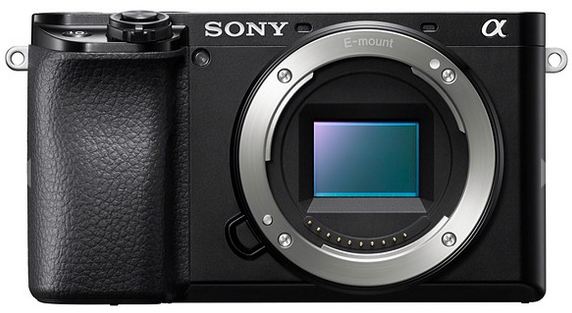
The Sony A6100 camera is available at 598 dollars (body only). For a kit lens or any prime lens, you need to spend extra, so it’s for those who have a slightly flexible budget beyond $500.
Price: $598 (Body only)
Deals Available at
Key Features:
- 24.2 MP APS-C sensor
- Uncropped 4K 30fps video recording
- 180° tilting display for selfies and vlogging
- Built-in electronic viewfinder
Why It’s Great for Beginners:
- Reliable autofocus system for stills and video.
- Compact body with professional-grade features.
- Excellent for content creators who are upgrading.
Cons:
- Slightly over $500 price range.
- Kit lenses are sold separately, adding to the cost.
The Sony A6100 camera is one of the best cameras Sony has ever made. It features a 24-megapixel APS-C sensor, uncropped 4K 30 fps video recording, and a 180-degree tilting display screen. You can record videos or create content effortlessly. The camera also features an electronic viewfinder, so you can capture images like a professional photographer. More or less, this is one of the feature-packed cameras available in a very reasonable price range. So, we have included this camera in our list. If possible, stretch your budget a bit more, and for sure, the Sony A6100 camera is one of the best cameras your money can buy.

3. Best M4/3 Camera Under $500 in 2025
Price: $499 (with 12-32mm kit lens)
Deals Available at
Key Features:
- 20.3 MP Micro Four Thirds sensor
- DFD (Depth from Defocus) autofocus system
- High-quality electronic viewfinder
- Compact and lightweight design
Why It’s Great for Beginners:
- Affordable interchangeable lens camera.
- Ideal for both photography and video creation.
- Easy to handle and learn.
Cons:
- Contrast-based autofocus is slower than hybrid systems.
The Panasonic G100D camera features a 20-megapixel Micro Four Thirds sensor and a DFD autofocusing system (Depth From Defocus). For photographers, this camera is a bargain under 500 dollars, especially with the 12-32mm kit lens. The camera also features a high-quality OLED electronic viewfinder. With this camera, you can capture snapshots as well as create content. However, the DFD autofocusing system is contrast-based, so it is not as fast as the hybrid AF system of the Sony A6100 camera. It is reliable but slightly slow. If your budget is very limited to under 500 dollars and you want an interchangeable lens camera for both photography and videography, the G100D is a good option.
Best blogging cameras available under 500 dollars
4. Best Canon Vlogging Camera Under $500 in 2025
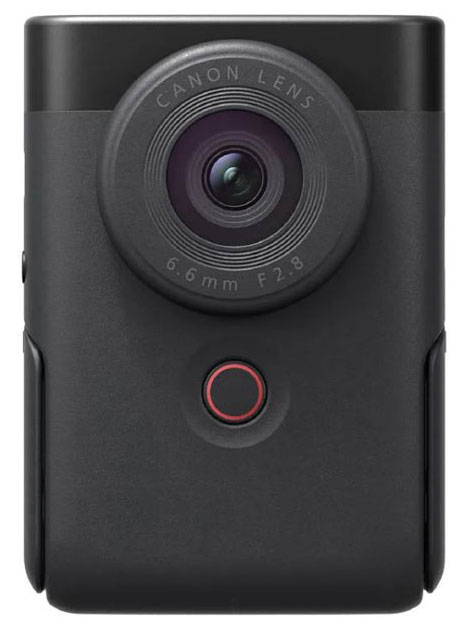
Canon V10
Price: $300 (approx.)
Deals Available at
Key Features:
- Compact design with a 1-inch sensor
- 4K video recording at 30fps
- High-quality built-in microphone
- Simple controls for easy operation
Why It’s Great for Beginners:
- Perfect for vlogging and content creation on a tight budget.
- Highly portable and easy to use on the go.
- Affordable price point.
Cons:
- Basic features compared to other cameras.
The Canon V10 is a small 1-inch sensor-based compact camera specifically made for content creation. The camera is able to record 4K videos at up to 30 fps and features a high-quality inbuilt microphone. With very few controls and a compact body, the camera is highly suitable for on-the-go vloggers, especially if you have a limited budget of 300 dollars. This camera will suit your needs perfectly.
If your budget allows, and you can stretch up to 600 dollars, we have an amazing option:
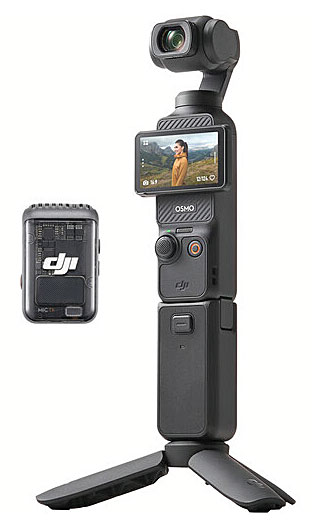
5. The Best Vlogging Kit With a Camera, Gimbal, and Wireless Mic
The DJI Pocket 3 Creator Kit with Accessories and Wireless Microphone
Price: $699 (approx.)
Deals Available at
Key Features:
- 1-inch sensor for high-quality footage
- Built-in 3-axis gimbal for stabilization
- Includes wireless microphone for crisp audio
- Compact, portable design
Why It’s Great for Beginners:
- Simplifies content creation with built-in stabilization and mic.
- Ideal for travel vlogging or handheld shooting.
- Easy to carry and operate.
Cons:
- Over $500 budget for entry-level users.
- Limited still photography capabilities
The DJI Pocket 3 Creator Kit features a high-quality 1-inch sensor. The camera is attached to a handheld gimbal that completely stabilizes your footage, even if you’re moving fast. The camera also includes gyro-based image stabilization for ultra-smooth footage. Additionally, the kit comes with a wireless microphone, which is essential for clean audio. All these features are packed into a device priced around 600 dollars. If you can stretch your budget, this is the best time to invest in a device like this for content creation.
The best Sony compact camera for creating content in 2025
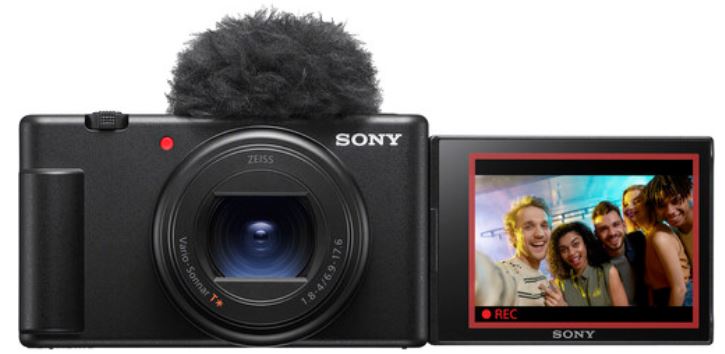
6. Best Sony Compact Under $500 in 2025
Sony ZV-1F
Price: $398 (approx.)
Deals Available at
Key Features:
- 20.1 MP 1-inch sensor
- 4K video recording
- Flip-out touchscreen for vlogging
- Compact design
Why It’s Great for Beginners:
- Designed specifically for content creators.
- Simple operation with high-quality video output.
- Reliable autofocus system.
Cons:
- No gimbal-like stabilization.
- No wireless mic include
The Sony ZV-1F is the best compact camera Sony has ever made under the 500-dollar price range for creating content on the go. Although it lacks a wireless microphone or a gimbal-like stabilization as found in the DJI Pocket 3 Creator Kit, it records excellent videos. If you prefer a Sony compact camera, this is a great option in the 500-dollar price range. However, if you can stretch your budget, the DJI Pocket 3 Creator Kit remains the most recommended device on this list.
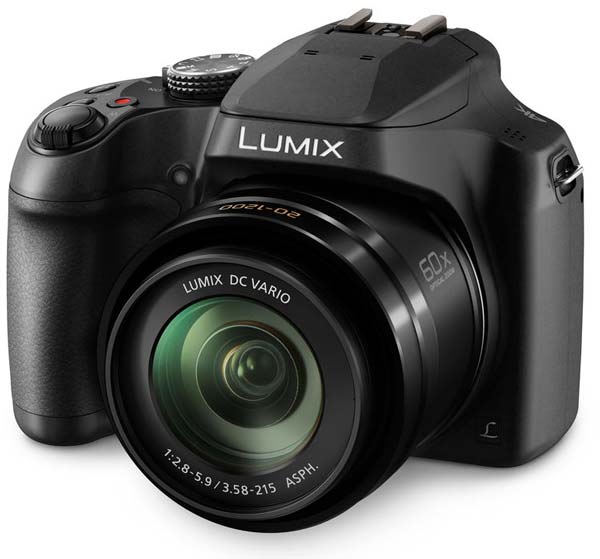
7. Best mega zoom Compact camera in 2025 under 500 dollars
Panasonic Lumix FZ80
Price: $450 (approx.)
Deals Available at
Key Features:
- 18 MP sensor with a 60x optical zoom lens
- Power O.I.S. (Optical Image Stabilization)
- Full HD and 4K video recording
- 10fps continuous shooting speed
Why It’s Great for Beginners:
- Versatile zoom lens for wildlife and travel photography.
- Affordable for a superzoom camera.
- Easy-to-use features for casual photographers.
Cons:
- Small sensor size limits low-light performance.
The Panasonic Lumix FZ80 features a 16-megapixel sensor and a high-quality Lumix DC Vario 60x optical zoom lens. With this lens, you can capture crisp and clear shots even at extreme focal lengths. The camera also supports Full HD and 4K video recording at up to 30 fps. Its ISO range starts from 80 and goes up to 3200. The camera’s continuous shooting speed is approximately 10 frames per second. This is one of the best budget-friendly cameras capable of capturing distant subjects with its 60x optical zoom lens.
The next camera is an instant camera that captures and prints images simultaneously
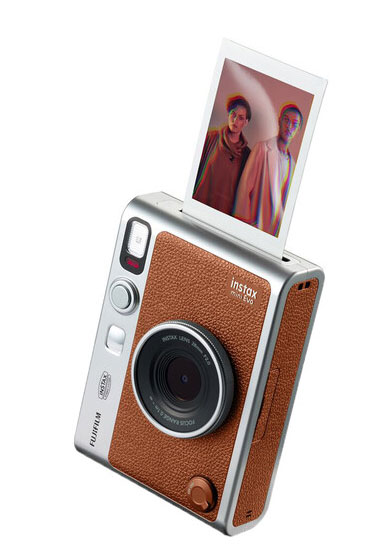
8. Best Instant Camera Under $200
Fujifilm Instax Mini EVO Hybrid Camera
Price: $200 (approx.)
Deals Available at
Key Features:
- 28mm fixed lens
- Instant print capability with Fujifilm Instax Mini films
- 3-inch LCD display
- Dual shutter buttons for ease of use
Why It’s Great for Beginners:
- Fun, instant-print feature for creative photography.
- Simple operation and retro design.
- Budget-friendly option.
Cons:
- Limited to fixed focal length.
- Image quality not comparable to larger sensor cameras
This camera, priced around 200 dollars, features a fixed 28mm f/2 lens, a 3-inch LCD display, and dual shutter buttons. You can save images on an SD card or print them instantly using Fujifilm Instax Mini films.
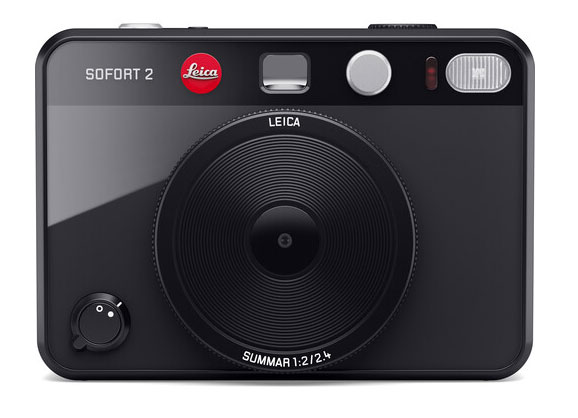
9. Only Leica Camera Under $500 in 2025
Leica Sofort Instant Camera
Price: $400 (approx.)
Deals Available at
Key Features:
- 28mm fixed lens
- Built-in flash and rechargeable battery
- Accepts Sofort instant film
- Compatible with Leica Photos app for editing
Why It’s Great for Beginners:
- Elegant design and excellent build quality.
- Easy-to-use instant camera with premium features.
- Rechargeable battery adds convenience.
Cons:
- High price for an instant camera.
- Limited creative control compared to digital cameras.
The Leica Sofort Instant Camera is priced under $400. It accepts Sofort film, features a 28mm f/2 lens, and has a 3-inch TFT display screen. It includes a built-in flash and a rechargeable lithium-ion battery. You can save images on a microSD card and customize your photos with the Leica Photos app.
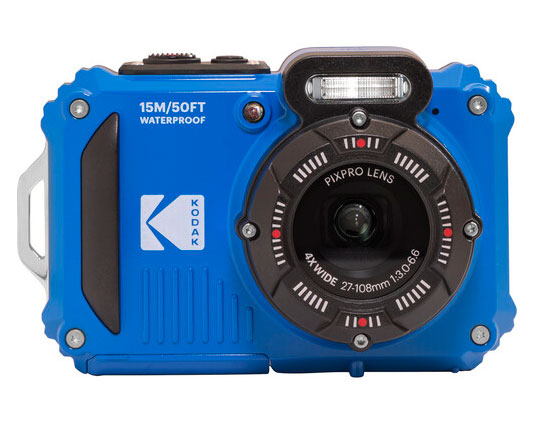
10. Best camera for kids under $200 in 2025
Kodak PixPro WPZ2
Price: $200 (approx.)
Key Features:
- 16 MP BSI CMOS sensor
- 4x optical zoom lens
- Waterproof and rugged design
- Full HD video recording
Why It’s Great for Beginners:
- Perfect for kids and adventure photography.
- Durable design for rough use.
- Affordable and easy to handle.
Cons:
- Limited manual controls.
- Smaller sensor affects image quality in low light
Deals Available at
The Kodak PixPro WPZ2 is a rugged camera featuring a 16-megapixel BSI CMOS sensor for high-quality images. It has a 4x optical zoom lens, is waterproof up to 49 feet, and is freeze-proof. The camera features a 2.7-inch LCD and captures Full HD videos at 30 fps. It is a great choice for kids or for capturing trip photos and videos.
See More – Top 10 Best Cameras Under $1000 in 2025
By admin, on October 12th, 2024
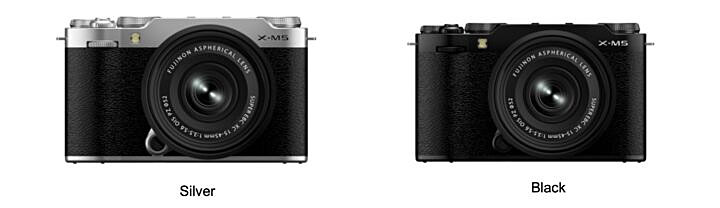
So finally, we have the Fuji X-M5 camera’s full details coming straight from Fujifilm X-M5 official press release. From the available set of details, we can clearly see the specs that are about to arrive inside the Fuji X-M5 camera. We will only miss the mechanical image stabilization, although the Fuji processor delivers very effective images. Take look at the Makor specification of the camera
Fuji X-M5 Price
Fujifilm X-M5 Body: £799 / €899- B&H Store
Fujifilm X-M5 + XC 15-45 Kit: £899 / €999 – B&H Store
Fujifilm XF 500mmF5.6 Lens: £2,899 / €3,399
Fujifilm XF 16-55mmF2.8 II: £1,149 / €1,349
Fuji X-M5 Specification
- Weight: Approximately 355g (including battery and memory card).
- Dimensions: 111.9mm width, 66.6mm height, 38.0mm depth.
- Sensor: 26.1 MP back-illuminated X-Trans CMOS 4 sensor.
- Processor: X-Processor 5 for high-speed image processing.
- Film Simulation: 20 Film Simulation modes.
- Autofocus (AF): AI-based subject detection AF (animals, cars, etc.).
- Face/Eye Detection: Supports face and eye AF.
- AF Algorithm: Predictive AF algorithm for moving subjects.
- Video Recording: 6.2K/30P 4:2:2 10-bit internal recording.
- 4K Video: Supports 4K/60P recording.
- High-Speed Video: 1080/240P recording.
- Stabilization: Powerful digital image stabilization for both minor and large shakes.
- Built-in Microphones: Three microphones with selectable directivity (surround, front, back, front & back).
- Noise Reduction: Steady-state noise reduction for continuous frequency noise.
- Vlog Mode: Touch-based intuitive control for shooting.
- 9:16 Short Movie Mode: Easy vertical video capture for social media.
- Bit Rates: Supports 8 Mbps and 25 Mbps bit rates for video.
- Card Slot: SD card storage for internal recording.
- Design: Symmetrical dials with a compact X-series aesthetic.
- Auto Mode: Auto scene recognition for first-time users.
- Low Power Consumption: Optimized for long shooting times.
- Bird & Insect Detection: Special AF setting to detect birds and insects.
- Drone Detection: Detects drones under the “Airplane” setting.
- Display: Touch-sensitive LCD with improved icon placement.
- High AF Precision: Improved precision even in low-contrast environments.
Fuji X-M5 Full Press Release and Images
These specs highlight the Fuji X-M5’s compact design, high-quality video recording
FUJIFILM X-M5 Mirrorless Digital Camera
The lightest model in the current X series
Equipped with advanced features for both stills and video. Enjoy shooting every day with ease
October 14, 2024
TOKYO, October 14, 2024 – FUJIFILM Corporation (President & CEO, Representative Director: Teiichi Goto) announces the launch of the latest model of the mirrorless digital camera the “FUJIFILM X-M5” (X-M5). It is a new addition to the X Series of mirrorless digital cameras known for their compact and lightweight body and superior image quality based on the company ’s proprietary color reproduction technology.
The X-M5 is a mirrorless digital camera with a compact and lightweight body weighing approximately 355g*1 making it the lightest*2 camera in the X series. The X-M5 is equipped with a full range of functions, including subject detection AF that can detect moving objects such as animals and cars using AI and a 6.2K/30P movie recording function, making it possible to shoot both still images and movies with a single camera. Additionally, the design features the high-quality appearance characteristic of the X series. The X-M5 is the perfect camera for a wide range of users, from first-time digital camera users to photography enthusiasts, enhancing the joy of photography.
The X-M5 is a mirrorless digital camera equipped with the back-side illuminated 26.1-megapixel “X-Trans™ CMOS 4”*3 sensor and the “X-Processor 5” high-speed image processing engine, enabling high-quality image capture. A Film Simulation dial is located on the top surface of the warship to switch between “Film Simulation” modes, which allows users to enjoy various color tone expressions as if they were changing photographic film. The X-M5 is equipped with high-performance video recording functions such as 6.2K/30P 4:2:2 10-bit video onto an SD card inserted in the camera. In addition, its powerful digital image stabilizer and high-performance built-in microphone support comfortable video recording. As for the Vlog Mode, the newly introduced “9:16 Short Movie Mode” makes it easy to shoot vertical videos.
*1 Including battery and memory card.
*2 For current X series models.
*3 X-Trans is a trademark or registered trademark of FUJIFILM Corporation.
1. Product features
(1) Compact and lightweight body and product design that makes you want to enjoy shooting
▪ It weighs approximately 355g and measures approximately 111.9mm in width, 66.6mm in height, and 38.0mm in depth. The extremely lightweight and compact body for a mirrorless digital camera makes it easy to carry around and enjoy photography every day.
▪ Despite its compact size, the camera has the high-quality appearance of the “X series”. Symmetrically placed dials on the top surface of the warship section highlight the beauty of the camera.
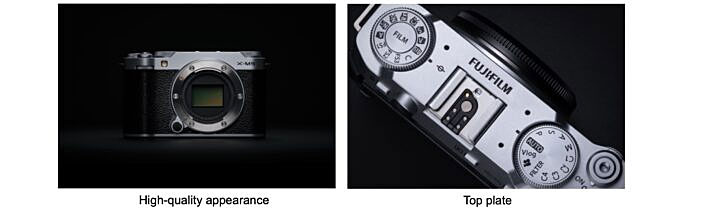
▪The Film Simulation dial is conveniently placed on the lek shoulder of the top face. Users can easily switch between a total of 20 Film Simulation modes according to the subjects and scenes, making it easier to enjoy a variety of color tones in both still and moving images.
▪ The top right features a mode dial. In AUTO mode, the camera automatically recognizes the optimal shooting mode for the scene, allowing even first-time digital camera users to easily capture high-quality stills and videos.
(2) Equipped with a high-performance sensor and high-speed image processing engine to achieve high image quality and high-performance AF
▪ The X-M5 is equipped with the back-illuminated “X-Trans™ CMOS 4” sensor with approximately 26.1 megapixels and the latest high-speed image processing engine “X-Processor 5”. This allows for high image quality photography with low power consumption.
▪ The camera features the subject detection AF, developed with deep learning technology, in addition to the existing Face / Eye AF. AI is used to add the ability to detect animals, birds, cars, motorcycles, bicycles,
airplanes, trains, insects and drones*4
▪ The latest AF predictive algorithm provides high tracking performance for moving subjects and high precision AF in low-contrast environments.
*4 Set the Subject Detection Selng to “BIRD” when you want to detect insects and to “AIRPLANE” when you want to detect drones.
(3) 6.2K/30P video recording and other extensive video func^ons
▪ The X-M5 can record 6.2K/30P 4:2:2 10-bit video onto an SD card inserted in the camera, and also supports extensive video functions including 4K/60P and 1080/240P capability.
▪ The camera is equipped with powerful digital image stabilization. It is effective not only for minor camera shake but also for large shaking that occurs when shooting video while walking.
▪ For the first time in our digital camera lineup, three built-in microphones are equipped. You can choose from four microphone directivity options: surround, front, back, or front & back, depending on the situation. The camera is also the first to feature a steady-state noise reduction function, which reduces noise that continues to ring at a certain frequency, such as air conditioning noise.
▪ Vlog mode allows users to change shoo^ng conditions intuitively by touching the LCD. Improvements in the number and placement of icons make video recording even more intuitive. In addition, the new “9:16 short movie mode” allows users to easily shoot vertical videos popular on various social media and smoothly share the captured content.
▪ New bit rates of 8 Mbps and 25 Mbps have been added to the bit rates that can be selected in the “Media Recording Settings” when shooting video. This shortens the transfer time to external devices such as
smartphones, and contributes to shortening the ^me required to upload captured video directly to social media.
2. optional accessories
Cooling Fan “FAN-001″*5 (already on sale)
▪ This cooling fan can be attached to the rear panel of the camera body without a cable, supporting long hour shooting and video recording in a high-temperature condition. The power can be supplied to the fan from the camera body
Tripod Grip “TG-BT1″*6 (already on sale)
▪ This grip enhances mobility and camera’s hold while adding tripod functionality. Users can comfortably take self-portraits and low angle shots, where it is normally difficult to hold the camera in position. As a tripod, the TG-BT1 can be used for a wide range of love fujiru mors applications from group shots to tabletop still.
*5 Compatible models are FUJIFILM X-M5, FUJIFILM X-H2S, FUJIFILM X-H2, and FUJIFILM X-S20.
*6 Compatible models are FUJIFILM X-H2S (Ver.3.00 or later), FUJIFILM X-H2 (Ver.1.2 or later), FUJIFILM X-T5 (Ver.1.00 or later), FUJIFILM X-T4 (Ver.1.70 or later), FUJIFILM X-T3 (Ver.4.50 or later), FUJIFILM X-S20, FUJIFILM X-S10 (Ver. 2.60 or later), FUJIFILM X-T30 II (Ver. 1.20 or later), FUJIFILM X-T30 (Ver. 1.50 or later).
source of the press release and images credit FR.com
By admin, on August 6th, 2024
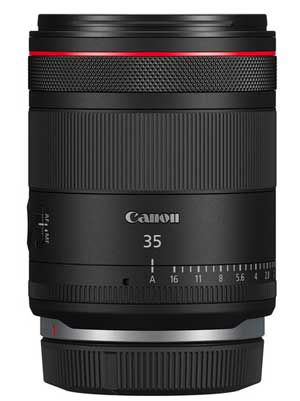
See the latest deals on Canon RF35mm F1.4 Lens at Amazon.com
According to the latest rumors we have from the rumor mill, after the amazing success of the Canon RF35mm F1.4L VCM lens, Canon is now planning two new VCM lenses, the RF 24mm F1.4 and RF 50mm F1.4L VCM. Both of them are coming in September 2024. The source of the rumor mill also added, “I suspect that you will need an EOS R5 Mark II and an EOS R1 to take advantage of the full capabilities of this lens (which will likely have some cool automation features never before seen).
Get LIVE RUMORS –> FACEBOOK | TWITTER | INSTAGRAM to get live news + Canon rumors 24X7
source CR.com
By admin, on July 6th, 2024
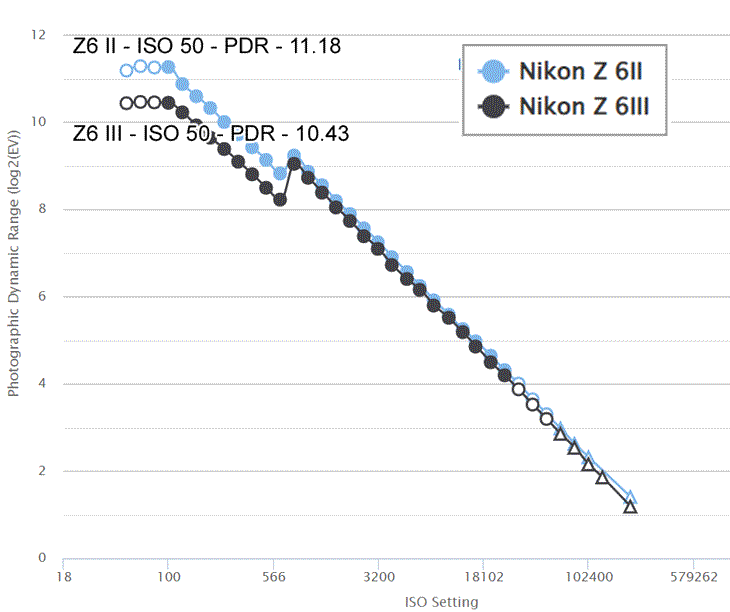
Recently, results from a dynamic range test published on March 6 by the Photons to Photos website show that the dynamic range of the recently announced Nikon Z6 Mark 3 camera is not as good as that of the Nikon Z6 Mark 2. Moreover, if you compare it with the Nikon Zf, you will notice that both the Nikon Z6 Mark 2 and the Zf have very similar dynamic ranges. However, the dynamic range of the Nikon Z6 Mark 3 is not up to the mark.
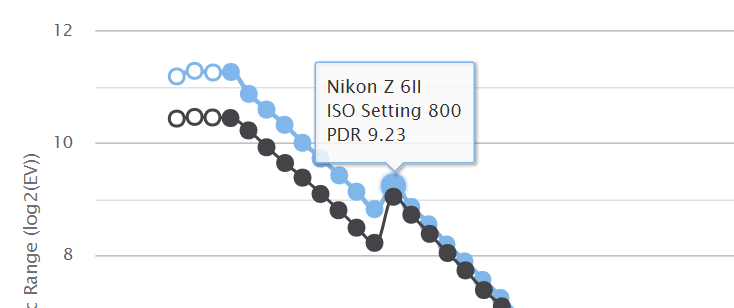
Specifically, the lower ISO dynamic range up to ISO 800 differs in the Z6 Mark 3 and Z6 Mark 2, with the Z6 Mark 3 camera sensor suffering from detail loss. So, suppose you are using your camera, specifically the newly announced Z6 Mark 3, in an ISO range of 100 to 800. In that case, you have to face detail loss, specifically in the shadowed area, which cannot be recovered as much as we have the capability in the Z6 Mark 2.
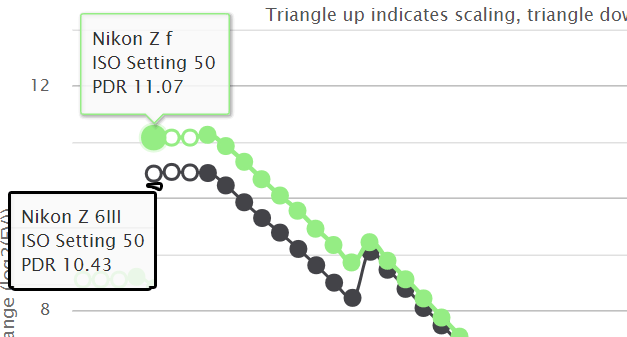
The Reason Why It’s Happening
The reason is clear since the Nikon engineers used the partially stacked CMOS sensor in the Nikon Z6 Mark 3 camera. Now, what happened in the previous generation sensor was that the readout speed was slow. Although it was not that good for sports and wildlife photography, due to the slower readout speed, each photodiode in the sensor was able to observe the incoming light perfectly. Now, in the partially stacked CMOS sensor, what they have done is they have replaced the circuitry just below the photodiodes in a similar manner to what a stacked sensor has. But due to the partial update, they somehow managed to increase the sensor’s readout speed. However, in the very same situation, the photodiodes are not able to grab the proper amount of light in a short period / High Speed, which is 12.4 milliseconds approx compared to the readout speed of the Nikon Z6 Mark 3 camera sensor which is approximately somewhere around 22 milliseconds.
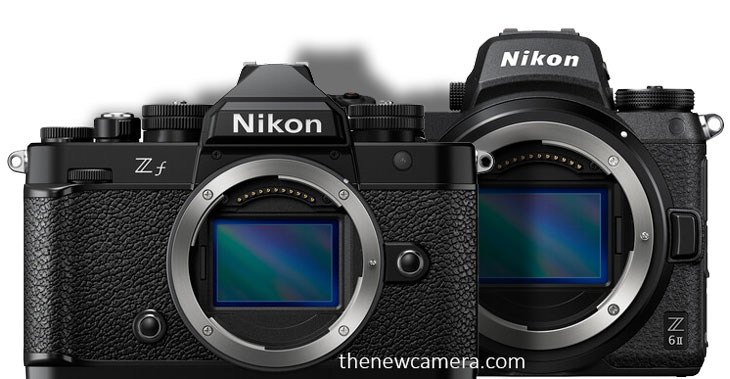
Nikon Zf from Amazon.com | Nikon Z6 II Amazon.com
So having a slower readout speed is not always a negative part of your camera system.
Having a slower readout speed helps to grab the incoming light properly. Suppose you are not in a hurry or not always shooting sports or wildlife. In that case, it is recommended to have a camera sensor with a slightly slower readout speed, specifically in Nikon cameras like we have in the Zf camera. The Z6 Mark 3’s sensor is significantly faster but despite that fact, we can extract the maximum dynamic range possible for the given scene with the Zf.
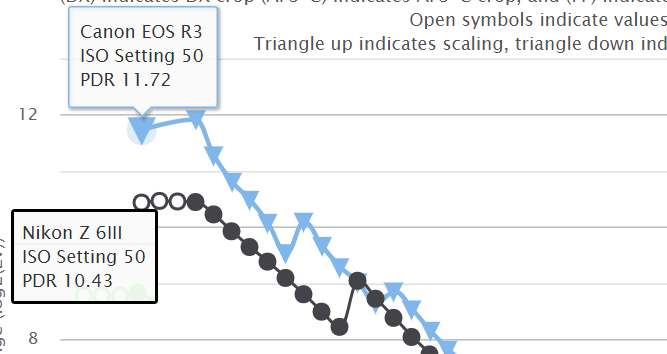
Comparing the Nikon Z6 Mark 3 Camera Sensor Dynamic Range with Canon R3 24 Megapixel Stacked CMOS Sensor
When we compare the dynamic range of the Canon R3 camera with the Nikon Z6 Mark 3, which is of course not that much feasible due to the price difference between the two cameras, the R3 has a similar resolution of 24 megapixels and a fully developed stacked CMOS sensor. Now in the test, we have found that the Nikon Z6 Mark 3 camera performs quite worse than the Canon R3 sensor. Surprisingly, when we also included the Nikon Z6 Mark 2 in the test charts, we were surprised that the Canon R3 camera’s 24-megapixel full-frame sensor is even performing better in the lower range compared to the Z6 Mark 2 camera sensor, specifically in terms of dynamic range.
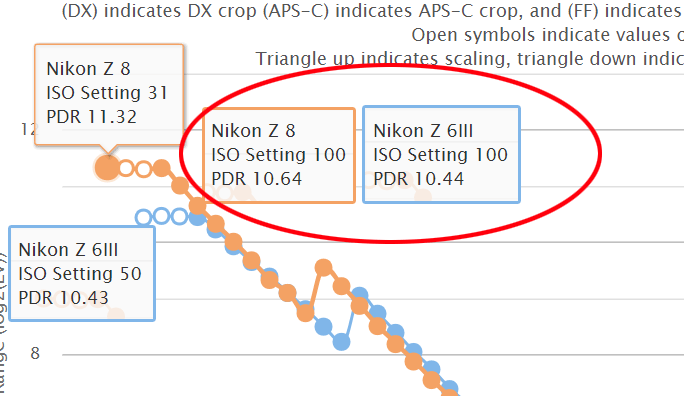
Comparing the Nikon Z6 Mark 3 Camera Dynamic Range with the Nikon Z8 Camera
In the dynamic range test score against the Nikon Z8 camera, we have found that in the very base ISO range starting from the base ISO 32 to 50 to 80, the dynamic range test score of the Z8 camera is better than that of the Z6 Mark 3. But as soon as you cross the base ISO 100, the dynamic range of both cameras becomes very similar when compared to each other. So that’s a fact that even if you have a camera with that much amount of pixel resolution, the dynamic range of the Z8 camera remains limited or performs well up to ISO 100 only. After that, it is very similar to the Z6 Mark 3. And if you compare it with the Z6 Mark 2, you will notice that the Z6 Mark 2 camera does have a slightly better dynamic range test score compared to the Z8.
Follow us on our social pages FACEBOOK | TWITTER | INSTAGRAM, If you have time –>see more Sony Alpha Rumor
source photonstophotos
By admin, on July 25th, 2022
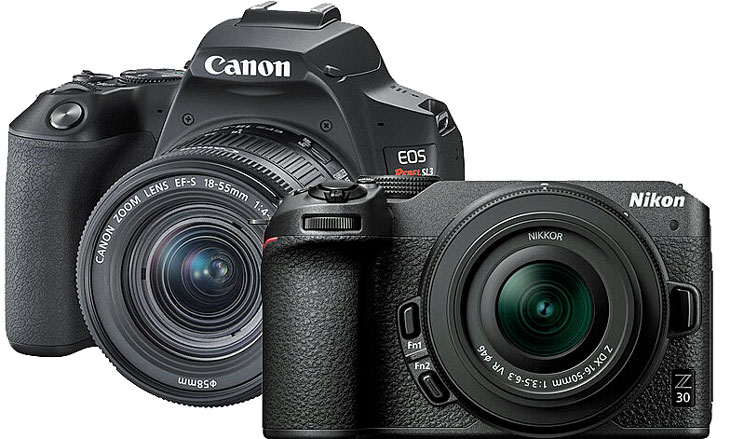
We are getting lots of requests for this comparison from our subscribers, we are comparing the major differences between the two. Not only Major we will also include an image quality test. To find out the best camera between the two
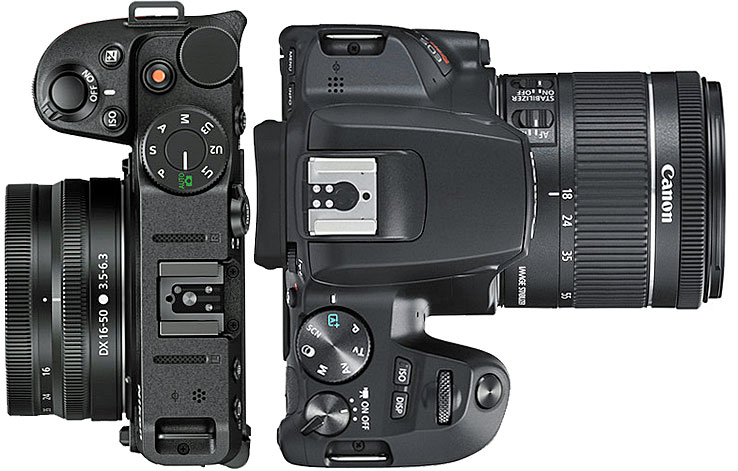
We have the Nikon Mirrorless camera against the Canon DSLR, I do agree that Nikon Z30 is a Mirrorless camera but at the same time, the Canon 200D isn’t a traditional DSLR. It’s a Fusion of Mirrorless in a DSLR body.
1. Viewfinder
Design-wise both cameras are slightly different, although both of them have very deep handgrip. If ur photographer au will fell very comfortable with each of them. The main issue with Nikon Z30 is the absence of EVF / OVF. But, if you’re coming from the smartphone generation then you won’t miss the viewfinder of the camera, but if you’re a photographer who is using Viewfinder in their DSLR they may miss it.
2. Auto Focus system
Nikon Z30 AF system now supports continuous burst up to 11 FPS with full-time AF support. As usual Canon 200D, Mark II has a limited 5.5 FPS burst speed when ur using the EVF, and when you switch to a better AF system/sensor based / display is active then Canon 200D Mark II AF speed drops to 3 FPS.
Earlier when the Nikon Z50 camera was announced roughly two years back, the AF system of the Nikon Z50 was weak and slow. But, with constant firmware updates the AF system has been improved to the next level and now we are able also to track human eyes in the video, and animal eye AF is also enabled in firmware 2.0. With the same pre-loaded firmware the Nikon Z30 camera has arrived with the same image sensor and image processor. So, we are expecting an enhanced AF performance this time with the Nikon Z30 camera. And it’s not only on paper, if you look at the AF sensitivity range of the camera it is far better than that of the Canon 200D Mark II DSLR.
AF comparison table
| Focus Type |
Auto and Manual Focus |
Auto and Manual Focus |
| Focus Mode |
Continuous-Servo AF, Manual Focus, Single-Servo AF |
Automatic, Continuous-Servo AF, Manual Focus, Single-Servo AF |
| Autofocus Points |
Photo, Video
Phase Detection: 209 |
Phase Detection: 9 (1 Cross-Type) |
| HYbrid AF |
209 |
143 AF Zones / 3975 AF points |
| Autofocus Sensitivity |
-4.5 to +19 EV |
-0.5 to +18 EV |
It doesn’t mean if Nikon Z30 is loaded with an enhanced AF algorithm, our Canon 200D Mark II DSLR becomes inferior at any point. The Canon 200D Mark II 143 AF zones (3975 AF points) are really very helpful in tracking the human eye and face. And at the time when the 200D Mark II was announced it was the only DSLR with a 3D AF object tracking mechanism even the Fuji X-T200 doesn’t have that. But, now Nikon Z30 have 3D object tracking mode in the still and video too.
Overall, if we count the AF sensitivity and burst speed of both the camera Nikon Z30 wins clearly.
|
Nikon Z30 |
Canon SL3 / 200D Mark II |
| Shutter Type |
Electronic Shutter, Mechanical Focal Plane Shutter |
Electronic Shutter, Mechanical Focal Plane Shutter |
| Shutter Speed |
Mechanical Shutter
1/4000 to 30 Seconds
Electronic Front Curtain Shutter
1/4000 to 30 Seconds
Electronic Shutter
1/4000 to 30 Seconds |
Mechanical Shutter
1/4000 to 30 Seconds |
| Bulb/Time Mode |
Bulb Mode, Time Mode |
Bulb Mode |
| ISO Sensitivity |
Photo
100 to 51,200
Video
100 to 25,600 |
Photo
100 to 25,600 in Auto Mode (Extended: 100 to 51,200)
Video
100 to 12,800 |
| Exposure Compensation |
-5 to +5 EV (1/3, 1/2 EV Steps) |
-5 to +5 EV (1/3, 1/2 EV Steps) |
| Metering Range |
-4 to 17 EV |
1 to 20 EV |
| White Balance |
2500 to 10,000K
Presets: Auto, Cloudy, Color Temperature, Direct Sunlight, Flash, Fluorescent, Incandescent, Preset Manual, Shade |
Presets: Auto, Cloudy, Custom, Daylight, Flash, Fluorescent (White), Shade, Tungsten |
| Continuous Shooting |
Up to 11 fps at 20.8 MP |
Up to 5 fps at 24.1 MP for up to 10 Frames (Raw) / Unlimited Frames (JPEG) |
| Interval Recording |
Yes |
Yes |
| Self-Timer |
2/10-Second Delay |
2/10-Second Delay |

3. Image Quality
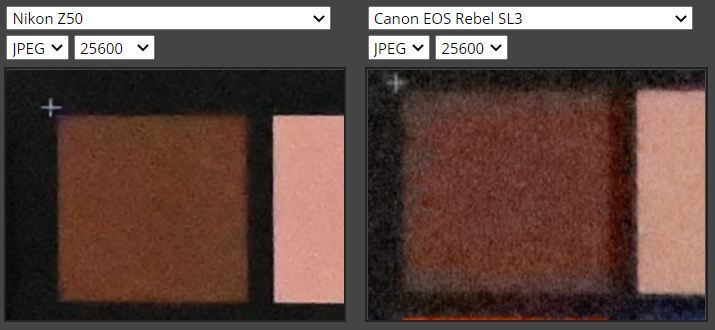
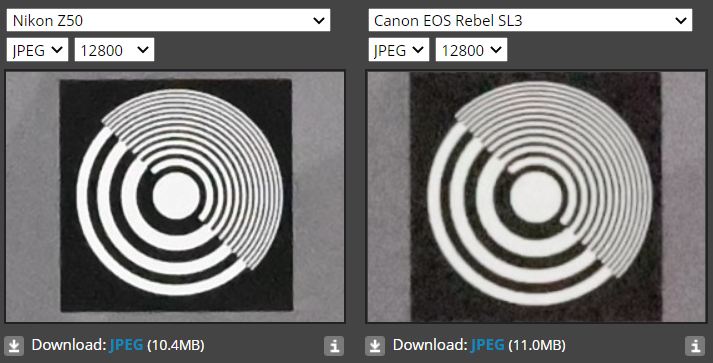
The Nikon Z30 uses the same 20MP sensor and Expeed 6 image processor we have seen in the Nikon Z50 camera, so we have decided to make a high ISO test between the Canon 200D mark II and the Nikon Z30, with a promise once the Z30 samples are available we will update this page too.
Initial High ISO test comparison, we can clearly notice that the Nikon Z50 / Z30 camera is able to preserve more details compared to the Canon 200D Mark II camera. So, we have added one more high ISO test image here @ISO 12800. In both, images it’s very clearly visible that Nikon 20MP sensor’s low-light performance is better than of Canon 24MP sensor used in the Canon 200D Mark II camera.
So, if you are working in an uncontrolled light environment then Nikon Z3 is best for you, otherwise, if you work with light / you work in the studio or always have portable lights with you then Canon 200D Mark II will also perform better.
4. Video Quality
Nikon Z30 camera captures oversampled 4k 24, 30 fps video. Oversampled video means the Nikon Z30 camera is using the entire 20MP sensor each pixel to create Oversampled 6K Video, so the quality we get from the Nikon Z30 video is just phenomenal. The color, contrast output, and shadow details are very good and usable. On the other side, we have a Canon 200D Mark II camera that creates video by sub-sampling / line-skipping method, so the details are not coming through the entire sensor. Although I have used the Canon 200D Mark II as a video camera and the Full HD video quality looks good to me. Also, kindly note that now Nikon Z30 doesn’t have any 30min recording limit.
In the end, I have to mention that in Canon 200D Mark II / SL3 we have to face an excessive crop of 1.6X. So, we already have a 1.6X cropped sensor and over that again we have to face a 1.6X crop. And the worst part is the DPAF gets disabled when you use the 4K video mode of the Canon 200D mark II or SL3 camera. No, such issue i am able to find in the Nikon Z30 camera.
|
Nikon Z30 |
Canon SL3 / 200D Mark II |
| Recording Modes |
H.264/MOV/MP4
UHD 4K (3840 x 2160) at 23.98p/25p/29.97p
Full HD (1920 x 1080) at 23.98p/25p/29.97p/50p/59.94p/100p/119.88p |
MP4/H.264
UHD 4K (3840 x 2160) at 23.98p/25p [120 Mb/s]
Full HD (1920 x 1080) at 25p/29.97p/50p/59.94p [12 to 60 Mb/s] |
| Recording Limit |
Up to 125 Minutes |
Up to 29 Minutes, 59 Seconds |
| Video System |
NTSC/PAL |
NTSC/PAL |
Viewfinder and display
|
Nikon Z30 |
Canon SL3 |
| Viewfinder |
No |
Yes, OVF |
| Size |
3.0″ |
3.0″ |
| Resolution |
1,040,000 Dot |
1,040,000 Dot |
| Display Type |
Articulating Touchscreen LCD |
Articulating Touchscreen LCD |
5. Verdict
If you are a photographer and want to get everything within budget, which includes Canon’s super affordable 50mm F1.8 lens, then you should go with SL3. Since the price and availability of lenses is the only factor where the Nikon Z30 fails to impress us. Otherwise, if we talk about sensor performance, Autofocus, or Video recording modes. Nikon Z30 is a clear winner.
Get Canon 200D Mark II from Amazon | B&H Store
Get Nikon Z30 From B&H Store | Amazon.com
Canon 200D Mark II / SL3 Best Lenses
Support us – Use or affiliate link Amazon.com | B&H Store for the next purchase u make – it helps us
|
KEEP THIS BLOG ALIVE - Support New Camera Buy Canon Lenses, Buy Music CD or Digital Camera at amazon it helps this site, and you do not pay anything extra, it is just a way to help support this site.

|