Join More Than 50,000+ Subscribers and get latest camera news and rumors
NEW CAMERA VIDEOS ON YOUTUBE
|
By admin, on September 4th, 2025
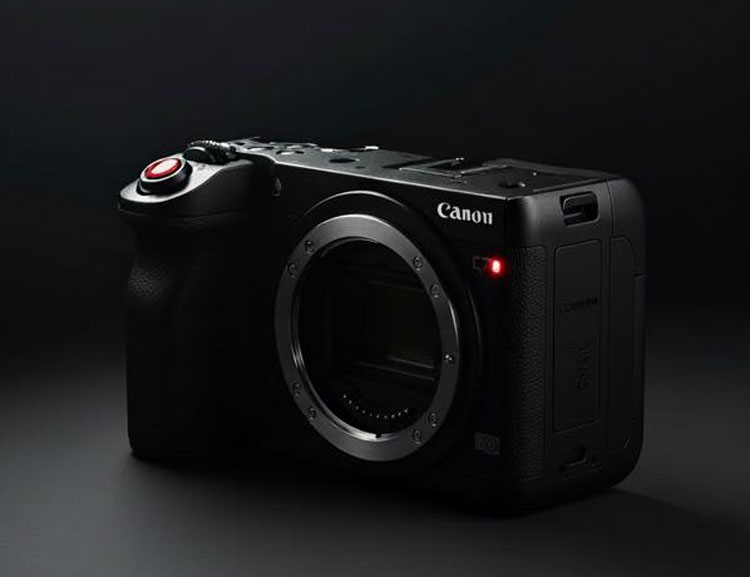
So obviously, the Canon C50 official announcement is on September 9, 2025, and just a few days away, our email, Twitter, and Facebook pages are getting images of the Canon C50. Obviously, most of them are fan-made, but some of them look so real that even I get confused sometimes. We have decided to share one with you, so you can also have an idea of what the Canon C50 will look like. Potentially one of the biggest Sony FX3 challengers is finally coming, and we don’t want to keep it to ourselves.
What Does the Fan-Made AI Image Show
The fan concept echoes the Canon C50 that we saw last week in the teaser. Every control looks very much the same. The camera with a minimalistic design without an electronic viewfinder, lots of custom controls, and threaded mounts all over the body for a perfect cinematic workflow experience.
The camera does have a boxy-style design, but with a very large and good hand grip that, even handheld, you can shoot exceptional images and videos.
The good thing is that, finally, we are getting IBIS in a Canon C50 camera alongside OpenGate recording. So, you can have creative freedom to use the camera handheld, without any compromise in the video quality. Obviously, the FX3 camera doesn’t support open gate recording yet. If you want to see or explore detailed core specifications related to the C50, you can look here.
Why We Have Picked This Image
We are getting a lot of leaked images from fans and subscribers, but we don’t post them here. The image of this one is looking very real, and it looks like it has been created by AI from a real image with some visual distortions, which has been done intentionally.
Canon C50 Rumors Recap – What We Know So Far
The sensor resolution of the Canon C50 is 32 megapixels, a full-frame CMOS sensor that records Open Gate videos. For detailed specification analysis of the upcoming camera, you can browse this post.
Pricing and Availability: The price range we are expecting is around $3,500–$4,000, making it accessible for indie filmmakers.
For more information, you can check our in-depth analysis of Canon C50 rumored specifications, and the B&H Store has already created a placeholder for Canon C50.
Disclaimer: This image is a fan-created AI concept and does not represent official Canon designs or leaks.
GET LIVE NOTIFICATION from Your Trusted Source GET LIVE NOTIFICATION Click ON Check  BOX for Latest NEWS and Rumors BOX for Latest NEWS and Rumors
The article “Canon C50 Fan-Made AI Concept Image: A Creative Take on the Rumored Compact Cinema Powerhouse” was written by thenewcamera.com team on 12:35 pm, Thursday, 4 September 2025, Greenwich Mean Time (GMT) | Follow us for more updates and get LIVE RUMORS –> FACEBOOK | TWITTER | INSTAGRAM to get live news — > get live Camera News + Canon Rumors 24X7.
By admin, on September 1st, 2025

It looks like theNikon will be going to redefine cinematography forever, after the acquisition of RED DIGITAL Cinema camera – a powerhouse in Raw video capture – Nikon has filed a patent, which clearly hints that the future Nikon Z cinema cameras will have an integrated revolutionary dual display system. So, this is not an incremental update; this is a revolutionary upgrade that has never been tried by any camera maker to date. Both of the displays will prove to be a game-changer for cinematographers. So, they can have seamless control over the optimised video processing.
The Patent Breakdown: A Stacked Sensor Powerhouse with Dual Displays
After reading the entire patent and analysing it briefly, we have seen that the camera is using a stacked CMOS sensor inside it, which has been clearly mentioned in the patent; even the structural design of the sensor has also been elaborated.
This back-illuminated setup layers an imaging chip, signal processing chip, and memory chip, connected via microbumps for lightning-fast data handling. The pixel region is divided into customizable blocks, allowing filmmakers/cinematographers to tweak imaging conditions like charge accumulation time, frame rate, gain, and thinning rates on a per-block basis.
The entire patent revolves around improving the post-production workflows, upscaling the video quality, and video performance of the camera. You are not going to find a single line that talks about the continuous frame rate or any photography-related specification enhancement. The entire patent is dedicated towards improving the overall cinematic workflow by upscaling the design part of the camera and introducing a new interface alongside with dual display system.
How Dual Displays Could Transform On-Set Workflows
What makes this patent truly exciting is the user-centric innovation done by Nikon’s research and development team, which makes the entire video workflow easier.
- The primary display (say, the larger first unit) is the primary display unit that shows the live feed from the camera sensor, just like you use a dedicated external display unit in your camera, which acts as a live view finder, showing a real-time composite feed from the sensor’s blocks.
- The secondary display flips open (via a hinge mechanism described in the patent) to become your control hub, better to say control panel. You can customize the quick control access screen as per your preference, at the very same time, the RED LUT table selection / and live LUT in preview will be a massive upgrade. Here, touch panels let you tweak settings on the fly: adjust frame rates, monitor waveforms, select HDR modes, or even browse thumbnails of recent takes. So, your eyes stay glued to the action while your fingers handle the tweaks.

Parallel Processing for Optimised Output
Beyond display, the system utilises dual image processing units, or more accurately, dual Expeed image processors. Parallel processors handle signals very well, without any lag, even while multitasking, and also enable real-time on-board optimisation for video. Users could assign one display to monitor raw output (e.g., from a high-gain night mode block) and the other to preview processed footage, for on-site advanced color correction, white balance, and color gradation adjustments spot-on before hitting record.
Why This Matters: Nikon’s Cinema Push in a Competitive Landscape
Nikon is not new to video. They already have the Nikon Z9 and Z8, which capture professional-level 8K Raw videos. After acquiring RED Digital Cinema, they now have access to more professional, pro-level cinematographic tools, and their research and development team is continuously working to upscale and integrate all those tools into the new age of upcoming Z-mount cinema release cameras.
The camera with a dual display unit clearly means less gear clutter in your bag—no need to carry external display monitors alongside you. The camera will help you by doubling the display unit and offering a brand-new control centre and live feed separately. Indie filmmakers can utilise the dual displays for solo shoots, while larger crews benefit from shared viewing.
Obviously, not all patents translate into real-world products. At the very same time, the filing is so recent—just a few weeks ago—that it’s hard for me to accept the fact that the upcoming Nikon Z Cinema camera on September 10th will have such a feature.
Let me know what you think, guys, about this patent, and obviously, would you love to see the dual display units in your cinema camera?
Below is a specification table derived from the patent details, summarizing all the key features from the document and technical aspects of the proposed Nikon cinema camera with dual displays.
Nikon Z Cinema Camera Specifications (from patent)
| Category |
Specification |
| Device Type |
Electronic device (e.g., Nikon Z Cinema Camera) |
| Imaging Element |
Stacked (back-illuminated imaging chip, signal chip, memory chip) |
| Chip Connection |
Microbumps (Cu or solder) |
| Pixel Arrangement |
Approx. Over 20 million pixels in matrix (pixel region 113A) for video |
| Unit Group |
16 pixels (4×4) or up to ~1,000 (e.g., 32×64) |
| Color Filter |
Bayer array (Green Gb/Gr, Blue B, Red R) |
| Sensor Control |
Drive unit (21) adjusts timing, frame rate, gain, thinning per block |
| Block Division |
Adjustable blocks with custom positions, shapes, ranges |
| Imaging Conditions |
– Charge time/number – Frame rate – Gain (ISO) – Thinning (0-0.5) – Row/column sums – Digitization bits |
| Image Processing |
– Dual units (30A, 30B) for parallel work – Frame extraction/discarding – Interpolation for smooth video – Simultaneous HDR |
| Display Unit |
– First display (51) with touch (52) – Second display (53) with touch (54), split (53L, 53R) |
| Display Functions |
– First: Composites, thumbnails, live view, menus – Second: Region images, enlarged thumbnails |
| Touch Panel |
Sends touch signals to system control (70) for selections |
| Operation Unit |
– Release switch (55a) – Video switch (55c) – Mode dial (55b) – Multi-selector (55d) for modes/HDR |
| Recording Unit |
– Dual card slots (61, 62) – Internal memory – Parallel region recording |
| System Control |
– CPU (70A) – Dividing unit (71) sets patterns – Drive control (72) adjusts conditions – Display control (73) manages output |
| Modes |
– Single region still – Multi-region high-speed still – Single region video – Mixed still+video |
| HDR Capability |
Two images with different exposures, selectable via multi-selector |
| Physical Design |
– First display on back – Second display rotates via hinge |
| Additional Features |
– Live view support – Detects main subjects (face, motion) – Flexible block patterns (checkerboard, columns/rows) |
The article “Nikon Z Cinema Cameras to Feature Dual Display – Patent Revealed” was written by thenewcamera.com team on 3:00 pm, Monday, 1 September 2025, Greenwich Mean Time (GMT) | Follow us for more updates and Get LIVE RUMORS –> FACEBOOK | TWITTER | INSTAGRAM to get live news — > get live news + Nikon Rumors 24X7
By admin, on August 29th, 2025

Thenewcamera.com exclusive report: Dream Technology, a brand that is already making home appliances now entered into the action camera market, and their first camera is the LEAPTIC. The LEAPTIC looks very similar to the DJI Osmo Nano, which is about to be released soon. The design of the camera looks very much innovative, and you can see the modular camera with an external display attached and the camera itself has an OLED display on the rear side, so overall it looks like a versatile POV-based action camera made for content creators.
LEAPTIC Action Camera price and availability
As of August 2025, at the time I am writing this article, the exact price has not been disclosed by the camera maker. Announcement of the camera is expected in September – October 2025, with a price tag of approximately $249 – $349 for the base model. The bundles, including different accessories like a magnetic mount or additional storage space, will cost you slightly more as per the package you select.
LEAPTIC Action Specification
Let’s discuss the set of specifications we have about this upcoming camera:
- Camera: 12MP CMOS sensor, capable of recording 4K video at 60fps and 1080p at 120fps for smooth slow-motion footage.
- Field of View (FOV): Ultra-wide 155° FOV
- Design: Magnetic split dual-screen system, with a detachable camera module and a secondary touchscreen module for vlogging.
- Weight and Size: Ultra-lightweight at approximately 35g (camera module only)
- Waterproofing: IP68 rating, waterproof up to 10 meters without a case, similar to the DJI Action 2.
- Stabilization: Advanced electronic image stabilization with proprietary technology, potentially branded as Dream Technology’s.
- Storage: Options for 32GB, 64GB, or 128GB internal storage, with no external microSD slot (similar to Insta360 Go series).
- Battery: Approximately 1 hour of recording with the dual-screen module attached; extended battery modules may be available.
- Connectivity: Built-in Wi-Fi for app integration and live streaming, compatible with a dedicated DreamTech app.
- Additional Features: Adjustable filters, timelapse, 8x slow-motion, and AI-enhanced editing capabilities.
The LEAPTIC’s specs position it as a direct competitor to the Insta360 Go 3S and DJI Osmo Nano, with a focus on portability and ease of use.
For editing or transferring the videos to your iOS Apple smartphone or iPads, or if you want to transfer it to Android devices, the company has developed a DreamTech app. The app also offers AI-powered editing tools that include quick video cuts, transitions, and effects, and even some added AI animation features which include a text flow motion. All these initial tools are highly helpful for social media content creators.
Recent News and Market Impact
So the Dream Technology’s latest entry into the action camera market is of course creating a lot of buzz. The DreamTech app specifically focuses on affordability and innovation. They have sold many of their innovative robotic designs during CES 2025, but that’s another thing. As a camera maker this is their first action camera, and we do hope and expect they will introduce more camera ranges soon.
Dream Technology LEAPTIC Action camera is really an exciting edition and looks very much similar to the upcoming DJI Osmo Nano camera. Its magnetic split dual-screen design also looks very similar to the DJI Osmo Nano, so it will be really interesting to compare them side by side and see which one does the best job. Apart from all this, I am really very much excited and happy to see so much competition in the new-age action cameras.
Stay tuned on thenewcamera.com for updates on LEAPTIC launch and hands-on reviews.
At TheNewCamera.com, we’re dedicated to keeping you informed about the latest camera news. The article is exclusively published first at thenewcamera.com “LEAPTIC Action Camera: Expected Price, Leaked Specification and Image” was published on 7:50 pm, Friday, 29 August 2025, Greenwich Mean Time (GMT)) by thenewcamera.com team | Follow us on our social pages FACEBOOK | TWITTER | INSTAGRAM to get live Camera News


By admin, on August 28th, 2025

The Osmo Nano is finally coming, and we have a new leaked image of the upcoming modular camera, which reconfirms its previous leaked design and images that we have shared with you. At the very same time, some of the major features have also been revealed, which we are going to cover in this post.
Breaking down the product structure and design innovations
The newly surfaced diagram that you can very clearly see at the top of the image from the tipster clearly illustrates the Osmo Nano’s clever modular setup design, and its usability with various attachments that will become available as accessories with the camera.
DJI OSMO Nano Price
| Model |
Europe (EUR) |
USA (USD) |
| DJI Osmo Nano 64GB |
€369 |
$399 (B&H Store) |
| DJI Osmo Nano 128GB |
€399 |
$429 (B&H Store) |

Major Design highlights of the Osmo Nano
- Design of the camera: The camera comes with a wide-angle lens and a green status indicator. It has been tagged on the top of a detachable module with a magnetic connection.
- Built-in SD Card Slot: Supports expandable storage, with a micro-SD card slot.
- Internal storage option: Available in 64GB or 128GB configurations.
- OLED Touchscreen: Despite being a tiny screen of a POV camera, it features a high-quality OLED display that will give you the major settings interface and live view coverage.
- Rapid Charging: The module charges itself to 80% in just 20 minutes, and supports fast charging.
Now the accessories shown in the leaked image will give you a lot of options and enhance the capability of the camera itself. We have a magnetic mount claw for secure grips on fabrics (perfect for pet POV shots, as depicted with a golden retriever), also we have a ball joint for flexible positioning, as clearly visible in the image, as well as dual magnetic adapters for vehicle or helmet mounts, plus a mount cap for headbands. All these make the DJI Osmo Nano quick-action camera ready for seamless switches between chest-worn first-person filming and tripod setups.

Osmo Nano Specifications
From the day of FCC filing, to the insider information, and right now, the illustration, all we have is a set of information from credible sources. So here are the specifications of the Osmo Nano, which is about to arrive in the next few days.
- Video Capabilities: 4K recording at DCI 4K60, UHD 4K120, 1080p240, Active AI tracking.
- Stabilization: RockSteady 3.0 for buttery-smooth footage from a POV camera, HorizonLock to maintain level horizons during tilts, and intelligent modes.
- Battery and Durability: Up to 2.5 hours of runtime on a single charge, 80% in just 20 minutes, with USB-C fast charging and bidirectional power. On the body, it also has a brushed metal finish, which adds durability without additional weight (estimated under 58g for the core unit).
- Seamless integration: You can easily pair your camera with the DJI Mic 3. It also pairs up easily with the DJI Mimo app for live previews, AI editing suggestions, and one-tap filters. Additionally, you will also get direct social sharing capability.

Head-to-Head: How Osmo Nano Compares to Insta360 GO Ultra and Competitors
Insta360 GO Ultra has already been announced on August 21, 2025, and it is said to be the direct competitor of the Osmo Nano. As you all know, the Insta360 GO Ultra features 4K 60fps recording with Active HDR and advanced low-light performance with PureVideo mode. So what does the DJI Osmo Nano have to compete against the GO Ultra? Let’s find out in the comparison table:
| Feature |
DJI Osmo Nano (Rumored) |
Insta360 GO Ultra (Official) |
GoPro Hero 11 Black Mini |
| Weight |
~50-60g (core unit) |
53g |
133g |
| Video Resolution |
4K/60fps, possible higher |
4K/60fps with Active HDR |
5.3K/60fps |
| Stabilization |
RockSteady 3.0, HorizonLock, AI tracking |
FlowState, Horizon Lock |
HyperSmooth 4.0 |
| Battery Life |
2-2.5 hours, 80% charge in 20 min |
Up to 170 min (with case) |
Up to 2 hours |
| Storage |
64/128GB internal + SD slot |
64/128GB internal |
microSD slot only |
| Unique Selling Point |
Modular magnets, detachable OLED screen |
PureVideo low-light, tiny form |
Rugged, waterproof to 33ft |
| Price (Expected) |
$399 |
$399 |
$299 |
So here is the full set of information we have related to the upcoming DJI Osmo Nano camera. The release of the camera is expected within a week or so — that is, before 31 August or the first week of September 2025. The new Osmo Nano actually represents DJI’s official entry into the hyper-portable AI-enhanced POV camera series. Yes, they do have Action 2 in the past, but its way more ahead in terms of design and specs. We do hope and expect we will see more variants of the same POV camera in the near future for capturing everyday adventures. Stay tuned for the official announcement at thenewcamera.com.
Stay updated with TheNewCamera.com
Follow us on our social pages FACEBOOK | TWITTER | INSTAGRAM, If you have time –>see more Camera News and DJI Rumors


By admin, on August 28th, 2025

Latest rumours from Chinese sources suggest a new third-party lens maker, specifically from China, will be joining the L-Mount Alliance soon. Right now, as of August 2025, when I am writing this article, the alliance includes nine companies—Leica, Sigma, Panasonic, Leitz Cine, DJI, ASTRODESIGN, Samyang, Blackmagic Design, and Sirui (joined March 2025)—offering over 100 lenses.
@Independent Photographers Association According to reliable sources, another domestic brand will join the L-Mount Alliance in 2025, a brand that is highly anticipated and requested by many. The L-Mount Alliance will be further strengthened. It is expected that by early 2026, the L-Mount lens lineup will rapidly expand with the addition of several domestic optical brands, potentially helping the L-Mount become one of the most diverse mirrorless camera mounts in terms of lens selection. A new milestone for the L-Mount Alliance is approaching
VILTROX official Entry into the L-mount market on September 1st, 2025
The L-Mount Alliance is expanding. Sirui ( Chinese company) officially joined in March 2025, increasing the member count to nine. Viltrox has already joined the L-Mount Alliance, the formal official announcement will happen on 1st September.
Brands 7Artisans, TTArtisan, and Venus Optics (Laowa) have been making lenses for the L-Mount since 2020, like we have Laowa 9mm f/2.8 Zero-D, 24mm f/14 2x Macro Probe, and 15mm f/4.5 Wide Angle Macro, +22 More L Mount lenses from these brands, designed for L-Mount cameras, they are not officially a part of the L-Mount Alliance.
Clarification: Current L-Mount Lenses vs. Official Alliance Membership
Not being an official member of the L-Mount Alliance means they can produce or make lenses for the L-Mount cameras, but they don’t have access to autofocus algorithms or EXIF support from the camera for their lenses.
Why will L-Mount become even stronger in 2025?
Multiple Chinese optical brands are in talks to become full L-Mount Alliance members, not just license holders. And in this race, Viltrox will be the #2 brand from China to join the alliance officially after SIRUI. They have been in advanced negotiations since early 2025, and the official and formal announcement is to be made in late 2025. Similarly, other brands that we have mentioned (7Artisans, TTArtisan*, and Laowa) are already making lenses for L-Mount cameras; they are the next candidates to get membership approval in 2026.
The membership approval will involve deeper integration so they can contribute to core development, Technology, and have access to the advanced autofocus protocols, and they can also participate in the joint marketing program of the Alliance.
So, the L-Mount is already gaining strength in 2025 and will become even stronger in 2026, with more Chinese brands set to officially join the L-Mount. The stats say Panasonic reported a 10% share of the premium camera market (over €3,000) as early as 2020, and Leica achieved 14% growth in 2024. As more members join the Alliance, the L-Mount will become a more attractive and cosy place for those who love budget-high-quality lens options and open-mount cameras, allowing for easy system swapping within the mount.
*(No, 7Artisans and TTArtisan are not the same; they are two different, competing Chinese lens manufacturers, TTArtisan has a couple of autofocus lenses, whereas 7Artisans only has manual focus lenses so far)
ABout the author: The article “L-Mount is Getting Stronger in 2025: Here’s Why” written and updated by thenewcamera.com team on7:45 am, Thursday, 28 August 2025, Greenwich Mean Time (GMT) | Follow us for more updates and Get LIVE RUMORS –> FACEBOOK | TWITTER | INSTAGRAM to get live news — > get LIVE News and Panasonic Rumor
source – camerabeta (webio) – Date published Aug 28, 2025

https://thenewcamera.com/wp-content/uploads/2025/08/Dji-mini-5-vs-mini-4-image.jpg
By admin, on August 27th, 2025

Nikon has done a tremendous job with this update. They have integrated dedicated EHANCED bird mode autofocus, and that was quite obvious since the camera is using the latest generation of partially stacked CMOS sensor and Expeed 7 image processor. But what they have additionally added is an auto capture mode so you have to just set your Nikon Z6 Mark 3 camera on tripod in a bird sanctuary and just pre configure the auto detect setting, and take a nap while your camera shoots the flying birds, This setting is highly usable and specifically very effective in while ur doing Birdography near ponds and lakes, acutomatically capturing them when they are taking off the flight will be an amazing experience in the auto mode.
Specifically, when we discuss key accuracy, the latest update has further fine-tuned the Bird AF Mode; the algorithm is now more effective in capturing fast and small bird moments. They specifically worked on capturing hummingbirds in flight, as they’re very quick in flight, and raptors, in motion. With this upscaled algorithm, we now have a more precise AF mode at work, making the camera foolproof for capturing birds in flight.
 The updated bird detection should increase the Z6III’s accuracy when it’s tracking small, fast birds, or species that don’t look all that similar to other birds. Another major update is Focus Limiter, with this you can define the exact focus area the camera should not take care specific distance, for example ignore the foreground branches 15 to 20 m away from the cam, you have to just put a sort of distance in the settings of the camera the software based tool works in its own way, camera does autofocus mapping and here you go, it is also very much useful when you are shooting wedding in overcrowded situation.
So , these are the major updates, and obviously, the Nikon Z6 III (with Firmware 2.0) has become the best Nikon camera for both photography in 2025.
Download the update from here – Nikon’s Official website You can download it for free now.
Let’s have a look at the regular press release of the Nikon Z6 Mark 3 firmware 2.0 update.
The article “Nikon Z6 III Firmware 2.0: Revolutionizing Bird Photography with Hands-Free Auto Capture for Flying Birds” was written by thenewcamera.com team on 7:05 pm, Wednesday, 27 August 2025, Greenwich Mean Time (GMT) | Follow us for more updates and Get LIVE RUMORS –> FACEBOOK | TWITTER | INSTAGRAM to get live news — > get live news + Nikon Rumors 24X7
Nikon Z6 III Firmware 2.0 Official Press Release
NIKON RELEASES FIRMWARE VERSION 2.00 FOR THE NIKON Z6III FULL-FRAME MIRRORLESS CAMERA
MELVILLE, NY (August 27, 2025) – Nikon Inc. is pleased to announce the release of firmware version 2.00 for its full-frame/FX-format mirrorless camera, the Nikon Z6III. This marks the first major update since the launch of the Z6III and introduces several features equivalent to those found in the flagship Nikon Z9 and Nikon Z8.
With its already incredible high-speed performance, this firmware update adds the long-awaited [Birds] mode to subject detection, offering an enhanced shooting experience for both still and videos. Plus, the Auto Capture function now enables automatic shooting under pre-configured conditions, supporting flexible shooting styles tailored to various situations.
Additionally, for the first time for a Nikon product, the Z6III supports the Nikon Authenticity Service*1 – a solution primarily aimed at media organizations and creators who require a high level of trustworthiness in their work. The service is compatible with the C2PA (Coalition for Content Provenance and Authenticity) standard, clearly recording provenance information from shooting through to editing to ensure greater transparency and reliability of content.
Nikon will continue to enhance its products through firmware updates that address user needs, while also fostering an environment in which all photographers and creators can engage in creative and professional activities with confidence and peace of mind.
Improved Subject Detection with Dedicated [Birds] Mode
A dedicated [Birds] mode has been added to the Z6III’s subject-detection options. When [Birds] mode is selected, the camera automatically tracks birds in flight with great precision, keeping them in focus even against complex, high-contrast backgrounds such as forests and rocky mountains. This allows photographers to concentrate on framing images, helping to meet their expectations. There is also a [Focus limiter setting] that can be assigned to a custom control to limit the shooting distance range, for more accurate focusing on the desired subject. In addition, the [JPEG fine] image quality setting can now be selected when Pre-Release Capture, which records images for up to one second before the shutter-release button is fully pressed, is used during full-frame shooting at 60 fps. This makes it possible to capture the moment a bird takes flight with superior image quality.
C2PA Compliance With Image Provenance Function
Nikon is committed to developing an image provenance function that supports confirmation of image authenticity, aiming to protect individuals and enterprises in the imaging industry from any unfavorable results caused by falsification and/or image manipulation, and to realize a society in which creative and business activities can be conducted with greater peace of mind. Z6III firmware version 2.00 includes an image provenance function that complies with the C2PA standard and is part of the Nikon Authenticity Service. By making a prior request through Nikon Imaging Cloud, users can load the digital certificate necessary for recording provenance data onto the Z6III.
The image provenance function adds metadata – such as information about the equipment used and data that makes it easy to verify whether the image has been tampered with, including a digital signature – to captured image files. This enables users to prove that a photo was taken with a Nikon camera.*2 If the image is then edited repeatedly using C2PA-compliant editing software, additional provenance information can be embedded in the image alongside the original shooting data, making it possible to prove that no misleading edits have been made.*3 In addition, image provenance data can be viewed in Nikon Imaging Cloud.
*1 There are some restrictions on shooting when the image provenance function is enabled.
*2 Provenance information is not embedded in images that are edited in-camera.
Auto Capture Function Expands Shooting Possibilities in Any A Variety Of Situations
Firmware version 2.00 adds the Auto Capture function, which enables automatic shooting with pre-configured conditions. This allows users to specify the subject type, direction of movement, and shooting distance range*4 to capture previously difficult scenes, such as those that require shooting in places or positions where photographers would disturb their subject. The function is also equipped with a scheduling feature that allows the user to specify the day and time to initiate Auto Capture in advance, reducing battery consumption between camera setup and the start of shooting. In combination with a USB-to-Ethernet adapter*5, it enables high-speed data transfer even to remote destinations, meeting the high demands of professional environments.
Expanded Functions and Improvements to Operability
- An [Automatic monitor display switch] function for disabling the eye sensor when the vari-angle monitor is deployed has been added, a first for the Nikon Z series.
- A function that allows users to exit the zoom view with a half-press of the shutter-release button when the focus mode is set to manual has been added.
- Pixel shift shooting can now be used in combination with focus shift shooting or AE bracketing settings for more precise photographic expression than ever before.
- A [Recall shooting functions] option that allows users to recall previously stored settings – including shooting mode, shutter speed, aperture value, and ISO sensitivity – with the press of a button has been added to the roles that can be assigned to a custom control.
- Adds support for USB streaming (UVC/UAC), which allows the camera to be used as a webcam by simply connecting it to a computer or smartphone.
- By default, firmware updates are now installed automatically after the camera connects to Nikon Imaging Cloud (a note about setting the camera’s date and time has been added to the instructions for connecting to the cloud to prevent connection errors between Nikon Imaging Cloud and the camera).
- Operation has been simplified by automatically displaying an update confirmation dialog on the camera monitor after registering an imaging recipe in Nikon Imaging Cloud.
Nikon Z6III owners can visit the website here to learn more about the new firmware. Nikon will continue to enhance its products through firmware updates that address user needs, while also fostering an environment in which all photographers and creators can engage in creative and professional activities with confidence and peace of mind.


By admin, on August 26th, 2025

We have already seen a lot of headlines related to the Hasselblad X2D II 100C Announcement. Specifically, everyone is talking about the new LiDAR auto focusing system as well as the IBIS, so this is quite obvious in every review that you have seen today, and just copy-pasting the same press release. So after looking at more than 4 to 5 complete review videos and reading more than 10 to 15 articles related to the announcement, what I actually found was very interesting and, after exploring to its core, it looks like the Hasselblad team has done something like a sci-fi movie scene for photographers. The X2D Mark II 100C is the only medium format camera in the world that offers 10 stops of sensor-shift image stabilization. Now, lets explore it further
What does 10 stops of sensor-shift IBIS mean?
Having 10 stops of sensor-shift image stabilization means it not only fights with your shaking hands, it also battles with the rotation of the Earth for crystal clear long exposure shots, actually without a need for a tripod, yes, you read exactly the right thing. The X2D Mark II camera is the first medium format camera that is going to redefine nighttime photography with its low-light magical effect.

How does it work: Earth Rotation Correction Feature in the New X2D Mark II Camera
Now how does the X2D II 100C do that? It’s not that simple. At first, the X2D II connects to the Phocus Mobile 2 app before shooting to grab GPS location and compass data. Why? To counteract the planet’s spin, which subtly blurs long exposures (when you set for 1–3 seconds or more) by shifting stars or horizons ever so slightly., Lets explore setp by step so you can understand easily
- Motion Detection: The internal Gyroscopes and accelerometers track 5-axis movements (pitch, yaw, roll, X/Y shifts), detecting subtle shakes, including low-frequency ones mimicking Earth’s rotation. bit to achieve 10 Stops of IBIS, X2D II also includes low-frequency movements that could mimic Earth’s rotation over long exposures.
- Signal Processing: The camera features Real-time analysis filters out Earth’s rotational effect (~15°/hour) using calibration, GPS, or compass data for precise long-exposure compensation. S
- Compensation Calculation: Algorithms compute counter-movements, achieving up to 10-stop stabilization (e.g., Hasselblad X2D II 100C), enabling sharp handheld shots of several seconds.
- Sensor Shifting: The sensor moves in 5 axes to counteract shake, optimized for high-resolution sensors like 100MP medium-format.
- Image Capture: Stabilized sensor ensures blur-free images with high dynamic range (15.3 stops) and 16-bit color, resetting for each shot.
We are not getting into too many details of this, since it will become way more technical. From this section, you can have a basic understanding of how it works and how much advanced IBIS system X2D II is used.

- A Real-World Wow: Testers from Digital Photography Review Team and vision sharp hand-held shots even at two or three seconds of shutter in dream light conditions — they are able to capture silky waterfalls on sunny days or starry skies without lugging a tripod with them. It’s really quite unbelievable that a medium format camera with a big body and big sensor is able to do 10 stops of IBIS.
- Surprising Edge Over Rivals: Traditional IBIS is able to handle maximum image stabilization up to 8.5 stops, but having a true 10 stops of image stabilization is first of its kind and none of the camera makers before like Canon, Nikon or Sony, has ever made a camera that features 10 stops of IBIS, and Hasselblad did it with the medium format large sensor.
The Canon R5 Mark II camera is their full-frame camera with 8.5 stops of IBIS, but it doesn’t even touch the details of a medium format sensor. At the very same time, we have full-frame cameras from Sony like the A1, which is limited to 5.5 stops. We do have Fuji, which does have 8 stops, but without this planetary technology. Right now, having ten stops of IBIS is nearly impossible for others, but Hasselblad made it true.
Why This Matters
How does a camera outsmart physics — and at least it was not expected from a medium format camera maker like Hasselblad. So whether you are a landscape photographer or you are a street shooter, or even an astro photography lover, you don’t need any extra gear alongside you — just the camera and the lens are enough.
So this is not just gear news, it’s a peek into the future of photography where the sci-fi tech will become reality. We do hope very soon competitors like Fuji, Canon, Nikon, and Sony will surely adopt this tech. But for now, Hasselblad X2D II is the undisputed king in the IBIS world.
What do you think about this? Is it a game-changer? Let me know your thoughts in the comments section.
Buy Hasselblad X2D II B&H Store,
We have previously discussed the price and detailed specs of the Hasselblad X2D II camera. Even before the announcement, follow us TheNewCamera.com for the latest updates, reviews, and camera rumors. Join our community on X for real-time news! Also Follow us on our social pages FACEBOOK | INSTAGRAM, If you have time –>see more Hasselblad rumors 24X7
*For the X2D II 100C’s 10-stop IBIS (measured per CIPA standards with specific lenses like the XCD 3,5/120 Macro), this allows effective stabilization equivalent to 10 stops at the image center (8 stops at edges


|
KEEP THIS BLOG ALIVE - Support New Camera Buy Canon Lenses, Buy Music CD or Digital Camera at amazon it helps this site, and you do not pay anything extra, it is just a way to help support this site.

|