Nikon ZR and the Canon C50 are both very new and were announced in September 2025.The Nikon ZR is Nikon’s first cinema mirrorless camera. Nikon, the Canon cinema line has been active inside Canon for more than a decade. The Nikon is priced at 2200 USD, and the Canon C50 will cost you approximately 3899. So, we do have a good price difference between these two cameras, but is the price difference between the two really worth it, meaning if you are someone who wants to do a fresh start, should you move towards a Canon or Nikon cinema camera? Or if ur a professional and not limited in any sort of budget boundaries, which camera should you choose? If you were searching for Nikon ZR vs Canon C50 comparison, then you have reached the right page. We have done the Most Detailed Specification Comparison between the two, lets dive into the details
1x CFexpress Type B + 1x MicroSD (bottom-mounted; no redundant recording)
Dual: 1x CFexpress + 1x SD
Battery Life & Thermals
~2 hours 6K RAW (EL15 battery); Fanless, no overheating (tested up to 32°C/90°F); 2-hour 5-min record limit
LP-E6P battery; Active cooling (fan) for extended recording; No known limits mentioned
Other Video Features
User LUT import (up to 65-point, RAW-only); Tally lights; Audio cues; Frame continuity challenges due to card access; RED intercutting
Frame.io support; Canon XC protocol; Multi-camera control/app transfer; Pre-burst in photos; Electronic burst up to 40fps (photos)
Resolution and Open Gate, anamorphic recording
In both the comparison tables, it is very clearly visible that the Canon C50 has supremacy in resolution; you can easily record 7K videos up to 60 frames per second and 4K 120fps uncropped with this Canon C50 camera.
Availability of Open Gate recording, which is 7K 60fps RAW in 3:2 format, available at Canon C50. Another major advantage apart from all these is the anamorphic recording ability and in-camera de-squeeze functionality.
So with Canon, you can go wider with anamorphic (in-camera de-squeezing), ultra slow motion videos without any compromise or crops, at the very same time you can use anamorphic ultra-wide lenses even while recording 4k 120fps, that’s great for sure.
Nikon ZR approach is more traditional, in the limited price range we are getting REDCODE RAW R3D 12-bit internal recording, at the very same time the same spec has been used in higher-end RED cameras like the Komodo or the V-Raptor, so it’s a boon for solo creators to have such a format in this price range.
Audio is one of the most important parts of the video, and the Nikon ZR is the only camera in between the two that offers 32-bit float audio recording capability. Again, it’s another boon for solo creators to record the highest quality audio possible without investing heavily in an audio setup. OZO has been added to the Nikon ZR, which is responsible for background noise reduction while recording with internal mics. With the help of the DJI Mic 3, which is also able to record 32-bit float audio, you can generate high-quality audio files while pairing up with the Nikon ZR camera.
The Canon is limited to 24-bit audio despite the XLR handle and inputs in the camera so that’s the limitation we have with the Canon C50.
Active cooling in Canon C50 [Only in Canon C50]
Active cooling effectively makes the recording time limit indefinite. C50 also utilises a higher-resolution sensor of 32MP, which generates more heat while recording videos or oversampling compared to a 24MP sensor. To prevent any kind of overheating issues and maintain the highest recording quality possible, Canon has added a built-in fan that will keep the camera cool for longer periods of time.
The Nikon ZR features a fanless body, but Nikon claims its heat sink is significantly improved over the previous generation of Nikon cameras. We can record 6K 60fps videos for up to 2 hours and 5 minutes at 32°C without interruption. So obviously, with Nikon ZR, you can record longer videos without any significant worries.
Sensor-shift image stabilisation system [Only in Nikon ZR]
The Nikon ZR does feature a 7.5 to 8 stops of sensor-shift image stabilisation system that we have already seen in the Nikon Z6 Mark III and the Nikon Zf camera. The IBIS mechanism of the Nikon ZR is intelligent and recognises the human body and face, and when your VR lens is linked with the autofocus point, you get a maximum of 7.5 stops of advantage even in the corner of the frame. In Canon, there is no sensor-shift image stabilisation system, so you have to depend upon rigs or gimbals.
Body Design Overview
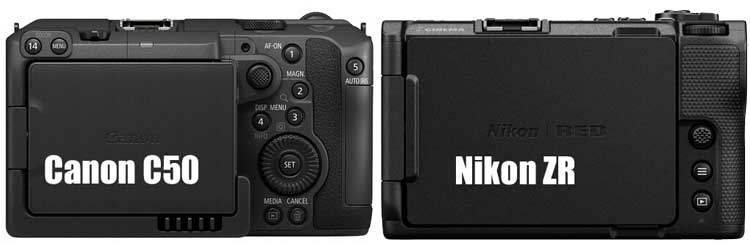
Both camera features a boxy style design. Well, the Canon C50 will be more convenient to a professional cinematographer since it already has a large handgrip, multiple Mount screw holes, even on the top plate of the camera. At the same time, a full-size HDMI port and an option for an XLR handle help to create an easy professional workflow.
With a Nikon ZR camera, it seems like we have to again use an external hand grip from grip makers like a small rig, since the grip is really very small, very similar to the Nikon Zf. Another most irritating thing is we are missing a Standard SD card slot, either u use a microSD card slot or CFexpress Type B. Comparing it to the Nikon ZR is more tilted towards a solo creator, which has all the bells and whistles that a solo creator may wish to have in their camera.
Aspect
Nikon ZR
Canon EOS C50
Dimensions (W x H x D)
133 x 81 x 49 mm
142 x 88 x 95 mm
Weight (Body Only)
630g
670g
Build Material
Fiber-reinforced plastic; rugged, lightweight
Not specified (durable cinema-grade construction assumed)
Grip/Handling
Minimal grip; boxy, EVF-less; gimbal-friendly but requires third-party cages for pro rigs
Decent integrated grip; flat-topped with handle for better handheld stability
Ergonomics
Video-focused UI; tiny joystick, zoom rocker, 3 custom top buttons; minimal for solo creators but cumbersome for cinema (e.g., bottom card access)
Cinema-optimized UI (separate photo/video modes); joystick, thumb wheel, 14 assignable buttons, 3 custom dials; highly customizable for pro workflows
Overall Feel
Vlog-like (similar to Sony ZV-E1); portable but needs accessories for cinema use
Cinema-ready (akin to Sony FX3 or Canon R5C); bulkier but more robust out-of-box
Display Comparison
Both cameras rely solely on rear screens for composition (no EVF or accessory viewfinder option), but the Nikon ZR’s display stands out for size and brightness, aiding outdoor monitoring. The C50’s screen is smaller but highly functional with touch controls.
Aspect
Nikon ZR
Canon EOS C50
Size
4 inches
3 inches
Resolution
3.07 million dots (1280 x 800 pixels)
1.62 million dots (900 x 600 pixels)
Brightness
1000 nits (peak)
Not specified (standard for cinema cameras; likely 300-500 nits)
Type/Features
Articulating; 16:10 aspect ratio; P3 color gamut support for accurate previews; touch-enabled
Larger and brighter for better visibility in bright environments; excellent for monitoring
Compact and versatile articulation; integrated touch UI for focus and settings
Expanding on ports, slots, mounting, cooling, and accessories, the C50 leans more professional with comprehensive connectivity and included extras, while the ZR prioritizes simplicity and silence.
Detachable handle (with XLR, REC/zoom controls, mic mount); LP-E6P battery; LC-E6E charger; Mic holder; Shoulder strap; USB-C cable; AC cable
Other Notes
Silent operation ideal for audio-sensitive sets; 32-bit float audio via ports/hotshoe
Built-in stereo mics; Ethernet via USB-C adapter; Frame.io integration for cloud workflows
Pros and Cons of the Nikon ZR
Pros
Cons
Affordable at $2,200 with internal 12-bit RED RAW for pro workflows
Ergonomics favor vlogging (no grip, bottom cards, tiny joystick)
Low rolling shutter (sub-10ms) for smooth action footage
Micro HDMI and no XLR; Limited ports for cinema rigs
Innovative 32-bit float audio with built-in OZO enhancements
High RAW data rates (~190-470 MB/s); Short record times on smaller cards
Lightweight (630g) and fanless with excellent thermals (~2+ hours)
No 14-bit RAW option; Overprocessed non-RAW modes (e.g., H.265 inaccuracies)
Superior 4-inch, 1000-nit screen for monitoring
Weak stabilization for dynamic shots; 2-hour 5-min arbitrary limit
Versatile zoom rocker and quick boot-up; UVC webcam support
LUT import limited to RAW; No redundant recording
Strong value as a B-cam for RED users or vlog upgrade
Inferior for photos compared to hybrids like Z6III
Pros and Cons of the Canon EOS C50
Pros
Cons
High-res 32MP sensor with 7K/60 RAW and 3:2 Open Gate for flexibility
Higher price at $3,899; No IBIS (relies on digital/lens stabilization)
Oversampled 4K/60 from 7K for sharp, detailed footage
Non-stacked sensor may have higher rolling shutter than competitors
Uncropped 4K/120 and 2K/180 for high-frame-rate options
No built-in ND filters; Audio requires handle (included but adds bulk)
Dual slots (CFexpress + SD) with easy access; Timecode support
Heavier (670g) and bulkier than some compacts; No viewfinder option
Active cooling for unlimited recording; Included XLR handle
Photos use electronic shutter only (potential rolling shutter issues)
Simultaneous wide + vertical/square crops for social media workflows
Vertical crops fixed (no tracking); Oversampling from cropped frame
15+ stops DR and Dual Base ISO for low-light performance
Less affordable for entry-level filmmakers; No 32-bit float audio
Cinema-focused build with rigging threads and custom buttons
Screen resolution lower (1.62M dots) than some rivals
Who Should Buy the Nikon ZR?
The Nikon ZR is made for budget-conscious content creators, vloggers, and hybrid shooters entering cinema workflows. It’s ideal for:
Solo filmmakers or YouTubers: If you are a solo filmmaker or YouTuber, looking for a budget solution, the Nikon ZR is the best camera for you. The additional advantage we are getting with this camera is the ability to record 32-bit audio, and OZO processing simplifies run-and-gun setups.
RED Ecosystem Users: Yes, you can use it as your primary camera; don’t underestimate its power; it inherits all the goodness of RED cameras, perfect for indie productions or commercials needing affordable RAW.
Hybrid Photographers: Yes, you can capture some still shots if you wish to, but primarily it’s
Avoid if: You need robust cinema ergonomics out of the box or uncropped high-FPS— go with the high budget cams then
Buy the Nikon ZR if ur overall budget is somehow limited within $3000 (since u have to buy lenses, lights, tripods, backdrops) so a lot of spending is still left even once you buy the camera.
Who Should Buy the Canon EOS C50?
The Canon EOS C50 targets professional videographers and small cinema teams seeking a bridge between hybrid and dedicated cinema cameras. It’s suited for:
Narrative Filmmakers: 7K Open Gate, 4k 120FPS uncropped, Pro body controls and ports, no compromise in features from inside to out, the only thing that you miss in the Canon C50 is the IBIS, but as most of the production houses place their camera on heavy rigs / moving platforms, they actually didn’t need IBIS, a bunch of Canon RF and and Canon CNR lenses available for the pro cam.
Multi-Cam Productions: Timecode, XLR, Anamorphic lenses support and in-camera de-squeez, and app control enable synced setups; active cooling handles long shoots like events or interviews.
Canon Ecosystem Loyalists: CNR Lenses as well as RF lenses support and Log2/3 integrate with C70/R5C; 32MP photos with 40fps burst appeal to hybrid pros (e.g., wedding videographers).
Avoid if: You’re on a tight, pls ge the Nikon Zr or Sony FX30
Choose the C50 if you can afford $3,899 and need cinema-grade tools like Open Gate or high DR for commercials/docs. It’s for those prioritizing flexibility in post (e.g., reframing) over the ZR’s RAW affordability, as evidenced by its positioning above the R5C but below the C70.
GET LIVE NOTIFICATION Your Trusted Source GET LIVE NOTIFICATION Click ON Check BOX for Latest NEWS and Rumors
The article “Nikon Zr Official Press Release” was written by thenewcamera.com team on 6:09 am, Wednesday, 10 September 2025, Greenwich Mean Time (GMT) | You can also follow us on Our Official Social Media HandlesFACEBOOK | TWITTER | INSTAGRAM to get live news — > get live news + Nikon Rumors + Camera News + Canon Rumors 24X7.
The Canon C50, a filmmaker powerhouse camera, is now official. The C50 major features include 3:2 open-gate recording, 7K RAW footage, a dedicated mode to capture 4K at 120 frames per second, and above this, an anamorphic de-squeeze.All these features that we are getting in this camera, we have never expected, at least from Canon. Hey, cripple hammer, are u slipping right now? 😉
One of the best consumer-level mirrorless cameras at this price range, and it can easily dominate the Sony FX3 in terms of video resolutions and still shooting capability. Now, let’s talk about the most important part of the camera – The Lenses — we have created the guide for the best lenses for the Canon C50 camera, which includes Canon’s Latest edition of CN-R cinema lenses, along with the standard RF lenses that you can use for capturing your perfect cinematic moments. Now, get ready for your storytelling, and let’s dive into the details.
Why the Canon C50 is a Game-Changer for Filmmakers
The Canon C50 launched at IBC 2025, and for me, it is one of the best Canon cinema cameras Canon has ever created. The 32.3 MP CMOS sensor captures the maximum detail possible, with the help of high-quality lenses that we are going to talk about in a moment. Apart from all this, you get 15 stops of dynamic range in Canon Log 2, as well as Dual Base ISO (up to 6400). The camera does not have a mechanical shutter, which means completely vibration-free shooting. At the very same time, we have an active cooling unit that ensures uninterrupted long recordings.This camera is literally built for professional cinematographers and pro creators who are looking for ultimate cinema-quality output in a highly compact and portable form factor.
CN-R Lenses: Canon’s Cinematic Superstars for the C50
Just like we have the L series of lenses in RF Mount, those which cost a bit more but deliver optimal performance, in the same manner, we have one more upgrade in the Canon RF lineup, and the elite squad of cine prime lenses called CN-R, for filmmaking and cinematography. The CN-R Lenses cost more than $4000, but with classic cinema lenses design, by inheriting all the modern features of L-series lenses, the CN-R lenses use T-Stop for more precise aperture measuring and geared rings for precise manual control with follow-focus rigs. The CN-R lenses are available from 14mm to 135mm. All these lenses have higher resolving capacity up to 8K to 12K, so even if you upgrade your body to a higher-resolution body in the near future, these lenses will remain relevant. As of 2025, the CN-R lineup includes powerhouses like the 14mm T3.1 L F, 20mm T1.5 L F, 24mm T1.5 L F, 35mm T1.5 L F, 50mm T1.3 L F, 85mm T1.3 L F, and 135mm T2.2 L F – all weather-sealed and ready for rugged shoots.
How CN-R Lenses Differ from Standard RF Lenses: The Cinematic Advantage
The CN-R lenses are actually Canon cinema einsteinces they are optimised for professional cinema work, that gives you, classic interface, by following up traditional cinema lenses protocol, using the ultimate optimal quality of optics available to Canon Japan, means Canon CN-R haven’t compromised with any of the qualities measures while keeping traditional controls with modern tech inside, but for that you have to pay even more than the Canon RF L series lenses. These CN-R lenses start from $4000. The biggest downside of CN-R lenses and their hefty price tag, compared to Canon’s RF-Mount, where the lenses start from $300.
What are the core differences between the C-NR and the Canon RF lenses?
The Canon CN-R lenses have cine-geared rings for focus, iris, and zoom (where applicable), with long throws for precise manual adjustments. RF lenses, such as the RF 50mm f/1.2L USM, focus on quick autofocus and lightweight design, which can feel abrupt in video pulls.
Focus Breathing and Distortion: The cinema lenses / CN-R minimise breathing (the subtle zoom during focus shifts) to zero, it’s not visible in any of the cine lenses and includes RF-enabled distortion correction for consistent framing. Now, some budget RF lenses may show some breathing, but if you buy the recently announced L-series RF lenses, like the RF 35mm f/1.4L VCM, the breathing is almost zero.
Aperture and Low-Light Performance: The CN-R utilises T-stops for precise light transmission (e.g., T1.3), which is a standard in filmmaking, allowing for superior low-light shooting without the need for adapters. RF lenses rely on f-stops and are often more budget-friendly but lack cine-specific refinements.
Price and Versatility: CN-R starts at around $4,000 for pro-grade builds, ideal for dedicated cinema rigs. RF lenses range from $300, offering image stabilization (IS) and AF perks for run-and-gun on the C50.
The Canon CN-R provides a true cinema experience, that “film-like” polish for the C50, while RF keeps things agile and affordable, and within reach. We have created the full Canon C50 lens compatibility guide. The guide contains the best lenses for the C50 camera (Canon CN-R and RF). We have handpicked the best lenses for the Canon C50 Camera, the list includes CN-R primes for cinematic excellence with RF zooms for flexibility.
The Best Lenses for Canon C50 Camera: Our Top Picks for 2025
Final Thoughts: Elevate Your Canon C50 with These Lenses Today!
The Canon C50 is not just a camera, it’s a bucket full of emotion it’s out tool to showcase or talent in the best possible way to the entire world, the best lenses for the Canon c50 camera like the CN-R will give you an to cinematic Xperience, at the very same time if you are looking for budget lenses, the RF lenses can fit for your requirement based on your budget. The new C50 is just the beginning. Best wishes, and stay tuned for handsonreview reviews on the new camera.com
if you want to get more updates related to Canon’s upcoming compact camera. GET LIVE NOTIFICATION, Select Your Trusted Source GET LIVE NOTIFICATION Click ON Check BOX for Latest NEWS and Rumors
The article “Best Lenses for Canon C50 Camera: Unlock Epic Cinematic Power with CN-R and RF Lenses in 2025” was written by thenewcamera.com team on 46:32 pm, Tuesday, 9 September 2025, Greenwich Mean Time (GMT) | You can also follow us on Our Official Social Media HandlesFACEBOOK | TWITTER | INSTAGRAM to get live news — > get live Camera News + Canon Rumors 24X7.
The Canon C50 camera has been officially announced. The camera features impressive specifications, such as 7K open-gate internal RAW recording at 60 frames per second, 4K video recording at 120 frames per second and above all it also has a brand new detachable XLR top handle made by Canon specifically for more professional control and high-grade audio integration. The camera is scheduled to ship by the end of Q4 2025. This camera actually positions itself as one of the strongest competitor models like the Sony FX3. Now, the C50 is able to blend high-end video capabilities in a very lightweight design. This allows filmmakers and professional cinematographers to easily handle solo projects without the need for a team. If you are searching for the Canon C50 price, we have compiled the latest details based on the official announcement and the regional pricing variations. Kindly note that the announced kit includes the body with XLR handle, and no separate body-only price has been confirmed yet by retailers; the listed bundle package starts at $3,899 in the US and we will break down the Canon C50 price across several markets, accounting for all the taxes, currency conversions and potential regional differences and extra charges worldwide so let’s dive into the details.
1. Canon C50 Price in the USA
If you are living in the US, you have to pay $3,899. For the Canon C50 camera, pair it with the XLR handle. Suggest you have to click on the buy and at store link, and the camera is yours with the handle at the very same time. The regional pricing may vary depending on the state’s different tax structure.. Sales tax typically ranges from 0% (in states like Delaware or Oregon) to around 10% ( like we have in California or New York).
Base Price: $3,899 [BODY only + XLR handle]
With Average Tax (7%): Approximately $4,172 (calculated as $3,899 × 1.07)
Price Difference Insight: The US price is often the baseline for global comparison.
Pre-orders are LIVE at B&H Store and Adorama Store, with no additional body-only option listed at launch.
2. Canon C50 Price in the UK
For someone in the UK, they have to pay a price of £3,359.99 for the Canon c50 camera alongside the XLR handle made by Canon itself. Obviously, the US pricing looks a bit lower when compared to the UK pricing since we have to add 20% VAT in the pricing, which is the value-added tax.
Inclusive Price: £3,359.99 [BODY only + XLR handle]
Ex-VAT Price: £2,799.99
Price Difference Insight: It’s quite obvious that the UK price is around 15% higher than the US price when including taxes, so you have to pay a bit more when purchasing the camera in the UK. Why do you have to pay more? It’s primarily due to VAT and EU-adjacent import regulations post-Brexit.
3. Canon C50 Price in Japan
Well, in Japan, the numbers are a bit high, specifically due to the conversion ratio. The price of the Canon c50 in Japan is ¥558,000 (body with XLR handle, excluding tax). We have applied the latest 2025 exchange rate of $1 = ¥143. Japan’s 10% consumption tax would add about ¥55,800, bringing the total to ¥613,800.
Estimated Base Price: ¥558,000 [BODY only + XLR handle]
With Tax (10%): ¥613,800 (approx. $4,290 USD)
4. Canon C50 Price in Europe
Canon EOS C50 with XLR handle is listed at €3,899.99, inclusive of VAT (which averages 20-22% across EU countries, varying slightly—e.g., 19% in Germany, 21% in the Netherlands). Excluding VAT, this is about €3,249.99 (roughly $3,575 USD at €1 = $1.10 exchange rate)
Inclusive Price: €3,899.99 [BODY only + XLR handle]
Ex-VAT Price (Average): €3,249.99
Price Difference Insight: Europe sees a 10-20% uplift compared to the US due to higher VAT rates and unified pricing across the EU.
Summary of Canon C50 Price Differences
To help visualise the variations, here’s a table comparing the estimated final consumer prices (including average taxes) and the percentage difference from the US base:
Region
Base Price (Local Currency)
With Tax (Approx.)
USD Equivalent (Approx.)
% Difference from US ($4,172 with tax)
USA
$3,899
$4,172
$4,172
Baseline
UK
£3,360
£3,360 (inc. VAT)
$4,402
+5.5%
Japan
¥558,000
¥613,800
$4,290
+2.8%
Europe
€3,900
€3,900 (inc. VAT)
$4,290
+2.8%
So all these calculations have been made on the approximate 2025 latest exchange rates (USD/GBP: 1.31, USD/JPY: 143, USD/EUR: 1.10, USD/INR: 84) and standard tax rates. The price does not always remain static; it varies due to the promotional offers, some personal offers by the retailer itself, as well as currency shifts and other adjustments. So this is the page for the Canon C50 pricing. If you want to see or explore the specification of the camera, you can visit here, and the official press release is mentioned here
f you want to get more updates related to Canon’s upcoming compact camera. GET LIVE NOTIFICATION, Select Your Trusted Source GET LIVE NOTIFICATION Click ON Check BOX for Latest NEWS and Rumors
The article “Canon C50 Price: Detailed Breakdown for USA, UK, Japan and Europe” was written by thenewcamera.com team on 4:04 pm, Tuesday, 9 September 2025, Greenwich Mean Time (GMT) | You can also follow us on Our Official Social Media HandlesFACEBOOK | TWITTER | INSTAGRAM to get live news — > get live Camera News + Canon Rumors 24X7.
Canon has now officially announced the Canon C50 Consumer-level Mirrorless camera. This is the official canon press release of the C50. The Canon C50 camera’s detailed specification is here
Canon C50 Press Release
Canon U.S.A. Announces New EOS C50 7K Full-Frame CMOS Sensor Cinema Camera and RF-Mount RF85mm F1.4 L VCM Hybrid Lens
Firmware updates for select Canon Cinema EOS cameras and new PowerShot ELPH 360 HS A camera also available
MELVILLE, NY, September 9, 2025 – Canon U.S.A., Inc., a leader in digital imaging solutions, is excited to introduce the new EOS C50 cinema camera, the newest addition to Canon’s cinema EOS system. The EOS C50 is a compact, full-frame cinema camera featuring a brand new 7K full-frame CMOS sensor, 7K 60P internal RAW recording and 32 megapixel still photo capture, making it a true hybrid camera. Weighing approximately one and a half pounds, the EOS C50 is Canon’s smallest and lightest cinema camera ever, making it ideal for handheld and verité shooting.
The lightweight design and hyper-mobile form factor the EOS C50 camera meets growing demands from shooters who are increasingly looking for compact, ergonomic cinema cameras for a variety of settings and shooting styles. Excellent for large and small scale productions, documentary shooting in the field, social media video creation, sports, and more, the EOS C50 camera features a detachable top handle which adds two full-size XLR audio inputs, a start-stop button, and a zoom rocker for unbeatable agility. It also features an RF-mount, lending it native compatibility with a wide variety of Canon lenses, such as the new RF85mm F1.4 L VCM Hybrid Lens.
EOS C50 Camera Recording Options
At the heart of the EOS C50 camera is the 7K full-frame CMOS sensor, which is capable of a Dual Base ISO of 800 and 6400 in Canon Log 2, and 12-bit Cinema RAW Light recording at up to 7K 60P. This powerful sensor is coupled with a DIGIC DV7 processor. The EOS C50 is the first camera in the Cinema EOS lineup to feature the full frame 3:2 open gate recording. In addition to Cinema RAW Light and the standard XF-AVC, the EOS C50 camera also features XF- AVC S and XF-HEVC S recording codecs, proving an easy-to-manage naming system and folder structure, all while preserving metadata and recording in the familiar MP4 format.
Social media shooters will enjoy that the EOS C50 camera is capable of simultaneous crop recording when shooting in 4K DCI or UHD, allowing you to record at a chosen aspect ratio while also recording a cropped portion of the frame in 2K. When shooting in simultaneous crop mode, the three format options include: 9:17, 9:16, or 1:1.
For those looking for camera connectivity, the EOS C50 camera supports XC protocol which allows for remote control over IP via Wi-Fi® or a compatible third-party USB-C ethernet adapter. The EOS C50 camera is also compatible with the Multi Camera Control App and features native integration of frame.io camera to cloud.
New RF-Mount RF85mm F1.4 L VCM Hybrid Lens
The new RF-Mount RF85mm F1.4 L VCM Hybrid lens is the latest addition to Canon’s line of VCM lenses, designed for shooters who increasingly are seeking powerful options whether shooting stills or video content. The RF85mm F1.4 L VCM has a focal length of 85mm, making it perfect for portrait-style shooting. The lens provides beautiful background blurring, as well as a F1.4 Maximum aperture, and well-controlled focus breathing.
Firmware Updates for EOS C400, C80, C70, and R5C Cameras
A new firmware update for select Canon Cinema EOS cameras bring in a few of these bleeding-edge features, available later this year. New firmware updates will enable full frame 3:2 open gate recording (EOS C400), view assist in media mode, quality improvement of focus peaking, improved assign buttons, improved Joy-Stick operability (EOS C80 and EOS C400), and more.
New PowerShot ELPH 360 HS A
Originally released in 2016, the PowerShot ELPH 360 HS still remains a popular compact camera. Appealing to fans of pocketable point and shoot style cameras, the newly updated PowerShot ELPH 360 HS A camera’s memory card slot will be changed from SD to microSD to help meet emerging needs in the compact camera market. The PowerShot ELPH 360 HS A camera will be available in two colors, black and silver.
Pricing and Availability
The Canon EOS C50 camera is currently scheduled to ship towards the end of Q4 of 2025 for an estimated retail price of $3,899.00*. The firmware updates for EOS C400, C80, C70, and the R5C cameras are currently scheduled to be available in Q4 of 2025.
f you want to get more updates related to Canon’s upcoming compact camera. GET LIVE NOTIFICATION, Select Your Trusted Source GET LIVE NOTIFICATION Click ON Check BOX for Latest NEWS and Rumors
The article “Canon C50 Specifications” was written by thenewcamera.com team on 8:21 am,Tuesday, 9 September 2025, Greenwich Mean Time (GMT) | You can also follow us on Our Official Social Media HandlesFACEBOOK | TWITTER | INSTAGRAM to get live news — > get live Camera News + Canon Rumors 24X7.
The Canon C50 specification is now officially available, offering a blend of high-end cinema camera features in a compact camera body. So the Canon C50 is actually the latest edition of compact consumer-grade cinema mirrorless camera specifications and professional hybrid shooters, those who love to have professional quality video without carrying a bulk load. In this comprehensive guide to the Canon C50 specifications, we will delve into the details by exploring its key features, including a detailed specification table and unique innovations introduced by Canon. We will also discuss the camera’s price and compare it to its competitors. Save your searching for Canon C50 specification and details because this article covers it all.
The Canon C50 camera was officially announced on September 9, 2025. It is built on the legacy of Canon Cinema EOS series mirrorless cameras, incorporating one of the most advanced full-frame sensors developed by Canon and high-end core specs. Let’s dive into the details.
Overview of the Canon C50
The Canon C50 is a full-frame camera that is specifically made for cinematographers and professional content creators, although you can also use it for photography purposes if you wish to. Although it doesn’t carry a mechanical shutter, which nowadays is in fashion that most of the prime cameras also don’t carry, at the very same time, Canon has optimized its readout speed to showcase minimal rolling shutter effect while even capturing at 40 frames per second. The key highlights of the camera are the 7K 60 FPS recording capability in RAW, an option to record uncropped 4K 120 FPS videos, and, obviously, the Open Gate option that was demanded by pro users for a long time for maximum creative flexibility.
See, the Canon C50 is completely different from the traditional cinema cameras. Here, we do not have any electronic viewfinder; the camera completely depends upon the electronic shutter for its silent operation. It also includes a fully articulating display screen of 3 inches on the rear side with a red record button, which is, of course, a hallmark of cinema cameras, as well as a dedicated tally light on the front and an optional XLR handle for professional-quality audio input. The design looks very similar to the nearest competitor, the Sony FX3, but it uses the Canon RF lens ecosystem, where users might feel a bit limited for now — but yes, the third-party Lenses and adapters are coming in 2026, and before that, we do have a huge range of Canon EF Lenses too.
Canon C50 Specifications
Specification
Details
Image Processor
DIGIC DV 7
Lens Mount
Canon RF (RF, RF-S, RF cinema; EF, EF-S, EF cinema with RF-EF adapter; PL with PL-RF adapter)
Sensor Type
Full-frame CMOS, 34.20 MP total (7144×4790)
Effective Pixels (Full Frame 3:2)
32.373 MP (6968×4646)
Effective Pixels (Full Frame)
25.628 MP (6960×3672), 24.032 MP (3840×2160)
Effective Pixels (Super 35mm Crop)
13.427 MP (5036×2656)
Effective Pixels (Super 16mm Crop)
3.388 MP (2524×1332)
Unit Pixel Size
5.16 x 5.16 μm
Dynamic Range
Canon Log 2: 15+ stops (Full Frame, ISO 800), 16 stops (Super 35mm, ISO 800)
Video Resolutions & Frame Rates
7K (6960×4640 up to 60P), 4K (4096×2160/3840×2160 up to 120P uncropped), Full HD (2048×1080/1920×1080 up to 180P)
RAW Recording
7K (6960×4640, up to 1800 Mbps, 59.94P, CFexpress only); 4K (6960×3672, up to 2900 Mbps, 59.94P)
XF-AVC Recording
4K (4096×2160, up to 1200 Mbps Intra, 59.94P); Full HD (up to 300 Mbps Intra, 59.94P)
XF-HEVC S Recording
7K (6912×4608, up to 1730 Mbps Intra, 23.98P); 4K (up to 225 Mbps Long GOP, 120P)
Slow & Fast Motion
Up to 120P (4K, Full Frame), 180P (Full HD, Full Frame), 150P (Full HD, Super 16mm)
Audio (Without XLR Handle)
3.5mm stereo mini jack (MIC: -72 dBV, LINE: -12 dBV), 2-channel MPEG2 AAC-LC or 4-channel Linear PCM (24-bit, 48kHz)
LP-E6P (7.2V, ~90-100 min at 7K), LP-E6NH compatible
Dimensions
143 x 88 x 95 mm (5.6 x 3.5 x 3.7 in., body only)
Weight (Body Only)
665 g (1.5 lb.)
Weight (With Accessories)
1110 g (2.4 lb.) with XLR handle, mic holder, battery, cards
Operating Temperature
0 to 40°C (32 to 104°F), 85% RH (performance)
Unique Features
Open Gate 3:2, 7K 60P RAW, active cooling, 40 fps stills burst
Price
Canon C50 camera available at $3899 with XLR handle at the B&H Store USA
If you want to get more updates related to Canon’s upcoming compact camera. GET LIVE NOTIFICATION, Select Your Trusted Source GET LIVE NOTIFICATION Click ON Check BOX for Latest NEWS and Rumors
The article “Canon C50 Specifications” was written by thenewcamera.com team on 8:21 am,Tuesday, 9 September 2025, Greenwich Mean Time (GMT) | You can also follow us on Our Official Social Media HandlesFACEBOOK | TWITTER | INSTAGRAM to get live news — > get live Camera News + Canon Rumors 24X7.
So, we all know the Canon C50 announcement is about to happen tomorrow (better to say within a few hours), that is on September 9, 2025. Just before that, two very clear images of the upcoming camera have been leaked by the Canon rumor mill. So in this particular post, we are going to explore the new design changes in the Canon C50 camera as well as we will also analyze the ports we have on the left side of the camera, which are clearly visible. So let’s jump into the content and explore the Canon C50 last last-minute leaks.
First Image: Side View (Ports and Connectivity Panel)
Well, we have this beautiful camera, kind of a boxy design, and the left side is very clearly visible, showcasing its professional input/output ports, which will be used for professional video workflow. So let’s explore the set of ports we have behind these rubber flaps:
Ports (from top to bottom):
USB-C port: Multipurpose USB-C port in the C50 body, for power delivery, data transfer, tethering, or accessory control.
Small rectangular port: A mini-USB or remote control terminal for wired remotes or LANC control.
Time Code port: A gold-plated BNC connector labeled “TIME CODE” for genlock or timecode in multi-camera setups.
HDMI port: Finally, we have a full-size Type A under an open rubber flap labeled “HDMI” for uncompressed video output.
MIC input: 3.5mm stereo jack with a person icon for external microphones.
Headphone output: 3.5mm jack with a headphone icon for audio monitoring.
Media Slot: A CFexpress Type B slot with an open door and ejection tool, supporting 8K or high-bitrate video. Other Controls: A small red lock switch or button, possibly for the battery compartment or menu lock. Vents and Cooling: No prominent vents, but internal airflow channels and a rumored active cooling fan suggest heat management.
Second Image: Front View (with Grip Attached)
Now let’s look at the front part of the camera, where we have the large hand grip, which is designed for comfortable longer hours of shooting.
Body and Labeling: The top of the camera is a metallic top plate with multiple threaded holes supporting accessory mounting. The branding “Canon EOS C50” on top, “Canon EOS C” with a red “C” on the front. Lens Mount: Canon RF mount with electronic contacts. Grip and Handheld Controls:
Large rubberized handgrip, a thumb rest, and a contoured shape.
Red REC button on the grip for one-handed recording.
Control dial/wheel for zoom, focus, or menu navigation.
Body Buttons: Custom programmable buttons.
The front button “12” is dedicated to AF LOCK.
Front button “13 REC”: Dedicated to Recording.
Vents and Cooling: Built-in dedicated cooling. Ventilation slots near the handgrip for air intake indicate an internal fan for 8K RAW heat management. Other Features: Power or tally light, an accessory shoe on top.
So, finally, the Canon C50 announcement is a few hours from now, and I am really very much excited to see how it is going to perform against the Sony FX3. We are not talking about the specifications right now since we are awaiting official announcements, and also as we get the detailed specification sheet of the camera, we will be publishing it right away on our website. Stay tuned for more updates related to the Canon C50.
If you want to get more updates related to Canon’s upcoming compact camera. GET LIVE NOTIFICATION, Select Your Trusted Source GET LIVE NOTIFICATION Click ON Check BOX for Latest NEWS and Rumors
The article “Canon C50: Last Minute Leaks” was written by thenewcamera.com team on 4:41 pm, Monday, 8 September 2025, Greenwich Mean Time (GMT) | You can also follow us on Our Official Social Media HandlesFACEBOOK | TWITTER | INSTAGRAM to get live news — > get live Camera News + Canon Rumors 24X7.
Finally, we have the official teaser of the Canon C50 camera, which is about to arrive soon. The good thing is, the XLR handle is very much clearly visible in the drone shot as well as in the studio close-up. So Canon will be not only announcing the C50 camera a Canon-branded XLR adaptor is also on its way. The XLR adaptor seems to be screwed into the camera via two screws, which is the same way as we do with the Sony XLR-H1 handle in the Sony FX3 camera.
Cannon Camera with XLR – New Canon Camera – Brightened Up Image
Most clear pic of Canon C50 camera, with XLR handle. As seen in the trailer image.
Looking at the screenshot below, I noticed this in the teaser, too; it quickly flashes to “52” on a timer. Does it confirm the specs will be based on the R5 Mark II? And all of us au here overlapping the Canon R6 Mark III camera specs with the Canon C50 ?
According to Reddit user CJ_900
On top of this, the caption reads “Open your world to what’s next. 9.9.25”, which could be another sneaky hint. Looking at the screenshot below, I noticed this in the teaser, too; it quickly flashes to “52” on a timer. Does it confirm the specs will be based on the R5 Mark II
Now, since the DJI mirrorless rumour turned out to be fake and even Yahoo Tech and Digital Camera World have republished those rumors, I am thinking to double double-checking everything even before I post, but that would take a lot of time and obviously, the channelization of data on our site will get disturbed, aka the refresh rate of posts.
Now I invite everyone who is reading this article to share your thoughts in the comment section, since you guys decide which is true or false. I am about to make everything 100% transparent. Everything that I am getting, I am sharing it with you.
While I was reading the entire information discussions related to the Canon C50 official teaser video sample, thinking that yeah it should carry R5 Mark II camera core specification, and started thinking that maybe we are overlapping the core specification of R6 Mark III over the C50, that is a chance.
Update on IBIS Rumors (September 7, 2025)
A new source claims that the upcoming Canon C50 doesn’t have IBIS, so that’s really disappointing news for all of us to hear that news. Now, we are waiting for an official announceement from Canon on Sep 9, 2025 to to clarify this critical feature. Stay tuned for live updates!
The article “Canon C50 Official Teaser: Confirms Open Gate, FX3-Style XLR Handle” was written by thenewcamera.com team on 7:55 am, Saturday, 6 September 2025, Greenwich Mean Time (GMT) | Follow us for more updates and get LIVE RUMORS –> FACEBOOK | TWITTER | INSTAGRAM to get live news — > get live Camera News + Canon Rumors 24X7.
Buy Canon Lenses, Buy Music CD or Digital Camera at amazon it helps this site, and you do not pay anything extra, it is just a way to help support this site.
New Camera Website, we list all type of new camera information, price review and all type camera rumors, subscribe us or follow us via twitter or facebook.
Disclaimer: We have attempted to select useful information to include on New Camera, and to ensure that the resources we have included on the site -- as well as the way we have described them -- are accurate, fair, and balanced. However, we make no claims, warranties, or other representations concerning the accuracy, completeness, or utility of the information provided, or concerning the abilities or performance of the organizations, agencies, companies, and other resources presented through New Camera




 BOX for Latest NEWS and Rumors