Join More Than 50,000+ Subscribers and get latest camera news and rumors
NEW CAMERA VIDEOS ON YOUTUBE
|
By admin, on July 22nd, 2026
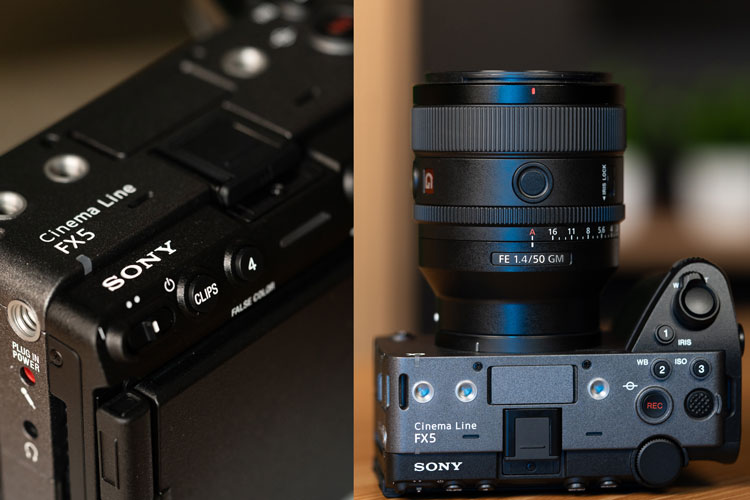
Sony FX5 camera has been finally announced, but it’s not a minor update. It has arrived with a revolutionary update. For the first time, they have introduced a 16-megapixel stacked CMOS sensor inside their FX line, and again for the first time, an FX camera records true Open Gate video, so the list is not small. A lot of new things have been introduced in the FX line through the FX5, and we are going to discuss all of them here.
From the past few years, the FX3 camera was quite popular among professional cinematographers and advanced content creators, but it also received a lot of criticism due to the lack of RAW recording and the absence of the Open Gate format. But the FX5 directly addresses these few issues, and not only that, it also gives us something more that we were not thinking about, so let’s compose the things that are there for the first time in the FX line.
The Biggest Firsts for the FX Series
The FX5 introduces multiple features that never existed in previous FX cameras (FX3, FX30, FX6, or FX9):
- Internal X-OCN RAW (16-bit)
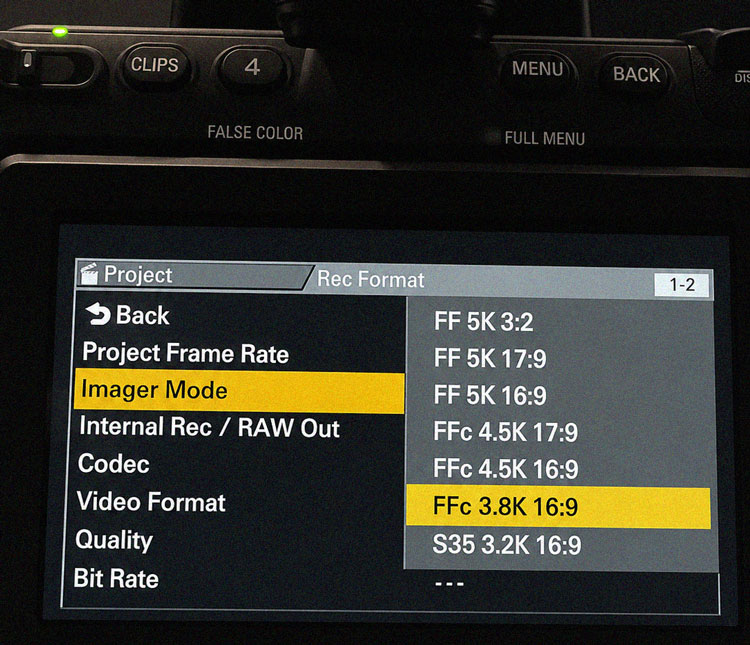
- Open Gate 5K 3:2 recording
- Triple Base ISO (800 / 4000 / 12,800)
- Dual Gain mode
- A completely new 16.6MP full-frame stacked sensor
These are not small incremental changes. They meaningfully expand what the camera can do in post-production and in varied lighting conditions.
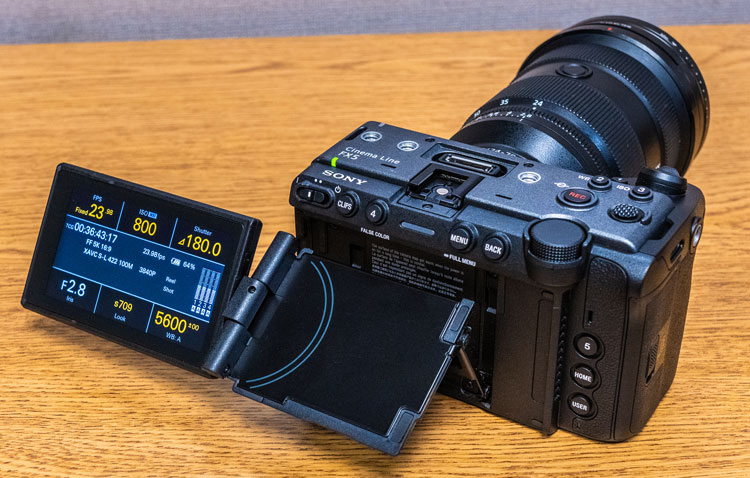
Why These Features Matter
Internal X-OCN RAW
Until now, FX-series users who wanted RAW had to rely on external recorders. The FX5 records Sony’s X-OCN format internally (with LT, C1, and C2 compression options). This reduces rig size, simplifies workflows, and brings Venice/Burano-level flexibility into a much smaller body. For many independent and documentary shooters, this alone will be the biggest reason to upgrade.
Open Gate Recording
Sony FX5 is one of the first cameras in the Alpha lineup that supports true Open Gate recording, allowing amazing flexibility for users to select the format or the composition of the shot once the filming is done. Soni FX five is one of the first camera in Alpha lineup that
This is especially useful for commercial, social media, and hybrid productions. Sony had previously kept Open Gate limited to much more expensive cameras.
Triple Base ISO + Dual Gain
Previous FX cameras remain limited to dual base ISO. For the firs time we have an Sony camera that Supports Tipple aka The FX5 adds a third base (4000) and a Dual Gain mode that combines low and high gain signals for cleaner shadows. In real-world terms, this should make the camera more consistent across a wider range of lighting situations and improve the quality of underexposed footage.
Sensor and Performance
The newly developed 16.6MP stacked sensor is faster than the one in the FX3, which helps with rolling shutter and enables higher-quality sampling for 4K and 5K modes. Sony claims over 15 stops of dynamic range in S-Log3, with Dual Gain offering further improvement in the shadows.
Frame rate options include:
- 5K Open Gate up to 60p
- 4K up to 120p (from 4.5K crop)
- FHD up to 240p
- Firmware planned for 2027 will add 4K/240
Body, Monitoring and Handling
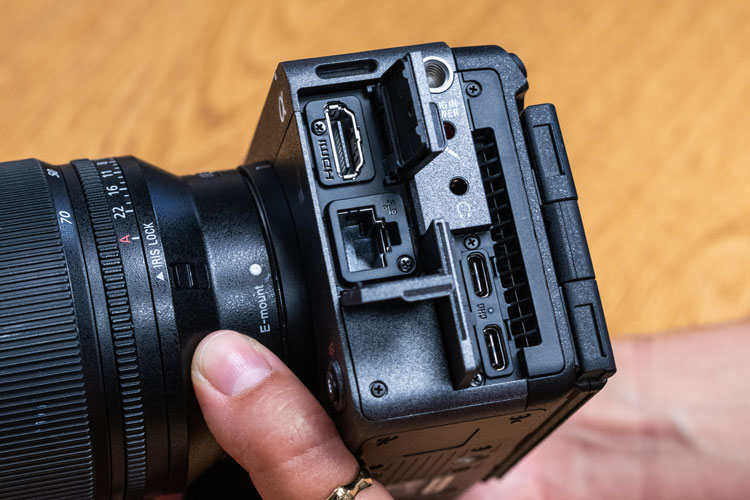
Despite major improvements in the hardware part, the FX5 remains compact and suitable for gimbals, though it is slightly larger and deeper than the FX3 (around 734g). It features a cooling fan, dual CFexpress Type A / SD slots, dual USB-C ports, Ethernet, and Wi-Fi 6E.
One of the more noticeable upgrades is the 3.5-inch 16:9 LCD, which is better proportioned for video than the FX3’s 3-inch 4:3 screen. Monitoring tools have also improved significantly, with waveform, vectorscope, false colour, and focus map now available.
The menu system has moved closer to Sony’s higher-end cinema cameras. This will feel more professional for some users, but existing FX3 owners may face a learning curve.
Optional Accessories
- XLR-H2 Handle: Adds XLR inputs and 32-bit float audio
- DVF-EL1 OLED Viewfinder: High-quality detachable EVF
- USB-C to BNC timecode cable
Pricing
- Body only: $4,899
- With XLR Handle: $5,499
Availability is expected from mid-August 2026.
How Does It Compare?
vs Sony FX3
The FX5 is the clearer upgrade path for users who need internal RAW, Open Gate, better monitoring tools, and more flexible base ISO options. The FX3 remains smaller, lighter, cheaper, and still excellent for many run-and-gun jobs. The FX5 is not a replacement for everyone — it is a step up for those who specifically need the new capabilities.
vs Canon EOS C50
The C50 offers 7K Open Gate and Cinema RAW Light at a lower price. The FX5 counters with stronger autofocus, better IBIS, internal X-OCN, and the Sony ecosystem advantage.
vs Nikon ZR
The ZR is significantly cheaper and offers internal REDCODE RAW with excellent IBIS. The FX5 feels more refined as a dedicated cinema tool and sits higher in terms of monitoring tools and system integration.
Potential Drawbacks
- No built-in variable ND (still a common request)
- New battery system (NP-SA100) means existing FX3 batteries won’t work
- Menu system is more complex than the FX3
- Price jump is substantial
Who Should Buy the FX5?
The FX5 makes the most sense for:
- Documentary and independent filmmakers who want internal RAW without a large rig
- Creators who need Open Gate flexibility for multi-format delivery
- Users already invested in the Sony Cinema Line who want a compact body that can intercut more easily with higher-end cameras
- Shooters who outgrew the FX3’s limitations but still want something portable
Those who primarily need a reliable, compact, affordable run-and-gun camera may still be better served by the FX3.
Final Thoughts
The Sony FX5 is one of the more significant updates to the Cinema Line in recent years. It does not reinvent the compact cinema camera, but it finally adds the missing professional tools that many FX3 users had been requesting.
Internal RAW, Open Gate, and triple base ISO are the features that define this camera. Whether the price justifies the upgrade will depend on how much those capabilities matter to your workflow.
We will follow up with more detailed analysis, real-world impressions, and India pricing information as soon as they become available.
The article “Sony FX5 Announced: Internal RAW and Open Gate Finally Arrive in a Compact Body” was written by thenewcamera.com team on 7:39 pm, Wednesday, 22 July 2026, Greenwich Mean Time (GMT) | You can also follow us on Our Official Social Media Handles FACEBOOK | TWITTER | INSTAGRAM to get more live Camera News + Canon Rumors 24X7


By admin, on July 3rd, 2026
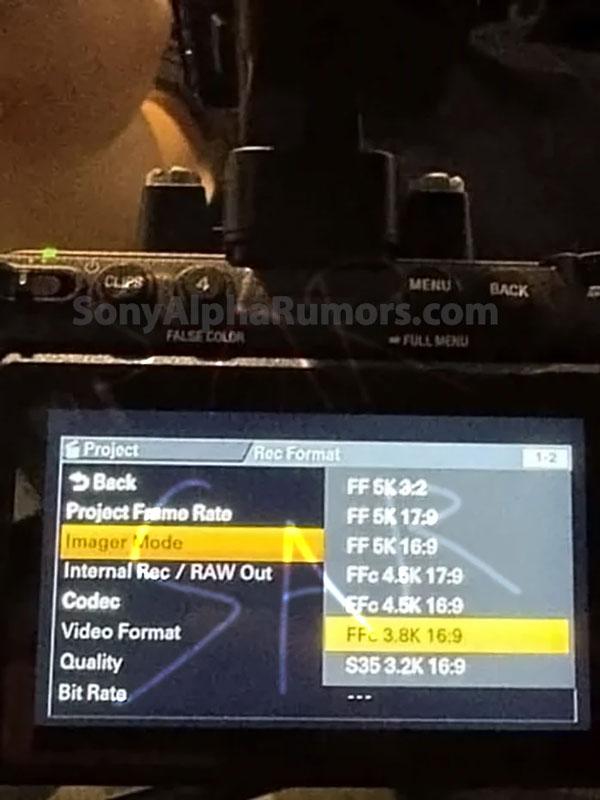
The Sony FX5 camera is coming, and as the announcement date approaches, we are getting more and more confirmation about its specs. If we compare the specs we know to the FX3, it’s a massive upgrade, without a doubt. In this article, we will try to explain the major upgraded specs we are about to witness in the upcoming FX5 camera. All these specs are coming from multiple sources cited by SAR.
Sony FX5 Rumoured Specifications
- Venice Style Display Menu: From the Latest leaked image, it seems that FX5 does not use the regular Alpha style menus
- Large Nikon ZR Style Display Screen: The display screen seems to be very large in the leaked image, almost covering up the entire back
- Open Gate 5K 3:2 recording – That’s the Big issue in Sony’s older generation of cameras, but now, thankfully, they are giving us Open Gate format so that filmmakers who want maximum flexibility in post (cropping for different aspect ratios without losing resolution).
- Triple Base ISO – Reportedly, the first Sony camera with three native ISO sensitivities. An excellent camera for handling extreme low-light situations, and this should deliver excellent dynamic range and low noise across a wider range of lighting conditions compared to dual-base ISO models like the FX3.
- Internal X-OCN RAW recording – Sony’s high-end 16-bit linear codec (X-OCN), previously limited to higher-end Cinema Line bodies like the Venice series. This brings professional-grade RAW workflow to a more compact form factor.
- ~16MP sensor — Unsure but what we have recent updates suggest a native ~16MP sensor (possibly fully stacked; global shutter rumors have been walked back or remain unconfirmed).
- Announcement window – Latter half of July 2026.
These specs align with the camera being positioned as a “mini Venice” or a more cinema-focused body than the FX3, potentially bridging the gap between the compact FX series and higher-end modular Cinema Line cameras.
Fact-Check and Cross-Verification
Fact-check and cross-verification: At the time I am writing this article, Sony has not made any official statements, nor have they posted any updates related to teasers of the upcoming cameras.
Yes, we have seen product registrations (e.g., references to ILME-FX models and codes like WW308784), and trusted sources like E88_8888 clearly mentioned that this one is an FX Line camera, not an Alpha or ZV Series camera. Although Sony does have plans to introduce a ZV Series camera in Q4 of 2026, as per camera registration details surfaced earlier, and we have reported it here at thenewcamera.com.
The Model name FX5 and related core specs information primarily originates from SonyAlphaRumors (Andrea Pizzini), a well-known and frequently accurate Sony leaker. It has been widely echoed across photography and videography sites, including Digital Camera World, YouTube channels (e.g., Ordinary Filmmaker, Nick Salazar), and social media discussions on X/Twitter.
Bottom line on credibility: Strong rumour momentum, but we have to wait for more confirmation
How Does This Compare to the FX3?
Well, it looks like the Sony FX3 will remain in its place within its price range, and the Sony FX5 will stand slightly above it in terms of price point, offering more features that filmmakers have been waiting for.
The rumoured FX5 appears aimed at users wanting more cinema-oriented tools (internal high-bit-depth RAW, superior ISO performance, open gate) in a similar compact body. If priced accessibly (speculation around $4,000–$7,000 range based on community chatter, unconfirmed), it could be a compelling upgrade for serious video professionals in the US market who need better low-light flexibility and post-production latitude without jumping to full Venice territory.
What to Expect Next
We’ll update this article as soon as more concrete information drops, including pricing for the US market and comparisons. If you’re in the market for a compact cinema camera, the FX5 could be a game-changer – stay tuned for more updates!
What are your thoughts on the rumored FX5? Would triple base ISO and internal X-OCN sway you from the FX3 or competitors? Drop a comment below.
(Article drafted for thenewcamera.com – optimized for US audience with practical filmmaker angles, SEO-friendly structure, and clear rumor disclaimers. All info current as of July 3, 2026.)
The article “Sony FX5 Specification and Leaked Image” was written by thenewcamera.com team at3:53 pm, Friday, 3 July 2026, Greenwich Mean Time (GMT)| You can also follow us on Our Official Social Media Handles FACEBOOK | TWITTER | INSTAGRAM > get live news — > DJI Rumors


By admin, on June 29th, 2026

According to the latest rumours, we have Sony RX10 V will be announced in early July 2026. Nearly nine years after the RX10 IV, Sony is about to post an update to the existing series. In this article, we will discuss the possible set of core specifications and the price of the Sony RX10 V camera.
While official specifications are still under wraps, reliable sources have given us a clear picture of what to expect. And based on the set of information available, related to be a meaningful but evolutionary update rather than a complete redesign.
Sony RX10 V Announcement Confirmed for Early July 2026
According to multiple trusted sources (we have covered it on our previous article), including Sony Alpha Rumours, Sony is about to announce the RX10 V in early July 2026, if everything goes according to schedule. Then, for sure, we will see teasers and the beginning of the week of July.
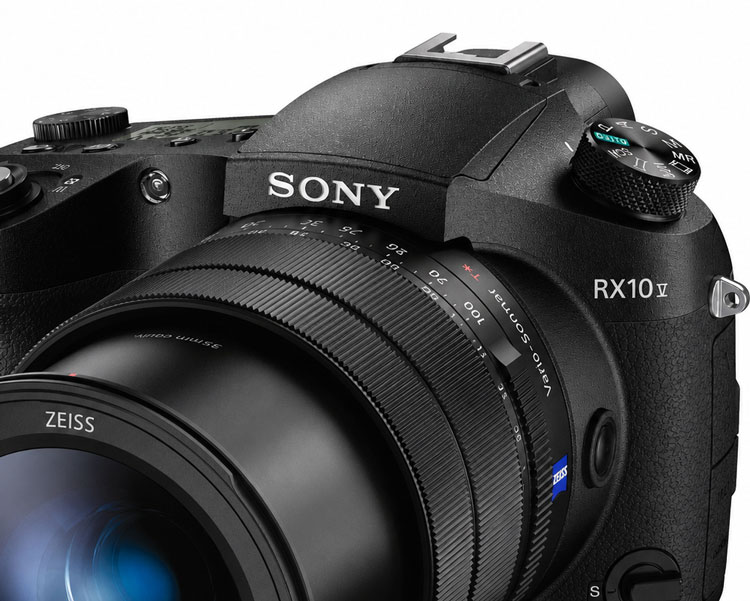
For sure, it’s welcome news for photographers who love large-sensor-based compact cameras. Sony RX10 V is said to be one of the best all-in-one cameras ever made. Even today, the RX10 IV remains highly sought after, with used prices often staying strong due to its excellent Zeiss 24-600mm lens and 1-inch stacked sensor.
Expected Specifications: RX10 V vs RX10 IV
Based on current rumors and logical analysis, here’s what we expect from the Sony RX10 V:
| Feature |
Sony RX10 IV (2017) |
Sony RX10 V (Expected July 2026) |
| Sensor |
20.1MP 1-inch Stacked Exmor RS |
20.1MP 1-inch Stacked Exmor RS (same or minor refresh) |
| Lens |
Zeiss 24-600mm f/2.4-4 (25x zoom) |
Zeiss 24-600mm f/2.4-4 (25x zoom) |
| Image Processor |
BIONZ X |
Latest BIONZ XR 2 (For AI integration) |
| Autofocus |
315 Phase Detection points |
Modern Real-time AI Eye AF (Humans, Animals, Birds), improved tracking, possible pre-capture |
| Burst Shooting |
Up to 24 fps with AF tracking |
Expected similar or slightly improved |
| Video |
4K 30 FPS Video (Standard shooting) |
Introduction of 4K 60FPS / 120 FPS in standard shooting mode |
| Connectivity |
micro-USB |
USB-C |
| Viewfinder |
0.39-inch OLED EVF |
Expected similar or minor improvements |
| Screen |
3-inch Tilting LCD |
Expected similar |
| Battery |
NP-FW50 |
Likely same or improved efficiency |
Key Upgrades Expected in the RX10 V
While the core hardware (lens + sensor) is expected to remain the same, the upgrades should make a noticeable difference in real-world use:
-
- Advance Autofocus System: This is the most important upgrade. The RX10 V is expected to get Sony’s current-generation AF with Real-time Eye AF for birds and animals — a game-changer for wildlife and bird photographers who loved the RX10 IV’s reach but were limited by older autofocus.
- BIONZ XR2 with an integrated AI processing unit. New generation of AI Processor for upscaling the overall Camera AF accuracy, upscaling the colour science and Stability performance.
- USB-C Port: A much-needed update for modern charging and faster data transfer. The lack of USB-C was one of the reasons the RX10 IV became harder to sell in some markets.
- Better Overall Performance: A newer image processor should bring improved noise handling, better colour science, and faster overall operation.
Sony appears to be taking a conservative approach — keeping the excellent Zeiss lens and 1-inch sensor combination that made the RX10 IV special, while updating the parts that have aged the most.
Sony RX10 V Expected Price (USA)
USA Pricing Prediction
The RX10 IV launched in 2017 at $1,699. After analyzing inflation, component costs, competitive positioning, and the value of the expected upgrades, we believe the Sony RX10 V will launch at $1,899 – $1,999 USD MSRP.
-
- Most likely street price: $1,799 – $1,899
- This positions it as a clear premium option above the Nikon Coolpix P1100 (~$1,100), which offers much more zoom but uses a smaller 1/2.3-inch sensor.
Wrap up
The return of the RX10 series after so many years is exciting. Sony seems to be taking a smart approach – keeping what made the RX10 IV great (the Zeiss lens and 1-inch sensor) while finally updating the autofocus and connectivity that had become outdated.
We’ll be watching the early July announcement closely and will update this article with official specifications and pricing as soon as they are available.
Would you like us to compare the RX10 V with any specific camera once more details are out? Let us know in the comments.
Update: This article will be updated immediately after Sony’s official announcement in July 2026.
GET LIVE NOTIFICATION, Select Your Trusted Source GET LIVE NOTIFICATION Click ON Check BOX for Latest NEWS and Rumors
The article “Sony RX10 V Rumored Specs, Expected Price – July 2026” was written by thenewcamera.com team on 7:49 am, Monday, 29 June 2026, Greenwich Mean Time (GMT). | You can also follow us on Our Official Social Media Handles FACEBOOK | TWITTER | INSTAGRAM >see more Sony Alpha Rumor Latest Camera News

By admin, on June 27th, 2026
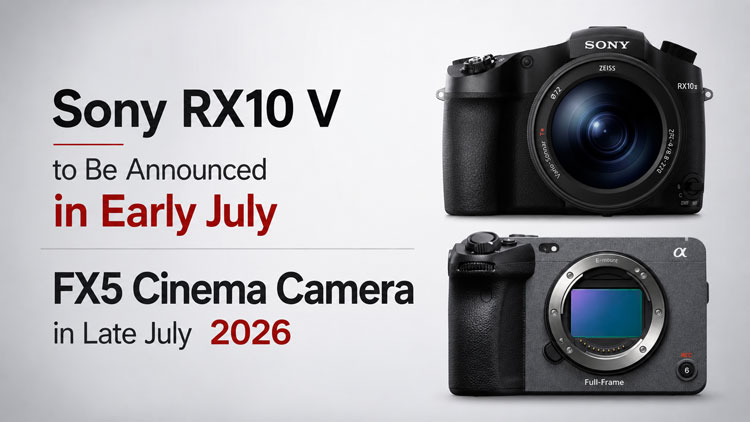
Sony will announce the RX10 V superzoom bridge camera in early July and the new FX5 cinema camera featuring a global shutter sensor and open-gate 5K recording in late July 2026. According to the latest rumours we have from reliable sources, these two announcements are about to happen next month. Let’s bring out more details. What do we know so far about these two upcoming cameras?
According to the SAR website, reliable sources have confirmed that Sony will announce two new cameras starting in the month of July 2026. We will have a premium/professional bridge camera update, the Sony RX10 V, and later in the month, we will have a Sony cinema camera named the Sony FX5.
This marks the return of Sony’s long-discontinued RX10 series after nearly nine years and introduces a new model in the Cinema Line that many did not expect.
RX10 V: A Modern Take on Sony’s Classic Superzoom
More than nine years ago, the RX 10 IV, launched in 2017, the RX series compacts from Sony featuring a 1-inch Hybrid CMOS sensor were built for pros looking for a compact solution without sacrificing quality. It was highly regarded for its 20.1MP 1-inch sensor and versatile 24-600mm f/2.4-4 Zeiss lens. The RX100 series always offers an excellent all-in-one solution for travel, wildlife, and hybrid shooters. After Sony discontinued the model, many photographers have been waiting for a successor.
We are waiting for the core specs of the RX10 V camera, as soon as it becomes available to us, we will be updating this post.
What upgrades are likely?
Most enthusiasts expect meaningful improvements in a 1-inch sensor and autofocus (including better subject detection), video capabilities, and processing power. If Sony brings current-generation autofocus and stronger 4K (or higher) video performance to the 24-600mm zoom, the RX10 V could become one of the most capable all-in-one cameras available.
For Indian photographers, a modern RX10 V would be particularly useful for travel, nature, and event shooting, where changing lenses is not practical.
FX5: Sony’s New Cinema Camera with Global Shutter
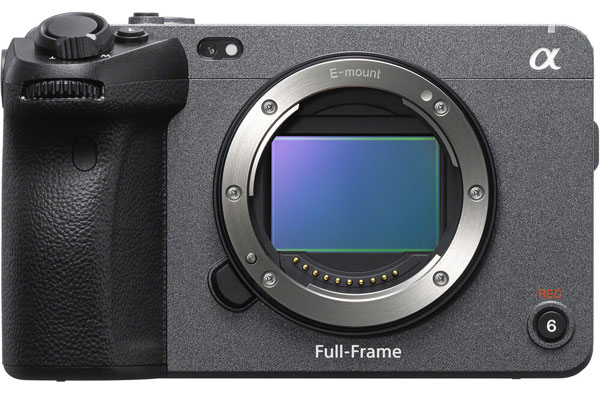
Yes, we are waiting for FX3 II as per the rumours. But we do have some strong rumours related to FX camera replacement. Instead of a simple FX3 II, Sony is launching the FX5 – a more advanced Cinema Line camera. Early details point to some very interesting upgrades:
- A new global shutter sensor (different from the one used in the α9 III)
- Open-gate 5K recording in 3:2 aspect ratio
- A body that is slightly larger than the current FX3
- Several new features (exact details still emerging)
Why global shutter and open-gate matter:
Global shutter technology removes rolling shutter distortion. This is a major advantage when shooting fast-moving subjects, panning shots, or in environments with LED lights and flickering sources. It gives a cleaner, more film-like result.
Open-gate 5K 3:2 recording provides extra resolution and flexibility. Creators can reframe shots in post-production, easily create vertical content for social media, or maintain higher quality when cropping.
The FX5 is being viewed by many as a “mini Venice” style camera — bringing higher-end cinema features into a more accessible body. It is expected to sit above the FX3 but below Sony’s higher-end Venice and FX9 models. The slightly larger body may also bring better ergonomics, improved cooling, and more professional I/O options.
Possible New Lens
Sources have also hinted at a new lens announcement around the same time. While details remain unconfirmed, one strong possibility is the long-rumored 16-28mm f/2.0 GM wide-angle zoom.
What This Means for Creators
| Camera |
Best For |
Key Rumored Advantage |
Likely Appeal |
| RX10 V |
Travel, Wildlife, Hybrid |
Modern AF + long zoom in one body |
All-in-one convenience for travel & events |
| FX5 |
Filmmakers, PRO YouTubers |
Global shutter + open-gate 5K, Made for the pros |
For professional use only |
For Indian creators, the RX10 V offers a practical all-in-one solution, while the FX5 brings professional cinema features (global shutter and open-gate) at a potentially more accessible price point than higher-end models.
Timeline & What Comes Next
- Early July 2026 — RX10 V announcement
- Late July 2026 — FX5 announcement (separate day)
We expect more detailed specifications, possible hands-on previews, and pricing information to emerge in the coming weeks. As always, availability in India through authorized channels usually follows global announcements within a few weeks to months.
Our Take
Sony’s July announcements look more interesting than many expected. The return of the RX10 series after such a long gap shows Sony is paying attention to the bridge camera segment again. At the same time, the FX5 appears to be a meaningful step forward in the Cinema Line rather than just an incremental FX3 update.
But, we have to be extra careful with these rumors, although a reputed website is saying it’s almost confirmed, but we have to be more conscious and wait for further confirmation. We will be posting an update asasp we get over this topic
What features are you hoping to see in the RX10 V or FX5? Let us know in the comments below.
GET LIVE NOTIFICATION, Select Your Trusted Source GET LIVE NOTIFICATION Click ON Check BOX for Latest NEWS and Rumors
The article “Confirmed: Sony RX10 V to Be Announced in Early July, FX5 Cinema Camera in Late July 2026” was written by thenewcamera.com team on 5:43 am, Saturday, 27 June 2026, Greenwich Mean Time (GMT). | You can also follow us on Our Official Social Media Handles FACEBOOK | TWITTER | INSTAGRAM >see more Sony Alpha Rumor Latest Camera News
source – sonyalpharumor [website]
By admin, on April 1st, 2026

The Sony A7R VI camera is rumored to feature a 67-megapixel sensor. Not only that. The A7R VI is likely to arrive in Q4 of 2026. For now, we all know that the current line of Sony A7R series cameras uses a 61 megapixel sensor, A7R V uses a 61 megapixel non-stacked sensor, whereas the Sony A7R V uses a 61 megapixel sensor with copper wiring to enhance data transmission speed of the sensor, which can also be used for capturing 8K videos up to 24fps and 4K 60fps without any crop due to the nature of its construction. According to rumors, Sony is about to introduce a 67-megapixel stacked CMOS sensor in the next-generation A7R VI camera, which is able to record up to 10k, which sounds really very interesting. Let’s dive deep into the details.
If the specs hold true, this could be the sensor that finally lands in the Sony A7R VI (or a high-end A7R VI body) and gives hybrid photographers and videographers the ultimate stills + cinema tool.
Leaked Sony 67MP Sensor Full Specifications
- Resolution: 67 Megapixels
- Readout Speed: 60 fps (full sensor)
- Pixel Size: 3.6 μm
- Format: 35 mm full-frame (Type 35 mm)
- Design: Partially stacked CMOS (exact stacking ratio not confirmed)
- Video Capabilities: 10K/30p, 8K/60p, 4K/120p
- Key Features: High-Speed AF, Super High-Speed Analog-to-Digital conversion, DCG-HDR (Dual Conversion Gain HDR)
- Interface: SLVS-EC v2.2 8×2
- Color Filter: Bayer RGB with PDAF (on-chip phase detection)
- Mass Production Start: Q4 2026
 Image sensor used inside the Sony A7V Mirrorless Camera What Makes This Sensor Special?
-
- Partial Stacking + Blazing 60 fps Readout
So after Sony A1 and Sony A9, the A7R VI is about to become the third Sony lineup to have a stacked sensor inside it, and this is a progressive journey in the future with hope. The next generation of the A7 series camera, which is the Sony A7 VI, will also have some sort of stacked or partially stacked CMOS sensor to compete properly against the Nikon Z6 series and ZR series, but for now, we should limit our discussion to the A7R series and the introduction of the 67MP sensor.
Obviously, with a fully stacked CMOS sensor, it will improve the readout, the overall video performance will be improved, the heat management will be much better compared to a sensor with a non-CMOS stacked architecture, and other than that, very minimal rolling shutter effect-free output, so technically we will have a major improvement in the next generation of A7R camera.
-
- DCG-HDR Technology
Now, just after the sensor core specification, the most important thing that I have written in the list of Sony A7R VI camera rumoured specifications is the Dual Conversion Gain HDR composite feature, which is expected to exist in the new camera. This specific feature will be enabled for A7R VI due to the presence of fast readout sensor technology.
And by the presence of a Dual Conversion Gain HDR composite, which composes two different gain readouts in a single frame, it will dramatically improve the dynamic range of the camera, specifically in the base ISO range starting from 100 to 2000, where it will have the maximum capability to scale the overall range of the camera, other than that at higher ISO we will have minimal noise input in the camera sensor.
Dual Conversion Gain HDR composite will dramatically improve the dynamic range and reduce noise across ISO levels.
-
- Insane Video Specs
If the rumored specs are true or not, then the Sony A7R VI will be the first camera to introduce 10K video recording capability in the Sony camera lineup.
-
- 10K/30p for future-proof oversampled 8K or extreme cropping
- 8K/60p for smooth high-resolution video
- 4K/120p slow-motion This would make the next A7R-series body a true hybrid flagship — finally giving the high-resolution R-line serious video muscle.
Sony A7R VI Arrival Date
- Now – Mid 2026: More leaks and possible prototype testing
- Q4 2026: Mass production begins
- Late 2026 / Early 2027: First cameras (Sony A7R VI + third-party models) expected
Well, despite so much excitement related to the core specifications of the Sony A7R VI, the announcement is not very near to us, but we are tracking this news and will be posting authentic updates here at thenewcamera.com.
What do you think? Would you upgrade to a 67 MP Sony A7R VI with these specs? Drop your thoughts in the comments below!
GET LIVE NOTIFICATION, Select Your Trusted Source GET LIVE NOTIFICATION Click ON Check  BOX for Latest NEWS and Rumors BOX for Latest NEWS and Rumors
The article “Sony A7R VI Rumors 2026: 67MP Partially Stacked CMOS Sensor with 10K Video – Latest Specs” was written by thenewcamera.com team on 7:37 pm, Wednesday, 1 April 2026, Greenwich Mean Time (GMT). | You can also follow us on Our Official Social Media Handles FACEBOOK | TWITTER | INSTAGRAM >see more Sony Alpha Rumor Latest Camera News
source – sonyalpharumor [website]


By admin, on February 20th, 2026

According to reliable sources, a Sony 16 megapixel sensor prototype has been spotted being tested in the wild. Now, just after that, speculation started that the 16 MP partially stacked sensor is expected to be used in Sony Cinema camera lineup, like the upcoming rumoured FX3 Mark II camera. At the very same time, it can also be integrated into future models of the Sony A7S IV. That is the Sony A7S Mark IV camera, which is also rumoured to arrive sometime in 2026. Already, it has been delayed a lot, but people are still waiting for its update.
With the 16 MP rumour, we are going to explore what other updates we have related to the prototype, which has been reported by the reliable sources of the rumour mill, as well as the other set of information we have related to these upcoming Sony Cinema cameras.

What We Know About the New Sony 16MP Partially Stacked Sensor
Even before we begin discussing the camera, let’s discuss the sensor. The sensor is not new. It has been reported earlier,16MP partially stacked sensor is a homegrown sensor from Sony, fully stacked. Have a look at the core specifications of the sensor
Here’s a breakdown of the rumored key specifications:
- Resolution: 16 megapixels (full-frame)
- Sensor Type: Partially stacked CMOS
- Video Capabilities: Near 5K recording with oversampling to 4K for superior image quality
- Readout Speed: 240fps—double that of the Sony A7V’s 120fps
- Autofocus: 120fps compatible two-point PDAF (Phase Detection Autofocus) system using all pixels
- Stabilization: Active image stabilization with minimal crop impact
- HDR Technology: DCG-HDR (Dual Conversion Gain HDR) for enhanced dynamic range in both stills and video
- Pixel Pitch: 7.2μm for exceptional low-light performance
Obviously, it has some recording limitations due to the limited 5K capability, not even stretching up to 6K. So I do have some serious doubts about whether that is going to be used inside the Sony FX3 Mark II or the Sony A7S IV

Sony’s Strategy and Limitations
We have the Sony FX2 camera, which does use a 33-megapixel CMOS sensor, but its recording capability remains stuck to 4K 60p, and we are not able to access 4K 120p in FX2. Now, with the help of the 16MP stacked CMOS sensor, Sony can push 4K recording up to 240 frames per second, despite the resolution limitation. So it would be quite interesting to see whether the Sony FX3 Mark II will use the new 16MP stacked CMOS sensor, which can push the 4K capturing speed up to 240fps, or if they are going to unlock the 7K 30fps recording capability of the 33-megapixel partially stacked sensor
As of the announcement on December 16, 2021. Sony Develops World’s First 1 Stacked CMOS Image Sensor Technology with 2-Layer Transistor Pixel
Sony does have an upper hand in sensor tech, but over the past 3 to 4 years, what we have seen is that they are pushing sort of limited updates in their camera. Like in the Sony A7V, we do not have any option to access open gate or 6K / 7K recording as we have in Nikon Z6 III or ZR or even Canon R6 III. Even in a pro Cinema camera like FX2, open gate recording is completely locked, and we do not even have an option to record 4L at 120p.

Release Timeline and What It Means for Creators
We discussed the release timing of the Sony FX3 Mark II camera as well as the Sony A7S Mark IV camera. Just before that, I must tell you that there is also one more camera which is rumoured to arrive—the Sony A7R VI. We covered the rumour in detail in our previous post, and you can look at that article to get more details.
Between the Sony FX3 Mark II and the Sony A7R VI, either of these cameras can arrive in the first half of 2026, likely in the second quarter of 2026. We may have the announcement of the next Sony cinema-style camera, and it can be anything for now, since there are multiple rumors related to the arrival of the Sony A7R VI as well as the Sony FX3 Mark II. So we are not putting any confirmation mark over any camera body name. As for the Sony A7S Mark IV, it is expected to arrive sometime in late 2026 or in the first half of 2027. This is the initial set of information we have related to the upcoming Sony cameras.
Pricing? Expect FX3 II around $3,500-$4,000, A7S IV maybe $3,000 if Sony undercuts to compete.
For creators, this could be a game-changer: Affordable 4K 240fps, HDR video that pops, and stabilization that lets you run-and-gun without gimbals. But if Sony locks open gate behind paywalls, it’ll frustrate. We’ll watch the leaks—stay tuned for updates. If this sensor delivers, Sony might reclaim video crown from Nikon and Canon.
GET LIVE NOTIFICATION, Select Your Trusted Source GET LIVE NOTIFICATION Click ON Check BOX for Latest NEWS and Rumors
The article “Sony 16MP Partially Stacked Sensor in FX3 II and A7S IV – Latest Sony Rumors February 2026” was written by thenewcamera.com team on 1:35 pm, Friday, 20 February 2026, Greenwich Mean Time (GMT). | You can also follow us on Our Official Social Media Handles FACEBOOK | TWITTER | INSTAGRAM >see more Sony Alpha Rumor Latest Camera News
source – sonyalpharumor [website]
Sony α7R VI or FX3 Mark II: Full List of Upcoming Mirrorless Cameras 2026-2027
By admin, on February 11th, 2026

Getting a lot of scattered posts online about the arrival of the Sony α7R VI camera, and there are also articles claiming the Sony FX3 Mark II is coming next.
The claim about the Sony FX3 Mark II camera’s arrival comes from one of the trusted rumour mills, SonyAlphaRumors, while other websites we consider trusted names in the industry, like PhotoRumors, are reporting that the Sony α7R VI camera announcement is on its way. They have also published the possible core specifications of the upcoming A7R VI camera. So in this article, we are going to discuss the probability of arrival of both cameras and the facts we have so far.

Starting from the FCC ID registration details of a flagship camera WW847606, which have been revealed recently in February 2026, the registered model code of the camera is being linked either to the Sony FX3 Mark II, which is expected to arrive sometime in April 2026, or to the Sony α7R VI. The registered model uses the same Wi-Fi unit that we have seen in the Sony α7 IV camera, and it is being manufactured in Japan. We all know that generally Japan is the place where Sony manufactures high-end mirrorless cameras, and that clearly indicates that among the Sony α7 series, it can be one of these two cameras.
Now the big question is why the entire internet is divided between these two cameras. Why are we not talking about any other Sony flagship full-frame mirrorless camera or APS-C camera for now?
Looking at Sony’s scheduled announcement pattern and their mirrorless camera update timeline, obviously, the Sony FX3 Mark II and the Sony α7R VI are due for an update. Other than that, we have the Sony α6900 camera, the Sony α6200 camera on the list, and the Sony α7S series is also overdue. People are waiting for the Sony α7S IV camera, but we have very few rumours related to it.
Upcoming Sony Mirrorless and Compact Cameras (2026-2027)
Based on Sony’s historical announcement patterns—such as refreshing full-frame mirrorless lines every 3-4 years (e.g., A7R series gaps lengthening from 20-39 months), APS-C models every 2-4 years, Note that Sony often announces high-end cameras in Q1-Q2 or Q4, with major pushes expected mid-2026 onward as part of a broader “offensive” in product launches.
| Model |
Type |
Expected Year |
Rumored Release Notes and Features |
| Sony FX3 II |
Mirrorless (Full-Frame Cinema Hybrid) |
2026 (March/April) |
Update to the 2021 FX3 with a partially stacked low-resolution sensor for improved readout speeds and low-light performance; WiFi 6 support; positioned to compete with Nikon Zr and Canon C50; registered in China as a high-end model. |
| Sony A7R VI |
Mirrorless (Full-Frame High-Resolution) |
Late 2026 or 2027 |
Successor to the 2022 A7R V; expected 61MP or higher sensor with partial stacking for reduced rolling shutter and better ISO; aligns with 4-year refresh cycle; focus on AI autofocus enhancements. |
| Sony A6900 |
Mirrorless (APS-C) |
2026 |
High-megapixel APS-C update (possibly 40MP+); improved sensor, EVF, burst rate, and ergonomics; follows 2023 A6700, targeting mid-range photographers; may merge features from A6100/A6400 lines. |
| Sony A6200 |
Mirrorless (APS-C Entry-Level) |
2026 |
Potential budget APS-C model combining A6100 and A6400 features; $1000 price point; no major updates rumored beyond standard refreshes. |
| Sony A7S IV |
Mirrorless (Full-Frame Video/Low-Light) |
2026-2027 |
Update to 2020 A7S III with 24MP stacked sensor, triple base ISO, and 6K video; rumors mixed on timing, possibly tied to broader video line refresh; not imminent per some sources. |
| Sony A7C III |
Mirrorless (Full-Frame Compact) |
2026-2027 |
Compact rangefinder-style update; improved autofocus and connectivity; low-priority rumor but fits Sony’s pattern of niche refreshes. |
| Sony ZV-E1 II |
Mirrorless (Full-Frame Vlogging) |
2026 |
Vlogging-focused update with better stabilization and AI features; alternative to FX3 II in some leaks. |
| Sony RX100 VIII |
Compact (Point-and-Shoot) |
2026 |
Successor to 2019 RX100 VII; simpler body with modern autofocus, better connectivity, and sensor updates; revival amid compact camera trend. |
Sony’s major camera announcement before July 2026
if anyone knows the announcement pattern of Sony and their mirrorless camera system, then obviously the two cameras that can be there are the Sony FX3 Mark II as well as the Sony α7R VI, which are on the top priority list for the 2026 and 2027 announcements. Other than that, the set of information we have received from the FCC ID also points toward the same.
But the most important part of the FCC ID process is that it gives 180 days of time to announce their product, since after 180 days, the external and internal test images of the product registered with the FCC ID go public. That clearly indicates the camera that Sony has registered in the month of February 2026 will officially arrive sometime before July 2026.
Sony A7R VI specification
- It uses a full-size stacked sensor with an effective pixel count of 80 million.
- The A7RVI is currently in a small-scale testing phase and is equipped with a BIONZ XR2 processor and boasts 8.5 stops of image stabilization.
- It is capable of continuous shooting in 14-bit RAW at 30fps.
- Equipped with RAW pre-capture function.
- 60fps with AE/AF tracking.
- Equipped with a high-resolution shooting function that combines 16 images.
- Noise-reducing composite shooting is possible by combining up to 32 images.
- The grip has been redesigned, with a deeper handle shape like the α1II.
- The maximum brightness of the rear LCD monitor is 50% higher than that of the α1II.
- This camera is considered a big step up from the A7V, and is positioned more like the A7RIII and A7III did back then.
- Does not support open gate, RAW video, or 6K HEVC.
- Supports 8K30p with 10.9K oversampling in full frame, 4K60p with 7.1K oversampling in APS-C, and 4K120p with 5.5K (pixel binning) oversampling in full frame.
- Stills can be shot at 30fps, but there is a strict limit on the number of shots that can be taken.
- The dynamic range is superior to that of the mechanically shuttered α7RV even when using the electronic shutter, achieving a dynamic range of over 16 stops when the mechanical shutter is enabled.
- The LCD monitor on the rear panel has more pixels than the α7V. The electronic shutter readout speed is slightly faster than before, but it is still only about one-third the speed of the α1II.
Well, these specification is coming from websites like Photorumors, but there’s no mention of the source or its authenticity, so it’s hard to say how reliable it is, but if it really does use an 80-megapixel stacked sensor, the α7RVI will likely be a big leap forward from the current α7RV. While the pixel count has increased, continuous shooting, video, and dynamic range have also been significantly improved, making it an impressive spec if true. However, despite being a stacked sensor, the electronic shutter speed is only one-third that of the α1II, which raises some questions. Is it a partial stacked sensor? Price-wise, expect it to land around $4,000-$4,500, positioning it as a premium stills monster. Sony’s clearly ramping up for a big year, so keep an eye on those certification deadlines—whatever drops before July will set the tone for the rest of 2026.
The article “Canon G7 X Mark III 30th Limited Edition in High Demand, Shipping Starts from April 28, 2026” was written by thenewcamera.com team on 6:46 am, Sunday, 8 February 2026, Greenwich Mean Time (GMT) | You can also follow us on Our Official Social Media Handles FACEBOOK | TWITTER | INSTAGRAM to get more live Camera News + Canon Rumors 24X7
source: sonyalpharumor | Photorumor

Canon G7 X Mark III 30th Limited Edition in High Demand, Shipping Starts from April 28, 2026

|
KEEP THIS BLOG ALIVE - Support New Camera Buy Canon Lenses, Buy Music CD or Digital Camera at amazon it helps this site, and you do not pay anything extra, it is just a way to help support this site.

|