Join More Than 50,000+ Subscribers and get latest camera news and rumors
NEW CAMERA VIDEOS ON YOUTUBE
|
By admin, on September 3rd, 2025
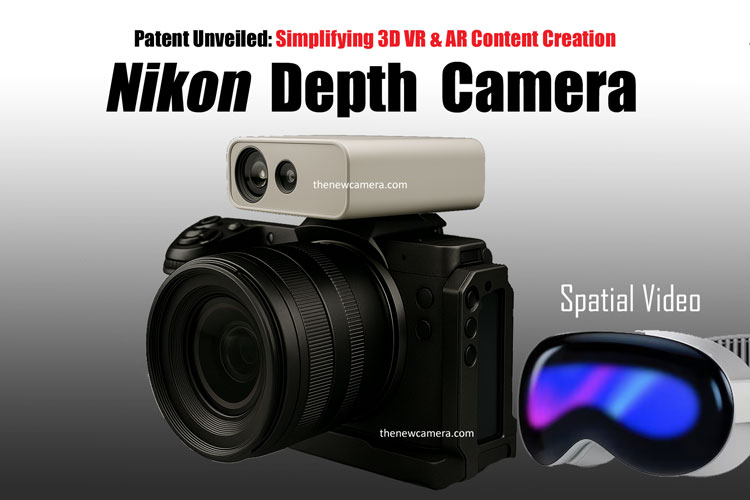 Nikon Depth Camera Module on hotshoe over proposed Z Cinema style camera We have a new Patent from Nikon, published in August 2025. They are working to simplify 3D VR and AR video recording with accessories. Specifically, the patent discusses the use Depth Camera as an accessory for 3D VR or AR recording in the Nikon Z Cinema Mount system. This means you don’t have to buy a Dual lens, like Canon, or spend heavily on 3D VR cameras. Nikon Cameras can now make easy 3D VR and AR content with this proposed ground breaking depth sensor Technology, that has been recently revealed in their latest patent, obviously it’s a game changer tech about to revolutionize how a camera capture depth, and able to synchronize with each other to create 3D content without spending a lot in getting a different 3D lens or different 3D Camera, it easily sync two camera for VR and Multiplce cameras with each other every frame bits by bits, to create AR or Augmented reality AR content.

What the Device Is, Its Purpose, and How It Syncs
The depth camera is clearly visible on the top of the camera. Is not a LiDAR, but its kinda of Nikon’s secret recipe that does a genius blend of infrared light and dual lenses. It measures distances and colors to build 3D maps, fueling VR and AR with precision.
- For VR, two cameras sync with each other to create a spatial or 180-degree video output.
- For AR, three or four create 360-degree overlays—think gaming, movies, or training simulations that feel alive.
We have a depth-sensing primary camera on the very top of the camera, and its main function is to provide per-pixel distance information and store it, which is then used by the synchronization unit to align frames. The data will later be used to sync frames with each other in two or more connected two-camera units.
The patent says that sync between the cameras happens via a smart process. But here’s the kicker—sync doesn’t just mean aligning frames; it’s about sync of everything among the camera units connected, which includes shot settings, color profile used, WB, and Exposure settings to make each frame a true copy of the other.

Creation of spatial videos with Apple Vision Pro or Meta Quest glasses
Here in the patent as demonstrated, Nikon’s depth camera setup is used to create 3D VR content, and obviously, if Nikon is bringing in these accessories to the Z Cine mount, VR content creation will become much cheaper and easier compared to the Canon RF system, where you need to invest in VR lenses, which are very limited and cost a lot for FF cameras. The Nikon accessories aka depth camera output is can be used and are compatible with devices like Apple Vision Pro or Meta Quest glasses, but there are specific considerations we have to talk about.
Compatibility:
- Apple Vision Pro: Yes, the supports spatial videos and photos with depth, viewable via its Camera and Photo apps or converted from 2D. Nikon’s 3D data could be processed into Apple’s Immersive Video format with additional software.
- Meta Quest: Supports 3D videos (e.g., VR180) and spatial videos from iPhone 15 Pro. Nikon’s output could be adapted using tools like Spatialify for Quest
With proper software processing to align with Apple or Meta’s 3D video formats, the Nikon Z Cine camera setup can create compatible VR content, leveraging its high-quality 3D capture. So, yes, we can see a blueprint of an early product in the article, but as they say, not every patent translates into a real product, since the patent is very new and was filed one Aug 2025, just after the Nikon Dual display camera patent. It does create high hopes that Nikon will soon bring out such tech in front of us to dominate the VR and AR market.
GET LIVE NOTIFICATION Your Trusted Source GET LIVE NOTIFICATION Click ON Check  BOX for Latest NEWS and Rumors BOX for Latest NEWS and Rumors
The article “Nikon Z Cinema Accessories Patent – for 3D VR and Spatial Video” was written by thenewcamera.com team on 7:32 pm, Wednesday, 3 September 2025, Greenwich Mean Time (GMT) | You can also follow us on Our Official Social Media Handles FACEBOOK | TWITTER | INSTAGRAM to get live news — > get live news + Nikon Rumors 24X7


By admin, on September 1st, 2025

It looks like theNikon will be going to redefine cinematography forever, after the acquisition of RED DIGITAL Cinema camera – a powerhouse in Raw video capture – Nikon has filed a patent, which clearly hints that the future Nikon Z cinema cameras will have an integrated revolutionary dual display system. So, this is not an incremental update; this is a revolutionary upgrade that has never been tried by any camera maker to date. Both of the displays will prove to be a game-changer for cinematographers. So, they can have seamless control over the optimised video processing.
The Patent Breakdown: A Stacked Sensor Powerhouse with Dual Displays
After reading the entire patent and analysing it briefly, we have seen that the camera is using a stacked CMOS sensor inside it, which has been clearly mentioned in the patent; even the structural design of the sensor has also been elaborated.
This back-illuminated setup layers an imaging chip, signal processing chip, and memory chip, connected via microbumps for lightning-fast data handling. The pixel region is divided into customizable blocks, allowing filmmakers/cinematographers to tweak imaging conditions like charge accumulation time, frame rate, gain, and thinning rates on a per-block basis.
The entire patent revolves around improving the post-production workflows, upscaling the video quality, and video performance of the camera. You are not going to find a single line that talks about the continuous frame rate or any photography-related specification enhancement. The entire patent is dedicated towards improving the overall cinematic workflow by upscaling the design part of the camera and introducing a new interface alongside with dual display system.
How Dual Displays Could Transform On-Set Workflows
What makes this patent truly exciting is the user-centric innovation done by Nikon’s research and development team, which makes the entire video workflow easier.
- The primary display (say, the larger first unit) is the primary display unit that shows the live feed from the camera sensor, just like you use a dedicated external display unit in your camera, which acts as a live view finder, showing a real-time composite feed from the sensor’s blocks.
- The secondary display flips open (via a hinge mechanism described in the patent) to become your control hub, better to say control panel. You can customize the quick control access screen as per your preference, at the very same time, the RED LUT table selection / and live LUT in preview will be a massive upgrade. Here, touch panels let you tweak settings on the fly: adjust frame rates, monitor waveforms, select HDR modes, or even browse thumbnails of recent takes. So, your eyes stay glued to the action while your fingers handle the tweaks.

Parallel Processing for Optimised Output
Beyond display, the system utilises dual image processing units, or more accurately, dual Expeed image processors. Parallel processors handle signals very well, without any lag, even while multitasking, and also enable real-time on-board optimisation for video. Users could assign one display to monitor raw output (e.g., from a high-gain night mode block) and the other to preview processed footage, for on-site advanced color correction, white balance, and color gradation adjustments spot-on before hitting record.
Why This Matters: Nikon’s Cinema Push in a Competitive Landscape
Nikon is not new to video. They already have the Nikon Z9 and Z8, which capture professional-level 8K Raw videos. After acquiring RED Digital Cinema, they now have access to more professional, pro-level cinematographic tools, and their research and development team is continuously working to upscale and integrate all those tools into the new age of upcoming Z-mount cinema release cameras.
The camera with a dual display unit clearly means less gear clutter in your bag—no need to carry external display monitors alongside you. The camera will help you by doubling the display unit and offering a brand-new control centre and live feed separately. Indie filmmakers can utilise the dual displays for solo shoots, while larger crews benefit from shared viewing.
Obviously, not all patents translate into real-world products. At the very same time, the filing is so recent—just a few weeks ago—that it’s hard for me to accept the fact that the upcoming Nikon Z Cinema camera on September 10th will have such a feature.
Let me know what you think, guys, about this patent, and obviously, would you love to see the dual display units in your cinema camera?
Below is a specification table derived from the patent details, summarizing all the key features from the document and technical aspects of the proposed Nikon cinema camera with dual displays.
Nikon Z Cinema Camera Specifications (from patent)
| Category |
Specification |
| Device Type |
Electronic device (e.g., Nikon Z Cinema Camera) |
| Imaging Element |
Stacked (back-illuminated imaging chip, signal chip, memory chip) |
| Chip Connection |
Microbumps (Cu or solder) |
| Pixel Arrangement |
Approx. Over 20 million pixels in matrix (pixel region 113A) for video |
| Unit Group |
16 pixels (4×4) or up to ~1,000 (e.g., 32×64) |
| Color Filter |
Bayer array (Green Gb/Gr, Blue B, Red R) |
| Sensor Control |
Drive unit (21) adjusts timing, frame rate, gain, thinning per block |
| Block Division |
Adjustable blocks with custom positions, shapes, ranges |
| Imaging Conditions |
– Charge time/number – Frame rate – Gain (ISO) – Thinning (0-0.5) – Row/column sums – Digitization bits |
| Image Processing |
– Dual units (30A, 30B) for parallel work – Frame extraction/discarding – Interpolation for smooth video – Simultaneous HDR |
| Display Unit |
– First display (51) with touch (52) – Second display (53) with touch (54), split (53L, 53R) |
| Display Functions |
– First: Composites, thumbnails, live view, menus – Second: Region images, enlarged thumbnails |
| Touch Panel |
Sends touch signals to system control (70) for selections |
| Operation Unit |
– Release switch (55a) – Video switch (55c) – Mode dial (55b) – Multi-selector (55d) for modes/HDR |
| Recording Unit |
– Dual card slots (61, 62) – Internal memory – Parallel region recording |
| System Control |
– CPU (70A) – Dividing unit (71) sets patterns – Drive control (72) adjusts conditions – Display control (73) manages output |
| Modes |
– Single region still – Multi-region high-speed still – Single region video – Mixed still+video |
| HDR Capability |
Two images with different exposures, selectable via multi-selector |
| Physical Design |
– First display on back – Second display rotates via hinge |
| Additional Features |
– Live view support – Detects main subjects (face, motion) – Flexible block patterns (checkerboard, columns/rows) |
The article “Nikon Z Cinema Cameras to Feature Dual Display – Patent Revealed” was written by thenewcamera.com team on 3:00 pm, Monday, 1 September 2025, Greenwich Mean Time (GMT) | Follow us for more updates and Get LIVE RUMORS –> FACEBOOK | TWITTER | INSTAGRAM to get live news — > get live news + Nikon Rumors 24X7
By admin, on March 30th, 2025

Nikon registered a new trademark, Nikon Z Cinema, on February 13, 2025. It will be very interesting to see whether Nikon is expanding its Z Cinema lineup to RED camera bodies only or if they will also bring dedicated cinema bodies to mirrorless consumers. just like Canon did with Canon R50V.
Support us – Use or affiliate link Amazon.com | B&H Store | Adorama.com for the next purchase u make – it helps us 🙂
Follow us on our social pages FACEBOOK | TWITTER | INSTAGRAM to get live Camera News + Nikon Rumors 24X7
|
KEEP THIS BLOG ALIVE - Support New Camera Buy Canon Lenses, Buy Music CD or Digital Camera at amazon it helps this site, and you do not pay anything extra, it is just a way to help support this site.

|