Join More Than 50,000+ Subscribers and get latest camera news and rumors
NEW CAMERA VIDEOS ON YOUTUBE
|
By admin, on September 17th, 2025

We have confirmed the announcement date of the DJI Osmo Nano [Post here], which is September 23, 2025. Now we have the confirmed set of specifications that is about to arrive inside the Osmo Nano 2025 edition. In this article, we will break down the detailed specifications of the DJI Osmo Nano, using other reliable information we have.
Design and Build
As you have seen in the leaked images, the DJI Osmo Nano keeps the modular magnetic design. It is an excellent point-of-view camera and very easy to carry, and you won’t believe the weight is only 58 grams—lighter than most smartphones—you won’t even notice while carrying it yourself. Now, other than that, the design is a bit rugged and suitable for outdoor activities. The camera also features a compact OLED touchscreen for controls/settings. At the same time, the camera also has gesture-based operations, meaning you can use it hands-free—that’s a tremendous thing for a type of Nano camera.

Camera and Video Capabilities
Finally, we received confirmation that the Osmo Nano features a 1/1.3-inch sensor, enabling high-quality footage even in challenging conditions. Video recording specs include:
- DCI 4K at 60fps
- UHD 4K at 120fps
- 1080p at 240fps f
Before discussing the details, let’s take a look at the specification table of the upcoming DJI Osmo Nano camera.
DJI Osmo Nano Specifications
| Category |
Specification |
Details |
| Design and Build |
Weight |
Less than 58 grams |
|
Design |
Modular magnetic design for easy attachment to surfaces like helmets, bikes, or clothing |
|
Display |
Compact OLED touchscreen with gesture-based operations |
| Camera Sensor |
Type |
1/1.3-inch sensor |
| Video Recording |
Resolutions and Frame Rates |
– DCI 4K at 60fps
– UHD 4K at 120fps
– 1080p at 240fps |
| Features |
— |
Active AI tracking, RockSteady 3.0 stabilization, HorizonLock (up to 360 degrees), time-lapse modes |
| Battery |
Runtime |
Up to 2.5 hours of continuous recording |
|
Charging |
USB-C fast charging: 80% in 20 minutes |
| Storage |
Internal |
64GB or 128GB options |
|
Expandable |
MicroSD (TF) card slot Not Available |
| Audio |
Integration |
Seamless pairing with DJI Mic 3 (no additional receiver needed) |
| Ecosystem |
App |
Integrates with DJI Mimo app for real-time editing, AI suggestions, and social media sharing |
| Pricing |
Standard Combo (64GB) |
$399 |
|
128GB Version |
$429 |
| Launch Date |
Date |
September 23, 2025 |
| Comparison |
Weight vs. Competitor |
Slightly heavier than Insta360 GO 3S (53g), but with superior ecosystem and features |

Battery and Storage
I am really very much impressed with the battery specification of the camera, offering up to 2.5 hours of continuous recording on a single charge. That’s really more than enough for a point-of-view camera like this being so tiny and able to record 4K videos for more than 2.5 hours. It is one of the best cameras for day-to-day life vlogs and recording point-of-view footage.
Audio and Ecosystem Integration
This is the best part of the DJI ecosystem, where you can easily connect your wireless DJI Mic 2 or Mic 3 with your DJI Osmo Nano camera—no need for an extra receiver to be connected to the camera, it’s built-in for the mic, and you can easily connect whenever you want to. It also integrates with the DJI Mimo app, so u have real-time editing tools access in ur hand, the Nano camera also features AI-powered suggestions, and easy social media sharing.
Pricing and Availability
The price information was leaked by Adorama a few days ago
- DJI Osmo Nano $399 for the 64GB standard combo
- and $429 for the 128GB version,
The ultra-portable point-of-view DJI Nano camera is one of the strongest contenders against the existing Insta360 GO 3S. The design is very unique, and specifically what I actually love about this camera is the integration with the DJI ecosystem, specifically the Mic 3. So I can also record my day-to-day life vlogs in a crystal-clear voice. Obviously, it will redefine the point-of-view action camera market since it is arriving with cutting-edge technology as well as its own ecosystem, which makes it quite a bit heavier competitor in the market.
source – Thenewcamera Twitter
By admin, on September 14th, 2025

Finally, we have the exact date of the Osmo Nano, as well as confirmation of the announcement timeline for the DJI Action 6 camera. The ultra-compact DJI Osmo Nano was originally scheduled to arrive on September 15, 2025, but due to unforeseen circumstances and a last-minute cancellation, DJI had to push the date to September 23, 2025. Now this is an insider report, which was 100% right. Meanwhile, let’s talk about the DJI powerhouse action camera, the DJI Osmo Action 6, which is gearing up for a mid-October 2025 arrival. So it is now confirmed that the camera Action 6 will arrive in mid-October 2025. We will share the exact date as soon as we get it.
Why the DJI Osmo Nano Is Generating Massive Buzz – Despite the Delay
The DJI Osmo Nano is coming with an ultra-small shape and size, with excellent core specs to deliver the best performance, all these factors making it a perfect, ultra-lightweight POV camera. At the very same time, the weight is only 58 grams, so it is much lighter than your smartphone. It easily fits on your magnetic mount over your clothes so you can use it wherever you like – even on your helmets or your bike – without the need for any bulky clip.

Key Specs and Features of DJI Osmo Nano
Here is the core specification of the upcoming DJI Osmo Nano camera. Let’s start with the video performance:
- Video Performance: Capture stunning DCI 4K at 60fps, UHD 4K at 120fps, or slow-motion 1080p at 240fps and Active AI tracking.
- Stabilisation Tech: Advanced RockSteady 3.0, paired with HorizonLock to keep your horizons perfectly level even in wild tilts.
- Battery and Storage: Enjoy up to 2.5 hours of runtime on a single charge, with 80% recharge in just 20 minutes via USB-C. Opt for 64GB or 128GB built-in storage, expandable via microSD slot.
- Display and Controls: A compact OLED touchscreen, gesture controls, and intelligent modes, as well as time-lapse, add creative flair.
- Ecosystem Integration: Pairs instantly with DJI Mic 3 for pro audio without receivers, and the DJI Mimo app enables real-time editing, AI suggestions, and easy social sharing.
Price of the DJI Osmo Nano
Priced at an expected $399 for the 64GB standard combo and $429 for the 128GB. The pricing is already confirmed by the recent leaks from Adorama, which was quickly pulled back, although it does confirm its official pricing before the announcement. So the pricing you see here is also 100% confirmed.
But why this delay from September 15 to 23? See, it has been done for a purpose. Exactly why we don’t know, but yeah, it has been delayed. Compared to the Insta360 Go Ultra (around 53g with similar 4K/60fps but less DJI ecosystem synergy).

DJI Osmo Action 6: Wait Until Mid-October 2025
Many of my subscribers were waiting for the DJI Osmo Action 6 camera. We have already published several clear pictures of the Osmo Action 6. Even though the FCC ID has been leaked. We have also seen hands-on images of the camera as well as the retail packaged boxes of the DJI Osmo Action 6, and our sources have confirmed that it does carry a large 1-inch sensor, and an unbeatable 13.5 stops of dynamic range have been spotted while testing the camera. So let’s explore the specifications that stand out against existing competition.

Standout Specs and Innovations in the DJI Osmo Action 6
Expect these features to make it a top pick for thrill-seekers:
- Video Capabilities: 8K at 30fps, 5.3K at 60fps, or 4K at 120fps for epic slow-mo, all in 10-bit D-Log M for flexible post-production editing.
- Stabilization Mastery: RockSteady 4.0 with AI-boosted HorizonSteady 360° keeps footage steady and super smooth.
- Durability and Battery: Waterproof up to 18-20 meters without a case, with a 1950mAh battery +4 hours of 4K recording.
- Built-in Storage: 47GB built-in storage.
- Connectivity and Screens: Dual OLED touchscreens, Wi-Fi 6, Bluetooth 5.1, and USB-C output for seamless workflows.
- Field of View: Digital super-wide modes and many options for vloggers, ranging from super-wide to vlog mode.
Price of Action 6 Camera
- Price of the Action 6 Camera standard combo at $329-$429,
- with the adventure bundle (extra batteries and mounts) at $479-$579.
So finally we have Action 6, which is coming with amazing specifications, a large 1-inch sensor and 8K resolution, that will also allow you to record 10-bit videos in D-Log for maximum latitude, so you can recover shadows and highlights later in post easily.
See more images and detailed core specification of the DJI action 6 camera here
What This Means for DJI Fans and the Market
Well, DJI is rocking right now with its DJI Mini 5 Pro announcement, and just after that, we will have the DJI Osmo Nano on September 23, and finally, just after a few weeks or so, we will have the Action 6 camera in mid-October. And all of these are not incremental updates – these are major updates. So if you love a drone or action cam or a POV cam, all these are coming from DJI, all these are coming within weeks.
Update: Sep 15 – Pls don’t get confused, I have clearly written in the article the Action 6 coming with 1-inch sensor, not the Osmo Nano, thanks
GET LIVE NOTIFICATION, Select Your Trusted Source GET LIVE NOTIFICATION Click ON Check  BOX for Latest NEWS and Rumors BOX for Latest NEWS and Rumors
The article “DJI Osmo Nano Announcement on September 23, and DJI Action 6 Coming on…” was written by thenewcamera.com team on7:52 pm, Sunday, 14 September 2025, Greenwich Mean Time (GMT) | You can also follow us on Our Official Social Media Handles FACEBOOK | TWITTER | INSTAGRAM to get live news — > DJI Rumors

By admin, on September 12th, 2025

Nikon ZR and the Canon C50 are both very new and were announced in September 2025. The Nikon ZR is Nikon’s first cinema mirrorless camera. Nikon, the Canon cinema line has been active inside Canon for more than a decade. The Nikon is priced at 2200 USD, and the Canon C50 will cost you approximately 3899. So, we do have a good price difference between these two cameras, but is the price difference between the two really worth it, meaning if you are someone who wants to do a fresh start, should you move towards a Canon or Nikon cinema camera? Or if ur a professional and not limited in any sort of budget boundaries, which camera should you choose? If you were searching for Nikon ZR vs Canon C50 comparison, then you have reached the right page. We have done the Most Detailed Specification Comparison between the two, lets dive into the details
Specification Comparison
| Feature |
Nikon ZR |
Canon EOS C50 |
| Sensor |
24MP full-frame partially stacked CMOS (from Z6III) |
32MP full-frame CMOS (new, non-stacked) |
| Max Video Resolution/FPS |
6K up to 60fps (uncropped); 4K up to 120fps (1.5x crop); 4K60 uncropped |
7K up to 60fps (RAW, 3:2 Open Gate); 4K up to 120fps (uncropped); 2K up to 180fps |
| Codecs |
REDCODE RAW (R3D NE, 12-bit, internal); N-RAW; ProRes RAW; ProRes 422 HQ; H.265 |
Canon Cinema RAW Lite (12-bit, internal); XF-AVC; XF-HEVC |
| Color Science & Log |
REDWideGamutRGB + Log3G10; N-Log; Nikon colors |
Canon Log 2/3; Wide DR; PQ/HLG/Canon 709/BT.709 |
| Oversampling |
6K to 4K oversampled for enhanced detail; |
4K up to 60fps oversampled from 7K (or 6.9K for 4K30) |
| Sensor Modes/Crops |
Full-frame uncropped in 6K/60; 1.5x crop in 4K/120; Hi-Res digital zoom |
Full-frame 3:2 Open Gate (7K full height); Super 35/16 crops; Simultaneous wide + vertical/square crops (fixed position, from cropped wide frame) |
| Dynamic Range |
15 total stops in 6K RED RAW; W |
15+ stops in full-frame (Log/RAW) |
| Rolling Shutter |
Sub-10ms (9.1ms in 6K RED RAW); Excellent for fast action |
Not fully tested |
| Audio |
32-bit float (built-in mic + 3.5mm); OZO processing (directional, zoom, isolation, cleanup); Multi-interface hotshoe |
24 Bit via XLR (via included handle); 3.5mm mic/headphone; Recording levels; Shotgun mic mount |
| Stabilization |
IBIS + Electronic (same as Z6III); Lens-based optional |
Digital compensation + lens-based optical; No IBIS |
| Ports & Connectivity |
Micro HDMI; USB-C (UVC webcam up to 1080p60); 3.5mm mic/headphone; Multi-interface hotshoe |
Full-size HDMI; USB-C; Timecode terminal; Remote; 3.5mm mic/headphone |
| Media Slots |
1x CFexpress Type B + 1x MicroSD (bottom-mounted; no redundant recording) |
Dual: 1x CFexpress + 1x SD |
| Battery Life & Thermals |
~2 hours 6K RAW (EL15 battery); Fanless, no overheating (tested up to 32°C/90°F); 2-hour 5-min record limit |
LP-E6P battery; Active cooling (fan) for extended recording; No known limits mentioned |
| Other Video Features |
User LUT import (up to 65-point, RAW-only); Tally lights; Audio cues; Frame continuity challenges due to card access; RED intercutting |
Frame.io support; Canon XC protocol; Multi-camera control/app transfer; Pre-burst in photos; Electronic burst up to 40fps (photos) |
Resolution and Open Gate, anamorphic recording
In both the comparison tables, it is very clearly visible that the Canon C50 has supremacy in resolution; you can easily record 7K videos up to 60 frames per second and 4K 120fps uncropped with this Canon C50 camera.
Availability of Open Gate recording, which is 7K 60fps RAW in 3:2 format, available at Canon C50. Another major advantage apart from all these is the anamorphic recording ability and in-camera de-squeeze functionality.
So with Canon, you can go wider with anamorphic (in-camera de-squeezing), ultra slow motion videos without any compromise or crops, at the very same time you can use anamorphic ultra-wide lenses even while recording 4k 120fps, that’s great for sure.
Nikon ZR approach is more traditional, in the limited price range we are getting REDCODE RAW R3D 12-bit internal recording, at the very same time the same spec has been used in higher-end RED cameras like the Komodo or the V-Raptor, so it’s a boon for solo creators to have such a format in this price range.
Audio is one of the most important parts of the video, and the Nikon ZR is the only camera in between the two that offers 32-bit float audio recording capability. Again, it’s another boon for solo creators to record the highest quality audio possible without investing heavily in an audio setup. OZO has been added to the Nikon ZR, which is responsible for background noise reduction while recording with internal mics. With the help of the DJI Mic 3, which is also able to record 32-bit float audio, you can generate high-quality audio files while pairing up with the Nikon ZR camera.
The Canon is limited to 24-bit audio despite the XLR handle and inputs in the camera so that’s the limitation we have with the Canon C50.

Active cooling in Canon C50 [Only in Canon C50]
Active cooling effectively makes the recording time limit indefinite. C50 also utilises a higher-resolution sensor of 32MP, which generates more heat while recording videos or oversampling compared to a 24MP sensor. To prevent any kind of overheating issues and maintain the highest recording quality possible, Canon has added a built-in fan that will keep the camera cool for longer periods of time.
The Nikon ZR features a fanless body, but Nikon claims its heat sink is significantly improved over the previous generation of Nikon cameras. We can record 6K 60fps videos for up to 2 hours and 5 minutes at 32°C without interruption. So obviously, with Nikon ZR, you can record longer videos without any significant worries.
Sensor-shift image stabilisation system [Only in Nikon ZR]
The Nikon ZR does feature a 7.5 to 8 stops of sensor-shift image stabilisation system that we have already seen in the Nikon Z6 Mark III and the Nikon Zf camera. The IBIS mechanism of the Nikon ZR is intelligent and recognises the human body and face, and when your VR lens is linked with the autofocus point, you get a maximum of 7.5 stops of advantage even in the corner of the frame. In Canon, there is no sensor-shift image stabilisation system, so you have to depend upon rigs or gimbals.
Body Design Overview
Both camera features a boxy style design. Well, the Canon C50 will be more convenient to a professional cinematographer since it already has a large handgrip, multiple Mount screw holes, even on the top plate of the camera. At the same time, a full-size HDMI port and an option for an XLR handle help to create an easy professional workflow.
With a Nikon ZR camera, it seems like we have to again use an external hand grip from grip makers like a small rig, since the grip is really very small, very similar to the Nikon Zf. Another most irritating thing is we are missing a Standard SD card slot, either u use a microSD card slot or CFexpress Type B. Comparing it to the Nikon ZR is more tilted towards a solo creator, which has all the bells and whistles that a solo creator may wish to have in their camera.
| Aspect |
Nikon ZR |
Canon EOS C50 |
| Dimensions (W x H x D) |
133 x 81 x 49 mm |
142 x 88 x 95 mm |
| Weight (Body Only) |
630g |
670g |
| Build Material |
Fiber-reinforced plastic; rugged, lightweight |
Not specified (durable cinema-grade construction assumed) |
| Grip/Handling |
Minimal grip; boxy, EVF-less; gimbal-friendly but requires third-party cages for pro rigs |
Decent integrated grip; flat-topped with handle for better handheld stability |
| Ergonomics |
Video-focused UI; tiny joystick, zoom rocker, 3 custom top buttons; minimal for solo creators but cumbersome for cinema (e.g., bottom card access) |
Cinema-optimized UI (separate photo/video modes); joystick, thumb wheel, 14 assignable buttons, 3 custom dials; highly customizable for pro workflows |
| Overall Feel |
Vlog-like (similar to Sony ZV-E1); portable but needs accessories for cinema use |
Cinema-ready (akin to Sony FX3 or Canon R5C); bulkier but more robust out-of-box |
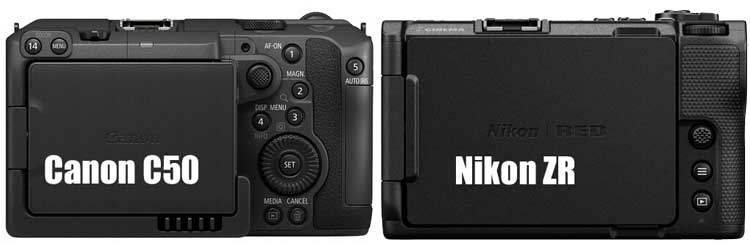
Display Comparison
Both cameras rely solely on rear screens for composition (no EVF or accessory viewfinder option), but the Nikon ZR’s display stands out for size and brightness, aiding outdoor monitoring. The C50’s screen is smaller but highly functional with touch controls.
| Aspect |
Nikon ZR |
Canon EOS C50 |
| Size |
4 inches |
3 inches |
| Resolution |
3.07 million dots (1280 x 800 pixels) |
1.62 million dots (900 x 600 pixels) |
| Brightness |
1000 nits (peak) |
Not specified (standard for cinema cameras; likely 300-500 nits) |
| Type/Features |
Articulating; 16:10 aspect ratio; P3 color gamut support for accurate previews; touch-enabled |
Side-hinged vari-angle touch panel; flips for self-facing; customizable peaking (Peaking 1/2) |
| Advantages |
Larger and brighter for better visibility in bright environments; excellent for monitoring |
Compact and versatile articulation; integrated touch UI for focus and settings |

Expanding on ports, slots, mounting, cooling, and accessories, the C50 leans more professional with comprehensive connectivity and included extras, while the ZR prioritizes simplicity and silence.
| Aspect |
Nikon ZR |
Canon EOS C50 |
| Ports |
Micro HDMI; USB-C (3.2); 3.5mm mic/headphone; Digital hotshoe (supports audio adapters, future XLR) |
Full-size HDMI (Type-A); USB-C (3.2 Gen2); 3.5mm mic/headphone; 2x XLR (via handle); Timecode (DIN1.0/2.3); Remote (2.5mm); DC input |
| Card Slots |
1x CFexpress Type B + 1x UHS-I microSD (bottom-mounted; microSD for settings/LUTs, not backups) |
1x CFexpress Type B + 1x SD/SDHC/SDXC (side-mounted; supports relay/simultaneous recording) |
| Mounting Points |
Single 1/4-20 bottom thread; gimbal-friendly but limited; third-party cages recommended |
Multiple rigging threads; Alignment pin behind tripod thread; Multi-accessory shoe for adapters (e.g., PL-RF, EF-EOS R) |
| Cooling System |
Passive (fanless); Efficient heat dissipation; No overheating in tests (up to 125 min with USB power) |
Active (quiet fan with large vent); Designed for unlimited long recordings |
| Included Accessories |
None specified (battery, charger assumed standard) |
Detachable handle (with XLR, REC/zoom controls, mic mount); LP-E6P battery; LC-E6E charger; Mic holder; Shoulder strap; USB-C cable; AC cable |
| Other Notes |
Silent operation ideal for audio-sensitive sets; 32-bit float audio via ports/hotshoe |
Built-in stereo mics; Ethernet via USB-C adapter; Frame.io integration for cloud workflows |

Pros and Cons of the Nikon ZR
| Pros |
Cons |
| Affordable at $2,200 with internal 12-bit RED RAW for pro workflows |
Ergonomics favor vlogging (no grip, bottom cards, tiny joystick) |
| Low rolling shutter (sub-10ms) for smooth action footage |
Micro HDMI and no XLR; Limited ports for cinema rigs |
| Innovative 32-bit float audio with built-in OZO enhancements |
High RAW data rates (~190-470 MB/s); Short record times on smaller cards |
| Lightweight (630g) and fanless with excellent thermals (~2+ hours) |
No 14-bit RAW option; Overprocessed non-RAW modes (e.g., H.265 inaccuracies) |
| Superior 4-inch, 1000-nit screen for monitoring |
Weak stabilization for dynamic shots; 2-hour 5-min arbitrary limit |
| Versatile zoom rocker and quick boot-up; UVC webcam support |
LUT import limited to RAW; No redundant recording |
| Strong value as a B-cam for RED users or vlog upgrade |
Inferior for photos compared to hybrids like Z6III |

Pros and Cons of the Canon EOS C50
| Pros |
Cons |
| High-res 32MP sensor with 7K/60 RAW and 3:2 Open Gate for flexibility |
Higher price at $3,899; No IBIS (relies on digital/lens stabilization) |
| Oversampled 4K/60 from 7K for sharp, detailed footage |
Non-stacked sensor may have higher rolling shutter than competitors |
| Uncropped 4K/120 and 2K/180 for high-frame-rate options |
No built-in ND filters; Audio requires handle (included but adds bulk) |
| Dual slots (CFexpress + SD) with easy access; Timecode support |
Heavier (670g) and bulkier than some compacts; No viewfinder option |
| Active cooling for unlimited recording; Included XLR handle |
Photos use electronic shutter only (potential rolling shutter issues) |
| Simultaneous wide + vertical/square crops for social media workflows |
Vertical crops fixed (no tracking); Oversampling from cropped frame |
| 15+ stops DR and Dual Base ISO for low-light performance |
Less affordable for entry-level filmmakers; No 32-bit float audio |
| Cinema-focused build with rigging threads and custom buttons |
Screen resolution lower (1.62M dots) than some rivals |

Who Should Buy the Nikon ZR?
The Nikon ZR is made for budget-conscious content creators, vloggers, and hybrid shooters entering cinema workflows. It’s ideal for:
- Solo filmmakers or YouTubers: If you are a solo filmmaker or YouTuber, looking for a budget solution, the Nikon ZR is the best camera for you. The additional advantage we are getting with this camera is the ability to record 32-bit audio, and OZO processing simplifies run-and-gun setups.
- RED Ecosystem Users: Yes, you can use it as your primary camera; don’t underestimate its power; it inherits all the goodness of RED cameras, perfect for indie productions or commercials needing affordable RAW.
- Hybrid Photographers: Yes, you can capture some still shots if you wish to, but primarily it’s
- Avoid if: You need robust cinema ergonomics out of the box or uncropped high-FPS— go with the high budget cams then
Buy the Nikon ZR if ur overall budget is somehow limited within $3000 (since u have to buy lenses, lights, tripods, backdrops) so a lot of spending is still left even once you buy the camera.
Who Should Buy the Canon EOS C50?
The Canon EOS C50 targets professional videographers and small cinema teams seeking a bridge between hybrid and dedicated cinema cameras. It’s suited for:
- Narrative Filmmakers: 7K Open Gate, 4k 120FPS uncropped, Pro body controls and ports, no compromise in features from inside to out, the only thing that you miss in the Canon C50 is the IBIS, but as most of the production houses place their camera on heavy rigs / moving platforms, they actually didn’t need IBIS, a bunch of Canon RF and and Canon CNR lenses available for the pro cam.
- Multi-Cam Productions: Timecode, XLR, Anamorphic lenses support and in-camera de-squeez, and app control enable synced setups; active cooling handles long shoots like events or interviews.
- Canon Ecosystem Loyalists: CNR Lenses as well as RF lenses support and Log2/3 integrate with C70/R5C; 32MP photos with 40fps burst appeal to hybrid pros (e.g., wedding videographers).
- Avoid if: You’re on a tight, pls ge the Nikon Zr or Sony FX30
Choose the C50 if you can afford $3,899 and need cinema-grade tools like Open Gate or high DR for commercials/docs. It’s for those prioritizing flexibility in post (e.g., reframing) over the ZR’s RAW affordability, as evidenced by its positioning above the R5C but below the C70.
Get Canon C50 from amazon.com | B&H Store
Get Nikon ZR from amazon.com | B&H Store
GET LIVE NOTIFICATION Your Trusted Source GET LIVE NOTIFICATION Click ON Check BOX for Latest NEWS and Rumors
The article “Nikon Zr Official Press Release” was written by thenewcamera.com team on 6:09 am, Wednesday, 10 September 2025, Greenwich Mean Time (GMT) | You can also follow us on Our Official Social Media Handles FACEBOOK | TWITTER | INSTAGRAM to get live news — > get live news + Nikon Rumors + Camera News + Canon Rumors 24X7.
Best Lenses for Canon C50 Camera: Unlock Epic Cinematic Power with CN-R and RF Lenses in 2025

By admin, on September 12th, 2025

As we know, the ZR is one of the first Nikon cinema release cameras that features a partially stacked CMOS sensor of Z6 III, and R3D RAW, now available on Amazon.com in the USA. When it was announced, I was really very much surprised to see the compact body design of the camera with a large 4-inch display screen on the back. After looking at the internal core specifications, it looks like a RED cinema camera. The cherry on top is that you are able to record 32-bit float audio in-camera, no XLR handle needed. And for solo creators, Nikon has also added an IBIS system, which is very similar to the advanced sensor-shift image stabilization system we have seen in the Nikon Z6 Mark III and the Nikon Zf camera.
So in this guide, we have tried to cover everything—whether you are searching for the Nikon ZR buy USA, Nikon ZR Amazon availability, where to buy the Nikon ZR in USA, or best place to buy the Nikon ZR camera—we have got everything in this article. So let’s dive in.
Why the Nikon ZR Is a Must-Buy for Cinema Enthusiasts
The Nikon ZR is one of the best Nikon Z cameras Nikon has ever announced. Now, since it’s a cinema camera, we are breaking down its top features in terms of cinema camera perspective:
- Sensor and Resolution: 6K full-frame sensor with RED color science for cinematic depth, dynamic range, and accurate colors ideal for post-production workflows.
- Audio and Monitoring: 32-bit float audio eliminates clipping issues, paired with a built-in 4″ DCI-P3 monitor for precise on-set viewing.
- Compatibility: Uses EN-EL15c batteries, compatible with existing Nikon Z-series accessories like those for the Z8, Zf, and Z6III.
- Video Performance: Supports R3D RAW recording, making it a powerhouse for professional filmmakers transitioning from DSLR to cinema setups.
- Build and Handling: Compact yet robust, with Nikon’s ergonomic design for long shoots.
Early reviews from professionals suggest it is potentially a professional-level tool and may not be for everyone. Why is it not made for everyone? Since it’s a cinema camera. But at the very same time, Nikon has made it for all of us—even if you don’t want to record your videos in complete RAW format, the camera does have recording codecs like H.265 / H.264 so you can record your videos in 10-bit or 8-bit lightweight MP4 format if you are recording for YouTube or social media.

Where to Buy Nikon ZR in the USA: Top Options
Wondering “where to buy Nikon ZR camera”? No need to think more—we have carefully selected all the available links on Amazon.com for you:
- Amazon.com USA – While searching for “Nikon ZR cinema camera” on their Nikon Z Series store page, you’ll find bundles including the body with a 24-50mm lens. With Amazon.com, we have great trust as well as benefits like Prime delivery, easy returns, and frequent deals.
- B&H Photo Video – One of my favorite stores for professional photography equipment. In general, they offer a lot of bundles, accessories, and recommendations. Check for Nikon ZR availability at B&H Store here if Amazon stocks run low.
- Adorama – Another trusted retailer and our partner store; they do offer very competitive pricing and financing options.
- Nikon USA Official Site – For direct-from-manufacturer purchases, warranties, and potential exclusives. However, Amazon often matches or beats their prices with better shipping.
Nikon ZR Price Comparison and Bundles
Based on official prices, we have multiple bundles of the Nikon ZR camera, and here they are:
Is the Nikon ZR Worth Buying Right Now?
Absolutely a BIG yes. If you’re a wedding cinematographer, beginner filmmaker, or pro content creator, the Nikon ZR is the best ever video camera Nikon created at this price range. Under $2000, you’re getting an amazing camera for cinematography—don’t miss it.
The article “Nikon ZR Now Available on Amazon.com USA: Where to Buy the New Nikon ZR Cinema Camera and More” was written by thenewcamera.com admin & team on 3:30 pm, Friday, 12 September 2025, Greenwich Mean Time (GMT) | Follow us for more updates and Get LIVE RUMORS –> FACEBOOK | TWITTER | INSTAGRAM to get live news — > get live news + Nikon Rumors 24X7
By admin, on September 11th, 2025

Too good to be true, the main excitement reached its peak when I saw the teaser sent by one of my subscribers. To be very clear, it’s a reseller of DJI products in Brazil and not an authorized dealer, so it is not a directly DJI-owned store, but it is backed by Multilseller status, and it also distributes DJI drones in the region. Located at Av. Brigadeiro Faria Lima, No. 1811, 15th floor, Zip Code 01452-001, São Paulo – SP (CNPJ 59.717.553/0001-02, Registration 112.159.766.117). Now, if you can see the Instagram post, he has clearly posted the teaser that got me super excited. It starts with “He Has Arrived” and in the next line you can read “the most anticipated DJI drone in recent years,” which is obviously true, and it is described as the new generation of technology. If you go through the teaser, it says “availability only on September 17th,” so they are urging you to take advantage of this particular special launch at the DJI Brazil Store.

Okay, this is just an addition to the recent developments and a lot of leaks—just part of those leaks suggesting a mid-September rollout. Although the dates are a bit varying since we have the embargo being lifted on the DJI Mini 5 Pro on September 18, we got many screenshots related to that. So, if we consider all these factors, one thing is sure without a doubt. We can expect the official announcement of the DJI Mini 5 Pro drone between September 16 and 18—it can happen anytime in between. Since on September 18 the embargo will finally lift, and all those who are testing the DJI Mini 5 drone are going to publish their reviews and videos live on YouTube and on their websites. So prior to that, DJI has to make an official announcement.
Breaking Down the Teaser: What It Reveals
The Instagram post coming straight from the Loja DJI reseller features a really great, dramatic black background, and obviously, a drone is being hidden under the cloth to create suspense and build anticipation. Now let’s talk about the key highlights:
- Launch Date: The date has been clearly mentioned: “Only on September 17th.” This may also suggest it could be the date for regional availability, pre-orders, or a full reveal.
- Pricing Hint: “It arrives with a similar price to its previous version.” This clearly states that the drone will cost the same as its predecessor.
- Special Conditions: The shop is encouraging potential buyers to have early access / register themselves for exclusive deals, bundles, or priority shipping—common for regional launches.
- Hype Language: Described as a “new generation in technology,” which obviously echoes leaks already known to us, like the new 1-inch sensor and LiDAR, positioning it as a significant upgrade.
While the teaser doesn’t name the “DJI Mini 5 Pro” outright, the context of ongoing leaks and the reseller’s focus on DJI drones make it a clear reference to this model.

Context from Recent Leaks: Building Toward the Announcement
The Loja DJI teaser doesn’t emerge in isolation; it’s part of a broader wave of leaks that have ramped up in early September 2025. Trusted sources, such as DroneXL / Jasper Ellens, are already discussing a mid-September announcement of the drone and the embargo ending on September 18, 2025. As we have reported, blind pre-orders are already underway in regions like Australia and China.
Expected Specs: What Makes the DJI Mini 5 Pro a Game-Changer
Take a look again at the confirmed specifications of the DJI Mini 5 Pro drone. We have summarized the specifications of the drone below:
| Category |
Expected Details |
| Design & Weight |
Ultra-light (<249g), foldable; enhanced wind resistance; weather-protected motors; quick-swap propellers. |
| Camera |
1-inch CMOS sensor (~20MP); 24mm f/1.8 lens with 2x optical zoom (48mm tele mode); 4K/120fps HDR video; 10-bit D-Log color; 225° gimbal for true vertical shooting. |
| Flight & Battery |
Up to 52 minutes with Plus battery (3,350mAh); ~36 minutes standard; 20km O3+ video transmission. |
| Safety Features |
Omnidirectional obstacle avoidance; forward-facing LiDAR for night operations; ActiveTrack modes for sports like running and cycling. |
| Additional Tech |
AI-powered editing in DJI Fly app; compatibility with RC2/RC-N3 controllers; ND filter sets (ND8/32/128). |
Pricing and Availability
- Base Model: Around $799–$850 USD, including basic controller.
- Fly More Combo: $999–$1,299 USD, with extras like additional batteries and RC2 controller.
Why This Teaser Matters: A Signal of Global Launch
Finally, we are getting some sort of official confirmations that fill the gaps—between speculative leaks and official confirmation. Without a doubt, if you look at the specifications of the Mini 5 Pro, it is one of the most advanced sub-249g drones of DJI yet. We are keeping an eye on further developments. Stay tuned, stay updated.
GET LIVE NOTIFICATION, Select Your Trusted Source GET LIVE NOTIFICATION Click ON Check BOX for Latest NEWS and Rumors
The article “DJI Mini 5 Pro announcement teaser by Brazilian reseller: Launch Imminent on September 17, 2025” was written by thenewcamera.com team on 3:49 am, Sunday, 7 September 2025, Greenwich Mean Time (GMT)| You can also follow us on Our Official Social Media Handles FACEBOOK | TWITTER | INSTAGRAM to get live news — > DJI Rumors
By admin, on September 10th, 2025

Nikon has finally announced the Nikon Zr camera, which comes at a very reasonable price and is loaded with exciting features. The best part of the camera is that it records 6K at 60FPS and DCI 4 K/UHD 4 K at 120FPS, features REDCODE RAW R3D + N-RAW Recording, and you’re getting 32-bit float audio, dual-base ISO. It’s sure to become highly popular as a Nikon camera in the upcoming days.

Key Specs:
- 24.5MP full-frame ‘partially Stacked’ CMOS sensor
- Nikon Z-mount
- 7.5EV IBIS
- Up to 6K 60p
- R3D (NE) Raw video codec
- 4″ 1000 nit display
- CFexpress Type B / microSD
- Autofocus subject detection for people, animals, vehicles and planes
- Internal 32-bit float
- No mechanical shutter
The ZR will retail for $2199 B&H Store – $500 cheaper than the Z6III, and will be available starting October 20th.
Nikon Zr Press Release
The first Nikon Camera in the Z Cinema Series Combines Nikon’s Optical expertise and High-Performance AF with RED’s Color Science and Cinematic DNA
Today, Nikon announced its first cinema camera, the ZR, designed for filmmakers. The ZR is an ultra-lightweight, full-frame camera that marks an audacious introduction to the Z Cinema series, a collection that invokes the best technologies and philosophies of both companies. Designed for emerging cinematographers and high-end content producers, the supremely capable Nikon ZR packs an unparalleled amount of professional video production features at a price that puts cinematic quality within reach for all types of filmmakers.
The Nikon ZR is as versatile as it is powerful, with a multitude of original and class-leading capture and workflow features never seen before in this level of camera. The new Nikon ZR can record up to 6K/60p (59.94p) and incorporates the new R3D NE1 RAW video file format with RED color science based on RED’s popular R3D RAW codec, with 15+ stops2 of dynamic range. This new codec uses color science and exposure standards of RED cameras to ensure accurate color matching, even for multi-cam shoots. The impressively huge 4 in. DCI-P3 LCD is nothing short of stunning, and bright enough to be used even in direct sunlight, while often eliminating the need for an external monitor. It also has class-leading audio capabilities such as 32-bit float audio from built-in and external microphones, plus OZO3 directional audio. The ZR also has 7.5 stops of built-in image stabilization (IBIS) and unlocks a whole new world of optical versatility, since the wide Nikon Z mount enables a large variety of lenses to be adapted using third-party lens adaptors4.
“We aren’t holding anything back – our first Nikon camera developed with RED has all the creative controls that filmmakers need, with features that have never been seen in this level of handheld cinema camera,” said Fumiko Kawabata, Sr. Vice President of Marketing and Planning, Nikon Inc. “The Nikon ZR is the camera that will challenge the established video market and will demonstrate Nikon’s commitment to advancing the tools available to video production professionals.”
Legendary RED Color Science, Built-In
The new ZR features a full-frame sensor for excellent depth of field and video quality and supports internal recording up to 12-bit RAW 6K/60p. This is the first camera to use the new 12-bit R3D NE RAW codec, a new RAW format which REDCODE RAW users will find familiar. By leveraging its broad 15+ stop dynamic range, it achieves well-balanced image quality from highlights to shadows. Support for Log3G10 and the REDWideGamutRGB gamut reproduces exposure standards and colors consistent with RED color science, with true RED color tonality, skin tone integrity and tonal roll-off – similar to the output of RED’s cinema cameras such as the V-RAPTOR [X] and KOMODO-X. Two base ISO sensitivities are available, ISO 800 and ISO 64005, allowing users to choose the best option for a particular scene or situation such as bright daylight or low-light interior scenes. However, just like REDCODE RAW, ISO in R3D NE files is fully adjustable in post for maximum flexibility.
Furthermore, users also have the option to shoot in N-RAW, ProRes RAW, and other formats to best suit their production and workflow. The camera also features a new view assist function which allows the user to store and select from up to ten LUTs in the camera. This will let the filmmaker preview the effect of the color grade in real time using the monitor. Three types of LUT data (17-point, 33-point, 65-point6) can be loaded into the camera. RED’s Creative LUT Kit is available for free via the RED website here.
The ZR features a new Cinematic video mode, a user preset for those who want to easily enjoy the RED cinematic look with a faster workflow in less data-intensive non-RAW formats. Cinematic mode automatically adjusts the shutter angle to 180 degrees, changes the frame rate to 24 fps, and applies the RED Cine Bias Picture Control for gorgeous yet simple cinematic color. What’s more, nine RED-curated cinematic Picture Controls based on RED creative LUTs will be available for free download via Nikon Imaging Cloud, expanding possibilities for more diverse imaging expression.
Incredible Audio: 32-Bit Float Audio Recording + OZO Audio Support for Built-In Mic
With uncompromising attention to audio capabilities, the ZR is the world’s first7 cinema camera to support 32-bit float audio recording with both built-in and external microphones, as well as through the 3.5mm microphone jack. This unique ability enables the recording of clear, distortion-free sound from quiet to loud, without requiring on-location gain adjustment. It supports recording a wide range of sound sources, from interviews to live concerts, with maximum audio flexibility in post. The three high-performance mics built into the camera use Nokia’s OZO Audio technology to realize cutting-edge audio recording. Filmmakers can choose from one of the five polar pickup patterns8 — [Front (Super directional)], [Front], [All directions], [Rear], and [Stereo (binaural)] — that best suits the situation, from interviews or product tutorials to immersive audio applications.
The ZR is also the first Nikon camera to feature a digital accessory shoe, which enables two-way digital communication between the camera and compatible accessories, allowing for advanced functionality such as tally lamp and microphone LED control. Additionally, the camera can supply power directly to supported accessories, eliminating the need for separate batteries or cables. The newly designed rubber shoe cover provides excellent dust and drip resistance, ensuring reliable performance in a variety of shooting environments. Going forward, Nikon will collaborate with third-party accessory manufacturers to offer a wide range of solutions that meet the diverse needs of filmmakers.
High-Performance Autofocus with Nikon’s Deep Learning-Based AI Technology
The impressive processing power of the EXPEED 7 image-processing engine installed in Nikon’s flagship camera Z9 and AI technology that utilizes deep learning, enables more accurate subject detection and tracking for optimal image processing in accordance with the subject, scene and situation. This makes capturing the intended subject with greater accuracy much easier, significantly expanding possibilities for film production. The camera also detects nine types of subjects automatically, including people, animals and vehicles. It even detects small faces occupying as little as 3% of the long side of the frame for precise focusing on distant human subjects. Users can also adjust AF speed and sensitivity to suit their creative style, enabling a slow rack for cinematic effect or fast-paced focus for action.
Designed to Thrive in any Production Environment
The ZR uses an innovative fanless design, with the entire camera body contributing to efficient heat dissipation and thermal management. This design decreases audible noise, enhances battery life and increases durability. The ZR can shoot uninterrupted recording for up to approximately 125 minutes9. Additionally, USB power delivery capability allows for long takes and worry-free shooting at events that require extended recording, such as weddings, concerts and interviews.
With its magnesium alloy chassis, the ZR inherits the same rugged durability standards of Nikon’s Z6III. This means it’s designed to handle the pressures of professional production environments—indoors or out. The body is resistant to dust, sand and moisture, thanks to careful sealing at critical points like buttons, seams and ports. It’s a tool designed for real-world filmmaking—resilient under pressure and ready to shoot on location. The controls on the ZR also reflect a new filmmaker-oriented UI, with familiar menus, a new quick menu for filmmakers, as well as customizable button placement made for a cinematographer’s most used features.
Additional Features of the Nikon ZR
- Super lightweight with small footprint at just 1.19 lb. (body only).
- A short 16mm flange focal distance (the shortest among full-frame cameras) offers greater flexibility in the lenses that can be used, allowing filmmakers to make the most of their existing lens assets.
- The shutter angle can be adjusted from 5.6° to 360° for video recording. Shutter speed is also available.
- The brightness of the information display (histogram/waveform monitor size, transparency and position, and zebra pattern color) can be changed.
- Automatic rotation of vertical video for social media content creation.
- A front tally light /rec lamp lets subjects know you are recording. Additionally, it receives tally control signals10 input via HDMI-CEC11 and displays the status of each camera when multiple cameras are used.
- A superior dust- and drip-resistant, durable construction expands shooting possibilities.
- Equipped with advanced still photography features inherited from the Z6III, as well as new features such as a preset for starscape photography and a new dehaze function.
- Slow-motion presets: Instant access to 4K/119.88p12 and Full HD/239.76p cinematic motion, as well as user modes for 4x and 5x slow-mo.
- It also supports Frame.io Camera to Cloud using NX MobileAir, automatically transferring video data directly to the cloud for a faster and more efficient post-shooting workflow.
RED Digital Cinema, Inc. Releases the V-RAPTOR XE
RED Digital Cinema, Inc., a subsidiary of Nikon Corporation, is pleased to announce the release13 of the new V-RAPTOR XE digital cinema camera, which was released on September 9, 2025. The newest addition to its acclaimed Z CINEMA camera lineup, this streamlined version of the revolutionary V-RAPTOR [X], curates the essential tools for cinematic storytelling. Designed for independent creators who demand uncompromising image quality, the V-RAPTOR XE delivers large-format, cinema-grade features at a more accessible price point. The new camera retains RED’s industry-leading 8K large format (VV) global shutter sensor found in the V-RAPTOR [X] series, ensuring cinematic image fidelity, dynamic range, and low-light performance that filmmakers trust. Nikon and RED will meet a wide range of needs in film production with an extensive lineup of cinema-oriented products under the Z CINEMA series.
New ME-D10 Shotgun Microphone
The ME-D10 is a 32-bit float shotgun microphone compatible with the new digital accessory shoe developed for the ZR. It requires no battery or cable and has built-in shock mounts to minimize any interference. It offers two recording modes, PURE and FOCUS, which can be selected with a switch on the microphone. PURE mode features a wide dynamic range and a sound design true to the original source, allowing natural and accurate capture of raw audio, including the ambient atmosphere. FOCUS Mode accurately captures the intended voice, even in noisy surroundings such as those outdoors, ensuring clear audio for product presentations and live streams.
Price and Availability
The new Nikon ZR Cinema Camera will be available in late October 2025 for a suggested retail price of $2,199.95* for the body only. Additional kit configurations include: the body with the NIKKOR Z 50mm f/1.8 lens for $2,749.95*, with the NIKKOR Z 35mm f/1.4 for $2,849.95*, or with the NIKKOR Z 24-50mm f/4-6.3 for $2,499.95*. The ME-D10 shotgun microphone, also scheduled for release in late October, has a suggested retail price of $339.95*.
For more information about the latest Nikon products, including the vast collection of NIKKOR Z lenses and the entire line of Z series cameras, please visit nikonusa.com.
About Nikon
Nikon Inc. is a world leader in digital imaging, precision optics and technologies for photo and video capture; globally recognized for setting new standards in product design and performance for an award-winning array of equipment that enables visual storytelling and content creation. Nikon Inc. distributes consumer and professional Z Series mirrorless cameras, digital SLR cameras, a vast array of NIKKOR and NIKKOR Z lenses, Speedlights and system accessories, Nikon COOLPIX® compact digital cameras and Nikon software products. For more information, dial (800) NIKON-US or visit www.nikonusa.com, which links all levels of photographers and visual storytellers to the Web’s most comprehensive learning and sharing communities. Connect with Nikon on Facebook, X, YouTube, Instagram and TikTok.
GET LIVE NOTIFICATION Your Trusted Source GET LIVE NOTIFICATION Click ON Check BOX for Latest NEWS and Rumors
The article “Nikon Zr Official Press Release” was written by thenewcamera.com team on 6:09 am, Wednesday, 10 September 2025, Greenwich Mean Time (GMT) | You can also follow us on Our Official Social Media Handles FACEBOOK | TWITTER | INSTAGRAM to get live news — > get live news + Nikon Rumors 24X7
By admin, on September 9th, 2025

The Canon C50, a filmmaker powerhouse camera, is now official. The C50 major features include 3:2 open-gate recording, 7K RAW footage, a dedicated mode to capture 4K at 120 frames per second, and above this, an anamorphic de-squeeze. All these features that we are getting in this camera, we have never expected, at least from Canon. Hey, cripple hammer, are u slipping right now? 😉
One of the best consumer-level mirrorless cameras at this price range, and it can easily dominate the Sony FX3 in terms of video resolutions and still shooting capability. Now, let’s talk about the most important part of the camera – The Lenses — we have created the guide for the best lenses for the Canon C50 camera, which includes Canon’s Latest edition of CN-R cinema lenses, along with the standard RF lenses that you can use for capturing your perfect cinematic moments. Now, get ready for your storytelling, and let’s dive into the details.
Why the Canon C50 is a Game-Changer for Filmmakers
The Canon C50 launched at IBC 2025, and for me, it is one of the best Canon cinema cameras Canon has ever created. The 32.3 MP CMOS sensor captures the maximum detail possible, with the help of high-quality lenses that we are going to talk about in a moment. Apart from all this, you get 15 stops of dynamic range in Canon Log 2, as well as Dual Base ISO (up to 6400). The camera does not have a mechanical shutter, which means completely vibration-free shooting. At the very same time, we have an active cooling unit that ensures uninterrupted long recordings. This camera is literally built for professional cinematographers and pro creators who are looking for ultimate cinema-quality output in a highly compact and portable form factor.

CN-R Lenses: Canon’s Cinematic Superstars for the C50
Just like we have the L series of lenses in RF Mount, those which cost a bit more but deliver optimal performance, in the same manner, we have one more upgrade in the Canon RF lineup, and the elite squad of cine prime lenses called CN-R, for filmmaking and cinematography. The CN-R Lenses cost more than $4000, but with classic cinema lenses design, by inheriting all the modern features of L-series lenses, the CN-R lenses use T-Stop for more precise aperture measuring and geared rings for precise manual control with follow-focus rigs. The CN-R lenses are available from 14mm to 135mm. All these lenses have higher resolving capacity up to 8K to 12K, so even if you upgrade your body to a higher-resolution body in the near future, these lenses will remain relevant. As of 2025, the CN-R lineup includes powerhouses like the 14mm T3.1 L F, 20mm T1.5 L F, 24mm T1.5 L F, 35mm T1.5 L F, 50mm T1.3 L F, 85mm T1.3 L F, and 135mm T2.2 L F – all weather-sealed and ready for rugged shoots.
How CN-R Lenses Differ from Standard RF Lenses: The Cinematic Advantage
The CN-R lenses are actually Canon cinema einsteinces they are optimised for professional cinema work, that gives you, classic interface, by following up traditional cinema lenses protocol, using the ultimate optimal quality of optics available to Canon Japan, means Canon CN-R haven’t compromised with any of the qualities measures while keeping traditional controls with modern tech inside, but for that you have to pay even more than the Canon RF L series lenses. These CN-R lenses start from $4000. The biggest downside of CN-R lenses and their hefty price tag, compared to Canon’s RF-Mount, where the lenses start from $300.

What are the core differences between the C-NR and the Canon RF lenses?
The Canon CN-R lenses have cine-geared rings for focus, iris, and zoom (where applicable), with long throws for precise manual adjustments. RF lenses, such as the RF 50mm f/1.2L USM, focus on quick autofocus and lightweight design, which can feel abrupt in video pulls.
- Focus Breathing and Distortion: The cinema lenses / CN-R minimise breathing (the subtle zoom during focus shifts) to zero, it’s not visible in any of the cine lenses and includes RF-enabled distortion correction for consistent framing. Now, some budget RF lenses may show some breathing, but if you buy the recently announced L-series RF lenses, like the RF 35mm f/1.4L VCM, the breathing is almost zero.
- Aperture and Low-Light Performance: The CN-R utilises T-stops for precise light transmission (e.g., T1.3), which is a standard in filmmaking, allowing for superior low-light shooting without the need for adapters. RF lenses rely on f-stops and are often more budget-friendly but lack cine-specific refinements.
- Price and Versatility: CN-R starts at around $4,000 for pro-grade builds, ideal for dedicated cinema rigs. RF lenses range from $300, offering image stabilization (IS) and AF perks for run-and-gun on the C50.
The Canon CN-R provides a true cinema experience, that “film-like” polish for the C50, while RF keeps things agile and affordable, and within reach. We have created the full Canon C50 lens compatibility guide. The guide contains the best lenses for the C50 camera (Canon CN-R and RF). We have handpicked the best lenses for the Canon C50 Camera, the list includes CN-R primes for cinematic excellence with RF zooms for flexibility.
The Best Lenses for Canon C50 Camera: Our Top Picks for 2025
| Lens Name |
Focal Length |
Aperture |
Type |
Key Features |
| Canon CN-R 14mm T3.1 L F |
14mm |
T3.1 |
CN-R Prime |
Minimal breathing, 8K-ready optics, geared rings |
| Canon CN-R 20mm T1.5 L F |
20mm |
T1.5 |
CN-R Prime |
Bright low-light performance, rich contrast |
| Canon CN-R 24mm T1.5 L F |
24mm |
T1.5 |
CN-R Prime |
HDR support, smooth focus throw |
| Canon CN-R 35mm T1.5 L F |
35mm |
T1.5 |
CN-R Prime |
Consistent T-stop, cine-geared |
| Canon CN-R 50mm T1.3 L F |
50mm |
T1.3 |
CN-R Prime |
Ultra-fast aperture, precise control |
| Canon CN-R 85mm T1.3 L F |
85mm |
T1.3 |
CN-R Prime |
Minimal distortion, creamy bokeh |
| Canon CN-R 135mm T2.2 L F |
135mm |
T2.2 |
CN-R Prime |
Long throw, high-res optics |
| Canon RF 85mm f/1.4L VCM |
85mm |
f/1.4 |
RF Prime |
Voice Coil Motor, minimal breathing, IS |
| Canon RF 15-35mm f/2.8L IS USM |
15-35mm |
f/2.8 |
RF Zoom |
wide range, IS |
| Canon RF 24-70mm f/2.8L IS USM |
24-70mm |
f/2.8 |
RF Zoom |
Constant aperture, versatile, IS |
| Canon RF 70-200mm f/2.8L IS USM |
70-200mm |
f/2.8 |
RF Zoom |
Compact telephoto, IS |
| Canon RF 35mm f/1.4L VCM |
35mm |
f/1.4 |
RF Prime |
Smooth aperture, hybrid design, IS |
| Canon RF 50mm f/1.4L VCM |
50mm |
f/1.4 |
RF Prime |
Sharp, video-AF optimized, IS |
Final Thoughts: Elevate Your Canon C50 with These Lenses Today!
The Canon C50 is not just a camera, it’s a bucket full of emotion it’s out tool to showcase or talent in the best possible way to the entire world, the best lenses for the Canon c50 camera like the CN-R will give you an to cinematic Xperience, at the very same time if you are looking for budget lenses, the RF lenses can fit for your requirement based on your budget. The new C50 is just the beginning. Best wishes, and stay tuned for handsonreview reviews on the new camera.com
if you want to get more updates related to Canon’s upcoming compact camera. GET LIVE NOTIFICATION, Select Your Trusted Source GET LIVE NOTIFICATION Click ON Check BOX for Latest NEWS and Rumors
The article “Best Lenses for Canon C50 Camera: Unlock Epic Cinematic Power with CN-R and RF Lenses in 2025” was written by thenewcamera.com team on 46:32 pm, Tuesday, 9 September 2025, Greenwich Mean Time (GMT) | You can also follow us on Our Official Social Media Handles FACEBOOK | TWITTER | INSTAGRAM to get live news — > get live Camera News + Canon Rumors 24X7.
|
KEEP THIS BLOG ALIVE - Support New Camera Buy Canon Lenses, Buy Music CD or Digital Camera at amazon it helps this site, and you do not pay anything extra, it is just a way to help support this site.

|