The Canon T7 was announced back in September 2025, but it is still the top choice of beginners. Budget-conscious photographers across the United States — the big question is, why are people still selecting this camera as their best beginner entry-level DSLR of 2025? Now, in this particular guide, we are going to dive into the details behind the popularity and exactly why people are selecting this DSLR. At the very same time, if you are interested in buying an entry-level beginner DSLR in 2027, should you buy the Canon T7 or any other camera? Let me help you to make your decision.
The Canon T7: A Quick Overview
The Canon T7 camera is a perfect blend of affordability and rock-solid performance. Despite being a DSLR camera, it is still the most favorite one among beginners in the US, the top-selling DSLR camera on Amazon, and one of the biggest reasons behind this popularity is the reliability of DSLRs over newer mirrorless systems. DSLRs last for years and even sometimes decades despite rough use. And the overall price of the bundle, which also includes a kit lens of 18-55mm (gives you approx 3X optical zoom), is priced under $500. The best part of the interchangeable lens-based Canon DSLR camera is that it opens up the gateway to use the ultra-affordable, high-quality DSLR lenses. So, if you get a 50mm F1.8 for your DSLR, you can capture exceptional portraits with a blurred background with the T7 DSLR. Overall, the Canon T7 offers a 24.1-megapixel APS-C CMOS sensor, which delivers sharp, high-quality images suitable for everything from family portraits to landscape photography.
Key specs at a glance:
24.1MP APS-C CMOS Sensor
DIGIC 4+ Image Processor
3.0″ 920k-Dot LCD Monitor
Full HD 1080/30p Video Recording
9-Point AF with Center Cross-Type Point
ISO 100-6400, Up to 3 fps Shooting
Built-In Wi-Fi with NFC
Scene Intelligent Auto Mode
Creative Filters and Creative Auto Modes
Why Is the Canon T7 the Best-Selling DSLR in the USA?
The Canon T7 is no.1 in the US in 2025, and it’s not accidental—it’s a result of several factors that resonate with American consumers. According to the latest reviews, feedback from users, and market analysis, take a look at the exact reasons why the Canon T7 can outsell competitors in 2025:
1. Unbeatable Affordability
Today, mirrorless cameras have a hefty price tag associated with them; only a few models, like the Canon R100, are available at a reasonable price, but still you have to pay a bit more compared to the Canon T7.
Canon T7 with kit Price Comparison against Mirrorless Camera in Amazon USA
Canon T7 with kit lens camera price on Amazon USA [$499 with kit Lens – $421 after Amazon store card Approval]
Canon R100 with kit lens Camera price in Amazon USA [$529 offer applied – $449 after Amazon Store Card Approval]
Nikon Z30 with kit lens Camera Price on Amazon USA [$769 Offers applied – $716 after Amazon Store Card Approval ]
Sony ZV-E10 Camera with kit lens Price on Amazon USA [$898 offers apply – $818 after Amazon store card approval]
As you can clearly see, the price is rising. We have listed all the latest entry-level cameras here. None of their prices fall under $500; the closest competitor to the Canon T7 is the Canon R100. After that, we do have big differences in the price range when compared to Nikon and Sony entry-level cameras.
Affordability is the major factor behind the sales of the Canon T7 camera. The Canon T7 is available at a friendly price tag without breaking the bank. This affordability is a major driver of its sales, especially among students, travelers, and first-time buyers. As one Reddit user noted, it’s “a very affordable option that you also won’t be as upset about dropping and breaking as a $1500 model.” In the USA, where economic considerations play a big role in purchasing decisions, the Canon T7’s budget price and specification is really hard to beat for competitors.
2. Beginner-Friendly Design and Ease of Use
The Canon T7’s other most important factor is the authentic controls users get while purchasing the DSLR camera experience. It has been designed with simplicity and a very helpful layout of controls specifically for beginners to understand the basics of photography, starting from shutter, aperture, and ISO based on the type of situation and understanding the basics of the exposure triangle. The camera is a gateway so you can learn and understand the basics of photography. No overprocessed JPEG files or AI algorithms, just a RAW camera for real-time experience. Latest reviews from 2025 highlight how it offers “excellent image quality and simplicity for first-time shooters.”
3. Reliable Performance and Image Quality
The Canon T7 uses a large APS-C 24 MP CMOS sensor, which is far better than most compact and smartphone camera modules of today’s world. ISO range goes up to 6400 (expandable to 12800). And the best part is, since it’s an EF (Canon Electro Focus DSLR Mount) mount camera, you have a huge selection of DSLR lenses on budget. The ecosystem of Canon DSLRs is versatile and open to all third-party lens makers. Up to 3fps burst mode for action shots and Full HD video capabilities are sufficient for casual videography of friends and family.
4. Built-In Connectivity for the Modern User
Despite being a traditional DSLR camera, the Canon T7 offers Wi-Fi and NFC connectivity. Once you have installed the Canon Camera Connect app on your Android or iOS device, you can seamlessly transfer files and photos. So, basically, Gen Z users, who love to share their lifestyle or images over social media handles, can do it easily. Obviously, the connectivity and sharing are not as easy as smartphones of today; first, you have to transfer the data from the device you have to the device you want to upload to.
5. Positive Reviews and Word-of-Mouth
Canon already has a long reputation for making lenses and cameras for more than 9 decades. They have witnessed and survived the film-to-DSLR and DSLR-to-mirrorless transition periods. Specifically, the Canon T7 DSLR camera has already received 8,000+ reviews with an average 4.7-star rating by its users. This shows not only trust but also user experience. Most users are happy with its durability, battery life, and how it helps them “learn the rudiments of photography” without unnecessary frills. In 2025, videos and blogs continue to ask, “Why does everyone buy this camera?”
Is the Canon T7 Still Worth Buying in 2025?
Absolutely—if you want to experience a REAL camera, not a camera that also shows you real and eats all your time, then you must buy this. This is not just an affordable camera, it’s once in a once-in-a-lifetime experience just like your first rollercoaster ride. With this camera, you have to learn the basics of shutter, ISO, and aperture, and how to balance all those with the help of the exposure triangle to get a perfectly exposed shot based on the situation. The image has real Gaussian grain noise, meaning the entire camera has its own set of behavior, which obviously is not that much technically perfect or smooth like your smartphone processes images or videos with AI.
I would highly recommend everyone who loves photography and those who are beginners start their journey with DSLRs; they will make you perfect.
In conclusion, the Canon EOS Rebel T7’s reign as the best-selling DSLR in the USA boils down to its affordability, user-friendly design, solid performance, and trusted brand name.
ABout the author: The article “Why the Canon EOS Rebel T7 is the Best-Selling DSLR in the USA in 2025” written by thenewcamera.com team on1:18 pm, Sunday, 28 September 2025, Greenwich Mean Time (GMT) | Follow us for more updates and Get LIVE RUMORS –> FACEBOOK | TWITTER | INSTAGRAM to get live news — > to get live Camera News + Canon Rumors 24X7.
The Canon C50, a filmmaker powerhouse camera, is now official. The C50 major features include 3:2 open-gate recording, 7K RAW footage, a dedicated mode to capture 4K at 120 frames per second, and above this, an anamorphic de-squeeze.All these features that we are getting in this camera, we have never expected, at least from Canon. Hey, cripple hammer, are u slipping right now? 😉
One of the best consumer-level mirrorless cameras at this price range, and it can easily dominate the Sony FX3 in terms of video resolutions and still shooting capability. Now, let’s talk about the most important part of the camera – The Lenses — we have created the guide for the best lenses for the Canon C50 camera, which includes Canon’s Latest edition of CN-R cinema lenses, along with the standard RF lenses that you can use for capturing your perfect cinematic moments. Now, get ready for your storytelling, and let’s dive into the details.
Why the Canon C50 is a Game-Changer for Filmmakers
The Canon C50 launched at IBC 2025, and for me, it is one of the best Canon cinema cameras Canon has ever created. The 32.3 MP CMOS sensor captures the maximum detail possible, with the help of high-quality lenses that we are going to talk about in a moment. Apart from all this, you get 15 stops of dynamic range in Canon Log 2, as well as Dual Base ISO (up to 6400). The camera does not have a mechanical shutter, which means completely vibration-free shooting. At the very same time, we have an active cooling unit that ensures uninterrupted long recordings.This camera is literally built for professional cinematographers and pro creators who are looking for ultimate cinema-quality output in a highly compact and portable form factor.
CN-R Lenses: Canon’s Cinematic Superstars for the C50
Just like we have the L series of lenses in RF Mount, those which cost a bit more but deliver optimal performance, in the same manner, we have one more upgrade in the Canon RF lineup, and the elite squad of cine prime lenses called CN-R, for filmmaking and cinematography. The CN-R Lenses cost more than $4000, but with classic cinema lenses design, by inheriting all the modern features of L-series lenses, the CN-R lenses use T-Stop for more precise aperture measuring and geared rings for precise manual control with follow-focus rigs. The CN-R lenses are available from 14mm to 135mm. All these lenses have higher resolving capacity up to 8K to 12K, so even if you upgrade your body to a higher-resolution body in the near future, these lenses will remain relevant. As of 2025, the CN-R lineup includes powerhouses like the 14mm T3.1 L F, 20mm T1.5 L F, 24mm T1.5 L F, 35mm T1.5 L F, 50mm T1.3 L F, 85mm T1.3 L F, and 135mm T2.2 L F – all weather-sealed and ready for rugged shoots.
How CN-R Lenses Differ from Standard RF Lenses: The Cinematic Advantage
The CN-R lenses are actually Canon cinema einsteinces they are optimised for professional cinema work, that gives you, classic interface, by following up traditional cinema lenses protocol, using the ultimate optimal quality of optics available to Canon Japan, means Canon CN-R haven’t compromised with any of the qualities measures while keeping traditional controls with modern tech inside, but for that you have to pay even more than the Canon RF L series lenses. These CN-R lenses start from $4000. The biggest downside of CN-R lenses and their hefty price tag, compared to Canon’s RF-Mount, where the lenses start from $300.
What are the core differences between the C-NR and the Canon RF lenses?
The Canon CN-R lenses have cine-geared rings for focus, iris, and zoom (where applicable), with long throws for precise manual adjustments. RF lenses, such as the RF 50mm f/1.2L USM, focus on quick autofocus and lightweight design, which can feel abrupt in video pulls.
Focus Breathing and Distortion: The cinema lenses / CN-R minimise breathing (the subtle zoom during focus shifts) to zero, it’s not visible in any of the cine lenses and includes RF-enabled distortion correction for consistent framing. Now, some budget RF lenses may show some breathing, but if you buy the recently announced L-series RF lenses, like the RF 35mm f/1.4L VCM, the breathing is almost zero.
Aperture and Low-Light Performance: The CN-R utilises T-stops for precise light transmission (e.g., T1.3), which is a standard in filmmaking, allowing for superior low-light shooting without the need for adapters. RF lenses rely on f-stops and are often more budget-friendly but lack cine-specific refinements.
Price and Versatility: CN-R starts at around $4,000 for pro-grade builds, ideal for dedicated cinema rigs. RF lenses range from $300, offering image stabilization (IS) and AF perks for run-and-gun on the C50.
The Canon CN-R provides a true cinema experience, that “film-like” polish for the C50, while RF keeps things agile and affordable, and within reach. We have created the full Canon C50 lens compatibility guide. The guide contains the best lenses for the C50 camera (Canon CN-R and RF). We have handpicked the best lenses for the Canon C50 Camera, the list includes CN-R primes for cinematic excellence with RF zooms for flexibility.
The Best Lenses for Canon C50 Camera: Our Top Picks for 2025
Final Thoughts: Elevate Your Canon C50 with These Lenses Today!
The Canon C50 is not just a camera, it’s a bucket full of emotion it’s out tool to showcase or talent in the best possible way to the entire world, the best lenses for the Canon c50 camera like the CN-R will give you an to cinematic Xperience, at the very same time if you are looking for budget lenses, the RF lenses can fit for your requirement based on your budget. The new C50 is just the beginning. Best wishes, and stay tuned for handsonreview reviews on the new camera.com
if you want to get more updates related to Canon’s upcoming compact camera. GET LIVE NOTIFICATION, Select Your Trusted Source GET LIVE NOTIFICATION Click ON Check BOX for Latest NEWS and Rumors
The article “Best Lenses for Canon C50 Camera: Unlock Epic Cinematic Power with CN-R and RF Lenses in 2025” was written by thenewcamera.com team on 46:32 pm, Tuesday, 9 September 2025, Greenwich Mean Time (GMT) | You can also follow us on Our Official Social Media HandlesFACEBOOK | TWITTER | INSTAGRAM to get live news — > get live Camera News + Canon Rumors 24X7.
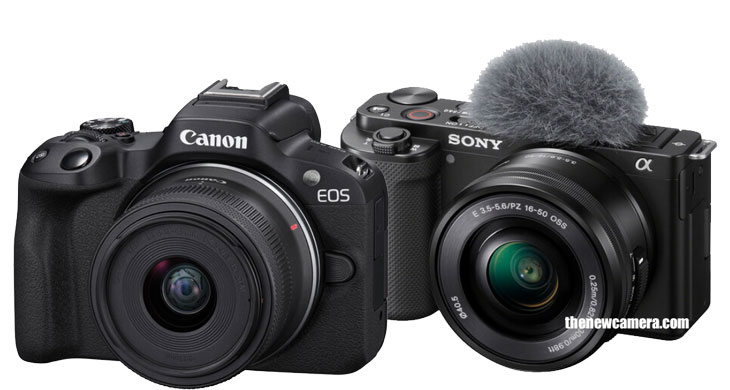
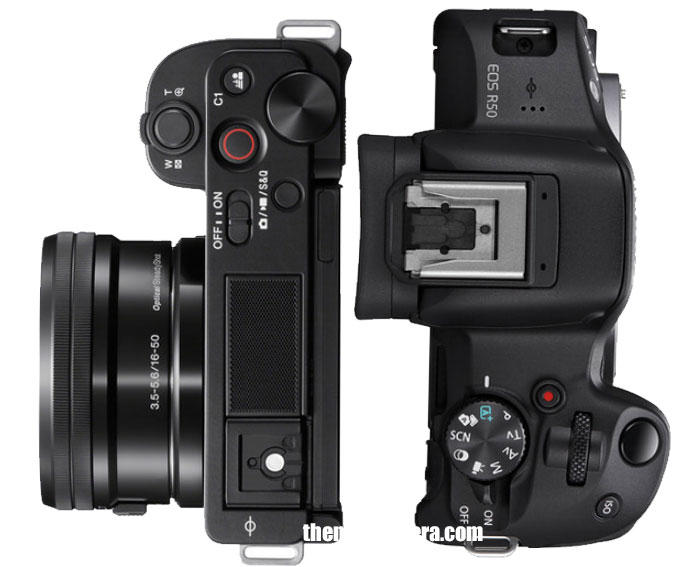
Let’s talk about the body design of both the camera the Canon R50 camera is more photographer friendly with the EVF and the deep hand grip that is missing in the Sony ZV-E10 camera
As you can clearly see Canon R50 and Sony ZV-E10 have different design approaches, Canon R50 has a more traditional, like a DSLR camera with a deep handgrip and also EVF for daylight shooting, while the Sony ZV-E10 may have a more modern, bit more compactish design that looks more vlogger friendly. Ultimately, the best camera for you will depend on your specific needs, shooting style, and set of available lenses (Open lens mount or close etc )
If you are a photographer and looking for a camera that has a more photographer-friendly design, it’s better to look up the Nikon z50 or maybe the Sony A6400.
But we have to also remember that the Canon RF mount supports a limited amount of lenses since it’s a closed mount and in Sony, we have an amazing range of lenses starting from the affordable to the g master series and the Sony lens amount of Sony is open from 2011. so literally, you have to be very conscious before making your decision
Actual: 25 Megapixel
Effective: 24.2 Megapixel (6000 x 4000)
Sensor Type
22.3 x 14.9 mm (APS-C) CMOS
23.5 x 15.6 mm (APS-C) CMOS
Crop Factor
1.6x
1.5x
Image Stabilization
None (Video)
Digital (Gyro Based)
Built-In ND Filter
None
None
Capture Type
Stills & Video
Stills & Video
After the body design let’s compare the internal core specification of both cameras.
The Canon R50 camera features the same 24-megapixel sensor that we have seen in the Canon R10 camera, and also here the Sony ZV-E10 camera uses 24MP sensor, which we have seen in the Sony 6400 camera or A6600 camera.
Electronic Shutter
Up to 15 fps for up to 28 Frames (JPEG) / 7 Frames (Raw) Electronic Shutter
Up to 12 fps for up to 42 Frames (JPEG) / 7 Frames (Raw)
Up to 11 fps at 24.2 MP for up to 116 Frames (JPEG) / 46 Frames (Raw)
Interval Recording
Yes
Yes
Self-Timer
2/10-Second Delay
2/5/10-Second Delay
AutoFocus Performancee
As you can see the number of AF points in Canon R50 is 4503 DPAF points for stills and 3713 DPAF points for Video. And when we compare it with the Sony’s ZV-E10 425 Hybrid AF points the comparison look meaningful less for a moment, but its not about how many numbers of AF points a camera has or fabricated inside it, the key factor of todays Mirrorless AF system in the Artificial Intelligent Algorithms inside the camera, and that’s the biggest reason why despite of having less number of AF points the AF performance of The Sony ZV-E10 is flawless.
Focus Type
Auto and Manual Focus
Auto and Manual Focus
Focus Mode
Continuous-Servo AF, Manual Focus, Single-Servo AF
Automatic, Continuous-Servo AF, Direct Manual Focus, Manual Focus, Single-Servo AF
Autofocus Points
Photo
Phase Detection: 4503 Video
Phase Detection: 3713
Phase Detection: 425
Contrast Detection: 425
-3 to +20 EV
Canon R10 – Fastest Shooting Entry-level camera
For the first time Canon has introduced an electronic shutter inside an Entry level body, now with the help of an electronic setter we are able Burst upto 15FPSbut, but sadly the buffer is limited to 30 Frames of JPEG, so you can hardly have two second buffer slot with the Canon R50 Camera.
Sony ZV-E10 camera has a limited Brust speed of 11 frames per second, but at the same time the buffer memory of Sony’s ZV-E10 camera is much more than that of the Canon R50, with the ZV-E10 camera you are able to record 116 frames of JPEG in a single Brust and 46 frames of RAW0
Since Canon R50 camera uses a Canon R10 camera sensor and the samples of Canon R5 isn’t available right now, that’s why we are keeping the R10 image samples in our comparison list, so you can have an idea how will R50 will perform against the Sony ZV-E10
BASE ISO TEST
In the base are you so test you can clearly see both cameras are performing equally well, the detail capturing ability of both the camera is good at the base ISO range.
HIGH ISO TEST
Now let’s talk about the HIGH ISO TEST of both the camera, As now you can see the Sony ZV-E10 camera is able to preserve slightly more details in some specific situations compared to the Canon R50 Mirrorless camera, so for low light purposes of course Nikon ZV-E10 is bit more helpful.
Video Specs
Internal Recording Modes
H.264/H.265/MPEG-4
UHD 4K (3840 x 2160) at 23.98/25/29.97 fps
1920 x 1080 at 23.98/25/29.97/50/59.94/100/120 fps
H.264/H.265/MPEG-4
UHD 4K (3840 x 2160) at 23.98/25/29.97 fps
1920 x 1080 at 23.98/25/29.97/50/59.94/100/120 fps
Broadcast Output
NTSC/PAL
NTSC/PAL
Built-In Microphone Type
Stereo
Stereo
Best Entry-Level Camera to Record Videos?
Both cameras share exactly the same video Resolution and frame rates, Canon R50 camera as well as the Sony’s ZV-E10 camera records 4K videos up to 30 FPS and full HD videos up to 120 per second. So, for the first time, we have a Canon entry-level model that doesn’t crop in 4K. Undoubtedly it will bring smiles in face of Canon users, those who are waiting to upgrade their cameras from Canon M50 Mark ii or Canon 200D Mark II / SL3 . But, at the same time in 3rd generation of making APS-C Mirrorless cameras, the ZV-E10 is more video oriented and focuses on content creator requirements.
None of the cameras have any time recording limit in 4K 24 and 30 FPS recording video, but yes you have to carry extra battery packs says the batteries dry out quickly with these entry-level cameras when you are recording 4K.
Canon features DIGITAL Image stabilization mode in VIDEO, which we see generally in entry-level cameras, the mode works but with a cost of crop and it becomes unbearable and painful to your hands when you try to vlog with the Canon 18-45 kit lens, the 18mm wide generates a 24mm equivalent focal length of a full-frame camera and after that, once you apply Digital IS Mode, you hardly adjust yourself in the frame. So, if you want to vlog with an R50 camera, better to buy the Canon’s 15-30mm Lens OR at least an RF 16mm F2.8 Lens. But, unfortunately, the RF 16mm lens doesn’t have OIS Support. To better get the 15-30mm lens for vlogging if possible. As you know, we don’t have many options with Canon since the lens mount is locked and we have to select from a limited range of lenses.
But, the biggest surprise is we have a gyro image stabilization system inside the Sony ZV-E10 which works very effectively when you are shooting videos with the camera. Although using Gyro-based data is not that easy, either you have to use the catalyst browse software to stabilize your footage prior to editing, or Sony now also offers Catalyst plugin for premier pro software.
The range of available lenses is much more than you would expect, The Best Sony ZV-E10 Lens for Vlogging in 2023 is Sony 11mm F1.8 Lens, The lens captures a super wide 16mm full-frame equivalent look and a BRIGHT F1.8 aperture perfect for vlogging.
The Sony ZV-E10 also features a 3-capsule-based enhanced internal microphone design that captures audio much better than you would expect from a regular entry-level camera, as well as to monitor that audio you also get an extra 3.5mm headphone port. Which is not available with the Canon R50.
Of course, a Range of dedicated modes is also there which includes face exposure priority, product showcase, and skin softening mode for vloggers.
Interface
Media/Memory Card Slot
Single Slot: SD/SDHC/SDXC
Single Slot: SD/SDHC/SDXC/Memory Stick Duo Hybrid (UHS-I)
Video I/O
1 x Micro-HDMI Output
1 x Micro-HDMI Output
Audio I/O
1 x 1/8″ / 3.5 mm TRS Stereo Microphone Input on Camera Body
1 x 1/8″ / 3.5 mm TRS Stereo Headphone Output 1 x 1/8″ / 3.5 mm TRS Stereo Microphone Input
Other I/O
1 x USB-C Input/Output
1 x USB-C Input/Output
Wireless
2.4 / 5 GHz Bluetooth 4.2 Control
1 x USB-C (USB 3.2 / 3.1 Gen 1) Input/Output (Shared with Power Input)
Mobile App Compatible
Yes *As of February, 2023: Check with manufacturer for the most up-to-date compatibility
Wi-Fi, Bluetooth
Global Positioning (GPS, GLONASS, etc.)
None
None
Best Camera for shooting Still Images and video?
Canon R50 overall design is more appealing to photographers since the camera also features EVF and a better handgrip, we also have an advanced AF system with AI AF object tracking mode and faster burst speed it looks ver impressive. But, at the same time you can see from the results of the High ISO Test, the Sony ZV-E10 sensor is preserving more details, if u want a more video-oriented camera with features like an advance microphone, dual 3.5mm jack, gyro-based IS, and product showcase mode, ZV-E10 best for you.
The Next BIG thing is Canon’s Locked lens mount. So, the range of lenses for an entry-level shooter is less (if you have a limited-budget lens ).
So, overall it depends upon who is buying the camera if he/she is a casual shooter. Not interested in having extra lenses and love the R50 design, then yes for you guys the R50 is best. But for those who are more serious with photography or video at the same time they have a limited budget, better to buy a Sony ZV-E10 camera (or A6400 is you are a photographer).
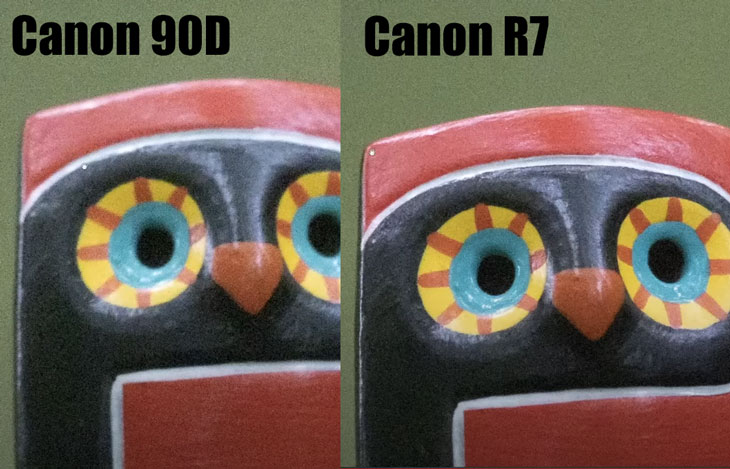
Canon 90D vs Canon R7 @ ISO 6400 – Image Credit Glenn Bartley
let’s compare the image quality of the Canon R7 and Canon 90D cameras. As per the information we have, Canon has updated the Canon R10 24 Mp micro lenses and Canon 90 32.5 Mp Sensor. What I personally feel buy updating the Microlenses, adding DIGIC X image processor with new AF Algo from Canon R3 and a new image decoding algo for Jpeg Files. We should at least see the drastic difference between the image quality of Canon R7 when compared to Canon 90D.
Canon 90D vs Canon R7 @ ISO 12800 – Image credit Glenn Bartley
We have tried to preserve as many details as possible.
Canon 90D vs Canon R7 Image Quality Analysis
No drastic but subtle differences between the two Cameras. Since Canon is in the process of DSLR cannibalization since 2018. So, in 2022 I would never recommend anyone to buy a Canon 90D DSLR camera. The good news is we do have some sensor quality improvement too in the Canon R7. Highly recommended to get Canon R7 Camera instead of Canon 90D.
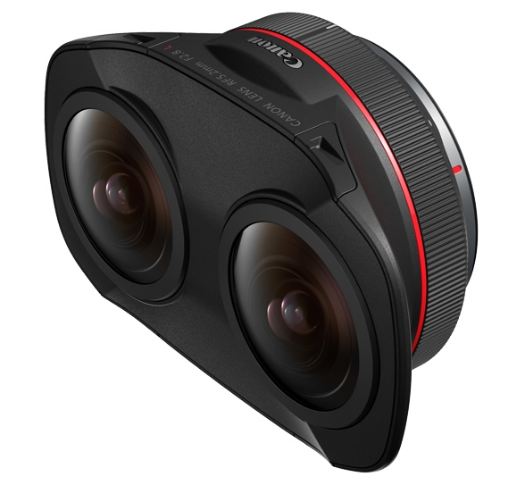
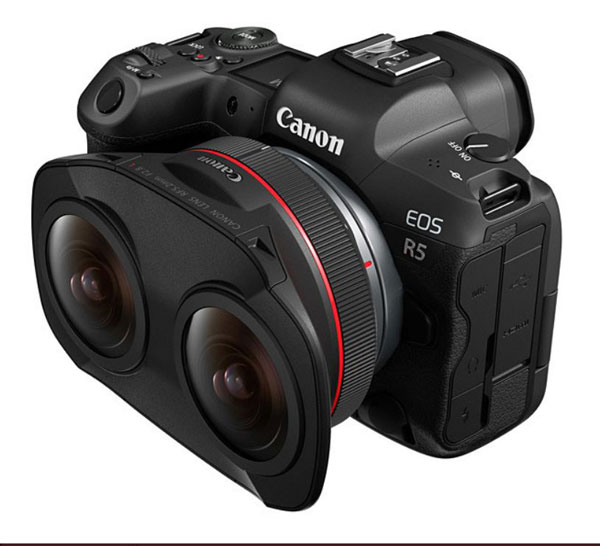
Canon RF lens RF5.2mm F2.8 L DUAL FISHEYE Announced, the shipping of the lens will start from December 2021. A stereo fisheye lens that enables 180-degree VR shooting when attached to the EOS R5. Since VR images normally shot by two image sensors can be shot with a single CMOS sensor, there is no need for left-right synchronization or stitching of the video, and the workflow can be shortened.
Currently, the only compatible model is the EOS R5. It is said that this lens can be used by applying the firmware scheduled to be released in early December.
The intended user is a video producer or company that provides live or event content. Compared to existing VR recording equipment, the advantages of using this product are that it is easy to set, the editing process is reduced, and the difference in brightness is strong by controlling the aperture of each of the left and right lenses.
In addition, the company has “EOS VR Utility” (some functions are charged) that covers 180-degree VR video confirmation, conversion, and editing as post-shooting processing software, and “EOS VR Plug-” that works with Adobe Premiere Pro. “in for Adobe Premiere Pro” is prepared.
The lens configuration is 12 elements in 10 groups, including a UD lens and a prism. The shortest shooting distance is 20 cm. A gelatin filter can be attached to the rear. By adopting SWC coating, it is said that it is strong against backlight photography and has a fluorine coating that enhances maintainability. The lens barrel is dust-proof and drip-proof.
The external dimensions are approximately 121.1 x 83.6 x 53.5 mm. Weight is about 350g.
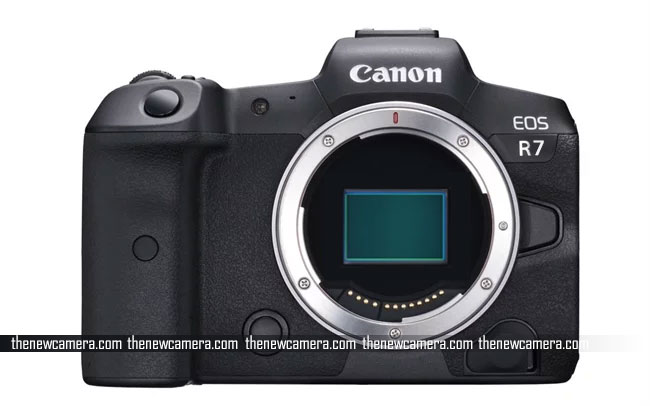
According to the latest rumors coming out from the rumor mill, Canon may announce a new APS-C RF Mount Camera in the second half of 2022. Although before we begin, let me tell you the RF Mount APS-C camera rumor isn’t new (Canon R7 ), we are getting Canon APS-C RF Mount camera rumors for more than a year.
Why Canon APS-C RF Mount Camera may arrive
The most logical reasoning is they have lost the versatility of the DSLR era (one mount for all) and they need to get it back gain.
Since, Canon Discountuned the 7D series camera without any further update, we were expecting they will continue the 7D series with the RF Mount.
I have now been told by a good source that Canon will definitely be bringing an APS-C RF mount camera equipped with a backside-illuminated sensor in the second half of 2022. source CR
28-32MP BSI Sensor
The sources of the rumor mill also added that the upcoming camera will feature a new 28-32MP BSI CMOS sensor. Since Canon has started manufacturing BSI CMOS sensors for their full-frame cameras now we can also expect the arrival of BSI sensors for APS-C.
What trusted sources say about APS-C RF Mount Camera
Nothing, they are silent,
So, it’s good to hear that the Canon APS-C RF Mount camera may arrive at the end of 2022, although trusted sources are silent so as I usually say take it with a grain of salt.
Finally, specification and pricing details of Canon RF 70-200mm f/4L IS USM Lens. When paired with Canon EOS R5 and R6 you will get Image stabilization advtage upto 7.5 stops.
Canon RF 70-200mm f/4L IS USM:
16 elements in 11 groups (including 4 UD elements)
Minimum focusing distance: 0.6m / 23.6″
Maximum magnification: 0.28x
9 aperture blades
77mm filter thread
Maximum stops of IS with the EOS RP and EOS R: 5 stops
Maximum stops of IS with the EOS R6 and EOS R5: 7.5 stops
Buy Canon Lenses, Buy Music CD or Digital Camera at amazon it helps this site, and you do not pay anything extra, it is just a way to help support this site.
New Camera Website, we list all type of new camera information, price review and all type camera rumors, subscribe us or follow us via twitter or facebook.
Disclaimer: We have attempted to select useful information to include on New Camera, and to ensure that the resources we have included on the site -- as well as the way we have described them -- are accurate, fair, and balanced. However, we make no claims, warranties, or other representations concerning the accuracy, completeness, or utility of the information provided, or concerning the abilities or performance of the organizations, agencies, companies, and other resources presented through New Camera


 BOX for Latest NEWS and Rumors