

Nikon ZR and the Canon C50 are both very new and were announced in September 2025. The Nikon ZR is Nikon’s first cinema mirrorless camera. Nikon, the Canon cinema line has been active inside Canon for more than a decade. The Nikon is priced at 2200 USD, and the Canon C50 will cost you approximately 3899. So, we do have a good price difference between these two cameras, but is the price difference between the two really worth it, meaning if you are someone who wants to do a fresh start, should you move towards a Canon or Nikon cinema camera? Or if ur a professional and not limited in any sort of budget boundaries, which camera should you choose? If you were searching for Nikon ZR vs Canon C50 comparison, then you have reached the right page. We have done the Most Detailed Specification Comparison between the two, lets dive into the details
Specification Comparison
| Feature | Nikon ZR | Canon EOS C50 |
| Sensor | 24MP full-frame partially stacked CMOS (from Z6III) | 32MP full-frame CMOS (new, non-stacked) |
| Max Video Resolution/FPS | 6K up to 60fps (uncropped); 4K up to 120fps (1.5x crop); 4K60 uncropped | 7K up to 60fps (RAW, 3:2 Open Gate); 4K up to 120fps (uncropped); 2K up to 180fps |
| Codecs | REDCODE RAW (R3D NE, 12-bit, internal); N-RAW; ProRes RAW; ProRes 422 HQ; H.265 | Canon Cinema RAW Lite (12-bit, internal); XF-AVC; XF-HEVC |
| Color Science & Log | REDWideGamutRGB + Log3G10; N-Log; Nikon colors | Canon Log 2/3; Wide DR; PQ/HLG/Canon 709/BT.709 |
| Oversampling | 6K to 4K oversampled for enhanced detail; | 4K up to 60fps oversampled from 7K (or 6.9K for 4K30) |
| Sensor Modes/Crops | Full-frame uncropped in 6K/60; 1.5x crop in 4K/120; Hi-Res digital zoom | Full-frame 3:2 Open Gate (7K full height); Super 35/16 crops; Simultaneous wide + vertical/square crops (fixed position, from cropped wide frame) |
| Dynamic Range | 15 total stops in 6K RED RAW; W | 15+ stops in full-frame (Log/RAW) |
| Rolling Shutter | Sub-10ms (9.1ms in 6K RED RAW); Excellent for fast action | Not fully tested |
| Audio | 32-bit float (built-in mic + 3.5mm); OZO processing (directional, zoom, isolation, cleanup); Multi-interface hotshoe | 24 Bit via XLR (via included handle); 3.5mm mic/headphone; Recording levels; Shotgun mic mount |
| Stabilization | IBIS + Electronic (same as Z6III); Lens-based optional | Digital compensation + lens-based optical; No IBIS |
| Ports & Connectivity | Micro HDMI; USB-C (UVC webcam up to 1080p60); 3.5mm mic/headphone; Multi-interface hotshoe | Full-size HDMI; USB-C; Timecode terminal; Remote; 3.5mm mic/headphone |
| Media Slots | 1x CFexpress Type B + 1x MicroSD (bottom-mounted; no redundant recording) | Dual: 1x CFexpress + 1x SD |
| Battery Life & Thermals | ~2 hours 6K RAW (EL15 battery); Fanless, no overheating (tested up to 32°C/90°F); 2-hour 5-min record limit | LP-E6P battery; Active cooling (fan) for extended recording; No known limits mentioned |
| Other Video Features | User LUT import (up to 65-point, RAW-only); Tally lights; Audio cues; Frame continuity challenges due to card access; RED intercutting | Frame.io support; Canon XC protocol; Multi-camera control/app transfer; Pre-burst in photos; Electronic burst up to 40fps (photos) |
Resolution and Open Gate, anamorphic recording
In both the comparison tables, it is very clearly visible that the Canon C50 has supremacy in resolution; you can easily record 7K videos up to 60 frames per second and 4K 120fps uncropped with this Canon C50 camera.
Availability of Open Gate recording, which is 7K 60fps RAW in 3:2 format, available at Canon C50. Another major advantage apart from all these is the anamorphic recording ability and in-camera de-squeeze functionality.
So with Canon, you can go wider with anamorphic (in-camera de-squeezing), ultra slow motion videos without any compromise or crops, at the very same time you can use anamorphic ultra-wide lenses even while recording 4k 120fps, that’s great for sure.
Nikon ZR approach is more traditional, in the limited price range we are getting REDCODE RAW R3D 12-bit internal recording, at the very same time the same spec has been used in higher-end RED cameras like the Komodo or the V-Raptor, so it’s a boon for solo creators to have such a format in this price range.
Audio is one of the most important parts of the video, and the Nikon ZR is the only camera in between the two that offers 32-bit float audio recording capability. Again, it’s another boon for solo creators to record the highest quality audio possible without investing heavily in an audio setup. OZO has been added to the Nikon ZR, which is responsible for background noise reduction while recording with internal mics. With the help of the DJI Mic 3, which is also able to record 32-bit float audio, you can generate high-quality audio files while pairing up with the Nikon ZR camera.
The Canon is limited to 24-bit audio despite the XLR handle and inputs in the camera so that’s the limitation we have with the Canon C50.

Active cooling in Canon C50 [Only in Canon C50]
Active cooling effectively makes the recording time limit indefinite. C50 also utilises a higher-resolution sensor of 32MP, which generates more heat while recording videos or oversampling compared to a 24MP sensor. To prevent any kind of overheating issues and maintain the highest recording quality possible, Canon has added a built-in fan that will keep the camera cool for longer periods of time.
The Nikon ZR features a fanless body, but Nikon claims its heat sink is significantly improved over the previous generation of Nikon cameras. We can record 6K 60fps videos for up to 2 hours and 5 minutes at 32°C without interruption. So obviously, with Nikon ZR, you can record longer videos without any significant worries.
Sensor-shift image stabilisation system [Only in Nikon ZR]
The Nikon ZR does feature a 7.5 to 8 stops of sensor-shift image stabilisation system that we have already seen in the Nikon Z6 Mark III and the Nikon Zf camera. The IBIS mechanism of the Nikon ZR is intelligent and recognises the human body and face, and when your VR lens is linked with the autofocus point, you get a maximum of 7.5 stops of advantage even in the corner of the frame. In Canon, there is no sensor-shift image stabilisation system, so you have to depend upon rigs or gimbals.
Body Design Overview
Both camera features a boxy style design. Well, the Canon C50 will be more convenient to a professional cinematographer since it already has a large handgrip, multiple Mount screw holes, even on the top plate of the camera. At the same time, a full-size HDMI port and an option for an XLR handle help to create an easy professional workflow.
With a Nikon ZR camera, it seems like we have to again use an external hand grip from grip makers like a small rig, since the grip is really very small, very similar to the Nikon Zf. Another most irritating thing is we are missing a Standard SD card slot, either u use a microSD card slot or CFexpress Type B. Comparing it to the Nikon ZR is more tilted towards a solo creator, which has all the bells and whistles that a solo creator may wish to have in their camera.
| Aspect | Nikon ZR | Canon EOS C50 |
| Dimensions (W x H x D) | 133 x 81 x 49 mm | 142 x 88 x 95 mm |
| Weight (Body Only) | 630g | 670g |
| Build Material | Fiber-reinforced plastic; rugged, lightweight | Not specified (durable cinema-grade construction assumed) |
| Grip/Handling | Minimal grip; boxy, EVF-less; gimbal-friendly but requires third-party cages for pro rigs | Decent integrated grip; flat-topped with handle for better handheld stability |
| Ergonomics | Video-focused UI; tiny joystick, zoom rocker, 3 custom top buttons; minimal for solo creators but cumbersome for cinema (e.g., bottom card access) | Cinema-optimized UI (separate photo/video modes); joystick, thumb wheel, 14 assignable buttons, 3 custom dials; highly customizable for pro workflows |
| Overall Feel | Vlog-like (similar to Sony ZV-E1); portable but needs accessories for cinema use | Cinema-ready (akin to Sony FX3 or Canon R5C); bulkier but more robust out-of-box |
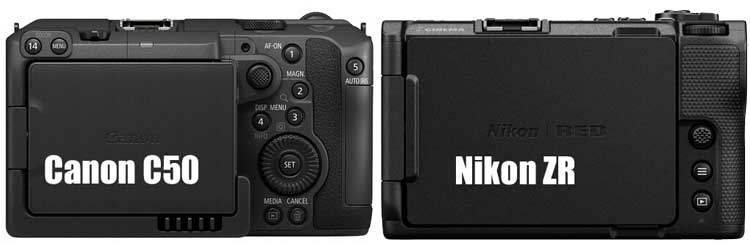
Display Comparison
Both cameras rely solely on rear screens for composition (no EVF or accessory viewfinder option), but the Nikon ZR’s display stands out for size and brightness, aiding outdoor monitoring. The C50’s screen is smaller but highly functional with touch controls.
| Aspect | Nikon ZR | Canon EOS C50 |
| Size | 4 inches | 3 inches |
| Resolution | 3.07 million dots (1280 x 800 pixels) | 1.62 million dots (900 x 600 pixels) |
| Brightness | 1000 nits (peak) | Not specified (standard for cinema cameras; likely 300-500 nits) |
| Type/Features | Articulating; 16:10 aspect ratio; P3 color gamut support for accurate previews; touch-enabled | Side-hinged vari-angle touch panel; flips for self-facing; customizable peaking (Peaking 1/2) |
| Advantages | Larger and brighter for better visibility in bright environments; excellent for monitoring | Compact and versatile articulation; integrated touch UI for focus and settings |

Expanding on ports, slots, mounting, cooling, and accessories, the C50 leans more professional with comprehensive connectivity and included extras, while the ZR prioritizes simplicity and silence.
| Aspect | Nikon ZR | Canon EOS C50 |
| Ports | Micro HDMI; USB-C (3.2); 3.5mm mic/headphone; Digital hotshoe (supports audio adapters, future XLR) | Full-size HDMI (Type-A); USB-C (3.2 Gen2); 3.5mm mic/headphone; 2x XLR (via handle); Timecode (DIN1.0/2.3); Remote (2.5mm); DC input |
| Card Slots | 1x CFexpress Type B + 1x UHS-I microSD (bottom-mounted; microSD for settings/LUTs, not backups) | 1x CFexpress Type B + 1x SD/SDHC/SDXC (side-mounted; supports relay/simultaneous recording) |
| Mounting Points | Single 1/4-20 bottom thread; gimbal-friendly but limited; third-party cages recommended | Multiple rigging threads; Alignment pin behind tripod thread; Multi-accessory shoe for adapters (e.g., PL-RF, EF-EOS R) |
| Cooling System | Passive (fanless); Efficient heat dissipation; No overheating in tests (up to 125 min with USB power) | Active (quiet fan with large vent); Designed for unlimited long recordings |
| Included Accessories | None specified (battery, charger assumed standard) | Detachable handle (with XLR, REC/zoom controls, mic mount); LP-E6P battery; LC-E6E charger; Mic holder; Shoulder strap; USB-C cable; AC cable |
| Other Notes | Silent operation ideal for audio-sensitive sets; 32-bit float audio via ports/hotshoe | Built-in stereo mics; Ethernet via USB-C adapter; Frame.io integration for cloud workflows |

Pros and Cons of the Nikon ZR
| Pros | Cons |
| Affordable at $2,200 with internal 12-bit RED RAW for pro workflows | Ergonomics favor vlogging (no grip, bottom cards, tiny joystick) |
| Low rolling shutter (sub-10ms) for smooth action footage | Micro HDMI and no XLR; Limited ports for cinema rigs |
| Innovative 32-bit float audio with built-in OZO enhancements | High RAW data rates (~190-470 MB/s); Short record times on smaller cards |
| Lightweight (630g) and fanless with excellent thermals (~2+ hours) | No 14-bit RAW option; Overprocessed non-RAW modes (e.g., H.265 inaccuracies) |
| Superior 4-inch, 1000-nit screen for monitoring | Weak stabilization for dynamic shots; 2-hour 5-min arbitrary limit |
| Versatile zoom rocker and quick boot-up; UVC webcam support | LUT import limited to RAW; No redundant recording |
| Strong value as a B-cam for RED users or vlog upgrade | Inferior for photos compared to hybrids like Z6III |

Pros and Cons of the Canon EOS C50
| Pros | Cons |
| High-res 32MP sensor with 7K/60 RAW and 3:2 Open Gate for flexibility | Higher price at $3,899; No IBIS (relies on digital/lens stabilization) |
| Oversampled 4K/60 from 7K for sharp, detailed footage | Non-stacked sensor may have higher rolling shutter than competitors |
| Uncropped 4K/120 and 2K/180 for high-frame-rate options | No built-in ND filters; Audio requires handle (included but adds bulk) |
| Dual slots (CFexpress + SD) with easy access; Timecode support | Heavier (670g) and bulkier than some compacts; No viewfinder option |
| Active cooling for unlimited recording; Included XLR handle | Photos use electronic shutter only (potential rolling shutter issues) |
| Simultaneous wide + vertical/square crops for social media workflows | Vertical crops fixed (no tracking); Oversampling from cropped frame |
| 15+ stops DR and Dual Base ISO for low-light performance | Less affordable for entry-level filmmakers; No 32-bit float audio |
| Cinema-focused build with rigging threads and custom buttons | Screen resolution lower (1.62M dots) than some rivals |

Who Should Buy the Nikon ZR?
The Nikon ZR is made for budget-conscious content creators, vloggers, and hybrid shooters entering cinema workflows. It’s ideal for:
- Solo filmmakers or YouTubers: If you are a solo filmmaker or YouTuber, looking for a budget solution, the Nikon ZR is the best camera for you. The additional advantage we are getting with this camera is the ability to record 32-bit audio, and OZO processing simplifies run-and-gun setups.
- RED Ecosystem Users: Yes, you can use it as your primary camera; don’t underestimate its power; it inherits all the goodness of RED cameras, perfect for indie productions or commercials needing affordable RAW.
- Hybrid Photographers: Yes, you can capture some still shots if you wish to, but primarily it’s
- Avoid if: You need robust cinema ergonomics out of the box or uncropped high-FPS— go with the high budget cams then
Buy the Nikon ZR if ur overall budget is somehow limited within $3000 (since u have to buy lenses, lights, tripods, backdrops) so a lot of spending is still left even once you buy the camera.
Who Should Buy the Canon EOS C50?
The Canon EOS C50 targets professional videographers and small cinema teams seeking a bridge between hybrid and dedicated cinema cameras. It’s suited for:
- Narrative Filmmakers: 7K Open Gate, 4k 120FPS uncropped, Pro body controls and ports, no compromise in features from inside to out, the only thing that you miss in the Canon C50 is the IBIS, but as most of the production houses place their camera on heavy rigs / moving platforms, they actually didn’t need IBIS, a bunch of Canon RF and and Canon CNR lenses available for the pro cam.
- Multi-Cam Productions: Timecode, XLR, Anamorphic lenses support and in-camera de-squeez, and app control enable synced setups; active cooling handles long shoots like events or interviews.
- Canon Ecosystem Loyalists: CNR Lenses as well as RF lenses support and Log2/3 integrate with C70/R5C; 32MP photos with 40fps burst appeal to hybrid pros (e.g., wedding videographers).
- Avoid if: You’re on a tight, pls ge the Nikon Zr or Sony FX30
Choose the C50 if you can afford $3,899 and need cinema-grade tools like Open Gate or high DR for commercials/docs. It’s for those prioritizing flexibility in post (e.g., reframing) over the ZR’s RAW affordability, as evidenced by its positioning above the R5C but below the C70.
Get Canon C50 from amazon.com | B&H Store
Get Nikon ZR from amazon.com | B&H Store
GET LIVE NOTIFICATION Your Trusted Source GET LIVE NOTIFICATION Click ON Check  BOX for Latest NEWS and Rumors
The article “Nikon Zr Official Press Release” was written by thenewcamera.com team on 6:09 am, Wednesday, 10 September 2025, Greenwich Mean Time (GMT) | You can also follow us on Our Official Social Media Handles FACEBOOK | TWITTER | INSTAGRAM to get live news — > get live news + Nikon Rumors + Camera News + Canon Rumors 24X7.
Best Lenses for Canon C50 Camera: Unlock Epic Cinematic Power with CN-R and RF Lenses in 2025