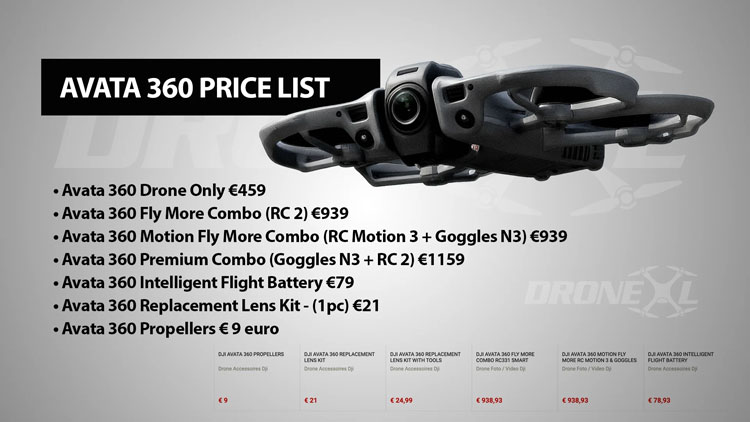
Finally, we have the official price list of the DJI Avata 360 drone, and the official pricing was revealed just 24 hours after DJI dropped the official teaser of the DJI Avata 360 drone. A major European retailer accidentally, whether it is knowingly or unknowingly, published the full pricing of the product on their product page, and luckily, a few subscribers were able to grab it. Jasper Allen was the first to report it on his Twitter account, adding an authenticity stamp over it. We now have a big, clear pricing of each product, which includes bundle and standalone DJI Avata 360 drone, the batteries, and everything is very clear in the screenshot below.
Converted at the current mid-market rate (1 EUR ≈ 1.16 USD). We’ve added direct comparisons to the brand-new Antigravity A1 (the 8K 360° competitor launched late 2025) and the original DJI Avata 1 (2022 model, now heavily discounted in 2026), so you can see exactly why the Avata 360 is such a game-changer.
Product
European Price (EUR)
US Equivalent (USD)*
How It Compares to Current Drone Prices (March 2026)
DJI Avata 360 Drone Only
€459
$533
Huge win — undercuts the Antigravity A1 Standard Bundle ($1,599) by over $1,000 while adding 8K replaceable lenses.
DJI Avata 360 Fly More Combo (RC 2)
€939
$1,089
DJI Avata 2 Fly More Combo ($849) — with 8K + replaceable lenses. Destroys Antigravity A1 Standard Bundle ($1,599) on price while offering a similar 360° FPV experience.
DJI Avata 360 Motion Fly More Combo
€939
$1,089
Antigravity A1 doesn’t even offer this bundle under $1,899.
DJI Avata 360 Premium Combo
€1,159
$1,344
Scheaper than Antigravity A1 Explorer Bundle ($1,899).
Intelligent Flight Battery
€79
$92
Antigravity A1 extra batteries push $150+.
Replacement Lens Kit (1pc)
€21
$24
A1 replacement lenses are $40–60.
Propellers (set)
€9
$10
Cheaper than a coffee. Antigravity A1 prop sets run $15–25. Original Avata 1 props were similar but less durable
DJI Avata 360 Fly More Combo for just €939 — that’s the headline deal everyone is talking about. For less than a thousand euros you get the drone, extra batteries, charger, and the new RC 2 controller. Insanely good value compared to the Avata 2 launch pricing.
DJI Avata 360 vs Antigravity A1: Cheaper Price
As you can see, we have a very big price difference between the Antigravity A1 drone, the competitor drone, and the DJI Avata 360. So obviously, being more affordable, the drone will have more reach. Other than that, those who don’t want to buy a 360 drone and just want an FPV drone can easily switch the modes in the DJI Avata 360, where the Avata 360 will start working as a standalone FPV drone, just like the previous generation of our Avata drones. But this cannot be done with the Antigravity A1; you cannot switch modes. It’s fixed that it can only capture 360 videos.
Revolutionary 8K Camera Module with User-Replaceable Lenses
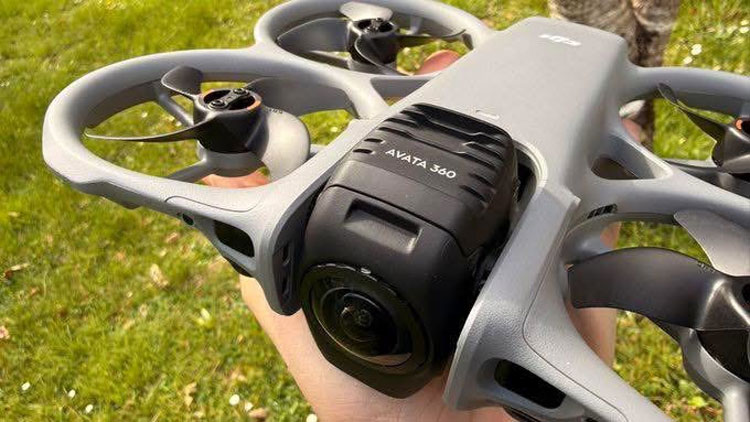
This is a first for DJI FPV drones. The DJI Avata 360 features an all-new 8K camera that uses interchangeable lenses. The leak shows a dedicated replacement lens kit priced at just €21. No more sending the entire drone in for repairs after a lens scratch — just swap it yourself in seconds.
Close-up shots confirm the lens sits behind a protective cover that looks far more crash-resistant than previous Avata models. Expect cinematic 8K footage with the same legendary DJI colour science that made the Avata 2 a YouTube favourite.
DJI Avata 360 Can Switch to “Normal Mode” — Fly Like a Mini or Neo
One of the most exciting leaked features: the Avata 360 will have a Normal Mode toggle.
You’ll finally be able to fly this beast like a regular camera drone (similar to the DJI Neo or Mini series) when you don’t want full FPV immersion. Perfect for beginners or when you just want smooth cinematic shots without the goggles.
This makes the Avata 360 the most versatile FPV drone DJI has ever released — combining the thrill of Avata-style acro flying with the ease of a Mini 5 or Neo 2.
Official Release Date Confirmed
China / Asia: March 26, 2026 (DJI Store launch)
Worldwide (US, Europe, India, Australia, etc.): April 9, 2026
That’s 16 days of official teaser marketing — the longest DJI pre-launch campaign in years. Multiple sources now confirm that DJI has lifted NDAs early, meaning reviewers and creators will flood YouTube with real flight footage before the global launch.
Mark your calendar for April 9, 2026 — the day the DJI Avata 360 officially changes the FPV game again.
Stay tuned for more updates
The article “DJI Avata 360 Official European Price List Revealed” was written by thenewcamera.com team 4:39 pm, Wednesday, 11 March 2026, Greenwich Mean Time (GMT). | You can also follow us on Our Official Social Media HandlesFACEBOOK | TWITTER | INSTAGRAM> get live news — > DJI Rumors
If you’ve been eyeing an Xtra camera but held back because of “no wireless mic support”… stop scrolling. Since a major firmware update was dropped in February 2026, every single Xtra camera — including Xtra Muse, Xtra Atto, Xtra Edge Pro, Xtra Edge, and Xtra Sphera360 can now connect wirelessly to DJI Mic Mini and DJI Mic 2.
So technically, this firmware update solves everything – specifically for a DJI user, those who were actually a little confused about getting an Xtra Muse or Xtra action camera due to ecosystem synchronicity. But right now, we have the same – the same – ecosystem as DJI, supporting the Xtra range of cameras.
And now the Xtra Muse becomes an excellent deal compared to the DJI Osmo Pocket 3, thanks to full ecosystem support.
The Firmware Update Creators Have Been Waiting For
The Xtra Muse is an almost exact copy of the DJI Osmo Pocket 3, but the only missing link was the ecosystem. A wireless mic pairing was not available with the Xtra Muse before the firmware update. Now, after the update, the camera has become an amazing alternative to the Pocket 3 at a lower price.
With this update, take a look wat hat you are getting:
DJI Mic Mini pairs instantly via Bluetooth.
DJI Mic 2 works with full 32-bit float audio — the same pro-level protection against clipping you get on real DJI gear.
Live audio meters pop up on-screen, exactly like the Pocket 3 or Osmo Action.
In short: Xtra just became a full member of the DJI audio ecosystem – at half the price.
Every Xtra Camera That Now Has Native DJI Mic Support
Model
What It’s For
Killer Specs
DJI Mic Compatibility
Xtra Muse
Pocket vlogging & travel
1″ CMOS, 4K/120fps, 3-axis gimbal
Mic Mini + Mic 2 (32-bit float)
Xtra Atto
Tiny POV & hands-free
54g, 4K/60fps, 220-minute battery
Mic Mini + Mic 2
Xtra Edge Pro
Rugged action & adventure
1/1.3″ sensor, 4K/120fps, tough build
Mic Mini + Mic 2
Xtra Edge
Everyday action cam
Compact, reliable all-rounder
Mic Mini + Mic 2
Xtra Sphra360
Immersive 360° content
True 8K panoramic, 1″ equiv. sensors
Mic Mini + Mic 2
Whether you’re filming solo vlogs with the Muse, running trails with the Atto, or capturing mind-blowing 360 with the Sphera360, your audio just went pro.
How to Connect the DJI Mic Mini to Any Xtra Camera (Takes 20 Seconds)
Creators are calling this the easiest pairing they’ve ever done. Here’s exactly how:
Update firmware (see next section).
Turn on your DJI Mic Mini (or Mic 2 transmitter).
On the Xtra camera: Settings → Wireless Mic → Connect.
Put the mic in pairing mode.
Tap Pair on the camera screen.
Done. Audio bars (1–5) appear immediately.
It feels 100% like using a native DJI camera. Many say the clean green Xtra menu actually looks better.
How to Get the New Firmware (Super Simple)
Pro tip: This update is only available through the Xtra app right now — not on the website.
Download/open the Xtra app on your phone.
Connect your camera via Wi-Fi or cable.
Look for the firmware notification (it started rolling out late last night).
If you don’t see it, force-close the app and reopen.
Update takes 2–3 minutes. Once done, the “Wireless Mic” menu magically appears.
This is all about the Xtra update — you can now have full synchronicity with DJI Mic Mini and DJI Mic 2, and that’s the best part of this firmware update. From now on, there’s no further hesitation in picking an Xtra product, since they are available at a much more affordable price compared to the DJI Osmo Pocket 3.
Nikon Z RC rumours are now heating up, and fresh leaks suggest that the Nikon video powerhouse’s budget entry-level APS-C dedicated expert video camera is set to arrive in 2026. If we discuss the camera ZRC, it carries forward the video-first DNA of the ultra-popular Nikon Z50 II, featuring an ultra-portable body design similar to that of the Nikon Z30. To reduce production costs and simplify the production line, it does not feature any mechanical shutters or electronic viewfinders. The camera is equipped with 4K 60p recording capability, the same as found in the Nikon Z50 II, and supports 10-bit internal recording simultaneously. Red colour profile supports professional recording demands. If the whispers hold, expect a Nikon Z RC release date in Q4 2026, priced at a creator-friendly $649-799 body-only—mirroring the Canon EOS R50V launch tag for maximum market disruption.
Nikon Z RC Design Rumours: Z30 Slimness, No Compromises on Portability
The Nikon Z RC camera body will be approximately the same as what we have already seen with the Nikon Z30, but will be much improved in terms of control, overall design, and heat management, refined for 2026 creators.Better to say it’s a mini ZR,
Nikon ZRC Key rumoured design perks:
Front weather-sealing for light-duty adventures.
ZR-inspired dials and a dedicated video button for intuitive handling.
Front / Rear Tally lamp to signal recording—bye-bye awkward cuts.
SD slot and USB-C PD charging for seamless workflows.
Battery? The same EN-EL25a as the Z50 II, promising ~330 CIPA shots or 75 minutes of 4K video.
Nikon Z RC Sensor and Processor Leaks: 20.9MP DX with EXPEED 7 Muscle
Then the Nikon Z RC is expected to use the same 20.9MP sensor that we have already seen in the Nikon Z50 II, but this time, much much-improved AF by using the Nikon Z9 AF algorithms to process faster AI AF tracking of moving subjects and stick to the subject’s face despite multiple distractions while capturing video.
To make it very clear, it has been reported several times that Nikon is testing prototypes of a 20.0 Mp Dedicated Entry Level Cinema camera to compete against the Canon R50V, as well as 26 – 33MP class DX-format camera for hybrid shooters and photographers (A6700 competitor), which we have also covered in our Nikon Z90 camera post. So, for now, a higher-resolution sensor is expected to arrive in a Nikon Z90 body in 2026, but not in the Z RC
No IBIS (in-body stabilization) per the leaks, but lens VR compatibility covers you. Noise reduction algorithms promise cleaner high-ISO files, making it a steal for low-light environments.
Nikon Z RC Video Specs Rumors: 4K/60p 10-Bit from Z50 II, No Overheating Drama
The report that we are getting from someone who has already used the prototypes of this DX-format camera, but keep in mind these are early prototypes being tested in the wild and are not part of the final production line. Its is yet to be approved by Nikon’s marketing team,
The Nikon Z RC rumours confirm a full transplant of the Z50 II’s cinematic toolkit into this tiny body. Say goodbye to the Z30’s 8-bit limits—hello, 4K UHD 60p (1.5x crop for gimbal stability) or uncropped 30p in 10-bit H.265. N-Log and HLG profiles enable pro grading, while Full HD 120p unlocks 4x slow-mo silkiness.
Nikon ZRC Standout rumoured video features:
125-minute max recording without thermal throttling.
Waveform/zebra monitors and focus peaking for exposure ninjas.
Product Review mode: AI auto-framing for effortless vlogs.
Mic/headphone jacks—no external rig required.
These Nikon Z RC Additonal video specs could make it the go-to for 2026 content creators, outpacing rivals in bit-depth without the bulk.
Nokia OZO Audio (5 Pickup Patterns): Software-driven spatial audio with omnidirectional, cardioid, supercardioid, bidirectional, and figure-8 patterns for immersive soundscapes in H.265/H.264 modes; integrable via app/firmware like existing wind noise reduction.
Breathing Compensation: Automatically corrects lens “breathing” (focal length shifts during focus pulls) for smoother, cinematic focus transitions.
Advanced LUT Management (Up to 10 Custom LUTs): Load and apply multiple 17/33/65-point LUTs for real-time color grading in Log modes (e.g., N-Log, RED Log3G10) at various frame rates.
Dual Base ISO: Two native ISO settings (800/6400) for optimal low-light noise performance in Log profiles, reducing grain in shadows/highlights.
Autofocus and Connectivity: AI Tracking Meets Creator Tools
Nikon’s 209-point hybrid AF with 9-subject detection (people, animals, birds, vehicles)—Eye-Detection locks onto eyes even in video chaos. Touch AF on the flip screen keeps it beginner-proof, while customizable Fn buttons speed up quick tweaks. Using inherited algorithms and deep-learning technology from the Nikon Z9, the Nikon Z RC will also feature an improved 3D-tracking system that seamlessly follows moving subjects, along with the introduction of more vlogging-speci
Nikon Z RC Price and Release Date
The Nikon Z RC price rumour? A body-only $649.99-$799spot-on spot-on with the Canon EOS R50 V’s April 2025 debut. Kit with the 16-50mm VR lens? Around $849. This aggressive pricing slots it below the Z50 II while undercutting Sony and Canon in the APS-C video wars.
As for the Nikon Z RC release date, leaks point to Q3/Q4 of 2026. With bundles including extra batteries.
Still, a lot of things are being kept as a surprise, and it is not the right time to reveal every detail about the camera in public. The information we have now is coming from someone who has tested the prototype; once the review units get distributed among photographers and cinematographers, more information via various leaks and sources is expected to surface across different channels.
About Nikon’s full-frame camera lineup, our sources say that two more professional full-frame cameras are currently being developed inside Nikon’s labs, and most probably we may see a glimpse of one at the very end of 2026. It could come in the form of a teaser, not an official announcement, but yes, after the successful market response of the Nikon ZR, Nikon has decided to expand its cinematography lineup.
The article “Nikon Z RC Rumors 2026: Leaked Specs, Price, and Arrival Time” was written by thenewcamera.com team on 9:01 am, Sunday, 21 December 2025, Greenwich Mean Time (GMT) | You can also follow us on Our Official Social Media HandlesFACEBOOK | TWITTER | INSTAGRAM > get live news + Nikon Rumors 24X7
The Insta360 is not only working on 1 or 2 drones; they are working on multiple drones and flight machines with 360 capturing capability, and in this article, we are going to discuss some of them that we have sorted out.
The Antigravity A1 drone was successfully announced on December 4, 2025, and it has created a lot of buzz in the media. Specifically, this beast of an under-250-g drone has officially become the world’s first drone to capture 360 videos in 8K. The AI-powered drone is just not a drone. It’s a panoramic powerhouse, specifically designed for content creators, filmmakers, and those who love to capture everything in the greatest detail possible.
If you’re googling Insta360 drones 2026 or best upcoming 360° drones, you’ve landed in the right spot.
Antigravity A1 Announcement Breakdown: DJI Neo Compatitor in the announcement pipeline
In the announcement pipeline, we have a DJI Neo series competitor, which is already being tested, and the prototype has been spotted multiple times
compact black drone with Insta360 branding on top, as well as foldable arms and ringed propeller guards, which were spotted while testing in the wild. As usual, drone makers like DJI or Insta360 do a lot of wild testing before announcing their final product. The drone design suggests a very lightweight build, looking very similar to the DJI Neo. It is very much obvious that it will be a lightweight drone, which falls somewhere in the ultra-lightweight category, similar to DJI’s Neo 150-gram drone series. One thing that is really interesting is that, unlike its bigger brother, which is able to capture 8K 360 video, in this leaked image, we are not able to detect the camera position. So the second model’s camera integration remains speculative — it’s very sleek and portable. More about this drone here
But the real magic? Patents that solve drone woes head-on
From the patent, we were able to find that. But the good thing is that Insta360 is right now only focusing on 360 drones, not normal ones, so DJI is quite a bit safe right now in its territory and doesn’t have any direct competition.
Patent Flying Saucer Concept-Based Mini 360 Drone
So we have a completely new design here. It’s not the regular drone you are thinking about; it looks like a flying saucer with a central wing assembly mount that positions the fuselage and props outside the panoramic lens field of view.
So that’s quite a nice idea. If you want to capture a 360 view of your room or indoor space, and you don’t want a hefty setup. – One of the most unique designs I have ever seen for a drone. The patent document claims 30% more flight time than the regular drones with this unique design.
Text from patent – up to 30% more flight time per patent claim. Paired with asymmetric arm groups (Patent CN202510xxx 1a top dome lens, 2a bottom gear, 3a arms), the A1’s first lens clears the upper arms for skyward views, while the second evades lower props for ground-level glory. Result? Reduced occlusion by 40%, minimal protrusion for crash-proofing, and footage that’s ready for Insta360 360° drone editing straight out of the air.
Gesture Magic Coming to Insta360 Drones: Wave, Snap, Fly
The Antigravity A1 drone doesn’t support hand gestures/movements; no hand-free support or the palm launch is available as of now. The Antigravity A1 drone uses a grip controller for its free motion mode, so you can point the controller or change the direction in the flight.
So specifically, the hand gesture support and controls are being developed for the upcoming compact drones, one that we have already discussed. Some new ultra-compact drones are coming; Insta360 is actively working on multiple prototypes of small, handy drones for indoor use.
Hands-free piloting is specifically coming with compact drones just gotten smarter. Drawing from Insta360’s Human-Computer Interaction embodiment (2025 filing), the upcoming compact drones from the Antigravity series will detect and respond to gestures across multiple users in real-time video frames. It scans N detection boxes, cherry-picks M targets for hand Localisation, and cross-references historical frames for rock-solid recognition – slashing compute time by 30% while boosting accuracy.
Patent icons spell it out: OK hand (takeoff), peace sign (record), thumbs up/down (hover/land), pointing fingers (directional pan), fist bump (emergency stop), and four-finger spread (zoom). In group shoots, it filters distractions for seamless HMI, making the A1 ideal for collaborative upcoming Insta360 drone adventures. No remotes needed – just gesture from afar, and watch it obey.
Fold & Fly: Rotatable Arms for Pocket-Sized Portability
Ultralight-weight drones are coming; they’re highly portable, easily fit in your pocket, the ultralight body carries a cylindrical-style design and housing, and a lens mounted over it captures the 360 view. These drones seem to be the most pocketable / ultra-compact 360 drone ever built.
Bulk be gone. The Panorama UAV Utility Model patent showcases the A1’s genius: a rotatable arm assembly (130: boom base, 131/132: folding joints) that pivots from flight-ready horizontal to storage-vertical, snug against the central body (120: cylindrical housing, 111: lens mount). A fixing component (410) locks it tight, with prop guards (310) folding in for a 60% size slash.
Schematics reveal top/bottom cameras (220) nestled safely, protected from travel dings or crushes. This compact design—echoing the bottom-view skid mounts (labels 1/2) for stable landings—means backpack-ready hauls without sacrificing lift. Users rave about the “pro-level UX,” preventing arm snaps and easing transport for on-the-go creators eyeing Insta360 foldable drones 2026.
Deployable Power: Emergency Pro Mapping That Turns Drones into Heroes
When fun meets function, the A1 shines. The Emergency Mapping Equipment Utility Model outfits the underbelly with an installation box, through-hole access, and dual electric telescopic rods for instant payload drops—like rapid-scan sensors for rescue ops or real estate surveys.
Integrated with 8K lenses, it fuses 360° visuals into 3D maps, all while the lightweight frame (100: fuselage outline) keeps things agile. Insta360’s patents position the A1 as a multitool: playful for reels, pro for payloads in the near-future Insta360 drone ecosystem.
So, these are the patents we have from inta360,.Stay tuned for more updates coming
The article “Insta360 Upcoming Drones 2026 – Lightweight 360 Prototype and New Patents” was written on 11:02 am,Monday, 8 December 2025, Greenwich Mean Time (GMT)
Thenewcamera.com Exclusive Report: GoPro is planning to launch its own professional-grade low-light camera as early as 2026 and two more cameras before the end of 2025. We all know that GoPro leads the US action camera market. But the major move is now — they are planning to announce their own professional-grade low-light camera in the market, and this is what GoPro CEO Nick Woodman is saying:
“Another important area in an adjacent product category that makes sense for GoPro to play in, but that we do not currently participate in today, is the higher-end low-light camera category for vloggers, prosumers, and professionals. That’s an exciting opportunity for us to participate in starting next year,” Woodman said in an interview during the Oppenheimer 28th Annual Technology, Internet, and Communications Conference.
Based on the gathered information, the GoPro announcement of a professional-grade low-light camera as early as 2026 completely aligns with the perfect strategic push into the vlogging prosumer market, which was largely avoided until now by GoPro.
Let’s discuss the possible set of specs of the upcoming GoPro prosumer camera.
What’s Coming in 2026 from GoPro
If we see from a wider perspective, GoPro already has a range of action cameras, and recently with the GoPro Max 2, they have entered the 360-degree camera market. Now, the two leftover zones that DJI is already in are:
The Ultrapopular DJI Pocket series is specifically made for professional vloggers and content creators.
And second is drones. For now, we don’t think that during the interview, CEO Woodman was talking about entering the drone market right now, so what we can assume is:
GoPro will soon enter the market with its compact vlogging camera with a larger sensor for better low-light performance, which will be very similar to the DJI Osmo Pocket series, creating a brand new consumer base for itself.
Why 2026? GoPro’s Strategic Timing
GoPro’s roadmap is very clear — they want to dominate the action camera market, and they’ve already taken steps by introducing the GoPro Max 2 360 camera. Now they are planning to introduce a dedicated camera with a larger sensor for content creators and professionals. Who knows, the next move might be to cover the drone space.
GoPro Upcoming Prosumer Camera Specification Analysis
1. Large sensor for better low-light performance
GoPro’s current lineup, all the Hero series that we have seen so far — I’m not talking about the upcoming, but all those announced before mid-2025 — consisted of a 1/1.3-inch sensor, which obviously struggles in low-light performance, especially while using higher ISO levels.
Major rivals like DJI are now using upgraded 1-inch sensors in most of their upcoming cameras and drones that have enhanced low-light performance and vibrant color output due to the wider dynamic range of a larger sensor. So, opting for a 1-inch sensor for their upcoming camera will be an excellent decision to deliver:
Superior low-light performance: Reduced noise for clean footage in dim settings.
Enhanced dynamic range: Vibrant colors and details for cinematic vlogs.
Professional-grade video quality: 4K/60fps with advanced color grading for prosumer creators.
If GoPro opts for a 1-inch sensor, it will mirror the greatness of the existing DJI Osmo Pocket 3’s 1-inch sensor, which excels in low-light performance and performs even better than iPhones for recording videos.
2. Built-in gimbal meets HyperSmooth for unmatched stability
GoPro is already known for its HyperSmooth image stabilization technology. Now, since they are working on their largest camera specifically for vloggers and content creators — other than 360 and action cameras — it will include a 3-axis gimbal that we have already seen in the DJI Pocket series cameras. With the help of HyperSmooth image stabilization, paired with 3-axis gimbal support, we’ll get unmatched stability.
3. Modular design for ultimate flexibility
We are expecting GoPro to enhance its entire ecosystem that a creator would love to be a part of — very similar to the DJI ecosystem.
External microphones: Crisp audio for professional content creation via external mic support.
Modular screens: Flip-out screens to enhance the overall creativity of solo creators and for easy framing.
Extended battery grip + tripods: Extended battery and tripod accessories to enhance battery life during long travels where backup is critical.
How Does It Stack Up Against the DJI Osmo Pocket 3
The DJI Osmo Pocket 3 is a vlogging camera that has already set a standard among professional content creators. It has a large 1-inch sensor, a dedicated 3-axis gimbal, and a compact design. GoPro already has a big consumer base in the action camera market and is one of the leading camera makers in that space. If they expand their product range, people will surely love to buy and try them out. So, it’s a real threat to the DJI Pocket series now that GoPro is entering their space.
GoPro Vlogging Revolution Starts in 2026
GoPro’s 2026 low-light vlogging camera — paired with a large 1-inch sensor, a 3-axis gimbal, fused with HyperSmooth technology, and a rugged design — is going to redefine the creator tools already available to us. Now in 2026, they will move into vlogging, which really feels inevitable — a logical evolution of the entire GoPro series that will shape a very distinct future for the entire vlogging market.
We’re really excited about this new product. Stay tuned to TheNewCamera.com for updates related to the GoPro 2026 release and more camera news!
ABout the author: The article “GoPro 2026 Vlogging Camera: Will It Crush DJI Osmo Pocket 3?” written and updated by thenewcamera.com team on 6:07 pm, Thursday, 21 August 2025, Greenwich Mean Time (GMT) | Follow us for more updates and Get LIVE RUMORS –> FACEBOOK | TWITTER | INSTAGRAM to get live news — >–> see more Camera News and DJI Rumors
Finally, the Hasselblad X2D Mark II has become official. The official press release, Hasselblad X2D II Price is $7,399 only. Which is $800 less than the Hasselblad X2D, the price Hasselblad X2D is slightly less than the Fujifilm GFX 100s II.
Pre-order and release timeline
Pre-order of Hasselblad X2D II 100C will begin from Aug 27, 2025. The Shipping will start from late September 2025. Stay tuned once the camera appears in the B&H Store, we will post and update here.
Hasselblad X2D II Price
The Hasselblad X2D II 100C will be available at £6,400 / $7,399, while the XCD 2,8–4/35–100E lens is priced at £4,100 / $4,599. The Vandra Backpack is £369 / $469, with the new 86mm filters priced between £259–£469 depending on type. Availability will be through Hasselblad Flagship Stores, authorised dealers,
Item
Price (GBP)
Price (USD)
Availability
Hasselblad X2D II 100C
£6,400
$7,399
Hasselblad Flagship Stores, Authorised Dealers
XCD 2,8–4/35–100E Lens
£4,100
$4,599
Hasselblad Flagship Stores, Authorised Dealers
Vandra Backpack
£369
$469
Hasselblad Flagship Stores, Authorised Dealers
86mm Filters (depending on type)
£259–£469
–
Hasselblad Flagship Stores, Authorised Dealers
Hasselblad X2D II Specifications
The X2D II anticipated specifications, corroborated by industry leaks and filings:
Feature
Details
Sensor
100-megapixel CMOS medium format sensor (43.8 x 32.9mm), 16-bit color depth
Autofocus
DJI LiDAR autofocus system, with face detection and improved tracking speed
Stabilization
5-axis in-body image stabilization (IBIS) with 8 stops
Dynamic Range
Approximately 15 stops, ideal for high-contrast scenes
Storage
Built-in 1TB SSD, supports CFexpress Type B memory cards
Color Technology
Hasselblad Natural Colour Solution (HNCS) for true-to-life tones
Lens Compatibility
Compatible with XCD, HC, HCD, XPan, and V System lenses
The Hasselblad X2D II camera is the first for Hasselblad, powered by deep learning algorithms to deliver faster, more reliable subject detection and tracking. Its Phase Detection Autofocus system now covers 425 zones, supported by LiDAR-assisted focusing and a new AF illuminator for improved performance in low light.
Main cameras in the $7,000–$8,000 range are Hasselblad X2D II 100C and Fujifilm GFX 100 II.
Feature
Hasselblad X2D II 100C
Fujifilm GFX 100s II
Price (USD)
$7,399
$8,199
Sensor Resolution
100MP
102MP
Sensor Type
BSI CMOS, 43.8 x 32.9mm, 16-bit color, 15 stops DR
BSI CMOS HS, 43.8 x 32.9mm, 16-bit color
Image Stabilization
5-axis IBIS, up to 7 stops
5-axis IBIS, up to 8 stops
Autofocus
DJI Advance LiDAR system with face detection | Fastest in MF Cameras
Phase detection with subject detection (face, eye, animal, etc.)
Video Capabilities
None
8K30, 4K60
Viewfinder
Built-in 5.76M-dot OLED EVF
Detachable 9.44M-dot OLED EVF
Rear Display
3.6″ 2.36M-dot tilting touchscreen
3.2″ 2.36M-dot 3-way tilting touchscreen
Storage
Built-in 1TB SSD, CFexpress Type B slot
CFexpress Type B + SD UHS-II slots
Weight (with battery)
Approx. 895g
1,030g (with EVF)
while I am writing this article, I have recently checked the B&H store page of the Hasselblad X2D 100C camera and it has been in the top selling cameras of B&H store. So Hasselblad has its fan base. And they will buy the camera despite the fact that cameras like GFX100S II have the same 102 MP sensor, alongside, they also offer video recording in 4k30p Flog2.
Follow TheNewCamera.com for the latest updates, reviews, and camera rumors. Join our community on X for real-time news! Also Follow us on our social pages FACEBOOK | INSTAGRAM, If you have time –>see more Hasselblad rumors 24X7
Disclaimer: This post contains affiliate links. As an Amazon Associate, we earn from qualifying purchases, which helps keep TheNewCamera.com running without additional cost to you.
I am getting very excited whenever Sony, Nikon, or Canon does a new camera registration. Still, unfortunately, we wait lot of time to get clear information even from tested rumour mills over there so that’s why I have stepped in to clear up the things. The recently registered model code on June 19, 2025, reported by the DC Life Camera Japan website, and the model code is WW295750, registered with the Indonesian certification agency, and the camera was originally manufactured in Thailand. Now that particular registration has awakened potential new Sony camera, but that’s not the truth.
WW295750 is an FX2 Variant, not a new Camera
According to a trusted source who does a very good account in keeping information related to registered camera models of multiple brands, yes I am talking about the E88_8888, the modern day Nokoshita has claimed the WW295750 registered product is not a new product but a single band wireless version of the Sony FX2 cinema mirrorless camera. The full form cinema release camera has already been associated with the model code WW934774, which was confirmed back on May 2025, so this is just a modified wireless version of the same camera, possibly optimised for a specific market or use cases. But the registered camera retains all the core specifications of the existing Sony FX2 camera, which is 33MP full-frame sensor, 4K 60 bit recording with RAW and all that stuff.
Updated Sony Camera Model Codes Table – June 2025
Below is an updated table of Sony’s registered and confirmed camera model codes as of June 2025, including the newly clarified WW295750 as a variant of the ILME-FX2.
The model code WW697160 with professional grade Wi-Fi 6E capability is expected to be a very strong contender for the upcoming Sony FX3 Mark II camera, and we also have WW084220, which is expected to be the Sony A7 V. So right now we have two pending model codes inside Sony and one is expected to be a high-end cinema camera model and other the A7 V.
For more details on these developments, you can also revisit our previous article, which very clearly mentions their registration and other details related to the Sony A7 V and the FX3 Mark II camera.
Buy Canon Lenses, Buy Music CD or Digital Camera at amazon it helps this site, and you do not pay anything extra, it is just a way to help support this site.
New Camera Website, we list all type of new camera information, price review and all type camera rumors, subscribe us or follow us via twitter or facebook.
Disclaimer: We have attempted to select useful information to include on New Camera, and to ensure that the resources we have included on the site -- as well as the way we have described them -- are accurate, fair, and balanced. However, we make no claims, warranties, or other representations concerning the accuracy, completeness, or utility of the information provided, or concerning the abilities or performance of the organizations, agencies, companies, and other resources presented through New Camera