Finally, Canon is gearing up to introduce a retro mirrorless camera in 2026, which is actually inspired by the iconic and one of the most popular film cameras of all time, the Canon AE-1. This was one of the most popular film cameras at its time.
but now we are having some confirmation related to the core specification of the upcoming camera from the rumor mills, Although it will carry an photographer centric core specs with Retro look and feel with extensive manual control over the body, but the key highlight is the sensor, The Canon Retro camera will use the same 32.5MP Full-Frame CMOS Sensor as of the Canon R6 mark III, Lets have an dipper dive in the set of core specification,
Stick around as we dive deep into the leaked specs, expected pricing, release timeline, and why this upcoming Canon full-frame retro camera is poised to dominate search rankings – and your camera bag.
The Design Story: Paying Homage to the Canon AE-1 with Modern Twists
Canon retro camera humour is not New. It is wobbling up from past year and as per the initial report, the camera is expected to arrive on AE-1’s 50th anniversary, Canon executives At CP+ 2025, Manabu Kato, a key Canon figure, shared: “I’m really glad to hear that you’re an AE-1 enthusiast because I also like that camera. … So if we were to do that with the design of the AE-1, would it really achieve the kind of ergonomics and usability that we need in a Canon camera? That’s the big question.” Yes, he clearly hinted at the Canon AE1 retro camera arrival, but will it really happen? At least we are expecting sometime in April 2026
The Canon AE-1 was originally released in April 1976, so its 50th anniversary falls exactly on April 2026.
With high hopes and fingers crossed, and Canon isn’t the first camera maker to try RETRO design for the first time, Nikon has its own retro line of cameras, like the ZF/ZFC and Fuji, already highly popular with their retro style Mirrorless and compact cameras,
Canon Retro Camera Specification: 32.5MP Sensor and Pro-Level Performance
It’s time to discuss the core specification of the Canon retro camera. Alongside the 32.5 MP sensor from the Canon R6 Mark three as well as the Digix X image processor, Take an look at the rumoured core specs below
Sensor: 32.5MP full-frame BSI CMOS (shared with EOS R6 Mark III).
Processor: Entry-level DIGIC X – efficient for RAW processing and Advanced AI-AF
Autofocus: Dual Pixel CMOS AF II with eye-detect and animal tracking – reliable for street, portrait, and travel shooting.
Burst Shooting: Up to 12fps mechanical shutter, ideal for capturing fleeting moments.
ISO Range: Native 100-51,200, expandable to 50-204,800, sensor optimised for low-light performance
Video Capabilities: Minimalist approach – 4K/30p at best, with no 8K or advanced codecs. This is a stills-first machine, leaving video beasts to the R5/R6 lineup.
So, here you will get an idea of the basic core specification of the upcoming camera. The camera will have a compact approach like X100 VI / Leica Q3 body, with a longer battery life of 500+ Shots per charge. No, more overloaded set of features.
Pricing and Release Date: When Can You Get Your Hands on the Canon Retro Camera 2026?
Making it affordable in the price range of Nikon Zf, around $1999, so if anyone wants a photographic-centric camera with a 32.5MP sensor, they should have access at $1999, as well as for hybrids, we do have Canon R6 III at $2799, so this is what we have the information for now.
As we have already discussed, Timeline-wise, mark your calendars for April 2026. With the AE-1’s 50th birthday hitting in April, expect an announcement around then, followed by a summer launch.
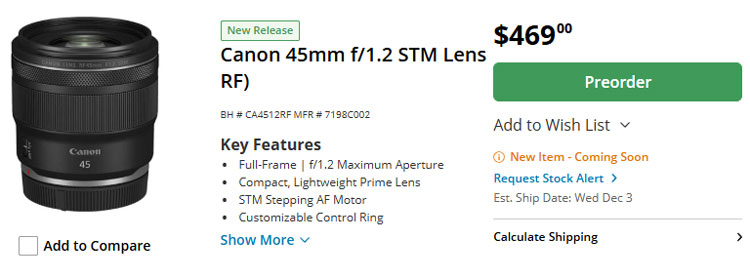
Let’s discuss the lenses now, since no retro camera is complete without its own set of exclusive customised lenses. Initially, during the announcement, we are expecting
RF 45mm f/1.2 STM: A fast prime for creamy bokeh and low-light portraits, with a vintage brass finish.
Yes, there are some murmurs of a customised RF 28-70mm f/2.8 IS STM also, as we get more confirmations, we will be adding more information on our website. Stay tuned to TheNewCamera.com for live updates
The article “DJI Neo 2 Drone at Amazon USA: Score It for Just $199 with Instant Savings” was written on 7:15 pm, Friday, 5 December 2025, Greenwich Mean Time (GMT)
Finally, the Sony A7 V camera has arrived with major updates to the core specifications. The newly announced camera features a new 33-megapixel stacked CMOS sensor paired up with the latest BIONZ XR Mark 2 image processor. Now, if you’re searching for the sample images of the camera, then you have reached exactly the right place where we are going to analyze the images of the Sony A7V camera captured at 100 per cent scale. So, let’s begin the journey.
Why the Sony A7V Delivers Unmatched Image Quality
We are not comparing any camera here. We are just talking about the image quality and the performance of the recently announced Sony A7V camera, so we will be limiting our discussion to the performance and the quality of the A7V’s recently announced 33-megapixel stacked BSI CMOS sensor.
Now before we begin, I should at least add this note that the Sony A7V is the only camera that features a BSI partially stacked CMOS sensor. Other than that, we do have an R6 Mark III camera with 33-megapixel resolution, but unfortunately, it uses an FSI CMOS sensor, not even BSI or stacked. The Nikon Z6 Mark III camera does use a 24-megapixel BSI stacked CMOS sensor, but unfortunately, the readout speed of the camera doesn’t cope with the DR range. So that’s enough for the competitors in the sample image article. Now let’s dive deep into the samples.
FE 50mm F1.2 GM | 50 mm (35 mm equiv. 50 mm) | 1/800 sec | f/4 | +0.0 EV | Manual | Multi-segment metering | ISO 100
Portrait Mastery: Expressive and Sharp Sony A7V Samples
The Image is available at 100% scale, as you can notice how mauch details the camera is able to capture even when viewed at 100%. So, without a doubt, the performance of the newly developed 33 MP BSI Stacked CMOS sensor is exceptional here.
As you can notice, how many details are visible, each lash is visible with macro level detailing, but again, is Sony still focusing on lashes in 2025? since the sample image is capturedby sony professional, but the focus seems to be locked on lashes instead of the eye.
Exploring the second eye at 100% scale, even in the left eye, the details at fantastic, and we can measure pixel-level details, but yes again the AF is locked over the lashes.
FE 70-200mm F2.8 GM OSS II | 136 mm (35 mm equiv. 136 mm) | 1/4000 sec | f/2.8 | +0.0 EV | Manual | Multi-segment metering | ISO 200
Sports Portrait Mastery: Freezing Face at 1/4000th of a second
Even while capturing at 1/1000th frame per second, we do have an acceptable amount of details visible at 100% scale. But, in the end, we have to say that at higher speed we have to compromise with details as well as the DR range of the image
You can explore More Sample Images here by Sony, or you can download high-res samples for self-analysis
In a move that’s sure to thrill hybrid shooters, wildlife enthusiasts, and sports photographers alike, Canon has officially unveiled the EOS R6 Mark III—the latest evolution in its wildly popular R6 series. Building on the legacy of its predecessors, this full-frame mirrorless powerhouse cranks up the performance with groundbreaking autofocus, enhanced image stabilization, and blistering speed, all packed into a body that’s as rugged as it is refined. If you’re in the market for a camera that doesn’t just keep up with your creative chaos but anticipates it, the R6 Mark III is here to deliver. Let’s dive into what makes this beast a game-changer.
A Sensor and Processor Duo That’s Pure Magic
At the heart of the R6 Mark III beats a 34.2-megapixel full-frame CMOS sensor, delivering the sharp, dynamic images Canon fans crave. Paired with the DIGIC X processor, it handles everything from low-light wizardry to high-speed bursts with effortless grace. The sensor’s built-in low-pass filter (4th-generation) and integrated EOS cleaning system keep dust at bay, while the RGB primary color filter ensures vibrant, true-to-life hues right from the source. But the real showstopper? Canon’s innovative 8.5-stop IBIS, offering rock-solid stabilization for handheld mastery. Say goodbye to shaky shots—whether you’re tracking a bird in flight or nailing that cinematic pan, this camera steadies the storm.
Autofocus That Reads Your Mind
If autofocus is your love language, the R6 Mark III speaks it fluently. Dual Pixel CMOS AF II boasts multi-subject detection for people, animals, and vehicles, with 100-face storage for lightning-fast recognition. It covers a staggering 100% x 100% of the frame, with a working range from EV -6.5 to 21 (tested with the RF 50mm F1.2 L USM at 23°C and ISO 100). That’s moonlit portraits and midday mayhem, all in focus.
Modes include One Shot and Servo AF, with manual selection options galore: Spot AF, 1-point, Expand areas, Zone, and even Whole Area AF. Tracking is next-level, locking onto faces, eyes, heads, bodies, and even vehicles like cars, motorbikes, trains, and aircraft—perfect for motorsports or aviation pros. Animal detection covers dogs, cats, birds, and horses, with up to 10 registrable subjects for your favorites.
Manual focus gets a boost too: Peaking sensitivity (High/Medium/Low), focus guides, and bracketing for 2–999 images with customizable increments. And don’t forget AF Assist Beam via LED or external flash for those dim venues.
Exposure and Metering: Precision in Every Pixel
Metering is real-time and evaluative, using the sensor for spot-on results across four modes: Evaluative (linked to all AF points), Partial (6% of viewfinder), Spot (2%), and Center-weighted average. The brightness range spans EV -3 to 20 (or up to 21 with EVF), with AE Lock triggered by AF-ON, Fx button, or shutter half-press.
Exposure compensation hits ±3 stops in 1/3- or 1/2-stop steps, and AEB bracketing does the same for three shots. ISO sensitivity? AUTO from 100-64,000 native—ideal for night owls. High ISO noise reduction offers four levels (including multi-shot), and Anti-Flicker Shooting detects 100% or 120Hz flicker from lights, ensuring clean stills and video.
White balance is flexible: AWB (Ambience or White priority), presets like Daylight, Shade, Cloudy, Tungsten, and Flash, plus custom Kelvin (2,500–10,000K) and bracketing. It’s all customizable in 50K increments for that perfect skin tone.
Shutter Speed Demons: Capture the Unmissable
The electronically controlled focal-plane shutter (with electronic 1st-curtain option) syncs at 1/250 sec X-sync and releases electromagnetically. Speeds? Mechanical: 30–1/8,000 sec; Electronic 1st-curtain: same; full electronic: up to 30 sec. Bulb mode is there for long exposures, and TWB (Time Value Movie) support keeps video smooth.
Burst shooters, rejoice: Up to 40 fps electronic shutter with pre-capture enabled and blackout-free viewfinder action. It’s a wildlife and action photographer’s dream.
Viewfinder and Display: See It All, Feel It All
Peering through the 5.76-million-dot EVF (0.76x magnification) feels like stepping into your shot—120fps performance, 20mm eyepoint, and dioptre correction from -4 to +2 m⁻¹. Brightness adjusts manually in four steps or auto, with anti-smudge coating on the 3.0-inch, 1.62-million-dot touchscreen LCD (100% coverage, seven brightness levels).
A Quick Specs Snapshot
For the detail-obsessed, here’s a curated table of the R6 Mark III’s core specs:
Category
Feature
Specification
Sensor
Type / Pixels
Effective: 34.2 Megapixel (7144 x 4790)
Stabilization
Sensor Shift IS
Up to 8.5 stops peripheral
Autofocus
Points / Coverage
1,053 Dual Pixel CMOS AF II / 100% x 100%
AF Range
Working Range
EV -6.5 to 21 (RF 50mm F1.2 L USM)
ISO
Native / Expanded
100–64,000 / L:50, H2:204,800
Shutter
Speed (Mechanical)
30–1/8,000 sec
Burst
Electronic Shutter
Up to 40 fps
Viewfinder
Type / Dots
0.5″ OLED EVF / 5.76 million
Display
Type / Dots
3.0″ TFT LCD touchscreen / 1.62 million
Lens Mount
Type
RF mount (1.6x crop equivalent)
Video Specs
For video creators, the R6 Mark III is a revelation. Shoot in RAW: 7K DCI (17:9) or Open Gate 3:2 at 24/25p with 12-bit CRM for maximum grading flexibility. Log profiles include Canon Log 2 & 3, alongside LGOP & All-I codecs. Open Gate mode shines with 3:2 7K RAW/MP4 + Full HD proxy for versatile post-production.
MP4 formats cover 4K/2K/Full HD in DCI/UHD and 17:9/16:9 aspect ratios, using XF-HEVC/H.265 or MPEG-4 AVC/H.264 codecs. Audio is pro-grade with 24-bit Linear PCM or AAC options. Time-lapse modes support 4K/2K/Full HD, and Slow & Fast (S&F) mode offers framerate multipliers (like 0.5x or 2x) for seamless quick switches between motion types.
Build and Connectivity: Built to Last The R6 Mark III’s rugged, weather-sealed body features dual slots (CFexpress B + SD UHS-II) for uninterrupted shooting, a full-size HDMI port for external monitoring
What do you think—does this seal the deal for your next camera buy? Drop your thoughts in the comments, and stay tuned to TheNewCamera.com for hands-on reviews, lens pairings, and firmware updates. Canon, you’ve done it again.
At TheNewCamera.com, we’re dedicated to keeping you informed about the latest camera news. The article “Canon R6 Mark III Announcement” was published on6:48 pm, Wednesday, 5 November 2025, Greenwich Mean Time (GMT) by thenewcamera.com team | Follow us on our social pages FACEBOOK | TWITTER | INSTAGRAM to get live Camera News + Canon Rumors 24X7.
In a recent report, we are really very much surprised to see that DJI has already covered 43% of the global 360° camera market share with their only single announcement, the Osmo 360 camera, so now you can imagine how impactful the DJI technology and their reach in the consumer base is, just with a single announcement. They have covered a large segment of the market.
If you talk about action cameras, the latest Q3 2025 report from Jiuqian Consulting shows DJI grabbing a massive 66% of the global action camera market. The GoPro camera market remains limited to 18% and Insta360 is around 13% only.
“Action Camera Gold Ranking.” The Osmo 360? It’s been #1 in “Outdoor 360° Action Camera Sales” for 49 straight days.
Why DJI Owns the Game Now: Action & 360° Market Domination Exposed
So now it’s time to do some fact-checking. We have collected all the possible statistics of the recent sales made by DJI and all thanks to Jiuqian Consulting for bringing out these numbers to us that clearly show how much people are inclined towards buying a DJI Osmo 360 or the action camera when compared to GoPro or Insta360.
Category
DJI Share
GoPro Share
Insta360 Share
Other
Global Action Cameras (Q3 2025)
66%
18%
13%
3%
Global 360° Cameras
43%
N/A
Implied <40%
~17%
China EC 360° Cameras
49%
N/A
Suppressed
~51%
Data sourced from Jiuqian Consulting via Digicame-Info.
One thing you have to keep in mind is that we are not talking about DJI drones. We are talking about action and 360 cameras, and the stats say, as we have already mentioned, that people are more inclined to get a camera. Maybe they are more reliable. Maybe they have their own ecosystem where you can easily integrate wireless mics without putting any external receiver at the same time, with durability, and at a price. All this combines as factors combine to make people buy the DJI products.
So whatever report you see is not an accidental report, DJI has worked in the past like no one else, and they have developed a cohesive ecosystem synchronising possibly most of the technologies with each other, and that’s why maybe people are preferring it more compared to others.
Spotlight on the Osmo 360: DJI’s Game-Changer
Now, all this started with the announcement of the DJI Osmo 360. It just created a new sort of wave, and it was quite unexpected that most of the Insta360 users, or maybe those who have never tried 360 video before, are going to buy 360 cameras in that use capacity or numbers, so it’s kind of a shift of a consumer base from one brand to a different brand. What is the exact reason behind it? The lower price than competitors, cohesive ecosystem, or the introduction of a large 1-inch sensor inside the 360 body — it can be any of that or all, these are the contributing factors behind the massive success.
The market is open to everyone, and just before the introduction of the Osmo 360 camera, the Insta360 accessories cameras were leading the market since there was no other option available at that time, but once DJI entered, it covered 40 to 50% of the market share in just a single sort of announcement. So, I personally think that Insta360 should take some extra care of their 360° cameras. Otherwise, they have to face a lot of hurdles in the near future due to a shrinking market share.
The Fallen Titans: GoPro and Insta360 Under Siege
The original action camera maker — better to say the father of the action camera — GoPro, they had almost all the market at the beginning, but started falling as soon as DJI entered the space. It all started back in 2010 when GoPro had introduced the first action camera in the market by claiming all the 100% space of the action camera for more than a decade. Now the situation has arrived that the entire consumer base remains limited to only 18% of the market share, as per the initial report we have from Q3 2025.
So why is GoPro falling off so rapidly? There are two big reasons behind that:
The first and foremost reason is the thermal nightmare in the new Hero 13 action cam; the users of the Hero 13 are heavily disappointed due to the overheating issues.
The second biggest reason is the lack of innovation. The Hero 13 does offer 5.3K recording at 60 frames per second with HyperSmooth 6.0, but it is not a revolutionary update, and all these are available for $400, whereas in DJI, we have cheaper options in DJI, which are already connected with an ecosystem and have no heating issues.
Service and support, so a central solution like DJI care for users
So, at the end, DJI is the most popular brand among its users, GoPro should learn from previous mistakes and get back in the market asap. I was a big fan of GoPro myself, but now I am using Pocket 3 and Action 5 Pro as my latest travel kit cameras. Another thing to look forward to is whether the company will actually enter the interchangeable lens mirrorless camera market, which has been rumored many times.
GET LIVE NOTIFICATION, Select Your Trusted Source GET LIVE NOTIFICATION Click ON Check BOX for Latest NEWS and Rumors
The article “DJI Neo 2 Review” was written by thenewcamera.com team on 8:07 pm, Thursday, 30 October 2025, Greenwich Mean Time (GMT) | You can also follow us on Our Official Social Media HandlesFACEBOOK | TWITTER | INSTAGRAM to get live news — > DJI Rumors
We already have the release date for the Canon R6 Mark III camera: November 6, 2025, 1 AM EDT. Canon R6 Mark III camera coming with the same 34.2 MP CMOS sensor we have seen in the Canon C50, not only that, R6 III is about to become Canon’s first commercial consumer camera to feature 7K open-gate recording internally in RAW format. The sensor readout speed of the Canon R6 III camera will remain the same as that of the Canon C50 —14.2 ms —since both use the same sensor. So, yes, a bit slower than the partially stacked CMOS sensor of ZR and Z6 III, but still highly usable.
If you’re thinking of pre-ordering the Canon R6 Mark III camera, the B&H Store of the USA has just made the Canon R6 Mark III camera page live on their website. You can click on Notify Me button on their website, so they can update you once the camera is available for pre-order.
B&H Teaser Page Details
Head to B&H’s dedicated page here for the official teaser. What stands out in this Canon R6 III announcement placeholder?
Event Timing: Canon LIVE stream will be there on November 6 at 1:00 AM EDT—perfect for global audiences.
Preorder Perks:B&H has already activated the camera page on their website. The pre-orders will get activated just after the official announcement of the camera.
So kindly the Canon R6 Mark III camera is coming, and we have already done a specific specification comparison review alongside with the Canon R6 Mark II camera where we do have a big difference in between the core specification of the two, and yes, if you’re thinking for an upgrade, the R6 Mark III camera does carry all the major core specification upgrade in terms of video as well as stills that you were waiting of.
And very soon, comparison with the Nikon Z6 Mark III and the Nikon ZR will go live on our website. Stay tuned, and if you have any sort of questions related to the upcoming comparison or suggestion, you can drop your thoughts in the comment section.
Canon R6 Mark III specification
– 34.2MP / 32MP (same as Cinema EOS C50)
– Dual Pixel CMOS AF II for multiple subject detection
– Can store up to 100 faces for AF recognition
– IBIS: 6.5 stops
– 5.76M dot EVF (0.76x) (unconfirmed)
– Pre-capture
– Maximum frame rate: 40fps Electronic shutter
– Canon Log-2 and Canon Log-3 (unconfirmed)
– LGOP
– “S&F” added to mode dial: This feature allows you to select frame rates more efficiently based on a multiplication factor. If you’re shooting at 24fps, selecting 0.5x will easily switch you to 12fps, while selecting 2x will double the frame rate. I’m not sure if there are any other multiplication factor settings.
– Max ISO: 64000
– 7K open gate like Cinema EOS C50
– Open gate RAW 24/25p
– 24-bit audio
– Dual slots (CFexpress Type B and SD UHS-II)
– Full-size HDMI port
– LP-E6P
– Price: 2899 euros
– Price: $2899 (estimated)
– Shipping starts November 20, 2025
My Personal Take
What I personally think after looking at the core specification of the Canon R6 Mark III is that it is targeting hybrid cinematographers or content creators more than photographers, and it’s not a viable thing, since if they really care about photographers and give a bit more priority to them, then they have introduced a stacked or a partially stacked sensor.But this time, they have offered the same C50 cinema sensor, and we are having a major upgrade in the videography core specification of the upcoming Canon R6 Mark III camera; the still specification remains almost the same.
Despite that, we do have an elevated resolution and the best part is the handheld shooting capability of the IBIS feature has been downgraded to 6.5 stops as per the initial set of information we have so that’s kind of a dilemma, confusion why we are having some decline in the IBIS as we do have an upscale sensor but 12.5 or 12.4 ms readout speed sensor will exhibit some sort of rolling shutter effect when used at 40fps, so that’s kind of a debate topic.
Obviously, we are looking at the initial set of reviews, what the expert reviewers say, but I have a personal sort of feeling that the camera does have a lot of things for content creators, professional cinematographers, but very limited, minimal updates for photographers.
Secure Your Canon EOS R6 Mark III Preorder: Next Steps
Don’t sleep on this—B&H’s setup screams limited supply. Head to the teaser page now, enable notifications, and explore bundles. For alternatives, check Adorama or Amazon for competitive pricing.
At TheNewCamera.com, we’re dedicated to keeping you informed about the latest camera news. The article “Canon R6 Mark III Announcement Incoming: B&H adds Pre-order Placeholder Page” was published on 7:34 am, Friday, 31 October 2025, Greenwich Mean Time (GMT) by thenewcamera.com team | Follow us on our social pages FACEBOOK | TWITTER | INSTAGRAM to get live Camera News + Canon Rumors 24X7.
We have done extensive coverage of the DJI Neo drone, and finally, it’s official in China, and we have our first review by pro reviewer Huaibab’s real-world tests. As we have published today (Oct 30), the DJI Neo 2 will be announced in Europe on November 13, 2025. Now we have its first review, although it’s in the mainland Chinese language, we have written and structured it for your better understanding, so let’s dig deep into the first review of the DJI, and how it impresses with its new features and set of extended controls.
Review done by Huaiba Crazy Tech
After watching the footage just now, everything was shot entirely using the NEO 2 by Huaibab. This time, let me get straight to the point: the NEO 2 has truly upgraded to the max—they’ve squeezed out every bit of the toothpaste without holding back. So, what exactly has been upgraded in the NEO 2? Let’s start with the exterior design of the drone.
Design Overhaul: Compact, Smarter, and Still Registration-Free
The NEO 2 features a completely new body design. The overall size and wheelbase are slightly larger, the colour has been changed to the same deep grey as the Mini 5 Pro, and the weight has increased by about 20 grams, 151 grams for the bare drone, and 160 grams with the O4 transmission module added. It still remains under 249 grams, qualifying as a drone that doesn’t require registration or a license. On the underside and sides of the body, two new buttons have been added. Now, you don’t need to open the DJI Fly App or wait for your phone to connect—you can directly long-press these buttons to switch and adjust shooting parameters. There’s also a small screen on the front that lets you instantly see the current shooting settings. The most thoughtful change is moving the LED indicator lights to the front, right next to the lens, so you can clearly see the drone’s status at a glance—no more guessing like with the previous generation whether the NEO has finished recording. And next to the LED lights is a laser obstacle avoidance system that works continuously at night for safe return-to-home, now also included on the NEO 2.
Feature
DJI Neo (Original)
DJI Neo 2
Weight (Bare)
135g
151g
Dimensions (Unfolded)
130 x 157 x 48.5 mm
147 x 171 x 41 mm
Color
White/Gray
Deep Gray (Mini 5 Pro match)
Controls
App-only
Side buttons + front OLED screen
Status Lights
Rear/side
Front (lens-adjacent)
Avoidance Sensors
Basic vision
Dual fisheye + forward LiDAR + IR down
Safety & Flight Smarts: Omnidirectional Avoidance on a Budget
The NEO 2 now has fisheye lenses on both the top and bottom of the body. With just dual binocular vision lenses, it achieves omnidirectional obstacle avoidance. This greatly improves flight safety when using movements like reverse tracking, gradual pull-away circling, etc. Thanks to the addition of the binocular vision positioning system, the NEO 2 now has significantly improved stability when flying over water, snow, or other surfaces with unclear ground textures. The key point is that DJI doesn’t just let the drone see its surroundings—it fully brings down advanced features from the Mini 4 Pro and above, like subject tracking for people and vehicles, and the 8-direction compass for custom follow angles. This gives the NEO 2 the same tracking capabilities as high-end models.
In terms of power, the NEO 2 has newly designed propellers that make flight noise quieter and less shrill. Ascent speed has increased by 65%, from 3 m/s to 5 m/s, while the maximum altitude remains capped at 120 meters. Wind resistance has slightly improved from Level 4 to Level 5. Tracking speed has jumped 50%, from about 28 km/h to 43 km/h, fully capable of keeping up with cycling. Battery life is similar to the previous generation—around 18 minutes, or enough for 20 palm takeoffs without issue.
Lowlight test by Huaiba Crazy Tech of the NEO 2 vs NEO drone
Imaging: Low-Light Magic and Vlog-Ready Upgrades
In terms of image quality, compared to the first generation, the aperture has been upgraded from F2.8 to F2.2. The sensor size remains 1/2 inch, but the NEO 2 uses a newly upgraded sensor and image processor, bringing clear improvements in low-light performance and video specs. Standard recording now supports an impressive 4K 60fps for smoother footage, perfect for slowing down to half speed in post-production. It also adds 4K 100fps slow-motion mode to capture stunning frozen moments. Additionally, vertical video—commonly used for short-form content—has been upgraded from 1080p to 2.7K. While photo resolution remains at 12 megapixels and still doesn’t support RAW (a slight downside), the gimbal has been completely redesigned. It upgrades from a single-axis to a dual-axis mechanical gimbal with the addition of a roll axis, and the pitch axis range has increased from 60° upward to 70°.
Video Specification Comparison
Mode
Neo 1
Neo 2
Standard Video
4K/30fps
4K/60fps HDR
Slow-Mo
N/A
4K/100fps
Vertical
1080p
2.7K
Gimbal
Single-axis
Dual-axis (pitch/roll)
Aperture/ISO
F2.8 / 100-6400
F2.2 / 100-12800
AI Tracking has much improved in the NEO 2
New Tricks: Gestures, Storage, and Playstyles
With the roll axis, flight footage stability is greatly improved, and digital stabilization cropping is significantly reduced. Compared to the first-gen NEO, the field of view is much wider. Windy conditions or downward shots during landing cause far less shaking, and you’ll rarely see gimbal limit warnings. H
Although the NEO 2 doesn’t support 10-bit DLog-M or RAW, it inherits the Mini 5 Pro’s color science, producing pleasing straight-out-of-camera footage without editing. Even in low evening light, colors remain vibrant, helping mask minor low-light detail flaws. Plus, the NEO 2 can now recognize people in the frame and uses algorithms to optimise skin tones and lighting.intelligent selfie feature—it’s like having a personal photographer automatically switching angles for perfect shots every time. The NEO 2 is truly the next-generation Vlog god machine.
Internally, storage has doubled from 22GB to 49GB. File
transfer speed to your phone is now 4x faster, reaching 80MB/s, so large videos move quickly.
The most fun new feature, as shown in the intro, is gesture control. Previously, you had to set follow angles and distances before takeoff. Now, just raise your palm and spread your fingers to instantly adjust follow direction. Open and close both hands to control shooting distance—super responsive and fun. You can even switch the follow subject: if someone else nearby raises their hand, the drone switches to them. New follow modes include cycling and skiing. In this demo, Huaibab used cycling follow with precise 8-angle compass settings—the bike tracking is incredibly strong. Master Shots are now built-in, and Flip’s signature dolly zoom is included for the first time.
To stop recording or return at any time, just extend your palm—the drone pauses, finds your hand, and lands. No need to stand still for 3 seconds or use the app like other models. For photos, the most practical new feature is intelligent selfie—let’s head outside to demo the NEO 2’s many playstyles.
For live audio in videos, open the DJI Fly App, pair, and it uses your phone’s mic. NEO 2 also supports voice commands like the first generation. Allow u to take off with voice. On-screen, it recognises the person as the subject. Default follow mode. In app, drag to change angle—e.g., rear follow, walk, it follows behind. Switch to front—it reverses. All audio you hear is NEO 2 + phone mic.
It also tracks vehicles. Select the car icon, enable follow, and switch angles. Car moves—it auto-adjusts (e.g., tail). Normally only on Mini 4 Pro+, but NEO 2’s omnidirectional avoidance enables 8-way people/vehicle tracking.
Choosing between the entry-level DJI Flip, NEO 2, and Mini 5 Pro?
Mini 5 Pro: Most complete, top image quality, six fisheye lenses for best avoidance, largest wheelbase = best wind/power, lossless vertical + rotation gimbal. Drawback: no palm takeoff. Choose for ultimate quality/features.
Flip vs. NEO 2: Flip has better image quality, 3-axis gimbal, larger wheelbase, 3000m altitude takeoff, better wind resistance. Pick Flip (or larger Mini 5 Pro) for harsh high-altitude/coastal use. Downside: forward-only avoidance—fly carefully.
Summary: NEO 2 packs omnidirectional avoidance, major image/power/speed upgrades into a tiny, cheap body. Most versatile mini DJI drone. Works with existing remotes/goggles. Palm takeoff/selfie, gesture control, remote for range, and goggles for FPV racing.
GET LIVE NOTIFICATION, Select Your Trusted Source GET LIVE NOTIFICATION Click ON Check BOX for Latest NEWS and Rumors
The article “DJI Neo 2 Review” was written by thenewcamera.com team on 8:07 pm, Thursday, 30 October 2025, Greenwich Mean Time (GMT) | You can also follow us on Our Official Social Media HandlesFACEBOOK | TWITTER | INSTAGRAM to get live news — > DJI Rumors
The Canon R6 Mark III camera is finally here, and without a doubt, it’s a massive upgrade over the Canon R6 Mark II camera. Shipping of the camera will start from November 20, 2025. The price of the camera is €2,899 / ~$2,899 (estimated). Pre-orders will soon go live at the B&H Store.
In this article, we are comparing the Canon R6 Mark III camera with the Canon R6 Mark II. The specification comparison will break down every detailed core specification, starting from sensor to resolution and video—everything in detail related to both cameras. Before we begin the specification comparison, one thing should be very clear: we do have a very big price difference between the two, so if you’re paying more, you will obviously be getting more specifications in the camera. So now let’s explore the set of features and the differences between the two.
Canon R6 Mark III vs R6 Mark II: Side-by-Side Specs Table
Feature
Canon R6 Mark III (2025)
Canon R6 Mark II (2022)
Sensor Resolution
34.2 MP (same as Cinema EOS C50)
24.2 MP (effective)
Sensor Type
Full-frame CMOS (rumored stacked)
Full-frame CMOS
Image Processor
Not confirmed (likely DIGIC X+)
DIGIC X
IBIS
6.5 stops
8 stops (with coordinated IS)
Autofocus System
Dual Pixel CMOS AF II
1053 + AF Zone and 100 face memory storage
Dual Pixel CMOS AF II
1,053 points
Subject Detection
Multiple (People, Animals, Vehicles)
People, Animals, Vehicles
Continuous Shooting
40 fps electronic shutter
40 fps electronic, 12 fps mechanical
Buffer (RAW)
Not confirmed
75 frames at 40 fps
EVF
5.76M-dot OLED, 0.76x (unconfirmed)
3.69M-dot OLED, 0.76x
Rear LCD
Not confirmed (likely 3.2″ vari-angle)
3.0″ 1.62M-dot articulating touchscreen
Pre-Capture
Yes
Yes
ISO Range (Native)
100–64,000 (unconfirmed)
100–102,400 (extended 204,800)
Video: Max Internal
7K Open Gate (24/25p RAW)
6K RAW external only
4K Video
Full sensor readout (oversampled)
4K 60p (from 6K), no recording limit
Log Profiles
Canon Log 2 + Log 3 (unconfirmed)
Canon Log 3, HDR-PQ
Open Gate Recording option
Yes
No
Slow Motion
Not confirmed
1080p 180fps
Audio
24-bit
24-bit LPCM / AAC
Frame Rate Dial (S&F)
New “S&F” mode – 0.5x, 2x multipliers (e.g., 24 → 12 or 48 fps)
No dedicated S&F dial
LGOP (Light GOP)
Yes
No
Memory Cards
CFexpress Type B + SD UHS-II
Dual SD UHS-II
HDMI Port
Full-size HDMI
Micro-HDMI
Battery
LP-E6P (higher capacity expected)
LP-E6NH (760 shots)
Build & Weight
Magnesium alloy (weight TBD)
588g (body only)
Price (Launch)
€2,899 / ~$2,899
$2,499 (original)
Shipping Date
November 20, 2025
November 2022
Key Upgrades: Why R6 Mark III Wins for Hybrid Shooters
1. 34.2 MP Sensor – Cinema-Level Detail
In the Canon R6 Mark III camera, we have a 40% higher resolution sensor compared to the Canon R6 Mark II. The cinematic sensor will not only upscale the core specifications of the camera in terms of open-gate video recording in 7K or 4K 60 uncropped videos downsampled from 7K, it will also give an option for hybrid shooters to do continuous capture at 40 frames per second with the help of the electronic shutter. So overall, the new sensor will boost the resolution and the details users are getting without affecting the speed of the camera. At the very same time, it’s not a stacked sensor, but the readout of the sensor is 12 ms as per the initial tests of the C50 camera. So overall, the sensor is far better than the predecessor R6 Mark II.
Shared with Cinema EOS C50
~40% more resolution than R6 Mark II
Ideal for 8K-downsampled 4K and high-res stills
2. 7K Open Gate RAW (24/25p)
The camera supports anamorphic recording as well as 6K RAW videos. We can remember that 6K RAW in the R6 Mark II camera was limited to external recording only, but at the very same time, we have the Canon R6 Mark III, where we can easily record 7K open gate in our CFexpress Type B card. At the very same time, the camera is coming with Open Gate Recording mode flexibility, so if you are a cinematographer or a content creator who loves to explore this videographic dimension to its maximum limit, you will surely love the new Canon R6 Mark III camera.
True anamorphic workflow without cropping
R6 Mark II limited to 6K RAW external only
Matches C50 / R5 C open-gate flexibility
3. Pro Connectivity
It looks like Canon is getting a bit serious about the competition. For the first time in the R6 series, we are getting a full-size HDMI port, and that’s a good thing—no more micro cable failures or switching back and forth. Other than that, again for the first time, we are having a CFexpress Type B card slot specifically to save the open-gate 7K recording internally in the camera, and finally a 24-bit audio that will help to elevate the overall video performance of the camera.
Full-size HDMI (no micro cable failures)
CFexpress Type B for 7K RAW bursts
24-bit audio for professional sound
Performance Deep Dive: Real-World Implications
Overall, if you look at the specifications of the camera, then it has been upgraded to a maximum extent, but at the very same time, I’m not able to understand why the IBIS mechanism/sensor-shift image stabilization mechanism has been dropped to 6.5 stops compared to the eight stops of IBIS available in the Canon R6 Mark II camera. If you ignore this part, then other than that, we have a massive update in the sensor resolution of the camera, and at the same time, while upscaling the pixel density, the low-light performance still remains highly usable. A lot of improvement in the still and video parts of the camera, which we have already discussed above, some more or less. This is one of the most advanced R6 series cameras Canon has ever announced, and it will appeal to a large consumer base—those who are looking for the best mid-range in a full-frame body.
Where R6 Mark II Still Holds Up
Advantage
R6 Mark II Wins Because…
IBIS
8 stops > 6.5 stops, offering superior stabilization for handheld video in low light or action.
Battery Life
Proven 760 shots (CIPA-rated), potentially outlasting the new LP-E6P in extended shoots.
Price
Now ~$2,000 street price, making it a budget-friendly entry into Canon’s hybrid ecosystem.
Availability
In stock everywhere—no wait times like the R6 Mark III’s launch rush.
Who Should Upgrade to R6 Mark III?
Upgrade if you need:
Pros: 7K open gate RAW for cinematic flexibility; 34.2 MP for detailed stills/video; S&F dial for efficient frame rate tweaks; Full-size HDMI + CFexpress for pro setups; Pre-capture for nailing action moments.
Ideal for: Cinema-hybrid creators, wedding pros, or anyone future-proofing for 2025 workflows.
Stick with R6 Mark II if:
Cons (for upgraders): Slightly lower IBIS; Higher price; Potentially similar burst speeds without major buffer gains.
Ideal for: Budget-conscious shooters focused on 4K/6K video, strong IBIS, or those happy with current AF without face memory.
Ultimately, the Canon R6 Mark III is one of the most advanced full-frame cameras ever announced by Canon. The camera approaches everyone—if you are a hybrid shooter or a cinematographer or a photographer, you will love this camera, irrespective of the profession you are involved in. This is a kind of all-rounder professional camera built by Canon.
At TheNewCamera.com, we’re dedicated to keeping you informed about the latest camera news. The article “Canon Major Announcement in November 2025” was published on 12:29 pm, Wednesday, 24 September 2025 (GMT-4), Time in Washington, DC, USA by thenewcamera.com team | Follow us on our social pages FACEBOOK | TWITTER | INSTAGRAM to get live Camera News + Canon Rumors 24X7.
Buy Canon Lenses, Buy Music CD or Digital Camera at amazon it helps this site, and you do not pay anything extra, it is just a way to help support this site.
New Camera Website, we list all type of new camera information, price review and all type camera rumors, subscribe us or follow us via twitter or facebook.
Disclaimer: We have attempted to select useful information to include on New Camera, and to ensure that the resources we have included on the site -- as well as the way we have described them -- are accurate, fair, and balanced. However, we make no claims, warranties, or other representations concerning the accuracy, completeness, or utility of the information provided, or concerning the abilities or performance of the organizations, agencies, companies, and other resources presented through New Camera



 So now it’s time to do some fact-checking. We have collected all the possible statistics of the recent sales made by DJI and all thanks to Jiuqian Consulting for bringing out these numbers to us that clearly show how much people are inclined towards buying a DJI Osmo 360 or the action camera when compared to GoPro or Insta360.
 BOX for Latest NEWS and Rumors