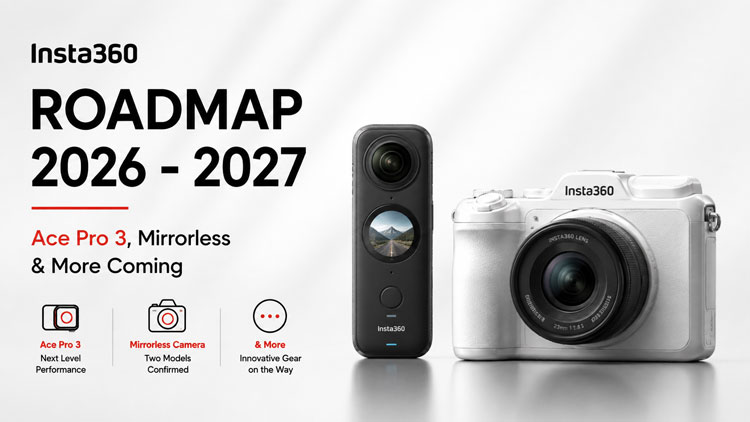
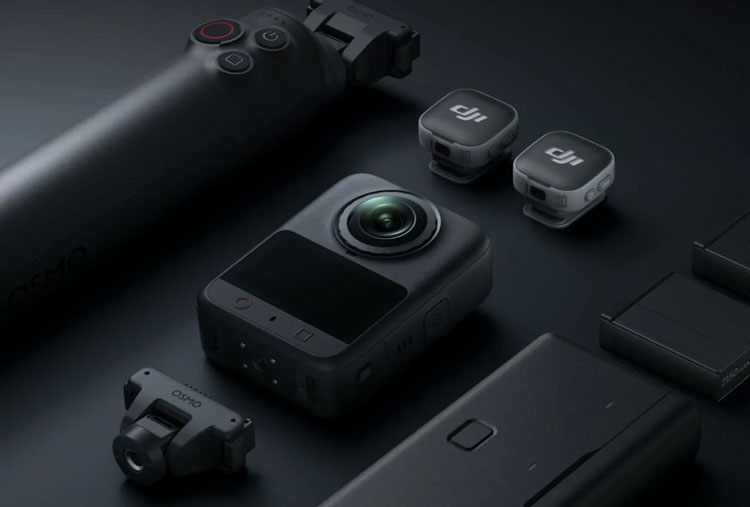
So, after the Insta360 Luna Pro, the product expansion hasn’t stopped yet. Still, there’s plenty of room in 2026, and 2027; Insta360 has already shown its dominance in the 360 camera market. And now they are challenging the largest video camera market by releasing one after another in their Pocket Cameras (Ultra series), starting with the Luna Ultra and then followed by the Luna Pro
Current Status: The Luna Series is Complete (For Now)
Starting with the Insta360 Luna Ultra announcement, Insta360 officially entered the pocket gimbal market in June 2026 with the dual-lens Luna Ultra. Two months later, it launched the single-lens Luna Pro in China as a more affordable alternative.
Model
Type
Key Specs
Launch Status
Approx. Price
Luna Ultra
Dual-lens Gimbal
1″ + 1/1.3″ sensors, Leica, 8K
Global (June 2026)
$770
Luna Pro
Single-lens Gimbal
1″ sensor, Leica, 8K, 4K vertical
China only (Aug 20–21, 2026)
¥3,399 (~$505)
These two recent announcements in 2026 created a deeper impact, and Luna Ultra is selling very well in the USA. The Insta360 Pro China announcement has already been made by the time I am writing this article
How Insta360 Actually Launches Products (2022–2026 Pattern)
Understanding the company’s rhythm is the key to predicting what comes next:
X Series (flagship 360): Traditionally April (X4 in 2024, X5 in 2025). The X6 broke this pattern and launched in August 2026 after delays.
Ace Series: Roughly annual, preferring Q4 (Ace Pro in November 2023 → Ace Pro 2 in October 2024).
GO Series: Prefers summer launches.
New categories: Almost always previewed at NAB (April) or CP+, then fully launched 1–4 months later (or the following year for complex new systems).
China → Global lag: Consistently 4–8 weeks for major products.
List of products from Insta360 expected to announce soon, and clear details about upcoming products based on a recent set of news published at thenewcamera.com and Insta360 schooled pattern of announcements
Highly Logical 2026–2027 Insta360 Roadmap
Priority
Expected Window
Product / Project
Confidence
Why This Timing Makes Sense
1
Sep – Oct 2026
Luna Pro Global Launch
Very High
Standard China-first staggered release pattern
2
Oct – Dec 2026
Ace Pro 3
High
Fits the Ace series’ traditional Q4 window after heavy delays
3
Feb 2027 (CP+)
Mirrorless Camera Prototype(s)
Confirmed
Explicitly stated by CEO JK Liu
4
Mid – Late 2027
First Mirrorless Camera Launch
Medium–High
Typical gap after prototype for brand-new categories
5
Spring 2027
X-series updates / limited editions
Medium
Full X7 unlikely so soon after X6
6
Mid 2027
Next GO Series generation
Medium
Consistent summer pattern for GO line
1. Luna Pro Global Launch (September–October 2026)
This is the highest-confidence next move.
Insta360 rarely launches a major product exclusively in China for long. The Luna Ultra followed the same path earlier this year. Expect official global pricing, Amazon/B&H listings, and review units to appear in September or early October.
What to watch for:
Global price (likely 549–599 range)
Creator bundles with Mic Air or ND filters
India availability and GST-inclusive pricing
2. Ace Pro 3 (October–November 2026)
FCC certification confirmed on 29 September 2026 (FCC ID 2AWWH-CINSABUA, model CINSABUA). This is the first hard public confirmation of the product. Based on Insta360’s typical FCC-to-announcement window (usually 2–6 weeks for flagship cameras) and the Ace series’ Q4 pattern, an official announcement is now expected on or before November 2026.
You can also bump the confidence from “High” to “Very High” in the table and add a brief “Last updated: 15 October 2026” note near the top or bottom.
This keeps the original roadmap intact while making it current. No need for a full rewrite unless you want one.
3. Mirrorless Cameras – The Real Long-Term Play (2027)
This is the most significant development on Insta360’s horizon.
We have also posted this back on In August 2026, CEO JK Liu confirmed that the company is developing two interchangeable-lens mirrorless cameras. One of them will feature a “surprising shape that you’ve never even considered before.”
A prototype of at least one model is expected at CP+ 2027 in Yokohama (February 2027). This matches Insta360’s historical approach to new categories: early public looks at major trade shows, followed by a full commercial launch later.
Key points so far:
Two different designs in development
One will break traditional form factors
Strong possibility of Micro Four Thirds (based on earlier leaks)
Focus on AI-assisted usability for non-traditional mirrorless users
A full commercial launch is more realistic in mid-to-late 2027 rather than immediately after CP+.
What This Means for Creators and Buyers
Short term (next 3–4 months):
Wait for Luna Pro global pricing if you want the single-lens version
Ace Pro 3 is the bigger upgrade if you shoot action or hybrid content
Medium term (2027):
The mirrorless cameras represent Insta360’s most ambitious expansion yet. If executed well, they could pull the brand into a completely new competitive space against OM System, Fujifilm, and Sony’s lower-end models.
India-specific notes:
Expect the Luna Pro to arrive in India within weeks of the global launch, following the same pattern as the Luna Ultra and X6. Pricing will likely sit in the ₹42,000–₹48,000 range after GST and local distribution margins.
Insta360’s 2026 strategy has been clear: finish the Luna series, refresh the 360 flagship (X6), and set up the Ace line for a late-year comeback. 2027 will be dominated by the mirrorless project. The company is no longer just a 360-camera specialist. It is systematically building a full creative imaging ecosystem — and the next 12–18 months will show how serious that ambition really is.
The article “Insta360 Roadmap 2026 – 2027: Ace Pro 3, Mirrorless & More Coming” was written by thenewcamera.com team on 8:32 am, Sunday, 23 August 2026, Greenwich Mean Time (GMT). | You can also follow us on Our Official Social Media HandlesFACEBOOK | TWITTER | INSTAGRAM> get live news — > DJI Rumors | Insta360 News
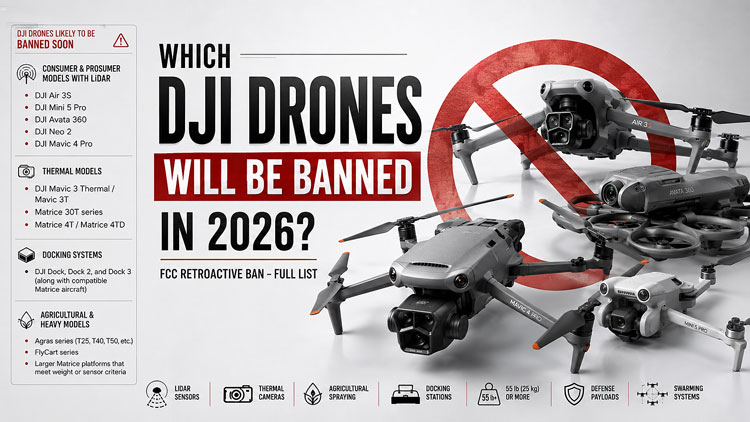
The second wave of the ban is coming, and we have created a list of drones that are going to be banned soon and a list of drones that will remain active in American airspace, and you can buy them whenever you want to for now, at least based on the rules. Since back from the December ban, we know that new drones of DJI are not allowed to be sold in the United States of America. Not only that, with the latest development that happened back in July, they have updated the military drone specifications, and in that, they have added LiDAR, and due to that specific addition, a lot of consumer drones, including the budget drone like Neo 2, have also been added to the Covered List. So, we have created a complete list of drones that are going to be banned soon by the United States of America and the list of those that will remain available even after the second wave of the ban that is about to happen after September 2026.
Public comments close on September 2, 2026. After that, the FCC will decide whether to adopt the restrictions.
What Exactly Is the FCC Proposing?
In Public Notice DA 26-758, the FCC is seeking to prohibit the continued importation and marketing of previously authorized foreign-made drones that fall into these categories:
To simplify it, we have added the entire list of updates in the table below, so you have a clear idea of when the public comment period will be called off. Specifically, the date is September 2, and after, obviously, the FCC will put a ban that will take a bit of time to make it properly effective at the ground level.
Important Timeline
Event
Date
Details
Proposal published
August 3, 2026
FCC Public Notice DA 26-758
Last date for public comments
September 2, 2026
Final day to submit comments
FCC Final Decision
After September 2 (no fixed date yet)
FCC decides, not DJI
Sales restriction (if approved)
~180 days after final decision
Import and marketing of affected models stop
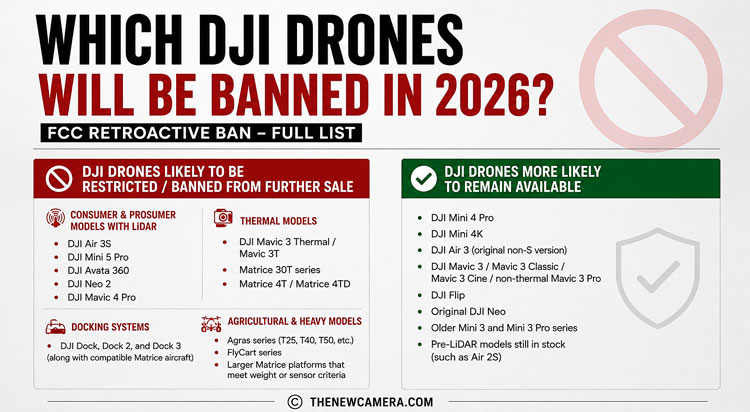
DJI Drones Likely to Be Restricted / Banned from Further Sale
Now here is the MOST IMPORTANT PART – List of drones that are about to be BANNED SOON
If the proposal is adopted as written, these models are at highest risk of no longer being sold new in the US:
Consumer & Prosumer Models with LiDAR
DJI Air 3S
DJI Mini 5 Pro
DJI Avata 360
DJI Neo 2
DJI Mavic 4 Pro
Thermal Models
DJI Mavic 3 Thermal / Mavic 3T
Matrice 30T series
Matrice 4T / Matrice 4TD
Docking Systems
DJI Dock, Dock 2, and Dock 3 (along with compatible Matrice aircraft)
Agricultural & Heavy Models
Agras series (T25, T40, T50, etc.)
FlyCart series
Larger Matrice platforms that meet weight or sensor criteria
DJI Drones More Likely to Remain Available
These models do not currently fall under the main restricted categories (no LiDAR, no thermal, under 55 lb, no docking or spraying):
DJI Mini 4 Pro
DJI Mini 4K
DJI Air 3 (original non-S version)
DJI Mavic 3 / Mavic 3 Classic / Mavic 3 Cine / non-thermal Mavic 3 Pro
DJI Flip
Original DJI Neo
Older Mini 3 and Mini 3 Pro series
Pre-LiDAR models still in stock (such as Air 2S)
What This Means for Current Owners
You can continue flying any DJI drone you already own.
Firmware and security updates for previously authorized models remain allowed (currently through at least January 2029).
Private second-hand sales stay legal.
Official spare parts and service for restricted models may become harder to obtain over time.
Buying Advice Right Now
The only buying advice I would like to give the readers at this moment is that if your business depends on drones, specifically those that are on the list that are going to be banned soon, and by business, I mean anything—either you are a wedding photographer or a cinematographer who would love to add high-quality, stabilized aerial shots to your project, as well as if you are a content creator who loves to capture themselves with a drone, specifically their recently announced To Capture, a creator-on-the-go with gesture controls only. So, technically, if your workflow is in any way associated with drones, and if they become unavailable or your existing drones may get disabled for any reason, then the entire workflow of your business/content creation will be deeply affected. So, the best thing is to have a backup. Have a proper backup of parts; have a proper backup of different units of drones. Otherwise, it would be a big mess.
The FCC proposal represents a serious escalation. Many of DJI’s most capable current models face a real risk of being cut off from new sales in the US market. At the same time, several solid and popular models without the restricted features should remain available while existing inventory lasts.
The comment window closes on September 2, 2026. After that, the FCC will make its decision. Until a final order is issued, the situation remains fluid.
We will update this article as soon as the FCC announces its final decision.
The article “Which DJI Drones Will Be Banned in 2026? FCC Retroactive Ban – Full List” was written by thenewcamera.com team on 7:38 pm, Thursday, 20 August 2026, Greenwich Mean Time (GMT). | You can also follow us on Our Official Social Media HandlesFACEBOOK | TWITTER | INSTAGRAM> get live news — > DJI Rumors | Insta360 News
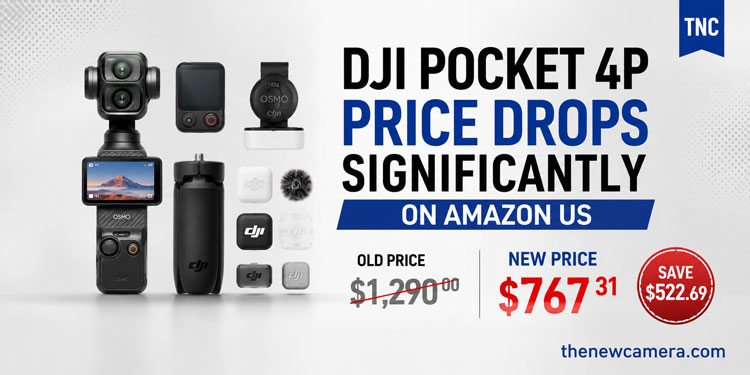
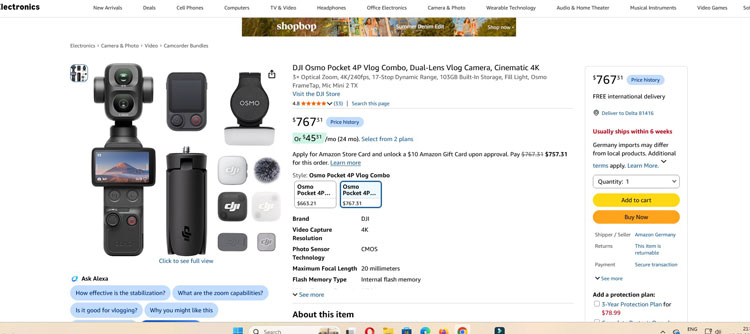
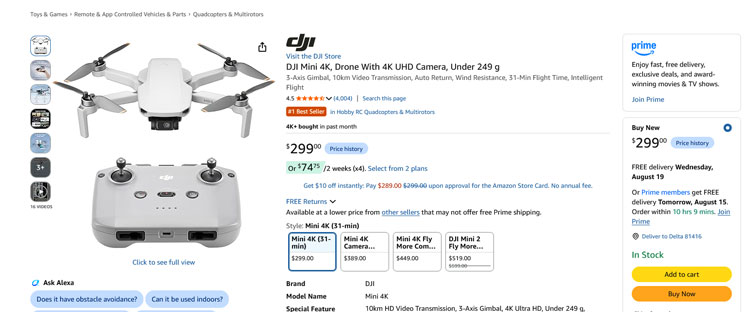
The DJI Osmo Pocket 4P has been listed on Amazon USA since mid-August 2026, and the camera was announced back in July. Right now, the only way for buyers to get it is through third-party grey-market importers. At the time, the Pocket 4P Standard units were costing somewhere around $980, and the Vlog/Creator Combo version was costing somewhere around $1,290–$1,390, and for proof, I have also attached the screenshot from that time. So, if someone wished to buy a 4P camera a month ago, they had to pay a very heavy price for it, specifically in the United States of America.
As of August 16, 2026, better options have appeared — particularly through Amazon Germany listings that ship to the United States.
Both versions currently show free international delivery and an estimated shipping window of around 6 weeks.
So, that’s the only issue that I am looking at right now, which is the wait of six weeks. But since it is being sold by Amazon Germany itself, what I do believe is that it is fair to get this camera at this price point if you can wait that long. And if you are not able to wait, and you are not already connected to the DJI ecosystem, you are not deeply invested in those cameras or accessories already, then you can shift your attention towards the Insta360 Luna Ultra or the upcoming Luna Pro. But for now, what I do believe is that if you are specifically interested in having the DJI Pocket 4P camera, then this is the best opportunity right now, in terms of price and seller reputation.
What’s Included
Standard Combo
Osmo Pocket 4P camera
Magnetic fill light
Handle with 1/4″ thread
Carrying pouch
Wrist strap
USB-C cable
Vlog Combo (recommended for most creators)
Everything in the Standard Combo, plus:
DJI Mic Mini 2 transmitter
Osmo FrameTap remote
Mini tripod
Larger carrying bag
Extra windscreens and magnetic clips
The Vlog Combo remains the better value for most people because the FrameTap remote and Mic Mini 2 are genuinely useful accessories.
Important Context for US Buyers
As we all know, the DJI Pocket 4P is not available in the USA due to Ban issues. The Osmo Pocket 4P is still not officially available in the United States. DJI remains on the FCC Covered List (added December 22, 2025), which prevents new models from receiving the equipment authorization required for legal sale through official channels.
These Amazon Germany listings are imported units. Key points to understand:
No official DJI Care Refresh or US-based warranty support
Potential complications with returns
Shipping times are longer than domestic orders (currently ~6 weeks)
Despite these caveats, the current pricing is much closer to the official international rates than what was available just two weeks ago.
The Luna Ultra offers 8K recording, a detachable touchscreen remote, and full US warranty/support. However, many creators still prefer the Pocket 4P’s image quality (especially the claimed 17 stops of dynamic range and D-Log 2), faster slow-motion, and larger internal storage (103GB vs 47GB).
At the new $767 price for the Vlog Combo, the Pocket 4P becomes significantly more competitive on pure value, even after factoring in the longer shipping and lack of official support.
Older Price screent shot for reference
Prices on grey-market imports can change quickly. Stock levels and delivery estimates also fluctuate.
GET LIVE NOTIFICATION, Select Your Trusted Source GET LIVE NOTIFICATION Click ON Check BOX for Latest NEWS and Rumors
The article “DJI Pocket 4P Price Drops on Amazon US: Best Deals Right Now (August 2026)” was written by thenewcamera.com team on 6:38 pm, Sunday, 16 August 2026, Greenwich Mean Time (GMT). | You can also follow us on Our Official Social Media HandlesFACEBOOK | TWITTER | INSTAGRAM> get live news — > DJI Rumors | Insta360 News
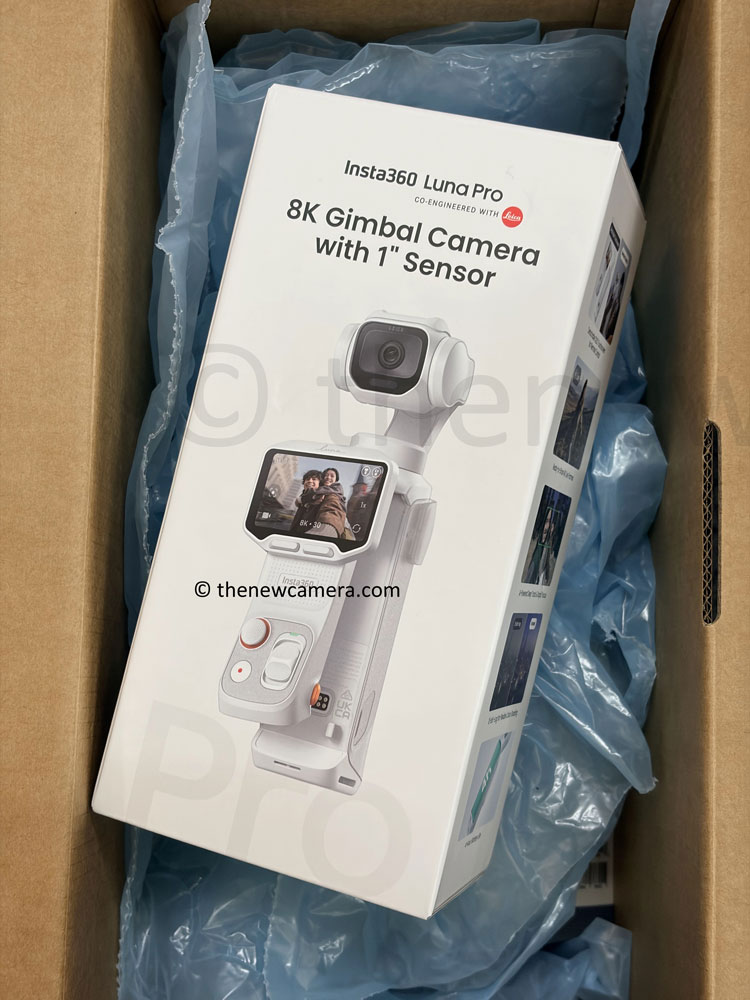
Finally, we have the unboxing video of the Luna Pro camera. The Luna Pro announcement is very close, and we have already seen images of retailers receiving boxes of the Luna Ultra Pro camera to keep in stock just before the announcement.
It’s time to watch the camera’s unboxing video, and at the same time, we will discuss the advantages you get with the Luna Pro compared to the Pocket 4 series in the United States of America. Since, as we all know, DJI has been banned, so not only has productavailability become an issue, but the warranty coverage is also not there if anything happens. It’s really hard to make sure your DJI Pocket 4P or any other related items from DJI will get service and repair, so it’s not only about the specifications. It’s also about the after-sales service, and if you have an option, then obviously I have to take some decision. Let’s have a quick look at the features of the Pro, and then the video we have (below post).
Unboxing Details
Inside the box you’ll find the camera, protective case, 1/4″ thread handle, wrist strap, USB-C cable, and documentation. The protective case fully covers the gimbal head and lens, which is a practical improvement over many competing pocket gimbals.
The camera itself feels solid and well-built. The single-lens design makes the head more compact than the Ultra, while the detachable 2-inch OLED touchscreen remote remains one of the most useful features in this category.
Why the Luna PRO is Currently the Better Option for Most US Buyers
For creators in the United States, the Luna PRO currently holds several practical advantages over the DJI Osmo Pocket 4 series:
Full official availability and support in the USA: Insta360 products are fully authorised and available through official channels (Insta360 Store, Amazon, B&H, Best Buy). There are no import or authorisation issues.
Clear and reliable warranty coverage Buying the Luna PRO through official US retailers means you get standard Insta360 warranty support without complications. This is currently a significant advantage compared to newer DJI products.
No uncertainty around future service or parts With ongoing regulatory pressure on DJI in the US market, long-term service, spare parts, and warranty claims for newer DJI models carry more uncertainty. Insta360 does not face the same restrictions.
Strong core features at a more accessible price You still get a 1-inch Leica-tuned sensor, 10-bit i-Log, excellent stabilization, and the detachable screen — without paying for a second telephoto camera you may not need every day.
If you are a US-based creator looking for a compact, high-quality pocket gimbal in 2026, the Insta360 Luna PRO currently offers a more reliable ownership experience than the DJI Osmo Pocket 4 series. You get strong image quality, a very useful detachable screen, and — most importantly — clear warranty and service coverage without the current regulatory uncertainty surrounding DJI products in the United States.
We will follow up with more detailed sample footage and real-world testing soon.
You can watch the full retail unboxing here:
Stay tuned; more updates are coming
We will update this page as soon as any official U.S. pricing, store listing, or availability announcement appears.
The article “Insta360 Luna PRO Unboxing Video ” was written by thenewcamera.com team on 2:05 pm Sunday, 16 August 2026, Greenwich Mean Time (GMT) | You can also follow us on Our Official Social Media HandlesFACEBOOK | TWITTER | INSTAGRAM> get live news — > DJI Rumors | Insta360 News
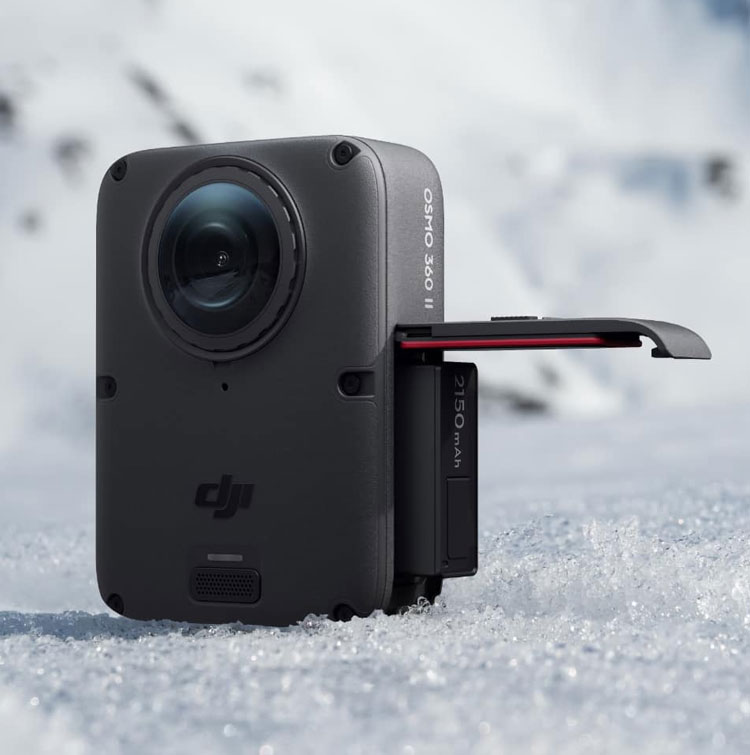
DJI Osmo 360 II has been officially announced in China on August 13, 2026. This is the second generation of the 360 camera, which arrives with some major noticeable improvements, including replaceable lenses, that was one of the biggest demands of first-generation 360 users. The second thing is having a 60 frames per second mode in 8K video recording; at the same time, the dynamic range of the camera has also been improved with AI algorithms and video processing, as well as the cherry on top, larger battery life and more internal storage to users.
As we all know, the 360, well, the recently announced 360 II is already using a large 1/1.1-inch sensor for video quality. It was already an excellent camera, but it is now much more improved with enhanced dynamic range and upgraded video processing algorithms.
The biggest question people are asking right now is when it will become available in the United States of America for sale.
For U.S. consumers, however, the most important detail remains unchanged: the Osmo 360 II is not officially available in the United States.
Current U.S. Status (August 14, 2026)
No product page exists on DJI’s American store.
No U.S. pricing has been announced.
No authorized U.S. retailers are listing the camera for sale.
DJI has not provided a U.S. release date or shipping timeline.
American buyers currently have no official channel to purchase the Osmo 360 II.
But, the good news is, the FCC authorization has been relay approved,. So, we do believe the OSMO360 II will soon become available for sale in USA
FCC Authorization: Approved, Not Pending
The camera carries a valid FCC equipment authorization under FCC ID 2ANDR-OQ0022512 (model OQ002).
The grant was issued on December 21, 2025. This detail was first reported by thenewcamera.com and later confirmed through public FCC records and independent coverage.
Will It Arrive in the USA Later?
This is not something unusual from DJI. As we all know, DJI has frequently launched its new products first in China and then brought them to the global market, including the United States, weeks or even months later.
Because the Osmo 360 II already has a valid FCC authorization from before the Covered List, it has a much clearer path toward entering the U.S. market compared with many other 2026 DJI products. So technically, the chances of the Osmo 360 II eventually coming to the United States are much higher than products that never received FCC approval.
But there is one important thing to remember. Several other 2026 non-drone DJI products have already launched internationally but still never made it to the American market. So, while the existing FCC authorization definitely improves the chances of a U.S. launch, it still does not guarantee that DJI will officially sell the Osmo 360 II in the United States.
What This Means for U.S. Buyers Right Now
Until DJI lists the camera on its U.S. store or authorized retailers begin carrying it, American buyers do not have an official path to purchase the Osmo 360 II. The Insta360 X6 remains the only new 360 camera with confirmed U.S. availability and support at this time.
We will update this page as soon as any official U.S. pricing, store listing, or availability announcement appears.
The article “DJI Osmo 360 II USA Availability Update ” was written by thenewcamera.com team on 4:53 pm, Friday, 14 August 2026, Greenwich Mean Time (GMT)
. | You can also follow us on Our Official Social Media HandlesFACEBOOK | TWITTER | INSTAGRAM> get live news — > DJI Rumors | Insta360 News
America’s consumers are mostly dependent on foreign drones, which the USA administration believes, and that’s why, even after completely banning new DJI drones back in December 2025, they are not stopping there. New rules have been updated for military drones, and now, according to the new rules, many DJI consumer-grade drones, including the NEO 2, are considered military-grade and are about to be banned, as we have already clearly mentioned in the previous article.
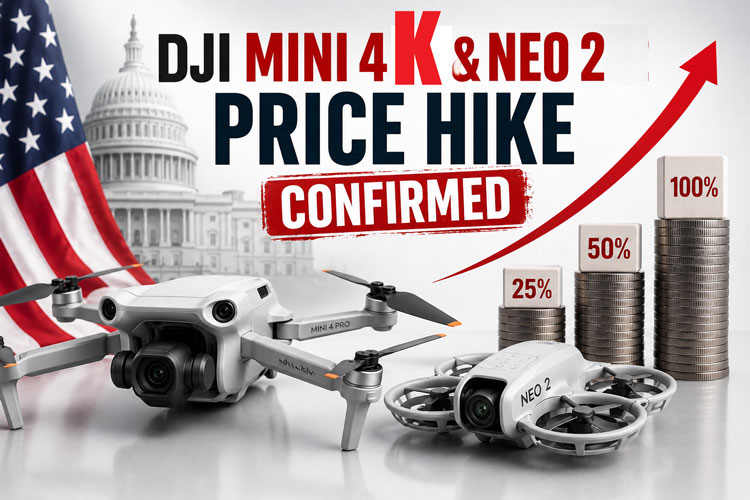
And now the next move: they have taken a major step to match the price of US-based drones to Chinese ones; already, all the drones we are purchasing have a 25% tariff over it. Some consumer-grade models will face 25% more tariff, approx 50%.
And some of the prosumer already-approved models, which are about to be banned soon in between September 2026 – March 2027, will face approx 100% tariff increase.
A clear price increase is coming for popular DJI drones in the US
….. and it has nothing to do with the proposed LiDAR ban.
Current Tariff Situation (Right Now)
China-origin drones such as the DJI Mini 4 Pro and DJI Neo 2 are already paying approximately 25% tariff under existing Section 301 rules.
Base duty: 0%
Section 301 tariff: +25%
Upcoming proposed traiff ≈ +25% ( tariff 100% for drones with thermal imaging)
What Changes from September 3, 2026
President Trump’s new Section 232 tariff will add an extra duty on imported drones. The rate depends on the type of drone:
Type of Drone
New Additional Tariff
Total Duty After Sept 3
Smaller consumer drones (25 kg or less, without thermal imaging)
+25%
~50%
Larger or sensitive drones (over 25 kg or with thermal imaging)
+100%
~125%
Which Drones Fall Under Which Category?
25% additional tariff (Total ~50%) applies to:
DJI Mini 4k
DJI Neo 2
Almost all DJI drones
Most Mini series, Air series (non-thermal versions), and other regular consumer drones under 25 kg without thermal cameras
100% additional tariff (Total ~125%) applies to:
Drones with maximum takeoff weight over 25 kg
Any drone that has thermal imaging capability
Docking stations and certain critical components of these drones
How Much Will Prices Actually Rise?
The new tariff is charged on the import value. In practice, most of the extra cost is passed on to buyers.
Expected impact on popular models (25% category):
Model
Current Approx. Price
Expected Price After New Tariff
Rough Increase
DJI Mini 4k (base)
$200 – $259
$250 – $370
+15% to 25%
DJI Neo 2 (drone only)
~$259
$310 – $340
+20% to 30%
Neo 2 Fly More Combo
~$429 – $450
$520 – $570
+20% to 25%
Drones that fall under the 100% category (thermal or heavy models) will see a much steeper price jump.
Critical Point: This Price Hike Comes First
There is a separate FCC proposal that may restrict drones with LiDAR or thermal sensors. That proposal is still under discussion and is not final.
The new tariff, however, is already confirmed and starts affecting new imports from approximately September 3, 2026.
In short:
The tariff-driven price increase is locked in.
It will start in early September.
This will happen before any possible LiDAR-related restrictions.
So, these are some important points to consider before you postpone your next drone purchase.
Drones already in the US are not charged the new tariff.
New stock arriving after early September will cost more.
Some sellers may raise prices even before September 3.
If you are planning to buy a Mini 4k, Neo 2, or similar consumer drone in the United States, the lower-price window is closing quickly.
GET LIVE NOTIFICATION, Select Your Trusted Source GET LIVE NOTIFICATION Click ON Check BOX for Latest NEWS and Rumors
The article “DJI Mini 4 Pro & Neo 2 Price Hike Confirmed in USA” was written by thenewcamera.com team on 9:22 am, Friday, 14 August 2026, Greenwich Mean Time (GMT). | You can also follow us on Our Official Social Media HandlesFACEBOOK | TWITTER | INSTAGRAM> get live news — > DJI Rumors | Insta360 News
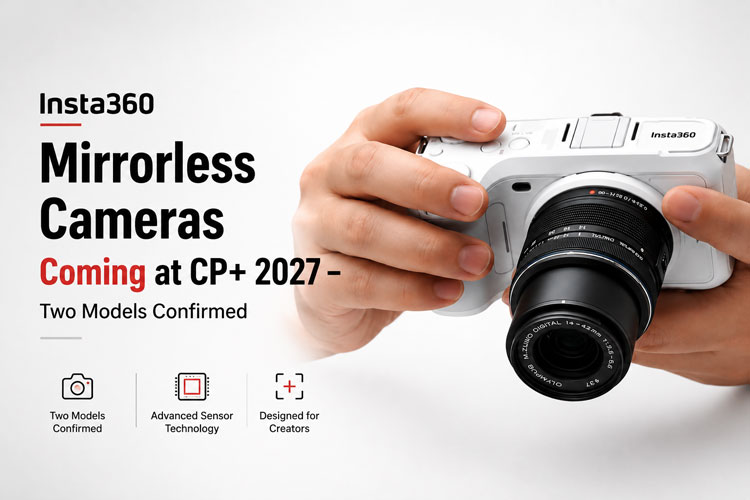
Insta360 Founder and CEO JK Liu confirmed that the company is working on TWO (2) brand-new mirrorless cameras. One we have already seen back in April 2026 (the Z 1): the camera used an M4/3-format sensor and an M4/3rd Olympus 14-42mm Lens. That clearly indicates Insta360 is about to target mainstream mirrorless cameras and camera giants like Canon and Sony with their latest tech.
The most interesting part is CEO JK Liu has also said that one of the cameras has a completely unconventional form factor that Liu described as “a shape no one has ever thought of before.”
The confirmation came during an interview with Japanese publication Mynavi News on the sidelines of the opening of Insta360’s first Japanese flagship store in Asakusa, Tokyo.
Official Confirmation from JK Liu
When asked about long-standing social media rumors of Insta360 entering the mirrorless camera segment, Liu stated:
“At this point, there are limited things I can talk about, but we are developing two types of mirrorless cameras.”
He further revealed that the two models have completely different characteristics. Regarding one of them, he said:
“One of them has a surprising shape that you have never thought of before.”
In the article title and reporting, Mynavi also highlighted the key phrase:
“It will be a shape that no one has ever thought of.”
Liu suggested this unusual design could change the traditional way people use cameras – the conventional process of framing, focusing, and pressing the shutter button. The camera is expected to incorporate Insta360’s expertise from its 360-degree and gimbal products, along with advanced AI features aimed at making photography more automated and accessible.
Prototype Possibility at CP+ 2027
On the timeline, Liu offered a cautious but clear indication:
“I think we can show you a prototype at next year’s CP+.”
This points to the possibility of a prototype display at CP+ 2027 in Japan. No commercial release date or official product announcement timeline was shared. Any speculation about a late-2027 launch remains unconfirmed.
Background and Context
Rumours about Insta360 working on a traditional or interchangeable-lens camera have circulated for several months in 2026. Earlier leaks and a January 2026 Weibo post by Liu showing unfamiliar camera bodies had already fueled speculation, including possible Micro Four Thirds designs. However, this is the first time the company’s founder and CEO has publicly confirmed active development of two distinct mirrorless models.
The statement aligns with Insta360’s broader long-term vision of creating cameras that behave more like intelligent “cameramen” — devices that can see, understand scenes, and assist users so they can stay more present in the moment rather than constantly managing framing and settings.
What We Know About Upcoming Z Series Mirrorless Cameras from Insta360
Sensor size or type – M4/3 Mirrorless Sensor
Lens mount – M4/3 Mount / L mount compatible
Details remain limited, as Liu himself noted that only restricted information can be shared at this stage.
Insta360 is officially entering the mirrorless camera space with two models. One will feature a radical new form factor that the company believes could redefine how people shoot. A prototype may appear at CP+ 2027, but a full commercial product is still further down the road.
This marks a significant expansion for a brand best known for 360-degree and action cameras. The camera industry will be watching closely when CP+ 2027 arrives.
GET LIVE NOTIFICATION, Select Your Trusted Source GET LIVE NOTIFICATION Click ON Check BOX for Latest NEWS and Rumours
The article “Insta360 Mirrorless Prototype Coming at CP+ 2027 – Two Models Confirmed” was written by thenewcamera.com team at 3:34 pm, Wednesday, 12 August 2026, Greenwich Mean Time (GMT). | You can also follow us on Our Official Social Media HandlesFACEBOOK | TWITTER | INSTAGRAM> get live news — > DJI Rumors | Insta360 News
Buy Canon Lenses, Buy Music CD or Digital Camera at amazon it helps this site, and you do not pay anything extra, it is just a way to help support this site.
New Camera Website, we list all type of new camera information, price review and all type camera rumors, subscribe us or follow us via twitter or facebook.
Disclaimer: We have attempted to select useful information to include on New Camera, and to ensure that the resources we have included on the site -- as well as the way we have described them -- are accurate, fair, and balanced. However, we make no claims, warranties, or other representations concerning the accuracy, completeness, or utility of the information provided, or concerning the abilities or performance of the organizations, agencies, companies, and other resources presented through New Camera