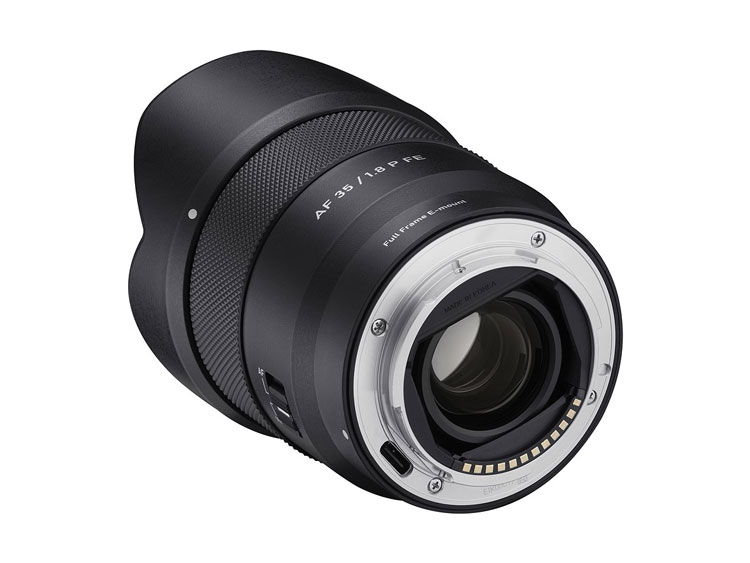
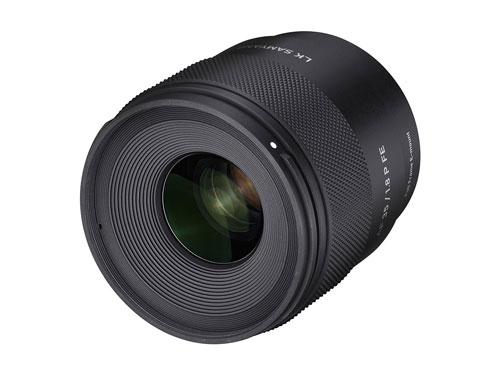
So we have a new 35mm f/1.8 lens on the block. The lens is a super compact.Its weight is approximately 216 g, and it’s perfect for compact bodies like the Sony ZV-E10, E-1, or the Sony A7C series. Although you can use it for photography, those who prefer a 35mm format on a budget find options a bit costly. Even the version of the 35mm f/1.4 is going to cost you approximately 699, and Sigma is also costly. But again, you do have an option from VILTROX in the market, that is 35mm f/1.8, which is available at approximately 379. So, overall, at the end, Samyang has made 35mm more and more affordable at $265. It all depends on the type—if you want a bit more affordable, then obviously the Samyang is the best prime. Other than that, a lot of other options are already available with different form factors, apertures, and price ranges.
Compared to the bigger, brighter AF 35mm F1.4 P FE (which tips the scales at 470g), the new F1.8 version is a svelte 216g and just 72mm long. That’s the kind of size that slips into a jacket pocket or pairs perfectly with the Sony α7C series or ZV-E bodies without making you regret leaving the house.
Here’s the no-fluff, real-world breakdown every photographer actually cares about. Prices are current US street prices from major retailers (B&H, Amazon, official sites). Note: No major third-party brand currently makes an exact AF 35mm f/1.5 FE lens — the closest realistic competitors are f/1.4 (brighter but bigger/heavier) and f/1.8 models. The new LK Samyang AF 35mm F1.8 P FE is the clear value king in the “actually carry it every day” category.
Lens Model
Max Aperture
Weight
Length
Approx. Price (USD)
Why It Matters / X-Factor vs New Samyang P
LK Samyang AF 35mm F1.8 P FE (New Prima)
f/1.8
216 g
72 mm
$265
The winner for most people. Lightest, cheapest, weather-sealed, modern STM II AF, USB-C firmware, and still sharp with great flare control. Built to be your daily walkaround lens.
Samyang AF 35mm f/1.4 FE II
f/1.4
659 g
115 mm
$699
Brighter aperture for more subject separation and low light, but over 3× heavier and 60% more expensive. Great if you prioritize bokeh over portability.
Sigma 35mm f/1.4 DG DN Art
f/1.4
640 g
109 mm
$949–$989
Premium build and optics that can trade blows with Sony GM glass, but you’re paying nearly 4× the price and carrying triple the weight. Overkill for everyday shooting.
Viltrox AF 35mm f/1.8 FE
f/1.8
~340 g
~82 mm
$379
Similar aperture and AF, but noticeably heavier and pricier than the new Prima. Solid budget option, yet the Samyang P still beats it on size, weight, and value.
Bottom Line – Why Recommend the New Samyang AF 35mm F1.8 P FE
Pure value: At $265 it’s $114–$724 cheaper than every other third-party option while being dramatically lighter and more compact.
Real-world usability: 216 g means it disappears on an a7C, a7IV, or ZV-E body. The others feel like you’re carrying extra gear.
No compromises on essentials: Weather sealing, 9-blade bokeh, fast/quiet Linear STM II motor, and direct USB-C updates — features you usually pay $400+ more to get.
Stay tuned, the Review is on its way
Press release:
LK SAMYANG Expands Prima Series with the New AF 35mm F1.8 P FE
A Compact Everyday Prime Expanding the Prima Series
Key Message
A compact and lightweight 35mm F1.8 prime lens designed for everyday photography and hybrid content creation
Upgraded optical performance with new XHR optical elements, UMC II coating, and Linear STM II autofocus motor
Enhanced usability with weather sealing and a USB-C port for direct firmware updates
March 26, 2026 – Republic of Korea – LK SAMYANG, a global optical solutions company with more than 50 years of expertise in optical technology and innovation, today announces the launch of the AF 35mm F1.8 P FE, a new addition to the Prima Series designed for hybrid creators and everyday photographers.
The new lens expands the Prima Series lineup following the introduction of the AF 35mm F1.4 P FE in 2024, and the AF 16mm F2.8 P FE and AF 85mm F1.8 P FE in 2025.
Built on the philosophy of portability, practicality, and usability, the Prima Series offers creators compact and lightweight prime lenses capable of delivering reliable optical performance for both photography and video creation.
The AF 35mm F1.8 P FE continues this vision by providing a versatile everyday lens that balances image quality, portability, and creative flexibility.
A Versatile 35mm Lens for Everyday Creativity
The 35mm focal length has long been regarded as one of the most versatile perspectives in photography. Its natural angle of view allows creators to capture a wide variety of subjects including street scenes, travel moments, portraits, and cinematic storytelling.
The AF 35mm F1.8 P FE is designed as a practical everyday lens that combines a bright aperture with a compact form factor and dependable autofocus performance.
While the AF 35mm F1.4 P FE focuses on maximum brightness and high-end optical performance, the AF 35mm F1.8 P FE offers a lighter and more compact alternative optimized for everyday shooting, making it an ideal companion for photographers and content creators who prioritize portability without compromising image quality.
Key Features
Compact and Lightweight Design : Made for Everyday Carry
The AF 35mm F1.8 P FE continues the Prima Series philosophy of compact and portable lens design.
With a maximum diameter of Φ69.8mm and a standard 62mm filter size, the lens integrates seamlessly into lightweight shooting setups and is easy to carry throughout the day.
Its compact form pairs particularly well with lightweight full-frame cameras such as the Sony α7C series and ZV-E models, making it an ideal everyday lens for travel, street photography, and hybrid content creation.
Bright F1.8 Aperture with Natural Bokeh : Balanced Performance for Photo and Video
The bright F1.8 aperture provides excellent flexibility across a wide range of lighting conditions, allowing creators to shoot confidently in both bright daylight and low-light environments.
A 9-blade rounded aperture produces smooth and natural background blur, enabling expressive subject separation for portraits, lifestyle photography, and cinematic video production.
This balance of brightness and portability makes the AF 35mm F1.8 P FE a practical lens for everyday creative work.
Next-Generation Optical Technology : XHR Element for Higher Performance
The AF 35mm F1.8 P FE features an advanced optical construction of 10 elements in 8 groups, including 2 ASP (Aspherical) elements and 2 newly developed XHR elements.
The XHR (Extra High Refractive) lens element is manufactured with higher precision compared to conventional high-refractive index elements, allowing for a more compact optical structure while effectively reducing optical aberrations.
By incorporating XHR elements, the lens achieves improved optical performance while maintaining a thinner and lighter design, delivering sharp resolution and consistent image quality across the entire frame.
Next-Generation Coating Technology : UMC II for Improved Image Clarity
The AF 35mm F1.8 P FE incorporates UMC II (Ultra Multi Coating II), the next generation of LK SAMYANG’s coating technology.
Compared to the previous coating system, UMC II further suppresses flare and ghosting, ensuring improved contrast and clarity even in challenging lighting environments such as strong backlight or night scenes.
This upgraded coating technology helps deliver cleaner and more vibrant images in real-world shooting conditions.
Fast and Quiet Autofocus : Linear STM II for Hybrid Creators
The AF 35mm F1.8 P FE is equipped with the next-generation Linear STM II autofocus motor.
Combined with continuously refined firmware algorithms, the Linear STM II system delivers faster, more accurate, and quieter autofocus performance, ensuring smooth focusing transitions for both still photography and video recording.
This improved autofocus system allows creators to capture dynamic scenes with greater precision and stability.
Enhanced Usability for Real-World Shooting : Weather Sealing and USB-C Connectivity
The AF 35mm F1.8 P FE is designed to perform reliably in real-world shooting environments.
The lens features weather sealing, helping protect it from light rain, dust, and outdoor shooting conditions.
It also includes a USB-C port, enabling users to easily update firmware and customize lens settings directly without the need for a separate lens station.
This convenient connectivity ensures that users can keep their lens up to date while maintaining optimal performance.
Designed for Modern Creators
An LK SAMYANG representative commented:
“The Prima Series was created to offer lenses that creators reach for first. The AF 35mm F1.8 P FE reflects that philosophy by delivering a balanced combination of portability, optical performance, and everyday usability, making it an ideal lens for both photography and video creation.”
Availability
The LK SAMYANG AF 35mm F1.8 P FE will be available for purchase starting late March 2026, with sales gradually launching across global markets through LK SAMYANG’s distribution network and authorized retailers.
The article “The $265 Lens That Just Made Every Other 35mm Feel Fat and Overpriced” was updated 1:04 pm,Saturday, 28 March 2026, Greenwich Mean Time (GMT) by thenewcamera.com team | You can also follow us on Our Official Social Media HandlesFACEBOOK | TWITTER | INSTAGRAM to get live news — > DJI Rumors
A lot of new information related to the Pocket 4 camera has leaked today, and most importantly, it has been leaked by Colombian DJI authorized dealer DroneTechx (@dronetechx), which has gone all-in with a massive Instagram campaign teasing the highly anticipated DJI Osmo Pocket 4.thenewcamera.com breaks it all down: country of origin, exact pre-sale pricing according to DroneTechx
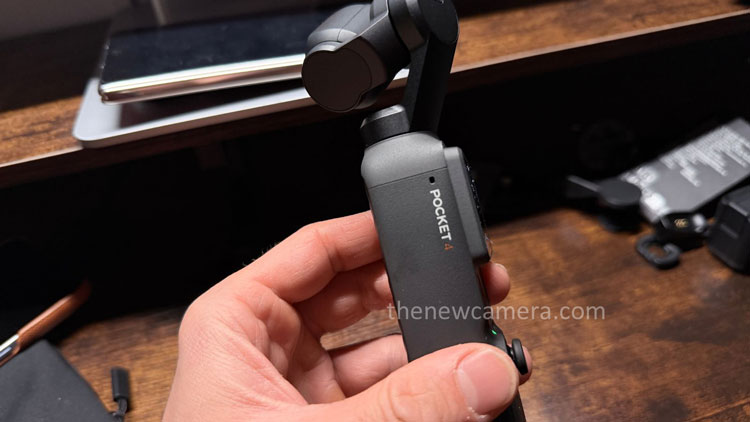
Yes, we have reported the dummy unit on its way to retailers just before this. But while writing this article, we have received a lot of information related to the DJI Pocket 4 standard edition model, thanks to our sources, those who captured all the possible information, reels available at that moment, and sent it back to us. For now, yes, some of the videos that have been taken down or are uploaded to the stories. But we do have them below so you can check them for yourself.
DJI Osmo Pocket 4 Price According to DroneTechx (Pre-Sale Exclusive)
DroneTechx is running a “PREVENTA EXCLUSIVA” (Exclusive Pre-Sale) campaign right now.
Hot Sale Price revealed in their promotions: COP $2,092,500 (approx. $567 USD at current rates).
Savings: Over COP $220,000 off regular pricing.
This appears to cover the Creator Combo bundle (most popular configuration).
No public “add to cart” price yet on the main website (still in teaser phase), but they urge followers to DM or WhatsApp for early access
Pocket 4 Specification – Key highlights they emphasize:
1-inch CMOS sensor for better low-light and detail.
Ultra-sharp professional video
Upgraded stabilization + possible 6K or 4K120fps video.
Larger battery (~1545mAh) for extended recording.
Improved modular accessories and Creator Combo extras.
Rotatable touchscreen + seamless DJI Mic 2 integration
Advanced intelligent stabilization – smoother than ever.
Creator Combo: $649–$749 USD. DroneTechx’s COP 2.09M pricing is highly competitive for Colombia, undercutting many local resellers.
How We Discovered the April 20, 2026 Date
While scrolling through the comments on DroneTechx’s recent Osmo Pocket 4 post, a customer (@oscalacaman) asked about delivery timing.
DroneTechx’s official reply (posted 10 hours ago):
“@oscalacaman herzlicher Gruß 20. April $3.800.000”
Translation: “Kind regards — April 20 — $3,800,000 COP”.
This is the first time an authorized dealer has publicly named April 20, 2026 as the availability date. The same comment thread also confirms it is the standard Osmo Pocket 4 (no “Pro” version announced yet).
Stay tuned at thenewcamera.com — we’ll update this article the moment the first units ship on April 20, 2026
Well, according to DroneTechx, the official announcement of the standard Pocket 4 camera is about to happen on April 20, 2026, so this is the date that we are getting from the standard set of conversations with their subscribers or customers. Again, we are still waiting for an official confirmation from DJI
GET LIVE NOTIFICATION, Select Your Trusted Source GET LIVE NOTIFICATION Click ON Check BOX for Latest NEWS and Rumors
The article “DJI Pocket 4 Coming April 20, 2026 – Massive Leak Before Official Announcement” was updated 2:16 pm, Friday, 27 March 2026, Greenwich Mean Time (GMT)by thenewcamera.com team | You can also follow us on Our Official Social Media HandlesFACEBOOK | TWITTER | INSTAGRAM to get live news — > DJI Rumors
Avata 360 is official, and finally all the rumours have come to an end, and the pre-orders of the Avata 360 on Amazon will start on and after March 30, 2026, so be ready to pre-order DJI. One of the most advanced 360 drones with an FPV mode. We have already discussed so much about the features of the Avata 360. It all looks like everything is known, so no further discussion about the core specifications of the drone.
Avata 360 is now official, and pre-orders will start on or after March 30, 2026.
Press Release
DJI Avata 360 Sets New Standards for Immersive 360 FPV Flying
Equipped with DJI’s flagship 1-inch imaging, O4+ video transmission, and omnidirectional obstacle sensing, creators can now film 360 footage in 8K with ease while flying with confidence
March 26, 2026 – DJI, the global leader in civilian drones and creative camera technology, today launches the Avata 360. Designed to unlock endless creativity in one take1, DJI’s new 8K 360° flagship drone delivers 360° imaging with 1-inch-equivalent sensors1 for filming in 8K/60fps HDR video. Meanwhile, DJI’s powerful O4+ video transmission system and obstacle sensing1 enable creators to see farther with a more stable, safer, and more immersive flight experience. Paired with DJI goggles and motion controllers, the latest addition to the popular Avata series delivers an immersive 360° flight experience for FPV thrills. Creators can also use the DJI remote controllers to capture a full 360° view in a single flight that can be reframed from any perspective, transforming a single take into multiple creative possibilities.
Brilliant Imaging, Boundless Creativity
Avata 360 offers two different lenses that can be seamlessly switched. The 360° lens uses 1-inch-equivalent sensors1 that can capture 360° images in rich detail for 8K/60fps HDR videos1 and 120 MP photos. With the large 2.4 μm pixels and high dynamic range, light and shadow are also captured with exquisite clarity. Both video and photos can be exported directly or reframed in post-production. Meanwhile, the Single Lens mode allows creators to use the classic Avata-style filming in 4K/60fps1.
Powerful Video Transmission, Immersive Flight
Avata 360 leverages DJI’s flagship O4+ video transmission system to deliver stable and clear live feeds for smoother, more immersive flights. Its strong anti-interference capabilities enable high-definition, high-frame-rate transmission at 1080p/60fps and support a range of up to 20 km1.
Fly With Confidence, Create With Ease
Avata 360 offers up to 23 minutes of flight time1 and includes several standard safety features, including nightscape omnidirectional obstacle sensing1 and integrated propeller guards. If damaged, the camera lens can be easily replaced with the DJI Avata 360 replacement lens kit with tools (sold separately). It also brings an exceptional experience to aerial content creation, where a single shot with the drone’s 360° imaging can be transformed into multiple, masterful creations through post production using the DJI Fly and DJI Studio apps, including:
Spotlight Free1 – Locks onto a moving subject and assists with camera movement, replicating the sophisticated camera language like a pro with Inspire 3. By comparison, Spotlight locks onto your subject’s face to effortlessly capture Circle or Dronie shots without manual adjustments.
ActiveTrack 360°1 – Automatically selects the optimal tracking mode. For example, Standard mode maintains a steady distance and altitude relative to the subject. Meanwhile, Cycling mode reacts faster to turns and keeps the subject in frame even in complex environments.
FPV mode – Enables even novice pilots to adds a natural roll effect to Spotlight Free, ActiveTrack 360°, and manual flights to create dynamic, high-speed FPV-style footage. This mode can be applied in post-production.
Intelligent Tracking – Powered by advanced algorithms, the DJI Fly and DJI Studio apps make it effortless to lock onto and smoothly track people, vehicles, pets, and more, even in 360° footage.
New One-Tap In-App Editing – With GyroFrame, 360° footage can be adjusted to an ideal angle and exported in the DJI Fly app. Both DJI Fly and DJI Studio allow camera movement effects to be added.
Virtual Gimbal1 – Uses a 360° view to enable infinite rotation and tilt for dynamic camera moves. Even when flying in one direction, horizons can be rotated, and perspectives can be shifted to look back or perform a flip.
Replaceable Front Lens Element – The front element features a replaceable design. Purchase a replacement lens kit with tools1, and you can easily replace the old lens yourself—no need to send it in for repair.
42GB Internal Storage and High-Speed Transfers – With 42GB of internal storage, 30 minutes of 360° video in 8K without a microSD card. Using Wi-Fi 6 High-Speed Transfer, 1 GB of footage can be transferred to the DJI Fly app in 10 seconds at up to 100 MB/s1.
FPV Flights and Aerial Filming in One Drone
Avata 360 combines the creative freedom of a 360 camera with the thrill of FPV flying like never before. It can be flown with the DJI remote controllers (RC 2, RC-N2, RC-N3) for precise camera movement, allowing creators to unlock new ways to create stunning aerial shots. Meanwhile, DJI goggles and motion controllers offer a more immersive flight experience with 360° imaging at 1080p/60fps. Like the Avata 2, aerial acrobatics like drifting can be performed – even by beginners – with the DJI RC Motion 3.
GET LIVE NOTIFICATION, Select Your Trusted Source GET LIVE NOTIFICATION Click ON Check BOX for Latest NEWS and Rumors
The article “DJI Avata 360 official Press Release” was updated
8:23 am, Friday, 27 March 2026, Greenwich Mean Time (GMT) by thenewcamera.com team | You can also follow us on Our Official Social Media HandlesFACEBOOK | TWITTER | INSTAGRAM to get live news — > DJI Rumors
Clear close-up of the official “Osmo Pocket 4 Dummy Unit” label showing date code, EAN/UPC, “Made in China”, and “Total: 15”.
So yes, we do have some new information related to the DJI standard Pocket 4 edition, and this was stated by the veteran DJI leaker @Quadro_News, who dropped a major update yesterday. Fresh images from our sources now make the evidence undeniable.
A major update was dropped yesterday, and fresh images from our sources now make the evidence undeniable.
In his post “Avata 360… Lito and Pocket 4… Yep, @DJIGlobal 🤭”, Igor Bogdanov confirmed three big 2026 products are real. But the attached shipping label — now backed by exclusive new warehouse photos — is the real bombshell: Osmo Pocket 4 dummy units are already being shipped in bulk.
That clearly indicates that DJI is not planning to announce the Pocket 4 camera very much sooner; units and the dummy units specifically made for retail store display sections are on their way for distribution purposes.
The dummy units specifically made for retail store display sections are on their way for distribution purposes.
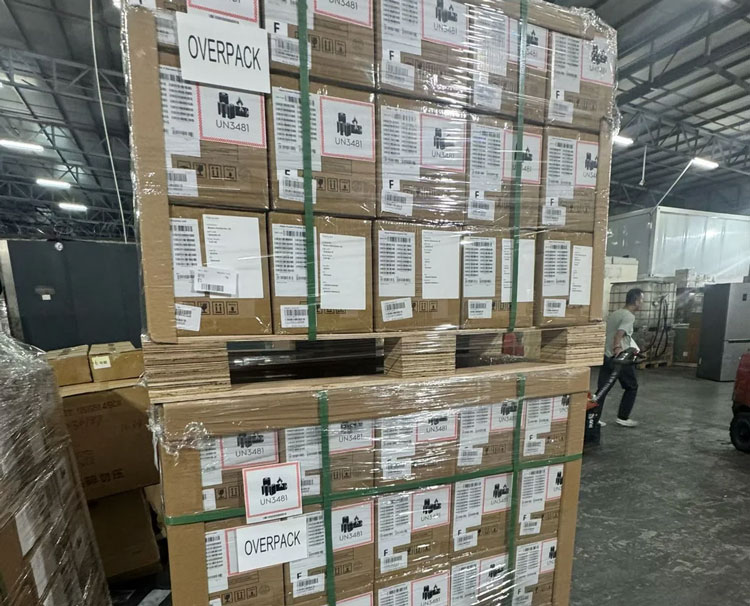
Massive OVERPACK pallets in a DJI warehouse filled with boxes marked UN3481 (standard lithium-ion battery shipping label used by DJI). This is not a small test batch — this is large-volume logistics preparation. These photos confirm that DJI has moved well past early prototyping. Dummy units are now being palletised and prepared for global distribution.
Exclusive New Warehouse Photos Reveal Full-Scale Preparation
Thankfully, our sources have sent us high-resolution images that go far beyond the original leaked image by the veteran sources, and in this detailed image, you can see not only one, but other lots of shipments that are ready to get distributed soon. You can see not only one, but multiple lots of shipments ready to be distributed soon.
What is a Dummy Unit?
Non-functional mock-ups used for packaging tests, retailer training, regulatory filings, and marketing photography. Retailers usually place dummy units to showcase various products. They technically show off the product without using the original product, as the unit is very low compared to the original product’s price. It is much safer for retailers to put down the dummy for people who just want to have hands-on and look how it feels holding the camera. If someone is really interested in buying the camera, then obviously, the store service is ready to showcase the product and allow them to have hands-on experience before purchasing.
What Else Was Confirmed in the Leak?
Well, that may be considered as the most important part, since the things that we know for now, based on what is visible to us, are that DJI Pocket 4 dummy units are now being shipped to retail stores for the final set of announcements, so that they can take pre-orders; so is the camera. But if you guys closely look at the tweet of Igor, then you will find that he has mentioned three names. And the three names are the 360 drone, the DJI Pocket 4 standard edition camera, and the Lito X1.
As you know, the Avata 360 announcement date is today, that is, March 26, 2026, in mainland China, as well as Canada and the United States of America. The Avata 360 will officially arrive on March 30, 2026. Other than that, the standard edition announcement is on its way, and most probably we will have it in April–May 2026. Other than that, the third name on the list, which is said to be a drone for now, clearly hints that after the standard Pocket 4, we have the Lito announcement next.
Dji Pocket 4 Standard Edition Prototype surfaced in a hands-on video
in February 2026. A customer visited DronesKaki Bukit Bintang in Fahrenheit 88, Kuala Lumpur, Malaysia, and showed off the DJI Pocket 4 to the store staff. As described in the post: “A customer came to show us the DJI Pocket 4! It’s a cool gimbal camera with an LED light.”
This 33-second Instagram Reel, uploaded on February 15, 2026, by the official DJI-authorized retailer DronesKaki, captures the first hands-on DJI Pocket 4 footage outside of China leaks. It’s perfect for vloggers eyeing the DJI Pocket 4 release date, DJI Osmo Pocket 4 specs, and DJI Pocket 4 Malaysia availability. We’ve embedded the video, broken down the highlights, compared it to the Pocket 3, and included the latest leaked specs.
What This Means for 2026: DJI’s Busiest Launch Window Yet
March 26, 2026 → Avata 360 is live
April–May 2026 → Osmo Pocket 4 very likely (China announcement possibly today or next week, global shortly after)
Q2–Q3 2026 → Lito 1 and Lito X1 drones
The warehouse-scale shipment of Pocket 4 dummy units strongly suggests DJI has already cleared major production and regulatory hurdles. Expect the official reveal and pre-orders in the coming weeks.
This is no longer just a rumor — it’s photographic proof of advanced pre-production. The combination of Quadro_News’ post plus these exclusive warehouse images makes the Osmo Pocket 4 one of the most certain upcoming DJI releases of 2026. We’ll update this article the moment DJI makes it official (possibly as soon as today). Turn on notifications so you don’t miss the reveal. What are you most excited for — the new Pocket 4, Avata 360, or the affordable Lito drones? Let us know in the comments!
TheNewCamera Exclusive coverage: Insta360 is pushing the boundaries of innovation, just one after another, and in the latest leak, we have a wireless microphone, which is an upcoming product of Insta360, accidentally revealed by insta360 CEO, in a newly surfaced clip from founder JK Liu (Liu Jie) shows the company was testing something truly unique: a wireless lavalier mic with a live-refreshable customizable display.
The short interview clip, originally shared on Xiaohongshu (now deleted/404), shows Liu holding a round black transmitter with a small circular screen. On it? A bright yellow-and-blue “对话 / DIALOGUE” logo with wings — and he explicitly says the display can be updated on the fly.
Subtitles from the clip (translated):
“This is the microphone we’re about to launch.”
“It can refresh the logo on top.”
“For example, the ‘Dialogue’ program team’s…”
“Just put the ‘Dialogue’ logo on it.”
Insta360 Wireless mic ready with a built-in screen capable of live branding or personalization.
What the Prototype Looked Like
The overall design looks very futuristic. From the glimpse, we have a tiny round microphone, which looks very similar to the circular microphones that we have, specifically from Hollyland and other brands.
But the unique thing that we have found in this image is the display over the microphone, which allows you to control the settings of the microphone, as well as customise its presence with variable colours, depending on the type of mood or the clothes you are wearing, even as mentioned by the source living branding / adding logo etc also possible in the mic to cutomize the overall look
So, it is much more advanced than the current generation of microphones we have seen, which rely on physical controls.
Liu’s excitement suggests this was meant to be a standout feature for content creators, event teams, YouTubers, and even TV production crews who want branded mics without stickers or tape.
The Arrival Date
Some commenters on the original Xiaohongshu thread speculated a connection to the Insta360 Luna pocket gimbal camera (expected any day now in late March or April 2026). But, while nothing is confirmed, a smart mic with visual feedback would pair beautifully with a vlogging-focused device like Luna.
What do you think about this innovative microphone? Would you want a wireless mic with a customizable screen, or is the current Mic Air already perfect? Drop your thoughts in the comments
Stay tuned at thenewcamera.com for the latest Insta360 leaks, Luna launch coverage, and hands-on reviews.
The article “Breaking News: Insta360 Wireless Mic Prototype with Customizable Display Leaked in JK Liu Interview” was written by thenewcamera.com team on 7:00 pm, Wednesday, 25 March 2026,Greenwich Mean Time (GMT). | You can also follow us on Our Official Social Media HandlesFACEBOOK | TWITTER | INSTAGRAM> get live news — > DJI Rumors
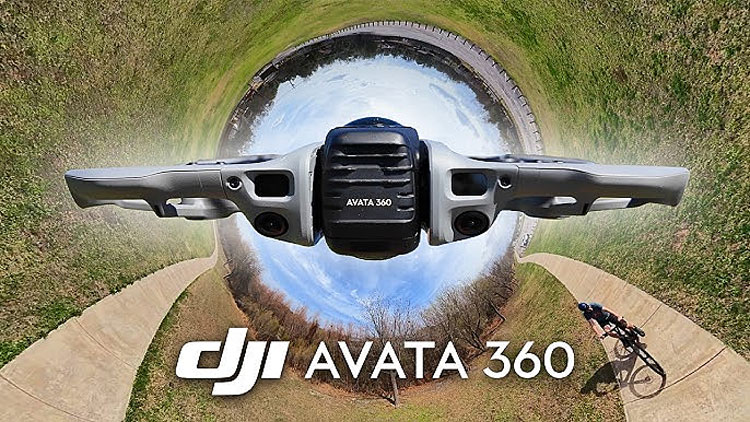
Well, this is really on top of the rest of the leaks that we have published recently, better to say kind of a breakthrough news that we have spotted – DJI has just uploaded a striking new promotional banner for the DJI Avata 360 directly on its official Amazon US storefront. Confirmation from the DJI itself. The banner confirms the product name, the “8K Flagship 360° Drone” positioning, and the bold tagline “Above It All, See It All.” This is the clearest visual proof yet for US buyers — the banner is live right now on the official DJI store page on Amazon.com. The release date is on March 26, 2026. Now waiting to get more confirmation about the shipping date of the upcoming drone
Below we have the price comparison. If you have missed our previous post comparing it to the Antigravity price with Avata360, even before that, take a look at the first hands-on report and reviews that have popped up for the Avata 360, which are very exciting, as well as a revolutionary upgrade over the drone while using it for the first time..
This is the most unique part of the entire drone. Of course, it has a full 360 camera, but how does it actually shoot 360° when one lens is facing you? The second camera is on the opposite side.
What I loved most: the camera actually rotates during takeoff and landing. It spins from the 360 position so the top camera moves to the bottom and vice versa. There are little protective feet/pads at the bottom, so when you land, you’re never touching the lens itself. It sits perfectly protected. You can read the first review here of the Avata 360
Prices are based on current official Antigravity bundles (USD) and leaked European Avata 360 figures converted at ~1 EUR ≈ 1.15 USD (mid-March 2026 rates). US pricing for Avata 360 may adjust slightly at launch, but is expected to align closely or be even more competitive.
The DJI Avata 360 comparison that we have done clearly shows that the core specifications [core specs comparison at this page] that we are getting inside the 360 drone are far better than what we have in the Antigravity. Even though detailed comparison videos will be uploaded once the drone becomes official, if you compare and look at the pricing that we have for now, you can clearly see that the Avata 360 is going to cost you a lot compared to the A1. Other than that, we have a dual operational mode — one is the FPV style, and the other is the regular 360 drone, so technically the 360 is more advanced, and the pricing is low.
Why the DJI Avata 360 Matters for US Drone Pilots
This is DJI’s first true hybrid FPV + 360° spherical drone. It combines the immersive flight experience of the Avata series with full 360° capture
This drone gives you one of the widest ranges in terms of dynamic experience, where you can capture in 360° and recompose it later as per your own convenience. Other than that, as a standalone system, the tight shooting experience that you get with this drone is something that is kind of unforgettable with a portable 360 drone, this could be the most versatile drone DJI has ever released under 250 g–500 g class regulations.
Stay tuned — we will update this article once the second pre-order links and full specifications drop on March 30.
The article “DJI Avata 360 Official Banner Revealed on DJI Store Amazon USA” was written by thenewcamera.com team on 1:07 pm, Wednesday, 25 March 2026, Greenwich Mean Time (GMT) | You can also follow us on Our Official Social Media HandlesFACEBOOK | TWITTER | INSTAGRAM> get live news — > DJI Rumors
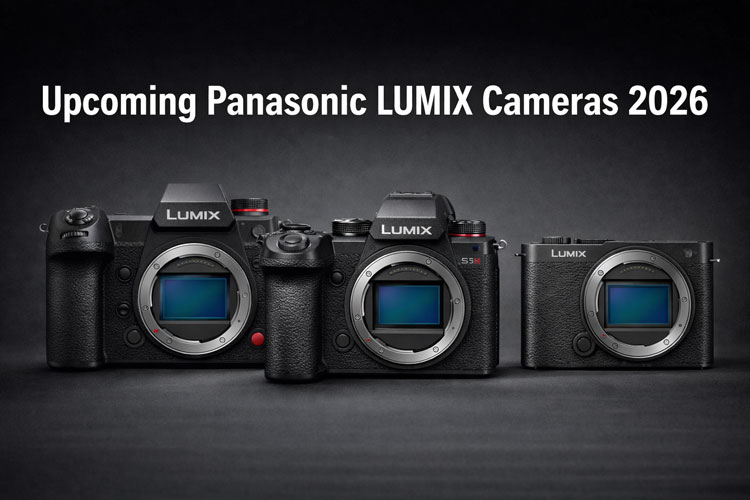
We are sharing a quick report about upcoming Panasonic cameras. Those that we are expecting may arrive in 2026 if Panasonic follows its scheduled update timeline. We all know that in 2025, Panasonic was very accurate with its lineup of cameras, and we expect that even in 2026, we will have some surprising announcements.
The Association of Independent Photographers has published their detailed prediction of what they would likely see in the upcoming months from Panasonic in 2026, so let’s explore them one by one.
1. LUMIX S9 II – The Compact Full-Frame Everyone Wants
The Panasonic S1 Mark II camera is expected to arrive in 2026. Still, again, we are not expecting much here, so maybe apart from a little improvement in quality, controls, and display, not much will be done. Still, overall, the specifications of the camera are expected to remain the same since it’s already one of the best offerings from Panasonic in this price segment, especially after they removed the overheating issues via a firmware update.
Now, the camera is able to record more than 30 minutes of 4K without any overheating issues, and despite its compact body, it has become more usable and more effective at this specific price point as a full-frame camera.
Let’s look at the set of updates that we are expecting from the upcoming camera and the price.
The S9 proved that a truly pocketable full-frame camera could be a hit. For the Mark II, the wish list is short but important:
Add a hot shoe (the current S9 only has a cold shoe)
Improved build quality and weather sealing
Keep the same lightweight, stylish body
If Panasonic prices it around $1,400–$1,500 (roughly the 10,000 yuan / 210,000 yen target mentioned), the S9 II could easily become the new “standard” full-frame camera for hybrid shooters who want flagship performance without the bulk. Many users are also hoping for an optional or built-in EVF, which would make it even more versatile for street and travel photography.
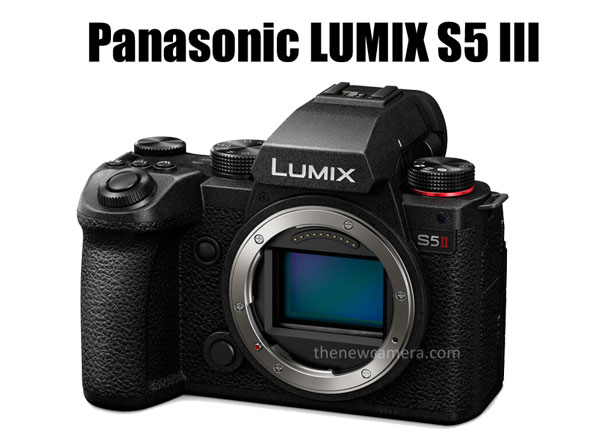
2. LUMIX S5 III – The Next Flagship Full-Frame Hybrid
Panasonic S5 Mark II is one of the most popular cameras. The Panasonic S5 Mark II is widely used by wedding cinematographers, so they can easily create videos for their clients in 16:9 format or 1:1 format while using the camera in open gate recording mode.
So technically, the S5 Mark II camera gives them the freedom to record the way they want, and later in the editing room, they can produce the type and style of videos the client requires.
Although in the next update, the Panasonic S5 Mark III, if it arrives in 2026, we are not expecting much change in size, and the sensor of the camera is expected to remain the same, as we have seen in the Panasonic S5 Mark II camera. We will likely see some investment in the autofocus performance of the camera, specifically improvements in the AI detection algorithm and overall image processing algorithm, and maybe we may also see an upgrade in the image processing engine with this update.
Yes, we are expecting the arrival of the Panasonic S5 Mark III in the year 2026.
New Image Processing Engine
Improved AI AF Aglos of next genration
Major sensor and AF upgrades
Even better video specs
Refined ergonomics and IBIS
It’s the logical successor that hybrid creators and serious enthusiasts have been waiting for.The current S5 II has become a runaway value king, with used bodies now regularly dipping below $1,000 in the U.S. market.
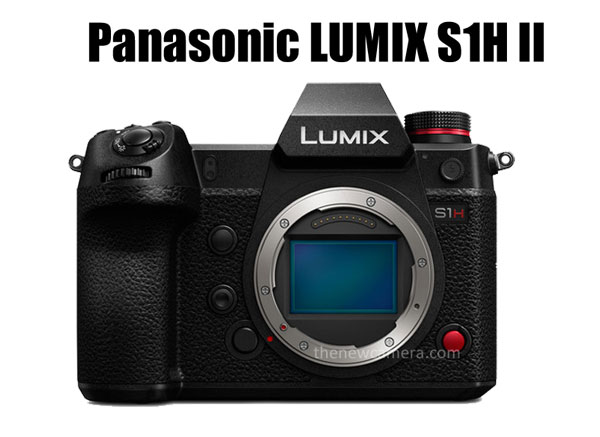
3. LUMIX S1H II – The Pro Video Workhorse
The original S1H launched in 2019 and is due for an update, and it is still a favorite among independent filmmakers for its cinema-grade video tools. Rumors about an S1H II have been circulating for some time, and the window feels right for a 2026 refresh.
For those who are new, the Panasonic S1H series is designed specifically as a “bridge” camera that brings professional cinema camera capabilities (comparable to the VariCam and EVA1) into a handheld mirrorless camera body.
Based on recent interviews and conversations, it looks like Panasonic is working on the successor to this camera, and this could be the best year to announce the successor of the S1H camera.
In a recent interview with Petapixel,Panasonic’s Toshiyuki Tsumura, Executive Vice President and Director of Imaging Solutions, said:
Panasonic Lumix’s goal with a future S1H is to combine professional broadcast-level capabilities with the S Series’ smaller camera size.
“We feel that in order to be called an S1H, we would have to include prosumer and professional video capability in the camera within the small camera footprint. However, this would probably require a lot of cables and specific functionality for professionals. It’s not necessarily just video capture capability, but also connectivity, IP control, and system integration capacity. We need to include that functionality in a small size, so we’re striving to develop this kind of system,” Tsumura.
Panasonic S1 H Mark II Rumoured core specification
6K/8K internal recording
ProRes RAW
Advanced cooling and connectivity
Pricing will be the big question in today’s market, but demand from indie studios and high-end creators remains strong.
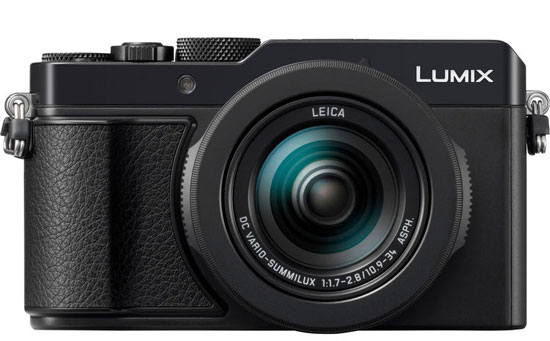
4. LUMIX LX100 III – Capitalizing on the Compact Camera Revival
Well, this is the most-awaited compact camera from the LX series. Last year, we had a kind of display screen update in the LX100 Mark II camera. Now we are waiting that at least this year, after a very long time, the LX100 II was announced back in August 2018, and since then, people have been waiting for an update or a refreshed compact camera in hand, but are still waiting for it.
The LX100 II was very capable when it was announced, using a 17-megapixel Micro Four Thirds sensor with an effective resolution output of 12.8 megapixels and a DFD (Depth From Defocus) autofocus system.
In 2026, we are expecting the LX100 Mark III camera with an updated sensor and a hybrid autofocus system.
. An LX100 III feels almost inevitable in 2026, likely featuring:
Updated sensor and processor
Improved EVF and touchscreen
Modern video capabilities
It could be one of the most exciting “fun” cameras of the year.
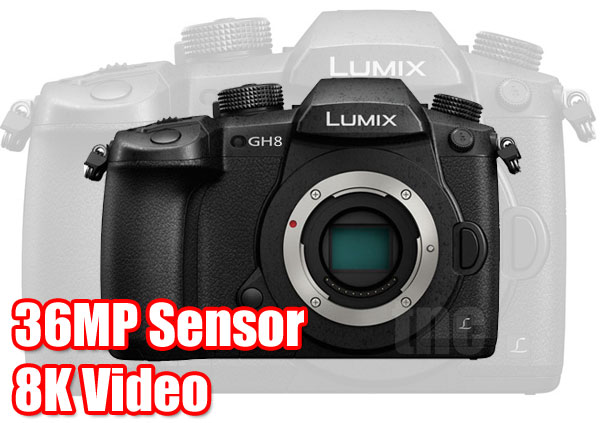
5. New Micro Four Thirds Bodies – Especially a GX9 Successor & GH8
The MFT system is far from dead, and fans are hungry for fresh models beyond the high-end GH and G9 series. Top requests include:
GX9 successor (known as GX7 Mark III in some markets) – a stylish, compact rangefinder-style body focused on design and portability
GH8 – the long-awaited next chapter for serious video creators who love the GH line’s features but want the latest tech
After several years of mostly premium releases, a strong mid-range or enthusiast MFT model would be very welcome.
6. Lenses: The Third-Party Wave Continues
On the glass side, Panasonic’s own lens roadmap has slowed, so many photographers are realistically looking toward Sigma, Viltrox, and Sirui for affordable, high-performance L-mount and MFT options in 2026.
Bottom line: 2026 looks like a very promising year for LUMIX fans. Between the S9 II’s potential hot-shoe/EVF upgrades, the S5 III flagship, a possible S1H II for video pros, the return of the LX100, and long-awaited MFT refreshes, Panasonic has plenty of room to excite both hybrid shooters and dedicated filmmakers.
We’ll keep a close eye on official announcements as the year progresses. Which rumored LUMIX 2026 camera are you most excited about? Drop your thoughts in the comments below!
Stay tuned to TheNewCamera.com for the latest Panasonic LUMIX news, rumors, and reviews.
At TheNewCamera.com, we’re dedicated to keeping you informed about the latest camera news. The article “Upcoming Panasonic LUMIX Cameras 2026: What to Expect as LUMIX Turns 25” was published on 4:41 pm, Tuesday, 24 March 2026, Greenwich Mean Time (GMT), Time in Washington, DC, USA, by thenewcamera.com team | Follow us on our social pages FACEBOOK | TWITTER | INSTAGRAM to get live Camera News + Panasonic Rumor
Buy Canon Lenses, Buy Music CD or Digital Camera at amazon it helps this site, and you do not pay anything extra, it is just a way to help support this site.
New Camera Website, we list all type of new camera information, price review and all type camera rumors, subscribe us or follow us via twitter or facebook.
Disclaimer: We have attempted to select useful information to include on New Camera, and to ensure that the resources we have included on the site -- as well as the way we have described them -- are accurate, fair, and balanced. However, we make no claims, warranties, or other representations concerning the accuracy, completeness, or utility of the information provided, or concerning the abilities or performance of the organizations, agencies, companies, and other resources presented through New Camera



 BOX for Latest NEWS and Rumors