Join More Than 50,000+ Subscribers and get latest camera news and rumors
NEW CAMERA VIDEOS ON YOUTUBE
|
By admin, on October 3rd, 2025

Innovative, newcomer, or timeless favourite, these two keyboards perfectly define the Yodobashi Camera’s sales rankings for the first half of September 2025. The Ricoh GR IV hold the No.1 spot of the sales ranking, the Canon PowerShot SX740 HS secured second position in the ranking, it does shows how much people still love 40X pocket zoom cameras like the SX740 HS. Canon has just restored the production of the Compacts like Canon SX740 HS, Canon G7X Mark III and Canon ELPH 360HS camera, and the 2nd rank of the SX740HS is something that I was expecting this month, since as per the Canon sales stats itself Canon Compact Camera Comeback: Sales Soared 187% precious month, so it will also reflect in sales report card of worldwide agencies.
Breaking Down Yodobashi’s Compact Digital Camera Sales Rankings
It’s quite obvious from the ranking that the demand for compact Zoom cameras is popular among the latest generation of smartphone users, although the Canon SX740 HS camera was announced back in 2018. And basically, most of their iOS smartphones don’t give true 17X Optical zoom, including the latest iPhone 17 Pro, where we have Canon SX 740 HS features true 40X digital zoom, which gives, in turn, higher image quality and a proper 4K video capture experience.
Here’s the complete top 10 from Yodobashi:
| Rank |
Camera Model |
| 1 |
Ricoh GR IV |
| 2 |
Canon PowerShot SX740 HS |
| 3 |
Sony VLOGCAM ZV-1 II |
| 4 |
Panasonic LUMIX TZ99 |
| 5 |
Fujifilm X half |
| 6 |
Sony Cyber-shot RX1R III |
| 7 |
Ricoh GR IIIx |
| 8 |
Kodak PIXPRO C1 |
| 9 |
Fujifilm X100VI |
| 10 |
Leica D-LUX8 |
Ricoh GR IV: The No.1 Compact Camera Making Waves with Premium Features
The Ricoh GR IV is a recent announcement from Ricoh; it’s a premium compact camera. Available at $1500 at B&H Store USA. The Camera is always in high demand, so if ur lucky, you will find it in stock; otherwise, most of us keep waiting for its stock to arrive. Take a look at the core specification of the camera (Ricoh’s special recipe that makes it No.1 in the market)
- 25.7MP APS-C BSI CMOS Sensor: Actually, the same 26 MP Sony sensor we have seen in most of the Fuji cameras, as well as the Sony A6700
- New 28mm f/2.8 Lens (Full-Frame Equiv.): Upgraded lens and optimised for optimal performance
- Improved AF and Low-Light Focusing: Hybrid Sensor locks and tracks the subject
- 5-Axis 6-Stop Shake Reduction System: You can grab clear images even in low-light conditions with a slower shutter speed with the help of an in-camera IBIS mechanism
- 3.0″ 1.04m-Dot Touchscreen LCD: Nice and easy display screen, with quick access to basic settings
- 53GB Built-In Memory & microSD Card Slot: That’s the best part, being a photographer, if you even forget to carry ur memory card, you still have 53GB space left
- 35mm and 50mm Focal Length Crop Modes: No need to worry, even if you have a prime lens, the 35mm and 50mm focal length gives you an excellent option to recompose your image.
As you can see from the specification, it’s highly impressive and made for photographers. The demand for the camera always remains high, but the supply shortages may affect future rankings of the GR IV Camera.
The Canon PowerShot SX740 HS’s showing is a strong presence just after its production revival. For the latest on top compact cameras like the Canon SX740 HS and Ricoh GR IV, follow thenewcamera.com for expert insights and updates.
ABout the author: The article “Top Compact Cameras 2025: Canon SX740 HS Hits #2 in Yodobashi Rankings” written and updated by thenewcamera.com team on 8:14 am, Friday, 3 October 2025, Greenwich Mean Time (GMT) | Follow us for more updates and Get LIVE RUMORS –> FACEBOOK | TWITTER | INSTAGRAM to get live news — > to get live news + + Ricoh rumors 24X7
Source – etnavi.jp/capa/news/481181


By admin, on September 29th, 2025

Canon R6 II Latest Amazon USA Prime Day Deals 2025: Save Big on New and Renewed Models: Are you really looking for the best deals related to the Canon R6 Mark II camera during Amazon Prime Day 2025? We have selected the best ones in this article. Amazon USA is giving us some massive discounts on the Canon R6 Mark III, in both NEW and Renewed models, which we have explained in this article. Now, how to get more discount, over the already discounted price? exclusive Amazon Store Card offers, and step-by-step instructions on how to snag them. Don’t miss out—these Prime Day Canon camera deals are flying off the shelves, with limited stock on renewed units (only 12 left as of today, while I am writing the post!).
Why the Canon EOS R6 Mark II is a Prime Day Must-Have
Before we jump into the deal, let me tell you one thing: Canon R6 Ma 2 is a workhorse hybrid mirrorless camera. It features a 24.2 MP full-frame Sensor, with a superfast continuous Capture speed of 40 frames per second. At the very same time, the camera is able to record 4K videos up to 60 frames per second without any crop. So, either you are a photographer or a cinematographer. This is a hybrid solution for all of us at the very same time; it has compatibility with the existing RF lineup of lenses, as well as with the help of an adapter. You can use the widest range of Canon EF lenses. So either you are interested in having. I don’t have to wait too much since the deals are already active.
Now, it’s time to explore the Amazon US Prime Day 2025 Deals

New Canon EOS R6 Mark II Deal: $1,899 (Save 14% Off List Price)
You don’t have to wait too much since the deals are already active. The Canon R6 marks a mirrorless camera. Canon EOS R6 Mark II Mirrorless Camera (Body Only, Black) is slashed to $1,899—a 14% discount from its original $2,199 MSRP. That’s a $300 instant savings for Prime members. And the best part of the deal is you have a 30 day return window where you will get a full refund of your amount if you don’t like the camera And the best part of the deal is you have a 30 day return window where you will get full refund of your amount if you don’t like the camera, so that’s one of the best part where you can.. the delivery of the product is completely free, so you don’t have to pay any extra penny for shipping charges so the discount that you are saying right now is the real price that you pay for the camera no extra or hidden charges included.
Unlock Extra Savings with Amazon Store Card: Pay Just $1,819
Now, let’s explore how to get more discounts with the help of the Amazon store card. Once you are approved for the Amazon store, Card, and pay $ 1,819 for your order upon approval, you receive an additional $80 off, bringing your total to under $1,850 for a flagship full-frame camera.
How to Get the New Canon R6 II + Amazon Store Card Deal
- Sign Up for Prime: If you’re not a member, first you have to become one, and you can grab a free 30-day trial at amazon.com/prime to access free shipping and exclusive deals.
- Head to the Product Page: Nest step is to visit the Canon EOS R6 Mark II on the Amazon page at the Amazon USA website
- Apply for the Amazon Store Card: Finally, to get an extra advantage during checkout, you have to select “Apply for Amazon Store Card.” Approval is instant for most users, based on a credit check (no hard pull required). You’ll see the $1,819 promo price reflected immediately.
- Choose Your Payment Plan: You can opt for 0% APR financing over 48 months ($75/month) if you prefer to spread payments—select from two flexible plans at checkout.
This Canon R6 II new price 2025 won’t last—stock is “In Stock” but moving fast during Prime Day.

Renewed Canon EOS R6 Mark II Deal: $1,761.47 (19% Off New Price Equivalent)
Now let’s dive into a more budget-friendly guide! The Renewed Model with 4.6 Star Rating by 52 Customers who purchased Renewed models (Refurbished Excellent Condition ) Canon EOS R6 Mirrorless Digital Camera (Body Only) is available at $1,761.47—a total of 19% off. Amazon Renewed guarantees like-new performance, tested and certified by Canon experts, a 90 Day Return Period Window, and a full 1-year warranty. As I have said is backed by 4.6 stars from 52 reviews, proving it’s a steal for near-mint quality.

Amazon Store Card Boost: Drop to $1,681.47
If you are able to pair it with the Amazon Store Card for an extra $80 off, it will land at just $1,681.47 upon approval. That’s under $1,700 for a full-frame beast— a perfect Hybrid Mirrorless consumer Mirrorless camera for Photographers and cinematographers.
How to Claim the Renewed Canon R6 II + Amazon Store Card Offer
Follow the same steps as the new model:
- First, you have to ensure Prime membership for free shipping (September 30 delivery, within 14 hours).
- Navigate to the Renewed Canon EOS R6 on Amazon (search “Renewed Canon EOS R6 body only”).
- Kindly apply for the Store Card at checkout to activate the $1,681.47 price.
- Select financing if needed ($697/month over 48 months or other plans).
- Hurry—only 12 left in stock! Ships via Amazon with full returns.
SO, now you have all the details on how to get the Maximum discount for Canon R6 Mark II camera.
Canon R6 II vs. Renewed: Which Prime Day Deal Wins?
| Feature |
New Canon R6 II |
Renewed Canon R6 II |
| Price |
$1,899 (14% off $2,199) |
$1,761.47 (19% off $2,165.19) |
| With the Amazon Card |
$1,819 |
$1,681.47 |
| Condition |
Brand new, full warranty |
Excellent refurbished, 1-yr warranty |
| Stock |
In stock (500+ recent buys) |
Only 12 left |
| Delivery |
Tomorrow (Prime) |
September 30 (Prime) |
| Best For |
Pros wanting pristine |
Value hunters on a budget |
Pro Tips for Maximizing Your Canon R6 II Prime Day 2025 Purchase
- Bundle Smart: You can also add protection plans ($159.99 for 3 years) or lenses during checkout for extra discounts. Opt for this protection plan if you use your gears extensively or rent your gears to others.
- Compare Sellers: Sometimes it happens that third-party sellers offer better undercut prices but skip free Prime shipping— But I would say to stick with Amazon for reliability.
- Credit Perks: The Store Card offer requires approval (typically 700+ FICO score), but it’s worth it for the instant rebate.
Ready to level up your kit? Grab the new Canon R6 II deal or snag the renewed steal before stock vanishes. For the best Canon camera deals 2025, subscribe to TheNewCamera.com alerts. What’s your next RF lens? Drop a comment below!
ABout the author: The article “Canon R6 II Latest Amazon USA Prime Day Deals 2025: Save Big on New and Renewed Models” written by thenewcamera.com team on 8:25 am, Monday, 29 September 2025, Greenwich Mean Time (GMT) | Follow us for more updates and Get LIVE RUMORS –> FACEBOOK | TWITTER | INSTAGRAM to get live news — > to get live Camera News + Canon Rumors 24X7.


By admin, on September 28th, 2025

The Canon T7 was announced back in September 2025, but it is still the top choice of beginners. Budget-conscious photographers across the United States — the big question is, why are people still selecting this camera as their best beginner entry-level DSLR of 2025? Now, in this particular guide, we are going to dive into the details behind the popularity and exactly why people are selecting this DSLR. At the very same time, if you are interested in buying an entry-level beginner DSLR in 2027, should you buy the Canon T7 or any other camera? Let me help you to make your decision.
The Canon T7: A Quick Overview
The Canon T7 camera is a perfect blend of affordability and rock-solid performance. Despite being a DSLR camera, it is still the most favorite one among beginners in the US, the top-selling DSLR camera on Amazon, and one of the biggest reasons behind this popularity is the reliability of DSLRs over newer mirrorless systems. DSLRs last for years and even sometimes decades despite rough use. And the overall price of the bundle, which also includes a kit lens of 18-55mm (gives you approx 3X optical zoom), is priced under $500. The best part of the interchangeable lens-based Canon DSLR camera is that it opens up the gateway to use the ultra-affordable, high-quality DSLR lenses. So, if you get a 50mm F1.8 for your DSLR, you can capture exceptional portraits with a blurred background with the T7 DSLR. Overall, the Canon T7 offers a 24.1-megapixel APS-C CMOS sensor, which delivers sharp, high-quality images suitable for everything from family portraits to landscape photography.
Key specs at a glance:
- 24.1MP APS-C CMOS Sensor
- DIGIC 4+ Image Processor
- 3.0″ 920k-Dot LCD Monitor
- Full HD 1080/30p Video Recording
- 9-Point AF with Center Cross-Type Point
- ISO 100-6400, Up to 3 fps Shooting
- Built-In Wi-Fi with NFC
- Scene Intelligent Auto Mode
- Creative Filters and Creative Auto Modes

Why Is the Canon T7 the Best-Selling DSLR in the USA?
The Canon T7 is no.1 in the US in 2025, and it’s not accidental—it’s a result of several factors that resonate with American consumers. According to the latest reviews, feedback from users, and market analysis, take a look at the exact reasons why the Canon T7 can outsell competitors in 2025:
1. Unbeatable Affordability
Today, mirrorless cameras have a hefty price tag associated with them; only a few models, like the Canon R100, are available at a reasonable price, but still you have to pay a bit more compared to the Canon T7.
Canon T7 with kit Price Comparison against Mirrorless Camera in Amazon USA
Canon T7 with kit lens camera price on Amazon USA [$499 with kit Lens – $421 after Amazon store card Approval]
Canon R100 with kit lens Camera price in Amazon USA [$529 offer applied – $449 after Amazon Store Card Approval]
Nikon Z30 with kit lens Camera Price on Amazon USA [$769 Offers applied – $716 after Amazon Store Card Approval ]
Sony ZV-E10 Camera with kit lens Price on Amazon USA [$898 offers apply – $818 after Amazon store card approval]
As you can clearly see, the price is rising. We have listed all the latest entry-level cameras here. None of their prices fall under $500; the closest competitor to the Canon T7 is the Canon R100. After that, we do have big differences in the price range when compared to Nikon and Sony entry-level cameras.
Affordability is the major factor behind the sales of the Canon T7 camera. The Canon T7 is available at a friendly price tag without breaking the bank. This affordability is a major driver of its sales, especially among students, travelers, and first-time buyers. As one Reddit user noted, it’s “a very affordable option that you also won’t be as upset about dropping and breaking as a $1500 model.” In the USA, where economic considerations play a big role in purchasing decisions, the Canon T7’s budget price and specification is really hard to beat for competitors.
2. Beginner-Friendly Design and Ease of Use
The Canon T7’s other most important factor is the authentic controls users get while purchasing the DSLR camera experience. It has been designed with simplicity and a very helpful layout of controls specifically for beginners to understand the basics of photography, starting from shutter, aperture, and ISO based on the type of situation and understanding the basics of the exposure triangle. The camera is a gateway so you can learn and understand the basics of photography. No overprocessed JPEG files or AI algorithms, just a RAW camera for real-time experience. Latest reviews from 2025 highlight how it offers “excellent image quality and simplicity for first-time shooters.”
3. Reliable Performance and Image Quality
The Canon T7 uses a large APS-C 24 MP CMOS sensor, which is far better than most compact and smartphone camera modules of today’s world. ISO range goes up to 6400 (expandable to 12800). And the best part is, since it’s an EF (Canon Electro Focus DSLR Mount) mount camera, you have a huge selection of DSLR lenses on budget. The ecosystem of Canon DSLRs is versatile and open to all third-party lens makers. Up to 3fps burst mode for action shots and Full HD video capabilities are sufficient for casual videography of friends and family.
4. Built-In Connectivity for the Modern User
Despite being a traditional DSLR camera, the Canon T7 offers Wi-Fi and NFC connectivity. Once you have installed the Canon Camera Connect app on your Android or iOS device, you can seamlessly transfer files and photos. So, basically, Gen Z users, who love to share their lifestyle or images over social media handles, can do it easily. Obviously, the connectivity and sharing are not as easy as smartphones of today; first, you have to transfer the data from the device you have to the device you want to upload to.
5. Positive Reviews and Word-of-Mouth
Canon already has a long reputation for making lenses and cameras for more than 9 decades. They have witnessed and survived the film-to-DSLR and DSLR-to-mirrorless transition periods. Specifically, the Canon T7 DSLR camera has already received 8,000+ reviews with an average 4.7-star rating by its users. This shows not only trust but also user experience. Most users are happy with its durability, battery life, and how it helps them “learn the rudiments of photography” without unnecessary frills. In 2025, videos and blogs continue to ask, “Why does everyone buy this camera?”
Is the Canon T7 Still Worth Buying in 2025?
Absolutely—if you want to experience a REAL camera, not a camera that also shows you real and eats all your time, then you must buy this. This is not just an affordable camera, it’s once in a once-in-a-lifetime experience just like your first rollercoaster ride. With this camera, you have to learn the basics of shutter, ISO, and aperture, and how to balance all those with the help of the exposure triangle to get a perfectly exposed shot based on the situation. The image has real Gaussian grain noise, meaning the entire camera has its own set of behavior, which obviously is not that much technically perfect or smooth like your smartphone processes images or videos with AI.
I would highly recommend everyone who loves photography and those who are beginners start their journey with DSLRs; they will make you perfect.
In conclusion, the Canon EOS Rebel T7’s reign as the best-selling DSLR in the USA boils down to its affordability, user-friendly design, solid performance, and trusted brand name.
ABout the author: The article “Why the Canon EOS Rebel T7 is the Best-Selling DSLR in the USA in 2025” written by thenewcamera.com team on1:18 pm, Sunday, 28 September 2025, Greenwich Mean Time (GMT) | Follow us for more updates and Get LIVE RUMORS –> FACEBOOK | TWITTER | INSTAGRAM to get live news — > to get live Camera News + Canon Rumors 24X7.
DJI Pocket 3 Amazon US Prime Deals October 2025: Score Big Savings on This Compact Vlogging Powerhouse
DJI Mini 4K Drone Plunges to Historic Low of $249 Ahead of Amazon’s October Big Deal Days
By admin, on September 24th, 2025
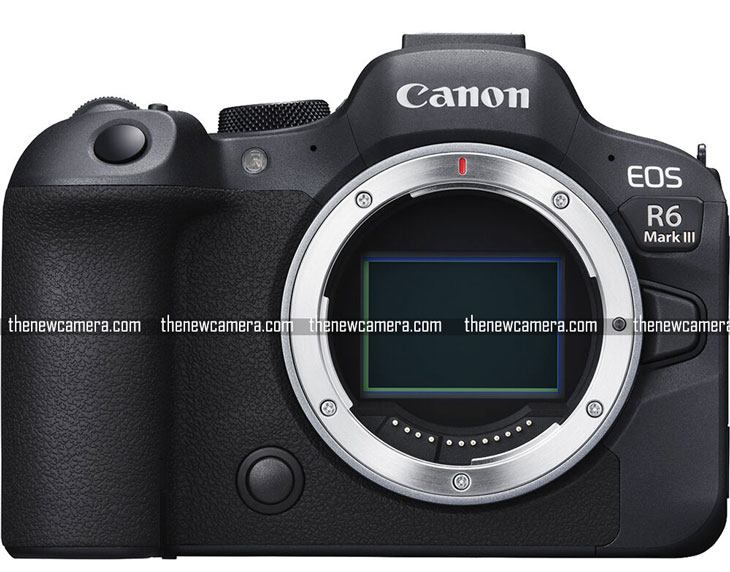
According to the latest rumors coming out from the Canon rumor mill, Canon will be announcing Cameras and Lenses in the month of November 2025. In fact, the Canonrumor mill shared two dates. for November: November 16, 2025, and November 26, 2025. A new camera is expected to be announced on one of these dates.
What kind of camera will it be? While it’s still too early to say for sure whether it’s the EOS R6 Mark III, sources have stated with a high degree of confidence that the EOS R6 Mark III is Canon’s next full-frame camera. Rumor mill also believes that the sensor in the EOS R6 Mark III will be the same as or close to the Cinema EOS C50.
But, adding the same sensor won’t cannibalize the sales of the Canon C50? If Canon R6 Mk III is coming with the same sensor, for sure they will use cripple hammer in the video spec of the camera, to keep the sales of C50, despite the arrival of R6 III camera with the same sensor.
Regarding new lenses, there are four lenses scheduled for announcement in the near future. It’s unclear what lenses will be released. The RF 300-600mm F4-5.6L IS is a likely candidate, as final testing and marketing for its release are already underway.
Thenewcamera.com take
There have been several theories about Canon’s next new product announcement, such as the end of the year or next year, but this rumor is said to be 99% accurate, so there seems to be a lot of hope. We don’t yet know what new product will be announced, but the EOS R6 Mark III seems to be a strong candidate. Since the announcement will be made in two parts, we can also expect the announcement of some kind of lens.
At TheNewCamera.com, we’re dedicated to keeping you informed about the latest camera news. The article “Canon Major Announcement in November 2025” was published on 12:29 pm, Wednesday, 24 September 2025 (GMT-4), Time in Washington, DC, USA by thenewcamera.com team | Follow us on our social pages FACEBOOK | TWITTER | INSTAGRAM to get live Camera News + Canon Rumors 24X7.
Source Canonrumor.com


By admin, on September 24th, 2025

If you’re searching for where to buy a DJI Nano in the USA, you have come to the right place, as we have all the latest details related to the availability of the DJI Nano in the USA, as well as shipping date information. The DJI Nano was a highly anticipated camera, and a lot of my subscribers were waiting. It’s an upscaled camera from the previous generation, with drastically improved low-light performance. So, the DJ I Osmo Nano is generally searched as the DJ I Nano. The camera has been officially announced on September 23, 2025, and its a very lightweight POV camera that packs a very impressive core specific is an inside able to record 4K 60 FPS video features a 1/1.3 in sensor and a magnetic mounting option that can be attached to any of your Steel surfaces without the need for any external mounting device. Okay, let’s get to the point. I have created this guy to be very specific here. I am going to break down everything you need to know before purchasing the DJI Nano in the US, including the stock status and delivery timeline, so you can get a complete idea of where and how to purchase your next action POV camera.
Quick Overview of the DJI Osmo Nano
Before diving into buying options, take a quick look at the Core specification of the DJI Nano camera, a weight of only 52 grams.
- Sensor and Video: 1/1.3-inch CMOS sensor supporting up to 4K/60fps (3840×2160), 2.7K/60fps, and 1080p/60fps, with slow-motion at 4x (120fps) in 4K and 8x (240fps) in 1080p. It also offers 10-bit D-Log M colour
- Battery and Endurance: Up to 200 minutes of recording time when paired with the Multifunctional Vision Dock (90 minutes standalone), tested at 1080p/24fps with stabilisation on. Fast charging reaches 80% in about 20 minutes via USB-C
- Storage and Durability: Built-in storage options of 64GB or 128GB, expandable via microSD up to 1TB. The camera is waterproof up to 10 meters (IPX4 when docked) and operates in temperatures from -20°C to 45°C
- Additional Features: Dual microphones for stereo audio, integration with the DJI Mimo app for AI editing and sharing, RockSteady 3.0 stabilisation, HorizonLock, and gesture controls for hands-free operation
As we all know, the DJI offers a unique ecosystem where you can easily integrate your wireless mics with the camera and record your clear audio without the need to add any extra receiver with your camera.

Availability Details for the DJI Nano in the USA
DJI Nano is available from September 23, 2025—the official global launch date— at Amazon.com. The link I have shared below is to the DJI store itself on Amazon USA, and only Amazon USA is an authorised dealer to sell DJI products, as of now. You can also check out this fact on the DJI USA online authorised dealers page. Even if you are thinking of buying the DJI Nano in the USA, always try to buy from an authorised dealer or trusted resellers like Be and as Store or Adorama, when the stock is available
Where to Buy DJI Nano in the USA
Yes, we do have several trusted retailers, which also include Adorama and B&H, but for now, as per the DJ I official USA website, Amazon.com is the authorised seller for the DJ eye products, so let’s start with Amazon and in the listening, we will also add the links of the B&H store and the Adorama
| Retailer |
Models Available |
Price Range |
Notes |
| Amazon.com |
Standard Combo (64GB), 128GB variants |
$299 (64GB) – $329 (128GB) |
Sold and shipped by Amazon; Prime members get next-day delivery in eligible areas. |
| Adorama. com |
Standard Combo (128GB) |
$429.99 |
Free shipping; monthly financing options available. |
| B&H Photo Video |
Likely Osmo Nano (check DJI Osmo section) |
$299 – $429 |
Extensive DJI inventory; in-store pickup in NYC or nationwide shipping. |
If you order through the official DJI store on Amazon, you get free shipping on all ur DJI products. You can enjoy a discount if ur an Amazon Prime member or through an Amazon store card
Shipping Date Information
Shipping for the DJI Osmo Nano in the USA starts immediately post-launch, with most retailers fulfilling orders within days. Here’s what to expect:
- Amazon: Due to massive pre-orders at the time of announcement, you have to face a little bit of delay. I am writing this article on September 24, and the shipping date I am getting today is October 8. For now, it’s 10 to 15 days of delay due to massive demand. But, just after a month or so, when demand gets neutralised, Prime members can get Next-day shipping in many areas, making it one of the quickest options
- B&H Store: Generally takes 3 to 4 days to ship the product. Check product status here
- Adorama Store: Generally takes 3 to 4 days to ship the product. Check product status here
The DJI OSMO Nano has finally been announced, and we were covering the news for rumours from its FCCID registration / leaked images, etc, and we are glad that all the information we have shared with you came out to be true.
-
About the author
- Written By thenewcamera.com team
- The article “Where to Buy DJI Nano in the USA, Availability Details, Shipping Date Information” was written on 7:07 am, Wednesday, 24 September 2025 (GMT-4), Time in Washington, DC, USA
- Follow us for more updates and get LIVE RUMORS –> FACEBOOK | TWITTER | INSTAGRAM to get live Drone news + DJI Rumors

By admin, on September 14th, 2025

Are you searching for the Best Canon camera under $500 in 2025? Canon does make some excellent cameras under the budget segment, specifically the new range of mirrorless cameras, and the compacts they have announced are really very versatile, and also, we have some reliable DSLR cameras in our list. All these cameras are easily available in the online retail stores in the United States of America (USA), so if you are a beginner, vlogger, or hobbyist, this camera will deliver Excellent Image quality, feature a beginner-friendly user interface, and some of them also have 4K video recording without breaking your bank.
Now, we have created this in-depth guide at TheNewCamera.com, and we will highlight the top and the best Canon cameras under $500 (although we do have some cameras in our guide that exceed your budget, like the Canon R50 or the 250D, but it does deliver exceptional performance, at a slightly higher price). We have selected the cameras based on the availability in 2025, Expert reviews, and the US market price. The article contains the best possible Canon cameras available and those that are relevant for this price range. This list is a mix of mirrorless, DSLR, and compact cameras, so you can select the best camera as per your own personal requirement and the budget you have.
So we have created a quick comparison table that will guide you to get the best Canon camera under $500 in 2025, and also a detailed analysis, and at the end, we also have an FAQ, if you have any questions or confusion.
Quick Comparison: Best Canon Cameras Under $500 in 2025
| Camera Model |
Type |
Price (USD) |
Key Features |
Rating (Out of 5) |
| Canon EOS R100 |
Mirrorless |
$399 (body + lens kit ~$479) |
24MP APS-C sensor, 4K video, Dual Pixel AF, RF mount |
4.7 |
| Canon EOS R50 |
Mirrorless |
$579 (with 18-45mm lens) |
24MP APS-C sensor, 4K/60fps video, advanced AF, subject detection |
4.8 |
| Canon EOS Rebel T7 (EOS 2000D) |
DSLR |
$399 (with 18-55mm lens) |
24MP APS-C sensor, Full HD video, Wi-Fi, 9-point AF |
4.5 |
| Canon EOS Rebel SL3 (EOS 250D) |
DSLR |
$549 (with 18-55mm lens) |
24MP APS-C sensor, 4K video, vari-angle touchscreen, Dual Pixel AF |
4.6 |
| Canon PowerShot SX740 HS |
Compact |
$429 |
20MP 1/2.3-inch sensor, 40x optical zoom, 4K video, tilting screen |
4.4 |
| Canon PowerShot V10 |
Compact |
$349 |
20MP 1-inch sensor, 4K video, built-in stand, vertical shooting |
4.3 |
| Canon PowerShot ELPH 360 HS |
Compact |
$249 |
20MP 1/2.3-inch sensor, 12x optical zoom, Full HD video, Wi-Fi |
4.2 |
Prices are approximate based on 2025 US retail averages from retailers like Amazon, Best Buy, and Canon USA. Kits include basic lenses where applicable. We’ve extended the budget to $600 for models like the R50, which provide superior value in 2025.

1. Canon EOS R100 – Best Overall Canon Camera Under $500
The Canon R100 camera is at the top of the list of the best Canon cameras under $500 in 2025, as it offers a perfect blend of performance and price. Suppose you are on a limited budget, looking for the best camera available for photography as well as for some video shoots. In that case, the R100 camera is the best beginner camera, and for sure, the specifications will impress you. Specifically made for photographers, the R100 camera features a Dual Pixel CMOS autofocus system, which tracks the subject automatically. You just have to click on the shutter button to capture the best pic possible, so the camera itself completely handles the autofocus part, and that’s the biggest advantage of mirrorless cameras over a DSLR. Other than that, the lens mount is now open, and we have a huge range of lenses available, so if you have purchased the Canon R100 camera and are looking for a lens upgrade, then we have also posted a dedicated article for the best lenses for the Canon R100 camera.
- Key Specs: 6.5fps burst shooting, 4K/24p video (cropped), electronic viewfinder (2.36m dots), guided user interface, Wi-Fi/Bluetooth
- Pros: Compact and lightweight, fast autofocus, compatible with EF lenses via adapter.
- Cons: Fixed LCD screen, no touchscreen functionality.
- Why Buythe Canon R100 in 2025?: Only $499 body-only on Amazon USA

2. Canon EOS R50 – Best Canon Mirrorless Camera Under $600
If you’re willing to stretch to $699, the Canon EOS R50 is the best Canon camera under $500 (or close) in 2025. The best part of the Canon R50 camera is its vari-angle display screen, which is missing in the Canon R100 camera. The other major important upgrade that you will notice specifically in the design part is touch capability in the display screen, so you can access and alter the controls most easily. Other than that, un-cropped 4K video — that’s the major core specification upgrade you will witness after getting this camera. So, if you are a beginner content creator or a wedding cinematographer, it’s highly recommended to start with the Canon R50 camera.
- Key Specs: 12fps electronic burst, 4K/60fps video, vari-angle touchscreen, subject detection (people/animals/vehicles), RF mount
- Pros: Excellent for vlogging with a flip-out screen, creative filters, and long battery life.
- Cons: Plastic build feels entry-level, limited buffer for bursts.
- Why Buy in Canon R50 2025?: Priced at $699 with kit lens in US stores, Renewed like new at $699, and New available at $799 at Amazon.com

3. Canon EOS Rebel T7 – Best Budget Canon DSLR Under $500
For traditionalists, if you are looking for the best DSLR camera under $500, the Canon EOS Rebel T7 is the best option and one of the strongest contenders in this price range. One of the best parts of investing in this DSLR camera is that we have access to a very large and vast EF lens lineup, which is affordable too. The DSLR cameras are known for their reliable performance for still photography purposes.
- Key Specs: 3fps burst, Full HD/30p video, optical viewfinder, 9-point autofocus, built-in flash
- Pros: Intuitive controls, great battery life (up to 500 shots), affordable lens kits.
- Cons: No 4K video, fixed non-touch screen.
- Why Buy the Canon T7 in 2025?: At $529 with the 18-55mm lens at Amazon.com

4. Canon EOS Rebel SL3 – Best Compact Canon DSLR Under $600
The Canon EOS Rebel SL3 stands out as a versatile best Canon camera under $500 (or $600) in 2025. One of the most advanced Canon hybrid DSLR cameras ever made for beginners, also known as Canon 250D / Canon 200D Mark II in Asian and European regions. The camera features a Dual Pixel sensor, which is used in Canon mirrorless cameras for hybrid autofocusing. The SL3 camera also features a vari-angle, fully touchable display screen, so you can also easily create video vlogs alongside photography.
- Key Specs: 5fps burst, 4K/24p video, vari-angle touchscreen, Dual Pixel CMOS AF in live view, eye detection
- Pros: Lightweight (under 1 lb), creative assist modes, external mic input.
- Cons: Small viewfinder, cropped 4K recording.
- Why Buy in 2025?: Dropping to $549 with kit lens in Amazon USA (renewed as new)

5. Canon PowerShot V10 – Best Vlogging Canon Compact Camera Under $500
If you are a content creator or vlogger, the Canon V10 is the best Canon camera under $500 in 2025. The camera features a 20.9-megapixel large 1-inch sensor, which is not usual in common compact cameras, or even in some premium quality smartphones. The camera is ultra-compact in size and ready for on-the-go video recording and live streaming with a built-in stand. The camera can be used anywhere and everywhere without any hassle.
- Key Specs: 20.9MP 1-inch sensor, 19mm wide-angle lens (equiv.), 4K UHD video at 30fps, 15fps burst, tilting touchscreen LCD, digital image stabilization
- Pros: Lightweight and portable, excellent autofocus for video, Wi-Fi and Bluetooth connectivity, built-in microphone with wind filter
- Cons: Fixed lens limits versatility, no optical zoom, battery life could be better
- Why Buy in 2025?: Priced at around $429, the Canon V10 is a top USA pick for vloggers
Best Canon DSLR Under $500 in 2025
If you prefer the optical viewfinder and robust build of DSLRs, if you want to do only photography with a rugged camera, and the DSLRs have a huge range of budget and affordable lenses, then the Canon T7, which is available under $500, is best for you, as we have already mentioned above. The next option is a hybrid DSLR camera like the Canon SL3, which is capable of shooting Full HD videos as well as 4K with crop and capture decent pics with the help of the hybrid CMOS autofocus sensor, which is being used in most of the cameras of today. Fortunately for a limited time, the Canon SL3 camera is available — keep in mind the $549 price tag based on bodies that are renewed Canon SL3 cameras, like ne,w according to Amazon.com.
How We Selected These Canon Cameras
Our 2025 recommendations prioritize Canon models with strong user ratings, recent price stability, and features like 4K where possible. Data collected from US-focused reviews and extended the budget slightly for value. No major new budget Canon releases by mid-2025 or in late 2025.
Choose the Best Canon Camera Under $500 for Your Needs
The best Canon camera under $500 in 2025 boils down to your style — now let’s sort out everything in a simple way: if you are looking for the Canon best mirrorless camera in 2025, it’s the Canon R100, which is available under $500 price tag. In DSLR, the Canon T7 is the best-selling DSLR camera of all time. Even today, if you check the best-selling DSLRs on Amazon USA rankings, the Canon T7 is ranked at #1 position. Under $500, that’s the best DSLR we have right now, but at the time I am writing this article, a few models of Canon 250D / 200D Mark II / Canon SL3 are available at Amazon for a limited period of time under the renewed section, available at only $549 with a kit lens. So, as far as I am concerned, this is the best deal ever, specifically in the DSLR cameras for beginners in 2025 under $500.
If you want to get more updates related to Canon’s upcoming compact camera. GET LIVE NOTIFICATION, Select Your Trusted Source GET LIVE NOTIFICATION Click ON Check  BOX for Latest NEWS and Rumors BOX for Latest NEWS and Rumors
The article “Canon C50: Last Minute Leaks” was written by thenewcamera.com team Post and this post was last updated on October 5, 2025, at 12:03 PM GMT (2025-10-05T12:03:00Z). | You can also follow us on Our Official Social Media Handles FACEBOOK | TWITTER | INSTAGRAM to get live news — > get live Camera News + Canon Rumors 24X7.
Post Update Log:
- This post was last updated on October 5, 2025, at 12:03 PM GMT (2025-10-05T12:03:00Z).

By admin, on September 12th, 2025

Nikon ZR and the Canon C50 are both very new and were announced in September 2025. The Nikon ZR is Nikon’s first cinema mirrorless camera. Nikon, the Canon cinema line has been active inside Canon for more than a decade. The Nikon is priced at 2200 USD, and the Canon C50 will cost you approximately 3899. So, we do have a good price difference between these two cameras, but is the price difference between the two really worth it, meaning if you are someone who wants to do a fresh start, should you move towards a Canon or Nikon cinema camera? Or if ur a professional and not limited in any sort of budget boundaries, which camera should you choose? If you were searching for Nikon ZR vs Canon C50 comparison, then you have reached the right page. We have done the Most Detailed Specification Comparison between the two, lets dive into the details
Specification Comparison
| Feature |
Nikon ZR |
Canon EOS C50 |
| Sensor |
24MP full-frame partially stacked CMOS (from Z6III) |
32MP full-frame CMOS (new, non-stacked) |
| Max Video Resolution/FPS |
6K up to 60fps (uncropped); 4K up to 120fps (1.5x crop); 4K60 uncropped |
7K up to 60fps (RAW, 3:2 Open Gate); 4K up to 120fps (uncropped); 2K up to 180fps |
| Codecs |
REDCODE RAW (R3D NE, 12-bit, internal); N-RAW; ProRes RAW; ProRes 422 HQ; H.265 |
Canon Cinema RAW Lite (12-bit, internal); XF-AVC; XF-HEVC |
| Color Science & Log |
REDWideGamutRGB + Log3G10; N-Log; Nikon colors |
Canon Log 2/3; Wide DR; PQ/HLG/Canon 709/BT.709 |
| Oversampling |
6K to 4K oversampled for enhanced detail; |
4K up to 60fps oversampled from 7K (or 6.9K for 4K30) |
| Sensor Modes/Crops |
Full-frame uncropped in 6K/60; 1.5x crop in 4K/120; Hi-Res digital zoom |
Full-frame 3:2 Open Gate (7K full height); Super 35/16 crops; Simultaneous wide + vertical/square crops (fixed position, from cropped wide frame) |
| Dynamic Range |
15 total stops in 6K RED RAW; W |
15+ stops in full-frame (Log/RAW) |
| Rolling Shutter |
Sub-10ms (9.1ms in 6K RED RAW); Excellent for fast action |
Not fully tested |
| Audio |
32-bit float (built-in mic + 3.5mm); OZO processing (directional, zoom, isolation, cleanup); Multi-interface hotshoe |
24 Bit via XLR (via included handle); 3.5mm mic/headphone; Recording levels; Shotgun mic mount |
| Stabilization |
IBIS + Electronic (same as Z6III); Lens-based optional |
Digital compensation + lens-based optical; No IBIS |
| Ports & Connectivity |
Micro HDMI; USB-C (UVC webcam up to 1080p60); 3.5mm mic/headphone; Multi-interface hotshoe |
Full-size HDMI; USB-C; Timecode terminal; Remote; 3.5mm mic/headphone |
| Media Slots |
1x CFexpress Type B + 1x MicroSD (bottom-mounted; no redundant recording) |
Dual: 1x CFexpress + 1x SD |
| Battery Life & Thermals |
~2 hours 6K RAW (EL15 battery); Fanless, no overheating (tested up to 32°C/90°F); 2-hour 5-min record limit |
LP-E6P battery; Active cooling (fan) for extended recording; No known limits mentioned |
| Other Video Features |
User LUT import (up to 65-point, RAW-only); Tally lights; Audio cues; Frame continuity challenges due to card access; RED intercutting |
Frame.io support; Canon XC protocol; Multi-camera control/app transfer; Pre-burst in photos; Electronic burst up to 40fps (photos) |
Resolution and Open Gate, anamorphic recording
In both the comparison tables, it is very clearly visible that the Canon C50 has supremacy in resolution; you can easily record 7K videos up to 60 frames per second and 4K 120fps uncropped with this Canon C50 camera.
Availability of Open Gate recording, which is 7K 60fps RAW in 3:2 format, available at Canon C50. Another major advantage apart from all these is the anamorphic recording ability and in-camera de-squeeze functionality.
So with Canon, you can go wider with anamorphic (in-camera de-squeezing), ultra slow motion videos without any compromise or crops, at the very same time you can use anamorphic ultra-wide lenses even while recording 4k 120fps, that’s great for sure.
Nikon ZR approach is more traditional, in the limited price range we are getting REDCODE RAW R3D 12-bit internal recording, at the very same time the same spec has been used in higher-end RED cameras like the Komodo or the V-Raptor, so it’s a boon for solo creators to have such a format in this price range.
Audio is one of the most important parts of the video, and the Nikon ZR is the only camera in between the two that offers 32-bit float audio recording capability. Again, it’s another boon for solo creators to record the highest quality audio possible without investing heavily in an audio setup. OZO has been added to the Nikon ZR, which is responsible for background noise reduction while recording with internal mics. With the help of the DJI Mic 3, which is also able to record 32-bit float audio, you can generate high-quality audio files while pairing up with the Nikon ZR camera.
The Canon is limited to 24-bit audio despite the XLR handle and inputs in the camera so that’s the limitation we have with the Canon C50.

Active cooling in Canon C50 [Only in Canon C50]
Active cooling effectively makes the recording time limit indefinite. C50 also utilises a higher-resolution sensor of 32MP, which generates more heat while recording videos or oversampling compared to a 24MP sensor. To prevent any kind of overheating issues and maintain the highest recording quality possible, Canon has added a built-in fan that will keep the camera cool for longer periods of time.
The Nikon ZR features a fanless body, but Nikon claims its heat sink is significantly improved over the previous generation of Nikon cameras. We can record 6K 60fps videos for up to 2 hours and 5 minutes at 32°C without interruption. So obviously, with Nikon ZR, you can record longer videos without any significant worries.
Sensor-shift image stabilisation system [Only in Nikon ZR]
The Nikon ZR does feature a 7.5 to 8 stops of sensor-shift image stabilisation system that we have already seen in the Nikon Z6 Mark III and the Nikon Zf camera. The IBIS mechanism of the Nikon ZR is intelligent and recognises the human body and face, and when your VR lens is linked with the autofocus point, you get a maximum of 7.5 stops of advantage even in the corner of the frame. In Canon, there is no sensor-shift image stabilisation system, so you have to depend upon rigs or gimbals.
Body Design Overview
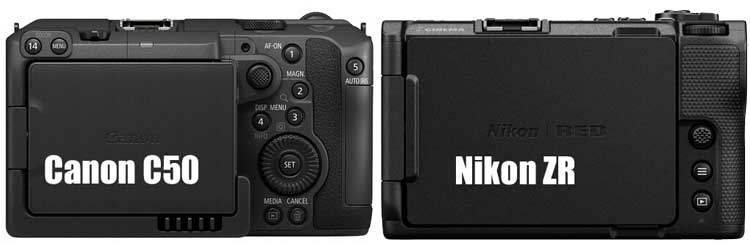
Both camera features a boxy style design. Well, the Canon C50 will be more convenient to a professional cinematographer since it already has a large handgrip, multiple Mount screw holes, even on the top plate of the camera. At the same time, a full-size HDMI port and an option for an XLR handle help to create an easy professional workflow.
With a Nikon ZR camera, it seems like we have to again use an external hand grip from grip makers like a small rig, since the grip is really very small, very similar to the Nikon Zf. Another most irritating thing is we are missing a Standard SD card slot, either u use a microSD card slot or CFexpress Type B. Comparing it to the Nikon ZR is more tilted towards a solo creator, which has all the bells and whistles that a solo creator may wish to have in their camera.
| Aspect |
Nikon ZR |
Canon EOS C50 |
| Dimensions (W x H x D) |
133 x 81 x 49 mm |
142 x 88 x 95 mm |
| Weight (Body Only) |
630g |
670g |
| Build Material |
Fiber-reinforced plastic; rugged, lightweight |
Not specified (durable cinema-grade construction assumed) |
| Grip/Handling |
Minimal grip; boxy, EVF-less; gimbal-friendly but requires third-party cages for pro rigs |
Decent integrated grip; flat-topped with handle for better handheld stability |
| Ergonomics |
Video-focused UI; tiny joystick, zoom rocker, 3 custom top buttons; minimal for solo creators but cumbersome for cinema (e.g., bottom card access) |
Cinema-optimized UI (separate photo/video modes); joystick, thumb wheel, 14 assignable buttons, 3 custom dials; highly customizable for pro workflows |
| Overall Feel |
Vlog-like (similar to Sony ZV-E1); portable but needs accessories for cinema use |
Cinema-ready (akin to Sony FX3 or Canon R5C); bulkier but more robust out-of-box |
Display Comparison
Both cameras rely solely on rear screens for composition (no EVF or accessory viewfinder option), but the Nikon ZR’s display stands out for size and brightness, aiding outdoor monitoring. The C50’s screen is smaller but highly functional with touch controls.
| Aspect |
Nikon ZR |
Canon EOS C50 |
| Size |
4 inches |
3 inches |
| Resolution |
3.07 million dots (1280 x 800 pixels) |
1.62 million dots (900 x 600 pixels) |
| Brightness |
1000 nits (peak) |
Not specified (standard for cinema cameras; likely 300-500 nits) |
| Type/Features |
Articulating; 16:10 aspect ratio; P3 color gamut support for accurate previews; touch-enabled |
Side-hinged vari-angle touch panel; flips for self-facing; customizable peaking (Peaking 1/2) |
| Advantages |
Larger and brighter for better visibility in bright environments; excellent for monitoring |
Compact and versatile articulation; integrated touch UI for focus and settings |

Expanding on ports, slots, mounting, cooling, and accessories, the C50 leans more professional with comprehensive connectivity and included extras, while the ZR prioritizes simplicity and silence.
| Aspect |
Nikon ZR |
Canon EOS C50 |
| Ports |
Micro HDMI; USB-C (3.2); 3.5mm mic/headphone; Digital hotshoe (supports audio adapters, future XLR) |
Full-size HDMI (Type-A); USB-C (3.2 Gen2); 3.5mm mic/headphone; 2x XLR (via handle); Timecode (DIN1.0/2.3); Remote (2.5mm); DC input |
| Card Slots |
1x CFexpress Type B + 1x UHS-I microSD (bottom-mounted; microSD for settings/LUTs, not backups) |
1x CFexpress Type B + 1x SD/SDHC/SDXC (side-mounted; supports relay/simultaneous recording) |
| Mounting Points |
Single 1/4-20 bottom thread; gimbal-friendly but limited; third-party cages recommended |
Multiple rigging threads; Alignment pin behind tripod thread; Multi-accessory shoe for adapters (e.g., PL-RF, EF-EOS R) |
| Cooling System |
Passive (fanless); Efficient heat dissipation; No overheating in tests (up to 125 min with USB power) |
Active (quiet fan with large vent); Designed for unlimited long recordings |
| Included Accessories |
None specified (battery, charger assumed standard) |
Detachable handle (with XLR, REC/zoom controls, mic mount); LP-E6P battery; LC-E6E charger; Mic holder; Shoulder strap; USB-C cable; AC cable |
| Other Notes |
Silent operation ideal for audio-sensitive sets; 32-bit float audio via ports/hotshoe |
Built-in stereo mics; Ethernet via USB-C adapter; Frame.io integration for cloud workflows |

Pros and Cons of the Nikon ZR
| Pros |
Cons |
| Affordable at $2,200 with internal 12-bit RED RAW for pro workflows |
Ergonomics favor vlogging (no grip, bottom cards, tiny joystick) |
| Low rolling shutter (sub-10ms) for smooth action footage |
Micro HDMI and no XLR; Limited ports for cinema rigs |
| Innovative 32-bit float audio with built-in OZO enhancements |
High RAW data rates (~190-470 MB/s); Short record times on smaller cards |
| Lightweight (630g) and fanless with excellent thermals (~2+ hours) |
No 14-bit RAW option; Overprocessed non-RAW modes (e.g., H.265 inaccuracies) |
| Superior 4-inch, 1000-nit screen for monitoring |
Weak stabilization for dynamic shots; 2-hour 5-min arbitrary limit |
| Versatile zoom rocker and quick boot-up; UVC webcam support |
LUT import limited to RAW; No redundant recording |
| Strong value as a B-cam for RED users or vlog upgrade |
Inferior for photos compared to hybrids like Z6III |

Pros and Cons of the Canon EOS C50
| Pros |
Cons |
| High-res 32MP sensor with 7K/60 RAW and 3:2 Open Gate for flexibility |
Higher price at $3,899; No IBIS (relies on digital/lens stabilization) |
| Oversampled 4K/60 from 7K for sharp, detailed footage |
Non-stacked sensor may have higher rolling shutter than competitors |
| Uncropped 4K/120 and 2K/180 for high-frame-rate options |
No built-in ND filters; Audio requires handle (included but adds bulk) |
| Dual slots (CFexpress + SD) with easy access; Timecode support |
Heavier (670g) and bulkier than some compacts; No viewfinder option |
| Active cooling for unlimited recording; Included XLR handle |
Photos use electronic shutter only (potential rolling shutter issues) |
| Simultaneous wide + vertical/square crops for social media workflows |
Vertical crops fixed (no tracking); Oversampling from cropped frame |
| 15+ stops DR and Dual Base ISO for low-light performance |
Less affordable for entry-level filmmakers; No 32-bit float audio |
| Cinema-focused build with rigging threads and custom buttons |
Screen resolution lower (1.62M dots) than some rivals |

Who Should Buy the Nikon ZR?
The Nikon ZR is made for budget-conscious content creators, vloggers, and hybrid shooters entering cinema workflows. It’s ideal for:
- Solo filmmakers or YouTubers: If you are a solo filmmaker or YouTuber, looking for a budget solution, the Nikon ZR is the best camera for you. The additional advantage we are getting with this camera is the ability to record 32-bit audio, and OZO processing simplifies run-and-gun setups.
- RED Ecosystem Users: Yes, you can use it as your primary camera; don’t underestimate its power; it inherits all the goodness of RED cameras, perfect for indie productions or commercials needing affordable RAW.
- Hybrid Photographers: Yes, you can capture some still shots if you wish to, but primarily it’s
- Avoid if: You need robust cinema ergonomics out of the box or uncropped high-FPS— go with the high budget cams then
Buy the Nikon ZR if ur overall budget is somehow limited within $3000 (since u have to buy lenses, lights, tripods, backdrops) so a lot of spending is still left even once you buy the camera.
Who Should Buy the Canon EOS C50?
The Canon EOS C50 targets professional videographers and small cinema teams seeking a bridge between hybrid and dedicated cinema cameras. It’s suited for:
- Narrative Filmmakers: 7K Open Gate, 4k 120FPS uncropped, Pro body controls and ports, no compromise in features from inside to out, the only thing that you miss in the Canon C50 is the IBIS, but as most of the production houses place their camera on heavy rigs / moving platforms, they actually didn’t need IBIS, a bunch of Canon RF and and Canon CNR lenses available for the pro cam.
- Multi-Cam Productions: Timecode, XLR, Anamorphic lenses support and in-camera de-squeez, and app control enable synced setups; active cooling handles long shoots like events or interviews.
- Canon Ecosystem Loyalists: CNR Lenses as well as RF lenses support and Log2/3 integrate with C70/R5C; 32MP photos with 40fps burst appeal to hybrid pros (e.g., wedding videographers).
- Avoid if: You’re on a tight, pls ge the Nikon Zr or Sony FX30
Choose the C50 if you can afford $3,899 and need cinema-grade tools like Open Gate or high DR for commercials/docs. It’s for those prioritizing flexibility in post (e.g., reframing) over the ZR’s RAW affordability, as evidenced by its positioning above the R5C but below the C70.
Get Canon C50 from amazon.com | B&H Store
Get Nikon ZR from amazon.com | B&H Store
GET LIVE NOTIFICATION Your Trusted Source GET LIVE NOTIFICATION Click ON Check BOX for Latest NEWS and Rumors
The article “Nikon Zr Official Press Release” was written by thenewcamera.com team on 6:09 am, Wednesday, 10 September 2025, Greenwich Mean Time (GMT) | You can also follow us on Our Official Social Media Handles FACEBOOK | TWITTER | INSTAGRAM to get live news — > get live news + Nikon Rumors + Camera News + Canon Rumors 24X7.
Best Lenses for Canon C50 Camera: Unlock Epic Cinematic Power with CN-R and RF Lenses in 2025

|
KEEP THIS BLOG ALIVE - Support New Camera Buy Canon Lenses, Buy Music CD or Digital Camera at amazon it helps this site, and you do not pay anything extra, it is just a way to help support this site.

|