What’s inside the Sony a7 V camera? In a fresh teardown of the Sony a7 V, a camera expert reveals the real story. By keeping the budget factor in mind, Sony has introduced numerous innovations. Specifically, the overheating system and internal panels have been improved, addressing a major pain point that was a serious issue with its predecessor.
Why the Sony A7 V Teardown Matters: From Plastic to Pro-Grade Build
The teardown done by carefully peeling out layer by layer of the Sony a7 V camera, and extensive engineering done by Sony engineers was clearly visible, which is really amazing to see how well they have added each layer of circuitry one after another.
Teardown specialist verdict: “Solid.”
Let’s break down the top five highlights, complete with direct quotes from the teardown.
1. Full Magnesium Alloy Body: Turning the Chassis into a Heat-Dissipating Beast
Sony has ditched the older model design previously used in the Sony A7 series. Earlier, the Sony A7-series cameras featured a mix of plastic and metal construction across most models. However, while unlocking the body, it has been found that the camera now uses a full magnesium alloy chassis, built to deliver uninterrupted performance without the fear of overheating..
Quote: “The back cover material is different—previous M-series used mostly plastic, but now it’s magnesium alloy, finally on par with the S and R series: full magnesium alloy body! The back shell has thermal conductive silicone pads attached, positioned right over the processor. This means the entire metal back cover acts as a massive ‘heat sink.'”
The experts’ take: enhancement of the overall heat management unit inside the camera was actually required in the Sony A7 series. As we all know, many Sony A7 IV -camera users are in deep trouble after purchasing the camera, specifically cinematographers who are unable to record 4K videos for more than 20 minutes. This upgrade, paired with thermal pads glued precisely over the CPU, transforms the camera’s back panel into an active, cooling system. No more Sony a7 IV–style thermal throttling after 20 minutes of 4K video
2. BIONZ XR2 Processor: Integrated AI That Rivals Apple’s M1 in a Mid-Range Body
Sony a7 V is the only camera right now that is using the BIONZ XR2 image processor, which has an integrated AI chip, the XR2 processor itself (up to 30% better than the Alpha 7 IV), and is more energy-efficient than the BIONZ XR image processor + AI chip used inside the A7 IV camera.. This results in up to 21% better battery life via EVF (630 shots vs. 520 on the a7 IV) or 29% via LCD (750 vs. 580)
Well, I am not getting into too much technical detail. What the teardown expert has said is that the overall improvement in the new camera looks impressive.
Quote: “The processor and Micron’s LPDDR5 memory are PoP stacked together. The AI processing unit is integrated into the main processor—more advanced than the external AI chip in the A7R5, similar to Apple’s M1: a full-featured SoC… already ahead of their own flagships.”
Why it matters for you: Having a major improvement in the image processor directly results in upscaling in the autofocus algorithms, as well as the overall performance of the camera, which is also greatly improved.
Flagship AI features (think real-time subject tracking for birds in flight or human pose detection), and the best part is that under $2,500 for the body, you are getting a boosted autofocus accuracy by up to 30% over the Sony a7 IV—without jumping to a $6,000 Sony a1.
3. Smartphone-Level Mainboard: AT&S Craftsmanship for Bulletproof Reliability
I’m really glad to know that the Sony a7 Vmotherboard cover is actually manufactured by the same AT&S, which also makes iPhone motherboards. So, when it comes to reliability and build quality, we can obviously trust the Sony a7 V camera, since it’s coming from the world of top-tier PCB manufacturers.
Quote: “The PCB comes from AT&S… a world-top PCB manufacturer that also makes iPhone motherboards… The A7M5 is fully ‘smartphone-ized’ high-performance, representing the highest craftsmanship in the current camera industry.”
It’s densely packed with high-density interconnects, ditching messy traces for iPhone-like efficiency.
4. Partially Stacked CMOS Sensor: Crushing Rolling Shutter with 7.5-Stop IBIS
Yes, that’s the star upgrade we have inside the camera. A partially stacked 33MP full-frame sensor, which was exclusive to Nikon and Panasonic till now, has been further improved by Sony. Since it is a partially stacked sensor, it also preserves dynamic range just like a normal BSI CMOS sensor.
As a result, neither are you going to face the infamous “jello” distortion effect, nor are you going to lose essential shadow and highlight details while capturing images from your camera.
Quote: “This is the legendary ‘partially stacked CMOS’ with 7.5-stop stabilization… double-speed partially stacked CMOS… genuinely fix the previous gen’s… obvious rolling shutter.”
Why it matters for you: Sony a7 IV owners know the frustration: electronic shutter shots of sports or drones turning into wavy messes. Having a sensor readout speed slower than 25 ms really disturbs the frame captured at higher frame rates, so it was really very much essential for Sony to introduce a faster readout–based sensor in the Sony a7 V camera, and they have clearly done that in a very beautiful manner, even while preserving the dynamic range of the sensor at the very same time.
The continuous shooting speed of the camera has also been pushed to 40 frames per second, plus 10 FPS of mechanical burst, so overall it’s an excellent upgrade that we have seen inside the Sony a7 V.
Additionally, with 7.5 stops of IBIS, handheld gimbal-free footage rivals dedicated rigs. It’s the fix that makes the Sony a7 V a versatile full-frame camera for wildlife or event coverage, with no pricier body required.
5. Flagship Tech Trickle-Down: Wireless, Stabilization, and More in One Package
Tying it all together, the A7 V borrows elite features like 2×2 MIMO Wi-Fi (for A1-speed transfers) and refined IBIS, all on that premium AT&S board.
Quote: “Full magnesium alloy body for heat sharing, trickle-down flagship wireless transfer and stabilization, and speed flip-doubled partially stacked CMOS, AT&S top-tier mainboard with BIONZ XR2 fully integrated SoC… These internal pile-ups of materials genuinely solved the previous generation’s pain points of poor heat dissipation, slow image transfer, and obvious rolling shutter effect.”
It’s a value bomb: internals that outpace some Sony flagships in efficiency.
Final Verdict: The Sony A7 V Is the Smart, “Solid” Choice for 2025 Creators
That was really kind of an eye-opener teardown, where we can very clearly see the parts and improvements that have been rightly done inside the Sony A7 series camera. This set of improvements not only brings us more reliability and peace of mind when buying this camera, but also lets us purchase it without a second thought.
Obviously no .” No revolutionary redesign, but fixes to overheating, lag, and distortion make it soar. If you’re eyeing the top mirrorless camera under $3,000, this is it—especially with firmware updates promising even more AI magic.
Score by teardown expert: 9.2/10 for internals alone. Grab one before stock dips, and pair it with our recommended Sony A7 V lenses for peak performance.
What’s your biggest A7 V question—heat, AF, or video? Drop it in the comments! Subscribe to TheNewCamera.com for weekly updates
DJI RS5 camera gimbal announcement is very near to us, since just a few days ago, we saw the price leak of the DJI RS5. DJI RS5 Australian price leak hinting at a $838 AUD (~$553 USD) entry-level model gimbal. An Australian retailer has sent us the price tag of the RS5 gimbal. Just after that, we have the product shots coming up from one of the trusted sources. Trusted DJI leaker Igor Bogdanov (@Quadro_News) has dropped the first official leaked images of the DJI RS5 gimbal.
So not one, we have multiple product shots of the gimbal that is expected to be announced soon. Since the product shots are already available, specs are also there, and the pricing is available from retailers, then for sure the product is already in stock worldwide and waiting for a formal official announcement.
DJI RS5 Specification
Modular Arm & Vertical Shooting: Enhanced NATO rails
LiDAR-Ready Focus Module: The side-mounted slot confirms compatibility with DJI Focus Pro, enabling AI-driven autofocus even in low light. The next-generation ActiveTrack Pro can directly read images from the camera built into the Focus Pro LiDAR Autofocus with no need for the Ronin Image Transmitter.
Ergonomic Grip Upgrades: The BG33 handle
Battery & Charging: The new BG33 intelligent handle delivers a 15% battery life increase (up to 13+ hours)
Full charge in just 1 hour via USB-C. No more mid-shoot swaps—ideal for wedding pros or travel vloggers.
Balancing Aid: A built-in Z-axis indicator
Smart Tracking & Composition: Upgraded intelligent composition and tracking algorithms promise smoother ActiveTrack-like following, with AR overlays in the Ronin app for virtual horizons.
Payload Capacity: Sticking to 3kg (6.6 lbs)—same as the RS4—confirming this base model targets mirrorless setups (e.g., Sony A7S III + lens). No jump here, but…
DJI RS5 Pro Bundle Set
What New inside the DJI RS 5 Gimbal
Battery/Charge: +15% life, 1h full vs. RS4’s 2h.
Tracking: Smarter AI for composition vs. RS4’s solid but basic.
Balancing: Z-axis helper absent in RS4.
Payload: Identical 3kg base; Pro upgrades pending.
Confirmed DJI RS5 Specs: Battery Life Jumps 15%, But Load Stays at 3kg
So here we are discussing the confirmed specifications of the upcoming DJI RS5 gimbal. The biggest disappointment that I feel after reading the specifications of the DJI RS5 is its payload. It remains at 3 kg, which is very similar to the DJI RS4 payload. Not even close to the DJI RS4 Pro, which can lift approximately 4.5 kg. So that’s a very clear indication that in the near future, very soon, we are going to have a DJI RS5 Pro gimbal in the lineup.
Since obviously the DJI RS5 isn’t a combined update or a major upgrade over the DJI RS4 Pro at the very same time. If you look at the announcement dates or the DJI scheduled announcement pattern, in the previous year the DJI RS4 and RS4 Pro were announced simultaneously on the same day (DJI’s history backs this: The RS4 and RS4 Pro launched together on April 9, 2024, at NAB—no staggered rollout). So even if the DJI RS5 Pro is not coming alongside the DJI RS5, we are expecting it sometime around or around CES 2026.
Accessory
Description
Why It Matters
DJI RS5 Gimbal Stabilizer
Three-axis unit with 4th-gen algos and Z-axis indicator.
3kg payload for smooth 8K on Sony/Canon hybrids; 15% better battery via BG33.
BG33 Intelligent Battery Grip
1-hour fast charge, 13+ hour runtime.
Powers extended shoots; haptic controls for zoom/focus.
Briefcase Handle & Quick-Release
Foldable carry with NATO plates and vertical adapter.
50% faster setups for dynamic tracking.
Focus Motor & LiDAR Module
Bundled for AI composition upgrades.
Improved subject tracking—solo op magic.
Cables & Mounts
USB-C kit, cold shoe, mini tripod.
App integration for real-time balancing aids.
Breaking Down the Leak: RS 5 Pricing in AUD (and USD Equivalents)
Before we jump into any new set of information, let’s analyse the pricing of the DJI RS 5 Gimbal in the USA/USD. We already have the Australian pricing of the DJI RS 5 Gimbal. We have to adjust a little bit based on the currency exchange factors and the tax we have to pay, and the overall figure that we get. We have added it in the table below.
Product
SKU
Price (AUD)
Approx. USD
RS 4 Equivalent (USD)
Price Delta (vs. RS 4 Base)
DJI RS 5
6738977
838.00
~553
N/A
+$84 (from RS 4’s ~$469)
DJI RS 5 Combo
6738976
998.00
~658
N/A
+$99 (from RS 4 Combo est.)
DJI Ronin RS 4
6189086
678.00
~447
469
Baseline
DJI Ronin RS 4 Combo
6189090
848.00
~559
N/A
N/A
DJI Ronin RS 4 Pro
6189082
1,298.00
~856
869
+$387 (from RS 4)
DJI Ronin RS 4 Pro Combo
6189083
1,598.00
~1,055
N/A
N/A
DJI RS 4 Mini
6702985
538.00
~355
369
Entry-level alt.
DJI RS 4 Mini Combo
6702986
658.00
~434
N/A
N/A
DJI RS BG21 Grip
5573682
119.00
~78
~79
Accessory staple
At $838 AUD (~$553 USD), the base RS 5 represents a modest 12% premium over the RS 4’s $678 AUD launch price, signaling DJI’s intent to keep the series accessible for hybrid shooters balancing cameras like the Nikon ZR, Sony AV or Canon R5 II. The Combo kit—likely bundling essentials like extra batteries, focus motors, and a RavenEye image transmitter—jumps to $998 AUD, offering better value for kit-builders. Compared to the RS 4 Pro’s $1,298 AUD entry, the RS 5 feels like a “Pro-lite” contender, potentially packing enough bells and whistles to lure users away from pricier alternatives like the Zhiyun Crane 5 or Moza AirCross 3.
So this post sums up the entire available set of information related to the DJI RS5, which is just about to arrive officially. And if we get any latest updates related to any upcoming DJI products, then we will be posting them at TheNewCamera.com. Stay tuned.
GET LIVE NOTIFICATION, Select Your Trusted Source GET LIVE NOTIFICATION Click ON Check BOX for Latest NEWS and Rumors
The article “DJI RS5 Gimbal Leaked Images and Price” was written by thenewcamera.com team on 1:54 pm, Wednesday, 10 December 2025, Greenwich Mean Time (GMT). | You can also follow us on Our Official Social Media HandlesFACEBOOK | TWITTER | INSTAGRAM to get live news — > DJI Rumors
The DJI Pocket Four camera has already created a lot of buzz. We expect the upcoming DJI Osmo Small Pocket camera to have a significant upgrade over the Pocket 3. With the help of a dual camera setup, we will have very clear zoom shots (2X & 4X) for the first time. Alongside AI auto framing, we will also see seamless transfer from one camera module to another/easy switch between camera modules without losing the quality.
Earlier this year, leaks pointed to a DJI Pocket 4 announcement date as early as December 18, 2025. Yes, all of us here at TheNewCamera.com were very excited about the arrival of the Pocket 4 camera before Christmas. However, right now, according to the latest leak coming from YouTuber photorabz, the DJI Pocket 4 camera announcement has been slightly delayed, and the camera is now expected to arrive sometime in January 2026, not in December 2025.
One of the clearest pics of the DJI Pocket 4 camera
Exact Quote: What the photorabz Said About the DJI Pocket 4 Announcement and Release
Just in the same plain, candid way, we are going to describe to you what the photorabz has said, and this is an exact quote from his video, transcribed for transparency without any edits
“But the Osmo Pocket 4 won’t be released in December. This is for sure. It might be announced by the end of the month, but for the moment, this has been postponed. This idea of releasing this camera has been postponed. Why? Because the accessories for this camera aren’t ready yet……. We don’t have any clear information about that. But according to the latest um talks and rumors and [music] you know these things this camera the Osmo Pocket 4 will be released in January in the second half of January not well it could be between the 10 and uh till the end of the month………..but it’s not going to be now before Christmas as we got as an information before.”
We have a delay in the DJI Pocket 4 arrival timeline. Specifically, the end of the year is a very volatile period for DJI due to the Dec 23 Ban issue. We don’t know which product announcements are going to be postponed. Although we have published a list of products that who cleared the FCCID certification recently.
Pocket 4 Camera With Dual Camera Setup is clearly visible
Breaking Down the Leak: What Does This Mean for the DJI Osmo Pocket 4 Timeline?
Let’s unpack this step by step, so you can plan your upgrades wisely:
1. No December Release – Confirmed Postponement
The vlogger is crystal clear: A full DJI Pocket 4 release in December 2025 is off the table. And the announcement is delayed till jan 2025. It’s really a bit disappointing for all of us who were waiting to pre-order Pocket 4 before Christmas.
Why the delay? The exact reason, as mentioned by photorabz, is that the Accessories are the culprit. As we all know, the Pocket 3 depends on a lot of external accessories, which include wireless mics, extra batteries, and modular mounts – DJI’s ecosystem thrives on these add-ons, and rushing them could lead to quality issues.
2. Announcement Date: Possible End-of-Month Tease
Silver lining: An official DJI Osmo Pocket 4 announcement Teaser could still drop by the end of December 2025. This aligns with DJI’s pattern of holiday-season reveals (remember the Pocket 3’s November 2023 debut?).
Expect confirmed specs, More Leaked Images and videos before leaks, but hands-on access? Save that for January.
If you’re a vlogger, traveller, or social media professional, the DJI Osmo Pocket 4 remains a must-watch device for 2026. We have already seen a lot of leaks, official teaser videos, as well as NDA-related documents and FCC ID filings of the Osmo Pocket 4. For now, we have seen almost everything possible before a product announcement. We are now only waiting for the Osmo Pocket 4 to become official as soon as possible.
Stay tuned as we get any updates related to DJI products. We will be posting updates at TheNewCamera.com. But before that, let’s break down what this delay actually means, specifically for the DJI Pocket 4.
The article “DJI Osmo Pocket 4 Release Delayed: Leaked Info Pushes Launch to January 2026 – No December Debut” was written on 7:15 pm, Friday, 5 December 2025, Greenwich Mean Time (GMT)
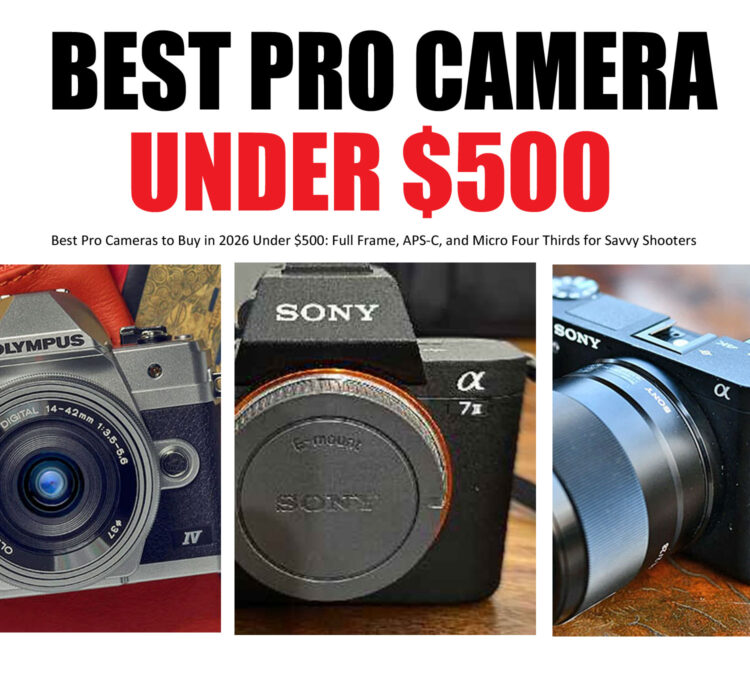
Now, in 2026, if you have $500 and want to buy your first camera, then this guide will obviously help if you’re looking for something professional, such as a full-frame camera, rather than a cheap plastic one. Then which one should you buy? We do have some options even in the $500 pro bodies that we are going to explore in this article.
The cameras that I am going to recommend are professional-level bodies, despite being available under $500, and these cameras have been used by professional photographers for years and are very much capable of producing publication-worthy images. So keep in mind that if a camera is cheap, it doesn’t mean that it’s bad. There are a number of factors that affect the camera’s resale value, so let’s jump into the guide.
Buying Tip #1 – Cameras Released Between 2016 – 2021 are Gold
Manufacturers are always pushing into the market with all their force, stacking test tech technologies to make sure users buy new camera systems alongside new lenses. But that doesn’t mean the DSLRs they made years ago are obsolete or not able to take great pictures. Even at that time, those cameras/DSLRs were taking amazing pictures, and even in the DxOMark list today, the D850 camera is considered one of the best DSLRs ever made and is still in the top five best cameras in the world.
So why does this push happen from camera makers for the mirrorless war or the DSLR cannibalisation? We have to understand that at some point, all these are marketing strategies, and we have to make some smart moves to save our hard-earned money and make correct decisions, specifically based on our requirements for a camera body.
I do agree that specifically in the videography/cinematography zone, there has been a lot of improvement in mirrorless cameras, but when we talk about still photography, yes, there are a lot of cameras—specifically the DSLR ones—available under budget and capable of capturing great pics. Most camera sensors from 10 years ago perform almost identically to modern sensors.
Buying Tip #2 – Buy Used on Amazon, Not Ebay, KEH or MPB
Why am I saying so? The reason is very simple. Amazon does have a quality management team that processes renewed and used models at the same time. If you receive a defective model, they have return policies, so you can return the model. Other than that, any of these websites like eBay, KEH, or MPB — I don’t know, a lot of users don’t have very good experiences with these, So in my personal user experience and recommendation, the best thing is to go with Amazon.com for these deals, and that’s the best option we have specifically in the United States of America.
Many camera YouTubers recommend buying on used camera websites like KEH or MPB because they’re sponsored by one of these two stores.
Best Full-frame Mirroless Camera Under $500
The Sony a7 IIcamera was released in 2014, and currently, most used models in good condition are available for around $500 on Amazon.com. And as I have said, the best thing with Amazon.com is that you get a replacement warranty with it. If you don’t like the product, you can replace it.
There are multiple sellers there — the reputed ones — who are selling the Sony a7 II in good condition. Just look for the ratings, sort it out, and now you have your camera in your hand.
The camera has so many great qualities, including:
24mp full-frame sensor
IBIS (Internal Image Stabilization)
The versatile Sony e-mount
Tilt screen
We are using multiple Sony cameras, starting with the Sony A7 II, as well as the A7 III, and also crop bodies, on our YouTube channel, The New Camera. And when I’m not shooting with my Sony cameras, I am using the iPhone 17 Pro.
The best part is that you can use most of the lenses without any worry since the Sony E-mount is completely open. Mostly in the studio, I use the Sony 50mm f/1.8 with the A7 III, the cheapest prime available for the camera. And specifically with the Sony ZV-E10 II, I am using the Sigma 16mm f/1.4.
Best APSC Mirrorless and Full Frame DSLR Under $500 – Sony A6300, Canon 5D II and Nikon D750
My personal pick for APS-C Sensor Mirrorless among the set of available models is the Sony a6300. Since I have used the 24MP sensor–based Sony a6400 as well as the a6600, the 24MP Hybrid CMOS AF sensor delivers exceptional image quality, and at the very same time, the a6300 AI AF / hybrid autofocus system, face and eye tracking are exceptionally good, and overall, you have a great range of third-party lenses available at an affordable price.
Key Features
24mp APSC sensor
4k video
4D FOCUS with 425 Phase-Detect Points
Full tilt screen
Compact size
Internal UHD 4K30 & 1080p120 Recording
Versatile Sony e-mount
Excellent auto-focus
It’s a Hybrid APS-C and can record 4K video, which would be great as a YouTube camera. Unfortunately, it doesn’t have IBIS, If you can upscale your budget up to $700 u can go with Sony A6500. If IBIS is a deal breaker for you, otherwise under $500-$600 range if you need an IBIS-based mirrorless camera, then you should look at our Best Micro Four Third Camera Under $500 section below.
Other models to consider for the same price, if you’re only interested in Still Photography
Canon and Nikon full-frame DSLRs are not that affordable and fall under the $500 (+$100) category. So if you’re a photographer interested in getting a Canon camera, then we do have some good Deals available for the Canon full-frame DSLR cameras
With all these cameras, as I have told you, we do have an option to return if the product is not as per what you expected. That’s the best part we have to deal with. Other than that, the pricing is very reasonable. We are getting a lot of options in the FF DSLR as well as the camera world.
Best Micro Four Thirds Camera Under $500 – Olympus e-m10 Mark IV
It’s a versatile camera for beginners available with Lens Under $699 ($639 with Amazon Visa card offer), with menus that help you learn photography directly on the camera. Scene modes, Art modes, and AP (Advanced Photography) modes — it’s all there. It even stitches panoramas in-camera for you.
This camera has all the advantages of a point-and-shoot, packed into a seriously nice and ergonomic retro-style body, with interchangeable lenses. And there are soooo many Olympus / OM System lenses to choose from — most of them are small and very manageable.
Behind all the easy-to-use menus and features, there is also a full set of manual controls for the amateur photographer. Great for selfies, but also for more serious work. You can definitely grow with this camera.
I guess that’s why this is Taylor Swift’s favorite camera (not kidding — look it up). She goes with it everywhere.
I love this camera when I run out and want to bring my smallest, easiest-to-carry kit that will always give me pictures far better than my iPhone 17 Pro.
Its standout features include:
20mp m4/3 sensor
Hybrid CMOS AF
Weather sealed
Compact for a professional camera
4k video
Fully articulating screen
High burst rates for fast shooting
Excellent IBIS
Great build quality
Stellar battery life
The auto-focus is very underrated. Olympus is using a HYBRID PDAF sensor in the M10 IV. Don’t fear the 20mp sensor. I found that 20mp is more than enough, even for large crops. Olympus IBIS is one of the best in the business. You can walk with this camera and get steady footage, something you can’t do with many flagship cameras even in 2026.
Recommendation and Conclusion
If you’re looking for a major update, a camera for your smartphone, then the best option is to invest in Olympus E-M10 Mark IV, at an approximate $500-$600 range, you will get a super sharp 14-42mm Lens and Camera body. I really don’t believe there is a better value on the market right now. The e-m10 Mark IV is capable of great stills, great video, and its compact size is a huge plus.
Micro four-thirds cameras aren’t trendy right now, which means it’s a buyer’s market.
The article “Best Pro Cameras to Buy in 2026 Under $500: Full Frame, APS-C, and Micro Four Thirds for Savvy Shooters” was written on 8:26 am, Saturday, 13 December 2025, Greenwich Mean Time (GMT) and Last Updated on 1:03 pm, Sunday, 28 December 2025, Greenwich Mean Time (GMT)
According to the latest set of rumours, Chinese lensmaker Viltrox is finally preparing to announce Canon RF-S Mount lenses in 2026, They are going to start announcing lenses for Canon APS-C cameras like the Canon R50, Canon EOS R10, R50, and R7. Viltrox will bring down loads of affordable, high-performance primes to the RF ecosystem. And then Fullframes.
Update: December 21, 2025
So it’s not a rumour anymore; we have now received confirmation just after the post we published that Viltrox RF lenses are coming for Canon in 2026. Our source was 100% correct, and just after this, we received another confirmation that they will be delivering the EPIC series 1.33x anamorphic cine lenses for Canon’s full-frame RF mount. These include the compact 35mm T2.0, 50mm T2.0, and 75mm T2.0 models, designed for widescreen storytelling with a 2x squeeze factor, high resolution, and color matching to legacy Kowa glass. Crucially, all these lenses are coming with full authorization from Canon, which clearly proves that Viltrox has now become an official partner of Canon, and very soon they will be adding RF / RF-S lenses to the system, starting with anamorphic full-frame lenses. The information was confirmed by the Vertran Rumour website Photorumors.com
One of the best parts of Viltrox is that most of their lenses are under $300. So once they start the production of Canon RF-S Mount lenses, the users will get a lot of options to choose from. But again, the Canon licensing practice is very tricky; most of the time, they try to avoid the focal length approval they already made or have in the market. So, most probably, we do have high hopes for the APS-C RF-S Mount; in that space, Canon has the least amount of RF-S lenses. Other than that, in the full-frame zone, it would be interesting to see what Viltrox will have to offer us.
Image of Viltrox 85mm F1.8 II Lens: The Lens 85mm series lenses were announced alongside with Canon R series back in 2018, but later on the 2nd gen of 85mm F1.8 II was banned by Canon. Since Viltrox was creating lenses for Canon via reverse engineering, not by taking proper licenses,- Canon asked Viltrox to STOP selling RF lenses (August 29th, 2022)
Why Viltrox RF-S Lenses Matter for Canon Users
Yeah, I know that Canon does have very tight control over the RF mount, specifically the full-frame lenses, but the APS-C segment (RF-S) has seen some expansion, and lensmakers like Sigma and Tamron are adding lens options for APS-C users starting from 2024. Like Sigma and Tamron are adding lens options for APS-C users starting from 2024. And we do hope and expect that in 2026, Viltrox will join the List of third-party lens manufacturers of the RF-S Mount.
Now, Viltrox already has a very good track record for making excellent optical-quality lenses with very good autofocus performance. A lot of users have been using the Viltrox lenses in Sony E mount as well as Nikon Z mount for more than 7 years without any issues.
Potential Viltrox RF-S Lens Lineup: What Could Be Coming Soon
We have a list of ultra-popular lenses available for multiple brands. These prime lenses start from $200, specifically, we are talking about the Air Series lenses, a total of 12 APS-C lenses are about to arrive, starting from ultra-wide to short telephoto
Viltrox AF 9mm f/2.8 Air: Compact ultra-wide for landscapes and vlogging.
Viltrox AF 13mm f/1.4: Expansive view with creamy bokeh—perfect for astrophotography.
Viltrox AF 15mm f/1.7 Air: Lightweight wide-angle for travel shooters.
Viltrox AF 23mm f/1.4: Street photography staple (EOS M favorite, RF-S inbound?).
Viltrox AF 25mm f/1.7 Air: Everyday normal lens with pancake vibes.
Viltrox AF 27mm f/1.2 Pro: Pro-grade brightness for portraits and events.
Viltrox AF 33mm f/1.4: Versatile normal prime (another EOS M hit).
Viltrox AF 35mm f/1.7 Air: Budget-friendly all-rounder.
Viltrox AF 56mm f/1.4: Portrait perfection with subject isolation.
Viltrox AF 56mm f/1.7 Air: Affordable telephoto alternative.
Viltrox AF 56mm f/1.2 Pro: Bokeh beast for pros on a budget.
Viltrox AF 75mm f/1.2 Pro: Short tele for flattering headshots.
This lineup would really fill some significant gaps in Canon’s RF-S offerings, particularly in the sub-$400 prime category. While Viltrox’s lenses might not take the crown from Sigma or Canon’s L-series glass, their “Pro” models have received a lot of love for their solid build quality and dependable autofocus—think sturdy metal barrels, USB firmware updates, and weather-sealed options in the high
BTW, which one of the Primes do you want to see soon for RF-S Mount Mirrorless cameras?
When Viltrox Lenses Come for Canon RF Mount
If Viltrox really pulls this off, we can look forward to a bunch of affordable RF-S prime lenses that will make pro-level low-light shooting accessible to everyone. Recent Set of Rumours Suggests Viltrox will officially announce New Lenses for Canon RF-S Mount, starting from the First Half of 2026.
If you are a beginner looking for the best entry-level drones in 2025 and live in the United States of America, then this is the best time to act, as the deadline set by the FY25 National Defense Authorization Act (NDAA) is just 11 days away, on December 23, 2025. The DJI products will get banned in the United States of America, so if you already having/own a DJI product, then there is no issue, but yes, new product announcements/registrations at the FCC may get halted after this date. A positive aspect is that the ban is not affecting flying or existing DJI drones, so if you’re considering stocking up on the latest model, this is an ideal time to buy them at a reasonable price.
Here we have sorted out the best entry-level beginner-friendly drones for you made by DJI. And this time, we’re not talking about any DJI alternatives for now, since DJI itself is the best drone maker in the world, and if you can get your hands on their drones before December 23, then why think of alternatives right now?
Keep in mind that the drones that we have selected in this buying guide are under 250g,. Just jump into the list below and sort the best drone as per your own set of requirements and the budget range you have.
Key Factors for Beginners When Choosing a DJI Drone
Don’t just grab the shiniest one—focus on what matters for new pilots. Here’s a quick rundown:
Weight: Always prefer an underweight drone >250g, since those underweight drones are trouble-free drones and don’t require extra paperwork/permission while taking off. Stick to under 250g (all our picks qualify) to avoid FAA registration and fly freely in most areas.
Camera Quality: All the drones we have listed record crisp smooth 4K footage;
Flight Time: 20-30 minutes per battery—get a combo pack for all-day sessions.
Ease of Use: App integration (DJI Fly app), GPS return-to-home, and beginner modes like auto-hover.
Portability & Price: Foldable designs under $500 for starters; wind resistance up to Level 5 for outdoor adventures.
We have selected some of the best and latest DJI drones for you, so before it’s too late, grab them as soon as possible, and all these drones are available at Amazon.com at a very reasonable price. The recently announced DJI Neo 2 is available at 35% off the MSRP pricing.
Based on 2025 reviews and current stock, here are our vetted picks across budgets. We’ve prioritised models with strong cameras, long batteries, and holiday discounts. (Prices as of Dec 11; affiliate links via Amazon/DJI Store for easy grabs.)
Budget Picks (Under $500: Perfect for First-Timers)
DJI Neo 2 – Finally, the DJI Neo 2 drone is now available at Amazon USA for $259. But if you apply the offer (mentioned below), the overall price goes down to $199 on Amazon USA. That’s a solid discount on the DJI Neo 2, a newly announced drone. Keep in mind that all these offers and rules are available until December 23, 2025, so hurry up. The new Neo 2 drone is perfect for beginners, content creators, and solo filmmakers who love having an aerial cinematographer with them who understands their gestures and follows them wherever they move.Buy DJI Neo 2 on Amazon for $239 and thank us later. The DJI Neo 2 is getting a positive response. Initial review scoring 4.5/5 stars from 269 reviews. ALERT: Stock running out FAST. ACT quickly to get the deal
DJI Mini 4K – The DJI Mini 4K Drone is the latest best-selling Amazon.com drone, and when we have seen almost 10,000 units sold in the past month alone of this drone, it was really a big surprise, and it is now available at $249 with a $50 discount from its usual $299 price. DJI Mini 4K is the best budget 4K drone in 2025 available for creators, vloggers, and hobbyists that offer professional-level features without any FAA registration. But as usual, we know that DJI is potentially facing a lot of bans, and stock shortages are everywhere. Price: $299 + Additional Discount $60 off with an Amazon card
Compact Solo Performer ($250-500: Solo Creativity)
DJI Flip –The drone features a 1/1.3-inch sensor, which is the same sensor as the pricey DJI Mini 4 Pro – so you are getting professional quality video up to 4K 60 FPS HDR, and the ability to capture still images of 48 megapixels. The DJI Flip also supports 10-bit internal video recording and D-Log with manual colour modes, which allows professional-level editing and very high latitude / DR range in your videos for working later on in shadows and highlights. It also has a slow-motion mode where you can capture 4K videos up to 100 frames per second, which will add a kind of cinematic flair to your entire footage. The DJI Flip also offers vertical shooting mode for Instagram Reels, YouTube Stories, as well as TikTok videos..Buy DJI Flip (affiliate).
DJI Mini 3 – Now, specifically for those creators who need extra airtime, the DJI Mini 3 arrives at $419 and shines as one of the best DJI drones under $500 for marathon-type sessions. The DJI Mini 3 was announced in 2022 but is still in demand even in 2025, offering unbeatable battery life for its price. You get a total flight time of up to 38 minutes in standard mode and approximately 51 minutes with the Plus battery (sold separately).1/1.3-inch sensor for 12MP photos and perfect 4K HDR videos. This DJI Mini 3 is capable of true vertical shooting, rotating the gimbal up to 90 degrees – perfect for creating social media content. Buy Now: Amazon ($419)
The 2025 DJI ban deadline is a wake-up call, but it’s also a golden window for beginners to score deals on world-class gear like the Neo or Flip. Don’t wait—stock up, fly safe, and capture those holiday memories in 4K glory. Questions? Drop a comment below
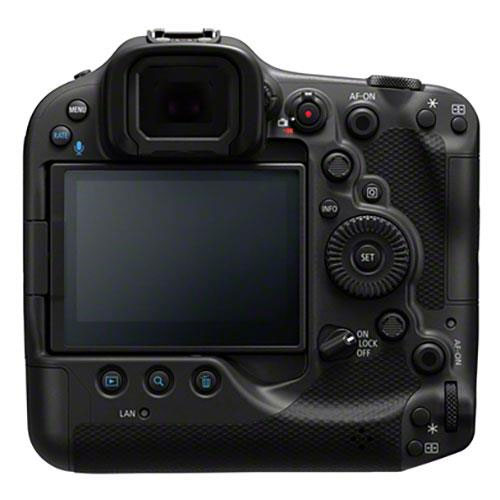
Canon R3 is always a professional sports and wildlife photographer’s favourite camera and considered to have ergonomics very similar to the Canon 1D-series DSLR, but as of now we have some sort of information coming from rumour mills that the Canon R3 Mark II camera will arrive before the 2026 Milan Olympics. In this article, we are going to discuss the possible set of core specifications, the arrival time of the R3 Mark II camera, so let’s dive in details.
Why Now? The Case for an EOS R3 Mark II
The Canon R3 was announced back in September 2021, one of the cameras that introduced Eye/Iris Control AF and that has impressed everyone as a flagship camera. The price is way too high, costing around $5999, specifically built for wildlife, sports, events, and photojournalism.
Rumours have started recently related to Canon R3 mark II camera arrival, since Canon does have a history of Olympic-tied flagship announcements. So for this time, we are expecting Canon to update its oldest flagship sports camera, the Canon R3.
Although not only Canon, Nikon was also stuck to Olympic-related announcements in post-DSLR times. Right now in the mirrorless world, we have to look at the dates and the patterns of these camera makers very carefully. They may change up everything they have done in the past, but for now, Phoblographer and Canon Rumours do believe that we are going to have Olympics-related announcements soon, or before February 2026.+
Rumoured Specs: What Could the R3 Mark II Bring to the Table?
Canon R3 Mark II camera specification based on the latest set of rumours and leaks we have
Sensor and Resolution
Global Shutter Tease?: Is Canon testing out Global shutter sensors for Canon R3 Mark II? Although the global shutter sensor isn’t a new thing for Canon. But yes, source has cancelled out the possibilities of an High Res Stacked CMOS sensor inside the Canon R3 Mark II camera, the sensor is said to be Inspired by Sony’s A9 III, some speculate a global shutter variant to eliminate rolling shutter distortion in action shots, boosting high-ISO performance (clean files above 12,800 ISO, per user feedback on the original R3).
DIGIC X Mark II: DIGIC X was first announced on January 6, 2020. As of December 11, 2025, it is approximately 5 years and 11 months old (or nearly 6 years). It debuted in the Canon EOS-1D X Mark III, Canon’s flagship professional DSLR at the time. It’s really a shame for Canon to still use the same 6 year old procesor in all their Flagship camera without any update or upgrade. In the meantime, they have added an AI chip, named Digic accelerator to handle AI based task. But, the image processor remains the same; we do believe the Canon R3 Mark II will bring out a new image processor in the Canon lineup.
Autofocus and Viewfinder
Eye-Control AF 2.0: Building on the original’s magic, with deeper AI for subject detection in chaotic scenes—sports, birds-in-flight, you name it.
EVF Upgrade: A 5.76M-dot OLED like the R1, but tuned for the gripped form factor.
Video Capabilities
Leaks are quiet here, but expect 6K/120p raw internals, with pro codecs for filmmakers doubling as stills shooters.
Release Date and Pricing: When Can We Get Our Hands on It?
Timeline: February 2026 announcement for Milan Olympics coverage, with shipping by spring. Miss this window? It might evaporate, per skeptics. Canon Rumors pegs Q1 alongside lenses, aligning with Phoblographer’s intel.
Pricing: Expect a bump to $6,500–$7,000 body-only, positioning it between the R5 II ($3,899) and R1. Bundles with RF 400mm f/2.8 or similar could sweeten Olympic deals.
These are the initial updates related to the Canon R3 Mark II camera. As we get any new information related to the same, we will be updating it here at TheNewCamera.com. Stay tuned for more updates.
Buy Canon Lenses, Buy Music CD or Digital Camera at amazon it helps this site, and you do not pay anything extra, it is just a way to help support this site.
New Camera Website, we list all type of new camera information, price review and all type camera rumors, subscribe us or follow us via twitter or facebook.
Disclaimer: We have attempted to select useful information to include on New Camera, and to ensure that the resources we have included on the site -- as well as the way we have described them -- are accurate, fair, and balanced. However, we make no claims, warranties, or other representations concerning the accuracy, completeness, or utility of the information provided, or concerning the abilities or performance of the organizations, agencies, companies, and other resources presented through New Camera


 BOX for Latest NEWS and Rumors