Join More Than 50,000+ Subscribers and get latest camera news and rumors
NEW CAMERA VIDEOS ON YOUTUBE
|
By admin, on February 7th, 2026

DJI continues to push boundaries; they are working on the next generation of connectivity tech. Stronger connectivity between their drones and the RC remote controller – with the help of 5G- will extend beyond visual range, offering more than 30km+ connectivity and transmission beyond what we already have in Pro DJI drones.
OcuSync 5 isn’t just in rumours anymore. Our team here at TheNewCamera.com has spotted an FCC ID registration for the DJI SDR Transmission 2 transceiver, with the model code DST-2, FCC ID: 2ANDR-DST2501. Now, this could be the game-changer and the foundation for the upcoming OcuSync 5 tech.
Text from FCCID analyst
OcuSync 5 is said to have 30 kilometre-plus range connectivity, made possible by integrating 5G technology. So let’s dive deep into what OcuSync 5 actually is, and also the expected set of models that are going to have this tech.
The filings detail a device named the “DJI SDR Transmission 2 Transceiver,” which is not just an incremental update to the company’s renowned OcuSync technology, but a revolutionary step forward, packing integrated 5G cellular connectivity alongside a powerful new Software Defined Radio. This move signals a future where DJI devices could have virtually unlimited range, enabling live streaming and control from anywhere with a cell signal.

What We Know About DJI OcuSync 5+
In the DJI drones we’ve seen so far, the current transmission powerhouse is OcuSync 4—often styled as O4 or OcuSync 4+ in models like the Mavic 4 Pro. It delivers reliable, low-latency video feeds up to 30 kilometres in ideal conditions, which is basically the max range most consumers would ever need.
But SDR Transmission 2 actually represents a seismic shift in technology, connectivity, and video transmission. What DJI is doing here is integrating 5G cellular connectivity. So, the drone connects to the RC controller over cellular networks. Technically, even if the drone flies way beyond the visual line of sight or past that twenty-kilometre mark, the RC controller and drone stay linked through 5G tech. That’s the next big step for next-generation OcuSync 5.
With 5G-connected drones, the range can basically be unlimited wherever there’s coverage. And technically, OcuSync 5 looks like one of the best innovations DJI has made recently in connectivity—way better than OcuSync 4+ that we saw in the Mavic 4 Pro, which launched in May 2025. Although there’s no official statement yet about OcuSync 5, the FCC ID makes it crystal clear they’re working on it.

The Hybrid Power: Local RF Meets Cellular for Unbreakable Links
Building on this foundation, OcuSync 5’s rumoured hybrid mode blends software-defined radio (SDR) for short-range, interference-resistant flights (think dual 2.4/5 GHz bands with MIMO antennas and ~35 ms latency) with seamless 5G failover. This setup supports high-bitrate 1080p/60fps streams up to 20 Mbps, making it perfect for urban BVLOS ops or remote inspections where cell towers are your best friend. Safety stays front and center too—FCC-compliant SAR levels under 1.0 W/kg ensure it’s worry-free.
DJI Mavic 5 Series: Expected to arrive with OcuSync 5 Integration
The Mavic 4 Pro was released in May 2025 with OcuSync 4 and a triple-camera setup that really impressed professional drone users. Sales were exceptionally high, and even now, demand for the DJI Mavic 4 Pro remains strong.
What we’re expecting now is that, with the arrival of OcuSync 5, the upcoming Mavic 5 – or Mavic 5 Pro – will integrate SDR Transmission 2. This tech will power both the controller and the drone itself, enabling 5G-enhanced BVLOS connectivity (beyond visual line of sight), live streaming, hybrid modes, and a solid 30+ km range.
U.S. import hurdles are already a reality, especially after the ban took effect on December 23, 2025. It’ll be interesting to see whether the Mavic 5 series actually reaches the United States, but globally, it’s definitely coming packed with seriously upscale tech. Recent FCC updates confirm that pre-2026 models like the Mavic 4 Pro remain supported through 2027, while new entries will face “Covered List” scrutiny—potentially delaying U.S. availability as other markets get first access.
Expected 2026 Models Featuring OcuSync 5 Tech
As teased, OcuSync 5 isn’t stopping at the Mavic flagship. Leaks point to a broader rollout across DJI’s lineup, emphasizing pro and enterprise drones first. Here’s a quick breakdown of rumored integrations:
| Drone Model |
Rumored Release |
Key OcuSync 5 Features |
Price Estimate |
| Mavic 5 Pro |
Q3-Q4 2026 |
5G BVLOS hybrid, 60GHz radar, upgraded sensors |
$1,800–$2,200 |
| Air 4 |
2026 |
Unlimited cellular streaming in compact form |
$1,200–$1,500 |
Why OcuSync 5 Could Redefine Drone Flying in 2026
This isn’t just about distance—it’s about ditching range anxiety for creators, pros, and hobbyists alike. Imagine glitch-free live streams from mountain peaks or seamless swarm ops in crowded skies, all powered by adaptive firmware and cloud tie-ins. With no fresh teases at CES 2026 yet (as of early February), the NAB show could drop the bomb. What’s your take: Will 5G make drones truly “unlimited,” or is the ban the bigger buzzkill? Drop your thoughts below, and stay tuned to TheNewCamera.com for the latest drops.
The article “DJI Pocket 4 PRO Coming to USA: Pocket 4 PRO FCCID Leaks” was written by thenewcamera.com team on 4:50 pm, Thursday, 5 February 2026, Greenwich Mean Time (GMT)| You can also follow us on Our Official Social Media Handles FACEBOOK | TWITTER | INSTAGRAM to get live news — > DJI Rumors


By admin, on February 5th, 2026

The DJI Pocket 4 Pro camera is well on its way to the United States of America, as the FCC ID for this new camera has been spotted clearly, signalling a new model code other than the registered model code of the DJI Pocket 4 that we have already published on our website. The new model code is the DJI Pocket 4P, and it’s not only the difference in the name—we also have a different FCC ID, and the registration dates of both the cameras are also different. So in this article, we are going to tell you the exact differences we have between the FCC ID of the DJI Pocket 4 camera and the DJI Pocket 4P, and obviously, being registered in the FCC ID clearly means the Pocket 4 Professional camera is also on its way to the United States of America.
Yes, DJI does register multiple variations of the same camera or product line with the FCC when they release distinct models, such as standard and Pro versions in series like the Mavic or Mini drones or the Osmo 7 and 7p camera gimbals.
Finally we have spotted the FCCID Reg details of the upcoming Pocket 4 PRO Camera and here it is

DJI Pocket 4 Pro Camera Leaks and FCC Certification Details
You already have very clear leaked images of the DJI Pocket 4 Pro camera, as you can see above—the Pocket 4 Pro is said to feature a dual lens system inside it. Obviously, it will come at an elevated price range, but again, the camera module matches very closely with the DJI Air 3S drone camera system. The DJI Pocket 4 Pro camera rumour is not new; it has been circulating on the web for more than 6 months, and not only one—we have seen at least two different prototypes of the DJI Pocket 4 Pro camera till now.
The biggest disappointment for me was that, before this leak happened, I was expecting that only one Pocket 4 series camera was going to be announced since we had only the one FCC ID details of the Pocket 4 camera, which surfaced back on another date in December 2022. Just before the FCC ID ban or something similar, DJI registered the Pocket 4P camera, and here the P stands for Pro.
From the freshly leaked FCC documents, we can confirm the model is listed as “Osmo Pocket 4P” with the specific model number PP-041. The FCC ID is 2ANDR-PP041, granted under the applicant SZ DJI Osmo Technology Co., Ltd., with the declaration signed by Niki Fang, Certification Supervisor, on 2025-12-15. This certification covers compliance with FCC rules under 47 CFR Part 2, including equipment authorisation, labelling requirements, and post-market surveillance obligations. The documents emphasise that the device complies with technical rules, and DJI agrees to provide samples for testing upon request by SGS, FCC, or ISED.

Key Differences Between DJI Pocket 4 and Pocket 4 Pro FCC IDs
Diving into the specifics, the standard DJI Pocket 4 (which we’ve covered extensively) has its own FCC ID, but the Pocket 4P stands out with FCC ID: 2ANDR-PP041. The registration date for the Pocket 4P is more recent, aligning with the 2025-12-15 declaration, compared to the earlier Pocket 4 filings. This isn’t just a rebrand—the documents highlight unique aspects like the E-Label access instructions, where users can view compliance info by sliding down on the camera view, tapping the settings icon, and scrolling to “Compliance Info.” The label itself shows the model as PP-041, with additional certifications like IC: 23060-PP041 and CAN ICES-003 (B)/NMB-003 (B), plus warnings for indoor use only (except for 5.2GHz connections) and battery specs (7.4V, 1545mAh, 11.96Wh).
Moreover, the SAR (Specific Absorption Rate) Test Report from SGS-CSTC Standards Technical Services Co., Ltd. Shenzhen Branch (Report No.: SZCR251100526406, dated 2025/12/15) confirms the device’s safety for body-worn and extremity use. Key SAR values include:
- Wi-Fi (2.4GHz): Body-worn 0.12 W/kg, Extremity 0.35 W/kg
- Wi-Fi (5GHz): Body-worn 0.48 W/kg, Extremity 2.59 W/kg
- BT: Body-worn <0.10 W/kg, Extremity 0.35 W/kg
- Maximum Simultaneous Transmission: Sum SAR Body-worn 0.56 W/kg, Extremity 2.93 W/kg (well under limits of 1.6 W/kg and 4.0 W/kg respectively)
These SAR results were tested under FCC 47 CFR §2.1093, with the device passing all configurations. This Pro variant seems tuned for higher performance, possibly explaining the elevated SAR in 5GHz Wi-Fi, but still safely within limits.
DJI Pocket 4 PRO Arrival Time
DJI Pocket 4 Pro is registered/granted FCC certification on December 22, 2025, the standard 180-day short-term confidentiality period (which often applies to exhibits like internal photos, block diagrams, schematics, and user manuals) would end on June 20, 2026 (a Saturday).
This means confidential details could become publicly visible shortly after that date, though DJI might request extensions in some cases. Launches frequently happen before the full 180 days expire, as the basic grant allows sales once approved.
What Does This Mean for the DJI Pocket 4 Pro Release in the USA?
With the FCC ID 2ANDR-PP041 now public, the DJI Osmo Pocket 4P is cleared for sale in the USA, paving the way for an imminent launch. This leak confirms the Pro model’s existence separate from the standard Pocket 4, likely featuring that rumoured dual-lens setup inspired by the Air 3S drone for superior imaging. Expect enhanced specs like better stabilisation, higher resolution video, and pro-level features that justify the “P” designation.
Stay tuned to TheNewCamera.com for more updates on DJI Pocket 4 Pro specs, price, release date, and hands-on reviews. What do you think—will the dual lenses make it worth the upgrade? Drop your thoughts in the comments!
The article “DJI Pocket 4 PRO Coming to USA: Pocket 4 PRO FCCID Leaks” was written by thenewcamera.com team on 4:50 pm, Thursday, 5 February 2026, Greenwich Mean Time (GMT)| You can also follow us on Our Official Social Media Handles FACEBOOK | TWITTER | INSTAGRAM to get live news — > DJI Rumors
By admin, on February 5th, 2026

Just after the release of the Z9, it has created new standards in the mirrorless camera industry. Now we have a fresh set of rumours confirming that the Z9 II camera will come with groundbreaking technology updates. And if these rumours hold, then for sure the Z9 Mark II camera is going to redefine the meaning of flagship cameras again, and why we are saying this since the sensor will have upgraded image quality, as of todays medium format camera with its 45 megapixel of resolution and will be 3.5 X faster than the existing z9 camera sensor, obviously with more superior autofocus capability and high-end professional-level RED flagship–level video capabilities, which means a perfect camera for both worlds.
Let’s dive into the latest Nikon Z9II rumours, including speculated specifications, release date, and how it stacks up against the original Z9.
Rumoured Nikon Z9II Specifications: A Leap Forward in Sensor Technology
According to recent leaks, the Nikon Z9II is set to feature a brand-new 46-megapixel stacked CMOS sensor. This isn’t just a minor upgrade—it’s rumoured to offer a readout speed that’s 3.5 times faster than the original Z9’s sensor.Take a look at the set of rumored specification of the upcoming camera
Key sensor highlights include:
-
- 46MP Stacked CMOS Image Sensor: Instead of using a global shutter, it uses a new stacked sensor that is 3.5 times faster than the Z9, with a maximum sync speed of 1/720 seconds, achieving performance close to that of a global shutter camera.
- New EXPEED processor.
- Low minimum normal sensitivity of ISO 32: This makes it possible to provide image quality that is “medium format camera-like.”
- New AF system: Tracking performance and focusing accuracy have been significantly improved.
- RAW continuous shooting: up to 60fps at full resolution, 120fps in DX format.
- Video Performance: Supports 12-bit R3DNE RAW video up to 8.3K 3:2 Open Gate 60p.
- New Film Simulation LUTs: Nikon is introducing several new film simulation LUTs for the Z9II and older models that deliver more natural and appealing visuals in both photos and videos.
- RED Video Features: The Z9II will come with a host of new RED video features.
- 5.76 million dot EVF: Same as the Nikon Z6 III.
- Content Authentication: Nikon has already mentioned this.
- It is scheduled to be released in 2026-2027.
These specs position the Z9II as a powerhouse for still photographers seeking top-tier resolution and speed. keeping in mind that early leaks are usually not 100% accurate.
Enhanced Autofocus and Burst Shooting for Pro Performance
Nikon was not known for its autofocus system before the Z9 system. Obviously, Nikon system cameras are always admired by professionals for their excellent image detail and better dynamic range, and the reason is quite obvious: Nikon system cameras don’t come with an optical low-pass filter. The most interesting thing that we are seeing in the core specifications is not that the camera can capture full-resolution RAW at 60 frames per second, but that in DX format, you can switch up to 120 frames per second in RAW, which was not possible with the Z9, and it was limited to JPEG only.
Obviously, the camera will be powered by the next-gen EXPEED 8 image processor, and we do hope and expect that after it comes in the Z9 Mark II, the EXPEED 8 will flow up to the lower variants as well, like the Z8 II, as well as the upcoming Z7 III.
Video Capabilities: 8.3K RAW and RED Integration
Nikon Z9 does have the capability to record 8K video at 30 and 60 FPS, and the RAW recording option is also available, but the big issue was that the camera was not able to utilise its entire sensor area, which means no open-gate recording option. But here, in the case of the Z9 II, with a faster sensor as well as a faster image processor, the camera can now support open-gate 8K recording in 3:2 format (8.3K 3:2 open gate recording at 60p in 12-bit R3DNE RAW format.)
For sure, this will open up creative possibilities for cinematic workflows, especially with the inclusion of many new RED video functions—likely a nod to Nikon’s acquisition of RED Digital Cinema.
Additional video enhancements:
- New film simulation LUTs for more natural and appealing colors in both photos and videos.
- Compatibility with older Nikon models for these LUTs, ensuring a seamless ecosystem.
If accurate, these features could make the Z9II a hybrid monster, rivaling dedicated cinema cameras while excelling in stills.
Nikon Z9II Release Date and Price Expectations
As we have already said, Nikon Z9 II is delayed and will arrive sometime at the end of 2026., aligning with Nikon’s typical flagship update cycle. Pricing details haven’t leaked yet, but expect it to be in the premium range, similar to the Z9’s launch price around $5,500. As with all rumors,.
Why the Nikon Z9II Could Be Worth the Wait
The specifications above do paint the larger picture of the upcoming Nikon Z9II camera that’s not just an incremental update but comes with a revolutionary upgrade. With its 3.5X faster New Sensor, AI advanced AF, and pro video tools, it could appeal to sports photographers, wildlife enthusiasts, wedding pros, and filmmakers alike. Features like content authentication (already teased by Nikon) add value for journalists and content creators needing verifiable media.
Compared to the original Z9, the Z9II seems focused on refining speed and quality without reinventing the wheel—perfect for those invested in the Nikon Z ecosystem. Stay tuned to TheNewCamera.com for more updates on Nikon Z9II specs, leaks, and official announcements.
What do you think of these Nikon Z9II rumours? Share your thoughts in the comments below!
The article “Nikon Z9II Specifications Leaked: 46MP Stacked Sensor, 8.3K Video, and Blazing Fast Performance” was written by thenewcamera.com team on 11:10 am, Thursday, 5 February 2026, Greenwich Mean Time (GMT) | You can also follow us on Our Official Social Media Handles FACEBOOK | TWITTER | INSTAGRAM > get live news + Nikon Rumors 24X7


By admin, on February 4th, 2026

Canon G7X Mark III is one of the most popular compact cameras of all time from Canon, and again it looks like Canon is about to re-release the G7X Mark III compact camera in a Limited Edition format. In this article, we will discuss in detail the upcoming Canon G7X Mark III camera, including its availability and pricing.
Why the Canon G7X Mark III Continues to Dominate in 2026
Just not a regular compact camera; it is a powerful content creator tool that is being loved by professionals out there. Since its announcement, the G7X Mark III has become one of the favourite cameras for content creators, and the popularity is mainly due to its crisp and clear 4K footage as well as the live streaming capabilities in a compact camera.
It’s really interesting – the G7X camera was announced back in 2018, and Canon discontinued the model in early 2026. Despite its discontinuation and the very limited amount of stock available in the market, its demand continuously remains the same, and the result is that its price has increased from $899 to around $1,200 right now on Amazon.com, even for refurbished or renewed bodies. People are still buying it, which clearly indicates there is a huge demand for this camera even in 2026, despite its discontinuation.So many 0options we have, people are still searching for the G7X Mark III camera, and most of them are buying it even in 2026. So Canon is doing the best thing right now—yes, they are not announcing the successor, but they are introducing a Limited Edition of the original G7X Mark III camera. So let’s waste less time on the details and explore.
Possible Announcement Date for the Canon G7X Mark III Limited Edition
Rumors have been swirling about a refreshed take on the Canon G7X Mark III, and it looks like an announcement is imminent. According to reliable sources, Canon is set to unveil a “Limited Edition” version of the Canon G7X Mark III this week—specifically on February 4, 2026. This timing aligns with Canon’s strategy to kick off the year with exciting releases, capitalizing on the camera’s enduring demand.
Why now? The original Canon G7X Mark III has seen a resurgence in popularity, with prices fluctuating due to supply shortages and high interest from creators. An announcement on February 4 would position the limited edition as a must-have for early adopters, potentially shipping shortly after. While this isn’t a full successor (rumors point to a Canon G7X Mark IV or replacement later in 2026), it’s a strategic move to refresh the lineup without overhauling the core product.
Colours Available for the Canon G7X Mark III
Yes, it is confirmed now—the Limited Edition Canon G7X Mark III camera is coming. At the very same time, we have already seen the black and silver versions of the camera, but this time it has been said that Canon is about to introduce a new graphite grey colour version of the same camera.
Finally, that’s the good news—we have the G7X Mark III camera coming again in a premium look and colour, and it will be available first-hand in most of the day-one stores in the United States of America as well as in Europe, but in limited quantity.
Specs of the Canon G7X Mark III: Why They’re Staying the Same
Specifications of the upcoming camera: The big question is, will the specifications be changed in the upcoming camera, or will they remain the same as we have seen in the Canon G7X Mark III camera? Well, the answer is very clear—the specifications of the Limited Edition G7X Mark III camera are going to remain the same as those of the G7X Mark III. It is just a limited edition for a limited audience. Canon is not in the mood to alter the core specifications of its best-selling camera; instead, they’re focusing on cosmetic and availability tweaks to extend the model’s lifespan.
Here’s a detailed breakdown of the core specifications that define the Canon G7X Mark III:
- Sensor and Image Quality: 20.1-megapixel 1-inch stacked CMOS sensor paired with the DIGIC 8 image processor. This combo delivers sharp, vibrant photos with excellent low-light performance, rivaling entry-level mirrorless cameras.
- Lens: Built-in 4.2x optical zoom lens (24-100mm equivalent) with a bright f/1.8-2.8 aperture. Ideal for portraits, landscapes, and everything in between, with optical image stabilization for steady shots.
- Video Capabilities: 4K UHD video recording at 30fps, Full HD at 120fps for slow-motion, and vertical video support. The Canon G7X Mark III also excels in live streaming directly to YouTube, a feature that’s boosted its popularity among content creators.
- Autofocus and Shooting Speed: 30fps continuous shooting in RAW burst mode, with reliable autofocus featuring face detection and eye AF—perfect for vlogging or action shots.
- Display and Controls: 3-inch tilting touchscreen LCD that flips up 180 degrees for selfies and vlogs. Intuitive controls make it user-friendly for beginners while offering manual modes for pros.
- Connectivity: Built-in Wi-Fi, Bluetooth, and USB-C charging. Easy file transfer to smartphones via the Canon Camera Connect app.
- Battery and Build: Compact body weighing just 304g, with battery life for about 235 shots (extendable with power-saving modes).
These specs have kept the Canon G7X Mark III competitive, and by not altering them, Canon ensures backward compatibility with accessories
Updated Price for the Canon G7X Mark III
Pricing for the Canon G7X Mark III has seen fluctuations due to demand and market dynamics. The standard model currently retails around $879.99 to $1,314.99, depending on the retailer and bundle. Recent price hikes—up to $1,439 at some outlets—reflect shortages and resale markups, with the camera often selling for $500 above MSRP due to hype.
For the limited edition Canon G7X Mark III, expect a premium: around $1,299. This updated price accounts for the exclusive graphite grey finish and limited production. Bundles with extras like memory cards or grips could push it to $1,674.95. Keep an eye on promotions, as Canon often offers free shipping or discounts during launch periods.
Where the Limited Edition Canon G7X Mark III Will Be Available
Availability for the standard Canon G7X Mark III is widespread, through major retailers like Amazon, Best Buy, Target, and Canon’s official site. However, the limited edition will be more exclusive. It’s confirmed for North America, with potential global rollout. In Europe, it’s restricted to just one retail chain, making it a rare find.
Announcement anytime soon, expect stock at authorised Canon dealers and online platforms. Due to “limited edition” status, it may sell out quickly – similar to how demand has driven up prices for the base model. For international buyers, check Canon’s regional sites or trusted resellers like Adorama or B&H Photo.
Stay tuned, we will be beginningthe update here soon
About the author

By admin, on February 4th, 2026
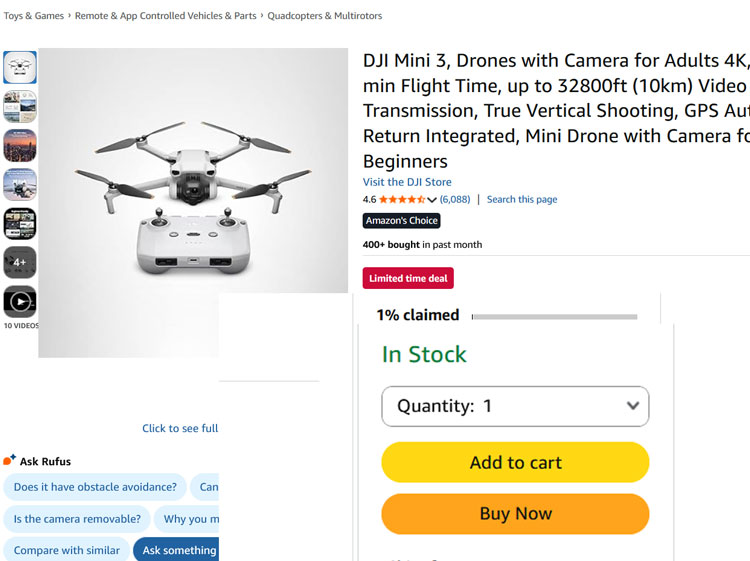
DJI Mini 3 is now seeing a price drop on Amazon USA, and at the same time, this discounted price is available for a limited period. You will be saving approximately 20% from the original price, as the drone is now available for around $335, which is the new price you need to pay.
The DJI Mini 3 drone is capable of recording uninterrupted videos and weighs under 249 grams, so you can easily fly this drone without any hassle. Other than that, in this post, we are going to explain why it is still one of the best drones for beginners in 2026. At the same time, first, let’s take a look at the discount we are getting on the DJI Mini 3 drone.
In this comprehensive guide from TheNewCamera.com, we’ll dive deep into the details of this deal, the drone’s standout features, why now is the perfect time to buy, and how it stacks up against newer models.
What’s the Current DJI Mini 3 Deal on Amazon?
The deal we have running right now on Amazon.com is open to anyone who lives in the United States of America. For the standard package, you only have to pay $335, down from $419. That’s a straight $84 discount, which means you’re getting around 20% off in this particular deal. But wait—this is a limited-period offer, and at the time of writing this post, 1% of the deal stock has already been claimed. So don’t think too much—if you really want an affordable drone on a budget in the month of February 2026, and considering everything happening in the market right now, this is the best time to grab the DJI Mini 3 drone.
 Get the Latest ongoing Discount at Amazon.com Get the Latest ongoing Discount at Amazon.com
For those looking for more bang for their buck, the DJI Mini 3 Fly More Combo is also on sale at $575, reduced from $719—a $144 saving. This bundle adds extra batteries (extending total flight time up to 114 minutes), a charging hub, and additional propellers, making it ideal for extended flying sessions.
Now, the price we are seeing for the DJI Mini 3 is among the lowest since late 2025, even beating some Black Friday deals from the previous year. However, since this is a limited-time offer, once the deal is claimed, the price is expected to bounce back to its original level.
Key Features and Specifications of the DJI Mini 3
Let’s take a look at the core specifications of the DJI Mini 3 drone once again, in case you forgot. The main advantage of this drone is that you can capture HDR videos in 4K at up to 30 fps, which is not even possible with the DJI Mini 4K.
Other than that, the biggest advantage you can see in the specifications is that on a single battery charge, you can fly longer, especially with the Fly More Combo.
Having said that, obviously, the DJI Mini 4K drone is available at a much lower price. Still, again, under the $500 price bracket, the DJI Mini 3 is available for beginners and even professionals who want a backup drone.
- Camera and Imaging: Equipped with a 1/2.3-inch CMOS sensor and f/1.7 aperture, the Mini 3 captures stunning 4K/30fps video and 12MP photos. It supports true vertical shooting for social media-ready content, HDR video (up to 30fps), and creative modes like 180° panoramas and sphere shots. The gimbal stabilisation ensures smooth footage even in windy conditions.
- Flight Performance: With a maximum flight time of 38 minutes on the standard battery (extendable to 51 minutes with the optional Intelligent Flight Battery Plus), you can cover more ground without constant recharges. It boasts a 10km (32,800ft) video transmission range in ideal conditions and can withstand winds up to 38 kph (Level 5 resistance).
- Design and Portability: Weighing under 249g, it doesn’t require FAA registration for recreational use in the USA. The foldable design makes it easy to pack, and features like GPS Auto Return and precise hovering add safety for new users.
- Intelligent Features: QuickShots modes (Dronie, Helix, Rocket, etc.) automate cinematic flights, while the DJI Fly app provides intuitive controls. Compatible with the DJI RC remote for a screen-integrated experience without needing your phone.
Compared to its predecessor, the Mini 2, the Mini 3 offers improved video quality and vertical shooting, making it a worthwhile upgrade for content creators focusing on TikTok or Instagram Reels.
Why Grab the DJI Mini 3 Price Drop in February 2026?
February is usually not the season for this type of discount, but in 2026, we are seeing some unexpected discounts on the DJI Mini 3 drone. Many users are confused about which drone they should buy: the DJI Mini 3 or the DJI Mini 4K. We are going to do a small comparison after this paragraph.
Here, we are simply explaining the reason why we are saying this. If you are not interested in spending this much amount, then obviously the DJI Mini 4K would be the better choice, since it is also available at a more affordable price. However, you should know what the actual differences are between these two drones, which we have explained in a very short comparison table below.
- Value for Money: At $335, you’re getting pro-level features at a budget price. Reviews highlight its reliability, with a 4.6-star rating from over 6,000 Amazon buyers praising ease of use and image quality.
- The most important feature that I really love about this drone is the 4K HDR recording capability, which gives you an extra little bit of space and room for grading in the shots, as well as scope for colour grading. On the other side, we have a little bit more flying time of 38 minutes, compared to 31 minutes flight time of the DJI Mini 4K.
- Beginner-Friendly: No need for complex setups – palm takeoff, subject tracking, and auto-return make it accessible. It’s perfect for aerial photography, videography, or just fun flights.
- Timely Savings: This 20% off is better than many holiday promotions, and with potential stock shortages, acting now could save you from paying full price later.

DJI Mini 4k Drone available at $239 only at Amazmon.com
Now, if you are confused about which drone you should buy, then we have compared both the drones in the table below, which is going to give you a very clear idea about the best drone as per your budget. Initially, if you can pay the price of the DJI Mini 3, without a doubt, it is the best one available right now. But if your budget is limited, then for sure even the DJI Mini 4K is an excellent option and is available at a discounted price right now on Amazon.com USA.
If you’re debating between the Mini 3 and the newer Mini 4K (which offers 4K UHD at a lower price point but similar specs), consider your needs: the Mini 3 excels in vertical shooting and has a proven track record, while the Mini 4K is even lighter on the wallet.
| Feature |
DJI Mini 3 |
DJI Mini 4K |
| Price (Current Deal) |
$335 |
$225-$239 |
| Camera |
4K/30fps, HDR 12MP |
4K UHD, Similar Gimbal |
| Flight Time |
38 min |
Up to 31 min |
| Weight |
<249g |
<249g |
| Best For |
Vertical Shooting, Beginners |
Budget Entry-Level |
How Does It Compare to Other DJI Drones?
So where does the DJ I mini 3 model exactly falls of its actually shit in between the dji mini 4K and the air and models like the marriage 3 Pro but at the very same time the mini 4K is targetting big near audience where as the mini 3 still stands for professional use and obviously you can obviously project you can go with the solutions like the mavic 3 pro
In the DJI lineup, the Mini 3 sits between the entry-level Mini 4K and higher-end models like the Mavic 3 Pro. The Mini 4K, currently at a record low of $225 with Amazon Visa discounts, offers similar 4K capabilities but shorter flight time. For pros, the Mavic 3 Pro Cine bundle is on sale but starts at higher prices for advanced features like ProRes recording.
If you’re upgrading from older models, the Mini 3’s true vertical shooting and extended range make it a step up without the bulk of larger drones.
Tips for Buying the DJI Mini 3 on Amazon
- Check Eligibility: Ensure you’re in the USA or use a forwarding service if international. Prime membership unlocks faster shipping.
- Accessories to Consider: Add ND filters for bright days or a propeller guard for safety – available separately on Amazon.
- Warranty and Returns: DJI offers solid support, and Amazon’s return policy covers you.
- Link to Buy: Head to Amazon’s DJI Mini 3 page to snag the deal before it’s gone.
Final Thoughts: Don’t Miss This February 2026 DJI Mini 3 Deal
The DJI Mini 3 price drop in February 2026 is a golden opportunity for anyone wanting a reliable, feature-packed drone without breaking the bank. At $335 on Amazon USA, this limited-time deal combines top-tier 4K imaging, long flight times, and user-friendly controls in a portable package. Whether you’re a beginner capturing stunning landscapes or a creator needing vertical video, the Mini 3 delivers. Act fast – deals like this don’t last long!

By admin, on February 3rd, 2026
Canon EOS R7 Mark II is obviously a camera that we are all waiting for. Believe me, the press FCC filings that we at TheNewCamera.com team have found clearly indicate that the R7 Mark II camera announcement is coming sooner than we originally expected. Yes, we are all waiting for this APS-C mirrorless powerhouse camera, and the latest FCC ID filing strongly suggests that the Canon EOS R7 Mark II camera is going to hit the market in the first half of 2026.
In this article, we are going to cover in-depth details explaining why we believe this. The recent observation of the Canon EOS R7 Mark II FCC filing supports this timeline. At the same time, we will explain why we believe the announcement of the Canon EOS R7 Mark II camera is likely to happen within the first half of 2026.
If we talk about the core specifications, then based on the recent set of reports, the Canon EOS R7 Mark II camera is expected to arrive with a 39–40MP stacked BSI sensor, blistering 40fps shooting, and pro-level features like 8.5-stop IBIS. This camera is set to redefine APS-C performance for wildlife, sports, and hybrid shooters. Let’s dive into the rock-solid facts, verified leaks, and reasoning behind why the Canon EOS R7 Mark II announcement is imminent before June 2026.

FCC Filing Breakdown: DS126933 Code Ties Directly to Canon R7 Mark II
A recently leaked FCC certification letter dated December 17, 2025, from Canon Inc. to UL Verification Services confirms wireless module integration for a new digital camera model coded DS126933 (FCC ID: AZD260). This filing details the use of a pre-certified Wireless Module (Model: ES204) with Bluetooth Classic capabilities at 2402-2480MHz, ensuring no deterioration in pass/fail test results when installed in the host device.
The question is, why do we think that the registered product matches the Canon EOS R7 Mark II? After cross-verification with reliable sources and based on the information we have received over the past year at TheNewCamera.com, all available data points consistently align with the Canon EOS R7 Mark II rather than any other model.
After deep analysis of all the available documents, including the type of wireless system used in the camera, we also found that the body design hints were clearly visible at the same time.
But one thing made it very clear to us that the upcoming camera is indeed the Canon EOS R7 Mark II, and not the Canon EOS R3 Mark II or anything else. That key factor is what finally made the situation clear—yes, this is the camera we have been waiting for.

Battery Evidence: LP-E6P Confirms R7 Mark II, Rules Out R3 Successor
One of the most compelling clues comes from the battery type. The leaked test report specifies the LP-E6P battery pack (along with PD-E2 USB power adapter and DR-E6P DC coupler), a high-capacity 2130mAh unit introduced with the EOS R5 Mark II and adopted in models like the EOS R6 Mark III. This battery is optimized for demanding features like high-frame-rate bursts, 4K/6K video, and in-camera charging – perfect for an upgraded APS-C hybrid like the R7 II.
There are two most eligible candidates for this model code that we were discussing: the Canon EOS R3 Mark II and the Canon EOS R7 Mark II. However, based on the type of battery the device uses and the power-supply details mentioned in the filing, it clearly indicates one thing—that this is the Canon EOS R7 Mark II camera.
Other than that, the Canon EOS R3 camera uses the larger LP-E19 battery, which is optimised for flagship pro bodies with extended endurance and built-in grips, making it incompatible with the more compact, mid-range design signalled by the LP-E6P in this filing. This battery distinction, combined with the device’s peripherals like the PD-E2 adapter and DR-E6P coupler, further cements its identity as an APS-C successor rather than a full-frame pro update, aligning perfectly with Canon’s strategy to refresh the enthusiast lineup in 2026.
This battery mismatch is rock-solid reasoning: The LP-E6P points squarely at the R7 Mark II, aligning with rumors of a larger body (similar to R6 size) for better heat dissipation and ergonomics.
Canon EOS R7 Mark II Rumored Specifications: A Game-Changer for APS-C
A set of core specifications we have published an while ago, through Canonrumor, about the Canon EOS R7 Mark II camera states that the camera may carry a 39–40 megapixel sensor, and 8K video recording capability. Now, let’s take a look at the key specifications that we are expecting from the Canon EOS R7 Mark II camera.
Based on verified leaks from multiple sources including canonrumor.com , the Canon EOS R7 Mark II is poised to outperform its predecessor with pro-grade upgrades. Here’s a breakdown of the expected specifications:
- Sensor: 39-40MP APS-C BSI CMOS (conflicting reports on stacked design for faster readout).
- Processor: DIGIC Accelerator for enhanced speed and image quality.
- Stabilization: Up to 8.5-stop 5-axis IBIS.
- Shooting Speed: 40fps electronic shutter—ideal for sports and wildlife.
- Autofocus: Best-in-class for APS-C, borrowing advanced tech from R3/R1.
- Video: RAW video (resolution TBD), with potential for 8K UHD.
- Storage: Dual slots (CFexpress + SD) for reliable backups.
- Viewfinder: High-resolution EVF.
- Body Design: Larger form factor (closer to EOS R6) for improved handling and cooling.
- Battery: LP-E6P for extended shooting and in-camera charging.
- Other Features: Advanced wireless (Bluetooth/Wi-Fi) per FCC filing, weather-sealing.
These specs position the R7 II as a “baby R5 Mark II” for APS-C users, offering 8K capabilities without stepping on full-frame toes.
Canon R7 Mark II Release Date & Price: What to Expect in 2026
The FCC certificate was issued on December 17, 2025, and the registered model code is DS126933. According to general planning and analysis, this model is closely tied to the Canon EOS R7 Mark II camera. As we all know, the FCC covers all external photos, test shots, and internal images of the registered product for a 180-day confidentiality period.
Based on this 180-day cycle, the registered camera details—including both external and internal images—will be published in June 2026. This clearly suggests that the Canon EOS R7 Mark II announcement is potentially expected between March and June 2026.
So now, we have a clear timeline for when the Canon EOS R7 Mark II camera is coming—on or before June 2026.
Pricing rumors peg the body-only at around $1,999 to $2,299, offering insane value for pro-APS-C performance.+
GET LIVE NOTIFICATION, Select Your Trusted Source GET LIVE NOTIFICATION Click ON Check  BOX for Latest NEWS and Rumors BOX for Latest NEWS and Rumors
The article “Canon R7 Mark II Announcement Expected Before June 2026: Latest Leaks, FCC Filings & Rumors” was written by thenewcamera.com team on 1:46 pm, Thursday, 15 January 2026, Greenwich Mean Time (GMT) | You can also follow us on Our Official Social Media Handles FACEBOOK | TWITTER | INSTAGRAM to get live news — > DJI Rumors
By admin, on February 1st, 2026

The DJI upcoming products in 2026 — we have created the most up-to-date list (updated on 4:22 am, Sunday, 1 February 2026), since we have covered almost all the products that appeared in FCC filings just before December 23, 2025, and we have collected the list here, as you all know. Despite ongoing U.S. regulatory challenges, leaks from reliable sources like thenewcamera.com and tipster Igor Bogdanov (@Quadro_News),
We have created a roadmap with Key products that include the DJI Osmo Pocket 4 (with a potential Pro variant), the compact DJI Lito X1 drone series, and the immersive DJI Avata 360 FPV drone. This February 2026 update covers rumoured specs, release dates, prices, and features based on FCC certifications, warehouse leaks, and expert analysis.
The content explores the list of products that are coming in 2026; all the products that have been mentioned are registered ones, and none of them are speculation or just rumours. This means all the products that we have mentioned in this article are about to arrive in the year 2026, so now let’s dive in.

1. DJI Osmo Pocket 4: Revolutionising Vlogging
The DJI Osmo Pocket 4 is one of the hottest topics right now, and we have published a lot of content related to the same. The DJI Osmo Pocket 4 whole camera is expected to arrive before April 2026, as we reported earlier this year as well.
From the initial design leaks, it is very clear that we have two different models of the upcoming Pocket 4 camera. One is the standard model, and the other is PRO with the dual-camera lens-based module. So far, it is said that the standard model is going to arrive first
DJI Pocket 4 Warehouse Inventory Leak: Reveals Kits, Hints at Imminent Launch
The good news is that the DJI Pocket 4 stock has now reached major retailers in China, and they have the entire list of the new Osmo Pocket 4 series cameras in their inventory. The same screenshot was leaked by one of the most trusted sources today.
The wait for the DJI Osmo Pocket 4 might be shorter than expected. A fresh DJI Osmo Pocket 4 leak from trusted leaker Igor Bogdanov (@Quadro_News) has surfaced, showing a warehouse app screenshot with a detailed listing shows stocked bundles of the DJI Pocket 4 camera and accessories.
Before the inventory leak, just before that, the DJI Pocket 4 was accidentally leaked on the Amazon website, which we also covered. In that accidental listing, DJI also published the core specifications of the Pocket 4 camera, which were clearly visible, although it was just a placeholder or dummy listing. The specs that we saw in that listing were visible at the time.
We are waiting for its official arrival, and yes, if we get any further updates about the upcoming DJI Pocket 4 camera, we will be updating it here at thenewcamera.com

Release Date Rumours: Official reveal possibly on or before March 2026; Warehouse sightings in China suggest stock is building.
Expected Price: $699–$749 for the Creator Combo (a slight increase from Pocket 3’s $669).

2. DJI Avata 360: The Ultimate 360-Degree FPV Drone
Recently. The pre-order page went live; we are not 100% sure about the authenticity, but yes, the pricing and the model code were listed. Apart from that, trusted sources like Igor from Twitter have also leaked bundle combo images from their account of the upcoming drone.
Not only that, but it has also been confirmed that the Avata 360 will work in dual modes. One will be the standard mode that was already known with the Avata lineup, and the next is the 360 capture mode. So, with the flip of the Avata 360 drone gimbal, it can easily switch modes depending upon the user’s selection.
This is one of the most advanced drones from DJI, which is about to arrive before May 2026. We are not very sure about the exact date, since the retailer listings are still not live yet, just like what we have seen with the Pocket 4.
The 360 drone is expected to arrive before the DJI Lito X1, and the expected arrival timeline of the DJI Avata 360 is sometime before May 2026. We will be updating this post as soon as we get any fresh information related to the drone, and you can also explore more content related to the Avata 360.
Rumored Specs & Features:
- Camera: Dual 1/1.1-inch CMOS sensors (borrowed from DJI Osmo 360) for 8K/50fps 360° video and 4K high-frame-rate FPV; rotating module switches between spherical and single-lens modes.
- Transmission: O4/O5 system for low-latency, 20km+ range.
- Safety and Flight: Omnidirectional obstacle avoidance, follow-me tracking, automated paths; cinewhoop design with full prop guards for indoor safety.
- Battery: Upgraded for 25–32+ minutes of flight time.
- Versatility: HDR support, wind resistance, and compatibility with RC 2/Motion 2 controllers.
Why it’s exciting: Its dual-mode capability (360° immersive + standard FPV) makes it a game-changer for content creators and VR enthusiasts. Here’s a look at the leaked designs:
 What they have done is they also leaked a drone which very closely resembles the arms of the DJI Mini 4K drone, and that was more than enough to confirm that DJI, as well as the Lito X1, is nothing other than the upcoming entry-level drones. 3. DJI Lito X1 (and Lito 1): Compact Drones for Beginners and Pros
Initially, it started with FCC ID leaks, which confirmed the arrival of the Lito Series in the United States of America. DJI Lito 1 and the DJI Lito X1 are the two drones that are already registered in FCC ID and are expected around the second and third quarter of 2026.
“DJI Lito X1 leaks” are heating up, with this sub-250g series positioned as successors to the Mini lineup. FCC approvals in late 2025 confirm global plans.
Rumored Specs & Features:
- Design: Foldable, lightweight (<250g for no registration); 360° obstacle avoidance with fisheye optics and infrared sensors.
- Transmission: O5/SDR+5G for 20km+ range and BVLOS flights; Wi-Fi 6/BLE support.
- Flight Time: Standard battery ~30 min; Plus ~50 min.
- Controls: Voice (“Hey fly”), motion gestures, app integration; wind resistance level 5.
- Storage: SD slot + internal (22GB for Lito 1, 42GB for X1).
- Variants: Lito 1 (entry-level, Mini 4K replacement); Lito X1 (advanced, Mini 5 Pro successor with pro video focus).
Leaked component images from Igor Bogdanov show modular arms and prototypes, with Asian listings confirming branding. You can watch more details here
Well, it may be DJI’s strategy; they could have leaked it intentionally to create pre-announcement buzz about which product is actually coming under the branding of Lito.
Release Date Rumours: Announcement late February to early April 2026; full launch Q2/Q3.
Expected Price: Lito 1 ~$330 base/$490 combo; Lito X1 ~$759 base.
Why it’s exciting: Affordable, regulation-friendly drones with premium features like unlimited-range 5G—great for hobbyists avoiding bulkier models. View the latest leaks:

4. DJI OSMO 360 II: Registered at FCC ID
The DJI Osmo 360 II (also known as the next-generation DJI Osmo 360 or Osmo 360 2) is the upcoming successor to DJI’s first dedicated 360-degree action camera. We have spotted its listing at FCCID. Registration was completed on December 9, 2025.
The certification filing confirms DJI is actively preparing a refreshed 360 action camera with modern wireless capabilities, addressing demands for faster workflows in vlogging, action sports, VR, and immersive content. The “Pass” result and non-covered status clear the path for global availability, including the US market.
Based on the original DJI Osmo 360 (Standard Combo $479.99–$499, Adventure Combo ~$599), the DJI Osmo 360 II is he expected to have the pricing somewhere between $499–$549 USD for the base kit,
- Standard Combo (Expected): $499–$579 USD (a slight bump from the original’s $479.99, reflecting upgrades like better battery).
- Adventure Combo (Expected): $629–$729 USD (bundles extra batteries, mounts, and selfie sticks).
- Regional: €509–€579 / £409–£469 / AU$809–$879.
- Potential Deals: Launch promotions could drop prices below $500 on DJI’s site or Amazon
Announcement time: Camera is expected to arrive on or before May 2026
Other Upcoming DJI Products in 2026
Gimbals and Stabilisers
- DJI RS 5 Pro: Already Announced now
- DJI Osmo Mobile 8P: Smartphone gimbal with improved AI tracking and portability, potentially launching alongside Pocket series updates in Q1 2026.
- DJI Osmo FrameTap: A new accessory or variant for frame-accurate tapping in video editing, mentioned in ban-unaffected lists for 2026.
Audio and Power Accessories
- DJI Mic Mini 2 / 2S Transmitter: Compact wireless mic with upgrades like longer battery (up to 14 hours), AI noise cancellation, and 400m range. Expected by June 2026 as a budget option for vloggers.
- DJI Power 1000 Mini: Portable power station (800W) with solar inputs, airline-safe design, and fast charging. Officially teased for January 6, 2026, but delayed slightly per leaks.
These products are highlighted in thenewcamera.com’s coverage due to their pre-ban FCC approvals, ensuring availability in markets like the US. Rumors suggest a wave of announcements in February-March 2026 to beat regulatory hurdles.
What to Watch in February 2026
With FCC clearances and Igor Bogdanov’s ongoing shares, DJI’s 2026 lineup prioritises innovation amid bans and focuses on global markets. Preorders for Avata 360 are already popping up, and Pocket 4 stock sightings hint at a reveal any day. Stay updated as official announcements could drop soon.
What DJI release are you hyped for? Drop your thoughts below!
Sources: Aggregated from thenewcamera.com (FCC details, specs, leaks), Igor Bogdanov (@Quadro_News on X.com for images and confirmations), and supporting sites as of January 31, 2026. All info is rumoured and subject to change.
GET LIVE NOTIFICATION, Select Your Trusted Source GET LIVE NOTIFICATION Click ON Check BOX for Latest NEWS and Rumors
The article “DJI OSMO 360 II Arrival Date, FCC ID Reg Details and Price” was written by thenewcamera.com team on 11:42 am, Thursday, 29 January 2026, Greenwich Mean Time (GMT) | You can also follow us on Our Official Social Media Handles FACEBOOK | TWITTER | INSTAGRAM to get live news — > DJI Rumors

|
KEEP THIS BLOG ALIVE - Support New Camera Buy Canon Lenses, Buy Music CD or Digital Camera at amazon it helps this site, and you do not pay anything extra, it is just a way to help support this site.

|