Join More Than 50,000+ Subscribers and get latest camera news and rumors
NEW CAMERA VIDEOS ON YOUTUBE
|
By admin, on September 12th, 2025 
Nikon ZR and the Canon C50 are both very new and were announced in September 2025. The Nikon ZR is Nikon’s first cinema mirrorless camera. Nikon, the Canon cinema line has been active inside Canon for more than a decade. The Nikon is priced at 2200 USD, and the Canon C50 will cost you approximately 3899. So, we do have a good price difference between these two cameras, but is the price difference between the two really worth it, meaning if you are someone who wants to do a fresh start, should you move towards a Canon or Nikon cinema camera? Or if ur a professional and not limited in any sort of budget boundaries, which camera should you choose? If you were searching for Nikon ZR vs Canon C50 comparison, then you have reached the right page. We have done the Most Detailed Specification Comparison between the two, lets dive into the details
Specification Comparison
| Feature |
Nikon ZR |
Canon EOS C50 |
| Sensor |
24MP full-frame partially stacked CMOS (from Z6III) |
32MP full-frame CMOS (new, non-stacked) |
| Max Video Resolution/FPS |
6K up to 60fps (uncropped); 4K up to 120fps (1.5x crop); 4K60 uncropped |
7K up to 60fps (RAW, 3:2 Open Gate); 4K up to 120fps (uncropped); 2K up to 180fps |
| Codecs |
REDCODE RAW (R3D NE, 12-bit, internal); N-RAW; ProRes RAW; ProRes 422 HQ; H.265 |
Canon Cinema RAW Lite (12-bit, internal); XF-AVC; XF-HEVC |
| Color Science & Log |
REDWideGamutRGB + Log3G10; N-Log; Nikon colors |
Canon Log 2/3; Wide DR; PQ/HLG/Canon 709/BT.709 |
| Oversampling |
6K to 4K oversampled for enhanced detail; |
4K up to 60fps oversampled from 7K (or 6.9K for 4K30) |
| Sensor Modes/Crops |
Full-frame uncropped in 6K/60; 1.5x crop in 4K/120; Hi-Res digital zoom |
Full-frame 3:2 Open Gate (7K full height); Super 35/16 crops; Simultaneous wide + vertical/square crops (fixed position, from cropped wide frame) |
| Dynamic Range |
15 total stops in 6K RED RAW; W |
15+ stops in full-frame (Log/RAW) |
| Rolling Shutter |
Sub-10ms (9.1ms in 6K RED RAW); Excellent for fast action |
Not fully tested |
| Audio |
32-bit float (built-in mic + 3.5mm); OZO processing (directional, zoom, isolation, cleanup); Multi-interface hotshoe |
24 Bit via XLR (via included handle); 3.5mm mic/headphone; Recording levels; Shotgun mic mount |
| Stabilization |
IBIS + Electronic (same as Z6III); Lens-based optional |
Digital compensation + lens-based optical; No IBIS |
| Ports & Connectivity |
Micro HDMI; USB-C (UVC webcam up to 1080p60); 3.5mm mic/headphone; Multi-interface hotshoe |
Full-size HDMI; USB-C; Timecode terminal; Remote; 3.5mm mic/headphone |
| Media Slots |
1x CFexpress Type B + 1x MicroSD (bottom-mounted; no redundant recording) |
Dual: 1x CFexpress + 1x SD |
| Battery Life & Thermals |
~2 hours 6K RAW (EL15 battery); Fanless, no overheating (tested up to 32°C/90°F); 2-hour 5-min record limit |
LP-E6P battery; Active cooling (fan) for extended recording; No known limits mentioned |
| Other Video Features |
User LUT import (up to 65-point, RAW-only); Tally lights; Audio cues; Frame continuity challenges due to card access; RED intercutting |
Frame.io support; Canon XC protocol; Multi-camera control/app transfer; Pre-burst in photos; Electronic burst up to 40fps (photos) |
Resolution and Open Gate, anamorphic recording
In both the comparison tables, it is very clearly visible that the Canon C50 has supremacy in resolution; you can easily record 7K videos up to 60 frames per second and 4K 120fps uncropped with this Canon C50 camera.
Availability of Open Gate recording, which is 7K 60fps RAW in 3:2 format, available at Canon C50. Another major advantage apart from all these is the anamorphic recording ability and in-camera de-squeeze functionality.
So with Canon, you can go wider with anamorphic (in-camera de-squeezing), ultra slow motion videos without any compromise or crops, at the very same time you can use anamorphic ultra-wide lenses even while recording 4k 120fps, that’s great for sure.
Nikon ZR approach is more traditional, in the limited price range we are getting REDCODE RAW R3D 12-bit internal recording, at the very same time the same spec has been used in higher-end RED cameras like the Komodo or the V-Raptor, so it’s a boon for solo creators to have such a format in this price range.
Audio is one of the most important parts of the video, and the Nikon ZR is the only camera in between the two that offers 32-bit float audio recording capability. Again, it’s another boon for solo creators to record the highest quality audio possible without investing heavily in an audio setup. OZO has been added to the Nikon ZR, which is responsible for background noise reduction while recording with internal mics. With the help of the DJI Mic 3, which is also able to record 32-bit float audio, you can generate high-quality audio files while pairing up with the Nikon ZR camera.
The Canon is limited to 24-bit audio despite the XLR handle and inputs in the camera so that’s the limitation we have with the Canon C50.

Active cooling in Canon C50 [Only in Canon C50]
Active cooling effectively makes the recording time limit indefinite. C50 also utilises a higher-resolution sensor of 32MP, which generates more heat while recording videos or oversampling compared to a 24MP sensor. To prevent any kind of overheating issues and maintain the highest recording quality possible, Canon has added a built-in fan that will keep the camera cool for longer periods of time.
The Nikon ZR features a fanless body, but Nikon claims its heat sink is significantly improved over the previous generation of Nikon cameras. We can record 6K 60fps videos for up to 2 hours and 5 minutes at 32°C without interruption. So obviously, with Nikon ZR, you can record longer videos without any significant worries.
Sensor-shift image stabilisation system [Only in Nikon ZR]
The Nikon ZR does feature a 7.5 to 8 stops of sensor-shift image stabilisation system that we have already seen in the Nikon Z6 Mark III and the Nikon Zf camera. The IBIS mechanism of the Nikon ZR is intelligent and recognises the human body and face, and when your VR lens is linked with the autofocus point, you get a maximum of 7.5 stops of advantage even in the corner of the frame. In Canon, there is no sensor-shift image stabilisation system, so you have to depend upon rigs or gimbals.
Body Design Overview
Both camera features a boxy style design. Well, the Canon C50 will be more convenient to a professional cinematographer since it already has a large handgrip, multiple Mount screw holes, even on the top plate of the camera. At the same time, a full-size HDMI port and an option for an XLR handle help to create an easy professional workflow.
With a Nikon ZR camera, it seems like we have to again use an external hand grip from grip makers like a small rig, since the grip is really very small, very similar to the Nikon Zf. Another most irritating thing is we are missing a Standard SD card slot, either u use a microSD card slot or CFexpress Type B. Comparing it to the Nikon ZR is more tilted towards a solo creator, which has all the bells and whistles that a solo creator may wish to have in their camera.
| Aspect |
Nikon ZR |
Canon EOS C50 |
| Dimensions (W x H x D) |
133 x 81 x 49 mm |
142 x 88 x 95 mm |
| Weight (Body Only) |
630g |
670g |
| Build Material |
Fiber-reinforced plastic; rugged, lightweight |
Not specified (durable cinema-grade construction assumed) |
| Grip/Handling |
Minimal grip; boxy, EVF-less; gimbal-friendly but requires third-party cages for pro rigs |
Decent integrated grip; flat-topped with handle for better handheld stability |
| Ergonomics |
Video-focused UI; tiny joystick, zoom rocker, 3 custom top buttons; minimal for solo creators but cumbersome for cinema (e.g., bottom card access) |
Cinema-optimized UI (separate photo/video modes); joystick, thumb wheel, 14 assignable buttons, 3 custom dials; highly customizable for pro workflows |
| Overall Feel |
Vlog-like (similar to Sony ZV-E1); portable but needs accessories for cinema use |
Cinema-ready (akin to Sony FX3 or Canon R5C); bulkier but more robust out-of-box |
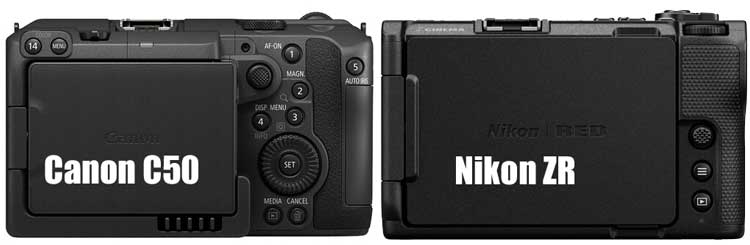
Display Comparison
Both cameras rely solely on rear screens for composition (no EVF or accessory viewfinder option), but the Nikon ZR’s display stands out for size and brightness, aiding outdoor monitoring. The C50’s screen is smaller but highly functional with touch controls.
| Aspect |
Nikon ZR |
Canon EOS C50 |
| Size |
4 inches |
3 inches |
| Resolution |
3.07 million dots (1280 x 800 pixels) |
1.62 million dots (900 x 600 pixels) |
| Brightness |
1000 nits (peak) |
Not specified (standard for cinema cameras; likely 300-500 nits) |
| Type/Features |
Articulating; 16:10 aspect ratio; P3 color gamut support for accurate previews; touch-enabled |
Side-hinged vari-angle touch panel; flips for self-facing; customizable peaking (Peaking 1/2) |
| Advantages |
Larger and brighter for better visibility in bright environments; excellent for monitoring |
Compact and versatile articulation; integrated touch UI for focus and settings |

Expanding on ports, slots, mounting, cooling, and accessories, the C50 leans more professional with comprehensive connectivity and included extras, while the ZR prioritizes simplicity and silence.
| Aspect |
Nikon ZR |
Canon EOS C50 |
| Ports |
Micro HDMI; USB-C (3.2); 3.5mm mic/headphone; Digital hotshoe (supports audio adapters, future XLR) |
Full-size HDMI (Type-A); USB-C (3.2 Gen2); 3.5mm mic/headphone; 2x XLR (via handle); Timecode (DIN1.0/2.3); Remote (2.5mm); DC input |
| Card Slots |
1x CFexpress Type B + 1x UHS-I microSD (bottom-mounted; microSD for settings/LUTs, not backups) |
1x CFexpress Type B + 1x SD/SDHC/SDXC (side-mounted; supports relay/simultaneous recording) |
| Mounting Points |
Single 1/4-20 bottom thread; gimbal-friendly but limited; third-party cages recommended |
Multiple rigging threads; Alignment pin behind tripod thread; Multi-accessory shoe for adapters (e.g., PL-RF, EF-EOS R) |
| Cooling System |
Passive (fanless); Efficient heat dissipation; No overheating in tests (up to 125 min with USB power) |
Active (quiet fan with large vent); Designed for unlimited long recordings |
| Included Accessories |
None specified (battery, charger assumed standard) |
Detachable handle (with XLR, REC/zoom controls, mic mount); LP-E6P battery; LC-E6E charger; Mic holder; Shoulder strap; USB-C cable; AC cable |
| Other Notes |
Silent operation ideal for audio-sensitive sets; 32-bit float audio via ports/hotshoe |
Built-in stereo mics; Ethernet via USB-C adapter; Frame.io integration for cloud workflows |

Pros and Cons of the Nikon ZR
| Pros |
Cons |
| Affordable at $2,200 with internal 12-bit RED RAW for pro workflows |
Ergonomics favor vlogging (no grip, bottom cards, tiny joystick) |
| Low rolling shutter (sub-10ms) for smooth action footage |
Micro HDMI and no XLR; Limited ports for cinema rigs |
| Innovative 32-bit float audio with built-in OZO enhancements |
High RAW data rates (~190-470 MB/s); Short record times on smaller cards |
| Lightweight (630g) and fanless with excellent thermals (~2+ hours) |
No 14-bit RAW option; Overprocessed non-RAW modes (e.g., H.265 inaccuracies) |
| Superior 4-inch, 1000-nit screen for monitoring |
Weak stabilization for dynamic shots; 2-hour 5-min arbitrary limit |
| Versatile zoom rocker and quick boot-up; UVC webcam support |
LUT import limited to RAW; No redundant recording |
| Strong value as a B-cam for RED users or vlog upgrade |
Inferior for photos compared to hybrids like Z6III |

Pros and Cons of the Canon EOS C50
| Pros |
Cons |
| High-res 32MP sensor with 7K/60 RAW and 3:2 Open Gate for flexibility |
Higher price at $3,899; No IBIS (relies on digital/lens stabilization) |
| Oversampled 4K/60 from 7K for sharp, detailed footage |
Non-stacked sensor may have higher rolling shutter than competitors |
| Uncropped 4K/120 and 2K/180 for high-frame-rate options |
No built-in ND filters; Audio requires handle (included but adds bulk) |
| Dual slots (CFexpress + SD) with easy access; Timecode support |
Heavier (670g) and bulkier than some compacts; No viewfinder option |
| Active cooling for unlimited recording; Included XLR handle |
Photos use electronic shutter only (potential rolling shutter issues) |
| Simultaneous wide + vertical/square crops for social media workflows |
Vertical crops fixed (no tracking); Oversampling from cropped frame |
| 15+ stops DR and Dual Base ISO for low-light performance |
Less affordable for entry-level filmmakers; No 32-bit float audio |
| Cinema-focused build with rigging threads and custom buttons |
Screen resolution lower (1.62M dots) than some rivals |

Who Should Buy the Nikon ZR?
The Nikon ZR is made for budget-conscious content creators, vloggers, and hybrid shooters entering cinema workflows. It’s ideal for:
- Solo filmmakers or YouTubers: If you are a solo filmmaker or YouTuber, looking for a budget solution, the Nikon ZR is the best camera for you. The additional advantage we are getting with this camera is the ability to record 32-bit audio, and OZO processing simplifies run-and-gun setups.
- RED Ecosystem Users: Yes, you can use it as your primary camera; don’t underestimate its power; it inherits all the goodness of RED cameras, perfect for indie productions or commercials needing affordable RAW.
- Hybrid Photographers: Yes, you can capture some still shots if you wish to, but primarily it’s
- Avoid if: You need robust cinema ergonomics out of the box or uncropped high-FPS— go with the high budget cams then
Buy the Nikon ZR if ur overall budget is somehow limited within $3000 (since u have to buy lenses, lights, tripods, backdrops) so a lot of spending is still left even once you buy the camera.
Who Should Buy the Canon EOS C50?
The Canon EOS C50 targets professional videographers and small cinema teams seeking a bridge between hybrid and dedicated cinema cameras. It’s suited for:
- Narrative Filmmakers: 7K Open Gate, 4k 120FPS uncropped, Pro body controls and ports, no compromise in features from inside to out, the only thing that you miss in the Canon C50 is the IBIS, but as most of the production houses place their camera on heavy rigs / moving platforms, they actually didn’t need IBIS, a bunch of Canon RF and and Canon CNR lenses available for the pro cam.
- Multi-Cam Productions: Timecode, XLR, Anamorphic lenses support and in-camera de-squeez, and app control enable synced setups; active cooling handles long shoots like events or interviews.
- Canon Ecosystem Loyalists: CNR Lenses as well as RF lenses support and Log2/3 integrate with C70/R5C; 32MP photos with 40fps burst appeal to hybrid pros (e.g., wedding videographers).
- Avoid if: You’re on a tight, pls ge the Nikon Zr or Sony FX30
Choose the C50 if you can afford $3,899 and need cinema-grade tools like Open Gate or high DR for commercials/docs. It’s for those prioritizing flexibility in post (e.g., reframing) over the ZR’s RAW affordability, as evidenced by its positioning above the R5C but below the C70.
Get Canon C50 from amazon.com | B&H Store
Get Nikon ZR from amazon.com | B&H Store
GET LIVE NOTIFICATION Your Trusted Source GET LIVE NOTIFICATION Click ON Check  BOX for Latest NEWS and Rumors
The article “Nikon Zr Official Press Release” was written by thenewcamera.com team on 6:09 am, Wednesday, 10 September 2025, Greenwich Mean Time (GMT) | You can also follow us on Our Official Social Media Handles FACEBOOK | TWITTER | INSTAGRAM to get live news — > get live news + Nikon Rumors + Camera News + Canon Rumors 24X7.
Best Lenses for Canon C50 Camera: Unlock Epic Cinematic Power with CN-R and RF Lenses in 2025

By admin, on September 12th, 2025 
As we know, the ZR is one of the first Nikon cinema release cameras that features a partially stacked CMOS sensor of Z6 III, and R3D RAW, now available on Amazon.com in the USA. When it was announced, I was really very much surprised to see the compact body design of the camera with a large 4-inch display screen on the back. After looking at the internal core specifications, it looks like a RED cinema camera. The cherry on top is that you are able to record 32-bit float audio in-camera, no XLR handle needed. And for solo creators, Nikon has also added an IBIS system, which is very similar to the advanced sensor-shift image stabilization system we have seen in the Nikon Z6 Mark III and the Nikon Zf camera.
So in this guide, we have tried to cover everything—whether you are searching for the Nikon ZR buy USA, Nikon ZR Amazon availability, where to buy the Nikon ZR in USA, or best place to buy the Nikon ZR camera—we have got everything in this article. So let’s dive in.
Why the Nikon ZR Is a Must-Buy for Cinema Enthusiasts
The Nikon ZR is one of the best Nikon Z cameras Nikon has ever announced. Now, since it’s a cinema camera, we are breaking down its top features in terms of cinema camera perspective:
- Sensor and Resolution: 6K full-frame sensor with RED color science for cinematic depth, dynamic range, and accurate colors ideal for post-production workflows.
- Audio and Monitoring: 32-bit float audio eliminates clipping issues, paired with a built-in 4″ DCI-P3 monitor for precise on-set viewing.
- Compatibility: Uses EN-EL15c batteries, compatible with existing Nikon Z-series accessories like those for the Z8, Zf, and Z6III.
- Video Performance: Supports R3D RAW recording, making it a powerhouse for professional filmmakers transitioning from DSLR to cinema setups.
- Build and Handling: Compact yet robust, with Nikon’s ergonomic design for long shoots.
Early reviews from professionals suggest it is potentially a professional-level tool and may not be for everyone. Why is it not made for everyone? Since it’s a cinema camera. But at the very same time, Nikon has made it for all of us—even if you don’t want to record your videos in complete RAW format, the camera does have recording codecs like H.265 / H.264 so you can record your videos in 10-bit or 8-bit lightweight MP4 format if you are recording for YouTube or social media.

Where to Buy Nikon ZR in the USA: Top Options
Wondering “where to buy Nikon ZR camera”? No need to think more—we have carefully selected all the available links on Amazon.com for you:
- Amazon.com USA – While searching for “Nikon ZR cinema camera” on their Nikon Z Series store page, you’ll find bundles including the body with a 24-50mm lens. With Amazon.com, we have great trust as well as benefits like Prime delivery, easy returns, and frequent deals.
- B&H Photo Video – One of my favorite stores for professional photography equipment. In general, they offer a lot of bundles, accessories, and recommendations. Check for Nikon ZR availability at B&H Store here if Amazon stocks run low.
- Adorama – Another trusted retailer and our partner store; they do offer very competitive pricing and financing options.
- Nikon USA Official Site – For direct-from-manufacturer purchases, warranties, and potential exclusives. However, Amazon often matches or beats their prices with better shipping.
Nikon ZR Price Comparison and Bundles
Based on official prices, we have multiple bundles of the Nikon ZR camera, and here they are:
Is the Nikon ZR Worth Buying Right Now?
Absolutely a BIG yes. If you’re a wedding cinematographer, beginner filmmaker, or pro content creator, the Nikon ZR is the best ever video camera Nikon created at this price range. Under $2000, you’re getting an amazing camera for cinematography—don’t miss it.
The article “Nikon ZR Now Available on Amazon.com USA: Where to Buy the New Nikon ZR Cinema Camera and More” was written by thenewcamera.com admin & team on 3:30 pm, Friday, 12 September 2025, Greenwich Mean Time (GMT) | Follow us for more updates and Get LIVE RUMORS –> FACEBOOK | TWITTER | INSTAGRAM to get live news — > get live news + Nikon Rumors 24X7
By admin, on September 12th, 2025 In the month of September, the DJI Mini 5 Pro announcement is already there, but just after that, a lot of products are in the announcement pipeline and we have listed all of them here. Just before that, we published the updated list of products that are coming in July 2025, and this article focuses on the latest leaks, confirmed specifications, and the rumors we have related to DJI’s upcoming products.
The DJI Mini 5 Pro is officially coming on September 18. Other than that, we have fresh details on the Pocket 4 camera, Osmo Action 6, the DJI Neo 2 drone, as well as the Avata 3. Along with that, we also have very interesting information related to the DJI 360 drone. So, this is a kind of comprehensive, well-sourced insight.

1. DJI Mini 5 Pro
Now, as September 2025 unfolds, we have several drones in the announcement pipeline, and we are also hearing some regulatory challenges like the potential US drone ban. We wrote an article back in July 2025, covering all the latest and upcoming action cameras, as well as DJI drones. In this update, we are focusing on the latest leaks, confirmed specs, and rumours we have related to the upcoming DJI drones in 2025. As we all know, the DJI Mini 5 Pro is about to arrive on September 18th. In addition to that, we have a list of DJI products coming, which includes the Osmo Action 6 camera, the DJI Pocket 4, the DJI Neo 2, and the Avata 3 drone. So let’s explore the updates we have related to these upcoming products.

DJI Mini 5 Pro: Announcement before September 18
The DJI Mini 5 Pro was expected to arrive in August, but now, as per the insider information we have and the embargo lifted, it all points towards a September 18 full-fledged announcement. On September 18, DJI will lift the embargo on the DJI Mini 5 Pro drone and the shipping will start on the same day by sellers, although the announcement may happen one day before that, maybe on September 16th or 17th. The DJI Mini 5 Pro is one of the first under-249 gram drones that features a large 1-inch sensor as well as an advanced obstacle detection system. So let’s see the major specifications of the Mini 5 Pro.
DJI Mini 5 Pro Specification
- Video 4K/60fps HDR · 4K/120fps
- Gimbal Rotation 225° · True vertical
- Transmission O4+ · up to 20 km (FCC)
- Flight time Up to 36 min (smart battery) or 52 min (Plus battery)
- LiDAR detection + omnidirectional vision
- C0 certification by default (EU)
DJI Mini 5 Pro Camera specification and functions:
- 50 MP 1″ CMOS sensor and f/1.8 aperture — better low-light performance.
- 4K/60fps HDR video (up to 14 dynamic stops in Auto) and 4K/120fps for slow-motion.
- 10-bit recording (H.265) and D-Log M and HLG modes for advanced post-production.
- True vertical shooting + gimbal with 225° rotation for creative shots.
- Nightscape Omnidirectional Obstacle Sensing with LiDAR and vision sensors.
- Improved 360° ActiveTrack (Standard and Cycling modes) with tracking up to 15 m/s in open environments.
- O4+ 10-bit video transmission and up to 20 km in range (FCC mode). Persistent Bluetooth for fast pairing.
- Flight time with smart (normal) battery: up to 36 minutes.
DJI Mini 5 Pro Price
- Base Model: $799–$950
- Fly More Combo: $1,099–$1,299 (includes extra batteries, charging hub)
- Premium Bundles: Up to $1,499 with accessories

2. DJI Pocket 4: New Leaked Images, Price and Specifications Updates
Now we have two different sets of images of the Pocket 4 gimbal. The first one, where you see the screen, is coming out of China, where you can clearly read Pocket 4 branding but no camera was visible; the image was shared via Weibo.

On the latest leaked image (below) of the Pocket 4 camera, better to say early prototype, we can clearly see a dual-lens setup-based camera. Both of the camera modules look completely different in size. The left one is noticeably tinier, akin to auxiliary sensors we generally see in smartphones or DJI drone multi-camera module units, for specialised functions. This asymmetry suggests not a symmetrical stereo pair but a main–auxiliary duo.

The main housing around the cameras of the new prototype seems to be compact, potentially even slimmer than the Pocket 3’s module when compared. That means DJI has managed to have a dual setup without excessive bulk. At the very same time, the device shown in the image looks fully functional—no extra wires or tapes seen on the body—which clearly indicates it’s a fully developed product or final prototype.
That’s why we have said: Will DJI risk their video quality performance/compromise in image quality by downsizing or replacing the larger sensor?

Now, not only these two, we have one more prototype image being published by Focused Media, which features a DJI prototype with a flat-style front camera that resembles the dual-camera setup, accompanied by a back display screen. So that’s quite unusual since till now you did not have any extra back screen on the Pocket series.
It’s really too hard to discuss the Pocket 4 specifications when you have multiple different types of prototypes floating in the market. In general, DJI tests several prototypes of the product before its official announcement. The source who shared early specs of the Pocket 4 camera also shared his thoughts that DJI is willing to expand the Pocket series, but this will not happen soon.
Our trusted source shared the DJI Pocket 4 specification, and we do believe him, since he recently shared embargo-related details of the Mini 4 drone.
DJI Pocket 4 Specifications (Rumoured, Updated)
- Gimbal: 3-Axis Mechanical Stabilizer, HyperSmooth-inspired
- Sensor: 1″ CMOS, Full-Pixel Fast Focusing
- Video Resolution: 8K30, 4K120, 1080p240, 170° Boost Mode
- Display: 2.2″ Rotatable OLED Touchscreen
- Shooting Modes: Smart Horizontal/Vertical, Social Media Optimized
- Color Profile: D-Log M, 10-Bit, 1 Billion Colors
- Subject Tracking: ActiveTrack 7.0, Face Auto-Detect, Dynamic Framing
- Audio: Omnidirectional Stereo, 2x DJI Mic 2 Compatibility
- Battery Life: 180 min (1080p/24fps), 80% Charge in 16 min (USB-C PD)
- Connectivity: Wi-Fi, Bluetooth, Live Streaming, File Transfer
- Slow-Motion: 4K/120fps (4x), 1080p/240fps (8x), Uncropped
- Accessories: Osmo Magnetic Quick Release, ND Filters, Microphones
- Design: Compact, Lightweight, Pocket Electrotouch

3. DJI Osmo Action 6: Fall 2025 Release with Enhanced Imaging and Durability
We have a lot of images of the Action 6 camera: images from the FCC ID, the first hands-on image of the camera as well as its retail box are also leaked. DJI will use a large 1-inch sensor in its upcoming Action 6 compact camera. The recent FCC leak reveals a larger camera housing—likely a move to accommodate a larger 1-inch sensor inside. DJI has been incorporating larger sensors into its products to enhance overall quality, including low-light performance, dynamic range, and colour reproduction.
When the DJI Action 6 is coming: On or before October 2025, the announcement of Action 6 is expected.
DJI Osmo Action 6 Price
- The DJI Osmo Action 6 is expected to be priced somewhere around $329 to $429 for the standard combo.
DJI Action 6 Specifications
- Sensor: 1-inch CMOS for superior low-light and dynamic range (13.5+ stops).
- Video Resolution: 8K30, 5.3K60, 4K120 for slow-mo.
- Frame Rates: 8K30, 4K120, 1080p240.
- Colour and Bit Depth: 10-bit D-Log M/Flat profiles for pro editing.
- Stabilisation: RockSteady 4.0 with AI-enhanced HorizonSteady 360°.
- Other Features: 47GB built-in storage (odd number for marketing, like Action 5 Pro’s 47MP photos), Bluetooth 5.1 and Wi-Fi 6, USB-C video out (but no native DisplayPort), improved waterproofing (18m without case), and dual OLED touchscreens. No optical zoom—instead, digital super-wide FOV modes.
- Battery: 1950mAh for 4+ hours at 4K.

4. DJI Neo 2: Beginner-Friendly Drone Eyed for Late 2025 Debut
The good thing about the DJI Neo 2 drone is that it is already registered with the FCC ID. FCC ID is actually a milestone for every product—once it’s registered, he Drone maker is bound to be announced within a specific time period. Now, since we already have a lot of information related to the DJI Neo 2. Recent information from tipsters reveals an announcement in November 2025. Another set of information suggests that DJI is bound to announce the Neo 2 drone before January 15, 2026, since after that, the embargoes and FCC ID deadline will get over. And then there is no point in announcing Neo 2 officially after that. So the exact time frame of arrival of the DJI Neo 2 drone is from November 5th to January 15th. Stay tuned for now—if we get any further updates related to the upcoming DJI Neo 2 we will post them on our website, TheNewCamera.com.
DJI Neo 2 Specifications
- Launch Date: November 2025
- Camera: Upgraded 1-axis gimbal for 4K30 video
- Flight Features: Palm takeoff/landing, AI tracking, 6 QuickShots
- Stabilization: RockSteady and HorizonBalancing
- Weight: ~135g, C0 classification
- Transmission: O4 up to 10km
- Durability: Full propeller guards, Level 4 wind resistance, larger battery
DJI Neo 2 Price
- Standard Combo: $229–$329
- Two-Battery Combo: $279–$379
- Three-Battery Combo: $329–$429
- Motion Fly More Combo: $429–$529

5. DJI Avata 3: FPV Powerhouse Slated for Q4 2025 with Pro Upgrades
Several test images of the DJI Avata 3 have been leaked—or it’s better to say these drones that look very similar to the DJI Avata 3 images have recently leaked and were published on our website. The big confusion for us right now is that the DJI Avata 3 style drone is showing an extra camera on the top, so maybe this is a kind of different prototype, or maybe an Avata 360 version. But that’s really a very exciting moment for us.
The DJI Avata 3 leaks are not new. The first image of the DJI Avata 3 drone surfaced on May 24, 2025, and here it is.
One thing is for sure: this time, the camera gimbal is excessively large, maybe due to the presence of a large 1-inch CMOS sensor inside it.

6. DJI 360 Drone: Emerging Rumors of a Panoramic FPV Hybrid by Late 2025
Just after the announcement of the Insta360 Antigravity A1 drone—although not available to the public right now, and sales will officially start in January 2026—a competitor will emerge from DJI. From the recent leaks, we have seen an Avata-style drone with a large gimbal-style structure in the front with multi-dimensional cameras. So there is a huge possibility that in the first part of 2026, or maybe as early as December 2025, we will see a DJI 360 drone.
Recently, as per an article published in a Chinese local magazine sourced from Weibo, the drone will use the same Osmo 360 1-inch sensor-based 360-degree cameras for high-quality video recording.
DJI 360 Drone Rumored Specifications
- 8K/50fps panoramic video for ultra-high-resolution immersive footage.
- 120MP panoramic photos with 10-bit D-Log M colour grading for professional post-production.
- Flight Time: 25–32 minutes
- Features: Omnidirectional sensing, AI stitching, immersive FPV modes
- Weight: ~200g with guards
- Transmission: O4 low-latency
These are the latest updates we have regarding the upcoming DJI products, which include drones and action cameras. At the same time, the ban risk is also present, and we have addressed it in this article. So if you are planning to buy a drone, better get yourself one before December 2025. Right now we have very good offers on the DJI Mini 4, as well as the DJI Avata 2, which is also available at its lowest price.
So that’s all for now. Let me know for which camera or specific drone you are waiting, and also share your thoughts—do DJI products deserve a ban, or should we have the freedom to use the best available in the drone industry?
Would you like me to also standardise product naming (like always writing DJI Avata 3 instead of sometimes DJ I Avata 3) so it’s fully consistent across the whole article?
Sources
GET LIVE NOTIFICATION, Select Your Trusted Source GET LIVE NOTIFICATION Click ON Check BOX for Latest NEWS and Rumors
The article “DJI Osmo Nano Leaked by Major Retailer Adorama: Official Listings Hint at Launch Readiness” was written by thenewcamera.com team on 3:18 am, Thursday, 11 September 2025, Greenwich Mean Time (GMT) | You can also follow us on Our Official Social Media Handles FACEBOOK | TWITTER | INSTAGRAM to get live news — > DJI Rumors
By admin, on September 11th, 2025 
Too good to be true, the main excitement reached its peak when I saw the teaser sent by one of my subscribers. To be very clear, it’s a reseller of DJI products in Brazil and not an authorized dealer, so it is not a directly DJI-owned store, but it is backed by Multilseller status, and it also distributes DJI drones in the region. Located at Av. Brigadeiro Faria Lima, No. 1811, 15th floor, Zip Code 01452-001, São Paulo – SP (CNPJ 59.717.553/0001-02, Registration 112.159.766.117). Now, if you can see the Instagram post, he has clearly posted the teaser that got me super excited. It starts with “He Has Arrived” and in the next line you can read “the most anticipated DJI drone in recent years,” which is obviously true, and it is described as the new generation of technology. If you go through the teaser, it says “availability only on September 17th,” so they are urging you to take advantage of this particular special launch at the DJI Brazil Store.

Okay, this is just an addition to the recent developments and a lot of leaks—just part of those leaks suggesting a mid-September rollout. Although the dates are a bit varying since we have the embargo being lifted on the DJI Mini 5 Pro on September 18, we got many screenshots related to that. So, if we consider all these factors, one thing is sure without a doubt. We can expect the official announcement of the DJI Mini 5 Pro drone between September 16 and 18—it can happen anytime in between. Since on September 18 the embargo will finally lift, and all those who are testing the DJI Mini 5 drone are going to publish their reviews and videos live on YouTube and on their websites. So prior to that, DJI has to make an official announcement.
Breaking Down the Teaser: What It Reveals
The Instagram post coming straight from the Loja DJI reseller features a really great, dramatic black background, and obviously, a drone is being hidden under the cloth to create suspense and build anticipation. Now let’s talk about the key highlights:
- Launch Date: The date has been clearly mentioned: “Only on September 17th.” This may also suggest it could be the date for regional availability, pre-orders, or a full reveal.
- Pricing Hint: “It arrives with a similar price to its previous version.” This clearly states that the drone will cost the same as its predecessor.
- Special Conditions: The shop is encouraging potential buyers to have early access / register themselves for exclusive deals, bundles, or priority shipping—common for regional launches.
- Hype Language: Described as a “new generation in technology,” which obviously echoes leaks already known to us, like the new 1-inch sensor and LiDAR, positioning it as a significant upgrade.
While the teaser doesn’t name the “DJI Mini 5 Pro” outright, the context of ongoing leaks and the reseller’s focus on DJI drones make it a clear reference to this model.

Context from Recent Leaks: Building Toward the Announcement
The Loja DJI teaser doesn’t emerge in isolation; it’s part of a broader wave of leaks that have ramped up in early September 2025. Trusted sources, such as DroneXL / Jasper Ellens, are already discussing a mid-September announcement of the drone and the embargo ending on September 18, 2025. As we have reported, blind pre-orders are already underway in regions like Australia and China.
Expected Specs: What Makes the DJI Mini 5 Pro a Game-Changer
Take a look again at the confirmed specifications of the DJI Mini 5 Pro drone. We have summarized the specifications of the drone below:
| Category |
Expected Details |
| Design & Weight |
Ultra-light (<249g), foldable; enhanced wind resistance; weather-protected motors; quick-swap propellers. |
| Camera |
1-inch CMOS sensor (~20MP); 24mm f/1.8 lens with 2x optical zoom (48mm tele mode); 4K/120fps HDR video; 10-bit D-Log color; 225° gimbal for true vertical shooting. |
| Flight & Battery |
Up to 52 minutes with Plus battery (3,350mAh); ~36 minutes standard; 20km O3+ video transmission. |
| Safety Features |
Omnidirectional obstacle avoidance; forward-facing LiDAR for night operations; ActiveTrack modes for sports like running and cycling. |
| Additional Tech |
AI-powered editing in DJI Fly app; compatibility with RC2/RC-N3 controllers; ND filter sets (ND8/32/128). |
Pricing and Availability
- Base Model: Around $799–$850 USD, including basic controller.
- Fly More Combo: $999–$1,299 USD, with extras like additional batteries and RC2 controller.
Why This Teaser Matters: A Signal of Global Launch
Finally, we are getting some sort of official confirmations that fill the gaps—between speculative leaks and official confirmation. Without a doubt, if you look at the specifications of the Mini 5 Pro, it is one of the most advanced sub-249g drones of DJI yet. We are keeping an eye on further developments. Stay tuned, stay updated.
GET LIVE NOTIFICATION, Select Your Trusted Source GET LIVE NOTIFICATION Click ON Check BOX for Latest NEWS and Rumors
The article “DJI Mini 5 Pro announcement teaser by Brazilian reseller: Launch Imminent on September 17, 2025” was written by thenewcamera.com team on 3:49 am, Sunday, 7 September 2025, Greenwich Mean Time (GMT)| You can also follow us on Our Official Social Media Handles FACEBOOK | TWITTER | INSTAGRAM to get live news — > DJI Rumors
By admin, on September 11th, 2025 
DJI Osmo Nano leaked by Adorama, we were lucky to spot that, and of course, we have taken a screenshot. Some of our subscribers also tried to pre-order the DJI, but the page was not working properly at that time, and very soon, the listing was also removed. That actually shows that it’s always at the horizon and very soon, within the next few hours or days, we will have an official announcement from DJI related to the Osmo Nano. Although DJI hasn’t confirmed anything, we have already got a lot of detailed specification vouchers related to the Osmo Nano. Now let’s talk about the price, which we have now confirmed since it has already been published at Adorama, so here is the latest price scoop.

DJI Osmo Nano Official Pricing
- DJI Osmo Nano Standard Combo (64GB): Priced at $399.99 (SKU: DJINAOS064). It includes free shipping and a suggested $67 monthly payment plan over six months.
- DJI Osmo Nano Standard Combo (128GB): Listed for $429.99 (SKU: DJINAOS128). Also with free shipping, it offers a $72 monthly financing option.
- DJI Osmo Nano Bidirectional Magnetic Ball Head Assembly: A new accessory at $34.99 (SKU: DJICPOS46201). This adjustable mounting solution promises enhanced versatility for creative shoots.
As you can see the listing currently features “Images Coming Soon” placeholders, so they are actually hinting us that the story is about to reveal very soon without doubt, and obviously, big retailers like Adorama often do inventory preparation drafting, and specifically in those moments, the leak happens. So September 2025 is already there, and we will soon have some official announcement from DJI.
The DJI Nano is an ultra-lightweight point of view cam with image stabilisation and integration to the DJI ecosystem so you can use the wireless mics without any receiver. So overall, it’s an amazing camera for recording, tracking, and adventures.
GET LIVE NOTIFICATION, Select Your Trusted Source GET LIVE NOTIFICATION Click ON Check BOX for Latest NEWS and Rumors
The article “DJI Osmo Nano Leaked by Major Retailer Adorama: Official Listings Hint at Launch Readiness” was written by thenewcamera.com team on 3:18 am, Thursday, 11 September 2025, Greenwich Mean Time (GMT) | You can also follow us on Our Official Social Media Handles FACEBOOK | TWITTER | INSTAGRAM to get live news — > DJI Rumors


By admin, on September 9th, 2025
The Canon C50, a filmmaker powerhouse camera, is now official. The C50 major features include 3:2 open-gate recording, 7K RAW footage, a dedicated mode to capture 4K at 120 frames per second, and above this, an anamorphic de-squeeze. All these features that we are getting in this camera, we have never expected, at least from Canon. Hey, cripple hammer, are u slipping right now? 😉
One of the best consumer-level mirrorless cameras at this price range, and it can easily dominate the Sony FX3 in terms of video resolutions and still shooting capability. Now, let’s talk about the most important part of the camera – The Lenses — we have created the guide for the best lenses for the Canon C50 camera, which includes Canon’s Latest edition of CN-R cinema lenses, along with the standard RF lenses that you can use for capturing your perfect cinematic moments. Now, get ready for your storytelling, and let’s dive into the details.
Why the Canon C50 is a Game-Changer for Filmmakers
The Canon C50 launched at IBC 2025, and for me, it is one of the best Canon cinema cameras Canon has ever created. The 32.3 MP CMOS sensor captures the maximum detail possible, with the help of high-quality lenses that we are going to talk about in a moment. Apart from all this, you get 15 stops of dynamic range in Canon Log 2, as well as Dual Base ISO (up to 6400). The camera does not have a mechanical shutter, which means completely vibration-free shooting. At the very same time, we have an active cooling unit that ensures uninterrupted long recordings. This camera is literally built for professional cinematographers and pro creators who are looking for ultimate cinema-quality output in a highly compact and portable form factor.

CN-R Lenses: Canon’s Cinematic Superstars for the C50
Just like we have the L series of lenses in RF Mount, those which cost a bit more but deliver optimal performance, in the same manner, we have one more upgrade in the Canon RF lineup, and the elite squad of cine prime lenses called CN-R, for filmmaking and cinematography. The CN-R Lenses cost more than $4000, but with classic cinema lenses design, by inheriting all the modern features of L-series lenses, the CN-R lenses use T-Stop for more precise aperture measuring and geared rings for precise manual control with follow-focus rigs. The CN-R lenses are available from 14mm to 135mm. All these lenses have higher resolving capacity up to 8K to 12K, so even if you upgrade your body to a higher-resolution body in the near future, these lenses will remain relevant. As of 2025, the CN-R lineup includes powerhouses like the 14mm T3.1 L F, 20mm T1.5 L F, 24mm T1.5 L F, 35mm T1.5 L F, 50mm T1.3 L F, 85mm T1.3 L F, and 135mm T2.2 L F – all weather-sealed and ready for rugged shoots.
How CN-R Lenses Differ from Standard RF Lenses: The Cinematic Advantage
The CN-R lenses are actually Canon cinema einsteinces they are optimised for professional cinema work, that gives you, classic interface, by following up traditional cinema lenses protocol, using the ultimate optimal quality of optics available to Canon Japan, means Canon CN-R haven’t compromised with any of the qualities measures while keeping traditional controls with modern tech inside, but for that you have to pay even more than the Canon RF L series lenses. These CN-R lenses start from $4000. The biggest downside of CN-R lenses and their hefty price tag, compared to Canon’s RF-Mount, where the lenses start from $300.

What are the core differences between the C-NR and the Canon RF lenses?
The Canon CN-R lenses have cine-geared rings for focus, iris, and zoom (where applicable), with long throws for precise manual adjustments. RF lenses, such as the RF 50mm f/1.2L USM, focus on quick autofocus and lightweight design, which can feel abrupt in video pulls.
- Focus Breathing and Distortion: The cinema lenses / CN-R minimise breathing (the subtle zoom during focus shifts) to zero, it’s not visible in any of the cine lenses and includes RF-enabled distortion correction for consistent framing. Now, some budget RF lenses may show some breathing, but if you buy the recently announced L-series RF lenses, like the RF 35mm f/1.4L VCM, the breathing is almost zero.
- Aperture and Low-Light Performance: The CN-R utilises T-stops for precise light transmission (e.g., T1.3), which is a standard in filmmaking, allowing for superior low-light shooting without the need for adapters. RF lenses rely on f-stops and are often more budget-friendly but lack cine-specific refinements.
- Price and Versatility: CN-R starts at around $4,000 for pro-grade builds, ideal for dedicated cinema rigs. RF lenses range from $300, offering image stabilization (IS) and AF perks for run-and-gun on the C50.
The Canon CN-R provides a true cinema experience, that “film-like” polish for the C50, while RF keeps things agile and affordable, and within reach. We have created the full Canon C50 lens compatibility guide. The guide contains the best lenses for the C50 camera (Canon CN-R and RF). We have handpicked the best lenses for the Canon C50 Camera, the list includes CN-R primes for cinematic excellence with RF zooms for flexibility.
The Best Lenses for Canon C50 Camera: Our Top Picks for 2025
| Lens Name |
Focal Length |
Aperture |
Type |
Key Features |
| Canon CN-R 14mm T3.1 L F |
14mm |
T3.1 |
CN-R Prime |
Minimal breathing, 8K-ready optics, geared rings |
| Canon CN-R 20mm T1.5 L F |
20mm |
T1.5 |
CN-R Prime |
Bright low-light performance, rich contrast |
| Canon CN-R 24mm T1.5 L F |
24mm |
T1.5 |
CN-R Prime |
HDR support, smooth focus throw |
| Canon CN-R 35mm T1.5 L F |
35mm |
T1.5 |
CN-R Prime |
Consistent T-stop, cine-geared |
| Canon CN-R 50mm T1.3 L F |
50mm |
T1.3 |
CN-R Prime |
Ultra-fast aperture, precise control |
| Canon CN-R 85mm T1.3 L F |
85mm |
T1.3 |
CN-R Prime |
Minimal distortion, creamy bokeh |
| Canon CN-R 135mm T2.2 L F |
135mm |
T2.2 |
CN-R Prime |
Long throw, high-res optics |
| Canon RF 85mm f/1.4L VCM |
85mm |
f/1.4 |
RF Prime |
Voice Coil Motor, minimal breathing, IS |
| Canon RF 15-35mm f/2.8L IS USM |
15-35mm |
f/2.8 |
RF Zoom |
wide range, IS |
| Canon RF 24-70mm f/2.8L IS USM |
24-70mm |
f/2.8 |
RF Zoom |
Constant aperture, versatile, IS |
| Canon RF 70-200mm f/2.8L IS USM |
70-200mm |
f/2.8 |
RF Zoom |
Compact telephoto, IS |
| Canon RF 35mm f/1.4L VCM |
35mm |
f/1.4 |
RF Prime |
Smooth aperture, hybrid design, IS |
| Canon RF 50mm f/1.4L VCM |
50mm |
f/1.4 |
RF Prime |
Sharp, video-AF optimized, IS |
Final Thoughts: Elevate Your Canon C50 with These Lenses Today!
The Canon C50 is not just a camera, it’s a bucket full of emotion it’s out tool to showcase or talent in the best possible way to the entire world, the best lenses for the Canon c50 camera like the CN-R will give you an to cinematic Xperience, at the very same time if you are looking for budget lenses, the RF lenses can fit for your requirement based on your budget. The new C50 is just the beginning. Best wishes, and stay tuned for handsonreview reviews on the new camera.com
if you want to get more updates related to Canon’s upcoming compact camera. GET LIVE NOTIFICATION, Select Your Trusted Source GET LIVE NOTIFICATION Click ON Check BOX for Latest NEWS and Rumors
The article “Best Lenses for Canon C50 Camera: Unlock Epic Cinematic Power with CN-R and RF Lenses in 2025” was written by thenewcamera.com team on 46:32 pm, Tuesday, 9 September 2025, Greenwich Mean Time (GMT) | You can also follow us on Our Official Social Media Handles FACEBOOK | TWITTER | INSTAGRAM to get live news — > get live Camera News + Canon Rumors 24X7.
By admin, on September 9th, 2025 
The Canon C50 camera has been officially announced. The camera features impressive specifications, such as 7K open-gate internal RAW recording at 60 frames per second, 4K video recording at 120 frames per second and above all it also has a brand new detachable XLR top handle made by Canon specifically for more professional control and high-grade audio integration. The camera is scheduled to ship by the end of Q4 2025. This camera actually positions itself as one of the strongest competitor models like the Sony FX3. Now, the C50 is able to blend high-end video capabilities in a very lightweight design. This allows filmmakers and professional cinematographers to easily handle solo projects without the need for a team. If you are searching for the Canon C50 price, we have compiled the latest details based on the official announcement and the regional pricing variations. Kindly note that the announced kit includes the body with XLR handle, and no separate body-only price has been confirmed yet by retailers; the listed bundle package starts at $3,899 in the US and we will break down the Canon C50 price across several markets, accounting for all the taxes, currency conversions and potential regional differences and extra charges worldwide so let’s dive into the details.
1. Canon C50 Price in the USA
If you are living in the US, you have to pay $3,899. For the Canon C50 camera, pair it with the XLR handle. Suggest you have to click on the buy and at store link, and the camera is yours with the handle at the very same time. The regional pricing may vary depending on the state’s different tax structure.. Sales tax typically ranges from 0% (in states like Delaware or Oregon) to around 10% ( like we have in California or New York).
- Base Price: $3,899 [BODY only + XLR handle]
- With Average Tax (7%): Approximately $4,172 (calculated as $3,899 × 1.07)
- Price Difference Insight: The US price is often the baseline for global comparison.
Pre-orders are LIVE at B&H Store and Adorama Store, with no additional body-only option listed at launch.
2. Canon C50 Price in the UK
For someone in the UK, they have to pay a price of £3,359.99 for the Canon c50 camera alongside the XLR handle made by Canon itself. Obviously, the US pricing looks a bit lower when compared to the UK pricing since we have to add 20% VAT in the pricing, which is the value-added tax.
- Inclusive Price: £3,359.99 [BODY only + XLR handle]
- Ex-VAT Price: £2,799.99
- Price Difference Insight: It’s quite obvious that the UK price is around 15% higher than the US price when including taxes, so you have to pay a bit more when purchasing the camera in the UK. Why do you have to pay more? It’s primarily due to VAT and EU-adjacent import regulations post-Brexit.
3. Canon C50 Price in Japan
Well, in Japan, the numbers are a bit high, specifically due to the conversion ratio. The price of the Canon c50 in Japan is ¥558,000 (body with XLR handle, excluding tax). We have applied the latest 2025 exchange rate of $1 = ¥143. Japan’s 10% consumption tax would add about ¥55,800, bringing the total to ¥613,800.
- Estimated Base Price: ¥558,000 [BODY only + XLR handle]
- With Tax (10%): ¥613,800 (approx. $4,290 USD)
4. Canon C50 Price in Europe
Canon EOS C50 with XLR handle is listed at €3,899.99, inclusive of VAT (which averages 20-22% across EU countries, varying slightly—e.g., 19% in Germany, 21% in the Netherlands). Excluding VAT, this is about €3,249.99 (roughly $3,575 USD at €1 = $1.10 exchange rate)
- Inclusive Price: €3,899.99 [BODY only + XLR handle]
- Ex-VAT Price (Average): €3,249.99
- Price Difference Insight: Europe sees a 10-20% uplift compared to the US due to higher VAT rates and unified pricing across the EU.
Summary of Canon C50 Price Differences
To help visualise the variations, here’s a table comparing the estimated final consumer prices (including average taxes) and the percentage difference from the US base:
| Region |
Base Price (Local Currency) |
With Tax (Approx.) |
USD Equivalent (Approx.) |
% Difference from US ($4,172 with tax) |
| USA |
$3,899 |
$4,172 |
$4,172 |
Baseline |
| UK |
£3,360 |
£3,360 (inc. VAT) |
$4,402 |
+5.5% |
| Japan |
¥558,000 |
¥613,800 |
$4,290 |
+2.8% |
| Europe |
€3,900 |
€3,900 (inc. VAT) |
$4,290 |
+2.8% |
So all these calculations have been made on the approximate 2025 latest exchange rates (USD/GBP: 1.31, USD/JPY: 143, USD/EUR: 1.10, USD/INR: 84) and standard tax rates. The price does not always remain static; it varies due to the promotional offers, some personal offers by the retailer itself, as well as currency shifts and other adjustments. So this is the page for the Canon C50 pricing. If you want to see or explore the specification of the camera, you can visit here, and the official press release is mentioned here
f you want to get more updates related to Canon’s upcoming compact camera. GET LIVE NOTIFICATION, Select Your Trusted Source GET LIVE NOTIFICATION Click ON Check BOX for Latest NEWS and Rumors
The article “Canon C50 Price: Detailed Breakdown for USA, UK, Japan and Europe” was written by thenewcamera.com team on 4:04 pm, Tuesday, 9 September 2025, Greenwich Mean Time (GMT) | You can also follow us on Our Official Social Media Handles FACEBOOK | TWITTER | INSTAGRAM to get live news — > get live Camera News + Canon Rumors 24X7.


|
KEEP THIS BLOG ALIVE - Support New Camera Buy Canon Lenses, Buy Music CD or Digital Camera at amazon it helps this site, and you do not pay anything extra, it is just a way to help support this site.

|