Join More Than 50,000+ Subscribers and get latest camera news and rumors
NEW CAMERA VIDEOS ON YOUTUBE
|
By admin, on July 19th, 2025

The Canon SX740 HS is a massive pocket superzoom camera that gives the ability to do 40x massive optical zoom even while recording 4K video or capturing still shots. The Canon SX740 HS features a 20.3-megapixel CMOS sensor paired with a Canon DIGIC 8 image processor. Canon has officially discontinued the SX740 HS camera in May 2025. The camera is now in very limited stock, but it’s still somehow available at Amazon.com. If you’re thinking of having a one-pocket superzoom camera, don’t think twice and grab the deal while the stock lasts.
Why the Canon PowerShot SX740 HS is in high demand
The Canon SX740 HS was announced back in 2018, and it continued to dominate the compact zoom camera market with its features, specifically the 40x optical zoom in a tiny, compact, pocketable body. The camera discontinuation news has spiked its demand in the market, and the camera price is going up everywhere.
The SX740 HS has become one of the favourite tools for travel and social media content creation. The additional advantage with these types of compact cameras is the privacy – you always have full control over your images and the images that you wish to share. You can easily upload to your smartphone or social network via Wi-Fi connectivity with the camera.
1. Let’s explore the key features of the Canon SX740 HS camera
The Canon SX740 HS features a massive 40x optical zoom in a very compact body. And let’s talk about the competitors — we have the Lumix ZS80 camera that features approximately 30x optical zoom, and the Sony HX99 with again 30x zoom. Framing Assist and 5-axis optical image stabilization help you to capture crisp and clear pictures and 4K videos even at extended 40x optical zoom.
2. Is the Canon PowerShot SX740 HS Discontinued?
Yes, it’s now official and confirmed by Canon and other websites that the Canon SX740 HS camera has now been discontinued by Canon itself. Canon is suspending its orders from March 2025 in most of its stores.
Canon is now focusing on their vlogging compact cameras, so it wants to put all its attention on the V-series cameras. So, after the announcement of Canon PowerShot V10, they have officially ended the production of SX740 HS to clear up the production lines and make space for V-series cameras.
3. Where to buy the Canon SX740 HS camera?
The Canon PowerShot SX740 HS camera is in stock on Amazon.com. The camera is getting a lot of praise all over social media — specifically, you can check all of its online reviews, including YouTube reviews. It is one of the best cameras for casual and travel photographers, and also social media content creators — those who love to have higher zoom quality images or video compared to their smartphone. However, since the sensor is small, you are getting lower dynamic range compared to DSLR or mirrorless cameras, larger sensors, and RAW video or RAW images capability.
| Product Title |
Price |
Buy from Amazon.com |
| Canon PowerShot SX740 HS Digital Camera (Black) (2955C001) + 64GB Memory Card + Card Reader + Deluxe Soft Bag + Flex Tripod + Hand Strap + Memory Wallet + Cleaning Kit |
$1,009.95 |
Buy from Amazon.com |
| Canon Powershot SX740 HS Digital Camera (Black) |
$910.00
List: $999.00 |
Buy from Amazon.com |
| Canon Cameras US Point and Shoot Digital Camera with 3.0″ LCD, Silver |
$769.00 |
Buy from Amazon.com |
| Canon PowerShot SX740 HS Digital Camera – Black (International Version) |
$849.00
Typical: $894.95
($530.63/in) |
Buy from Amazon.com |
Page Update September 25, 2026
We have updated the page on September 25, 205, with the latest price and listings available.
So, here is the list we can find related to the current stock of the Canon SX70 HS camera
Get LIVE RUMORS –> FACEBOOK | TWITTER | INSTAGRAM to get live Camera News + Canon rumors 24X7


By admin, on July 19th, 2025
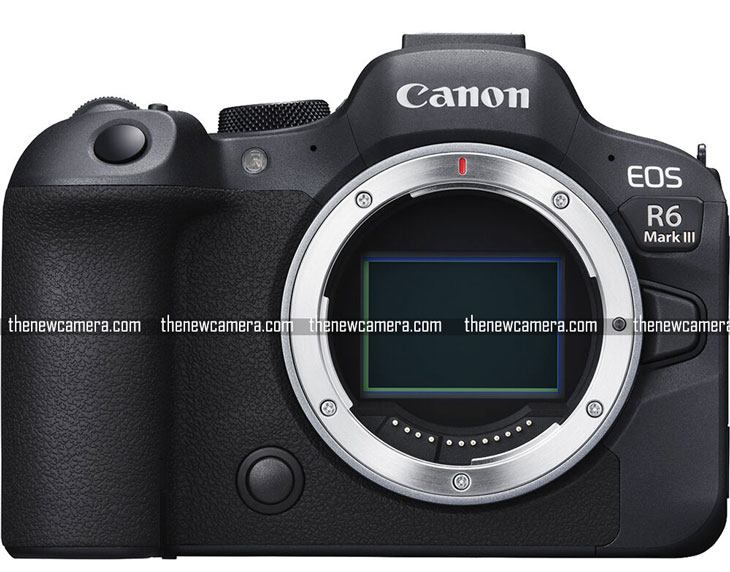
The Canon R6 Mark III camera price has now been announced, and all of us are waiting for its official announcement. But we can make a highly accurate estimate based on the pricing of previous models of the Canon R6 series camera, comparable offerings, and higher-end model prices right now.

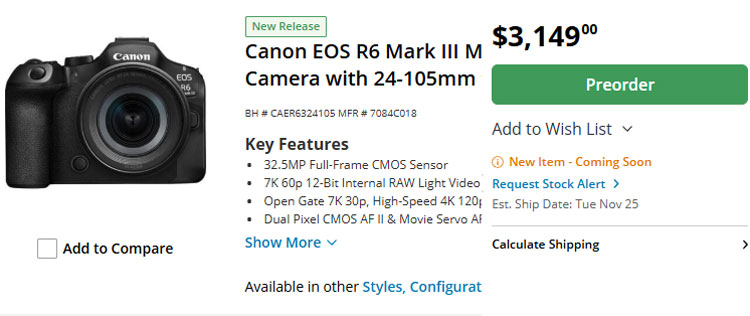
Pricing between the Canon R5 and the Canon R6 II
- Canon R6 Mark II was announced in November 2022 with a price tag of $2499 for the body only, confirmed by Canon USA. And the Canon R5 right now is being sold at $3199. Although the Canon R5 Mark II camera arrived at a much higher price range, that doesn’t matter here.
- The Canon R6 Mark III camera is coming with an approximately 30MP sensor, and its a big upgrade in the core specifications of the camera. But if Canon keeps its price above $3100 or even at $3000, then people will prefer getting a Canon R5 body with a much higher resolution sensor and a more premium body.
Canon Price increase pattern between models
If you look at the recent price increase pattern of Canon, then from the model Canon R5 to the Canon R5 Mark II, we have seen a $400 price increase between the models, and the R5 Mark II camera carries a stacked CMOS sensor and a massive update over its predecessor.
And if we Look at the competition right now: the Nikon Z6 Mark III camera arrived at a $2497 price tag, which features a 24.5 megapixel partially stacked CMOS sensor and 6K 60 FPS N-RAW recording capability. Similarly, the price of the Sony A7V is expected to be around $ 2,799-$ 3,000.
Canon R6 Mark II Price
Considering all these factors, we can confidently conclude that if the Canon R6 Mark III camera arrives with a 30- to 32-MP full-frame BSI sensor and professional-grade features, the expected price of the camera is $ 2,799 to $ 2,899.
That’s what we are expecting: a $400 price increase, which we have seen from the Canon R5 to the Canon R5 Mark II, keeping the market price of the Canon R6 Mark III camera competitive according to the competitors.
Canon R6 III Estimated Prices in USA, UK, EU, Japan, Canada, and India (2025)
Based on the updated U.S. price range of $2,799 to $2,899 and historical pricing trends for Canon cameras in various markets, we can estimate the R6 Mark III’s price in other countries. These estimates account for regional taxes, import duties, and currency exchange rates as of July 19, 2025, with the exchange rate for India specifically calculated using 1 USD = 86.19 INR. Note that actual prices may vary due to local market conditions and retailer pricing strategies.
| Country |
Estimated Price Range |
Notes |
| United States |
$2,799 – $2,899 |
Body only, excluding taxes, which vary by state |
| United Kingdom |
£2,750 – £2,850 |
Includes 20% VAT; based on R6 Mark II’s launch price of £2,499.99. |
| European Union |
€2,950 – €3,050 |
Includes 19-21% VAT; based on R6 Mark II’s launch price of ~€2,799.99. |
| Canada |
CAD 3,800 – CAD 3,950 |
Includes 5-13% taxes; based on R6 Mark II’s launch price of CAD 3,399.99. |
| Australia |
AUD 4,200 – AUD 4,350 |
Includes 10% GST; based on R6 Mark II’s launch price of ~AUD 3,999. |
| Japan |
¥390,000 – ¥405,000 |
Includes 10% consumption tax; based on R6 Mark II’s launch price of ~¥343,000. |
| India |
₹2,41,066 – ₹2,49,687 |
Includes 18% GST; calculated using 1 USD = 86.19 INR, based based on R6 Mark II’s launch price of ~₹2,25,999. |
Let us know your thoughts about the Canon R6 Mark 3 camera if it arrives at an approximate price. price of $7899, or would you prefer a different model or a camera from a different brand?
See More Posts Related to Canon R6 Mark III
Get LIVE RUMORS –> FACEBOOK | TWITTER | INSTAGRAM to get live Camera News + Canon rumors 24X7
By admin, on July 19th, 2025

BCN has published the best-selling cameras, lenses, and all the photography/videography-related stuff — brand names that topped the selling list in the first half of 2025. Before moving on to more details, let me explain what BCN is. BCN is the real sales data, which comes from around 40% of Japanese retailers that are part of the BCN chain of retail stores.
There is no big surprise that Sony returns to the number one spot in mirrorless cameras.
It’s nothing new — Sony was number one before in the mirrorless zone, as evidenced by previous records. And even this time, Sony is covering approximately 30.4% of the entire market share in the first half of 2025, which is not as good as it was in 2024, when it was approximately 35.8%, resulting in a visible drop of around 5%.
The top-selling Sony cameras in the first half of 2025 were:
Sony A7 IV, Sony ZV-E10, and Sony A7C Mark II in the Japanese market. Btw, we have created a guide of the TOP 20 Mirrorless Cameras of 2025, explore them to know our personal favorites camera.
Here is a simple and clear table showing the market share of Canon, Sony, and Tamron in their respective categories based on the BCN Awards 2025 (First Half):
| Brand |
Category |
Market Share (%) |
2024 Market Share (%) |
Change |
| Sony |
Mirrorless Cameras (Interchangeable) |
30.4% |
35.8% |
▼ 5.4% |
| Canon |
DSLR Cameras |
46.8% |
69.4% |
▼ 22.6% |
| Tamron |
Interchangeable Lenses |
21.8% |
17.5% |
▲ 4.3% |
Why are Japanese users preferring Sony mirrorless cameras over others?
Let’s conclude why they think Sony is better compared to others:
-
- Superior Autofocus – Real-time autofocus with outstanding eye-detection is extremely good in Sony cameras. That’s the number one reason why people prefer them over other brands.
- Versatile Lens Ecosystem – There are no limitations or locks. You’re free to use any lens. Sony’s E-mount is completely open since 2012.
- Compact & Powerful – Sony generally makes compact, powerful cameras, especially good for vlogging and cinematography. A big plus is their dedicated vlogging series (ZV series) — something other brands have failed to bring out effectively and are still lagging behind.
Canon Maintains DSLR Market Leadership
It’s a big surprise that Canon has officially declared they have stopped research and development of DSLRs, and most of their EF lens manufacturing units have stopped producing DSLR lenses.
Despite all these efforts to shift focus to mirrorless and intentionally reduce DSLR sales, Canon remains the number one DSLR brand in the first half of 2025 — covering approximately 46.8% of the market share.
However, that’s a sharp decline compared to 2024, when they had about 69.4% market share.
This is my personal note to Canon:
You should at least announce a proper successor to your most popular and reliable mid-range and flexible DSLR cameras. Cameras like Canon 200D Mark II, Canon 90D, and even the Canon 5D series badly need updates. People are still buying the older versions — especially photographers.
Tamron Surges as the Number One Interchangeable Lens Brand
That’s a big surprise — I’m personally a Sigma lover, and most of the lenses I own for my mirrorless system cameras are either native or made by Sigma. But let’s talk about the Tamron lenses that are the most popular:
- Tamron 35-150mm f/2-2.8
- Tamron 28-200mm f/2.8-5.6 Di III RXD
These two lenses are driving major sales for Tamron. Their market share jumped from 17.5% to 21.8%. Also, rebranded Tamron lenses made for Z-mount system cameras — like the 28-75mm f/2.8 — are also contributing heavily to their sales.
Kodak Leading in the Fixed-Lens Camera Market
This is a big setback for Canon. Canon was holding around 21.7% market share in the compact camera segment. But current stats say Kodak is now the most sold compact camera brand. Other popular fixed-lens cameras in Japan include the Fujifilm X100VI and the Leica D-Lux 8.
If you’re exploring the best superzoom cameras, we have already created a dedicated list of the best superzoom cameras of 2025 — you can check them now.
DJI Dominates Action and Video Camera Market
According to the same stats, DJI is the leading brand in the video camera market, covering around 45.2% of total sales. In the action camera category, they’re leading with 35.3% market share. GoPro was once the dominant player in action cameras, but now no one talks about them. Key products like the DJI Osmo Action 4 and DJI Pocket 3 are among the most popular in the first half of 2025.
Final Words
The BCN Awards 2025 (First Half) give us a clear snapshot of the most popular brands and what products people are actually buying right now.
I was also looking for Nikon’s sales stats, but unfortunately, I couldn’t find how much market share they captured in the first half of 2025.
If you have any information, feel free to comment below.
Upgrade your photography gear with TheNewCamera.com
We’ve created dedicated guides for the best mirrorless cameras, lenses, and all that you need to upgrade your gear — all based on deep analysis and years of experience.


By admin, on July 14th, 2025

Well, in Japan, Fuji is dominating the mirrorless market share as well as their Fuji X100VI compact dominating the June and July sales report. Now in the USA, it’s almost mid-July and if you are going to explore the sales ranking, Canon R50 holds the crown, and surprisingly, the next camera in the list is Canon R6 Mark II and you are not going to believe the third camera is Canon R100. So in the USA, Canon is more popular and in the top 3 we have all Canon cameras, and in 4th we have Sony’s A6400 camera, and in the fifth ranking we have the A6700. You can explore all the rankings below.
Top 5 Best-Selling Mirrorless Cameras on Amazon for July 2025
1. Canon EOS R50 Mirrorless Camera (RF-S18-45mm F4.5-6.3 IS STM Lens Kit)
2. Canon R6 Mark II (Body Only)
3. Canon EOS R100 (RF-S18-45mm F4.5-6.3 IS STM Lens Kit)
4. Sony Alpha a6400 (16-50mm Lens)
5. Sony Alpha 6700 (Body Only)
6. Canon EOS RP (RF24-105mm F4-7.1 IS STM Lens Kit)
7. Sony a7 III (28-70mm Lens)
8. Panasonic Lumix G7 (14-42mm and 45-150mm Lenses)
9. Canon EOS R8 (Body Only)
10. Sony Alpha ZV-E10 II (16-50mm Lens)
Why this camera stands out in July 2025
Canon camera dominance can be clearly seen in the top three spots, so it is very clear that these cameras appeal to both beginner photographers and professional shooters. Sony A6400 is still in the list, that’s a really big surprise. Apart from this, Panasonic G7 remains the best budget mirrorless M4/3 camera. I will request Panasonic to at least introduce autofocus in the same price range — it would be great, and they will continue to keep the dominance for the next 5 to 7 years. Other than that, we also have A6700 and ZV-E10, but surprisingly, Nikon seems to be a bit less popular in the USA as of now, specifically in July.
By admin, on July 11th, 2025

Canon listened to their customers, and they are the first camera makers to add password protection to their cameras. Recently, Canon has announced a significant firmware update introducing a password protection feature. This particular improvement enhances the security for photographers and videographers. Having a password-protected camera ensures that your camera is safe.
This feature is highly useful for wedding and travel photographers since most of them suffer from gear theft issues. But how will the thieves know the camera gear is password protected? For now, since this is a very new update, we have to paste stickers on our camera bags saying the cameras inside these bags are password protected.
Canon’s commitment to security
Since the feature has been introduced by the Canon R&D team after intensive research, to enhance overall security, it completely prevents unauthorized access to the settings of the camera or any data.
Why Password Protection Matters
-
Data Security: Prevents unauthorized access to images, videos, and camera settings.
-
Theft Deterrence: Adds a Firewall of protection, making stolen cameras completely unusable
Canon Camera Models Eligible for Password Protection Update
The firmware update applies to the following 10 Canon camera models. The best part is they have also covered the most used DSLRs of all time, as well as compact cameras too
- Canon EOS R5
- Canon EOS R6
- Canon EOS R3
- Canon EOS R7
- Canon EOS R10
- Canon EOS 1D X Mark III
- Canon EOS 5D Mark IV
- Canon EOS 6D Mark II
- Canon EOS 90D
- Canon PowerShot G7 X Mark III
These models span Canon’s mirrorless and DSLR lines, ensuring broad compatibility for users across different genres, including portrait photography, wildlife photography, and vlogging.
How does the password protection feature work in Canon cameras?
The new firmware introduces a lock screen mechanism that we generally see on our smartphones. It requires a user-defined password that you can easily remember all the time. So it should be a kind of number that you usually remember, like your date of birth or phone number — something very similar to that. But don’t keep it too easy so others can unlock it. Take a look at the key specs of the feature.
Take a look at the process invloved

- Enter a 6-digit number to set a password , and then press the < MENU > button.
- Next step: Select [OK]

- Enter your password again
- Select [OK] to set the password.
- When you turn on the camera or when it recovers from auto power off, the [Password] screen will be displayed. Enter the password you set.
- If you check “Don’t ask again,” this screen will not be displayed next time.
Features of Canon Paseord protect mode
- Customizable Passwords: Users can set a unique password multiple times.
- Quick Access: Setting up a password and unlocking it is a very easy process
How to activate the password protection 🛡️ in Canon cameras?
To activate the password protection feature, a user must download and install the free firmware update available on the Canon website. You have to first check whether your model is eligible for the update. The list of eligible models has already been mentioned in the post. The entire update process is so smooth, you won’t find any issues in updating your firmware.
What are the benefits or advantages for photographers and videographers?
This update is really a game-changer, and Canon is the first camera maker to introduce such a feature. Let’s find out why it’s a game-changer for your camera.
How to Update Your Canon Camera
To take advantage of this new feature, follow these steps:
- Visit Canon’s Official Website: Navigate to the support section and locate the firmware update for your camera model.
- Download the Firmware: Ensure you select the correct version compatible with your camera.
- Install the Update: Follow Canon’s step-by-step guide to install the firmware via a memory card or USB connection.
- Set Up Password Protection: Once updated, access the camera’s menu to configure your password.
For detailed instructions, check Canon’s support page or consult your camera’s user manual.
This particular update demonstrates Canon’s commitment towards addressing user-specific needs in this digital age by enhancing security without additional cost or any hardware requirement. Canon has shown its most generous sign of supporting users from the core of their hearts without putting any burden on their pockets. This update enhances the overall security of Canon system cameras, making them a top choice for professional photographers looking for reliability and peace of mind.
NOTE: The feature will likely be available for download on July 17, 2025.
Stay Updated with TheNewCamera.com
At TheNewCamera.com, we’re dedicated to keeping you informed about the latest camera news. The article “Canon Adds Password Protection to 10 cameras for Enhanced Security” by thenewcamera.com team on 12:50 pm, Friday, 11 July 2025, Greenwich Mean Time (GMT) | Follow us on our social pages FACEBOOK | TWITTER | INSTAGRAM to get live Camera News + Canon Rumors 24X7.
By admin, on July 11th, 2025
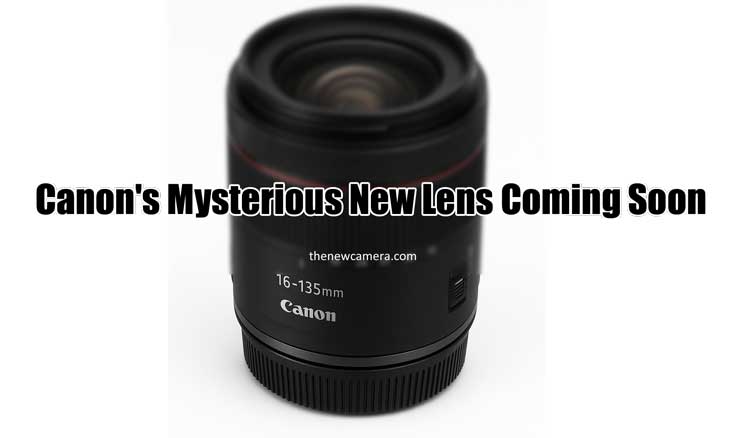
According to the latest rumours coming out from the rumour mill, Canon is about to announce a lens that never existed before. That’s really kind of very tricky information. But yes, it is very interesting since they are talking about a lens which covers a focal length of approx 16 to 135mm, and it’s not an L-series or a white lens that comes with a hefty price tag. to good to be true, I love to have such a range in budget.
So if the information is true, then we will have a budget, ultra-coverage lens for full-frame cameras — highly useful for travel shooters and wedding photographers.
We do know that Canon is fully prepared to announce two of their cameras in late August, and recently, they have done one more registration in the wireless certification agency that confirms a third camera for late November or December, or maybe the very beginning months of 2026. So, let’s hope for the best — if any update arrives, going to update you very soon.
Stay Updated with TheNewCamera.com
At TheNewCamera.com, we’re dedicated to keeping you informed about the latest camera news. The article “Canon’s Mysterious New Lens Coming Soon” by thenewcamera.com team posted on 10:48 am, Friday, 11 July 2025, Greenwich Mean Time (GMT) | Follow us on our social pages FACEBOOK | TWITTER | INSTAGRAM to get live Camera News + Canon Rumors 24X7.
source / credit of information: canonrumor.com
By admin, on July 10th, 2025

The Canon RF 75-300mm lens is now available for pre-order, with shipping starting from July 29. The best thing about this lens is its price, available at $219 only. Therefore, within this price range, no other lens offers such a wide reach. And again, the best part of the lens is that it is made for full-frame cameras. So, if you are using an APS-C body, with the help of crop factor, you will get extra reach.
Optics are usable, but not as great as we usually see in Canon’s lenses. However, at this price point, expecting high-grade optical performance from this lens is not realistic. At 75mm, the lens performs exceptionally well; however, as you zoom in to 300mm, the optical performance begins to degrade slightly. So this is the sort of lens we have, and it is just a mirrorless version of the ultra-popular 75-300mm DSLR lens.
Get the Canon 75-300mm Lens from the B&H Store
Follow us on our social pages FACEBOOK | TWITTER | INSTAGRAM to get live Camera News + Canon Rumors 24X7.
|
KEEP THIS BLOG ALIVE - Support New Camera Buy Canon Lenses, Buy Music CD or Digital Camera at amazon it helps this site, and you do not pay anything extra, it is just a way to help support this site.

|