Join More Than 50,000+ Subscribers and get latest camera news and rumors
NEW CAMERA VIDEOS ON YOUTUBE
|
By admin, on July 12th, 2025

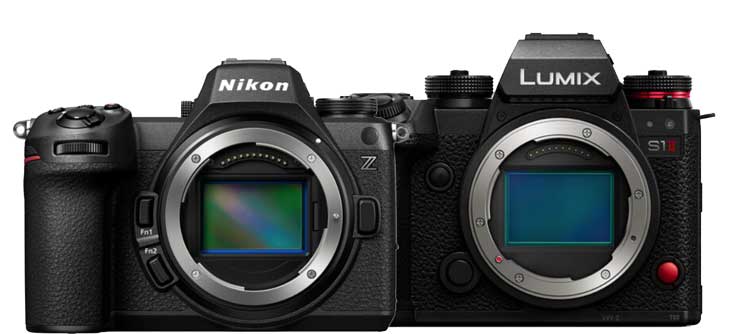
Panasonic Lumix S1 II vs. Nikon Z6 III – Which One Is the Best Camera for Photo and Video? Let’s explore which one is the Best Camera for you. Here is the verdict / quick recommendation whcihexplained in the later part of the video
Choose Nikon Z6 III for:
- For Photography, Nikon Z6 III is more recommended
- For 4K vlogging, travel, and run-and-gun videography, the Nikon Z6 Mark III is highly recommended
- Excellent for recording slow-mo video, starting from Full HD 240 FPS and 4K up to 120 FPS
- Projects prioritizing sharp 4K footage and high frame rates.
Choose Panasonic Lumix S1 II for:
- 6K cinematic video with Open Gate and ARRI LogC3 for High-End post-production flexibility.
- 6K documentary, When you actually need the 6K quality, Panasonic S1 II is more recommended
- for thermal management, built-in FAN, and advanced 32 BIT audio.
- Anamorphic in-camera De Squeez Frame.io integration.

| Feature |
Nikon Z6 Mark III |
Panasonic S1 II |
| Lens Mount |
Nikon Z |
L-Mount |
| Dimensions (W x H x D) |
5.5 x 4 x 2.9″ (138.5 x 101.5 x 74 mm) |
5.29 x 4.03 x 3.61″ (134.37 x 102.36 x 91.69 mm) |
| Weight |
23.6 oz / 670 g (Body Only) |
1.58 lb / 717 g (Body Only), 1.76 lb / 798 g (With Battery, Media) |
| Battery |
EN-EL15c Rechargeable Lithium-Ion (~360 shots) |
Rechargeable Lithium-Ion, 7.2 VDC, 2200 mAh |
| Operating Conditions |
32 to 104°F / 0 to 40°C, up to 85% Humidity |
14 to 104°F / -10 to 40°C, 10 to 80% Humidity |
| Media/Memory Card Slot |
Slot 1: CFexpress Type B / XQD, Slot 2: SD/SDHC/SDXC (UHS-II) |
Slot 1: CFexpress Type B, Slot 2: SD/SDHC/SDXC |
| Wireless |
2.4 / 5 GHz Wi-Fi 5 (802.11ac), Bluetooth 5.0 |
5 GHz Wi-Fi 5 (802.11ac) |
| Mobile App |
Nikon Imaging Cloud (Android/iOS, file access, firmware updates) |
Lumix Lab (Android/iOS) |
| Monitor |
3.2″, 2,100,000 Dot, Articulating Touchscreen LCD, Top Status Display |
3″, 1,840,000 Dot, Free-Angle Tilting Touchscreen LCD |
| Viewfinder |
Electronic, 0.5″, 5,760,000 Dot, 0.8x Magnification, -4 to +2 Diopter |
Electronic (OLED), 5,760,000 Dot, 0.78x Magnification, -4 to +2 Diopter |
| Video I/O |
1x HDMI Output |
1x HDMI Output |
| Audio I/O |
1x 3.5 mm TRS Stereo Headphone Output, 1x 3.5 mm TRS Stereo Microphone Input |
1x 3.5 mm TRS Stereo Headphone Output, 1x 3.5 mm TRS Stereo Microphone Input |
| Power I/O |
1x USB-C Input |
1x USB-C Input |
| Other I/O |
1x Nikon DC2 Data Input, 1x USB-C Data Output (Shared with Power Input) |
1x USB-C Data Output (Shared with Power Input) |
Still image comparison between Panasonic S1 Mark II, Nikon Z6 Mark III in JPEG mode – Image quality-wise, the Nikon Z6 Mark 3 camera can capture with more detail compared to the Panasonic S1 Mark II, and even considering the price and AI autofocus mode, the best investment should be the Nikon Z6 Mark 3.

Video Core Specification Comparison
| Feature |
Nikon Z6 III |
Panasonic Lumix S1 II |
| Max Video Resolution |
6K (6048 x 3402) @ 60p (RAW) |
6K (5952 x 3968) @ 29.97p, 5.1K (5088 x 3392) @ 60p (Open Gate) |
| 4K Frame Rates |
4K UHD (3840 x 2160) @ 120p |
4K (3840 x 2160) @ 119.88p, C4K (4096 x 2160) @ 119.88p |
| Slow Motion |
Full HD (1920 x 1080) @ 240p |
Full HD (1920 x 1080) @ 239.76p |
| RAW Recording |
N-RAW, ProRes RAW HQ (12-bit) |
Apple ProRes RAW (10-bit) |
| Compression Options |
ProRes 422 HQ (10-bit), H.265/HEVC, H.264/AVC (8/10-bit) |
Apple ProRes, H.264/MPEG-4 AVC, H.265/HEVC, HEIF (10-bit) |
| Log Recording |
N-Log, HDR (HLG) |
V-Log, ARRI LogC3 (with DMW-SFU3A upgrade) |
| Audio |
Linear PCM (48 KHz, 24-bit), AAC (48 KHz, 16-bit), 3.5mm mic/headphone |
LPCM (48/96 KHz, 24/32-bit), AAC (48 KHz, 16-bit), XLR via DMW-XLR2 |
| Max Recording Time |
2 hours 5 minutes |
Not specified (internal fan for extended recording) |
| Stabilization |
5-axis IBIS (8 stops) |
5-axis IBIS (8 stops), Active I.S., cropless mode |
| Additional Features |
Waveform, focus peaking, zebra, time code, e-VR, dual-format proxy |
Real Time LUT, Frame.io C2C, anamorphic desqueeze, full HDMI output |
| Weight |
1.5 lbs (675 g) |
1.76 lbs (800 g) |
| Dimensions |
5.47 x 4.02 x 2.91 in |
5.28 x 4.04 x 3.63 in |
Nikon Z6 Mark 3 and Panasonic S1 Mark II camera – Which is best for your videographic needs?

Nikon Z6 III captures more details in a video clip compared to the Panasonic S1 II
Based on videographic requirements, which camera is the best one for you? The Nikon Z6 Mark 3 camera delivers excellent 4K video quality, and the details are very sharp. You can also see the samples that have been attached to this page. The 4K details captured by the Nikon Z6 III are remarkably sharp. Panasonic Lumix S1 Mark II camera 4k samples, doesn’t carry that many details that which we can notice in the Nikon Z6 III camera.
What users are saying, those who have both the camera

The Nikon Z6 Mark 3 camera can capture 4K videos up to 120 frames per second, so that’s the best option we have if you wish to capture high-quality dance moves or action sequences in slow motion. The Nikon Z6 Mark 3 camera also offers the latest Nikon RED LUTs to put a cinematic feel inside your camera. The camera also offers waveform functionality and timecode support.
Why should you buy the Nikon Z6 Mark 3? If you are a content creator, travel blogger, street filmmaker, or even wedding cinematographer, and your requirement is limited to 4K video recording, then of course, the Nikon Z6 Mark 3 is more recommended for you.

At first, we were also confused when we saw the samples, since the Z6 III details are less compared to the Nikon Z6 III at 6K mode., but keep in mind since Nikon has unlocked the RAW mode of the camera, and the samples are clipped from RAW files not the in-camera processed mp4 that’s why the details visually less compared to the Panasonoc processed 6k MP4 file.

In 5k mode, when both are set at H.265, 10 bit, then as you can see, the Nikon Z6 III renders more details compared to the Panasonic S1 II camera.
Panasonic S1 Mark II Lacks RAW 6K Recording
The big problem with the Panasonic S1 Mark II camera is no RAW video recording mode is available at 6K and that creates a big confusion while comparing the clips of the camera that the S1 Mark II is generating a higher amount of detail, but the fact is the Z6 Mark III camera is giving us complete RAW footage, that’s why the details are soft in the initial inspection that can create confusion to any of us.
5K Comparison Shows Nikon Z6 III Advantage
But again, in 5K video recording mode, when you compare both the files or the clips of the camera, where none of them are recording in RAW format, then you can clearly see that Z6 Mark III camera details are much clearer.
Nikon Z6 III Offers 6K 60fps and 4K 120fps – But Misses Key Features
And since only the Nikon Z6 III camera is able to give us exclusively 6K 60 fps mode as well as 4K 120 fps mode, what we are missing inside the Z6 III is the anamorphic de-squeeze function as well as 32-bit float audio.
Which One Should You Buy – Final Recommendation
So to be very clear, for photography purposes, Nikon Z6 Mark III camera is the best option. Other than that, in videography purposes, if you’re going to shoot in anamorphic lenses and you have to use the in-camera de-squeeze functionality as well as you’re connected to post-production and your requirement is actually 32-bit float audio, in this specific scenario I am going to recommend you Panasonic S1 Mark II camera. Otherwise, Nikon Z6 Mark III is the best camera available at a lesser price and you should go with that camera.
Best camera for high-quality slow-motion video
Nikon Z6 Mark 3 is the straightforward answer. With this camera, you can record high-quality Full HD videos up to 240 frames per second. You can use it later in 10x slow-motion mode, delivering ultra-smooth, super slow-motion footage for a cinematic look. Other than that, the camera also offers 4K video recording up to 120 frames per second. So again, you are getting an option to record high-quality slow-motion footage—although you have to face a crop while recording at 120 FPS, but at least you get the option.
There is no such option present in the Panasonic S1 Mark II. It has advantages in its 6K mode, but yes—even in the 6K mode—it’s missing the 60fps frame rate which the Z6 Mark 3 is able to deliver.
Best camera for higher resolution Video
Please note, the Panasonic S1 Mark II does not offer RAW recording in 6K, whereas the Nikon Z6 Mark III offers full 6K RAW video, which gives more flexibility in post-production even if initial clips may look softer.
The Nikon Z6 Mark III offers 6K 60fps and 4K 120fps with internal RAW, but lacks 32-bit float audio and anamorphic de-squeeze support, making the S1 Mark II still a better choice if audio and anamorphic workflows are a priority.
Verdict – Best Camera for You
Choose Nikon Z6 III for:
- For Photography, Nikon Z6 III is more recommended
- For 6k 60FPS / NRAW video Nikon Z6 III
- For 4K vlogging, travel, and run-and-gun videography, the Nikon Z6 Mark III is highly recommended
- Excellent for recording slow-mo video, starting from Full HD 240 FPS and 4K up to 120 FPS
- Projects prioritizing sharp 4K footage and high frame rates.
Choose Panasonic Lumix S1 II for:
- 6K cinematic video with Open Gate and ARRI LogC3 + 32-bit Audio
- for thermal management, built-in FAN, and advanced 32 BIT audio.
- Anamorphic in-camera De Squeez Frame.io integration.
Stay Updated with TheNewCamera.com
At TheNewCamera.com, we’re dedicated to keeping you informed about the latest camera news. The article “Panasonic Lumix S1 II vs. Nikon Z6 III – Which one is the Best Camera for Photo and Video?” by thenewcamera.com team on 9:04 am Saturday, 12 July 2025 Greenwich Mean Time (GMT) | Follow us on our social pages FACEBOOK | TWITTER | INSTAGRAM to get live Camera News + Canon Rumors 24X7.
Credit Image Dpreview.com
By admin, on May 30th, 2025
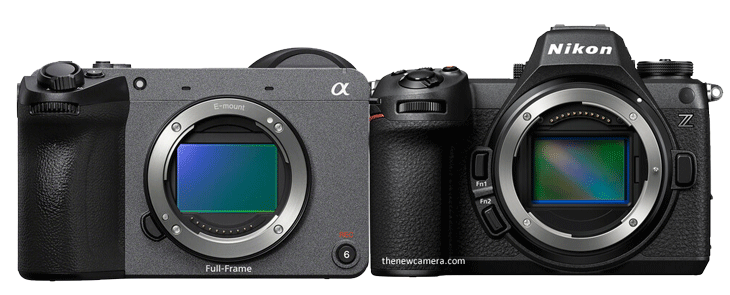
Sony FX2 versus the Nikon Z6 Mark III camera, let’s explore the differences between the two point by point
The Nikon Z6 Mark III camera is slightly larger, with a photography-friendly body and controls. The Sony FX2 does have a deep hand grip, but it has a somewhat boxy design. The thing that makes a big difference between the two, specifically in the design part, is that Sony is made for cinematography purposes and carries a lot of tripod threads all over the body to mount it perfectly in cinema rigs. The other advantage we have with the Sony FX2 camera is the moving viewfinder.
Nikon Z6 III and the Sony FX2 — both of them support dual card slots, one dedicated for CFexpress and one SD card slot. The Nikon Z6 Mark III monitor is slightly larger and of higher resolution, so users may experience better LCD quality with the Z6 Mark III camera. At the very same time, the electronic viewfinder is also a 5.76 million-dot unit compared to a 3.6 million-dot electronic viewfinder in Sony, but yeah, we are getting better display units in the Nikon Z6 Mark III.
The wireless functionality of the two is almost the same, but Nikon does have GPS support via smartphone to enable geotagging functionality for travel purposes, documentary work, or maybe for photojournalism purposes. The FX Mark 2 camera misses out. Although the humidity tolerance and the weatherproof criteria of both cameras match each other, so we literally do have almost the same build quality in both cameras.
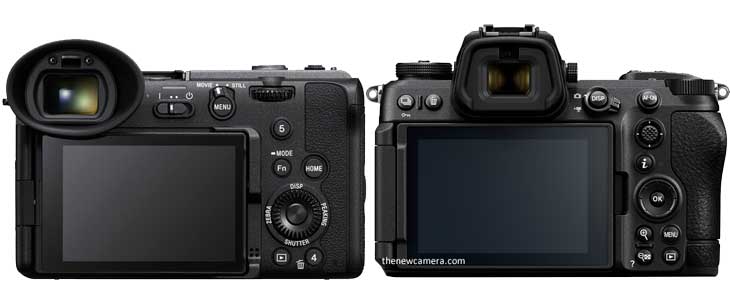
Design Comparison
| Feature |
Sony FX2 |
Nikon Z6 III |
| Lens Mount |
Sony E |
Nikon Z |
| Material of Construction |
Magnesium Alloy |
Magnesium Alloy |
| Dimensions (W x H x D) |
5.1 x 4.1 x 3.1″ / 129.7 x 103.7 x 77.8 mm |
5.5 x 4 x 2.9″ / 138.5 x 101.5 x 74 mm |
| Weight |
1.3 lb / 594 g (Body Only), 1.5 lb / 679 g (With Battery, Recording Media) |
23.6 oz / 670 g (Body Only) |
| Shoe Mount |
1x Intelligent Hot Shoe |
1x Hot Shoe |
| Tripod Mounting Thread |
2x 1/4″-20 Female (Bottom) |
1x 1/4″-20 Female (Bottom) |
| Accessory Mounting Thread |
3x 1/4″-20 on Camera Body |
Not specified |
| Operating Conditions |
32 to 104°F / 0 to 40°C |
32 to 104°F / 0 to 40°C up to 85% Humidity |
| Media/Memory Card Slot |
Slot 1: CFexpress Type A / SD (UHS-II)
Slot 2: SD/SDHC/SDXC (UHS-II) |
Slot 1: CFexpress Type B / XQD
Slot 2: SD/SDHC/SDXC (UHS-II) |
| Wireless |
2.4 GHz Bluetooth 5.0, 2.4 / 5 GHz Wi-Fi (802.11a/b/g/n/ac) |
2.4 / 5 GHz Wi-Fi 5 (802.11ac), Bluetooth 5.0 |
| Mobile App Compatible |
Yes: Android & iOS (Sony |
Creators’ App |
| Global Positioning |
No |
GPS (via Connected Smartphone) |
| Monitor |
3″ Tilting Touchscreen LCD, 1,036,800 Dot |
3.2″ Articulating Touchscreen LCD, 2,100,000 Dot |
| Viewfinder |
Electronic (OLED), 3,686,400 Dot / Titling EVF |
Electronic, 5,760,000 Dot, 0.5″ |
Best Camera for Photographers
Sony FX2 camera offers higher resolution at 33 megapixels, but at the very same time, the Nikon Z6 Mark 3 camera offers 24.5 megapixel resolution, which is of course limited. But if you talk about sensor architecture, then the Nikon Z6 Mark 3 camera is using a partially stacked CMOS sensor.
Video Recording: Nikon Z6 III Excels
Of course, the Sony FX2 camera is able to create highly detailed 4K 30fps footage from a 7K oversampled file. At the very same time, when you are recording videos at 4K 60 frames per second or 4K 120 frames per second with the Nikon Z6 Mark 3 camera—and of course, to be noted—4K 120 FPS is not possible with the Sony FX2 despite being in a higher price range. Other than that, even when you are trying to record 4K @ 60 frames per second, at that time you have to face a 1.5x crop in the Sony FX2. So with the FX2, we have limitations attached in the higher frame rate, and 4K 120 is not possible.
Continuous Shooting Speed Comparison
The same advantage we also get in the continuous shooting speed of the camera, where we are able to get up to 20 FPS RAW, and up to 60 frames per second in full resolution, and up to 120 frames per second in the DX crop mode. Thankfully, the Sony FX2 camera is using a mechanical shutter, but despite that, the continuous shooting speed of the camera remains limited to 11 frames per second.
Autofocus: Sony FX2’s Precision
When you dive into autofocus performance, each system really brings something different to the table. Sony’s FX2 boasts a whopping 759 phase-detection points (compared with Nikon’s 299 “hybrid” points), which means it can lock onto—and keep track of—moving subjects across with Sony’s famous AI AF. That’s a huge advantage when you’re shooting fast-paced street scenes or busy event coverage.
Nikon Z6 III’s Low-Light Autofocus
On the other hand, Nikon’s autofocus shines in low-light situations. With a sensitivity down to –10 EV (versus Sony’s 4 EV), the Z6 III can find and focus on subjects in near-darkness—perfect for late-night cityscapes, dimly lit weddings, or cozy indoor gatherings.
Autofocus Tracking: Nikon Closing the Gap
Recent reviews peg the Z6 III’s subject recognition and tracking as nearly on par with Sony’s vaunted system, so you’re not really “giving up” much by choosing Nikon—especially if you need that extra push in challenging light. Still, many pros continue to call Sony the gold standard for sheer reliability, so it really comes down to what kind of shooting you do most often.
Image Stabilization: Nikon’s Edge
Sensor-shift image stabilization of the Nikon Z6 Mark 3 is more helpful, since you can link your autofocus point with the VR system of the camera, and you will be getting a true 7.5 stops of stabilization all the time, even if you are focusing in the corner of the frame. Sony’s Active Image Stabilization is highly effective in video mode, but when you are talking about stills, it’s the traditional-style IBIS system we are getting.
Why Choose Nikon Z6 III for Pros
Nikon Z6 Mark III camera, due to its partially stacked CMOS sensor and Expeed 7 image processor, the autofocus calculation is being done at the rate of 120 frames per second in-camera. So the autofocus and the auto exposure refresh rate is actually 120 FPS. And due to the introduction of a new artificially intelligent autofocus algorithm inside the camera, the overall photographic experience is now elevated to the next level.
So if you are a professional photographer, then the Nikon Z6 Mark 3 will be a perfect choice for your requirements.
Photographic Features Compared
| Feature |
Sony FX2 |
Nikon Z6 III |
| Sensor Resolution |
Actual: 34.1 MP, Effective: 33 MP |
Actual: 26.79 MP, Effective: 24.5 MP (6048 x 4032) |
| Image Sensor |
35.9 x 23.9 mm (Full-Frame) CMOS |
35.9 x 23.9 mm (Full-Frame) Partially Stacked CMOS |
| Image Stabilization |
Sensor-Shift, 5-Axis, Active IS |
Sensor-Shift, 5-Axis, AF points can be linked to VR |
| ISO Sensitivity |
Native 100-51,200 (50-204,800 Extended) |
Photo: Native 100-64,000 (50-204,800 Extended) |
| Shutter Type |
Mechanical Focal Plane and Electronic Rolling Shutter |
Mechanical Focal Plane and Electronic Rolling Shutter |
| Shutter Speed |
1/8000 to 30 Seconds (Photo) |
1/8000 to 15 Minutes (Mechanical), 1/16000 to 15 Minutes (Electronic) |
| Continuous Shooting |
Not specified in the provided data (10 fps per web sources) |
Up to 20 fps at Maximum Resolution |
| Autofocus Points |
Photo: Phase Detection: 759 |
Photo, Video: Contrast Detection, Phase Detection: 299 |
| Autofocus Sensitivity |
4 to +20 EV |
-10 to +18 EV |
| White Balance |
2500 to 9900K |
2500 to 10,000K, Presets: Auto, Cloudy, Color Temperature, Direct Sunlight, Flash, Fluorescent, Incandescent, Shade |
| Image File Format |
Not specified (JPEG, Raw per web sources) |
HEIF, JPEG, Raw |
| Bit Depth |
Not specified (14-bit per web sources) |
14-Bit |
Best Camera for Video
When it comes to video, the Z6 III feels like a powerhouse that’s ready to stretch your creativity. Imagine being able to capture in gorgeous ProRes RAW—right inside the camera—at up to 6K/60p. With the help of the stacked CMOS sensor, the camera can record 6K 60fps videos. Despite being a consumer hybrid mirrorless camera, the Nikon Z6 Mark III is able to deliver 6K resolution, that is really a big surprise.
That means you’ve got room to push and pull your colors, tweak contrast, and hold onto every bit of shadow and highlight detail without worrying about external recorders or cables.
Nikon Z6 Mark III Slow-Motion Capabilities
And if you need silky-smooth slow-mo or a little extra resolution, you can jump into uncropped 4K/120p or even 1080p/240p modes. While shooting 4K 120 frames per second, you have to face a 1.5x DX crop, and when you are shooting 4K @ 60 frames per second, there is a negligible amount of crop, which remains unnoticeable.
Sony FX2 Video Features
Sony’s FX2 isn’t slouching, though. It delivers clean, 10-bit H.264/H.265 internally and will give you oversampled 4K/30p for sharp, detailed footage. If you really need that ProRes RAW goodness, you can use an external recorder via HDMI—but that means more gear hanging off your rig. And when you want to push the frame rate higher in 4K—meaning if you want to record your 4K videos at 60 frames per second—you have to face a 1.5x crop, and there is no 120 frames per second option available in the Sony FX2 while recording 4K videos.
Sony FX2 Live-Streaming Advantages
Where Sony shines is in its live-streaming chops: built-in RTMP/RTMPS and SRT support make it a dream camera for one-person streaming setups, whereas the Z6 III leaves you hunting for a separate encoder. Both cameras give you flexible picture profiles—N-Log on Nikon holds up beautifully alongside Sony’s S-Log 3 and S-Cinetone—but in professional circles, S-Log and Cinetone have built a bit more of a buzz.
Audio and Rolling Shutter Comparison
Don’t forget audio: both record in 24-bit LPCM, but Sony’s extra channels give you more mics or ambient tracks to play with. And if rolling shutter is a worry, Nikon’s stacked sensor really pulls ahead—its readout is faster, so you’ll see far less “jello” when you whip the camera side-to-side at 4K/60p or 120p.
Nikon Z6 III vs. Sony FX2: Which to Choose?
In short, if you’re a solo shooter who loves to color-grade, chase cinematic slow-mo, and keep your rig light, the Z6 III’s internal RAW and high-speed modes deliver. If you’re streaming live, mixing multiple audio sources, or don’t mind an external recorder for 16-bit RAW, the FX2’s built-in streaming and flexible codecs have you covered.
Video Comparison
| Feature |
Sony FX2 |
Nikon Z6 III |
| RAW |
16 BIT via HDMI |
12 Bit internally |
| MAX RES. |
4K 60p |
6K 60p N-RAW, 6K 30p ProRes RAW |
| Internal Recording Modes |
H.264/H.265 8/10-Bit:
UHD 4K (3840 x 2160) at 23.98/25/29.97/50/59.94 fps
DCI 4K (4096 x 2160) at 23.98/24/25/29.97/50/59.94 fps
|
ProRes RAW/ProRes RAW HQ/Raw: 6048 x 3404 at 23.98/25/29.97/50/59.94 fps
4032 x 2268 at 23.98/25/29.97/50/59.94 fps 3984 x 2240 at 23.98/25/29.97/50/59.94/100/120 fps
UHD 4K (3840 x 2160) at 23.98/25/29.97/50/59.94/100/120 fps
|
| Format and codes |
16 Bit RAW, 10-Bit 4:2:2 XAVC S-I |
12 Bit RAW, |
| 4k 60 FPS |
Yes, 1.5X Crop |
Yes, No crop at 4k 60FPS |
| 4K 120 FPS |
No |
Yes, 1.5X Crop |
| External Recording Modes |
4:2:2 8/10-Bit via HDMI:
DCI 4K (4096 x 2160)
UHD 4K (3840 x 2160)
HD (1920 x 1080)
Raw 16-Bit: 4672 x 2628 |
HDMI: UHD 4K (3840 x 2160) |
Dual Native ISO
|
Dual Base 800/4000 |
Dual Native ISO 800 |
| Built-in Fan |
Yes |
No |
| Video IS |
Very effective / Active IS + Gyro |
Mechanical IBIS + EVR |
| Fast-/Slow-Motion Support |
Yes |
Slow-Motion Only |
| Gamma Curve |
HDR-HLG, Rec709, S Cinetone, Sony S-Log 3, Standard |
HDR-HLG, Nikon N-Log |
| Anomorphic Lenses support |
Yes |
No |
| Audio Recording |
2/4-Channel 24-Bit 48 kHz LPCM
2-Channel 16-Bit 48 kHz LPCM |
16-Bit 48 kHz AAC Audio
2-Channel 24-Bit 48 kHz LPCM Audio |
| IP Streaming |
RTMP, RTMPS, SRT: 1280 x 720 to 3840 x 2160 at 25p, 29.97p, 50p, 59.94p |
No |
Buy Nikon Z6 Mark III from Amazon.com | B&H Camera store
Buy Sony FX2 From B&H Store
also see
Which one is the Best Camera for Recording Video – Panasonic Lumix S1 II vs. Nikon Z6 III?
Best Lenses for Nikon Z6 III
By admin, on June 17th, 2024
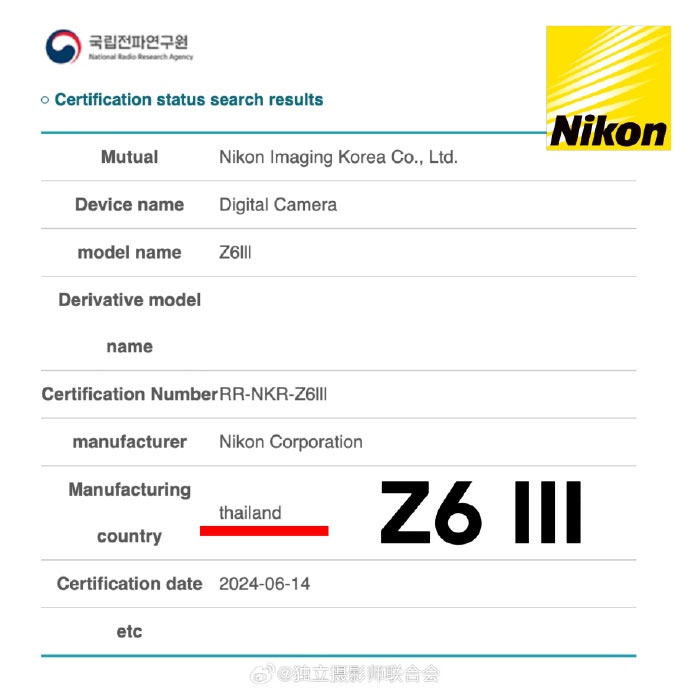
Nikon Z6 Mark III camera registration details surfaced over the web, as you can see in the registration the Nikon Z6 Mark III camera is made in Thailand. The Announcement of the camera is about to happen today and the pre-order links will also become active
Nikon Z6 Mark III – B&H Store
All about Nikon Z6 Mark III here
Also see – Nikon’s Lens Empire Expands: Sendai Factory’s Mega Investment!
Follow us on our social pages FACEBOOK | TWITTER | INSTAGRAM to get live news + Nikon Rumors 24X7.
By admin, on June 6th, 2024
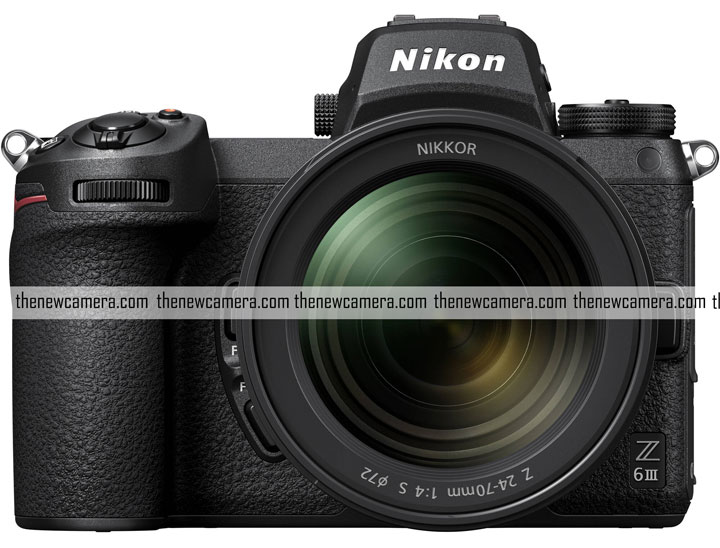
Nikon Z6 Mark 3 camera has been announced and without a doubt it is one of the most advanced mid-range full-frame mirrorless cameras in its category with a BSI stacked CMOS sensor and AI autofocus. Let’s explore the specifications of the Nikon Z6 Mark 3 camera in detail.
Key Specifications
Sensor and Processor
- 24.5MP Partially Stacked CMOS Sensor: According to Nikon, it features 3.5x faster readout than the Nikon Z6 II
- EXPEED 7 Processor: Powers 6K 60 FPS video
Video Capabilities
- 6K RAW Recording: 6K/60p (N-RAW), 6K/30p (ProRes RAW HQ, 12-bit) for cinematic flexibility.
- 4K and Full HD: 4K/120p (1.5x crop) and Full HD/240p for 10x slow motion.
- Codecs: 10-bit ProRes 422 HQ, H.265/H.264, with log profiles for grading.
- Recording Time: Up to 125 minutes in 4K/60p.
- Connectivity: HDMI output, headphone/mic ports for professional workflows.
Stills Performance
Photographers benefit from:
- Burst Shooting: 120fps JPEG (10MP, DX mode), 60fps JPEG (24MP, full-frame), 20fps RAW (electronic), 14fps (mechanical).
- Pre-Release Capture: Buffers 1 second before shutter press, ideal for wildlife or sports.
- Formats: HEIF, JPEG, 14-bit RAW for rich detail.
Autofocus and Stabilization
- AF System: 9-subject detection (people, animals, vehicles) down to -10EV, inherited from Z8/Z9.
- 8-Stop IBIS: Ensures sharp images and steady video, even handheld.
Viewfinder and Display
- EVF: 4000-nit, 5760k-dot, 120fps refresh rate with DCI-P3 color gamut.
- LCD: 3.2-inch, 2.1M-dot vari-angle touchscreen.
Build and Connectivity
- Weather Sealing: Operates at -10°C, built with magnesium alloy.
- Dual Card Slots: CFexpress Type B + UHS-II SD.
- Connectivity: USB-C, Wi-Fi, Bluetooth, Nikon Imaging Cloud for updates and presets.
Pricing and Availability
The Nikon Z6 III is available for $2499/£2699/€3099 (body only). Check latest prices.
Kit Options:
- Available as body only or in a kit with the 24-70mm f/4, 24-120mm f/4, and an additional lens
Who is the Nikon Z6 III made for?
The Nikon Z6 III camera is made for wedding photographers, those who love to have a perfect hybrid camera in their hand with 6K RAW recording option. And due to the introduction of a partially stacked CMOS sensor, the area of application does not remain limited to wedding photographers or videographers only — you can also use this camera in wildlife and sports photography due to the minimal rolling shutter effect. Overall, it’s a pro-grade camera and just falls behind the Nikon Z8.
Follow us on our social pages FACEBOOK | TWITTER | INSTAGRAM to get live news + Nikon Rumors 24X7.
By admin, on May 30th, 2024
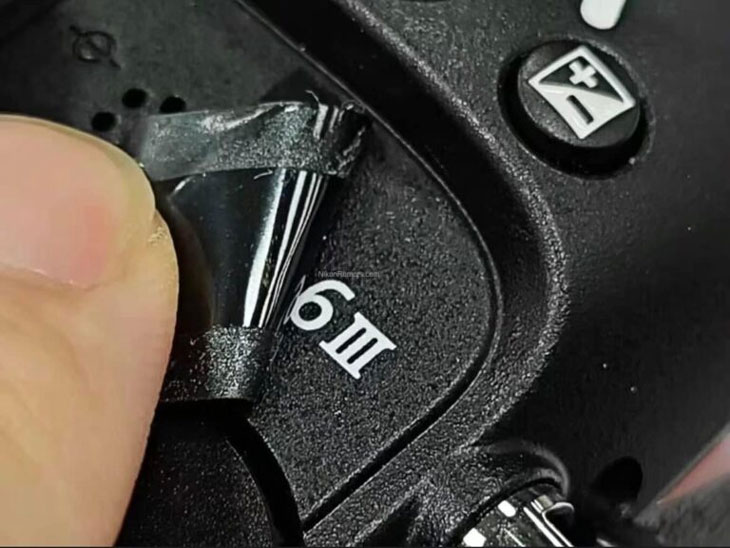
According to the latest rumors from the rumor mill, the Nikon Z6 Mark 3 camera is expected to arrive on June 11. Take a look at the set of rumored specifications of the upcoming Z6 Mark 3 camera.
Nikon Z6 Mark III specification
Pixels: 24.5 million pixels
Processor: EXPEED7 processor
Anti-shake: Level 7 anti-shake
Shutter speed: 1/16000 second
AF: 299 points
Video: 6K/60p&4K/120p 12bit N-RAW recording
4KH.265 10Bit MOV video, can be 6K oversampled 4K
FX format or DX format up to 120p.
Continuous shooting: up to 40fps FX format, 120fps DX format continuous shooting
Viewfinder: Brand new high-resolution viewfinder with 5.76 million pixels
Card slot: support CFexvressB, SD UHS-II
Battery: EL-15 battery
Set up a warm association of photographers
Additional Specs
other
Pixel displacement high-resolution photography
Easy-to-use multi-angle LCD screen
Fine shutter angle options, split the project pause rate from the shooting pause rate
Support WiFi2.4/5GHZ, Bluetooth LE connection
USB-C fast charge & HDMI Type-A connection
Inherited from the Z8 style body, smaller than the Z8
Top micro-label (same as Z8 and Z9)
PASM dial pad
Nikon Z6 mark III Shipping information
According to the previous set of information we have published a while ago the Nikon Z6 mark III camera shipping will start in July 2024. [Check here]
Follow us on our social pages FACEBOOK | TWITTER | INSTAGRAM to get live news + Nikon Rumors 24X7.
source NR.com
By admin, on May 21st, 2024
There lot of discussion has been circulating on the Internet following our post where we published the registration details of three new cameras after the Z6 Mark III camera registration. This raised questions from users who commented on our website and the rumor mill, suggesting that these registrations are not new, specifically the three registrations that appeared after the Z6 Mark 3 camera. Is this true? Let’s find out.
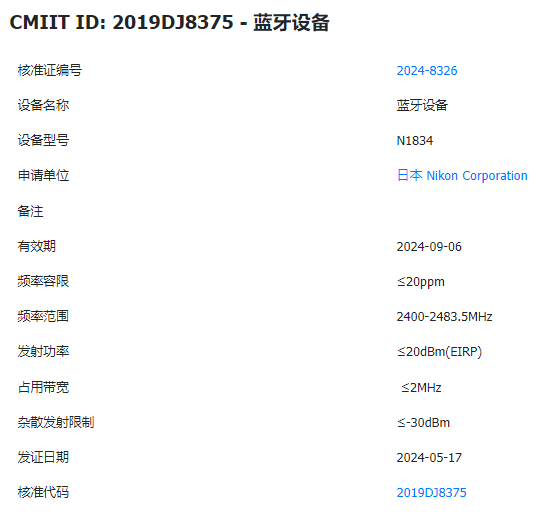
In 2024 The 1834 Model Code Used to Register a Bluetooth Device (No WiFi inside the device )

The Orginal P950 Reg Certificate shows it also has WLAN capabilities (WiFi)
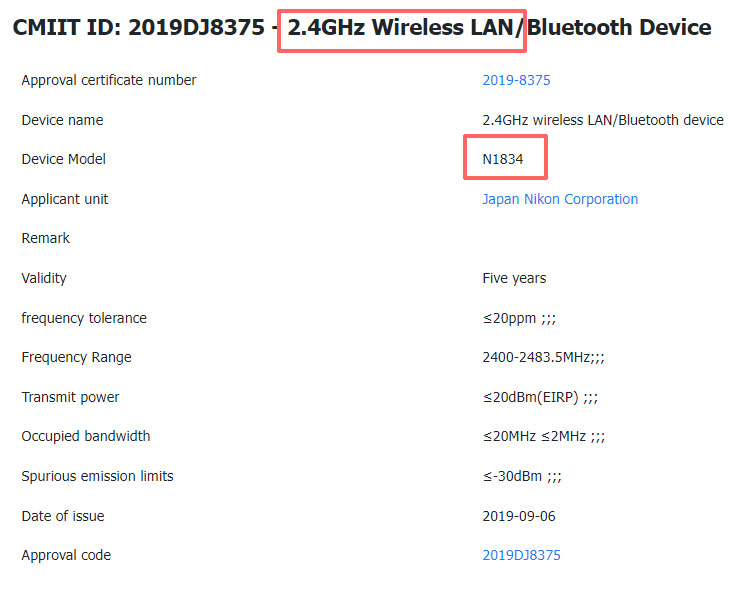
The 1834 Model Used by Nikon P950 – Digital Camera
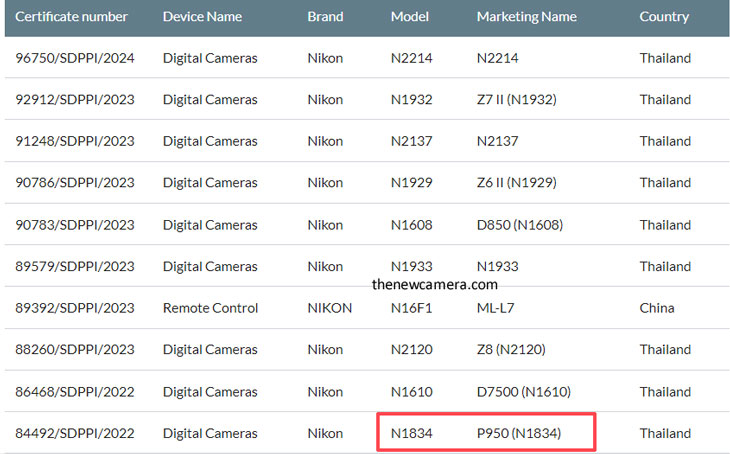
The mistake made by the camera maker, which users did not notice while pointing out that all three are older generation cameras, is the Nikon P950 registration model code name, 1834, which was registered back in 2022 with WiFi – WLAN 2.4 Ghz. Nikon has used the same model code to trick us, but the major mistake they made was using that particular model code for a Bluetooth device in 2024. If they were renewing a particular product, both products should share similar wireless capabilities, but the new N1834 mode doesn’t have WiFi inside it,. It’s very clear from this incident that the camera maker is reusing its old model codes for their new products. This particular incident reveals their future strategy. I hope this clears up any confusion.
And yes, there is a strong chance that all three models are old and Nikon is just upgrading the certification time, let’s hope for the best.
Follow us on our social pages FACEBOOK | TWITTER | INSTAGRAM to get live news + Nikon Rumors 24X7.
By admin, on April 15th, 2024
We are getting more confirmation that the Nikon Z 6 Mark III camera will carry a 33-megapixel partially stacked CMOS sensor. This information recently broke out from a Chinese source, which is approximately 90% of the time correct in the past. He also said that the Nikon Z7 Mark III camera will carry a 61-megapixel sensor.

So at this time, we got one more confirmation that not only the Z 6 Mark 3 camera is coming, but the Nikon Z7 Mark 3 is also set to arrive. The Nikon Z73 will have a huge upgrade in the sensor resolution from a 45-megapixel FX format BSI mass sensor. The upcoming camera will carry a 61 MP Sensor as per the latest set of rumors we have.
Source 1 E8M_8888
Actual: 62.5 Megapixel Effective: 61 Megapixel (9504 x 6336)
We received more information a few days ago but decided not to publish it at that time.
Source 2
Z7III, 67 million pixels, TowerJazz. Z6III, 33 million pixels, Sony.
A source claims that the Nikon Z7 Mark III Camera uses a 67 MP sensor made by TowerJazz, and as usual, the Nikon Z6 Mark III camera uses a 24 MP Sensor.
Is Nikon testing out several prototypes of higher-resolution sensors?
As we all know, before a camera goes to the final production line, camera makers test several prototypes. So, maybe both of them are correct, but we don’t know at this moment which camera was made for the final production line.
This reminds me of the post that I published back in Aug 2022, when Nikon China accidentally published an image of a 67 67-megapixel resolution Camera on their social media account. However, at that time, we thought maybe the upcoming Nikon Z8 camera may carry a higher-resolution sensor. But, as we all know, the Nikon Z8 uses a 45.7 MP Sensor. So, that means they do have a working prototype of a 67MP body, and they have been testing it for a long time.

So, now the story is taking its final shape. Nikon does have a 67 MP working prototype, and recent rumors suggest that there is one 61 MP too. Now let’s wait and watch which prototypes get approval for the final production line
This article was first published on thenewcamera.com website, copying the content above and republishing without citing us as the source is strictly prohibited
Follow us on our social pages FACEBOOK | TWITTER | INSTAGRAM to get live news + Nikon Rumors 24X7.
source here
|
KEEP THIS BLOG ALIVE - Support New Camera Buy Canon Lenses, Buy Music CD or Digital Camera at amazon it helps this site, and you do not pay anything extra, it is just a way to help support this site.

|