Join More Than 50,000+ Subscribers and get latest camera news and rumors
NEW CAMERA VIDEOS ON YOUTUBE
|
By admin, on December 4th, 2025

Sony A7 Five camera versus the Canon R6 Mark III, the most demanded specification comparison review by our subscribers. Now before we begin, I must tell you one thing very clearly, there is no clear-cut winner here. Still, more important than that, you have to understand which one of the two, the Canon R6 Mark III or the Sony A7 V, fits your requirements and budget before investing.
Specification Comparison Table
| Feature |
Sony A7 V |
Canon EOS R6 Mark III |
| Sensor |
33MP partially stacked full-frame Exmor RS BSI CMOS (faster 4.5x readout) |
32.5MP full-frame BSI CMOS (unstacked) |
| Processor |
Bionz XR2 with dedicated AI unit |
Digic X |
| ISO Range (Native) |
100–51,200 (expandable to 50–204,800) |
100–51,200 (expandable to 50–102,400) |
| Dynamic Range |
16+ stops (superior shadow recovery in lab tests) |
~15 stops (strong highlights, but trails in noise at ISO 6400+) |
| Autofocus Points |
759 hybrid phase/contrast (94% coverage) |
Dual Pixel CMOS AF II (~1,053 zones, 100% coverage) |
| Low-Light AF Sensitivity |
-4EV (f/2 lens) |
-6.5EV (f/1.2 lens; better for dim events) |
| Subject Detection |
Humans (pose/eye/face/torso), animals/birds (eye/head/body), insects, vehicles (cars/trains/airplanes, incl. helmets) |
Humans (incl. 10 registered faces/profiles), animals (dogs/cats/birds/horses), vehicles (aircraft/trains) |
| Burst Shooting |
30fps elec (blackout-free, full AF/AE), 10fps mech |
40fps elec (12-bit RAW), 12fps mech |
| Pre-Capture Buffer |
1 second (up to 30 frames) |
0.5 seconds (up to 20 frames) |
| Max Shutter Speed (Mech/Elec) |
1/8,000s / 1/32,000s |
1/8,000s / 1/16,000s |
| Flash Sync Speed |
1/250s |
1/250s (elec first-curtain); 1/200s (mech) |
| Video (Max) |
4K/120p (Super 35 crop), 4K/60p oversampled full-frame (no binning); 1080p/240p |
7K/60p RAW internal (Open Gate at 30p), 4K/120p full-width; 2K/180p |
| Video Codecs & Bit Depths |
XAVC S/HS/S-I (H.264/265); 10-bit 4:2:2 (up to 280Mbps) |
IPB/All-I/RAW (H.265); 10/12-bit 4:2:2 (up to 1.6Gbps RAW); C-Log 2/3 |
| Video Unique Features |
AI Auto Framing, S-Log3/S-Cinetone/HLG, mic noise reduction; cooler runtime (2+ hrs 4K/60p) |
Waveform/false color/custom LUTs, 4-ch audio, pre-recording (3/5s), UVC 4K/60p streaming; more overheating in 4K/120p |
| IBIS |
Up to 7.5 stops (center; 6.5 edges) |
Up to 8.5 stops (coordinated with lens) |
| Pixel Shift Multi-Shot |
Yes (up to 240MP handheld) |
No |
| EVF |
3.69M-dot OLED, 0.78x mag, 120fps (fully blackout-free) |
3.69M-dot OLED, 0.76x mag, 120fps (partial blackout in bursts) |
| LCD |
3.2″ 2.1M-dot 4-axis fully articulating touchscreen (multiple angles) |
3″ 1.62M-dot vari-angle touchscreen (folds flat for protection) |
| Memory Cards |
Dual: CFexpress Type A/SD (UHS-II; one slot interchangeable) |
Dual: CFexpress Type B/SD (UHS-II; simultaneous recording) |
| Battery Life (CIPA) |
750 shots (LCD), 630 (EVF); NP-FZ100 |
620 shots; LP-E6P (shorter in video) |
| Weight (w/ Battery) |
695g |
699g |
| Dimensions (W x H x D) |
130 x 96 x 72 mm |
138 x 98 x 88 mm |
| Build & Sealing |
Magnesium alloy, weather-sealed (but user reports note weaker gaskets) |
Magnesium alloy, advanced weather-sealing (dust/moisture resistant) |
| Audio Ports |
3.5mm mic/headphone; digital multi-interface shoe |
3.5mm mic/headphone; 4-channel support via multi-function shoe |
| HDMI |
Full-size (Type A) |
Full-size (Type A) |
| USB Ports |
2x USB-C (3.2 Gen 2 10Gbps transfer; 2.0 480Mbps charge) |
1x USB-C (3.2 Gen 2 10Gbps) |
| Wi-Fi/Bluetooth |
Wi-Fi 6E (2.4/5/6GHz, 2×2 MIMO for 2x faster transfers); BT 5.1 |
Wi-Fi 6 (5GHz); BT 5.1 |
| Customizable Buttons |
11 (incl. C1-C4 dials) |
8 |
| Price (Body Only, Dec 2025) |
$2,899 |
$2,799 |
Side-by-Side Specs: Sony A7 V vs Canon R6 III Comparison Table
At their core, both cameras pack 33MP full-frame sensors, 5-axis IBIS, and hybrid prowess. But dig deeper, and differences in burst rates, video codecs, and AF shine. Here’s the definitive Sony A7 V vs Canon R6 III specs comparison for 2025:
Sources: Official specs, DPReview, and PetaPixel reviews. Prices as of December 2025.
Key Differences: What the Reviews Say
DPReview hails the Sony A7 V as a “do-it-all powerhouse.” This means the camera is perfect, a kinda all-in-one camera for Photographers as well as Cinematographers.
We have a Sony A7 V with the new sensor, and the big benefit we are getting is the improved dynamic range, which was not possible with the previous generation of partially stacked CMOS sensors, like the one in the Nikon Z6 Mark III.
Intal Reviews: The photographers using the mechanical set of the Sony A7 five camera have noticed that, specifically between ISO 100 and 1000, the camera produces a better dynamic range while using the mechanical shutter. And there is quite a bit interesting pattern since the Apica dynamic range is only visible when one is using the mechanical set of the camera; otherwise, with the electronic shutter, the range gets affected.
Sensor Comparison Table
| Sensor Aspect |
Sony A7 V |
Canon EOS R6 Mark III |
| Sensor Type |
33MP Full-Frame Partially Stacked Exmor RS CMOS (BSI) |
32.5MP Full-Frame CMOS (BSI, Dual Pixel AF with FSI layer) |
| Resolution (Effective Pixels) |
33 megapixels |
32.5 megapixels |
| Sensor Size |
35.8 x 23.8 mm (Full-Frame) |
35.9 x 23.9 mm (Full-Frame) |
| Pixel Pitch |
Approximately 5.12µm |
Approximately 5.14µm |
| Base ISO |
ISO 100 |
ISO 100 |
| Maximum Native ISO |
ISO 51,200 |
ISO 64,000 |
| Dynamic Range |
16 stops |
15 stops |
| Low-Pass Filter |
No (AA-less) |
Yes (Built-in/Fixed) |
| Readout Speed |
~1/200s (electronic shutter, full 14-bit) |
~1/180s (electronic shutter, 14-bit) |
| Image Processor |
Bionz XR2 with AI unit |
Digic X |
| Color Filter Array |
RGB Primary Color |
RGB Primary Color |
| Sensor Cleaning |
Supersonic wave filter |
EOS integrated cleaning system |
| IBIS Integration |
Sensor-shift with up to 7.5 stops (center) |
Sensor-shift with up to 8.5 stops (center) / 7.5 stops (peripheral) |
After a long gap of time, Sony has done a Major Update here. Introducing a Partially Stacked CMOS sensor while maintaining Dynamic Range and higher resolution is a great move
The actual sensor quality test will be done, and we are going to publish that also on our website, but before that, as per the initial set of core specifications, Sony does have a technical advantage over the Canon R6 Mark III sensor.
Sony A7 V vs. Canon EOS R6 Mark III: Autofocus System Comparison
So let’s take a look at the major differences between the two. Both of the cameras’ autofocus systems are very capable, and both of them feature deep-learning AI algorithms that get improved as much as you shoot with time. Now it’s time to dig up more details, since which one is better for a more sticky AF tracking process or which one does 3D object tracking better, so we have created a table that gives you a basic idea for which purpose either Canon or Sony is more suitable for you. This will give you a basic idea of the differences between the autofocusing performance of the two.
| Aspect |
Sony A7 V |
Canon EOS R6 Mark III |
| AF Points & Coverage |
759 hybrid phase/contrast-detection points; ~94% frame coverage |
Dual Pixel CMOS AF II (~1,053 zones); 100% frame coverage |
| Low-Light Sensitivity |
-4EV (f/2 lens); solid but trails in dim venues |
-6.5EV (f/1.2 lens); excels in concerts/events (e.g., ISO 12,800+ with lock-on) |
| Subject Detection |
AI unit detects: Humans (pose/eye/face/torso), animals/birds (eye/head/body), insects, vehicles (cars/trains/airplanes, incl. helmets/grazing eyes); “Auto” mode auto-switches subjects |
AI tracks: Humans (up to 10 registered faces/profiles), animals (dogs/cats/birds/horses), vehicles (aircraft/trains); 6 custom AF profiles for quick recall |
| Tracking Accuracy & Speed |
Real-time tracking with AI prediction; 99%+ hit rate for eyes/bodies; smooth in bursts (30fps blackout-free) |
“Sticky” Dual Pixel tracking; 99%+ for erratic motion (e.g., birds/wildlife); pre-capture aids unpredictable action |
| Unique Features |
Obstacle-avoiding tracking; improved for turned heads/small animals |
Registered People Priority (side profiles); waveform/false color for video AF |
| Real-World Performance |
Super-fast lock-on (e.g., portraits/wildlife); benefits from latest firmware upgrades |
Consistent in speed/light challenges; “snappier” than predecessors for small/fast subjects |
Continuous shooting between Sony A7V and Canon R6 Mark III, so here we are comparing the different continuous shooting modes and the capacity of the cameras based on their buffer memory, which is actually very important. When you are doing sports and wildlife photography, the first and foremost thing is blackout-free shooting, which you get almost in both the cameras, although Sony does it a little better, but when it comes to buffer memory at the maximum continuous shooting speed of 30 frames per second, you will be getting a bit limited amount of memory in the Sony A7V. To clarify that, we have created a table that will give you a basic understanding of much time span you are getting when you are using the maximum continuous shooting speed of the camera. When you are at 15 frames per second or 10 frames per second, everything becomes normal, and you are getting unlimited space in almost both cameras, but to clarify all this, we have created the table below.
| Burst Mode |
File Format |
Sony A7 V Buffer Depth |
Canon EOS R6 Mark III Buffer Depth |
Key Notes |
| 30/40fps Electronic |
Uncompressed RAW |
95 frames (14-bit) |
150 frames (12-bit) |
Canon edges out for action; Sony’s faster readout minimizes rolling shutter. |
| 30/40fps Electronic |
Compressed RAW |
200+ frames (14-bit lossless) |
280 frames (C-RAW) |
|
| 30/40fps Electronic |
JPEG (Fine/Extra Fine) |
~200 frames |
330 frames |
Canon’s deeper JPEG buffer suits event shooters needing quick previews. |
| 10/12fps Mechanical |
Uncompressed RAW |
Unlimited (with fast cards) |
Unlimited (with fast cards) |
Both handle extended sequences effortlessly |
| Pre-Capture |
RAW + JPEG |
1 second (up to 30 frames at 30fps) |
0.5 seconds (up to 20 frames at 40fps) |
Sony captures more lead-in frames for unpredictable moments like jumps or goals. |
Sony A7 V vs. Canon EOS R6 Mark III: Video Core Specification comparison
Video Specs Comparison: We have done a highly detailed Video specification comparison. This will give you a very clear idea of the core differences between the two
| Video Aspect |
Sony A7 V |
Canon EOS R6 Mark III |
| Maximum Resolution & Framerate |
4K UHD (3840×2160) up to 60p (full-width, oversampled from 7K); 4K UHD up to 120p (1.5x Super35/APS-C crop); 1080p up to 240p |
7K DCI (6960×3672) up to 60p (RAW Light internal); 7K up to 30p (open-gate 3:2); 4K UHD up to 120p (full-width, oversampled); 1080p up to 180p |
| RAW Video Support |
No internal RAW; external RAW via HDMI (e.g., ProRes RAW at up to 4K) |
Internal 12-bit Canon RAW Light up to 7K/60p; external ProRes RAW up to 7K/30p via HDMI |
| Bit Depth & Color Sampling |
10-bit 4:2:2 internal (XAVC S-I, HS, S); 8-bit 4:2:0 |
12-bit RAW; 10-bit 4:2:2 (XF-HEVC/H.265, MP4); 8-bit 4:2:0 |
| Color Profiles & Gamma |
S-Log3, S-Log2, S-Cinetone, HLG (HDR), User LUT import (up to 16) |
Canon Log 3, Canon Log 2, HDR PQ, HLG |
| Codecs & Containers |
XAVC S-I (All-I, 10-bit 4:2:2 up to 600Mbps), XAVC HS (H.265, 10-bit 4:2:2), XAVC S (H.264, up to 10-bit 4:2:2), MPEG HD |
XF-HEVC S/H.265 (10-bit 4:2:2 up to 400Mbps+), MPEG-4 AVC/H.264 (up to 10-bit), MP4, Canon RAW Light (CRM) |
| Dynamic Range in Video |
Up to 15+ stops (S-Log3 at base ISO 800) |
Up to 16+ stops (C-Log3 at base ISO 800) |
| ISO Range (Video) |
Native: 100-51,200 (expandable to 50-204,800); Dual base ISO (100/8000 in S-Log3) |
Native: 100-102,400 (expandable to 50-204,800); Dual base ISO (400/3200 in C-Log3) |
| Recording Time & Overheating |
Up to 90 min continuous 4K/60p (20°C ambient, with graphite heatsink); no fan, but efficient dissipation |
Varies: Unlimited in many 4K modes; 30-60 min in high-bitrate/high-framerate (e.g., 4K/120p ~30 min); active cooling options via firmware |
| Sensor Readout Speed & Rolling Shutter |
~1/200s (15.1ms full-frame electronic, 14-bit) |
~1/180s (13.5ms full-frame electronic) |
| Stabilization in Video |
Up to 7.5 stops (5-axis IBIS + lens OSS); Active/Dynamic modes for handheld smoothness; gyro data for post-stabilization |
Up to 8.5 stops (5-axis IBIS + lens IS); Coordinated IS; enhanced digital IS for video |
| Audio Input/Output |
3.5mm mic/headphone jacks; MI Shoe (digital audio with compatible mics); no XLR |
3.5mm mic/headphone jacks; Multi-Function Shoe (digital audio); optional XLR via adapter |
| Monitoring Tools |
Zebra, histogram, waveform (basic), focus peaking, focus map, breathing compensation |
Zebra, False Color, advanced waveform monitor, focus guide, peaking |
| HDMI Output & External Recording |
HDMI clean output (4K/60p 10-bit 4:2:2); supports external RAW |
HDMI RAW output up to 6K/60p; ProRes RAW to compatible recorders |
| Proxy & Dual Recording |
Proxy recording not native; simultaneous card recording (CFexpress A/SD) |
Proxy MP4 (Full HD) simultaneous with main; main/sub/relay across CFexpress B/SD slots |
| Streaming & Webcam |
UVC/UAC up to 4K/30p; direct to platforms via Wi-Fi 6E |
UVC/UAC up to 4K/60p; streaming to services via Wi-Fi/Ethernet adapter |
The Canon R6 Mark III camera is superior in video core specification since you are able to record Open Gate 7K videos at the rate of 60 frames per second internally inside the Canon CFexpress Type B card slot as well and HDMI access to Open Gate is also available. The other big advantage of the Canon R6 Mark III camera is that you are getting uncropped 4K 120p video recording mode, so technically, the Canon R6 Mark III camera is more advanced.
Sony is more particularly a hybrid-style camera, which does offer all the basic requirements that a wedding cinematographer or an entry-level content creator requires from their camera: 4K 60fps uncropped and 4K 120fps at 1.5x crop. Similarly, no Open Gate recording option is available, nor do we have an option to record 7K or 6K videos, externally or internally. But the good thing is that with the help of the new partially stacked CMOS sensor and BIONZ XR II image processor, the overall heat generation has been minimized and the camera can be used up to 1 hour at 40°C while recording 4K 60fps videos. So overall, Sony made it more usable for hybrid photographers and wedding cinematographers.
But if you want to push boundaries with 7K 60fps recording or 4K 120fps uncropped recording, then you have to go with the Canon R6 Mark III.
We have analyzed both camera core specifications in detail, let me know which camera you prefer and why?
About the author
By admin, on November 18th, 2025
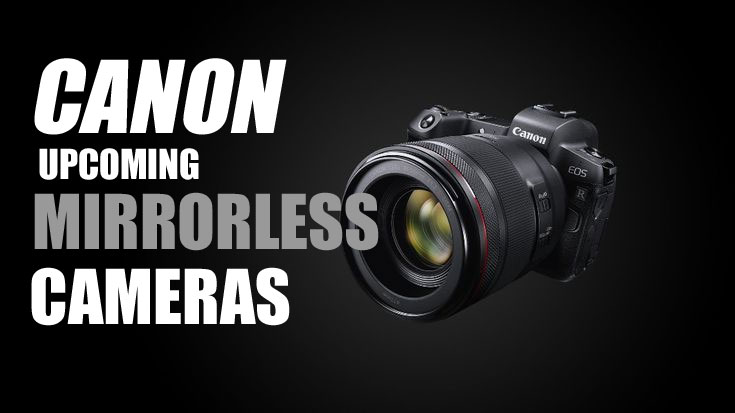
Canon upcoming cameras in 2026, well this year will be the year of APS-C and compact cameras, since from past 18 months Canon were putting a lot of attention in updating their full frame camera lineup, now what we are expecting now is a major refresh in Canon APS-C bodies, a long-teased retro full-frame mirrorless to mark the 50th anniversary of the iconic AE-1, and a revival of compact PowerShots amid surging demand in Japan (up 187% in sales).
Now it’s time to take a deep dive, and before we jump into the list, we must clarify the data and content if coming straight from trusted leakers like Canon Rumors, supply chain whispers, and insiders, plus recent patents and executive interviews of Canon reps. Here’s our exhaustive breakdown of the most credible Canon upcoming cameras 2026 rumors. Not only the name of the camera in the list we have also included the leaked specs, potential pricing, comparisons to predecessors, and strategic analysis of each information based on logic and facts. All info is speculative here, but at the very end, we have to say that Canon loves surprises.
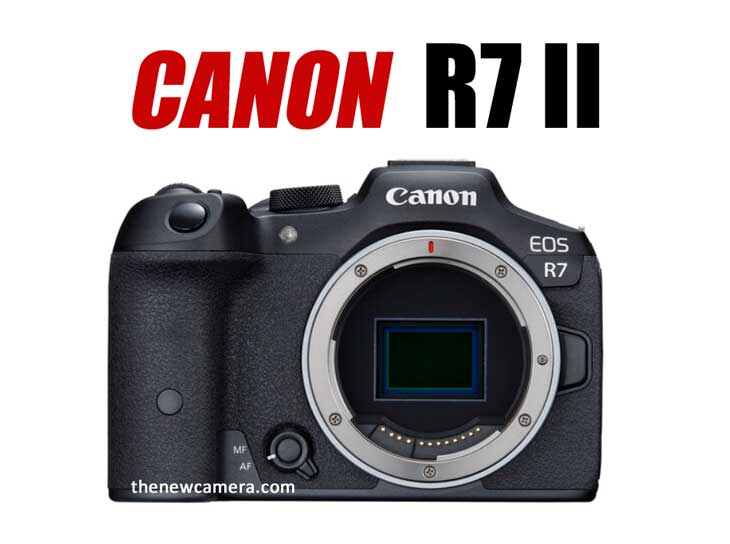
1. Canon R7 Mark II
The Canon R7 Mark II camera announcement is also due. As per the latest rumors, As per the latest reports, the announcement date has been delayed and is now shifted to the first half of 2026. So, this is not the first time we have been getting the news, Canon R7 Mark II is delayed. The post that we published back on August 29, 2025, where we already dug out some of the core specifications expected to arrive inside the Canon R7 Mark II camera. We very clearly wrote in bold letters, even in the main image, that the R7 Mark II camera is expected to arrive sometime in 2026, specifically in the first or second quarter.
Canon R7 Mark II Specification [Expectations]
- 32.5MP Stacked APS-C CMOS Sensor
- Dual Pixel CMOS AF II
- 4K 120p 10-Bit Video, HDR-PQ & C-Log 3
- External 6K ProRes RAW Recording
- 40 fps E. Shutter, 15 fps Mech. Shutter
- Sensor-Shift 5-Axis Image Stabilization
- 3.69 m-Dot OLED EVF
- 1.6m-Dot Vari-Angle Touchscreen LCD
- Sensor-Shift 5-Axis Image Stabilization
- Dual UHS-II Memory Card Slots
- Multi-Function Shoe, Wi-Fi, and Bluetooth
So, for now, we have to wait for the Canon R7 Mark II camera. And as soon as we get any new updates, we will be posting them at thenewcamera.com

2. Canon R3 Mark II
The Canon R3 was announced back in September 2021, one of the cameras that introduced Eye/Iris Control AF and that has impressed everyone as a flagship camera. The price is way too high, costing around $5999, specifically built for wildlife, sports, events, and photojournalism.
Rumours have started recently related to Canon R3 mark II camera arrival, since Canon does have a history of Olympic-tied flagship announcements. So for this time, we are expecting Canon to update its oldest flagship sports camera, the Canon R3.
Canon R3 Mark II Sensor and Resolution
- Global Shutter Tease?: Is Canon testing out Global shutter sensors for Canon R3 Mark II? Although the global shutter sensor isn’t a new thing for Canon. But yes, source has cancelled out the possibilities of an High Res Stacked CMOS sensor inside the Canon R3 Mark II camera, the sensor is said to be Inspired by Sony’s A9 III, some speculate a global shutter variant to eliminate rolling shutter distortion in action shots, boosting high-ISO performance (clean files above 12,800 ISO, per user feedback on the original R3).
Not only Canon R3 Mark II, but also some chattrings about Canon R1 MkII Camera arrival with a global shutter sensor
Processor and Performance
- DIGIC X Mark II: DIGIC X was first announced on January 6, 2020. As of December 11, 2025, it is approximately 5 years and 11 months old (or nearly 6 years). It debuted in the Canon EOS-1D X Mark III, Canon’s flagship professional DSLR at the time. It’s really a shame for Canon to still use the same 6 year old procesor in all their Flagship camera without any update or upgrade. In the meantime, they have added an AI chip, named Digic accelerator to handle AI based task. But, the image processor remains the same; we do believe the Canon R3 Mark II will bring out a new image processor in the Canon lineup.
Autofocus and Viewfinder
- Eye-Control AF 2.0: Building on the original’s magic, with deeper AI for subject detection in chaotic scenes—sports, birds-in-flight, you name it.
- EVF Upgrade: A 5.76M-dot OLED like the R1, but tuned for the gripped form factor.
Video Capabilities
- Leaks are quiet here, but expect 6K/120p raw internals, with pro codecs for filmmakers doubling as stills shooters.
Release Date and Pricing
- Timeline: February 2026 announcement for Milan Olympics coverage, with shipping by spring. Miss this window? It might evaporate, per skeptics. Canon Rumors pegs Q1 alongside lenses, aligning with Phoblographer’s intel.
- Pricing: Expect a bump to $6,500–$7,000 body-only, positioning it between the R5 II ($3,899) and R1. Bundles with RF 400mm f/2.8 or similar could sweeten Olympic deals.
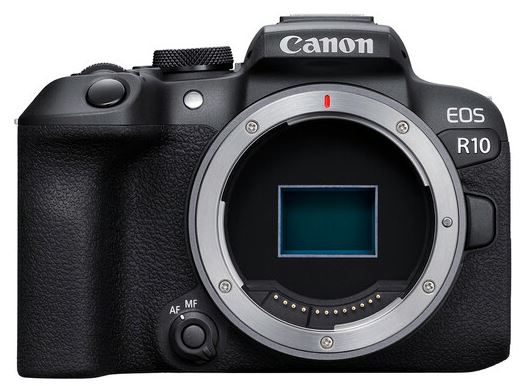
3. Canon R10 Mark II
Canon R10 was announced back in May 2022, if we look back at DSLR time, Canon was updating the mid-range Rebel series every 1.5 – 2 years, so we are expecting the Canon R10 Mark II camera to arrive sometime in Q4 of 2025, but unfortunately it has been delayed, still we are ecpecting its arrivel sometime in late December 2025 or Q1 of 2025. As per the previous set of rumors we have related to the Canon R10 Mark II camera, it will use the same sensor as we have seen in the Canon R7 Camera, with almost the same core specs we have witnessed in the Canon R7. Although the body design and card slot options will remain the same as of the Canon R10.
Canon R10 Mark II Rumored Specification
- 32.5MP APS-C CMOS Sensor
- Dual Pixel CMOS AF II
- 4K60 10-Bit Video, HDR-PQ (NO lOG)
- 15 fps Mech. Shutter
- 2.36m-Dot OLED EVF
- 1.6m-Dot Vari-Angle Touchscreen LCD
- Sensor-Shift 5-Axis Image Stabilization
- Single SD Card Slot
- Multi-Function Shoe, Wi-Fi, and Bluetooth
Let’s hope Canon won’t disappoint us more or keep us just waiting and waiting, as a mid-range Mirrorless camera, the Canon R10 has overaged and requires a quick replacement from Canon.

4. Canon R8V Specification
We were the first to post information related to Canon R8V [See more details here]. After the announcement of the Canon R50V Camera, Canon will soon expand its V series camera series to the full-frame division too, so we are expecting the NEXT V series mirrorless camera to be Canon R8V in 2026. Let’s explore the detailed set of specifications of the upcoming camera
Canon R8 Specification
- Full-frame, 24.2MP CMOS sensor (~1/68s readout).
- Video: 4K 60p (uncropped, oversampled from 6K), 4K 120p (1.2x crop), Canon Log 3, 10-bit 4:2:2 (H.265), HDR PQ, 2.35:1 aspect ratio.
- 4-channel 24-bit audio.
- Stabilization: IBIS (5–6 stops), up to 7.5 stops with lens IS.
- Autofocus: Dual Pixel CMOS AF II with deep-learning subject tracking (people, animals, vehicles).
- Body: Cube-style, EVF-free, ~498g, 3″ vari-angle touchscreen (1.62M dots), single UHS-II SD card slot, no weather sealing.
- Connectivity: USB-C 3.2, micro-HDMI, mic/headphone jacks, Wi-Fi, Bluetooth, Canon Live Switcher support.
- Shutter: Electronic first curtain, up to 1/8000s, 6fps burst.
- Power: LP-E17/LP-E6NH battery, enhanced battery life, no grip support.
- Lens Mount: RF mount.
The Rumored price: $1,799 (body), $1,999 (with RF 24-50mm f/4.5-6.3 IS STM lens). For more details visit Canon R8V

5. Canon Retro Styled Camera – inspired by AE-1
To celebrate the 50th anniversary of the legendary Canon AE-1 (1976–2026), Canon is preparing a nostalgic full-frame mirrorless camera. We may see a Canon retro-style camera competing with Nikon ZF or Zfc cameras shortly. Yes, it is possible since during an interview, when the interviewer asked about the possibility of a Canon retro film-style camera, a Canon representative said there is a significant number of people who really love film cameras and the more vintage look. Therefore, there is a possibility that Canon will address those needs from the industry.
Canon Retro Styled Camera Major Features
- Body Design – Very Similar to Canon AE-1.
- Full-frame or APS-C sensor, rumored 24MP.
- Vari-angle display screen, focus on photographic features rather than video.
- Possible Kodak film simulations and vintage-style lenses.
This indicates that Canon is considering a retro-style camera in its lineup. The rumor is not new; before this interview, we published a rumor back on March 11th, 2024, According to the rumor
Early prototypes of to be announced Canon retro camera design are inspired by the image above (Canon QL 17 G Mark 3). One of the early prototypes is said to feature a full 24-megapixel CMOS sensor and a vari-angle display screen. Not only full frame there is which possibility that an APSC sensor-based retro camera is also under development. We do not have any Fixed time for the announcement of these retro-style cameras they are still under test and in the prototype stage. So if we expect it to arrive too early then it would be somewhere between the end of 2024 are the beginning first quarter of 2025
So, that is the latest set of information we have related to Canon’s upcoming retro-style camera.

6. Canon SX750 HS and G7 X Mark IV – 2026 Expected Release
Latest rumors suggest that Canon may revive its compact series again. Apart from the V series, which is already active, they will put their focus on one of the most popular compacts of all time—the SX740 HS and G7 X Mark III. The successors are expected to arrive between March and September 2026.
- Canon SX750 HS – is expected to arrive next year—that is, in 2026. You’d like to see an improved sensor, core specifications, as well as a more powerful zoom lens added to the camera.We are expecting a major update in the core specs,
- Canon PowerShot G7 X Mark IV – The Canon G7 X Mark III is undoubtedly one of the most popular compact cameras from Canon. Even after the arrival of the Canon V1, the demand for the G7 X series remains constant, and people are buying the G7 X Mark II and Mark III models at higher price tags. Stock shortages, worldwide high demand—this all makes Canon reactivate the series once again.
Specification-wise, we obviously expect a 1-inch sensor inside the G7 X Mark IV compact camera. But this time, you’d love to see Dual Pixel CMOS autofocus for faster focusing and 4K recording up to 60FPS.
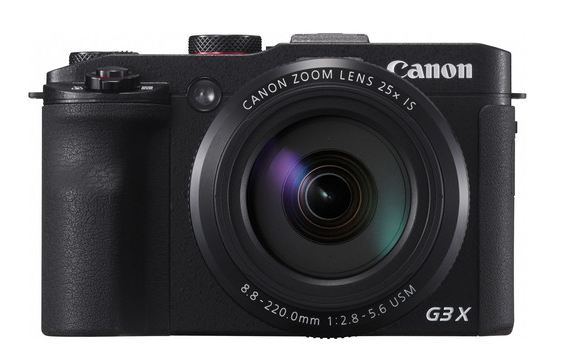
7. Canon V3 – Large Sensor Compact Zoom
According to the latest rumors coming from the rumor mill, Canon is rumored to announce the Canon V3 camera, very similar to the Canon G3 X high-quality super zoom compact camera. It will carry forward the same sensor that we have seen in the Canon V1 camera—the 1.4-inch 22.4 MP sensor and an optical zoom lens.
Canon V3 Specifications
- 1.4-inch, 22.4MP sensor. (Same sensor as Canon V1)
- Optical zoom lens.
- Built-in electronic viewfinder (EVF).
- Photography-oriented design with deep hand grip, robust build, and no side vents.
The camera is expected to arrive in the first half of 2026.

8. Canon V10 Mark II
Canon generally updates its compact cameras in one or two years; that’s the update cycle it generally keeps with its compact cameras. The Canon V10 was announced back in May 2023, and now, in May 2025, it will complete the two-year mark of its announcement date, and hence, it will become eligible for an update. The Canon V10 Mark II is expected to arrive in Q1 of 2026 (if everything goes as scheduled inside Canon). The upcoming camera will have a subtle update in the core specifications.
Expected Upgrades for the Canon V10 Mark II
- 24.2MP 1″ CMOS Sensor
- UHD 4K up to 60 fps
- Full HD up to 120 fps:
- Dual Pixel CMOS AF II: Advanced autofocus system for accurate subject tracking in video and live streaming.
- Web Camera Compatibility with UVC Support: Seamless use as a webcam for live streaming.
- 1.04M-Dot 2.5″ Articulating Touchscreen LCD: Larger and higher-resolution screen with full articulation for easier framing in different orientations.
- Wi-Fi 6 & Bluetooth 5.2
- Vertical Video Capture with Auto Orientation
- Built-in adjustable Stand with 180° Range
- Improved Battery Life
- USB-C Charging & Power Delivery
The Canon V10 Mark II Core Specification is based on our expectations, not a rumored core specification of the camera.

9. Canon Modular Cameras for 180° and 360° VR Video
Canon prototypes of 180-degree and 360-degree-based cameras and the initial prototypes were displayed in Yokohama, Japan (2023). These cameras are multi-purpose cameras able to record 3D 360 spatial videos too for Apple Vision PRO. We are waiting for their official announcement in 2025.

10. Canon V100 – Canon Vlogging Camera with a Large sensor
Canon next next-generation vlogging camera patent surfaced in Canon patents as you can see in the image above, the design being shown in the patent is slightly different from the existing Canon V10 camera. Also, the sensor area shown in the figure resembles an APS-C sensor instead of a 1-inch sensor being used in the Canon V10 camera, take a look at the images below
Canon V1 / V100 Expected Specification
- 24.2MP APS-C CMOS Sensor
- DIGIC X Image Processor
- Dual Pixel CMOS AF II
- 4K30 Video, 4K60 with Crop;
- HDR-PQ
- IBIS (Enhanced EIS+ IBIS + OIS for Video)
- Background Defocus
- Face Priority AE
- Movie for Close-Up Demos Mode
- Vertical Movie Mode
- Directional Capsule Mic and Windscreen
- 15 fps E. Shutter
- No EVF
- 1.04m-Dot Vari-Angle Touchscreen LCD
- Wi-Fi and Bluetooth
Canon will surely expand its V- V-series vlogging cameras in 2025-26, since they are in very high demand and people are waiting for a direct competitor of Sony ZV-series of cameras.

11. Canon Vision Pro – Virtual Reality Headset
Just like Apple Vision PRO, Canon is also working towards its range of VR headsets, as usual, the VR headset is different from Canon MREAL X2, We all know that Canon is in partnership with Apple, as they are making special spatial Lenses for their Apple Vision PRO, and their content can be directly used on Apple iPhone platforms and the VR headset for augmented reality purposes. You can read the Full patent details here
When the Canon Vision Pro is Coming
as usual Camera makers like Canon take 2-3 years, once their patent is published, they do extensive research and testing beofre the announce the commerical version of the product. So, we can expect it sometime in 2026.

12. Canon Hands-Free Vlogging Compact Camera
Canon is also working on Hands hands-free vlogging camera, as you can see the cylindrical style camera can rotate up to 360 with a large display attached to the rear side of the camera. The Display part can be stuck to smooth surfaces like Glass windows it’s very clearly mentioned in the patent. I am very much impressed by the design of the camera and let’s hope we will see the announcement of such a camera soon from Canon.

One more closer image of the camera
Canon future vlogging compact camera, The camera features a brand new moveable cylindrical camera unit that detects and tracks human + body face very effectively. The rear side of the camera we have a Display unit which is used for customization of camera basic settings.

13. Canon Patent Neckband Style Camera
The concept is truly unique, and it will assist content creators in producing videos without exerting too much effort in holding their camera and creating content. more about the patent details here

14. Canon V1 – Fullframe Vlogging Camera [Patent/concept design]
The Next full-frame vlogging camera that surfaced from the patent may use the Canon R8 Sensor and compact gimbal-style design. The overall design is very unique and advanced. But this patent was done by Canon back in 2020. Maybe their marketing team is waiting for the right time to announce such a product; otherwise, it will become a product without any direct competitor on the Row. We all know what happened with the Sony DSC R1 camera, it was an APS-C style compact camera announced back in Sep 2016 by Sony. But, at that time, people were not ready for that type of advanced camera, nor were Canon or Nikon able to put a direct competitor out, so Sony never announced the next version of the same. Similarly, I think Canon’s marketing team is waiting for the right time. 165
Get LIVE RUMORS –> FACEBOOK | TWITTER | INSTAGRAM to get live news + Canon rumors 24X7

By admin, on November 5th, 2025

In a move that’s sure to thrill hybrid shooters, wildlife enthusiasts, and sports photographers alike, Canon has officially unveiled the EOS R6 Mark III—the latest evolution in its wildly popular R6 series. Building on the legacy of its predecessors, this full-frame mirrorless powerhouse cranks up the performance with groundbreaking autofocus, enhanced image stabilization, and blistering speed, all packed into a body that’s as rugged as it is refined. If you’re in the market for a camera that doesn’t just keep up with your creative chaos but anticipates it, the R6 Mark III is here to deliver. Let’s dive into what makes this beast a game-changer.
A Sensor and Processor Duo That’s Pure Magic
At the heart of the R6 Mark III beats a 34.2-megapixel full-frame CMOS sensor, delivering the sharp, dynamic images Canon fans crave. Paired with the DIGIC X processor, it handles everything from low-light wizardry to high-speed bursts with effortless grace. The sensor’s built-in low-pass filter (4th-generation) and integrated EOS cleaning system keep dust at bay, while the RGB primary color filter ensures vibrant, true-to-life hues right from the source. But the real showstopper? Canon’s innovative 8.5-stop IBIS, offering rock-solid stabilization for handheld mastery. Say goodbye to shaky shots—whether you’re tracking a bird in flight or nailing that cinematic pan, this camera steadies the storm.

Autofocus That Reads Your Mind
If autofocus is your love language, the R6 Mark III speaks it fluently. Dual Pixel CMOS AF II boasts multi-subject detection for people, animals, and vehicles, with 100-face storage for lightning-fast recognition. It covers a staggering 100% x 100% of the frame, with a working range from EV -6.5 to 21 (tested with the RF 50mm F1.2 L USM at 23°C and ISO 100). That’s moonlit portraits and midday mayhem, all in focus.
Modes include One Shot and Servo AF, with manual selection options galore: Spot AF, 1-point, Expand areas, Zone, and even Whole Area AF. Tracking is next-level, locking onto faces, eyes, heads, bodies, and even vehicles like cars, motorbikes, trains, and aircraft—perfect for motorsports or aviation pros. Animal detection covers dogs, cats, birds, and horses, with up to 10 registrable subjects for your favorites.
Manual focus gets a boost too: Peaking sensitivity (High/Medium/Low), focus guides, and bracketing for 2–999 images with customizable increments. And don’t forget AF Assist Beam via LED or external flash for those dim venues.

Exposure and Metering: Precision in Every Pixel
Metering is real-time and evaluative, using the sensor for spot-on results across four modes: Evaluative (linked to all AF points), Partial (6% of viewfinder), Spot (2%), and Center-weighted average. The brightness range spans EV -3 to 20 (or up to 21 with EVF), with AE Lock triggered by AF-ON, Fx button, or shutter half-press.
Exposure compensation hits ±3 stops in 1/3- or 1/2-stop steps, and AEB bracketing does the same for three shots. ISO sensitivity? AUTO from 100-64,000 native—ideal for night owls. High ISO noise reduction offers four levels (including multi-shot), and Anti-Flicker Shooting detects 100% or 120Hz flicker from lights, ensuring clean stills and video.
White balance is flexible: AWB (Ambience or White priority), presets like Daylight, Shade, Cloudy, Tungsten, and Flash, plus custom Kelvin (2,500–10,000K) and bracketing. It’s all customizable in 50K increments for that perfect skin tone.

Shutter Speed Demons: Capture the Unmissable
The electronically controlled focal-plane shutter (with electronic 1st-curtain option) syncs at 1/250 sec X-sync and releases electromagnetically. Speeds? Mechanical: 30–1/8,000 sec; Electronic 1st-curtain: same; full electronic: up to 30 sec. Bulb mode is there for long exposures, and TWB (Time Value Movie) support keeps video smooth.
Burst shooters, rejoice: Up to 40 fps electronic shutter with pre-capture enabled and blackout-free viewfinder action. It’s a wildlife and action photographer’s dream.
Viewfinder and Display: See It All, Feel It All
Peering through the 5.76-million-dot EVF (0.76x magnification) feels like stepping into your shot—120fps performance, 20mm eyepoint, and dioptre correction from -4 to +2 m⁻¹. Brightness adjusts manually in four steps or auto, with anti-smudge coating on the 3.0-inch, 1.62-million-dot touchscreen LCD (100% coverage, seven brightness levels).
A Quick Specs Snapshot
For the detail-obsessed, here’s a curated table of the R6 Mark III’s core specs:
| Category |
Feature |
Specification |
| Sensor |
Type / Pixels |
Effective: 34.2 Megapixel (7144 x 4790) |
| Stabilization |
Sensor Shift IS |
Up to 8.5 stops peripheral |
| Autofocus |
Points / Coverage |
1,053 Dual Pixel CMOS AF II / 100% x 100% |
| AF Range |
Working Range |
EV -6.5 to 21 (RF 50mm F1.2 L USM) |
| ISO |
Native / Expanded |
100–64,000 / L:50, H2:204,800 |
| Shutter |
Speed (Mechanical) |
30–1/8,000 sec |
| Burst |
Electronic Shutter |
Up to 40 fps |
| Viewfinder |
Type / Dots |
0.5″ OLED EVF / 5.76 million |
| Display |
Type / Dots |
3.0″ TFT LCD touchscreen / 1.62 million |
| Lens Mount |
Type |
RF mount (1.6x crop equivalent) |
Video Specs
For video creators, the R6 Mark III is a revelation. Shoot in RAW: 7K DCI (17:9) or Open Gate 3:2 at 24/25p with 12-bit CRM for maximum grading flexibility. Log profiles include Canon Log 2 & 3, alongside LGOP & All-I codecs. Open Gate mode shines with 3:2 7K RAW/MP4 + Full HD proxy for versatile post-production.
MP4 formats cover 4K/2K/Full HD in DCI/UHD and 17:9/16:9 aspect ratios, using XF-HEVC/H.265 or MPEG-4 AVC/H.264 codecs. Audio is pro-grade with 24-bit Linear PCM or AAC options. Time-lapse modes support 4K/2K/Full HD, and Slow & Fast (S&F) mode offers framerate multipliers (like 0.5x or 2x) for seamless quick switches between motion types.
Build and Connectivity: Built to Last The R6 Mark III’s rugged, weather-sealed body features dual slots (CFexpress B + SD UHS-II) for uninterrupted shooting, a full-size HDMI port for external monitoring
What do you think—does this seal the deal for your next camera buy? Drop your thoughts in the comments, and stay tuned to TheNewCamera.com for hands-on reviews, lens pairings, and firmware updates. Canon, you’ve done it again.

At TheNewCamera.com, we’re dedicated to keeping you informed about the latest camera news. The article “Canon R6 Mark III Announcement” was published on6:48 pm, Wednesday, 5 November 2025, Greenwich Mean Time (GMT) by thenewcamera.com team | Follow us on our social pages FACEBOOK | TWITTER | INSTAGRAM to get live Camera News + Canon Rumors 24X7.
By admin, on November 1st, 2025
Some sort of official marketing material has been leaked about the Canon R6 Mark III camera by a Canon camera retailer ahead of the November 6, 2025 announcement, and obviously, they have accidentally posted on an online doc as well as on their Instagram page (both removed now). Luckily, can Canon rumour mill has captured the content and published, so here is some sort of mini official press text related to the Canon R6 Mark III camera announcement.
Leaked Canon Retailer Teaser Text Ahead of Nov 6 Launch
 shared by a new source, it can be a mockup or real; use it as a reference image for now Canon EOS R6 Mark III — Redefining Performance and Precision
Get ready to experience Canon’s latest leap in imaging innovation. The EOS R6 Mark III brings together unmatched speed, advanced autofocus, and stunning image quality in a compact, full-frame mirrorless body. Equipped with a new-generation CMOS sensor and DIGIC X processor, it delivers outstanding low-light performance, crisp 4K video recording, and lightning-fast continuous shooting — perfect for professionals and enthusiasts alike.
With Dual Pixel CMOS AF II, real-time subject tracking, and improved image stabilization, the R6 Mark III ensures you never miss a moment, whether capturing action, portraits, or cinematic visuals.
Rumoured Canon R6 Mark III Specifications
- Sensor & Processor: Effective: 34.2 Megapixel (7144 x 4790)
- Autofocus: Dual Pixel CMOS AF II, multi-subject detection (people, animals, vehicles); 100-face storage
- Stabilization: 6.5-stop IBIS
- Viewfinder: 5.76M-dot EVF (0.76x magnification) – unconfirmed
- Shooting Speed: 40fps electronic shutter; pre-capture enabled
- ISO: Up to 64,000 native
- Video Highlights:
- RAW: 7K DCI (17:9) / Open Gate 3:2 at 24/25p; 12-bit CRM
- Log Profiles: Canon Log 2 & 3; LGOP & All-I codecs
- Open Gate: 3:2 7K RAW/MP4 + Full HD proxy
- MP4 Formats: 4K/2K/Full HD (DCI/UHD, 17:9/16:9); XF-HEVC/H.265, MPEG-4 AVC/H.264
- Audio: 24-bit Linear PCM/AAC
- Time-Lapse: 4K/2K/Full HD modes
- S&F Mode: Framerate multipliers for quick switches (0.5x, 2x, etc.)
- Build: Dual slots (CFe B + SD UHS-II); full-size HDMI; LP-E6P battery
- Price: €2,899 / $2,899 (tentative)
- Release: Ships November 20, 2025
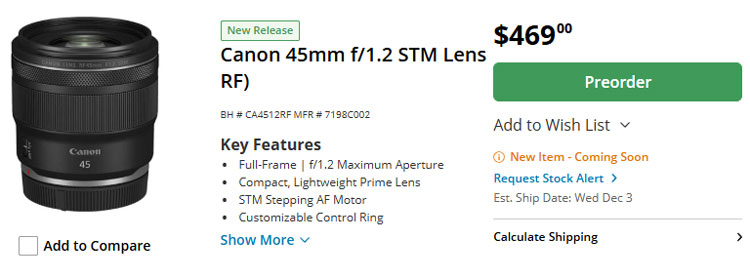
 shared by a new source, it can be a mockup or real, use it as a reference image for now Bonus: Canon RF 45mm f/1.2 STM Lens Tease
Canon RF 45mm f/1.2 STM – AN true optical rival to the RF 50mm f/1.2L USM, with digital focus breathing correction, 67mm filter thread, 346g weight, and €499/€599 pricing. A bokeh beast for Canon R6 III portraits.
- Optical quality similar to EF 50mm F1.2L USM
- Digital Focus Breathing Correction
- 67mm Filter Thread
- Weight: 346g
- Price: €499 or €599 (We have been told both price points)
So these are the latest updates we have related to the upcoming Canon R6 Mark III, with full core spec. We have also posted a comparison of the camera alongside Canon R6 Mark II (Canon R6 III vs Canon R6 II), and the best part is that B&H has already activated the camera page on their website. The pre-orders will get activated just after the official announcement of the camera.
Additional Leaked Images / Screenshot


At TheNewCamera.com, we’re dedicated to keeping you informed about the latest camera news. The article “Canon R6 Mark III Announcement Incoming: B&H adds Pre-order Placeholder Page” was published on 7:34 am, Friday, 31 October 2025, Greenwich Mean Time (GMT) by thenewcamera.com team | Follow us on our social pages FACEBOOK | TWITTER | INSTAGRAM to get live Camera News + Canon Rumors 24X7.
source –canonrumor.com

By admin, on October 31st, 2025

We already have the release date for the Canon R6 Mark III camera: November 6, 2025, 1 AM EDT. Canon R6 Mark III camera coming with the same 34.2 MP CMOS sensor we have seen in the Canon C50, not only that, R6 III is about to become Canon’s first commercial consumer camera to feature 7K open-gate recording internally in RAW format. The sensor readout speed of the Canon R6 III camera will remain the same as that of the Canon C50 —14.2 ms —since both use the same sensor. So, yes, a bit slower than the partially stacked CMOS sensor of ZR and Z6 III, but still highly usable.
If you’re thinking of pre-ordering the Canon R6 Mark III camera, the B&H Store of the USA has just made the Canon R6 Mark III camera page live on their website. You can click on Notify Me button on their website, so they can update you once the camera is available for pre-order.

B&H Teaser Page Details
Head to B&H’s dedicated page here for the official teaser. What stands out in this Canon R6 III announcement placeholder?
- Event Timing: Canon LIVE stream will be there on November 6 at 1:00 AM EDT—perfect for global audiences.
- Preorder Perks: B&H has already activated the camera page on their website. The pre-orders will get activated just after the official announcement of the camera.
So kindly the Canon R6 Mark III camera is coming, and we have already done a specific specification comparison review alongside with the Canon R6 Mark II camera where we do have a big difference in between the core specification of the two, and yes, if you’re thinking for an upgrade, the R6 Mark III camera does carry all the major core specification upgrade in terms of video as well as stills that you were waiting of.
And very soon, comparison with the Nikon Z6 Mark III and the Nikon ZR will go live on our website. Stay tuned, and if you have any sort of questions related to the upcoming comparison or suggestion, you can drop your thoughts in the comment section.
Canon R6 Mark III specification
- – 34.2MP / 32MP (same as Cinema EOS C50)
- – Dual Pixel CMOS AF II for multiple subject detection
- – Can store up to 100 faces for AF recognition
- – IBIS: 6.5 stops
- – 5.76M dot EVF (0.76x) (unconfirmed)
- – Pre-capture
- – Maximum frame rate: 40fps Electronic shutter
- – Canon Log-2 and Canon Log-3 (unconfirmed)
- – LGOP
- – “S&F” added to mode dial: This feature allows you to select frame rates more efficiently based on a multiplication factor. If you’re shooting at 24fps, selecting 0.5x will easily switch you to 12fps, while selecting 2x will double the frame rate. I’m not sure if there are any other multiplication factor settings.
- – Max ISO: 64000
- – 7K open gate like Cinema EOS C50
- – Open gate RAW 24/25p
- – 24-bit audio
- – Dual slots (CFexpress Type B and SD UHS-II)
- – Full-size HDMI port
- – LP-E6P
- – Price: 2899 euros
- – Price: $2899 (estimated)
- – Shipping starts November 20, 2025
My Personal Take
What I personally think after looking at the core specification of the Canon R6 Mark III is that it is targeting hybrid cinematographers or content creators more than photographers, and it’s not a viable thing, since if they really care about photographers and give a bit more priority to them, then they have introduced a stacked or a partially stacked sensor. But this time, they have offered the same C50 cinema sensor, and we are having a major upgrade in the videography core specification of the upcoming Canon R6 Mark III camera; the still specification remains almost the same.
Despite that, we do have an elevated resolution and the best part is the handheld shooting capability of the IBIS feature has been downgraded to 6.5 stops as per the initial set of information we have so that’s kind of a dilemma, confusion why we are having some decline in the IBIS as we do have an upscale sensor but 12.5 or 12.4 ms readout speed sensor will exhibit some sort of rolling shutter effect when used at 40fps, so that’s kind of a debate topic.
Obviously, we are looking at the initial set of reviews, what the expert reviewers say, but I have a personal sort of feeling that the camera does have a lot of things for content creators, professional cinematographers, but very limited, minimal updates for photographers.
Secure Your Canon EOS R6 Mark III Preorder: Next Steps
Don’t sleep on this—B&H’s setup screams limited supply. Head to the teaser page now, enable notifications, and explore bundles. For alternatives, check Adorama or Amazon for competitive pricing.
At TheNewCamera.com, we’re dedicated to keeping you informed about the latest camera news. The article “Canon R6 Mark III Announcement Incoming: B&H adds Pre-order Placeholder Page” was published on 7:34 am, Friday, 31 October 2025, Greenwich Mean Time (GMT) by thenewcamera.com team | Follow us on our social pages FACEBOOK | TWITTER | INSTAGRAM to get live Camera News + Canon Rumors 24X7.

By admin, on October 30th, 2025
creative image credit tnc team The Canon R6 Mark III camera is finally here, and without a doubt, it’s a massive upgrade over the Canon R6 Mark II camera. Shipping of the camera will start from November 20, 2025. The price of the camera is €2,899 / ~$2,899 (estimated). Pre-orders will soon go live at the B&H Store.
In this article, we are comparing the Canon R6 Mark III camera with the Canon R6 Mark II. The specification comparison will break down every detailed core specification, starting from sensor to resolution and video—everything in detail related to both cameras. Before we begin the specification comparison, one thing should be very clear: we do have a very big price difference between the two, so if you’re paying more, you will obviously be getting more specifications in the camera. So now let’s explore the set of features and the differences between the two.
Canon R6 Mark III vs R6 Mark II: Side-by-Side Specs Table
| Feature |
Canon R6 Mark III (2025) |
Canon R6 Mark II (2022) |
| Sensor Resolution |
34.2 MP (same as Cinema EOS C50) |
24.2 MP (effective) |
| Sensor Type |
Full-frame CMOS (rumored stacked) |
Full-frame CMOS |
| Image Processor |
Not confirmed (likely DIGIC X+) |
DIGIC X |
| IBIS |
6.5 stops |
8 stops (with coordinated IS) |
| Autofocus System |
Dual Pixel CMOS AF II
1053 + AF Zone and 100 face memory storage |
Dual Pixel CMOS AF II
1,053 points |
| Subject Detection |
Multiple (People, Animals, Vehicles) |
People, Animals, Vehicles |
| Continuous Shooting |
40 fps electronic shutter |
40 fps electronic, 12 fps mechanical |
| Buffer (RAW) |
Not confirmed |
75 frames at 40 fps |
| EVF |
5.76M-dot OLED, 0.76x (unconfirmed) |
3.69M-dot OLED, 0.76x |
| Rear LCD |
Not confirmed (likely 3.2″ vari-angle) |
3.0″ 1.62M-dot articulating touchscreen |
| Pre-Capture |
Yes |
Yes |
| ISO Range (Native) |
100–64,000 (unconfirmed) |
100–102,400 (extended 204,800) |
| Video: Max Internal |
7K Open Gate (24/25p RAW) |
6K RAW external only |
| 4K Video |
Full sensor readout (oversampled) |
4K 60p (from 6K), no recording limit |
| Log Profiles |
Canon Log 2 + Log 3 (unconfirmed) |
Canon Log 3, HDR-PQ |
| Open Gate Recording option |
Yes |
No |
| Slow Motion |
Not confirmed |
1080p 180fps |
| Audio |
24-bit |
24-bit LPCM / AAC |
| Frame Rate Dial (S&F) |
New “S&F” mode – 0.5x, 2x multipliers (e.g., 24 → 12 or 48 fps) |
No dedicated S&F dial |
| LGOP (Light GOP) |
Yes |
No |
| Memory Cards |
CFexpress Type B + SD UHS-II |
Dual SD UHS-II |
| HDMI Port |
Full-size HDMI |
Micro-HDMI |
| Battery |
LP-E6P (higher capacity expected) |
LP-E6NH (760 shots) |
| Build & Weight |
Magnesium alloy (weight TBD) |
588g (body only) |
| Price (Launch) |
€2,899 / ~$2,899 |
$2,499 (original) |
| Shipping Date |
November 20, 2025 |
November 2022 |

Key Upgrades: Why R6 Mark III Wins for Hybrid Shooters
1. 34.2 MP Sensor – Cinema-Level Detail
In the Canon R6 Mark III camera, we have a 40% higher resolution sensor compared to the Canon R6 Mark II. The cinematic sensor will not only upscale the core specifications of the camera in terms of open-gate video recording in 7K or 4K 60 uncropped videos downsampled from 7K, it will also give an option for hybrid shooters to do continuous capture at 40 frames per second with the help of the electronic shutter. So overall, the new sensor will boost the resolution and the details users are getting without affecting the speed of the camera. At the very same time, it’s not a stacked sensor, but the readout of the sensor is 12 ms as per the initial tests of the C50 camera. So overall, the sensor is far better than the predecessor R6 Mark II.
- Shared with Cinema EOS C50
- ~40% more resolution than R6 Mark II
- Ideal for 8K-downsampled 4K and high-res stills
2. 7K Open Gate RAW (24/25p)
The camera supports anamorphic recording as well as 6K RAW videos. We can remember that 6K RAW in the R6 Mark II camera was limited to external recording only, but at the very same time, we have the Canon R6 Mark III, where we can easily record 7K open gate in our CFexpress Type B card. At the very same time, the camera is coming with Open Gate Recording mode flexibility, so if you are a cinematographer or a content creator who loves to explore this videographic dimension to its maximum limit, you will surely love the new Canon R6 Mark III camera.
- True anamorphic workflow without cropping
- R6 Mark II limited to 6K RAW external only
- Matches C50 / R5 C open-gate flexibility
3. Pro Connectivity
It looks like Canon is getting a bit serious about the competition. For the first time in the R6 series, we are getting a full-size HDMI port, and that’s a good thing—no more micro cable failures or switching back and forth. Other than that, again for the first time, we are having a CFexpress Type B card slot specifically to save the open-gate 7K recording internally in the camera, and finally a 24-bit audio that will help to elevate the overall video performance of the camera.
- Full-size HDMI (no micro cable failures)
- CFexpress Type B for 7K RAW bursts
- 24-bit audio for professional sound
Performance Deep Dive: Real-World Implications
Overall, if you look at the specifications of the camera, then it has been upgraded to a maximum extent, but at the very same time, I’m not able to understand why the IBIS mechanism/sensor-shift image stabilization mechanism has been dropped to 6.5 stops compared to the eight stops of IBIS available in the Canon R6 Mark II camera. If you ignore this part, then other than that, we have a massive update in the sensor resolution of the camera, and at the same time, while upscaling the pixel density, the low-light performance still remains highly usable. A lot of improvement in the still and video parts of the camera, which we have already discussed above, some more or less. This is one of the most advanced R6 series cameras Canon has ever announced, and it will appeal to a large consumer base—those who are looking for the best mid-range in a full-frame body.
Where R6 Mark II Still Holds Up
| Advantage |
R6 Mark II Wins Because… |
| IBIS |
8 stops > 6.5 stops, offering superior stabilization for handheld video in low light or action. |
| Battery Life |
Proven 760 shots (CIPA-rated), potentially outlasting the new LP-E6P in extended shoots. |
| Price |
Now ~$2,000 street price, making it a budget-friendly entry into Canon’s hybrid ecosystem. |
| Availability |
In stock everywhere—no wait times like the R6 Mark III’s launch rush. |
Who Should Upgrade to R6 Mark III?
Upgrade if you need:
- Pros: 7K open gate RAW for cinematic flexibility; 34.2 MP for detailed stills/video; S&F dial for efficient frame rate tweaks; Full-size HDMI + CFexpress for pro setups; Pre-capture for nailing action moments.
- Ideal for: Cinema-hybrid creators, wedding pros, or anyone future-proofing for 2025 workflows.
Stick with R6 Mark II if:
- Cons (for upgraders): Slightly lower IBIS; Higher price; Potentially similar burst speeds without major buffer gains.
- Ideal for: Budget-conscious shooters focused on 4K/6K video, strong IBIS, or those happy with current AF without face memory.
Ultimately, the Canon R6 Mark III is one of the most advanced full-frame cameras ever announced by Canon. The camera approaches everyone—if you are a hybrid shooter or a cinematographer or a photographer, you will love this camera, irrespective of the profession you are involved in. This is a kind of all-rounder professional camera built by Canon.
At TheNewCamera.com, we’re dedicated to keeping you informed about the latest camera news. The article “Canon Major Announcement in November 2025” was published on 12:29 pm, Wednesday, 24 September 2025 (GMT-4), Time in Washington, DC, USA by thenewcamera.com team | Follow us on our social pages FACEBOOK | TWITTER | INSTAGRAM to get live Camera News + Canon Rumors 24X7.
By admin, on October 28th, 2025

We’ve all been waiting for the Canon EOS R6 III camera, and now we have confirmation. Canon USA just dropped a teaser on social media, which clearly indicates that the Canon R6 III will be revealed on Nov 6, 2025, at 1 AM EDT. Now, one of the most exciting cameras, not only for photographers but also for hybrid shooters and cinematographers, is eagerly awaited. As per the initial set of specifications, Camera is coming with the same 34.2 Megapixel (7144 x 4790) sensor that we have already seen in the Canon C50 camera. And not only the camera, we also have a lens announcement, the lens is the RF 45mm F1.2 STM lens. And the best part of the lens, despite its high-grade optics, is that the price of the lens is under $600. Therefore, it will surely become the most affordable budget F1.2 lens from Canon for the first time in our market after the official announcement. Both of these announcements are amazing. Now it’s time to take a look at the Major specifications of the Canon R6 Mark III camera,
 Canon R6 Mark III official teaser posted for Canon R6 III announcement Canon R6 Mark III specification
- – 34.2MP / 32MP (same as Cinema EOS C50)
- – Dual Pixel CMOS AF II for multiple subject detection
- – Can store up to 100 faces for AF recognition
- – IBIS: 6.5 stops
- – 5.76M dot EVF (0.76x) (unconfirmed)
- – Pre-capture
- – Maximum frame rate: 40fps Electronic shutter
- – Canon Log-2 and Canon Log-3 (unconfirmed)
- – LGOP
- – “S&F” added to mode dial: This feature allows you to select frame rates more efficiently based on a multiplication factor. If you’re shooting at 24fps, selecting 0.5x will easily switch you to 12fps, while selecting 2x will double the frame rate. I’m not sure if there are any other multiplication factor settings.
- – Max ISO: 64000
- – 7K open gate like Cinema EOS C50
- – Open gate RAW 24/25p
- – 24-bit audio
- – Dual slots (CFexpress Type B and SD UHS-II)
- – Full-size HDMI port
- – LP-E6P
- – Price: 2899 euros
- – Price: $2899 (estimated)
- – Shipping starts November 20, 2025
Finally, we have all the details of the upcoming camera and lenses, now, let’s wait for the Nob 6, once the Canon R6 Mark III becomes official, and we can get some hands-on and review of the camera. Stay tuned for leatest images and comparison of Canon R6 Mark III
GET LIVE NOTIFICATION Your Trusted Source GET LIVE NOTIFICATION Click ON Check  BOX for Latest NEWS and Rumors BOX for Latest NEWS and Rumors
The article “Canon R6 Mark III Teased: Everything We Know So Far Ahead of November 6 Reveal!” was written by thenewcamera.com team on 1:45 pm,Tuesday, 28 October 2025, Greenwich Mean Time (GMT) | You can also follow us on Our Official Social Media Handles FACEBOOK | TWITTER | INSTAGRAM to get live news — > get live news Camera News + Canon Rumors 24X7.

|
KEEP THIS BLOG ALIVE - Support New Camera Buy Canon Lenses, Buy Music CD or Digital Camera at amazon it helps this site, and you do not pay anything extra, it is just a way to help support this site.

|