Join More Than 50,000+ Subscribers and get latest camera news and rumors
NEW CAMERA VIDEOS ON YOUTUBE
|
By admin, on September 3rd, 2025
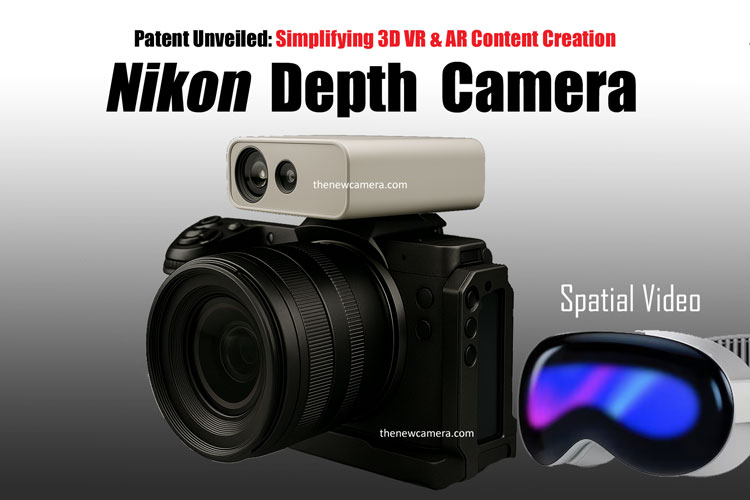 Nikon Depth Camera Module on hotshoe over proposed Z Cinema style camera We have a new Patent from Nikon, published in August 2025. They are working to simplify 3D VR and AR video recording with accessories. Specifically, the patent discusses the use Depth Camera as an accessory for 3D VR or AR recording in the Nikon Z Cinema Mount system. This means you don’t have to buy a Dual lens, like Canon, or spend heavily on 3D VR cameras. Nikon Cameras can now make easy 3D VR and AR content with this proposed ground breaking depth sensor Technology, that has been recently revealed in their latest patent, obviously it’s a game changer tech about to revolutionize how a camera capture depth, and able to synchronize with each other to create 3D content without spending a lot in getting a different 3D lens or different 3D Camera, it easily sync two camera for VR and Multiplce cameras with each other every frame bits by bits, to create AR or Augmented reality AR content.

What the Device Is, Its Purpose, and How It Syncs
The depth camera is clearly visible on the top of the camera. Is not a LiDAR, but its kinda of Nikon’s secret recipe that does a genius blend of infrared light and dual lenses. It measures distances and colors to build 3D maps, fueling VR and AR with precision.
- For VR, two cameras sync with each other to create a spatial or 180-degree video output.
- For AR, three or four create 360-degree overlays—think gaming, movies, or training simulations that feel alive.
We have a depth-sensing primary camera on the very top of the camera, and its main function is to provide per-pixel distance information and store it, which is then used by the synchronization unit to align frames. The data will later be used to sync frames with each other in two or more connected two-camera units.
The patent says that sync between the cameras happens via a smart process. But here’s the kicker—sync doesn’t just mean aligning frames; it’s about sync of everything among the camera units connected, which includes shot settings, color profile used, WB, and Exposure settings to make each frame a true copy of the other.

Creation of spatial videos with Apple Vision Pro or Meta Quest glasses
Here in the patent as demonstrated, Nikon’s depth camera setup is used to create 3D VR content, and obviously, if Nikon is bringing in these accessories to the Z Cine mount, VR content creation will become much cheaper and easier compared to the Canon RF system, where you need to invest in VR lenses, which are very limited and cost a lot for FF cameras. The Nikon accessories aka depth camera output is can be used and are compatible with devices like Apple Vision Pro or Meta Quest glasses, but there are specific considerations we have to talk about.
Compatibility:
- Apple Vision Pro: Yes, the supports spatial videos and photos with depth, viewable via its Camera and Photo apps or converted from 2D. Nikon’s 3D data could be processed into Apple’s Immersive Video format with additional software.
- Meta Quest: Supports 3D videos (e.g., VR180) and spatial videos from iPhone 15 Pro. Nikon’s output could be adapted using tools like Spatialify for Quest
With proper software processing to align with Apple or Meta’s 3D video formats, the Nikon Z Cine camera setup can create compatible VR content, leveraging its high-quality 3D capture. So, yes, we can see a blueprint of an early product in the article, but as they say, not every patent translates into a real product, since the patent is very new and was filed one Aug 2025, just after the Nikon Dual display camera patent. It does create high hopes that Nikon will soon bring out such tech in front of us to dominate the VR and AR market.
GET LIVE NOTIFICATION Your Trusted Source GET LIVE NOTIFICATION Click ON Check  BOX for Latest NEWS and Rumors BOX for Latest NEWS and Rumors
The article “Nikon Z Cinema Accessories Patent – for 3D VR and Spatial Video” was written by thenewcamera.com team on 7:32 pm, Wednesday, 3 September 2025, Greenwich Mean Time (GMT) | You can also follow us on Our Official Social Media Handles FACEBOOK | TWITTER | INSTAGRAM to get live news — > get live news + Nikon Rumors 24X7


By admin, on September 3rd, 2025

According to the latest update coming from a new source, the next Canon Cinema APS-C camera will be called Canon EOS C10. The C10 is about to challenge the existence of the Sony FX30 in the budget APS-C consumer cinema camera segment. Although the announcement date has not been confirmed yet, the Canon C10 will be Canon’s first APS-C camera to offer 6K Open Gate RAW internal recording, a game-changing feature for indie filmmakers and content creators. In this article, we will dive deep into the information shared with us.
Canon C10: A New Benchmark for APS-C Filmmaking
The Canon C10 camera is coming to fill the critical gap that exists in the Canon Cinema portfolio. The Canon C10 camera has been specifically designed and developed to target the budget filmmaking segment dominated by the Sony FX30. The camera is priced between $1,999 and $2,499. The C10 will not only appeal to budget cinematographers due to its set of features, but it will also be used by professionals. At the very same time, when I am writing this article, a very limited amount of specifications is available to us, but I am going to share it with you.
Open Gate Recording Capability
It will create and fill a big gap that exists in the Canon Cinema portfolio. Despite having cameras like Canon C70 / C80 — one with APS-C / Super 35mm and the other C80 dedicated 6K full-frame sensor — none of the cameras offer Open Gate RAW recording. At the very same time, none of them are able to record 4K 120 FPS. The Canon C10 is the first budget consumer-level mirrorless camera from Canon that will break all this nostalgic lock, and will become the first APS-C camera in Canon to offer Open Gate recording as well as 4K 120 FPS with a slight crop, which is negligible.
Specifications of the Canon C10
But before that, let’s have a look at the direct set of specifications we have from a tipster who has shared with us the name and the specs of the upcoming camera.
- Sensor: A newly developed sensor, with dual gain circuitry, offering fast readout speeds comparable to the Canon EOS R1 to minimize rolling shutter and enhance low-light performance.
- Open Gate Recording: Full sensor readout in a 3:2 aspect ratio.
- Video Capabilities:
- 4K 60p (oversampled from 6K) for sharp, detailed footage.
- 4K 120p with a slight crop for professional-grade slow-motion capture.
- C-Log 3 and 10-bit 4:2:2 internal recording for robust color grading.
- Potential internal RAW recording (awaiting confirmation).
- Autofocus: Dual Pixel CMOS AF II paired with DIGIC Accelerator.
- Stabilization: In-body image stabilization (IBIS), providing a significant advantage over the Sony FX30, which relies on lens-based stabilization or post-production fixes.
- Design: A compact, box-style design very similar to Canon C50, with an optional tiltable electronic viewfinder (EVF) (to be available as an accessory) and weather-sealed construction for durability.
- Connectivity: HDMI 2.0, timecode support, and dual SD card slots for cost-effective, reliable media storage.
- Battery: An upgraded battery for extended shooting, addressing limitations found in Canon’s hybrid camera models.
Canon C10 vs. Sony FX30: A Head-to-Head Comparison
Take a look below, a detailed comparison table highlighting the major differences between the two:
| Feature |
Canon EOS C10 (Rumored) |
Sony FX30 |
| Sensor |
Dual gain circuitry, fast readout speeds (comparable to Canon EOS R1) |
26MP APS-C Exmor R CMOS with fast readout speeds |
| Open Gate Recording |
Yes, full sensor readout in 3:2 aspect ratio |
No |
| Video Capabilities |
4K 60p (oversampled from 6K), 4K 120p (slight crop), C-Log 3, 10-bit 4:2:2, potential RAW |
4K 60p (oversampled from 6K), 4K 120p (cropped), S-Log3, 10-bit 4:2:2 |
| Autofocus |
Dual Pixel CMOS AF II with DIGIC Accelerator for fast, reliable tracking |
Fast Hybrid AF with Real-time Eye AF and Tracking |
| Stabilization |
In-body image stabilization (IBIS) for smoother handheld footage |
No IBIS; relies on lens-based stabilization or post-production fixes |
| Design |
Compact, box-style (similar to Canon C50), optional tiltable EVF, weather-sealed |
Compact, box-style, optional tiltable EVF (via accessory), weather-sealed |
| Connectivity |
HDMI 2.0, timecode support, dual SD card slots |
HDMI 2.0, timecode support, dual CFexpress Type A/SD card slots |
| Battery |
Upgraded battery for extended shooting, improved over Canon hybrid models |
NP-FZ100 battery, good for moderate shooting durations |
| Lens Mount |
RF mount, compatible with RF and EF lenses (via adapter) |
E-mount, compatible with Sony APS-C and full-frame E-mount lenses |
| Price (Estimated) |
$1,999–$2,499 (rumored) |
$1,799–$2,199 (MSRP at launch) |
These are the major differences between the two. Resolution-wise, we are not very sure at this moment, so we are not sharing the numbers with you. Initially, it has been suggested it is somewhere around 24 to 26MP.
Canon’s Strategic Push into the APS-C Cinema Market
As we noted in our August 15th article, Canon is now moving to introduce APS-C Cinema EOS cameras. The Canon C50 and the C10 announcements will define Canon’s broader strategy to expand its video camera consumer base by offering more versatile solutions to users at a reasonable price. The success, or better to say the sales numbers, of the Canon R50V (a $650 video camera) has clearly demonstrated the high demand for affordable and high-performance tools among content creators. The upcoming Canon EOS C10 camera is actually built on this momentum generated by the R50V, and with Canon’s advanced technology like the DIGIC Accelerator chip, the Canon C10 will attract new consumers towards Canon.
The C10 is likely one of the three Cinema EOS cameras registered under model codes ID174, ID179, and ID0814 (reported in May and June 2025), as per our earlier coverage. While Canon has confirmed a major Cinema EOS announcement for September 9, 2025, current indications suggest this will focus on another model, leaving the C10’s reveal date uncertain — possibly slated for Q4 2025 or early 2026.
Why the Canon C10 Could Redefine the APS-C Cinema Market
The Canon C10 has the very big potential to disrupt the compact cinema space by combining Open Gate recording, sensor-shift image stabilization up to 8 stops, and Canon’s renowned color science in an APS-C body. At the very same time, the Canon RF mount for APS-C mirrorless cameras is now open to third-party lens makers like Sigma and Tamron, as well as EF lenses with an adapter. So now you have very fast access to Canon RF, Sigma, Tamron, and Canon EF lenses.
If our tipster information is correct and Canon C10 delivers the rumored core specifications without any compromise, then for sure the Canon C10 will set a new standard for APS-C consumer-level mirrorless cameras.
Stay tuned to TheNewCamera.com for the latest updates related to the Canon C10 and other Canon developments.
ABout the author: The article “Canon New Compact Cinema EOS Camera: What to Expect in September 2025” written and updated by thenewcamera.com team on 4:08 pm, Friday, 15 August 2025, Greenwich Mean Time (GMT) | Follow us for more updates and Get LIVE RUMORS –> FACEBOOK | TWITTER | INSTAGRAM to get live news — > get live Camera News + Canon Rumors 24X7.
By admin, on September 3rd, 2025

Just before the official announcement of this Canon C50 on September 9, 2025, at 3:00 p.m. CST. 3. Some blurred images surface over the web, thanks to a German YouTuber. These images do give you a sneak peek at the full-frame cinema camera, which is obviously coming with a fully articulating display screen that looks very similar to the Sony FX3 camera.
– UPDATE: The YouTuber said it’s not a Canon. So there is a 100% chance this is the Nikon Zr since he mentioned it as an upcoming camera, but not made by Canon

What the images show
In the Image, several key design elements of the Canon C50 camera are still visible, despite the main camera unit being blurred.
- Fully Articulating Screen: A first Canon perfect Hybrid Cinema camera is coming, which is perfectly ideal for vloggers and solo filmmakers needing flexible shooting angles and portability.
- Boxy, Rig-Ready Build: The camera features multiple mounting screw points, a highly essential feature for a cinema camera, and, above that, it’s ultra-compact, specifically designed for indie filmmakers.
- Red Record Button and Tally Light: These features, clearly visible in the images, including the teaser image, hint at a video-first body optimized for professional workflows.

Canon C50 Confirmed Specs So Far
We have already published the detailed core specification analysis of the Canon C50 camera here, now we got more confirmation over that when German YouTuber (DAVISION), Here is the specification he shared
- 32MP full-frame BSI CMOS sensor with Open Gate recording.
- 6K RAW at 60fps, 4K 120fps, and Full HD 240fps.
- Dual Pixel CMOS AF II, IBIS (up to 8 stops), and internal ND filters.
- Priced around $3,499–$3,999, positioning it against the Sony FX3.

Why it matters
All these images are not crystal clear; obviously, it is being hidden for a reason—people under NDA don’t want to break up their relationship with Canon—but yes, it is a time for excitement among filmmakers to have a glimpse of the camera. Specifically, we can clearly see the articulating screen that makes the camera more versatile for cinematographers, solo creators, and professional content creators. The official announcement is just around the corner, and obviously, we do hope it will be a game-changer in the indie cinema market.
The article “Canon C50 Leaked Images Reveal Articulating Screen Before September 9 Announcement” was written by thenewcamera.com team on 8:14 am, Wednesday, 3 September 2025, Greenwich Mean Time (GMT) | Follow us for more updates and get LIVE RUMORS –> FACEBOOK | TWITTER | INSTAGRAM to get live news — > get live Camera News + Canon Rumors 24X7.
source: youtube.com/@DAVISION-YT
Canon C50: Rumored Specs, Price, Release Date, and In-Depth Analysis

By admin, on September 3rd, 2025

Just before the official arrival of the Canon C50 camera, the B&H Store has launched a placeholder for the upcoming camera, which is about to arrive on September 9, 2025, just ahead of the IBC trade show in Amsterdam. The placeholder right now doesn’t contain any data; it is just written with a title – Canon Coming Soon 9/9/25 – “The page also teases the tagline: A new way to capture the world.”
Specification
- The Sensor and the Image Processor: Canon C50 features a 32-megapixel full-frame BSI CMOS sensor with 15+ stops of dynamic range, powered by the DIGIC Accelerator plus DIGIC X for faster readout and AI-enhanced autofocus system.
- Video Capabilities: 6K RAW at 60fps (full-sensor readout), 4K 120fps (10-bit 4:2:2 internal), and Full HD 240fps. Supports Canon RAW Light, C-Log 2/3, HDR-PQ, XF-AVC, and MP4, with internal ND filters (up to 10 stops) and proxy recording.
- Autofocus and Stabilization: Second generation of Dual Pixel CMOS AF II with AI subject detection (people, animals, vehicles) across 1,053 AF zones, plus IBIS offering up to 8 stops for handheld shooting, though a recent source has claimed that the Canon C50 body doesn have the IBIS feature, so the IBIS feature will remain unconfimred till the offfical announcement date.
- Design and Connectivity: Compact, rig-ready box-style body (~650g) with RF mount, weather-sealed aluminum alloy construction, and an active cooling fan for unlimited recording. Features dual card slots (CFexpress Type B + SD UHS-II), HDMI 2.1, USB-C 3.2, XLR audio inputs (via optional top handle), and Wi-Fi 6E.
- Additional Features: Open Gate recording, waveform/vectorscope monitoring, false color, and anamorphic de-squeeze functionality. To be announced: An optional 5.76M-dot OLED EVF and 3.2-inch vari-angle LCD (2.1M-dot) are also expected.
Pricing and Market Position
The Canon C50 is expected to retail between $3,499 and $3,999 (body only), so it will be a direct competitor of the ultra-popular Sony FX3 camera, which is available at $3,800. At the same time, we also have the Canon C70, which is a cinema camera priced at $5,000+ and doesn’t have the capability to record Open Gate or 6K 60fps, along with other skilled features that we are witnessing in the new Canon C50. More or less, the Canon C50 also challenges the RED Komodo, which is available at $5,995, with its 6K RAW capabilities.
Competing with the Best
The Canon C50’s Open Gate recording capability and uncropped 4K 120fps recording create a benchmark in the core specifications of cinema cameras available at this price point. The Canon C50 also introduces built-in ND filters, a full-size HDMI 2.1 port, and timecode I/O for multi-camera setups, making it a versatile choice for professional workflows.
Community Buzz and Final Thoughts
The Canon C50 is already creating a lot of buzz before its official arrival and now also has a placeholder on the B&H Store, which is of course creating further discussion on platforms like X, where creators are talking about the popularity of the C50 among indie filmmakers when it becomes official. Overall, from the available set of core specifications, it’s a perfect blend of full-frame performance as well as robust cooling, carrying forward professional tools that never before existed in Canon cinema cameras, like Open Gate recording, 4K 120fps uncropped recording, and anamorphic lens support with in-camera de-squeeze functionality.
Canon C50 Arrival Date and Time
From the table below, you will get a clear idea when the camera is exactly coming according to your time zone. The Canon EOS C50 announcement reveal is scheduled at 2:00 PM BST (British Summer Time) on September 9, 2025.
Placeholder Page Here – bhphotovideo.com/c/product/1918167-REG/
| Region |
Time Zone |
Announcement Time |
| UK |
BST |
2:00 PM, September 9, 2025 |
| Europe |
CEST |
3:00 PM, September 9, 2025 |
| USA (Eastern) |
EDT |
9:00 AM, September 9, 2025 |
| Japan |
JST |
10:00 PM, September 9, 2025 |
| China |
CST |
9:00 PM, September 9, 2025 |
| India |
IST |
6:30 PM, September 9, 2025 |
The new announcement will certainly create a lot of buzz on the internet. For the latest updates and information, follow thenewcamera.com.
The article “Canon C50 Got a Placeholder at B&H Store” was written by thenewcamera.com team on 5:58 am, Wednesday, 3 September 2025, Greenwich Mean Time (GMT)) | Follow us for more updates and get LIVE RUMORS –> FACEBOOK | TWITTER | INSTAGRAM to get live news — > get live Camera News + Canon Rumors 24X7.
Canon C50: Rumored Specs, Price, Release Date, and In-Depth Analysis

By admin, on September 2nd, 2025
Canon is creating a lot of buzz as well as anticipation in the professional film-making world with its latest edition of the cinema lineup, the Canon C50 camera. The full-frame camera may be a direct successor to the ultra-popular Canon R5C, Canon’s first consumer-level 8K cinema mirrorless camera. The hands-on with the camera is expected in just a few days, on September 9, 2025, strategically just ahead of the IBC trade show in Amsterdam.
The Canon C50 will represent Canon’s latest and renewed push into the competitive consumer cinema camera market. Now, from the recent leaks and industry insights, this article dives deep into the expected specifications and a thorough analysis of how the Canon C50 could reset the entire landscape for filmmakers as well as cinematographers—from indie creators to studio professionals.
Canon EOS C50 Background and Market Positioning
Now, you all know that Canon has been a powerhouse in creating Canon EOS cinema cameras. But from the past 2 to 3 years, Canon is facing heavy competition from Sony—specifically from their FX series of cinema cameras, with models like Sony FX3 and Sony FX30 grabbing a lot of the consumer base in the beginner cinematography market.
The Canon R5C was announced back in 2022, but it was not able to become very popular despite its ability to record 8K. Some of the reasons were:
- No 3D LUT support even in 10-bit mode
- No C-Log 2
- No ability to use anamorphic lenses or in-camera de-squeeze functionality
- Very poor battery life (almost all users complained that the battery exhausted very quickly)
- No IBIS mechanism inside the camera, so handheld use was very limited
- Limited lens ecosystem
- Overheating in prolonged use despite internal or built-in cooling
So, what I have listed here are the most common issues faced by R5C users. The user base remained limited to specific Canon loyalists only.
Rumors suggest that the Canon C50 will target all the shortcomings of the Canon R5C and directly compete with the Sony FX3 with its improved overall specifications, portability factor, and advanced professional video workflow.
From inside to out, Canon has now upgraded its cinema line of consumer-level cameras with the new box-style design and lots of mounting threads. The new C50 is ready to hit the market and create a brand-new consumer base of new-age cinematographers and professional content creators.
Notably, Canon is also about to introduce a direct competitor to the Sony FX30 camera. It’s really interesting to see whether they will further expand their “V” line of cameras (started from Canon R50 V, and we also have some rumors related to the Canon R8 V) which, as per Canon, is for vloggers—while the “C” series is for cinematographers—in the APS-C range, or introduce a new cinema range ending with “C” (just like the recent R50 camera).
This dual approach allows Canon to cover both budget-conscious creators and those demanding the depth-of-field control and low-light performance of full-frame sensors.
Canon C50 Specification: A Deep Dive
It must be confirmed now that the upcoming Canon C50 camera features almost the same hardware core specifications that we have seen in the Canon R5 Mark II. Alongside, it has some advanced video enhancements. So, here is the breakdown of the Canon C50 specifications:
Canon EOS C50 Sensor and Image Processing
- 32MP Full-Frame BSI CMOS Sensor: Adapted from R5-series tech but at a reduced 32MP resolution for better heat management and faster readouts in video modes. (~6936 x 4624 pixels in 3:2 aspect ratio for stills; supports Open Gate full-sensor readout for video). Features Dual Gain Output (DGO) for enhanced dynamic range (15+ stops), borrowed from C300/C70 technology. Analysis: With the help of the BSI CMOS sensor, the low-light performance of the camera improves, as well as heat management issues become much better due to the lower resolution sensor compared to the R5 Mark II with 45 megapixels. So, the lower resolution choice makes it an ideal sensor for cinema workflow, making it highly efficient for solo professionals.
- DIGIC Accelerator + DIGIC X: Dual-processor setup added with AI DIGIC Accelerator, the Canon 32MP sensor has fast sensor readout, despite being a non-stacked CMOS sensor, and reduced rolling shutter. Analysis: The image processor is responsible for the overall performance of the camera. Paired up with Canon’s homegrown AI image processor known as DIGIC Accelerator, it boosts the AF performance of the camera. The Accelerated Capture system reduces rolling shutter distortion, ensuring smooth footage during fast action. Advanced Dual Pixel Intelligent AF, powered by the DIGIC Accelerator, offers precise subject tracking.
Canon EOS C50 Video Capabilities
- Resolution and Frame Rates: Canon C50 is available to capture 6K RAW at 60 FPS (full-sensor readout; oversampled from 7K / 32MP for high detail). 4K at 120 FPS (uncropped or minimal crop, 10-bit 4:2:2 internal). Additional modes include 4K 60 FPS oversampled (from 7K-equivalent downsample for superior quality, no line-skipping) and Full HD at 240 FPS. Analysis: The core video specifications actually outperform the Sony FX3 4K 120 limit in resolution flexibility, focusing more on cleaner capture by oversampling from 7K. The Canon C50 camera also has an active full cooling fan inside, so no recording limit.
- Codecs and Log Profiles: Canon RAW Light (LT/STD/HQ), Canon Log 2/3, HDR-PQ, XF-AVC, MP4 (H.265/H.264). Features internal ND filters (up to 10 stops), timecode I/O, proxy recording. Analysis: The above codecs, resolution, and frame rates all qualify for high-end production needs, and it will very easily make its space in top Netflix-recommended cameras.
Canon EOS C50 Autofocus and Stabilisation
- Dual Pixel CMOS AF II: AI subject detection for people, animals, vehicles; up to 1,053 AF zones; face/eye tracking with registration for up to 10 subjects. Analysis: The need to track 3D moving subjects even in complex scenes makes it very ideal for documentary-style or event shooting. At the same time, with the AI enhancement, users will experience a major shift in autofocus performance compared to the Canon R5C.
- In-Body Image Stabilisation (IBIS): Up to 8 stops, with electronic IS coordination for video. Analysis: The Canon C50 allows you to shoot handheld videos due to the presence of its sensor-shift image stabilisation system. Further, you can also use gimbals or external stabilisers to enhance performance. Canon R5C and FX3 — neither of them had IBIS.
Canon EOS C50 Build and Connectivity
- Compact Box-Style Design: Aluminium alloy body construction, weather-sealed; active cooling fan for unlimited recording; weight ~650g (body only); RF mount with EF adapter support. TBA: Optional electronic viewfinder (EVF) attachment (5.76M-dot OLED); 3.2-inch vari-angle touchscreen LCD (2.1M-dot). Analysis: The new Canon C50 is a rig-ready camera, a mix with the Sony FX3 design. You can easily mount several accessories on the mounting threads all around the body.
- Ports and Storage: Dual card slots (CFexpress Type B + SD UHS-II); full-size HDMI 2.1; USB-C 3.2; XLR audio inputs via optional top handle; Wi-Fi 6E, Bluetooth 5.3; Ethernet via adapter. Analysis: Lots of upgrades in the new C50 body — starting with a full-size HDMI port (HDMI 2.1) and timecode I/O support for multi-cam setups, positioning it above consumer hybrids.
- Battery & Power: LP-E6P battery (2+ hours of 4K recording); power delivery via USB-C; optional battery grip or V-mount compatibility.
Other Features
- The Canon C50 will be Canon’s first cinema camera to offer Open Gate recording for flexible aspect ratios. Waveform/vectorscope monitoring will also be there, along with false color. A new feature is anamorphic de-squeeze functionality, and AI upscaling to 8K is proposed (not available in the initial version of the camera).
Canon C50 Pricing [Expected] and Value Proposition
- Canon C50 Price: $3,499–$3,999 body only [Approx]. Analysis: At this level, the C50 enters the higher-end cinema EOS lineup, positioned below the C70 ($5,499). It offers more than the FX3 ($3,899), but the C70 was less popular due to its price point and limited Canon’s RF lens ecosystem (lenses start at $300+). Hopefully, this year, third-party makers will release a massive range of full-frame RF autofocus lenses. For indie filmmakers, the C50 represents excellent value for money—delivering 6K capabilities at half the cost of a RED Komodo ($5,995). However, if Canon opts for a higher tag (e.g., $4,799), it risks alienating budget-conscious creators.
Canon EOS C50 vs. Competitors: Comparative Analysis
| Feature |
Canon EOS C50 (Rumored) |
Sony FX3 |
Canon EOS R5C |
Blackmagic Pocket Cinema Camera 6K |
| Sensor |
32 MP Full-Frame BSI CMOS |
12MP Full-Frame CMOS |
45MP Full-Frame CMOS |
23.1MP Super 35 CMOS |
| Max Video |
6K 60p RAW, 4K 120p |
4K 120p |
8K 60p RAW, 4K 120p |
6K 60p RAW, 4K 120p |
| AF/Stabilisation |
Dual Pixel AF II, IBIS (up to 8 stops) |
Real-time Tracking, No IBIS |
Dual Pixel AF, No IBIS |
Manual Focus, No IBIS |
| Cooling |
Built-in Fan |
Active Fan |
Built-in Fan |
Active Fan |
| Price (Approx.) |
$3,499–$3,999 |
$3,899 |
$3,799 (Current) |
$2,495 |
Canon C50 Final Thoughts
The Canon C50 is Canon’s best shot in the indie filmmaker zone—featuring best-in-class CMOS sensor performance, 8K video recording capability, robust cooling, and professional connectivity. The C50 is coming on September 9, 2025, offering full-frame excellence at a very competitive price. Do share your thoughts about the camera
Update on IBIS Rumors (September 7, 2025)
A new source claims that the upcoming Canon C50 doesn’t have IBIS, so that’s really disappointing news for all of us to hear that news. Now, we are waiting for an official announcement from Canon on Sep 9, 2025, to clarify this critical feature. Stay tuned for live updates!
The same source also confirms the camera does have a 32MP full-frame BSI CMOS sensor, it also features Open Gate recording for the first time in any Canon camera. All these fresh leaks confirm and align with our prior reports. The C50’s Sony FX3-like boxy design with an XLR handle is further validated by Canon’s teaser.
ollow us for more updates and Get LIVE RUMORS –> FACEBOOK | TWITTER | INSTAGRAM to get live news — > get live Camera News + Canon Rumors 24X7.
Article Update log – Updates on 4:43 pm, Tuesday, 2 September 2025, Greenwich Mean Time (GMT) – With latest set of information available to us, stay tuned at thenewcamera.com for Live news and Rumors.
By admin, on September 1st, 2025
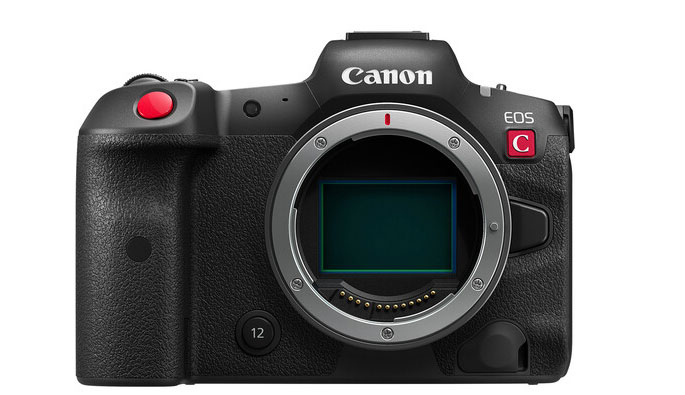 Canon R5C Image Canon is gearing up for a major announcement with the upcoming release of the Canon EOS C50 and not the Canon R6 Mark III as of now. The Canon C50 is said to be the direct successor of the highly popular camera, the Canon R5 C. The new full-frame camera with a new name will directly compete against the existing Sony FX3 camera, which is made for advanced filmmakers and cinematographers. The announcement is scheduled for September 9, 2025, just ahead of the IBC trade show. Canon has already posted the teaser and image of the upcoming camera, so now it’s not a rumor anymore; it’s confirmed news. Let’s explore further.
Canon EOS C50: What to Expect
The Canon C50 uses a 32MP full-frame BSI CMOS sensor, as confirmed by multiple sources. One of the earlier sources was reporting the presence of a 45MP sensor inside the Canon C50 body. The camera uses DIGIC Accelerator and a DIGIC X image processor, which will upscale the overall performance of the camera.
Although these are just the specifications, for professional filmmakers and cinematographers, it will inherit all the possible features that we have already seen in the Canon Cinema EOS series cameras, along with new features that will also be elaborated and showcased to the public at IBC 2025.
Canon’s strategic move with the C50 will certainly aim to capture the attention of new cinematographers and professional videographers who want a professional cinematic solution with a reasonable price tag and cutting-edge features. The upcoming Canon C50 will directly compete against Sony FX3 and will deliver enhanced video workflow, improved autofocus performance, and more professional-grade codecs, making it a stronger contender in the full-frame cinema camera market.
 Canon teaser of the upcoming Canon C50 Camera APS-C Cinema EOS Camera on the Horizon
In addition to the Canon C50 camera, Canon is also working on an APS-C-based Cinema EOS camera to directly compete against the Sony FX30 camera. At the time I am writing this article, it remains unclear when the model will arrive. For now, Canon is focusing on both full-frame and APS-C camera markets, and they will surely give an aggressive push to dominate the cinema market across multiple sensor sizes and budgets.
Why This Matters
The Canon Cinema C50 camera is a significant step in Canon’s effort to power up the entry-level cinematography camera line by introducing a professional video camera for cinematographers. The camera is a direct replacement for the Canon R5 C while inheriting the same core specifications of the Canon R5 Mark II and custom-tailored features specifically made for new cinematographers and filmmakers. Canon is actually addressing the growing demand for hybrid cameras that excel in both video and photography.
Update on IBIS Rumors (September 7, 2025)
A new source claims that the upcoming Canon C50 doesn’t have IBIS, so that’s really disappointing news for all of us to hear that news. Now, we are waiting for an official announceement from Canon on Sep 9, 2025 to to clarify this critical feature. Stay tuned for live updates!
The new announcement will certainly create a lot of buzz. For the latest updates and information, follow thenewcamera.com.
The article “Canon EOS C50 Set to Replace EOS R5 C, Targeting Sony’s FX3” was written by thenewcamera.com team on 6:17 pm, Monday, 1 September 2025, Greenwich Mean Time (GMT) | Follow us for more updates and Get LIVE RUMORS –> FACEBOOK | TWITTER | INSTAGRAM to get live news — > get live Camera News + Canon Rumors 24X7.
source – Canonrumor.com
By admin, on September 1st, 2025

It looks like theNikon will be going to redefine cinematography forever, after the acquisition of RED DIGITAL Cinema camera – a powerhouse in Raw video capture – Nikon has filed a patent, which clearly hints that the future Nikon Z cinema cameras will have an integrated revolutionary dual display system. So, this is not an incremental update; this is a revolutionary upgrade that has never been tried by any camera maker to date. Both of the displays will prove to be a game-changer for cinematographers. So, they can have seamless control over the optimised video processing.
The Patent Breakdown: A Stacked Sensor Powerhouse with Dual Displays
After reading the entire patent and analysing it briefly, we have seen that the camera is using a stacked CMOS sensor inside it, which has been clearly mentioned in the patent; even the structural design of the sensor has also been elaborated.
This back-illuminated setup layers an imaging chip, signal processing chip, and memory chip, connected via microbumps for lightning-fast data handling. The pixel region is divided into customizable blocks, allowing filmmakers/cinematographers to tweak imaging conditions like charge accumulation time, frame rate, gain, and thinning rates on a per-block basis.
The entire patent revolves around improving the post-production workflows, upscaling the video quality, and video performance of the camera. You are not going to find a single line that talks about the continuous frame rate or any photography-related specification enhancement. The entire patent is dedicated towards improving the overall cinematic workflow by upscaling the design part of the camera and introducing a new interface alongside with dual display system.
How Dual Displays Could Transform On-Set Workflows
What makes this patent truly exciting is the user-centric innovation done by Nikon’s research and development team, which makes the entire video workflow easier.
- The primary display (say, the larger first unit) is the primary display unit that shows the live feed from the camera sensor, just like you use a dedicated external display unit in your camera, which acts as a live view finder, showing a real-time composite feed from the sensor’s blocks.
- The secondary display flips open (via a hinge mechanism described in the patent) to become your control hub, better to say control panel. You can customize the quick control access screen as per your preference, at the very same time, the RED LUT table selection / and live LUT in preview will be a massive upgrade. Here, touch panels let you tweak settings on the fly: adjust frame rates, monitor waveforms, select HDR modes, or even browse thumbnails of recent takes. So, your eyes stay glued to the action while your fingers handle the tweaks.

Parallel Processing for Optimised Output
Beyond display, the system utilises dual image processing units, or more accurately, dual Expeed image processors. Parallel processors handle signals very well, without any lag, even while multitasking, and also enable real-time on-board optimisation for video. Users could assign one display to monitor raw output (e.g., from a high-gain night mode block) and the other to preview processed footage, for on-site advanced color correction, white balance, and color gradation adjustments spot-on before hitting record.
Why This Matters: Nikon’s Cinema Push in a Competitive Landscape
Nikon is not new to video. They already have the Nikon Z9 and Z8, which capture professional-level 8K Raw videos. After acquiring RED Digital Cinema, they now have access to more professional, pro-level cinematographic tools, and their research and development team is continuously working to upscale and integrate all those tools into the new age of upcoming Z-mount cinema release cameras.
The camera with a dual display unit clearly means less gear clutter in your bag—no need to carry external display monitors alongside you. The camera will help you by doubling the display unit and offering a brand-new control centre and live feed separately. Indie filmmakers can utilise the dual displays for solo shoots, while larger crews benefit from shared viewing.
Obviously, not all patents translate into real-world products. At the very same time, the filing is so recent—just a few weeks ago—that it’s hard for me to accept the fact that the upcoming Nikon Z Cinema camera on September 10th will have such a feature.
Let me know what you think, guys, about this patent, and obviously, would you love to see the dual display units in your cinema camera?
Below is a specification table derived from the patent details, summarizing all the key features from the document and technical aspects of the proposed Nikon cinema camera with dual displays.
Nikon Z Cinema Camera Specifications (from patent)
| Category |
Specification |
| Device Type |
Electronic device (e.g., Nikon Z Cinema Camera) |
| Imaging Element |
Stacked (back-illuminated imaging chip, signal chip, memory chip) |
| Chip Connection |
Microbumps (Cu or solder) |
| Pixel Arrangement |
Approx. Over 20 million pixels in matrix (pixel region 113A) for video |
| Unit Group |
16 pixels (4×4) or up to ~1,000 (e.g., 32×64) |
| Color Filter |
Bayer array (Green Gb/Gr, Blue B, Red R) |
| Sensor Control |
Drive unit (21) adjusts timing, frame rate, gain, thinning per block |
| Block Division |
Adjustable blocks with custom positions, shapes, ranges |
| Imaging Conditions |
– Charge time/number – Frame rate – Gain (ISO) – Thinning (0-0.5) – Row/column sums – Digitization bits |
| Image Processing |
– Dual units (30A, 30B) for parallel work – Frame extraction/discarding – Interpolation for smooth video – Simultaneous HDR |
| Display Unit |
– First display (51) with touch (52) – Second display (53) with touch (54), split (53L, 53R) |
| Display Functions |
– First: Composites, thumbnails, live view, menus – Second: Region images, enlarged thumbnails |
| Touch Panel |
Sends touch signals to system control (70) for selections |
| Operation Unit |
– Release switch (55a) – Video switch (55c) – Mode dial (55b) – Multi-selector (55d) for modes/HDR |
| Recording Unit |
– Dual card slots (61, 62) – Internal memory – Parallel region recording |
| System Control |
– CPU (70A) – Dividing unit (71) sets patterns – Drive control (72) adjusts conditions – Display control (73) manages output |
| Modes |
– Single region still – Multi-region high-speed still – Single region video – Mixed still+video |
| HDR Capability |
Two images with different exposures, selectable via multi-selector |
| Physical Design |
– First display on back – Second display rotates via hinge |
| Additional Features |
– Live view support – Detects main subjects (face, motion) – Flexible block patterns (checkerboard, columns/rows) |
The article “Nikon Z Cinema Cameras to Feature Dual Display – Patent Revealed” was written by thenewcamera.com team on 3:00 pm, Monday, 1 September 2025, Greenwich Mean Time (GMT) | Follow us for more updates and Get LIVE RUMORS –> FACEBOOK | TWITTER | INSTAGRAM to get live news — > get live news + Nikon Rumors 24X7
|
KEEP THIS BLOG ALIVE - Support New Camera Buy Canon Lenses, Buy Music CD or Digital Camera at amazon it helps this site, and you do not pay anything extra, it is just a way to help support this site.

|