Join More Than 50,000+ Subscribers and get latest camera news and rumors
NEW CAMERA VIDEOS ON YOUTUBE
|
By admin, on April 9th, 2026
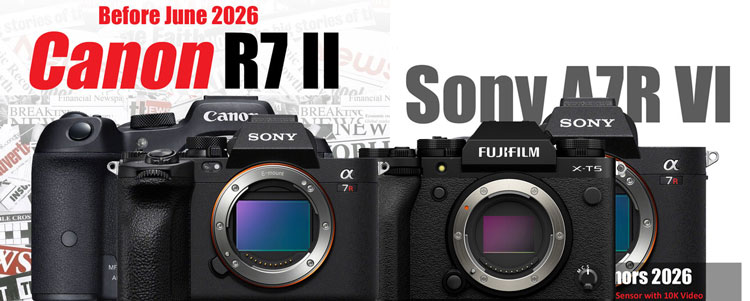
We have a list of cameras that are about to arrive within the next two to three months. Yes, we have already published details about the upcoming Canon R7 Mark II camera a few months ago. But recently, more details have emerged from a reputable source, E88_8888. who has uncovered new models registered with the China CMIIT wireless certification agency and is expected to arrive in the upcoming months.
Before we begin, we can be quite confident about two upcoming models: the Sony A7R VI (officially registered) and the Fujifilm X-T6.
For Nikon and Panasonic, there are several rumored models in the pipeline (such as various Z-series updates for Nikon and potential S1H II / S5R-style bodies for Panasonic), but we do not have clear, confirmed registration details or solid timelines for them yet.
2026 Camera Release Calendar – What’s Next?
Yes, as we have said, the Canon R7 II is already on the horizon, expected to arrive before June. The announcement may happen in May 2027. Other than R7 Mk II, the next set of cameras that are confirmed and loaded in the announcement pipeline are
| Brand |
Model |
Key Feature |
Expected Announcement |
Status |
| Fujifilm |
X-T6 (FF260001) |
X-Processor 6 + Wi-Fi 6 |
September 2026 |
Certified |
| Sony |
A7R VI (ILCE-7RM6) |
67–80 MP stacked sensor |
May 2026 |
Certified |
| Nikon |
N2324 (Z****) |
Affordable Z-series |
Q2–Q3 2026 |
Certified |
| Panasonic |
P2409A / P2501A |
Mid-range + entry-level |
Spring–Summer 2026 |
Certified |
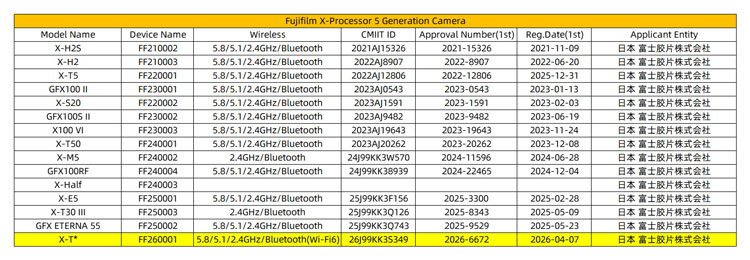
Why These CMIIT Certifications Matter: 100% Legit Early Signals
CMIIT (China MIIT) and SRRC filings are required before any camera with wireless features can enter the Chinese market. Historical accuracy exceeds 90% – these leaks have correctly predicted launches for years. So once the camera name appears here, rest assured the camera is in the announcement pipeline, and although sometimes, like with Nikon, we’re not able to clarify the model name, but with the help of sources and repeated rumours, you will soon find out what’s coming next from Nikon.
- Fujifilm FF260001: First X-Processor 6 model with tri-band Wi-Fi 6 (2.4/5.1/5.8 GHz).
- Nikon N2324: Dual-band wireless sibling to recent affordable Z bodies.
- Panasonic P2409A & P2501A: Dual-band and Bluetooth-only entries (registered earlier in Feb 2026).
- Sony ILCE-7RM6: Wi-Fi 6 high-res flagship.
These are not speculation — they’re official regulatory approvals dated April 7, 2026 (Fujifilm & Nikon) and February 2026 (Panasonic & Sony).
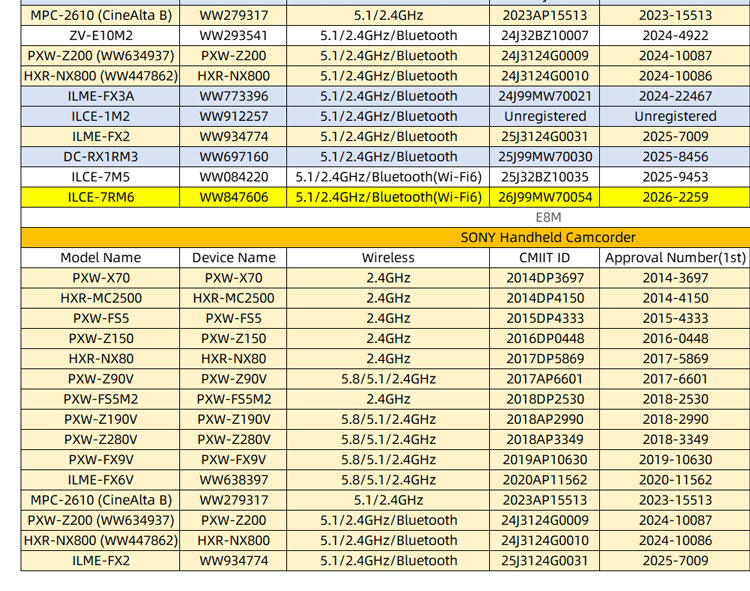
1. Sony ILCE-7RM6: The A7R VI High-Res Flagship
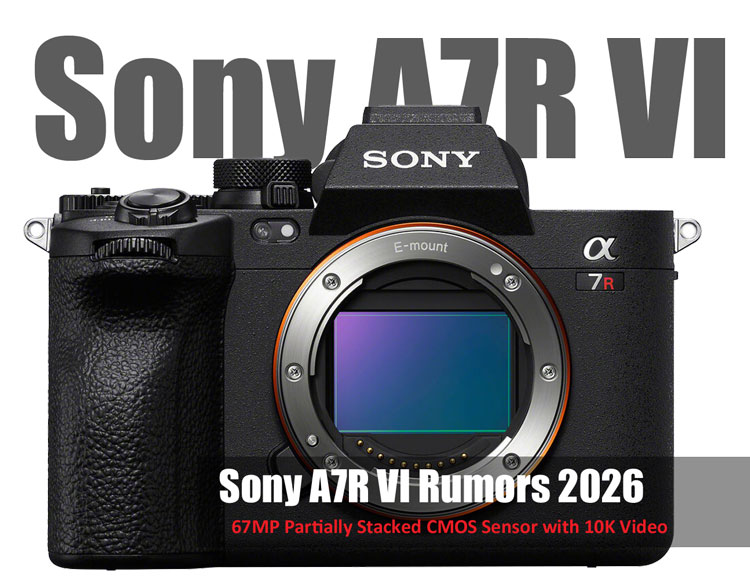
The Sony A7R VI camera is rumored to feature a 67-megapixel sensor. Not only that. The A7R VI is likely to arrive in Q4 of 2026.
Model Code: WW847606 (ILCE-7RM6)
Certification: 2026-2259 | CMIIT ID 26j99MW70054 | Reg. Date: Feb 4, 2026
According to rumors, Sony is about to introduce a 67-megapixel stacked CMOS sensor in the next-generation A7R VI camera, which is able to record up to 10k, which sounds really very interesting. Let’s dive deep into the details.
If the specs hold, this could be the sensor that finally lands in the Sony A7R VI (or a high-end A7R VI body) and gives hybrid photographers and videographers the ultimate stills + cinema tool.
Wireless: 5.1/2.4 GHz + Bluetooth (Wi-Fi 6)
Sony’s next high-resolution beast is already in the pipeline. Consistent leaks point to:
-
- 67–80 MP stacked sensor
- 8K–10K video
- Near-zero rolling shutter
- Vastly improved AI tracking
- 8.5+ stops IBIS
- New body design
Timeline: Strong rumors suggest a May 2026 announcement — possibly alongside new GM lenses. Sony’s pattern of flagship drops every 2–3 years fits perfectly after the A7R V.
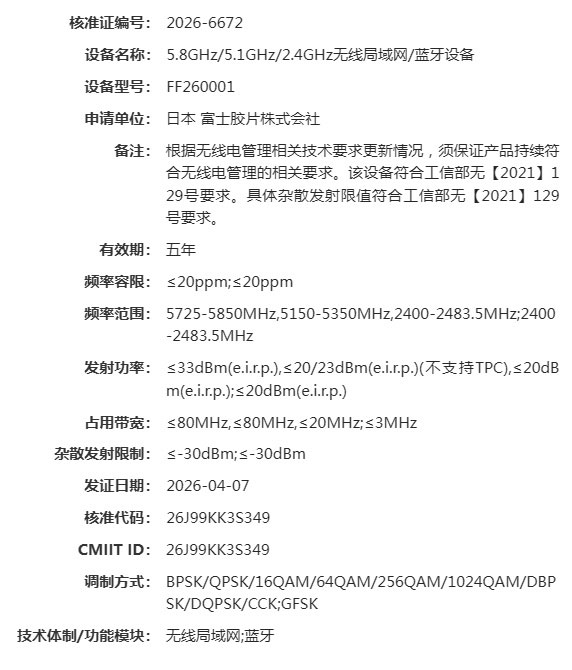
2. Fujifilm FF260001: The X-T6 Arrives with X-Processor 6 and Wi-Fi 6
Model Code: FF260001 (listed internally as X-T*)
Certification: 2026-6672 | CMIIT ID 26j99KK3S349 | Reg. Date: April 7, 2026
Wireless: 5.8/5.1/2.4 GHz + Bluetooth (explicit Wi-Fi 6 for the China region)
This is the first camera on Fujifilm’s brand-new 6th-generation platform. The jump from X-Processor 5 (X-T5) to X-Processor 6 is expected to bring massive gains in autofocus, video, and processing speed. Already registered and about to arrive means we have 100% percent about them
Apart from this, there are also some strong rumours related to the next generation of X pro camera, which is expected to arrive this year, but in this article, we are only concentrating on those cameras that are already registered and about to arrive, which means we have one hundred percent certainty about them
Rumored X-T6 Specs (Consistent Across Rumor Mills):
- 40MP partially-stacked X-Trans VI sensor (or higher-res HR variant)
- 8K video capability (30p or higher, with oversampled 4K)
- AI-driven subject detection and tracking
- 8+ stops IBIS
- Up to 200MP Pixel Shift mode
- Fully articulating screen (upgrade over X-T5’s 3-way tilt)
- Faster burst rates and dramatically improved rolling-shutter performance
Release Timeline: Multiple sources (FujiRumors, KF Concept, Vietnamese retailer leaks) point to a September 2026 announcement. This aligns perfectly with Fujifilm’s historical pattern of major X-series bodies in spring/summer.
The X-T6 is shaping up to be Fujifilm’s “full-frame killer” APS-C flagship — exactly what enthusiasts have been waiting for since the X-T5 launched in late 2022.
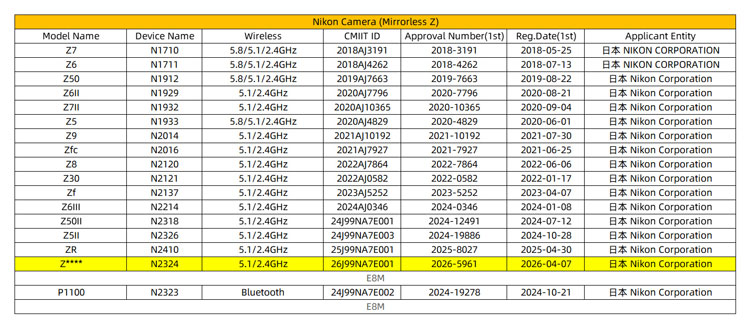
3. Nikon N2324: New Affordable Z-Series Body Incoming
Model Code: N2324 (listed as Z****)
Certification: 2026-5961 | CMIIT ID 26j99NA7E001 | Reg. Date: April 7, 2026
Wireless: 5.1/2.4 GHz (dual-band only)
NikonRumors also confirmed this filing immediately. E88_8888 describes it as a “sibling to the Z50 II, Z5 II, and P1100” — meaning it’s an accessible/mid-tier Z body, likely without an EVF or aimed at vloggers/entry-level users. But, basically, we have to wait for more confirmation on this before jumping specifically to a camera name. Although we do have published an article “Nikon ZRc, Nikon Z500, Nikon ZFC II and Z30 II Specs & Release Rumors Revealed by Matt”, so you can have a clear glimpse of upcoming DX format cameras from Nikon by Nikon PRO Matt itself
Timeline: Q2–Q3 2026 announcement expected (typical 3–6 months after certification).
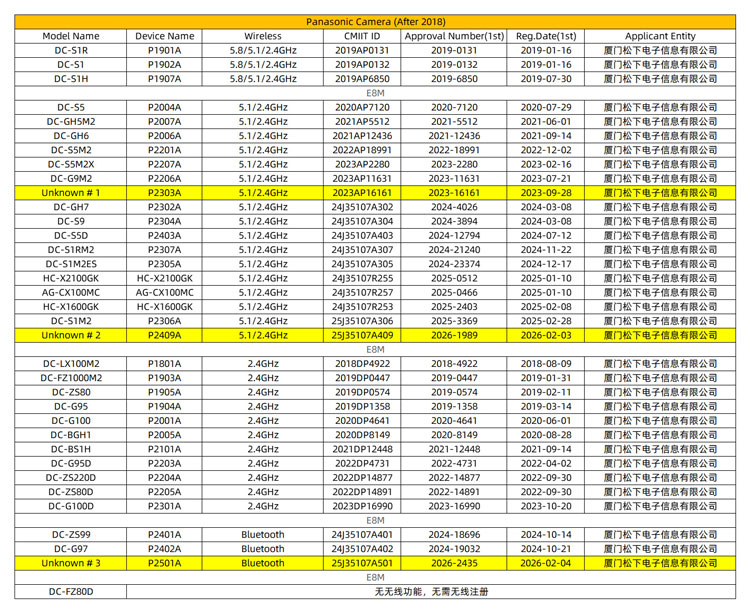
4. Panasonic P2409A & P2501A: Two New Lumix Models Certified
P2409A (Unknown #2)
- Dual-band Wi-Fi (5.1/2.4 GHz)
- CMIIT ID 25j3S107A409 | Approval 2026-1989 | Feb 3, 2026
P2501A (Unknown #3)
- Bluetooth only
- CMIIT ID 25j3S107A501 | Approval 2026-2435 | Feb 4, 2026
Panasonic Next camera, we do have some rumours about the arrival of the Panasonic S1H Mark II camera, and the update is overdue, and the fans are waiting restlessly for the S1H Mark II. Let’s see if the recent camera fulfils the fan demand. All we are keeping an eye on the registration details as well as the latest Panasonic rumours from sources, and we will be updating.
Panasonic 2026 Outlook: Focused on full-frame S-series updates and occasional compacts. Rumors mention possible S1H II, G100 II, or new affordable point-and-shoot models. Panasonic typically announces 3 – 6 months after foreign certifications.
2026 Camera Release Calendar – What’s Next?
| Brand |
Model |
Key Feature |
Expected Announcement |
Status |
| Fujifilm |
X-T6 (FF260001) |
X-Processor 6 + Wi-Fi 6 |
September 2026 |
Certified |
| Sony |
A7R VI (ILCE-7RM6) |
67–80 MP stacked sensor |
May 2026 |
Certified |
| Nikon |
N2324 (Z****) |
Affordable Z-series |
Q2–Q3 2026 |
Certified |
| Panasonic |
P2409A / P2501A |
Mid-range + entry-level |
Spring–Summer 2026 |
Certified |
Overall 2026 Outlook: A blockbuster year. Fujifilm and Sony are delivering generational leaps first, Nikon is refreshing its accessible lineup, and Panasonic continues steady updates with a possible compact revival.
These certifications mean the hardware is locked in — expect official teasers and announcements within weeks to months.
Stay tuned to TheNewCamera.com for full specs, hands-on previews, and price details as they drop. Which of these upcoming cameras are you most excited about — the Fujifilm X-T6, Sony A7R VI, or something else? Drop your thoughts in the comments below!
GET LIVE NOTIFICATION, Select Your Trusted Source GET LIVE NOTIFICATION Click ON Check  BOX for Latest NEWS and Rumors BOX for Latest NEWS and Rumors
The article “Upcoming Cameras 2026: Sony A7R VI, Fuji X-T6, Nikon Z and Panasonic Models Get Official CMIIT Green Light” was written by thenewcamera.com team on 3:48 pm, Thursday, 9 April 2026, Greenwich Mean Time (GMT) | You can also follow us on Our Official Social Media Handles FACEBOOK | TWITTER | INSTAGRAM to get live news — > DJI Rumors

By admin, on February 23rd, 2026
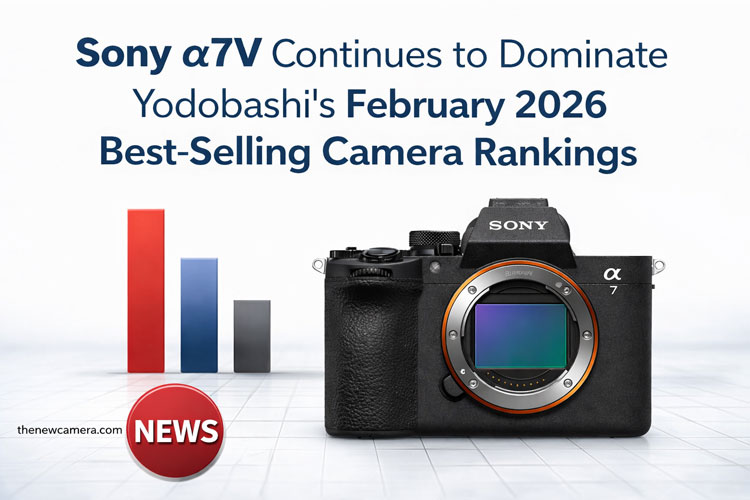
Now we have a fresh set of rankings from CAPA CAMERA WEB, and according to them, the Sony α7 V has secured the number one spot on the February 2026 best-selling list of cameras. The Sony α7 V camera is slowly leading the ranking chart of best-selling cameras, not only in Japan but also in the United States of America. Specifically, when we talk about full-frame sensor-based cameras, the Sony α7 V ranks as the number one best-selling full-frame camera on Amazon USA, ahead of the Canon EOS R6 Mark II. [Best-selling mirrorless Amazon USA] This marks the third consecutive win for the α7V since its debut in late December 2025 in Japan, solidifying its position as a must-have for photographers and videographers alike.
Top 10 Best-Selling Interchangeable Lens Cameras at Yodobashi (February 1-15, 2026)
Here’s the complete top 10 list based on sales data:
| Rank |
Camera Model |
Brand |
| 1 |
Sony α7 V Body |
Sony |
| 2 |
Hasselblad X2D II 100C Body |
Hasselblad |
| 3 |
Sony α7C II Zoom Lens Kit |
Sony |
| 4 |
Fujifilm X-T30 III XC13-33mm Lens Kit |
Fujifilm |
| 5 |
Sony α7C II Body |
Sony |
| 6 |
Sony VLOGCAM ZV-E10 II Double Zoom Lens Kit |
Sony |
| 7 |
Nikon Z50II Double Zoom Kit |
Nikon |
| 8 |
Canon EOS R50 Double Zoom Kit |
Canon |
| 9 |
Canon EOS R10 RF-S18-150 IS STM Lens Kit |
Canon |
| 10 |
Fujifilm X-E5 XF23mm Lens Kit |
Fujifilm |
Sony α7 V is not only getting high rankings from December to January and through February in the CAPA CAMERA WEB rankings, but we also published the Map Camera rankings for December on January 17, and according to that, the α7 V, just after its announcement, also topped the Map Camera ranking chart.
Why the Sony α7V is Crushing the Competition
This is not a surprise coming out of nowhere. The Sony α7 V features an exceptional set of specifications, including a 33-megapixel partially stacked CMOS sensor. It also includes the latest BIONZ XR image processor with a built-in AI unit—for the first time in a Sony Alpha camera.
Additionally, AI subject recognition and auto framing have been improved. With the Sony α7 V, you can easily shoot 4K video recordings up to 30p and 60p (with a Super 35mm crop) in 10-bit 4:2:2 format. It also supports up to 7.5 stops of image stabilization for stills and Dynamic Active image stabilization for video.
So, having all these features makes this camera appealing to users at the given price point, and that’s possibly why it has been trending in the number one position for the past three consecutive months in Japan.

Best Lenses for Sony A7V Here [Updated 2026 Guide]
Sony leads overall with four models in the top 10 (including three variations of the α7 series), showcasing the brand’s strong market presence. The α7C II, in particular, holds steady in third and fifth places, thanks to its compact design and excellent value for content creators.
Standouts from Other Brands
Hasselblad X2D II 100C Body (2nd Place): That’s a really big surprise since Hasselblad isn’t a cheap camera, nor is it made in Japan, but most likely a new generation of photographers and content creators love to experience the ultimate bliss in photography, and may be thats why they are choosing it.
Rising from third in previous rankings, this medium-format camera continues to impress with its long-term popularity. It’s a testament to the demand for high-end, specialised gear among serious photographers.

Hasselblad X2D 100C 100MP Medium Format Mirrorless Camera: Electronics
Sony α7C II (3rd and 5th Places): This is one of the most popular Sony cameras of the past two years, and it consistently stays in the top five, or at least the top 10 list, all the time. The name is the Sony α7C II. People love this camera due to its affordability—it is kind of a budget-oriented model while still offering solid photography options with a 33MP BSI sensor and 4K 30p video recording capability.
Overall, this full-frame camera from Sony is perfect for those who want high-quality images and videos on a budget in the full-frame segment. Its zoom lens kit version edges out the body-only option, suggesting buyers prefer ready-to-shoot packages.

Sony Alpha 7C II Full-Frame Interchangeable Lens Camera
- Fujifilm’s Strong Showing: With the X-T30 III in fourth and X-E5 in tenth, Fujifilm proves that affordable, retro-styled cameras still have a place. The X-T30 III, in particular, punches above its weight in value, holding its position from last month.
- Nikon and Canon Lagging Slightly: Both brands feature APS-C models lower in the list (Nikon Z50II at 7th, Canon EOS R50 and R10 at 8th and 9th). While these are solid entry-level options, full-frame dominance from Sony and Hasselblad suggests a shift toward premium gear in early 2026.
Recent trends from Yodobashi’s 2025 year-end rankings showed compact cameras like the Fujifilm X100VI leading overall, but in this February snapshot, mirrorless full-frames are stealing the show.
What This Means for Camera Buyers in 2026
If you’re in the market for a new camera, these Yodobashi rankings are a great indicator of real-world popularity. The α7V’s streak raises the question: Can it maintain this lead through the rest of the year? With competition heating up from Nikon, Canon, and Fujifilm, we’ll be watching closely.
GET LIVE NOTIFICATION, Select Your Trusted Source GET LIVE NOTIFICATION Click ON Check BOX for Latest NEWS and Rumors
The article “Sony α7V Continues to Dominate Yodobashi’s February 2026 Best-Selling Camera Rankings” was written by thenewcamera.com team on 3:14 pm, Monday, 23 February 2026, Greenwich Mean Time (GMT). | You can also follow us on Our Official Social Media Handles FACEBOOK | TWITTER | INSTAGRAM >see more Sony Alpha Rumor Latest Camera News
Best Mirrorless Cameras Under $500 in 2026

Canon R10 Mark II Rumors: 2026 Release Date, Specs, and FCC Insights

By admin, on February 20th, 2026

According to reliable sources, a Sony 16 megapixel sensor prototype has been spotted being tested in the wild. Now, just after that, speculation started that the 16 MP partially stacked sensor is expected to be used in Sony Cinema camera lineup, like the upcoming rumoured FX3 Mark II camera. At the very same time, it can also be integrated into future models of the Sony A7S IV. That is the Sony A7S Mark IV camera, which is also rumoured to arrive sometime in 2026. Already, it has been delayed a lot, but people are still waiting for its update.
With the 16 MP rumour, we are going to explore what other updates we have related to the prototype, which has been reported by the reliable sources of the rumour mill, as well as the other set of information we have related to these upcoming Sony Cinema cameras.

What We Know About the New Sony 16MP Partially Stacked Sensor
Even before we begin discussing the camera, let’s discuss the sensor. The sensor is not new. It has been reported earlier,16MP partially stacked sensor is a homegrown sensor from Sony, fully stacked. Have a look at the core specifications of the sensor
Here’s a breakdown of the rumored key specifications:
- Resolution: 16 megapixels (full-frame)
- Sensor Type: Partially stacked CMOS
- Video Capabilities: Near 5K recording with oversampling to 4K for superior image quality
- Readout Speed: 240fps—double that of the Sony A7V’s 120fps
- Autofocus: 120fps compatible two-point PDAF (Phase Detection Autofocus) system using all pixels
- Stabilization: Active image stabilization with minimal crop impact
- HDR Technology: DCG-HDR (Dual Conversion Gain HDR) for enhanced dynamic range in both stills and video
- Pixel Pitch: 7.2μm for exceptional low-light performance
Obviously, it has some recording limitations due to the limited 5K capability, not even stretching up to 6K. So I do have some serious doubts about whether that is going to be used inside the Sony FX3 Mark II or the Sony A7S IV

Sony’s Strategy and Limitations
We have the Sony FX2 camera, which does use a 33-megapixel CMOS sensor, but its recording capability remains stuck to 4K 60p, and we are not able to access 4K 120p in FX2. Now, with the help of the 16MP stacked CMOS sensor, Sony can push 4K recording up to 240 frames per second, despite the resolution limitation. So it would be quite interesting to see whether the Sony FX3 Mark II will use the new 16MP stacked CMOS sensor, which can push the 4K capturing speed up to 240fps, or if they are going to unlock the 7K 30fps recording capability of the 33-megapixel partially stacked sensor
As of the announcement on December 16, 2021. Sony Develops World’s First 1 Stacked CMOS Image Sensor Technology with 2-Layer Transistor Pixel
Sony does have an upper hand in sensor tech, but over the past 3 to 4 years, what we have seen is that they are pushing sort of limited updates in their camera. Like in the Sony A7V, we do not have any option to access open gate or 6K / 7K recording as we have in Nikon Z6 III or ZR or even Canon R6 III. Even in a pro Cinema camera like FX2, open gate recording is completely locked, and we do not even have an option to record 4L at 120p.

Release Timeline and What It Means for Creators
We discussed the release timing of the Sony FX3 Mark II camera as well as the Sony A7S Mark IV camera. Just before that, I must tell you that there is also one more camera which is rumoured to arrive—the Sony A7R VI. We covered the rumour in detail in our previous post, and you can look at that article to get more details.
Between the Sony FX3 Mark II and the Sony A7R VI, either of these cameras can arrive in the first half of 2026, likely in the second quarter of 2026. We may have the announcement of the next Sony cinema-style camera, and it can be anything for now, since there are multiple rumors related to the arrival of the Sony A7R VI as well as the Sony FX3 Mark II. So we are not putting any confirmation mark over any camera body name. As for the Sony A7S Mark IV, it is expected to arrive sometime in late 2026 or in the first half of 2027. This is the initial set of information we have related to the upcoming Sony cameras.
Pricing? Expect FX3 II around $3,500-$4,000, A7S IV maybe $3,000 if Sony undercuts to compete.
For creators, this could be a game-changer: Affordable 4K 240fps, HDR video that pops, and stabilization that lets you run-and-gun without gimbals. But if Sony locks open gate behind paywalls, it’ll frustrate. We’ll watch the leaks—stay tuned for updates. If this sensor delivers, Sony might reclaim video crown from Nikon and Canon.
GET LIVE NOTIFICATION, Select Your Trusted Source GET LIVE NOTIFICATION Click ON Check BOX for Latest NEWS and Rumors
The article “Sony 16MP Partially Stacked Sensor in FX3 II and A7S IV – Latest Sony Rumors February 2026” was written by thenewcamera.com team on 1:35 pm, Friday, 20 February 2026, Greenwich Mean Time (GMT). | You can also follow us on Our Official Social Media Handles FACEBOOK | TWITTER | INSTAGRAM >see more Sony Alpha Rumor Latest Camera News
source – sonyalpharumor [website]
Sony α7R VI or FX3 Mark II: Full List of Upcoming Mirrorless Cameras 2026-2027

By admin, on February 11th, 2026

Getting a lot of scattered posts online about the arrival of the Sony α7R VI camera, and there are also articles claiming the Sony FX3 Mark II is coming next.
The claim about the Sony FX3 Mark II camera’s arrival comes from one of the trusted rumour mills, SonyAlphaRumors, while other websites we consider trusted names in the industry, like PhotoRumors, are reporting that the Sony α7R VI camera announcement is on its way. They have also published the possible core specifications of the upcoming A7R VI camera. So in this article, we are going to discuss the probability of arrival of both cameras and the facts we have so far.

Starting from the FCC ID registration details of a flagship camera WW847606, which have been revealed recently in February 2026, the registered model code of the camera is being linked either to the Sony FX3 Mark II, which is expected to arrive sometime in April 2026, or to the Sony α7R VI. The registered model uses the same Wi-Fi unit that we have seen in the Sony α7 IV camera, and it is being manufactured in Japan. We all know that generally Japan is the place where Sony manufactures high-end mirrorless cameras, and that clearly indicates that among the Sony α7 series, it can be one of these two cameras.
Now the big question is why the entire internet is divided between these two cameras. Why are we not talking about any other Sony flagship full-frame mirrorless camera or APS-C camera for now?
Looking at Sony’s scheduled announcement pattern and their mirrorless camera update timeline, obviously, the Sony FX3 Mark II and the Sony α7R VI are due for an update. Other than that, we have the Sony α6900 camera, the Sony α6200 camera on the list, and the Sony α7S series is also overdue. People are waiting for the Sony α7S IV camera, but we have very few rumours related to it.
Upcoming Sony Mirrorless and Compact Cameras (2026-2027)
Based on Sony’s historical announcement patterns—such as refreshing full-frame mirrorless lines every 3-4 years (e.g., A7R series gaps lengthening from 20-39 months), APS-C models every 2-4 years, Note that Sony often announces high-end cameras in Q1-Q2 or Q4, with major pushes expected mid-2026 onward as part of a broader “offensive” in product launches.
| Model |
Type |
Expected Year |
Rumored Release Notes and Features |
| Sony FX3 II |
Mirrorless (Full-Frame Cinema Hybrid) |
2026 (March/April) |
Update to the 2021 FX3 with a partially stacked low-resolution sensor for improved readout speeds and low-light performance; WiFi 6 support; positioned to compete with Nikon Zr and Canon C50; registered in China as a high-end model. |
| Sony A7R VI |
Mirrorless (Full-Frame High-Resolution) |
Late 2026 or 2027 |
Successor to the 2022 A7R V; expected 61MP or higher sensor with partial stacking for reduced rolling shutter and better ISO; aligns with 4-year refresh cycle; focus on AI autofocus enhancements. |
| Sony A6900 |
Mirrorless (APS-C) |
2026 |
High-megapixel APS-C update (possibly 40MP+); improved sensor, EVF, burst rate, and ergonomics; follows 2023 A6700, targeting mid-range photographers; may merge features from A6100/A6400 lines. |
| Sony A6200 |
Mirrorless (APS-C Entry-Level) |
2026 |
Potential budget APS-C model combining A6100 and A6400 features; $1000 price point; no major updates rumored beyond standard refreshes. |
| Sony A7S IV |
Mirrorless (Full-Frame Video/Low-Light) |
2026-2027 |
Update to 2020 A7S III with 24MP stacked sensor, triple base ISO, and 6K video; rumors mixed on timing, possibly tied to broader video line refresh; not imminent per some sources. |
| Sony A7C III |
Mirrorless (Full-Frame Compact) |
2026-2027 |
Compact rangefinder-style update; improved autofocus and connectivity; low-priority rumor but fits Sony’s pattern of niche refreshes. |
| Sony ZV-E1 II |
Mirrorless (Full-Frame Vlogging) |
2026 |
Vlogging-focused update with better stabilization and AI features; alternative to FX3 II in some leaks. |
| Sony RX100 VIII |
Compact (Point-and-Shoot) |
2026 |
Successor to 2019 RX100 VII; simpler body with modern autofocus, better connectivity, and sensor updates; revival amid compact camera trend. |
Sony’s major camera announcement before July 2026
if anyone knows the announcement pattern of Sony and their mirrorless camera system, then obviously the two cameras that can be there are the Sony FX3 Mark II as well as the Sony α7R VI, which are on the top priority list for the 2026 and 2027 announcements. Other than that, the set of information we have received from the FCC ID also points toward the same.
But the most important part of the FCC ID process is that it gives 180 days of time to announce their product, since after 180 days, the external and internal test images of the product registered with the FCC ID go public. That clearly indicates the camera that Sony has registered in the month of February 2026 will officially arrive sometime before July 2026.
Sony A7R VI specification
- It uses a full-size stacked sensor with an effective pixel count of 80 million.
- The A7RVI is currently in a small-scale testing phase and is equipped with a BIONZ XR2 processor and boasts 8.5 stops of image stabilization.
- It is capable of continuous shooting in 14-bit RAW at 30fps.
- Equipped with RAW pre-capture function.
- 60fps with AE/AF tracking.
- Equipped with a high-resolution shooting function that combines 16 images.
- Noise-reducing composite shooting is possible by combining up to 32 images.
- The grip has been redesigned, with a deeper handle shape like the α1II.
- The maximum brightness of the rear LCD monitor is 50% higher than that of the α1II.
- This camera is considered a big step up from the A7V, and is positioned more like the A7RIII and A7III did back then.
- Does not support open gate, RAW video, or 6K HEVC.
- Supports 8K30p with 10.9K oversampling in full frame, 4K60p with 7.1K oversampling in APS-C, and 4K120p with 5.5K (pixel binning) oversampling in full frame.
- Stills can be shot at 30fps, but there is a strict limit on the number of shots that can be taken.
- The dynamic range is superior to that of the mechanically shuttered α7RV even when using the electronic shutter, achieving a dynamic range of over 16 stops when the mechanical shutter is enabled.
- The LCD monitor on the rear panel has more pixels than the α7V. The electronic shutter readout speed is slightly faster than before, but it is still only about one-third the speed of the α1II.
Well, these specification is coming from websites like Photorumors, but there’s no mention of the source or its authenticity, so it’s hard to say how reliable it is, but if it really does use an 80-megapixel stacked sensor, the α7RVI will likely be a big leap forward from the current α7RV. While the pixel count has increased, continuous shooting, video, and dynamic range have also been significantly improved, making it an impressive spec if true. However, despite being a stacked sensor, the electronic shutter speed is only one-third that of the α1II, which raises some questions. Is it a partial stacked sensor? Price-wise, expect it to land around $4,000-$4,500, positioning it as a premium stills monster. Sony’s clearly ramping up for a big year, so keep an eye on those certification deadlines—whatever drops before July will set the tone for the rest of 2026.
The article “Canon G7 X Mark III 30th Limited Edition in High Demand, Shipping Starts from April 28, 2026” was written by thenewcamera.com team on 6:46 am, Sunday, 8 February 2026, Greenwich Mean Time (GMT) | You can also follow us on Our Official Social Media Handles FACEBOOK | TWITTER | INSTAGRAM to get more live Camera News + Canon Rumors 24X7
source: sonyalpharumor | Photorumor

Canon G7 X Mark III 30th Limited Edition in High Demand, Shipping Starts from April 28, 2026

By admin, on December 29th, 2025

Update History: 7:59 pm, Thursday, 19 February 2026, Greenwich Mean Time (GMT) — Initial launch with live Amazon/B&H pricing. Prices as of 10 AM EST—live widgets below fluctuate daily.
(We’ll refresh prices, rankings, and availability daily at 10 AM EST—check back for the latest Amazon flash sales and B&H bundles. Subscribe for alerts on new budget mirrorless drops like rumored Nikon Z30 refreshes.)
The most up-to-date photography guide for the best mirrorless cameras under $500. You are planning to buy an entry-level camera under $500; this guide has a very comprehensive and exhaustive list of 15+ cameras that are picked (sourced from Amazon best-sellers and B&H top-sellers), sorted by value score (rating × reviews/price), with interactive tables for easy comparison. The best part of this guide is that the prices are updated in real-time, focusing on Amazon and B&H Digital camera inventory systems, as well as USA pricing with daily updates. Specifically, we are doing this to give you the best possible options available and to capture price drops and new stock.
Now, under $500 is a sweet spot for budget mirrorless cameras in 2025. Many users, including entry-level photographers and hybrid shooters, appreciate having a camera within budget. Any student or beginner who is starting or trying to understand how photography works doesn’t want to invest a lot in a camera or lenses, so they generally look for a camera available under $500 in new models.
We do have some options, such as the Canon EOS R100, which comes with its kit lens for under $500. If you look at the refurbished set of cameras, then we also have some options from Sony, and in Micro Four Thirds, we have options like the Panasonic Lumix G7. So, there are a lot of choices available with crop-sensor bodies out there.
Specifically, if you’re searching for “cheap mirrorless camera for beginners” or “best entry-level APS-C under 500”, this is your toolkit—complete with pros and cons, spec breakdowns, and affiliate links for seamless purchases.
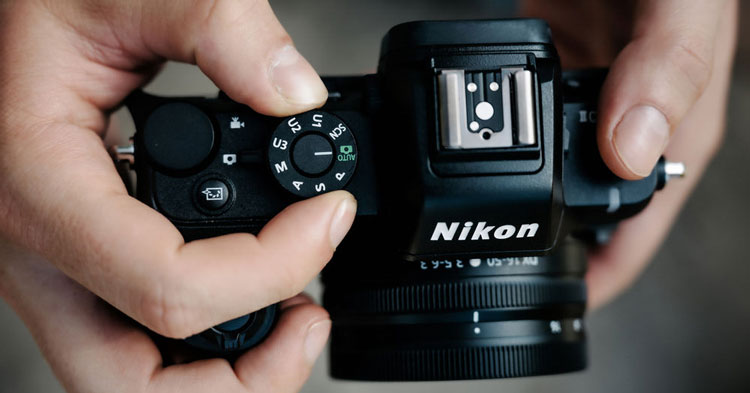
Why Choose a Mirrorless Camera Under $500 in 2026?
As a beginner, why do you need to spend more than $500 when everything you need—whether you’re starting for photography, hybrid shooting, or only videography, including 4K video—is already available in this range? First, you need to understand how the camera operates overall. You need to determine whether you are comfortable with your new camera or not, or whether you still prefer to use a smartphone all the time. It all depends on usability and comfort.
The amount you invest at the very beginning versus later stages is important. In the initial phase, I would highly recommend starting with a reference camera, a used camera, or a basic and reliable camera. Make yourself comfortable with the camera. If you feel that, yes, you can use it as your day-to-day tool in your workflow or for any purpose you are interested in, then you can invest more in the future.
But at the starting point, it is not recommended to invest a huge amount of money in your camera, gear, or lenses.
Now, take a look at the advantages that we are getting with a camera under $500.
- 4K Video Boom: Most under-$500 options now hit 4K/24p or better, rivaling $1,000 rigs for YouTube creators.
- Autofocus Evolution: Dual Pixel or Eye AF tracks subjects like a boss, even on moving pets or kids.
- Ecosystem Growth: Canon’s RF, Sony’s E-mount, and Panasonic’s L-mount have affordable primes under $200.
- Sustainability Angle: Refurbs from Amazon Renewed or B&H Used cut e-waste while saving 20-30%.
Drawbacks? Yes. The entry-level bodies do have some drawbacks when compared to a more expensive body, especially when you are spending $1,000 or more on a full-frame camera. Then, obviously, you are getting a bigger sensor, better performance, and more innovative, artificial intelligence–based AF tracking, and the list is quite extensive.

Top 5 Best Mirrorless Cameras Under $500 (Quick Picks)
Handpicked for max value: Beginners prioritize ease (Canon), vloggers want flip screens (Sony), travelers seek IBIS (Olympus). Prices fluctuate—please embed live widgets below for accurate information. (Live Amazon/B&H Data: Only 2 new kits under $500 today—refurbs expand options.)
| Rank |
Model |
Price (USD) |
Key Highlight |
Best For |
Rating (Reviews) |
Buy Now |
| 1 |
Canon EOS R100 + 18-45mm Kit |
$499 |
24.1MP APS-C, 4K/24p, Dual Pixel AF |
Beginners & Stills |
4.5 (789) |
Amazon |
| 2 |
Panasonic Lumix G7 + 14-42mm Kit |
$497.99 |
16MP MFT, 4K/30p, 5-axis IBIS tease |
Video Enthusiasts |
4.5 (1,996) |
Amazon |
| 3 |
Sony A5000 + 16-50mm Kit (Refurb) |
$398 |
24.3MP APS-C, 1080p/60p, 11fps Burst |
Vloggers & Speed |
4.6 (5,000+) |
Amazon Renewed |
| 4 |
Canon EOS M3 + 18-55mm Lens (Used like New – B&H 90 Days Warranty) |
$489 |
24.3MP APS-C Hybrid AF Sensor, 1080p 60p, ISO 25600 |
Photography and Travel |
4.7 (1,200) |
B&H Store |
| 5 |
Canon EOS M50 Mark II + 15-45mm Kit (used like new) |
$492.25 |
24.1MP APS-C, 4K/24p, Vari-Angle Screen |
Content Creators |
4.5 (2,000+) |
B&H Store |
These top picks dominate Amazon’s mirrorless best-sellers under $500, with the Canon R100 leading for its RF-mount future-proofing (TechRadar calls it “the cheapest new mirrorless in 2025”). For daily updates, we’ll replace risers like the Nikon Z50 if prices drop below $460.
Full List: 15 Best Budget Mirrorless Cameras Under $500 (Comparison Table)
Now we are diving deep into Handpick Guide, a full list of 15 mirrorless cameras. Those who are the best and available under $500: 15 options from Amazon/B&H stock (new/refurb/used). Sorted by value score for quick scans. Prices as of Dec 28, 2025; click for live deals. Slim new options today—focus on certified refurbs for value.
| Rank |
Model |
Price (USD) |
Key Highlight |
Best For |
Rating (Reviews) |
Buy Now |
| 1 |
Panasonic Lumix G100D with 12-32mm (Refurb- Good as new) |
$571 |
20.3MP Digital Live MOS Sensor, 5-Axis Hybrid Image Stabilization, 4K V-Log L |
Vloggers and Photographers |
4.6 (100+) |
B&H |
| 2 |
Nikon 1 J5 Mirrorless Digital Camera w/ 10-30mm PD-ZOOM Lens |
$448-$328 |
Budget king for stills, 1-inch HYBIRD CMOS sensor, Vlog Ready 4K Video |
Vloggers & Speed |
4.7 (3,000+) |
Amazon.com |
| 3 |
Sony A5000 + 16-50mm Kit (Refurb) |
$489 |
24.3MP APS-C, 1080p/60p, 11fps Burst |
Travel Portraits |
4.2 (400) |
Amazon |
| 4 |
Canon EOS M3 Body (Used like New – B&H 90 Days Warranty) |
$379 |
24.3MP APS-C Hybrid AF Sensor, 1080p 60p, ISO 25600 |
Photography and Travel |
4.7 (1,200) |
B&H Store |
| 5 |
Canon EOS M5 (Renewed) ONLY 1 in STOCK |
$510 |
24.3MP APS-C, 1080p/60p, 11fps Burst |
Street & Travel |
4.4 (600) |
Amazon |
| 6 |
Canon EOS M50 Mark II + 15-45mm Kit (Refurb) |
$492 |
16.1MP APS-C, 4K/24p, Vari-Angle Screen |
Content Creators |
4.5 (2,000+) |
B&H Store |
| 7 |
Nikon Z30 Mirrorless Camera (Used like New – B&H 90 Days Warranty) |
$497 |
2.02 MP APS-C, 4k 30fps, Vari-angle Display Screen |
Vlogging /Photography |
4.5 (800) |
B&H Used |
| 8 |
Canon EOS R100 + 18-45mm Kit [NEW] |
$499 |
Pro IBIS (5.5 stops), weatherproof |
Action & Wildlife |
4.8 (1,000) |
Amazon |
| 9 |
Fujifilm X-T10 – Body Only [used] |
$475 |
16.3 MP APS-C X-Trans CMOS II Sensor, EXR Processor II |
Travel & Photography |
4.7 (1,200) |
Amazon |
| 10 |
Sony NEX-7 Pro APS-C cam (used) |
$498 |
24.3 MP Hybrid CMOS AF, 1080 60p, tiltable LCD, OLED EVF |
Photography Enthusiasts |
4.5 (1,996) |
Amazon |
| 11 |
Panasonic Lumix G100D Mirrorless Camera with 12-32mm Lens – Creator Grip – Good as NEW |
$557 |
20.3MP Digital Live MOS Sensor, 5-Axis Hybrid Image Stabilization, 4K V-Log L |
Vloggers and Photographers |
4.4 (700) |
B&H |
| 12 |
Nikon Z50 Mirrorless Camera BODY ONLY (used like new) |
$538 |
20.9MP DX-Format CMOS Sensor, UHD 4K and Full HD Video Recording, 209-Point Hybrid AF, Eye Detection |
Hybrid Shooters / Photographers |
4.7 (800) |
B&H Store |
| 13 |
Canon EOS 5D Mark II Full Frame DSLR Camera [Body Only] Renewed |
$528 |
Full Frame Pro Camera for Photographers |
Street & Portraits |
4.6 (500) |
Amazon |
| 14 |
Panasonic LUMIX G7 4K Digital Camera, with LUMIX G VARIO 14-42mm Mega [NEW] |
$597 |
16 megapixel Micro Four Thirds sensor. 4K Video and Vari-angle Screen, DFD AF System |
Vloggers and Photographers |
4.5 (789) |
Amazon |
| 15 |
Fujifilm X-T100 (Refurb) |
$539 |
Film sims for JPEG magic, EVF bargain |
JPEG Lovers |
4.3 (300) |
Amazon.com |
Ultimate Buying Guide: How to Pick the Best Cheap Mirrorless Under $500
1. Sensor & Image Quality
A full-frame sensor is always better—we all know that—but yes, under $500, the biggest sensor size you can get most probably is APS-C. In general, what we have seen is that APS-C (Canon / Sony / Nikon) edges out Micro Four Thirds (Olympus / Panasonic) in low-light performance. The best option is to try to buy an APS-C sensor–based camera, either for creating videos or vlogs, or for photography purposes, forunder $500. A lot of APS-C options can be seen here on the list.
The secondary option is the Micro Four Thirds (MFT) sensor. The MFT sensor does have some limitations in low-light performance, but fortunately, cameras like the Panasonic Lumix G10 are not only able to record 4K video, but they also record V-Log, allowing for maximum dynamic range and better detail in highlights and shadows. Therefore, most likely, Panasonic cameras with MFT sensors excel at offering Log profiles, even within a budget of under $500.
2. Video Features for 2025 Creators
If you are a content creator or a beginner cinematographer, having 4K video recording capability in your camera is a must-have factor in 2026, especially when we are talking about budget cameras. Cameras like the Panasonic Lumix G100, which is already listed in our list, are not only able to record 4K video, but they also offer V-Log. Although it remains limited to 8-bit, the V-Log profile helps you extract the maximum possible details from your camera.
Similarly, if you’re looking for a video-focused camera, yes, we do have 4K options, but you should be aware of excessive crop factors, specifically in cameras like the Canon EOS R100, where there is an additional 1.5× crop while recording 4K video, and even Dual Pixel AF (DPAF) becomes unavailable.
So, specifically under $500, if you’re looking for a video or content-creation camera, it is better to prefer Sony or Panasonic. If you are interested in buying a Canon camera, then the nearest best option in terms of budget is the Canon EOS R50. A $200 discount is already going on for the body-only version, but the price still goes up a bit to around $569–$599. This camera is able to record 10-bit video, 4K/30p, and 4K/60p with a 1.5× crop, and it features a compact, mini filmmaking–style design that works well for both videography and photography. Overall, it is really impressive for creators stepping slightly above the $500 budget range
3. Autofocus & Speed
Autofocus is one of the most important parts where you should put your focus. Canon and Sony both have flawless autofocus systems. Canon is using Dual Pixel Autofocus, and the same autofocus technology is available in almost all the cameras that are listed here. So, the overall autofocus performance is not going to disappoint you in any way, whether you are using a Canon or Sony hybrid autofocus, sensor-based camera.
Next is Nikon. Even Nikon, in its Z30 and Z50, which are already mentioned in the list, uses a hybrid autofocus sensor and locks focus in no time. We also have Panasonic, which uses the DFD (Depth From Defocus) autofocus system. This system uses special processing hardware, but it is still based on a contrast-detect AF method, so the autofocus performance is slightly slower, but still reliable.
4. Build & Battery
Under 400 g bodies travel easily, but IBIS is limited to specific models and is not available in approximately priced bodies around $500. Although the best part is that the kit lenses we get with these bodies usually have Optical Image Stabilisation (OIS) built into them.
IBIS, as seen in cameras like the Olympus OM-D E-M10 Mark IV, can replace a tripod in many situations, but unfortunately, sensor-based IBIS cameras are generally available at a higher price range.
5. Lenses & Ecosystem
Under 400 g bodies travel easily, but IBIS is limited to specific models and is not available in approximately priced bodies around $500. Although the best part is that the kit lenses we get with these bodies usually have Optical Image Stabilization (OIS) built into them.
IBIS, as seen in cameras like the Olympus OM-D E-M10 Mark IV, can replace a tripod in many situations, but unfortunately, sensor-based IBIS cameras are generally available at a higher price range.
6. New vs Refurb: Smart Savings
Most of the listings shared are from Amazon Renewed as well as B&H Used / Open Box products. The best part is that no matter which of these two you choose, you are getting a warranty ranging from three months to one year, depending on the product and pricing, along with a return window of 7 to 30 days. So, if you don’t like the product or if you face any issues, everything is covered.
The reason we are putting most of the listings from the renewed and used section is because, under $500, there are very few new options available right now. If you only go with brand-new options, then you are mostly left with one or two cameras, like the Canon EOS R100 and the Panasonic Lumix G7. The best advantage of having more options is that you can choose according to your workflow and requirements.
Nearly 70% of sub-$500 cameras are refurbished—Amazon Renewed offers up to a 1-year warranty, and B&H Used professionals inspect the gear before resale. As per Wirecutter, refurbished cameras retain around 90% of their value after two years.
Common Pitfalls
- Yes, they are cheap and available in a much more affordable package, but try to avoid discontinued mounts (EF-M) without adapters.
- Check crop factors: MFT x2, APS-C x1.5 for lens math.
- 2025 Hot Drop: Canon R100 v2 rumored at $450—daily watchlist.
Final Thoughts: Start Shooting with the Best Budget Mirrorless Today
One of the best beginner, entry-level hybrid cameras is obviously the Canon EOS R100. Other than that, we have several cameras in our list, like the Panasonic Lumix G100D with its kit lens, which is also a creator-friendly camera available at approximately the $500 price range.
Apart from that, we also have the Fujifilm X-T10 in our list, featuring an APS-C sensor, available under $500, as well as some older pro-level cameras. So, there is a mix of professional and entry-level cameras combined, and some unique offerings are also included, such as the availability of the Nikon Z50 camera at around $538 in like-new condition, as well as the Nikon Z30. In addition to that, we have also added the Canon EOS 5D Mark II camera body with a full-frame sensor.
So, just go through the list and decide the best camera that fits your budget and requirements.
The list will be updated daily with the latest pricing and listing status for the most up-to-date information.
Questions? Hit reply—we’ll tweak for your needs. Affiliate disclosure: Links earn commissions at no extra cost. Happy clicking!
About the author
-
- Written By thenewcamera.com team
- The article “Best Mirrorless Cameras Under $500 in 2026” was written on 6:33 pm, Monday, 29 December 2025, Greenwich Mean Time (GMT) and Last Updated on 7:59 pm, Thursday, 19 February 2026, Greenwich Mean Time (GMT)
- Follow us for more updates and get LIVE RUMORS –> FACEBOOK | TWITTER | INSTAGRAM

Best Pro Cameras to Buy in 2026 Under $500: Full Frame, APS-C, and Micro Four Thirds for Savvy Shooters
By admin, on December 4th, 2025

Sony A7 Five camera versus the Canon R6 Mark III, the most demanded specification comparison review by our subscribers. Now before we begin, I must tell you one thing very clearly, there is no clear-cut winner here. Still, more important than that, you have to understand which one of the two, the Canon R6 Mark III or the Sony A7 V, fits your requirements and budget before investing.
Specification Comparison Table
| Feature |
Sony A7 V |
Canon EOS R6 Mark III |
| Sensor |
33MP partially stacked full-frame Exmor RS BSI CMOS (faster 4.5x readout) |
32.5MP full-frame BSI CMOS (unstacked) |
| Processor |
Bionz XR2 with dedicated AI unit |
Digic X |
| ISO Range (Native) |
100–51,200 (expandable to 50–204,800) |
100–51,200 (expandable to 50–102,400) |
| Dynamic Range |
16+ stops (superior shadow recovery in lab tests) |
~15 stops (strong highlights, but trails in noise at ISO 6400+) |
| Autofocus Points |
759 hybrid phase/contrast (94% coverage) |
Dual Pixel CMOS AF II (~1,053 zones, 100% coverage) |
| Low-Light AF Sensitivity |
-4EV (f/2 lens) |
-6.5EV (f/1.2 lens; better for dim events) |
| Subject Detection |
Humans (pose/eye/face/torso), animals/birds (eye/head/body), insects, vehicles (cars/trains/airplanes, incl. helmets) |
Humans (incl. 10 registered faces/profiles), animals (dogs/cats/birds/horses), vehicles (aircraft/trains) |
| Burst Shooting |
30fps elec (blackout-free, full AF/AE), 10fps mech |
40fps elec (12-bit RAW), 12fps mech |
| Pre-Capture Buffer |
1 second (up to 30 frames) |
0.5 seconds (up to 20 frames) |
| Max Shutter Speed (Mech/Elec) |
1/8,000s / 1/32,000s |
1/8,000s / 1/16,000s |
| Flash Sync Speed |
1/250s |
1/250s (elec first-curtain); 1/200s (mech) |
| Video (Max) |
4K/120p (Super 35 crop), 4K/60p oversampled full-frame (no binning); 1080p/240p |
7K/60p RAW internal (Open Gate at 30p), 4K/120p full-width; 2K/180p |
| Video Codecs & Bit Depths |
XAVC S/HS/S-I (H.264/265); 10-bit 4:2:2 (up to 280Mbps) |
IPB/All-I/RAW (H.265); 10/12-bit 4:2:2 (up to 1.6Gbps RAW); C-Log 2/3 |
| Video Unique Features |
AI Auto Framing, S-Log3/S-Cinetone/HLG, mic noise reduction; cooler runtime (2+ hrs 4K/60p) |
Waveform/false color/custom LUTs, 4-ch audio, pre-recording (3/5s), UVC 4K/60p streaming; more overheating in 4K/120p |
| IBIS |
Up to 7.5 stops (center; 6.5 edges) |
Up to 8.5 stops (coordinated with lens) |
| Pixel Shift Multi-Shot |
Yes (up to 240MP handheld) |
No |
| EVF |
3.69M-dot OLED, 0.78x mag, 120fps (fully blackout-free) |
3.69M-dot OLED, 0.76x mag, 120fps (partial blackout in bursts) |
| LCD |
3.2″ 2.1M-dot 4-axis fully articulating touchscreen (multiple angles) |
3″ 1.62M-dot vari-angle touchscreen (folds flat for protection) |
| Memory Cards |
Dual: CFexpress Type A/SD (UHS-II; one slot interchangeable) |
Dual: CFexpress Type B/SD (UHS-II; simultaneous recording) |
| Battery Life (CIPA) |
750 shots (LCD), 630 (EVF); NP-FZ100 |
620 shots; LP-E6P (shorter in video) |
| Weight (w/ Battery) |
695g |
699g |
| Dimensions (W x H x D) |
130 x 96 x 72 mm |
138 x 98 x 88 mm |
| Build & Sealing |
Magnesium alloy, weather-sealed (but user reports note weaker gaskets) |
Magnesium alloy, advanced weather-sealing (dust/moisture resistant) |
| Audio Ports |
3.5mm mic/headphone; digital multi-interface shoe |
3.5mm mic/headphone; 4-channel support via multi-function shoe |
| HDMI |
Full-size (Type A) |
Full-size (Type A) |
| USB Ports |
2x USB-C (3.2 Gen 2 10Gbps transfer; 2.0 480Mbps charge) |
1x USB-C (3.2 Gen 2 10Gbps) |
| Wi-Fi/Bluetooth |
Wi-Fi 6E (2.4/5/6GHz, 2×2 MIMO for 2x faster transfers); BT 5.1 |
Wi-Fi 6 (5GHz); BT 5.1 |
| Customizable Buttons |
11 (incl. C1-C4 dials) |
8 |
| Price (Body Only, Dec 2025) |
$2,899 |
$2,799 |
Side-by-Side Specs: Sony A7 V vs Canon R6 III Comparison Table
At their core, both cameras pack 33MP full-frame sensors, 5-axis IBIS, and hybrid prowess. But dig deeper, and differences in burst rates, video codecs, and AF shine. Here’s the definitive Sony A7 V vs Canon R6 III specs comparison for 2025:
Sources: Official specs, DPReview, and PetaPixel reviews. Prices as of December 2025.
Key Differences: What the Reviews Say
DPReview hails the Sony A7 V as a “do-it-all powerhouse.” This means the camera is perfect, a kinda all-in-one camera for Photographers as well as Cinematographers.
We have a Sony A7 V with the new sensor, and the big benefit we are getting is the improved dynamic range, which was not possible with the previous generation of partially stacked CMOS sensors, like the one in the Nikon Z6 Mark III.
Intal Reviews: The photographers using the mechanical set of the Sony A7 five camera have noticed that, specifically between ISO 100 and 1000, the camera produces a better dynamic range while using the mechanical shutter. And there is quite a bit interesting pattern since the Apica dynamic range is only visible when one is using the mechanical set of the camera; otherwise, with the electronic shutter, the range gets affected.
Sensor Comparison Table
| Sensor Aspect |
Sony A7 V |
Canon EOS R6 Mark III |
| Sensor Type |
33MP Full-Frame Partially Stacked Exmor RS CMOS (BSI) |
32.5MP Full-Frame CMOS (BSI, Dual Pixel AF with FSI layer) |
| Resolution (Effective Pixels) |
33 megapixels |
32.5 megapixels |
| Sensor Size |
35.8 x 23.8 mm (Full-Frame) |
35.9 x 23.9 mm (Full-Frame) |
| Pixel Pitch |
Approximately 5.12µm |
Approximately 5.14µm |
| Base ISO |
ISO 100 |
ISO 100 |
| Maximum Native ISO |
ISO 51,200 |
ISO 64,000 |
| Dynamic Range |
16 stops |
15 stops |
| Low-Pass Filter |
No (AA-less) |
Yes (Built-in/Fixed) |
| Readout Speed |
~1/200s (electronic shutter, full 14-bit) |
~1/180s (electronic shutter, 14-bit) |
| Image Processor |
Bionz XR2 with AI unit |
Digic X |
| Color Filter Array |
RGB Primary Color |
RGB Primary Color |
| Sensor Cleaning |
Supersonic wave filter |
EOS integrated cleaning system |
| IBIS Integration |
Sensor-shift with up to 7.5 stops (center) |
Sensor-shift with up to 8.5 stops (center) / 7.5 stops (peripheral) |
After a long gap of time, Sony has done a Major Update here. Introducing a Partially Stacked CMOS sensor while maintaining Dynamic Range and higher resolution is a great move
The actual sensor quality test will be done, and we are going to publish that also on our website, but before that, as per the initial set of core specifications, Sony does have a technical advantage over the Canon R6 Mark III sensor.
Sony A7 V vs. Canon EOS R6 Mark III: Autofocus System Comparison
So let’s take a look at the major differences between the two. Both of the cameras’ autofocus systems are very capable, and both of them feature deep-learning AI algorithms that get improved as much as you shoot with time. Now it’s time to dig up more details, since which one is better for a more sticky AF tracking process or which one does 3D object tracking better, so we have created a table that gives you a basic idea for which purpose either Canon or Sony is more suitable for you. This will give you a basic idea of the differences between the autofocusing performance of the two.
| Aspect |
Sony A7 V |
Canon EOS R6 Mark III |
| AF Points & Coverage |
759 hybrid phase/contrast-detection points; ~94% frame coverage |
Dual Pixel CMOS AF II (~1,053 zones); 100% frame coverage |
| Low-Light Sensitivity |
-4EV (f/2 lens); solid but trails in dim venues |
-6.5EV (f/1.2 lens); excels in concerts/events (e.g., ISO 12,800+ with lock-on) |
| Subject Detection |
AI unit detects: Humans (pose/eye/face/torso), animals/birds (eye/head/body), insects, vehicles (cars/trains/airplanes, incl. helmets/grazing eyes); “Auto” mode auto-switches subjects |
AI tracks: Humans (up to 10 registered faces/profiles), animals (dogs/cats/birds/horses), vehicles (aircraft/trains); 6 custom AF profiles for quick recall |
| Tracking Accuracy & Speed |
Real-time tracking with AI prediction; 99%+ hit rate for eyes/bodies; smooth in bursts (30fps blackout-free) |
“Sticky” Dual Pixel tracking; 99%+ for erratic motion (e.g., birds/wildlife); pre-capture aids unpredictable action |
| Unique Features |
Obstacle-avoiding tracking; improved for turned heads/small animals |
Registered People Priority (side profiles); waveform/false color for video AF |
| Real-World Performance |
Super-fast lock-on (e.g., portraits/wildlife); benefits from latest firmware upgrades |
Consistent in speed/light challenges; “snappier” than predecessors for small/fast subjects |
Continuous shooting between Sony A7V and Canon R6 Mark III, so here we are comparing the different continuous shooting modes and the capacity of the cameras based on their buffer memory, which is actually very important. When you are doing sports and wildlife photography, the first and foremost thing is blackout-free shooting, which you get almost in both the cameras, although Sony does it a little better, but when it comes to buffer memory at the maximum continuous shooting speed of 30 frames per second, you will be getting a bit limited amount of memory in the Sony A7V. To clarify that, we have created a table that will give you a basic understanding of much time span you are getting when you are using the maximum continuous shooting speed of the camera. When you are at 15 frames per second or 10 frames per second, everything becomes normal, and you are getting unlimited space in almost both cameras, but to clarify all this, we have created the table below.
| Burst Mode |
File Format |
Sony A7 V Buffer Depth |
Canon EOS R6 Mark III Buffer Depth |
Key Notes |
| 30/40fps Electronic |
Uncompressed RAW |
95 frames (14-bit) |
150 frames (12-bit) |
Canon edges out for action; Sony’s faster readout minimizes rolling shutter. |
| 30/40fps Electronic |
Compressed RAW |
200+ frames (14-bit lossless) |
280 frames (C-RAW) |
|
| 30/40fps Electronic |
JPEG (Fine/Extra Fine) |
~200 frames |
330 frames |
Canon’s deeper JPEG buffer suits event shooters needing quick previews. |
| 10/12fps Mechanical |
Uncompressed RAW |
Unlimited (with fast cards) |
Unlimited (with fast cards) |
Both handle extended sequences effortlessly |
| Pre-Capture |
RAW + JPEG |
1 second (up to 30 frames at 30fps) |
0.5 seconds (up to 20 frames at 40fps) |
Sony captures more lead-in frames for unpredictable moments like jumps or goals. |
Sony A7 V vs. Canon EOS R6 Mark III: Video Core Specification comparison
Video Specs Comparison: We have done a highly detailed Video specification comparison. This will give you a very clear idea of the core differences between the two
| Video Aspect |
Sony A7 V |
Canon EOS R6 Mark III |
| Maximum Resolution & Framerate |
4K UHD (3840×2160) up to 60p (full-width, oversampled from 7K); 4K UHD up to 120p (1.5x Super35/APS-C crop); 1080p up to 240p |
7K DCI (6960×3672) up to 60p (RAW Light internal); 7K up to 30p (open-gate 3:2); 4K UHD up to 120p (full-width, oversampled); 1080p up to 180p |
| RAW Video Support |
No internal RAW; external RAW via HDMI (e.g., ProRes RAW at up to 4K) |
Internal 12-bit Canon RAW Light up to 7K/60p; external ProRes RAW up to 7K/30p via HDMI |
| Bit Depth & Color Sampling |
10-bit 4:2:2 internal (XAVC S-I, HS, S); 8-bit 4:2:0 |
12-bit RAW; 10-bit 4:2:2 (XF-HEVC/H.265, MP4); 8-bit 4:2:0 |
| Color Profiles & Gamma |
S-Log3, S-Log2, S-Cinetone, HLG (HDR), User LUT import (up to 16) |
Canon Log 3, Canon Log 2, HDR PQ, HLG |
| Codecs & Containers |
XAVC S-I (All-I, 10-bit 4:2:2 up to 600Mbps), XAVC HS (H.265, 10-bit 4:2:2), XAVC S (H.264, up to 10-bit 4:2:2), MPEG HD |
XF-HEVC S/H.265 (10-bit 4:2:2 up to 400Mbps+), MPEG-4 AVC/H.264 (up to 10-bit), MP4, Canon RAW Light (CRM) |
| Dynamic Range in Video |
Up to 15+ stops (S-Log3 at base ISO 800) |
Up to 16+ stops (C-Log3 at base ISO 800) |
| ISO Range (Video) |
Native: 100-51,200 (expandable to 50-204,800); Dual base ISO (100/8000 in S-Log3) |
Native: 100-102,400 (expandable to 50-204,800); Dual base ISO (400/3200 in C-Log3) |
| Recording Time & Overheating |
Up to 90 min continuous 4K/60p (20°C ambient, with graphite heatsink); no fan, but efficient dissipation |
Varies: Unlimited in many 4K modes; 30-60 min in high-bitrate/high-framerate (e.g., 4K/120p ~30 min); active cooling options via firmware |
| Sensor Readout Speed & Rolling Shutter |
~1/200s (15.1ms full-frame electronic, 14-bit) |
~1/180s (13.5ms full-frame electronic) |
| Stabilization in Video |
Up to 7.5 stops (5-axis IBIS + lens OSS); Active/Dynamic modes for handheld smoothness; gyro data for post-stabilization |
Up to 8.5 stops (5-axis IBIS + lens IS); Coordinated IS; enhanced digital IS for video |
| Audio Input/Output |
3.5mm mic/headphone jacks; MI Shoe (digital audio with compatible mics); no XLR |
3.5mm mic/headphone jacks; Multi-Function Shoe (digital audio); optional XLR via adapter |
| Monitoring Tools |
Zebra, histogram, waveform (basic), focus peaking, focus map, breathing compensation |
Zebra, False Color, advanced waveform monitor, focus guide, peaking |
| HDMI Output & External Recording |
HDMI clean output (4K/60p 10-bit 4:2:2); supports external RAW |
HDMI RAW output up to 6K/60p; ProRes RAW to compatible recorders |
| Proxy & Dual Recording |
Proxy recording not native; simultaneous card recording (CFexpress A/SD) |
Proxy MP4 (Full HD) simultaneous with main; main/sub/relay across CFexpress B/SD slots |
| Streaming & Webcam |
UVC/UAC up to 4K/30p; direct to platforms via Wi-Fi 6E |
UVC/UAC up to 4K/60p; streaming to services via Wi-Fi/Ethernet adapter |
The Canon R6 Mark III camera is superior in video core specification since you are able to record Open Gate 7K videos at the rate of 60 frames per second internally inside the Canon CFexpress Type B card slot as well and HDMI access to Open Gate is also available. The other big advantage of the Canon R6 Mark III camera is that you are getting uncropped 4K 120p video recording mode, so technically, the Canon R6 Mark III camera is more advanced.
Sony is more particularly a hybrid-style camera, which does offer all the basic requirements that a wedding cinematographer or an entry-level content creator requires from their camera: 4K 60fps uncropped and 4K 120fps at 1.5x crop. Similarly, no Open Gate recording option is available, nor do we have an option to record 7K or 6K videos, externally or internally. But the good thing is that with the help of the new partially stacked CMOS sensor and BIONZ XR II image processor, the overall heat generation has been minimized and the camera can be used up to 1 hour at 40°C while recording 4K 60fps videos. So overall, Sony made it more usable for hybrid photographers and wedding cinematographers.
But if you want to push boundaries with 7K 60fps recording or 4K 120fps uncropped recording, then you have to go with the Canon R6 Mark III.
We have analyzed both camera core specifications in detail, let me know which camera you prefer and why?
About the author
By admin, on December 3rd, 2025

Finally, the Sony A7 V camera has arrived with major updates to the core specifications. The newly announced camera features a new 33-megapixel stacked CMOS sensor paired up with the latest BIONZ XR Mark 2 image processor. Now, if you’re searching for the sample images of the camera, then you have reached exactly the right place where we are going to analyze the images of the Sony A7V camera captured at 100 per cent scale. So, let’s begin the journey.
Why the Sony A7V Delivers Unmatched Image Quality
We are not comparing any camera here. We are just talking about the image quality and the performance of the recently announced Sony A7V camera, so we will be limiting our discussion to the performance and the quality of the A7V’s recently announced 33-megapixel stacked BSI CMOS sensor.
Now before we begin, I should at least add this note that the Sony A7V is the only camera that features a BSI partially stacked CMOS sensor. Other than that, we do have an R6 Mark III camera with 33-megapixel resolution, but unfortunately, it uses an FSI CMOS sensor, not even BSI or stacked. The Nikon Z6 Mark III camera does use a 24-megapixel BSI stacked CMOS sensor, but unfortunately, the readout speed of the camera doesn’t cope with the DR range. So that’s enough for the competitors in the sample image article. Now let’s dive deep into the samples.
 FE 50mm F1.2 GM | 50 mm (35 mm equiv. 50 mm) | 1/800 sec | f/4 | +0.0 EV | Manual | Multi-segment metering | ISO 100 Portrait Mastery: Expressive and Sharp Sony A7V Samples
The Image is available at 100% scale, as you can notice how mauch details the camera is able to capture even when viewed at 100%. So, without a doubt, the performance of the newly developed 33 MP BSI Stacked CMOS sensor is exceptional here.

As you can notice, how many details are visible, each lash is visible with macro level detailing, but again, is Sony still focusing on lashes in 2025? since the sample image is capturedby sony professional, but the focus seems to be locked on lashes instead of the eye.

Exploring the second eye at 100% scale, even in the left eye, the details at fantastic, and we can measure pixel-level details, but yes again the AF is locked over the lashes.
 FE 70-200mm F2.8 GM OSS II | 136 mm (35 mm equiv. 136 mm) | 1/4000 sec | f/2.8 | +0.0 EV | Manual | Multi-segment metering | ISO 200 Sports Portrait Mastery: Freezing Face at 1/4000th of a second

Even while capturing at 1/1000th frame per second, we do have an acceptable amount of details visible at 100% scale. But, in the end, we have to say that at higher speed we have to compromise with details as well as the DR range of the image
You can explore More Sample Images here by Sony, or you can download high-res samples for self-analysis
Sony A7V Pre Order Options
About the author

|
KEEP THIS BLOG ALIVE - Support New Camera Buy Canon Lenses, Buy Music CD or Digital Camera at amazon it helps this site, and you do not pay anything extra, it is just a way to help support this site.

|