Join More Than 50,000+ Subscribers and get latest camera news and rumors
NEW CAMERA VIDEOS ON YOUTUBE
|
By admin, on July 26th, 2025

So if you are looking for the best compact camera under the $1000 price range, then we have done a detailed comparison between the recently announced Fujifilm X-Half camera compared with the Canon V1 and the Sony ZV-1 Mark II. We have also included a mirrorless camera that falls under the same price range, with an additional lens to give you a clear understanding of what the difference will be if you opt for a mirrorless camera in the same price range instead of a compact. So you have all the test results in front of you — we will be analysing it as fairly as possible, but you are also free to comment on what you feel is related to the test.
Image Quality Comparison

As we can see from the first image analysis, captured at ISO 200, among the compacts, the ZV-1 Mark II camera, with its one-inch sensor, is performing very well. After that, we also have the PowerShot V1 camera, which is able to capture details in a proper manner. In the third position, we have the Fuji X-Half camera. Although at the top we do have the ZV-E10, since it has the largest sensor in the group and also falls in the same price range or even lower, that’s why we have included it to notice the real difference between them, despite the form factors they are in.

Keep an eye on pencil sketches, the pencil lines are very clearly visible in ZV-E10 image, after that we have the Sony ZV-1 Mk II, and then in the Canon V1 and the Fuji X-Half.
Image Quality TEST at ISO 12800

If we have to rank them accordingly, then of course the top camera is the Sony ZV-E10, after that we have the Sony ZV-1 Mark II, in third we have the Canon V10, and in the fourth position we have the Fuji X-Half.
Best Camera Ranking
| Rank |
Camera Name |
Sensor Type |
Form Factor |
Performance at ISO 200 |
| 1 |
Sony ZV-E10 |
APS-C (largest) |
Mirrorless |
Best performance overall |
| 2 |
Sony ZV-1 Mark II |
1-inch sensor |
Compact |
Very good performance |
| 3 |
Canon PowerShot V10 |
1-inch sensor |
Compact |
Proper detail capture |
| 4 |
Fujifilm X-Half |
Unspecified (small) |
Compact |
Least impressive among the group |
Let’s find out which lens is being used by whom, in the comparison table below, let’s clear up the things.
Lens Comparison Table
| Camera |
Lens Focal Length (Equivalent) |
Maximum Aperture |
Optical Zoom |
Notes |
| Fujifilm X-Half |
33mm (Prime) |
f/2.8-16 |
None |
Fixed focal length, JPEG-only |
| Canon PowerShot V1 |
16-50mm (Zoom) |
f/2.8-4.5 |
3.1x |
Wide-angle zoom, video-focused |
| Sony ZV-1 Mark II |
18-50mm (Zoom) |
f/1.8-4.0 |
2.7x |
Bright, wide-end, compact design |
| Sony ZV-E10 |
Optional / Used 55mm F1.8 Lens during test |
F1.8 |
None / Optional |
APS-C, interchangeable lenses |
From the table, it’s very clear that Fuji has spent less effort in selecting the lens for the X-Half Sensor, despite having a PRIME lens, the aperture value starts from F2.8, which shows how terrible the lens is being used. Sony, having a 2.7X Zoom lens, the aperture range is a lot better despite having a larger number of lens elements, which clearly shows the quality of the zoom lens, and in Canon again, yes, they are using a zoom lens, but the aperture starts from F2.8, showing use of a slower zoom lens.
If you are a Fuji lover, then we have a Better Alternative in the Same Price Range
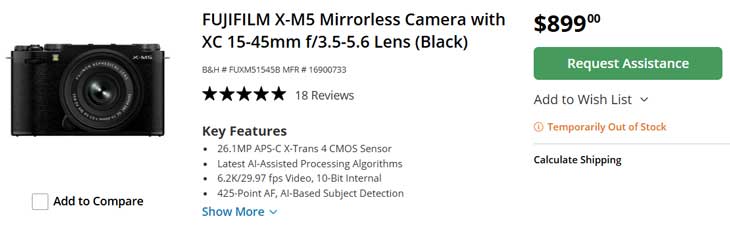
Get LIVE RUMORS –> FACEBOOK | TWITTER | INSTAGRAM to get live news — > get live news + –> See More Fuji Rumors
Imagecredit dpreview.com
By admin, on July 26th, 2025

DJI Osmo Mobile 8 spotted in FCC filing, a model code is DJI Osmo Mobile 8 (Model: DS308, FCC ID: 2ANDR-DS308). Now since it has been confirmed by a recent FCC filing, so obviously sparks and excitement that once the camera gets registered in FCC then usually its official announcement happens in next 3 months, since FCC hides the external images and internal test images of the cameras up to 180 days, so if they fail to do so then all the data, images, specs that has been registered will become available to public in general. DJI announces their products within 180 days.

Expected features of the DJI Osmo Mobile 8 gimbal
The Osmo Mobile 7 series uses ActiveTrack 7.0 and a multifunctional module. The Osmo Mobile 8 is expected to offer an advanced set of features, and some of them are:
- Next-generation stabilization: an upgraded 3-axis image stabilization for ultra-smooth capture. Inclusion of dynamic vlogging and cinematic modes.
- Advanced AI tracking: ActiveTrack 8.0 with improved subject detection and gesture control.
- LiDAR integration: So there were Osmo Mobile 7 Pro will have the LiDAR integration, but now we are expecting it for the Osmo Mobile 8.
- Compact and portable, lightweight foldable design, very similar to the Mobile 7P.
- Extended battery life of up to 10 to 12 hours of continuous use, without any interruption, exceeding the Osmo 7’s 10-hour battery life.
- Multifunctional modular upgrade: pairing a piece live with integrated lighting, wireless mic reception to the device connected to it, smart tracking and of course there is high possibility that it can even sync with third-party apps.
Expected arrival time
November 2025: The Osmo 8 Smartphone Mobile gimbal will arrive in November 2025. The date we are mentioning here is based on the DJI announcement pattern followed over the past 2 years.
And what I possibly think they would love to align their announcement with the latest iPhone arrival, so September will be the month that we are expecting the official arrival of the Osmo Mobile 8.
Expected price
The pricing is a very crucial part of any product, but fortunately, the DJI Osmo Mobile series doesn’t cost your bank.
- The DJI Osmo 8 standard model will cost somewhere around $99 to $199.
- The Pro model will cost you $159 to $179 with advanced features and a multifunctional module as an option.
So these are the latest updates related to the Osmo Mobile 8, and of course, if it arrives with what we are expecting, then it will be a kind of a game changer for smartphone vlogging, and obviously videography. Let’s hope for the best, and we will update this post as we get any new information.
Follow us on our social pages FACEBOOK | TWITTER | INSTAGRAM, If you have time, see more Camera News and DJI Rumors
Post Update Log:
- This post was last updated on October 4, 2025, at 5:46 AM GMT (2025-10-04T05:46:00Z).


By admin, on July 25th, 2025

DJI Osmo Nano is an action-packed, tiny camera that is set to launch in August 2025. The DJI Osmo Nano 2025 edition is perfect for content creators and those who love to have a tiny bodycam to record their entire day-to-day workout routine or their street experiences while they are travelling. The camera has magnetic pins on the back so it can be easily attached while wearing its attachment unit.
Features of the DJI Osmo Nano
- Modular magnetic design: So it can be detached and reattached easily, making it versatile for everyday use over clothes.
- Ultra-compact design: Ideal for POV shots, which is called the point of view, where you can show your own perspective to the world very clearly and neatly.
- Advanced image stabilisation: The tiny Osmo Nano is rumoured to feature DJI’s latest stabilisation tech inside it, so it would be a great thing to have DJI image stabilisation inside a tiny action POV camera.

DJI Osmo Nano Release Date
Based on the FCC filings and the set of rumoured specifications and information we have, the DJI Osmo Nano is expected to be officially announced in late September 2025
DJI OSMO Nano Price
| Model |
Europe (EUR) |
USA (USD) |
| DJI Osmo Nano 64GB |
€369 |
$338 (B&H Store) |
| DJI Osmo Nano 128GB |
€399 |
$365 (B&H Store) |
Stay tuned, more updates coming
This post was published on 4:14 pm, Friday, 25 July 2025, Greenwich Mean Time (GMT)
Follow us on our social pages FACEBOOK | TWITTER | INSTAGRAM, If you have time –>see more Camera News and DJI Rumors

By admin, on July 24th, 2025

The Insta360 Antigravity A1 was officially announced on August 14, 2025, and is one of the world’s first 8K 360-degree drones. Now, with Insta360’s expertise in 360-degree cameras, it’s quite obvious to expect groundbreaking features inside the new drone. It is designed for creators and professionals. While the final pricing is yet to be confirmed, since we have the official announcement — or better to say, the global launch — in January 2026, we have compiled all the possible latest information related to the upcoming 360 drone, including its estimated Insta360 Antigravity A1 prices, official specifications, and how it stacks up against the existing competitors like DJI. So here’s everything you need to know.
Release Date and Availability
- Announcement Date: August 14, 2025 (official reveal)
- Pre-Order Date: Expected to start in January 2026
- Shipping Date: Global shipping begins January 2026
Antigravity A1 Drone Price
| Bundle Tier |
Inclusions |
Estimated Price Range (USD) |
Notes |
| Standard Bundle |
Drone + Grip controller + Vision goggles |
$1,199–$1,399 |
Entry-level |
| Fly More Combo |
Standard bundle + 2 extra batteries + spare props + carrying case |
$1,300–$1,499 |
Mid-tier bundle aligning |
| Creator/Pro Kit |
Fly More bundle + creative mounts + ND filters + editing software voucher + premium case |
$1,500–$1,699 |
Premium consumer bundle |
| Enterprise Add-Ons |
Pro Kit + commercial extras (e.g., SDK access, extended warranty) |
$1,700–$1,999 |
Niche tier for business users |
As of August 18, 2025, Insta360 has not yet revealed the final pricing for the Antigravity A1, but we do have early estimates based on the industry, existing online drone lineup, and 360 cameras, as well as experts’ opinion. So here is the expected price range of the main bundles:
Why Antigravity Could Redefine Aerial Storytelling in 2025
- Industry Insight: Just after the announcement of the Insta360 A1 drone, I stumbled across the web, and, starting from The Verge, they have suggested the Antigravity A1 shouldn’t cost $2000. While in a Reddit discussion and in some of the YouTube creators’ videos, I have found that a $999–$1,299 price for the Standard Bundle Kit, is what they are claiming for the upcoming drone.
- Value Proposition: The Creator/Professional Kit targets Insta360’s existing camera users, as well as it also offers bundled savings valued at a $500 premium but feeling like a $200 to $300 add-on.
- Stay Updated: Final pricing and the regional details are expected closer to the January 2026 pre-order phase, and you can bookmark this page — thenewcamera.com — or follow us on Facebook, Twitter, and Instagram for the latest updates.
Official Specification and Features of the Insta360 Antigravity A1
The Antigravity A1 combines Insta360’s 360-degree camera expertise. The drone has one of the newest and most innovative designs. The drone never had a 360 ° camera on it before, and it has been designed in such a way that the drone becomes completely invisible, and you get a 360° viewing angle in 8K resolution.
Weight: Under 249 grams – so that’s a perfect weight when you want to fly the drone everywhere you want without taking any permission, since most countries do not have any restrictions on drones which weigh under 249g.
Camera: Insta360 features dual 360-degree 8K recording cameras, which can record smooth 8K 30FPS video with FlowState image stabilization and AI-powered editing tools.
Camera Specs:
- Resolution: 8K
- Capture Type: 360-degree capture
- Lens Configuration: Dual-lens setup (top-and-bottom)
- Stitching: Advanced algorithms for invisible drone effect in live video feed and final footage
The Invisible Drone Effect: That’s the best part of the 360 recording. Some users also say while using the DJI goggles they feel like Superman, since with the drone perspective you can explore everything everywhere in 8K resolution — and that gives the true “Superman Effect.”
Flight Performance:
- Flight Experience: Immersive 360-degree flight with FreeMotion technology
- Control: Intuitive point-to-fly controls via Grip controller
- Live View: 360 immersive live view with head tracking via Vision goggles
- Editing Flexibility: Fly first, frame later; allows post-flight reframing and editing in any aspect ratio without quality loss
- FreeMotion Technology: Enables immersive flying experiences, compatible with Insta360’s Vision goggles and Grip controller for intuitive control
Modular Design: So we have the attached propeller guards and a complete modular compartment that can be easily repaired. Portability is also easy.
Safety Features for Your Drone: We have attached propeller guards to the Antigravity A1, and a return-to-home feature is also included — so if you lose the signal, the drone will automatically return home. At the same time, obstacle avoidance and precise landing capabilities are already in place.
Additional Features: So we have AI-enhanced editing, advanced image stabilization, and compatibility with the existing Insta360 software ecosystem.
How Does It Compare to DJI Drones?
Insta360 Antigravity A1 enters a competitive market dominated by the DJI Mini and Air series. So let’s have a quick comparison:
- Weight and Portability: 249 grams — the Antigravity A1 exactly matches the DJI offerings at the very same price point, making it equally travel-friendly and easy to carry.
- Camera: Now we have the Antigravity A1 drone, which is capable of recording 8K 360° video. At this moment, none of the DJI drones are able to do so. But yes, we do have some rumours related to DJI’s upcoming 360 drone. So it may not compete directly, but it will be a great option for us. Right now in the standard DJI 4K offering, we have the Mini 4 Pro, which is also affordable at a very reasonable price point
So now we have the big question: Will the Insta360 Antigravity Drone A1 — and not only the A1, since others are also coming just behind the A1 — challenge DJI’s dominance?
For the latest updates, check Insta360’s official blog or thenewcamera.com
Post last updated on October 16, 2025
- Updated Content structure and Price
ABout the author: The article “Insta360 Antigravity Drone, Price, Specs, Camera, Release Date: Official Details” written and updated by thenewcamera.com team on 12:38 am, Wednesday, 1 October 2025, Greenwich Mean Time (GMT) | Follow us for more updates and Get LIVE RUMORS –> FACEBOOK | TWITTER | INSTAGRAM to get live news — > get live get live Drone news + Insta360 Drone Rumors 24X7


By admin, on July 23rd, 2025

Sony recently announced the camcorder PXW-Z300, the latest generation of Sony camcorder cameras, which feature AI autofocus tracking similar to that seen on the Sony A7R V and the latest generation of professional mirrorless cameras. The camera uses 1/2 inch 4K 3 CMOS Exmor sensors. With these three sensors, you get highly detailed video and a 17x optical zoom lens, which enhances the overall video quality while shooting for news, documentaries, sports, or live production.
Sony PAW – Z3000 Camcorder / Pro Handycam Price
Sony PAW – Z3000 Shipping information
- The official worldwide announcement is in September, and Shipping of the camera will start from mid-October 2025
Sony PXW-Z300 Features Explained
Superior image quality with three CMOS sensors: The PXW-Z300 utilizes three distinct 1/2-inch BSI CMOS sensors. These RGB sensors help you to extract the maximum amount of light and colours, and with the help of the BIONZ XR image processor, it deliver stunning 4K 60p output. The camera offers multiple recording formats, which include MXF file recording, MP4K HD in 10-bit 4:2:2 Long GOP 4K in 4:2:0, and even though it keeps an MP4 proxy.
What’s the 17x Optical Zoom Lens
The PXW-Z300 features a professional 17x zoom lens with a constant f/1.9 aperture, so you can imagine the level of video quality that you are getting from this camera. One more thing to be noted: with the help of constant aperture lenses, the exposure remains constant irrespective of the focal length you are using. So, either you are zooming in or zooming out during the shot, the exposure will remain the same.
- An additional 1.5x zoom has been added in the 4K video recording mode to help you reach closer without sacrifice of image quality.
- It has approximately 5 stops of optical image stabilization system in the camera and inclusion of variable electronic ND filter, with a neutral density range of 1/4 to 1/128 of a second.
- The PXW-Z300 is the world’s first camcorder that features a content authentication system to fight fake and digitally manipulated videos.
Enhanced Connectivity and Workflow
- 5G and cloud integration: The camera supports live streaming through RTMP/RTMPS protocol, SRT protocol, fast file transfer via Sony C3 portal or wired CI media.
- On the side, we also have a V-mount so you can securely attach a smartphone with your camera and use it as an external display if you wish to.
- You also have the Sony Monitor and Control App: With the help of the Control App, you can enable multi-camera shooting as well as remote shooting with setting adjustment and specific angle confirmation with the help of a smartphone or display.
- The camera also supports XLR input and features a multi-interface hot shoe, compatible with four-channel audio recording. You can also use your UWP series wireless microphone.
The Z300 is custom-tailored for professionals, specifically photojournalists who cover live news happening anywhere in the highest possible quality.
follow us on our social pages FACEBOOK | TWITTER | INSTAGRAM, –>If you have time –>see more Sony Alpha Rumor Latest Camera News
By admin, on July 21st, 2025

The Nikon ZF camera was launched back in 2023, and it was one of its kind of camera with extensive manual control and retro look, so it’s actually a blend of retro aesthetics with modern performance. As we know, the Nikon Z6 Mark III camera has already been announced with a partially stacked CMOS sensor, and the Nikon Z9 Mark II camera is expected to arrive with Nikon’s latest image processor on or before the 2026 Winter Olympics, according to the latest set of rumours we have. So what we are expecting right now is that the ZF Mark II will have the best of both worlds – a new sensor and a new image processor. Let’s explore it further.
Nikon ZF Mark II Specification
- 24.5MP FX-Format Partially Stacked CMOS Sensor
- EXPEED 8 Image Processor
- 6K 60p N-RAW, 4K 120p ProRes RAW
- 6K 60p and 4K 120p Video, 10-Bit Internal
- Up to 20 fps RAW, 60 fps JPEG Shooting
- 273-Point AF, AI-Based Subject Detection with Bird Mode
- Blackout-Free 5.76M-Dot OLED Viewfinder
- 3.2″ Fully Articulating Touchscreen LCD
- Optional Vertical Grip, CFexpress Type B and UHS-II SD Slots
- 5 GHz Wi-Fi, Bluetooth 5.0, and GNSS
The Sensor of the Nikon ZF Mark II Camera
The Nikon ZF Mark II camera usually picks up the sensor from the Z6 line and since the Nikon Z6 Mark 3 has been already announced a year ago with a partially stacked CMOS sensor, it has raised the expectation that the next variation of the ZF series camera — the ZF Mark II — will use the same sensor to enhance the overall performance. As we all know, the partially stacked CMOS sensor allows 3.5x faster readout speed compared to a conventional CMOS sensor being used inside the Nikon ZF and the Z6 Mark II camera.
Expeed 8 Image Processor Inside the Nikon ZF Mark II
With the introduction of the Nikon Z9 Mark II camera in the first half of 2026, Nikon will then unleash its powerful Expeed 8 image processor to lower-end cameras, and what we do believe is that ZF Mark II does have a very high chance of adopting it — specifically if it arrives in late September 2026 or in the first quarter of 2027.
6K 60fps RAW and 4K 120fps ProRes RAW
The Nikon ZF Mark II camera is expected to inherit the same video core specifications that we have already witnessed in the Z6 Mark 3 camera. Capability to record 6K 60fps videos and 4K 120fps videos in 10-bit H.265 is highly expected. Alongside with the 4K 120fps recording, the camera is expected to support Full HD 240fps recording for extreme slow-motion videos.
AI Autofocus Including Bird Detect Mode
Pairing the partially stacked CMOS sensor with an even faster image processor will elevate the autofocusing performance of the Nikon ZF Mark II camera to the next level. Since with the introduction of a new image processor, a camera maker always introduces a new autofocus algorithm alongside the image decoding algorithm, what we are expecting here is that the camera will surpass the autofocus capability and even the image quality of the existing Nikon Z6 Mark 3 and the ZF camera.
Additional Expected Features of the Nikon ZF Mark II Camera
In-Camera Pixel Shift Mode: The Nikon Expeed 8 image processor will end the requirement of stitching pixel shift mode images outside the camera.
Extended Dynamic Range Mode: This specific mode of the Nikon cameras is under development and we are expecting to see it soon in upcoming Nikon cameras including the Nikon ZF Mark II. And this is not new to the camera industry — the Panasonic S1H Mark II camera is already using this particular mode to officially scale the overall dynamic range performance of the camera by slowing down the sensor readout speed.
Arrival Date of the Nikon ZF Mark II
Based on a 3 to 4 year refresh cycle as well as preserving the sales of other models including the Nikon Z6 Mark 3, we are expecting the potential release of Nikon ZF Mark II camera in September 2026. So this particular date aligns with the Nikon Z9 Mark II camera release as well as having a good gap from Nikon Z6 Mark 3 camera, which will preserve the sales of the mid-range full-frame model.
And it has to be September 2026, since if we go on schedule, then the Nikon Z6 Mark 4 predicted announcement date is June 2027 — if everything goes as per schedule inside Nikon.
Nikon Z6 and Zf Announcement Dates
| Camera Name |
Announcement Date |
| Nikon Z6 |
August 23, 2018 |
| Nikon Z6 II |
October 14, 2020 |
| Nikon Z6 III |
June 17, 2024 |
| Nikon Zf |
September 20, 2023 |
| Nikon Zf II |
September 2026 (Predicted) |
| Nikon Z6 IV |
June 2027 (Predicted) |
The Nikon ZF Mark II Camera Price
The Nikon ZF was announced at $1999, and the Nikon Z6 Mark III camera is now selling at $2199 (the announcement price of the Nikon Z6 III is $2,496). So, Nikon ZF Mark II will have $2699 announcement price tag as per our initial expectation.
The Nikon ZF series camera has a separate fan base inside Nikon, specifically people who love retro-inspired design. Now, we are expecting that the arrival of the Nikon ZF Mark II camera will redefine modern performance in a retro aesthetic body. But at the very same time, they also have to preserve the sales of the Nikon Z6 Mark 3 camera. If the camera arrives in September 2026, the peak sales period of the Nikon Z6 Mark 3 camera will be over at that time. As well as with a new sensor and a bit higher price tag, it will redefine its position in the Nikon lineup.
Do share your thoughts with us.
The article “Nikon ZF Mark II Specification Expectation, Arrival Date and Price” written and updated by thenewcamera.com team on 7:53 am, Monday, 21 July 2025, Greenwich Mean Time (GMT)| Follow us for more updates and Get LIVE RUMORS –> FACEBOOK | TWITTER | INSTAGRAM to get live news — > get live news + Nikon Rumors 24X7
By admin, on July 20th, 2025

Let’s compare the two prime compact cameras and find out the best one for you. Of course, there is a price difference between them — the Leica Q3 comes at a bit heavier price, and the RX1R Mark 3 is available at a lower price range. But if it is the comparison of the two, then which one is more suitable for you? Find out.
First of all, we will compare the design of both cameras. Then we will talk about the photographic core specifications, which will be the main part of both the cameras, and later on, the video core specs comparison. So let’s start with the design part.
Both cameras come with fixed lenses, so we are including the lenses also in the design comparison.
| Feature |
Sony RX1R Mark 3 |
Leica Q3 |
| Price Range |
Lower |
Higher |
| Lens |
Fixed 35mm f/2 (non-stabilized) |
Fixed 28mm f/1.7 with Optical Image Stabilisation (OIS) |
| Lens Light Capability |
Captures less light (F2) |
Captures 1 stop more light (F1.7) |
| Stabilisation |
Digital Video IS only (crop-based) |
Optical Image Stabilisation (approx. 4.5 stops) |
| Low-Light Performance |
Moderate (f/2, no OIS) |
Better (f/1.7 + OIS for slower shutter) |
| Electronic Viewfinder (EVF) |
2.36M-dot EVF (same as RX1R Mark II, 9 yrs old tech) |
5.76M-dot high-resolution EVF |
| Weather Sealing |
Yes, but no official certification |
IP52 Certified Weather Sealing |
| Build Quality |
Well-built and compact |
Well-built with robust weather sealing |
| Portability |
More compact and lightweight |
Slightly bulkier and heavier |
Sony RX1R Mark 3 versus Leica Q3 Design Comparison
As we can see, both of them are very well-built — it can even be easily visible from the images that you have seen side by side. However, one thing to note is that the Leica Q3’s 28mm lens is optically stabilised, providing approximately 4.5 stops of OIS with the Leica Q3 camera. The Sony RX1R Mark 3 camera features only digital video image stabilisation, which reduces shakiness by applying a crop to the video.
Again, we have one more thing left in the lens quality — the 28mm f/1.7 lens captures a stop more light compared to the 35mm f/2 lens. So specifically for low-light photography, when you are using the Leica camera, the 28mm f/1.7 lens is more helpful for delivering a bit more light, and the optical image stabilisation of the lens helps you to use a slower shutter speed.
Now, in the same design part, we also have viewfinders in both the cameras. The Sony RX1R Mark 3 has the same viewfinder that was being used in the RX1R Mark 2 camera approximately 9 years ago — a 2.36 million-dot EVF — compared to the Leica Q3, where we have a high-resolution 5.76 million-dot electronic viewfinder.
The Leica Q3 body has IP52 weather sealing certification that ensures durability. On the other hand, the Sony RX1R Mark 3 camera does have a weather-sealed body, but we do not have any weather-sealing certification.
The good thing about Sony is that it is a bit more lightweight and compact compared to the Leica camera. So for the portability factor, I will give preference to the Sony RX1R Mark 3.
High ISO Test Comparison Between Leica and Sony

The Left side image is of the Sony A7CR using the same 61MP sensor and an 85mm Gmaster F1.2 Lens used at F5.6 Aperture to capture the shot
On the Right Side, we have Leica Q3 43 ( The 43 uses a 43mm f/2.0 APO-Summicron ASPH lens). Both Q3 and Q3 43 models are the same, only the lenses are different. During the test, the 40mm F2.0 Lens was kept at F6.3 Aperture

Leica Image processing isn’t adding any extra layers of smoothness in the JPEG files, the words are visible and clear even when shot at ISO 25600 / ISO 25000

Even when the ISO was raised to 51200 / 51000, you can see how visibly Leica is keeping the color blocks intact, unlike the Sony A7CR sample, where everything looks like a hot mess.
Big Surprise – Leica RAW Files have less color noise

Even when we are comparing Leica RAW files at higher ISO levels, these RAW files have significantly less noise than Sony A7CR files.
Image Comparison Conclusion – Leica is a clear winner
We don’t want to add any extra creamy layers on this thing, even though I use Sony cameras in all my studio and I am a big Sony FAN. But, the fact is a fact, and Leica is visibly capturing less noise than of Sony A7CR sensor.
Respect for Leica Camera has been raised after looking at the test
Both cameras are using the same sensor, but the Leica Q3 enhances the photography experience with 15 FPS of continuous shooting versus 5 FPS of Sony. At the very same time, the buffer is also larger — 63 versus 52 RAW photos.
As you know, the Leica Q3 also has an optical image stabilization system. So, with a faster aperture, more ISO range, and having an optical image stabilization system, the Leica Q3 will give you the ability to capture still images in even more low-light scenarios while using a slower shutter speed. So, if we talk about an overall package, the Leica Q3 stands out in the competition.
And finally, images from both cameras, the Leica Q3 is a clear winner in terms of image quality
Which Camera Should You Choose?
- Choose the Leica Q3 if you need:
- Better Image Quality: Leica cameras showing off better images during the test
- Advanced video capabilities (8K, ProRes, high frame rates) for professional filmmaking.
- Optical stabilization for steady photos and videos.
- Weather sealing for outdoor shooting.
- Faster shooting (15 fps) for action photography.
- A 28mm f/1.7 lens for low-light and wide-angle shots, ideal for street or landscape photography.
- Choose the Sony RX1R II if you prioritize:
- Compact size for portability, perfect for travel or discreet street photography.
- HEIF support for smaller file sizes.
- No video time limit for extended recording.
- A 35mm f/2 lens for classic portrait or tighter compositions.
Sony RX1R III: Available from July 25, 2025, via retailers like B&H Photo and Amazon.com
Leica Q3 43 Edition at B&H Store and Amaozn.com | leica Q3 28mm Lens Edition on B&H Store and Amazon.com
Detailed specification comparison table for the still and video parts
Sony RX1R II vs Leica Q3: Still Image Capture Comparison
| Feature |
Sony RX1R II |
Leica Q3 |
| Effective Resolution |
61 MP (9504 x 6336) |
60.3 MP (9520 x 6336) |
| Aspect Ratio |
1:1, 3:2, 4:3, 16:9 |
1:1, 3:2, 4:3, 16:9 |
| Image File Format |
HEIF, JPEG, Raw |
DNG, JPEG |
| Bit Depth |
14-Bit |
14-Bit |
| ISO Sensitivity |
Native: 100 to 32,000 (Extended: 50 to 102,400) |
Native: 50 to 100,000 (Manual), 100 to 100,000 (Auto) |
| Shutter Speed |
Mechanical: 1/4000 to 30s, Electronic: 1/8000 to 30s, Bulb Mode |
Mechanical: 1/2000 to 120s, Electronic: 1/16000 to 1s |
| Continuous Shooting |
Up to 5 fps for 52 Frames (Raw) / 40 Frames (Raw, JPEG) / 1000 Frames (JPEG) |
Up to 15 fps for 63 Frames (Raw) / 67 Frames (JPEG) |
| Focus Range |
Normal: 11.8″ to Infinity / 30 cm to Infinity, Macro: 7.9″ to 13.8″ / 20 to 35 cm |
Normal: 11.8″ to Infinity / 30 cm to Infinity, Macro: 6.7″ to Infinity / 17 cm |
| Metering Method |
Average, Center-Weighted Average, Highlight Weighted, Multi, Spot |
Center-Weighted Average, Highlight Weighted, Multi, Spot |
| Exposure Compensation |
-5 to +5 EV (1/3, 1/2 EV Steps) |
-3 to +3 EV (1/3 EV Steps) |
| White Balance |
2500 to 9900K, Presets: ATW, AWB, Auto, Cloudy, Custom, Daylight, Flash, etc. |
2000 to 11,500K, Presets: Auto, Cloudy, Daylight, Flash, Manual, Shade, etc. |
| Self-Timer |
2/5/10-Second Delay |
2/12-Second Delay |
| Interval Recording |
Yes |
Yes |
Sony RX1R II vs Leica Q3: Video Capture Comparison
| Feature |
Sony RX1R II |
Leica Q3 |
| Internal Recording |
XAVC S 4:2:2/4:2:0 8/10-Bit: UHD 4K (3840 x 2160) at 23.98/25/29.97 fps [60-140 Mb/s], 1920 x 1080 at 23.98/25/29.97/50/59.94/100/120 fps [16-100 Mb/s]; XAVC S-I 4:2:2 10-Bit: DCI 4K (3840 x 2160) at 23.98/25/29.97 fps [240-300 Mb/s], 1920 x 1080 at 23.98/25/29.97/50/59.94 fps [89-222 Mb/s] |
H.264 ALL-Intra/MOV 4:2:2 10-Bit: DCI/UHD 4K at 23.98/24/25/29.97/47.95/48/50/59.94 fps [400-600 Mb/s]; H.264 Long GOP/MP4 4:2:0 8-Bit: UHD 4K at 23.98/25/29.97 fps [100 Mb/s], 1920 x 1080 at 23.98/25/29.97/50/59.94 fps [20-28 Mb/s]; H.265 Long GOP/MOV 4:2:0 10-Bit: DCI 8K/UHD 8K at 23.98/24/25/29.97 fps [300 Mb/s], 1920 x 1080 at 100/120 fps [100 Mb/s]; ProRes 422 HQ: 1920 x 1080 at 23.98/24/25/29.97/50/59.94 fps [181-454 Mb/s] |
| Video Output |
4:2:2 8/10-Bit via HDMI: UHD 4K at 23.98/25/29.97 fps, 1920 x 1080i at 50/59.94 fps, 1920 x 1080 at 23.98/50/59.94 fps |
4:2:0 8-Bit via HDMI: DCI/UHD 8K at 23.98/24/25/29.97 fps; 4:2:2 10-Bit via HDMI: DCI/UHD 4K at 23.98/24/25/29.97/50/59.94 fps, 1920 x 1080 at 23.98/24/25/29.97/50/59.94/100/120 fps |
| Recording Limit |
No |
30-Minute Maximum |
| Audio Recording |
2-Channel 24-Bit 48 kHz LPCM, 2-Channel 16-Bit 48 kHz LPCM |
MP4: 48-Bit 16 kHz AAC, MOV: 28-Bit 24 kHz LPCM |
| Built-In Microphone |
Stereo |
Stereo |
Image credits dpreviewimagecomparions
|
KEEP THIS BLOG ALIVE - Support New Camera Buy Canon Lenses, Buy Music CD or Digital Camera at amazon it helps this site, and you do not pay anything extra, it is just a way to help support this site.

|