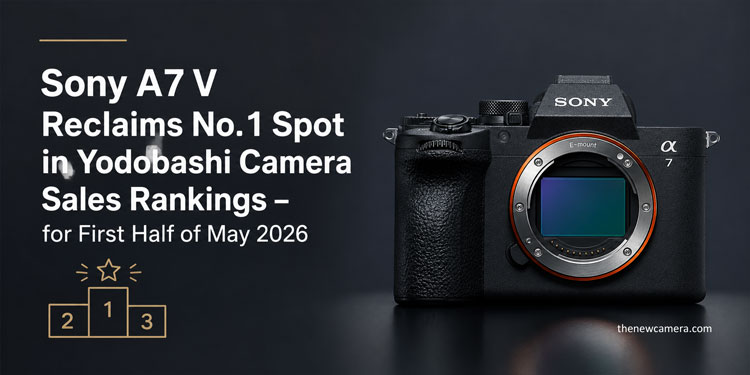
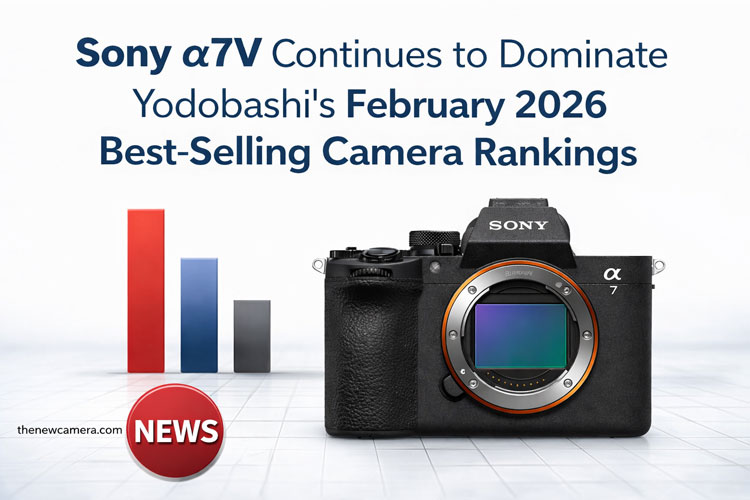
The Sony A7 five-camera is stopped in users’ chats. According to the sales data released by CAPA CAMERA WEB, the Sony α7 V Body has reclaimed the number one position in Yodobashi Camera’s best-selling interchangeable-lens camera rankings for the first half of May 2026 (May 1–15).
This clearly indicates that, in mid-full-frame, people prefer the Sony A7 V over the others, possibly due to the introduction of a partially stacked 33-megapixel sensor.
And this is not the first time the Sony A7 V camera is at the top of the sales chart. It has done it before — the winning streak of the Sony A7 V camera started after the latter half of January 2026. It was interrupted in the previous period, but as of now, the top two spots have been fixed, and Sony is dominating the market once again.
Complete Top 10 Best-Selling Interchangeable-Lens Cameras at Yodobashi (May 1–15, 2026)
Full-frame hybrid flagship with 33MP partially stacked sensor, 30fps blackout-free shooting, advanced AI AF
2
Sony α7C II Zoom Lens Kit
Compact full-frame body + versatile zoom kit – perfect for travel and street
3
Canon EOS R50 Double Zoom Kit
Entry-level APS-C mirrorless making its first top-3 appearance in nearly 2 years
4
Sony VLOGCAM ZV-E10 II Double Zoom Lens Kit
Vlogging favorite with creator-focused features
5
Fujifilm X-T30 III XC13-33mm Lens Kit
Retro-styled APS-C with film simulation magic
6
Fujifilm X-M5 XC15-45mm Lens Kit
Compact, affordable Fuji for beginners
7
Sony α7C II Body
Compact full-frame body-only option
8
Canon EOS R10 RF-S18-150 IS STM Lens Kit
Versatile APS-C zoom kit for all-rounders
9
Nikon Z50II Double Zoom Kit
Nikon’s refreshed APS-C mirrorless
10
Canon EOS R5 Mark II Body
High-resolution pro full-frame still going strong
As we can clearly see, Sony dominates with 4 entries in the top 10, including the top two spots. Canon secures three places (notably the surprise podium finish for the R50), while Fujifilm and Nikon round out the list with strong APS-C offerings.
Why the Sony α7 V Is Dominating Sales Again in May 2026
Sony A7 has been dominating the market since 2018, with their A7 III model, and now it’s time for Sony A7V, and Sony is again in the headlines with the Sony A7V Model.
Blackout-free continuous shooting at up to 30 fps with AF/AE tracking
Advanced AI subject recognition for humans, animals, birds, insects, cars, and more
Impressive 4K video up to 60p (7K oversampled) and 120p in crop mode
7.5-stop IBIS and dual USB-C ports for extended power/data workflows
Buyers love the body-only version because it pairs perfectly with their existing E-mount lenses – from affordable primes to pro zooms. Its return to #1 after a one-period dip shows sustained demand among serious enthusiasts who want flagship performance without the premium price of the α1 or α9 series.
Runner-up Sony α7C II Zoom Lens Kit continues to appeal to travellers and content creators who prioritise compactness without sacrificing full-frame image quality.
The Canon R50, still one of the fav cameras in Japan, specifically in terms of entry-level users. Canon EOS R50 Double Zoom Kit is climbing to 3rd place — its first appearance in the top three since the second half of May 2024 (almost exactly two years ago).
This affordable APS-C mirrorless kit (RF-S18-45mm + RF-S55-210mm) remains a favorite for beginners and vloggers thanks to:
24.2MP sensor with Dual Pixel CMOS AF II
4K 30p video (6K oversampled)
Intuitive touchscreen interface and lightweight design
The strong performance of Canon’s entry-level kit alongside the more advanced EOS R10 and R5 Mark II shows balanced demand across price segments.
Should You Buy the Sony α7 V or One of the Other Top Sellers?
Choose the α7 V if you want pro-level stills + video in one rugged body and already own Sony glass.
Go for the α7C II Kit for a more compact full-frame travel camera.
Consider the Canon EOS R50 Double Zoom Kit if you’re a beginner or vlogger on a budget — its return to the podium proves it’s still one of the best value mirrorless options in 2026.
Yodobashi Camera rankings like this are updated every two weeks, so we’ll be watching closely for the second half of May results. Will the α7 V extend its reign, or will Canon or Fujifilm shake things up?
What’s your take? Are you team Sony full-frame or prefer the lighter APS-C options? Drop your thoughts in the comments below!
Stay tuned to TheNewCamera.com for the latest camera news, reviews, and sales rankings from Japan and around the world.
Data source: CAPA CAMERA WEB / Yodobashi Camera (May 1–15, 2026)
The article “Has the Sony a7V Become Unbeatable? Map Camera’s February 2026 Rankings ” was written on 4:45 pm, Tuesday, 26 May 2026, Greenwich Mean Time (GMT)
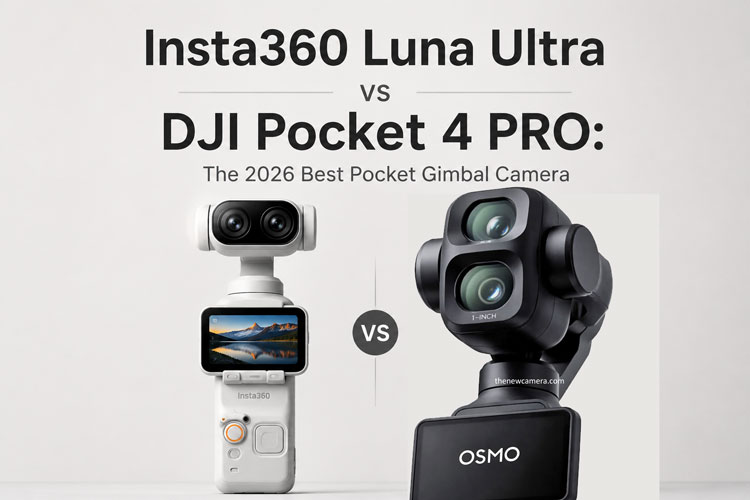
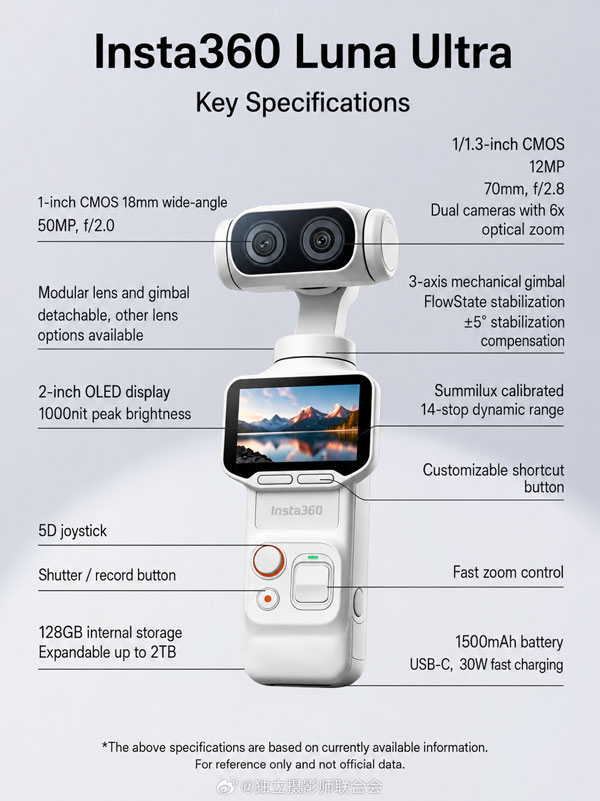
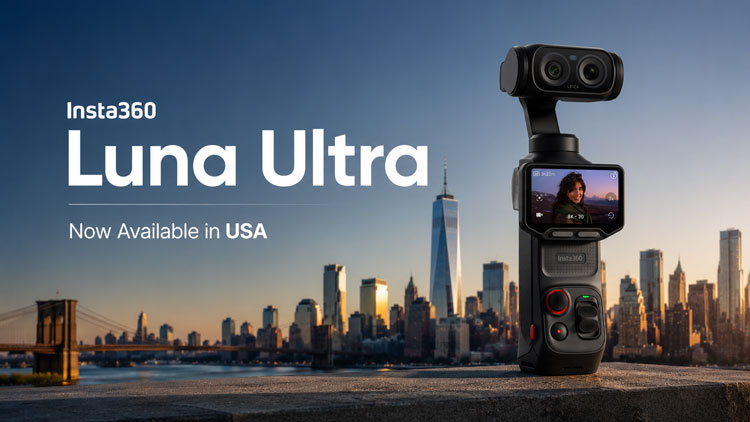
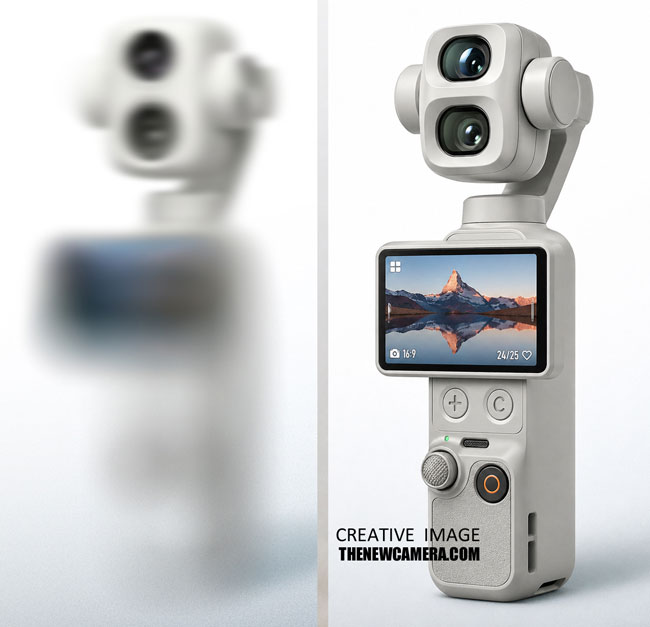
The Insta360 Luna Ultra has now officially launched (June 10, 2026), while the DJI Pocket 4 Pro is on June 15, 2026 (still pending wider release). We have prepared an updated head-to-head comparison of the best set of core specifications to help you decide which pocket gimbal camera is better for your needs in 2026.
We’ve compared specs, real-world footage performance, availability, and pricing so you can make the right choice, but here, let’s start with comparing the major specifications of the camera
Highly Detailed Specs Comparison Table
Feature
Insta360 Luna Ultra
DJI Osmo Pocket 4P
Main (Wide) Sensor
1-inch CMOS, 50MP, ~18mm equiv
1-inch / 1.1-inch CMOS, 50MP, ~20mm equiv
Main Aperture
Fixed f/2.0 (leaks say f/1.8)
Variable f/1.7–f/2.8
Telephoto Sensor
1/1.3-inch CMOS, 12MP, ~70mm f/2.8
1/1.3-inch class, ~60mm
Zoom
~3.9–6x optical/lossless, up to 12x hybrid
2–4x optical (mostly 3x confirmed)
Dynamic Range
14 stops, 10-bit iLog (Leica Summilux calibrated)
14 stops (some claims 17), 10-bit D-Log M (Hasselblad)
Fully available – Amazon, B&H, Adorama, Insta360.com
Grey market only (FCC Covered List issues)
We tried to keep the differences as clean as possible, and we have done multiple verifications while creating this table. If you find any errors, kindly report them in the comment section. We will fix it as soon as possible
Key Differences Explained
Zoom Reach – Insta360 Wins by a Mile
The Luna Ultra’s longer ~70mm tele + true 6x lossless zoom is the killer feature. DJI’s 3x optical on the Pocket 4P feels limiting the moment you step back for a clean portrait or compressed background. If you shoot travel vlogs, street, or events where you can’t always get close, the Insta360 is noticeably more versatile right now.
Creative Control – DJI’s Variable Aperture is a Pro Move
DJI gives you real aperture blades (f/1.7–f/2.8). That means shallow depth-of-field without ND filters and better exposure flexibility in changing light. Insta360’s fixed bright aperture is great for low light but less flexible for cinematic work. US hybrid shooters who grade in DaVinci or Premiere will appreciate the extra control.
Color Science & Look
Leica tuning on the Luna Ultra = punchy, filmic, high-contrast look straight out of camera.
Hasselblad Natural Color on the Pocket 4P = more accurate skin tones and realistic rendition (DJI’s long-time strength).
Both do excellent 10-bit log. Real tests will decide, but neither is “bad.”
Modularity & Future-Proofing
Insta360’s detachable lens/gimbal head is genuinely new for this category. You can use the handle as a wireless remote or swap lenses later. DJI is the more “finished” product today, but Insta360 feels like the one that will evolve.
The Giant USA Elephant in the Room: Availability & Warranty
This is the biggest practical difference for American buyers.
Insta360 Luna Ultra → Ships worldwide, full US warranty, easy returns on Amazon/B&H.
DJI Osmo Pocket 4P → Standard Pocket 4 is available, but the Pro (4P) dual-lens version has serious FCC/Covered List complications. Many US buyers are stuck with grey-market imports that void warranty and have no official support. If you value peace of mind and easy returns, the Luna Ultra is the safer (and currently more available) choice.
Who Should Buy Which?
Buy the Insta360 Luna Ultra if you:
Want maximum optical zoom reach
Detachable screen/remote
Love the idea of a modular system that could grow with you
Shoot a lot of travel, events, or portraits where compression matters
Want immediate US availability and full warranty
Prefer Leica’s cinematic look
Buy the DJI Osmo Pocket 4P if you:
Prioritize variable aperture and creative exposure control
Already live in the DJI ecosystem (Mavic, Ronin, etc.)
Value ActiveTrack 7.0 for run-and-gun subject following
Are okay hunting grey-market deals or waiting for possible official channels
Love Hasselblad’s more neutral color science
Our Verdict – The Best Camera for You
If you’re in the US, the Insta360 Luna Ultra is currently the clearer and safer choice because it has full official availability and warranty.
Outside the US, or if you’re already deep in the DJI ecosystem, the Pocket 4 (standard) is available now and performs very well, while the Pocket 4 Pro is still awaited in many markets
Right now, as we all know, if you are living in the United States of America, the only option you have is the Insta360 Luna Ultra. But if you’re not in the United States of America and already part of the DJI ecosystem, the Pocket 4 Pro is obviously the best choice for you.
But again, if you are completely new and looking for a gimbal camera, then obviously the Insta360 Luna Ultra gives you more freedom with a remote control and attachable display screen, for which you have to pay extra in the DJI Pocket 4 Pro gimbal camera. Specifically, I am talking about the additional frame and the tap remote controller.
Both cameras are massive leaps over the single-lens pockets of the past. The dual-lens era is finally here, and Insta360 just delivered the version that feels more future-proof for US buyers.
What do you think? Drop your choice in the comments — Luna Ultra or Pocket 4P? We’ll update this article with full side-by-side footage tests the moment both are in our hands.
The article “Xtra Muse 2 Pro and Muse 2 Get Dual-Side Flip Touchscreen” was written Updated by thenewcamera.com team on 6:53 am, Monday, 15 June 2026, Greenwich Mean Time (GMT)
| You can also follow us on Our Official Social Media HandlesFACEBOOK | TWITTER | INSTAGRAM> get live news — > DJI Rumors
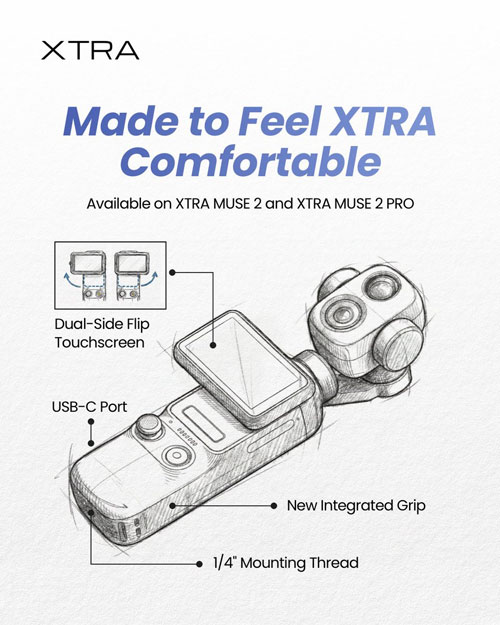
Xtra Muse 2 and Xtra Muse 2 Pro are coming with a slightly different design than what we have seen in the DJI 4 or the 4 Pro camera, and the main difference is visible in the display screen of the camera, which can be shifted to the extreme left or to the extreme right side of the camera as per the user’s requirement.
This detail about the new kind of display screen was revealed by the Xtra Camera official page an hour ago.
Official teaser sketch showing the new dual-sided flip screen and integrated grip on the Xtra Muse 2 series. Credit: @xtracameras
What’s New on the Xtra Muse 2 & 2 Pro
Well, if we look at the text of the Xtra written in their Xtra official handle, it calls the refresh “Made to Feel XTRA Comfortable” and it focuses on two practical improvements creators have been asking for:
Dual-Side Flip Touchscreen: The articulating screen features a very unique design-wise flip-out display, accessible from either side of the camera. Whether you’re shooting traditional vlogs selfie-style or framing from the rear (great for run-and-gun or third-person shots), you get instant, accurate framing without awkward angles while using sing hand, Well, that’s a perfect companion for pros who do daily life vlogs.
Integrated Ergonomic Grip. Instead of an add-on accessory, the new built-in grip is molded directly into the body. This gives the Xtra Muse 2 series a cleaner, more premium look while delivering significantly better handheld comfort for long shooting sessions.
The official post also gives a shoutout to designer @createbeyondboundarie for helping perfect the naming and overall feel.
Why These Changes Matter for Creators
Yes, pls keep in mind while reading this port, these aren’t flashy spec bumps – they’re the kind of thoughtful aka design upgrade and refinements already DONE in their upcoming camera, that make a pocket camera actually enjoyable to use all day.
Faster framing in any orientation
More stable and comfortable grip (less fatigue during travel vlogs, events, or street shooting)
Cleaner design with fewer loose accessories
This update builds directly on the earlier teasers that already promised a 2-way/bi-directional screen. Today’s reveal confirms the final execution and shows Xtra is listening closely to real-world feedback.
With the new dual-side screen and built-in grip, the Xtra Muse 2 series is closing the comfort gap even further against the current DJI Pocket lineup. Many U.S. creators are already eyeing the Muse 2 Pro as the most practical “DJI Pocket 4 Pro alternative” available stateside this summer.
Bottom line: If you already own DJI ECO system-based mics etc, and are waiting for the next big pocket vlogging camera that’s actually comfortable to shoot with for hours, today’s update makes the Xtra Muse 2 / 2 Pro even more compelling.
We’ll update this page the moment Xtra drops full specs, pricing, or pre-order details. Expected U.S. launch remains June–July 2026.
What do you think? Is the dual-side flip screen and built-in grip enough to make you choose the Xtra Muse 2 over the competition? Drop your thoughts in the comments below!
The article “Xtra Muse 2 Pro and Muse 2 Get Dual-Side Flip Touchscreen” was written by thenewcamera.com team on 5:37 am, Saturday, 23 May 2026, Greenwich Mean Time (GMT)
| You can also follow us on Our Official Social Media HandlesFACEBOOK | TWITTER | INSTAGRAM> get live news — > DJI Rumors
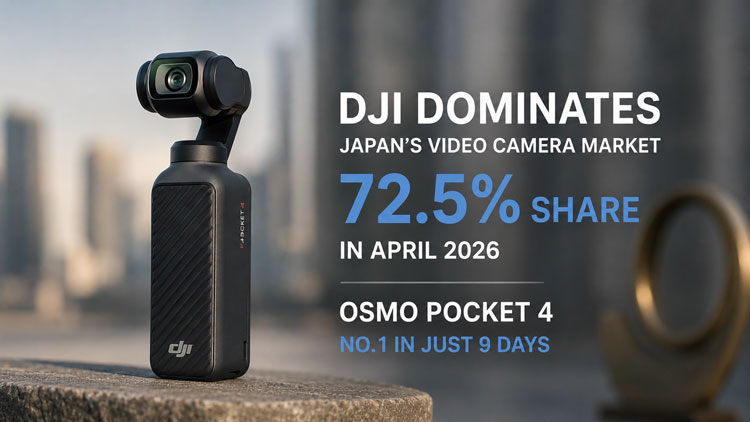
So, we have the latest report coming straight out from the most popular and the largest retail store firm, BCN+R. The DJI Pocket series cameras have captured more than 72.5% of the Japanese camera market share, according to data from April 2026.
The highlight of the month was the biggest debut of the Osmo Pocket 4. And the demand was so high, despite being released on April 22, the compact gimbal camera sold at a blistering pace, securing 21.5% of the entire month’s video camera sales volume in just nine days of availability — enough to claim the No. 1 position outright.
Complete Market Domination
The sales rankings paint an even clearer picture of DJI’s overwhelming lead:
1st: Osmo Pocket 4 (DJI)
2nd: Osmo Pocket 3 (DJI)
3rd & 4th: Other DJI models
Only in 5th place did a non-DJI product appear — Insta360’s GO Ultra. The top four positions being swept by a single brand is rare in any consumer electronics category and underscores the current reality of the video camera market in Japan.
According to BCN+R, total video camera sales in April surged dramatically year-over-year (158% in volume and 135% in value), largely fueled by the hype and strong demand for the Osmo Pocket 4.
A Trend That Keeps Growing
DJI has now maintained the top manufacturer position for approximately 30 consecutive months. While Insta360 remains the closest competitor, the gap has widened significantly. Most other brands, including GoPro, Sony, and Panasonic, are now fighting for single-digit market shares.
The Osmo Pocket 3 was already credited with reshaping the affordable, high-quality video camera segment. Its successor, the Osmo Pocket 4, appears poised to take that dominance even further. Industry observers note that the combination of improved image quality, better stabilization, enhanced features, and strong brand loyalty has created what many are calling a near-monopoly in the pocket-sized and action camera space.
What’s Next?
Despite DJI’s commanding position, the competition is not standing still. Insta360 and GoPro have both launched competitive new models recently, and it remains to be seen whether they can chip away at DJI’s lead in the coming months.
For now, however, DJI is in complete control of the Japanese video camera market. The Osmo Pocket 4’s record-breaking start suggests that the company’s grip on this segment is only getting stronger.
The article “DJI Pocket 4 Becomes No.1 in Japan in Just 9 Days, Drives Record 72.5% Market Share” was written by thenewcamera.com team on 9:17 am, Wednesday, 20 May 2026, Greenwich Mean Time (GMT) | You can also follow us on Our Official Social Media HandlesFACEBOOK | TWITTER | INSTAGRAM> get live news — > DJI Rumors
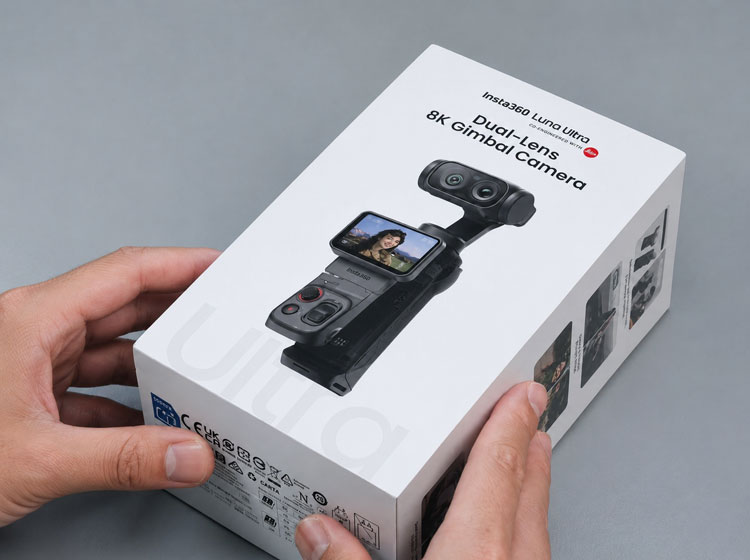
Finally, we have the first unboxing video of Insta360 Luna, it does confirm that we are not at the verge of an announcement. So, make everything look authentic. On May 18, 2026, tech YouTuber Kingmi Mobile released what appears to be the world’s first full unboxing and hands-on of the Insta360 Luna Ultra Black — the highly anticipated dual-lens flagship that’s shaping up to be DJI’s strongest rival yet.
What’s Inside the Insta360 Luna Ultra Box
Yes, here is where the real excitement begins. We have reached the horizon level, where we are witnessing the unboxing of the Insta360 Luna. And let’s explore what we will be getting in the packaging
Insta360 Luna Ultra Black body with dual Leica Summicron lenses
Detachable OLED touchscreen remote (the standout modular feature)
Tripod, wrist strap, charging cable, and protective pouch
Documentation and Insta360 Care promo
Notably missing in the base kit (as pointed out in viewer comments): microSD card and fill light – you’ll need to buy those separately.
What we can extract from this unboxing video is the build and the design quality, and most importantly, for the first time, we have seen how the entire setup works and the most amazing part was removing the handheld controller from the camera
Key Highlights from the Kingmi Mobile Unboxing
Build & Design: Premium feel in matte black. The magnetic detachable handle with integrated OLED screen works flawlessly as a wireless remote with live view.
Dual-Lens System: 1-inch main sensor (F1.8) + telephoto lens for true optical zoom (up to 6x lossless reported). So, it’s no less than the DJI Pocket Gimbal 4 PRO that has been recently announced globally
De-attachable Screen: Flip-out + fully detachable OLED for remote control — a game-changer for solo vloggers.
First Impressions: Yes, it does have an impressive look with an Excellent build quality, smooth gimbal, and promising low-light performance thanks to the large sensor and Triple AI Chip.
The video also gives a quick look at the camera’s menu system, stabilisation, and initial handling impressions.
Special Features: Detachable OLED remote, AI Deep Track, 4-hour battery life, Triple AI Chip for low light
Colors: Black and White (Panda) editions
Insta360 Luna Ultra vs DJI Osmo Pocket 4
This is the big question everyone is asking. The Luna Ultra brings:
Larger 1-inch sensor + brighter F1.8 aperture
True dual-lens optical zoom
Innovative detachable wireless remote screen
However, early feedback notes higher international pricing (~$780 body / ~$960 kit in US/EU markets) compared to DJI.
Release Date & Pricing
Official global launch is expected in late May to early June 2026. Pre-order pricing leaks suggest aggressive positioning in some markets, but US/EU buyers should prepare for premium DSLR-like pricing.
The article “Insta360 Luna Ultra Unboxing Finally Here” was written by thenewcamera.com team on 7:59 pm, Tuesday, 19 May 2026, Greenwich Mean Time (GMT) | You can also follow us on Our Official Social Media HandlesFACEBOOK | TWITTER | INSTAGRAM> get live news — > DJI Rumors
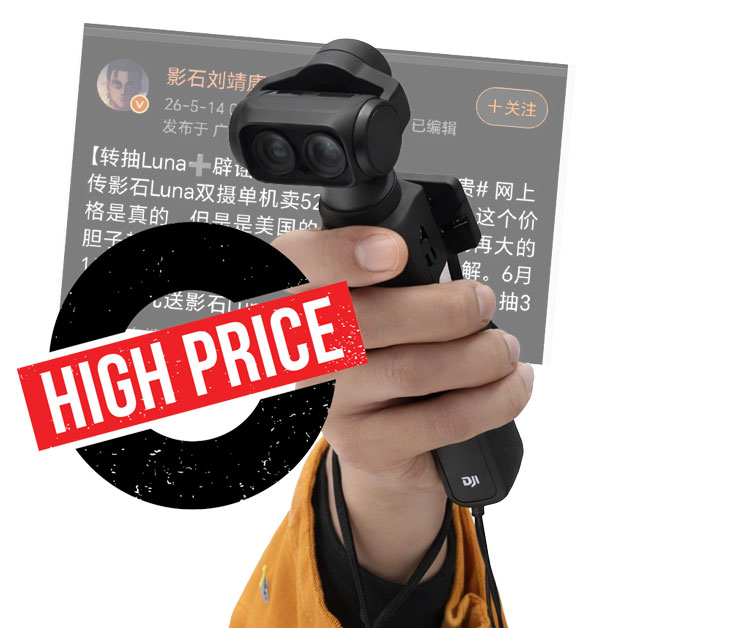
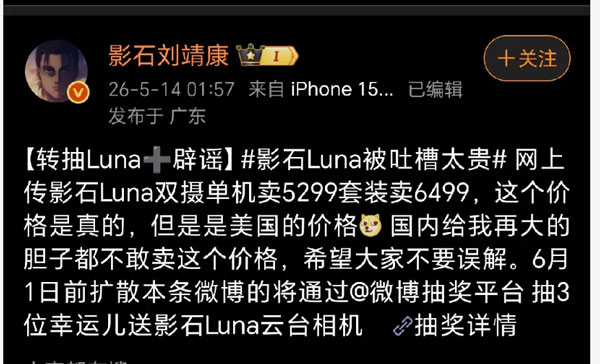
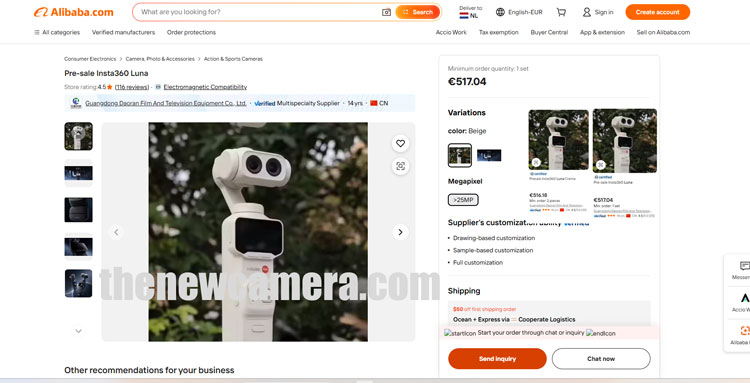
The Insta360 pocket gimbal camera is on the verge of its announcement, but people are confused about its pricing. Now everything was going perfectly till the company’s founder and CEO, Liu Jingkang, directly addressed the leaked pricing on Weibo, confirming that the rumoured figures are real… but only for the US and international markets.
According to the CEO’s post (widely shared on Reddit’s r/dji and Chinese social media), the Luna Ultra will carry a noticeably higher price tag outside China. He stated (rough translation):
“People online are saying Luna is too expensive. The rumoured online pricing is real, but that’s the US price. I wouldn’t dare to sell it at that price range in China. Hope people don’t misunderstand.”
Obviously, these Chinese products have to pay hefty taxes in other countries around the world, so they have no option but to pass the burden of extra taxes onto the consumers who are buying the product.
Confirmed US Pricing
Luna Ultra Body Only — ~$780 USD
Luna Ultra Full Creator Bundle / Kit — ~$960 USD
These are the official prices American buyers can expect. Early grey-market leaks floated $560–$620 ranges, but the CEO has now made it crystal clear that those lower figures do not apply to the US market. Yes, they have limited to the Chinese market.
The Pricing in the Chinese Market is expected to remain low, very similar to the data we have from Chinese retailers, which we have published earlier
Earlier pre-sale leaks from Chinese suppliers had the Luna Ultra hovering around $560–$620 during early listings. The CEO’s clarification suggests those lower figures were likely China-specific or promotional, while global buyers will pay a premium.
Obviously, the DJI Pocket 4 Pro is not available in the United States of America due to FCC-related issues regarding the dual-lens-based pocket gimbal camera. Insta360 Luna has a golden opportunity for now, but as per the initial set of reports, the DJI Pocket 4 Pro is being rebranded and will soon become available in the United States market under the name Xtra Music Pro 2, which we had earlier mentioned in one of our published posts.
Quick Specs Recap: Why the Price Tag?
The Insta360 Luna Ultra isn’t just another pocket camera — it’s positioned as a premium creator tool:
Dual Leica Summicron lenses (20mm main f/1.8 + 120mm telephoto)
Detachable OLED touchscreen that doubles as a wireless remote controller
Advanced 3-axis gimbal + FlowState stabilization
AI tracking, Hi-Fi 48kHz 32-bit audio, modular design elements
It’s clearly gunning for the high-end segment of the DJI Osmo Pocket 4 / Pocket 4 Pro crowd.
The Big Question for American Buyers
Will the Leica tuning, true dual-lens zoom, and detachable remote screen be worth the hefty US premium over DJI’s ecosystem? Or will most US creators stick with the more wallet-friendly (and widely available) Osmo Pocket 4 series? Or maybe we should wait for Xtramuse 2 PRO camera for a reasonable pricing-based option…
Drop your take below:
Are you buying the Insta360 Luna Ultra at these US prices, waiting for a sale, or going DJI instead?
What do you think? Is the Insta360 Luna Ultra worth the extra cost for its Leica optics and modular design, or will you wait for DJI’s next move? Drop your thoughts in the comments below.
We’ll keep you updated with the official global launch pricing, India availability, and hands-on impressions as soon as they drop.
Stay tuned to TheNewCamera.com for the latest on Insta360 Luna, DJI Pocket 4 Pro, and all pocket gimbal camera news!
Follow us on X (Twitter), Instagram, or subscribe for instant updates.
The article “Insta360 Luna Ultra US Pricing Shock: CEO Confirms Americans Pay $780–$960 While China Gets It Cheaper” was written by thenewcamera.com team on 7:51 pm, Saturday, 16 May 2026, Greenwich Mean Time (GMT) | You can also follow us on Our Official Social Media HandlesFACEBOOK | TWITTER | INSTAGRAM> get live news — > DJI Rumors
So finally, DJI has announced the DJI Osmo Pocket 4P / PRO camera. The camera was officially announced on May 14, 2026, and obviously, based on the design, functionality, and the features of the camera, most of the audience of The New Camera.com already know it has positioned itself as a professional filmmaking/cinematography camera for content creators. Those who want to have a handheld gimbal-style, small, tiny pocket camera with amazing cinematography capability.
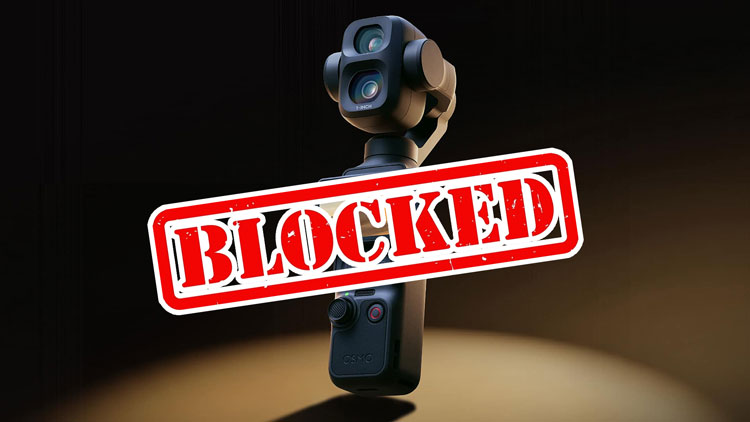
Critical update for American readers: As we know that, the standard Osmo Pocket 4 was released in April 2026, the new Osmo Pocket 4P is not expected to launch officially in the United States due to ongoing FCC authorization issues and the broader DJI Covered List restrictions. Despite the fact that we do know it’s not a drone, but yes, official US sales channels (DJI.com, Amazon US, B&H, Adorama, etc.) are highly unlikely to carry it at launch. If Any Update arrives about its arrival in the USA, we will be updating asap.
Why US Availability Is Blocked (Straight Talk for American Creators)
We all know initially it all started with the drone ban, but the situation has gone too far, and after approval by the FCC in late November and December 2025, both the DJI Osmo Pocket 4 and DJI Osmo Pocket 4P are not available for now in the United States of America. Some claims have been raised, and it is that the last 10 to 15 products which have been approved by the FCC are now facing issues becoming available in the USA.
So for now, take a look at what we know so far about the availability of the DJI Osmo Pocket 4P camera.
US Release Date: No official US launch window
Buy in USA: Gray-market imports possible (e.g., via forwarders from Europe/Asia), but expect no warranty, potential customs delays, and compliance risks
Current Recommendation: Many US creators are sticking with the still-excellent Osmo Pocket 3 or waiting to see if any legal changes occur
If you’re a US-based YouTuber, vlogger, or indie filmmaker searching for “DJI Pocket 4P US release” or “buy Osmo Pocket 4P in America,” this is the reality right now.
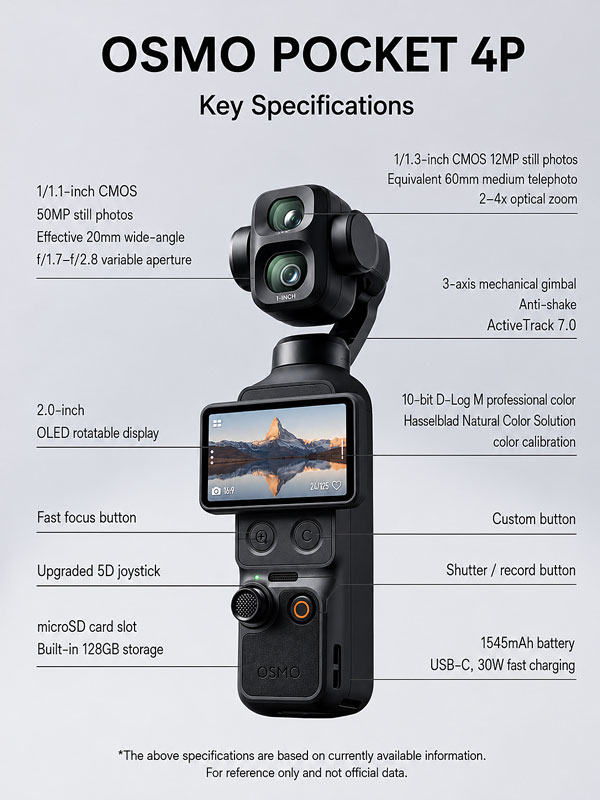
Features of the DJI Osmo Pocket 4 PRO
This is the biggest upgrade in Pocket history — a true dual-camera cinematic pocket gimbal:
Dual-camera system — 1-inch main CMOS sensor (wide ~20mm equivalent) + dedicated 3x optical telephoto (~70mm equivalent)
True optical zoom — seamless switching with no heavy cropping
10-bit D-Log2 color — Hasselblad-tuned for professional grading
Cinematic dynamic range — early leaks suggest up to 17 stops + HDR support
Improved low-light performance and natural skin tones for portraits/interviews
Rotatable touchscreen, 4-channel OsmoAudio, and premium build
Rumored video specs (based on consistent pre-launch info):
6K/60fps or 4K/240fps
Up to 12x hybrid zoom
107–128 GB built-in storage (no microSD in most reports)
DJI Osmo Pocket 4 PRO vs Osmo Pocket 4 – Quick US Comparison
Feature
Osmo Pocket 4P (New)
Osmo Pocket 4
Camera System
Dual (1″ wide + 3x tele)
Single 1″ CMOS
Optical Zoom
True 3x optical
Digital zoom only
Color Science
10-bit D-Log2
10-bit D-Log
Dynamic Range
Up to 17 stops
~14 stops
Best For US Creators
Portraits, interviews, cinema
Everyday vlogging
Expected Price (USD)
$730–$800+ (rumored)
Lower tier (not sold in US)
US Availability
Highly unlikely at launch
Not available
Pricing & Global Timeline (What US Buyers Can Expect)
Announced on – May 14, 2026 – Cannes, France
Global rollout (Europe, Asia, etc.): Shortly after
US pricing estimate: $730–$800 base model (roughly €749–799 in Europe)
Creator Combo bundles will be higher
Pre-orders are expected to open first on the official DJI Store outside the US. American buyers looking for the cheapest route often use freight forwarders, but again — warranty and support will be limited.
High-res press images and teaser videos are now live.
What This Means for US Filmmakers & Content Creators
The dual-lens system (wide + flattering 3x telephoto) is a game-changer for portraits, compressed backgrounds, and flexible storytelling — exactly what Hollywood-adjacent and indie creators have wanted. Unfortunately, the FCC situation means most Americans will have to decide between:
Importing at your own risk
Sticking with the Osmo Pocket 3 (still widely available and excellent)
Waiting for any potential policy changes
Stay tuned — we’ll update this page the moment any new US-specific info, gray-market options, or full sample footage drops. Bookmark this or follow us on X (@thenewcamera) for real-time alerts.
Questions about buying the DJI Osmo Pocket 4P in the USA? Drop them in the comments. We answer the most common US-specific questions (import tips, warranty, alternatives) in our upcoming FAQ.
[Best Pocket Gimbal Alternatives for US Creators Right Now]
The article “BREAKING: DJI Pocket 4 PRO with 3x Optical Zoom Drops – Full US Release and FCC Ban Update” was written by thenewcamera.com team on 7:44 pm, Friday, 15 May 2026, Greenwich Mean Time (GMT) | You can also follow us on Our Official Social Media HandlesFACEBOOK | TWITTER | INSTAGRAM> get live news — > DJI Rumors
Buy Canon Lenses, Buy Music CD or Digital Camera at amazon it helps this site, and you do not pay anything extra, it is just a way to help support this site.
New Camera Website, we list all type of new camera information, price review and all type camera rumors, subscribe us or follow us via twitter or facebook.
Disclaimer: We have attempted to select useful information to include on New Camera, and to ensure that the resources we have included on the site -- as well as the way we have described them -- are accurate, fair, and balanced. However, we make no claims, warranties, or other representations concerning the accuracy, completeness, or utility of the information provided, or concerning the abilities or performance of the organizations, agencies, companies, and other resources presented through New Camera