Join More Than 50,000+ Subscribers and get latest camera news and rumors
NEW CAMERA VIDEOS ON YOUTUBE
|
By admin, on July 9th, 2025

Canon has registered one more camera today, with the model code DS126936. As per the initial specifications, the camera resembles an entry-level model — either the full-frame Canon R8V or an APS-C line update, or the Canon R10 Mark II. Canon R10 was announced back in May 2022, due for an update
Canon updated the list of model codes in July 2025
-
- DS126922: EOS R5 II (Dual-band Wi-Fi 6 & Bluetooth)
- DS126928: EOS R1 (Dual-band Wi-Fi 6 & Bluetooth)
- DS126941: EOS R50 V (Dual-band Wi-Fi 5 & Bluetooth)
- DS126904: PowerShot V1 (Dual-band Wi-Fi 5 & Bluetooth)
- ID174: Unknown (Dual-band Wi-Fi 5)
- ID179: Unknown (Dual-band Wi-Fi 5)
- ID0814: Unknown (Dual-band Wi-Fi 5)
- DS126916: Unknown (Dual-band Wi-Fi 5)
- DS126936: Unknown (Dual-band Wi-Fi 5 & Bluetooth, in line with EOS R50V, EOS R8)
All the registered cameras support 2.4 gigahertz and 5.1 gigahertz Wi-Fi modules inside them. The cameras starting with DS represent mirrorless cameras or high-end compacts, and the cameras starting with ID are the cinema cameras from Canon.
The newly registered camera DS126936 has wireless specifications very similar to the R50 V and the Canon R8 camera, so it is expected that we may see the successor of the Canon R8 — the R8 V camera — which we have already discussed the specs of in our previous article. Also, there is also high possibility of the arrival of Canon R10 Mark II, since it has already been 2+ years since the original camera and it is completely outdated.
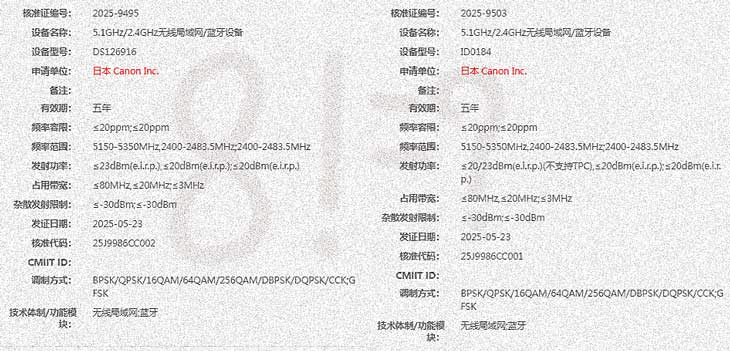
In May 2025, Canon already registered two more cameras, as we all know, when a camera maker like Canon does a registration, they take at least three months to make the product official, so the May 2025 registered model codes are expected to arrive in the last week of Aug and early September 2025
Earlier, Canon registered two new cameras in May 2025. In that post, we have very clearly written that we expect a Canon announcement sometime in the 4th Week of August or Early September 2025.
This is what we have already said in the May 2028 Post
Some EOS or Cinema EOS cameras are planned for the future, and may be announced in the coming months. Rumor has it that they will be the Canon R6 Mark III or EOS R7 Mark II, but as we can see here, Canon is preparing for only one Consumer Mirrorless camera and the other is Cinema EOS.
Canon Camera Announcement in the 4th Week of August or Early September 2025
 Canon registered both cameras in the 4th week of May 2025, roughly the camera maker takes 3 months to make it official, so expect a Canon announcement sometime in the 4th Week of August or Early September 2025. When will DS126936 arrive? [July Registration]

Based on the Canon Announcement pattern and the time of announcement, the DS126936 is expected to arrive sometime in 1st week of November 2025. Canon will take at least three months of time to its safe to assume after the Aug/Sep Announcement, the next announcement from Canon is expected to happen sometime in November 2025.
Stay Updated with TheNewCamera.com
At TheNewCamera.com, we’re dedicated to keeping you informed about the latest camera news. The article “Canon Registered one More Model – DS126936 – July 2025 Update” by thenewcamera.com team | Follow us on our social pages FACEBOOK | TWITTER | INSTAGRAM to get live Camera News + Canon Rumors 24X7.
source E88_8888
Canon R8V: Specification, Arrival Date, and Price Expectations

The Vlogging Camera of the Future?

By admin, on July 7th, 2025
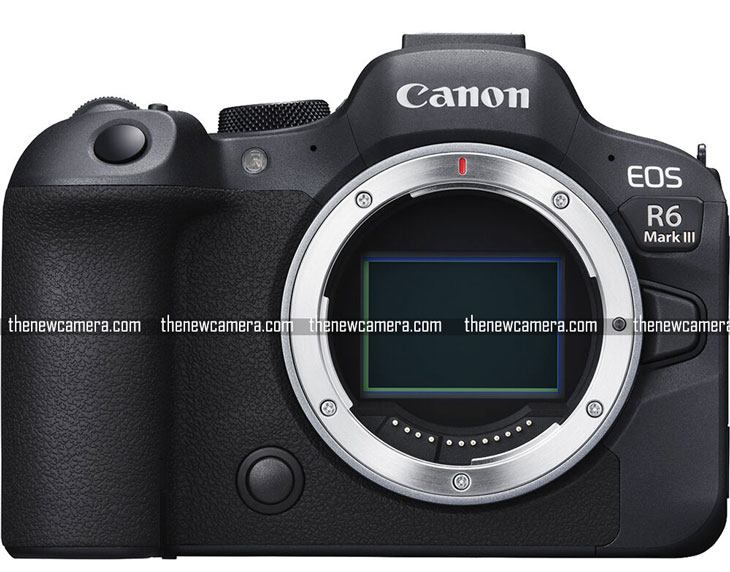
According to the latest rumors coming from the rumor mill, Canon is about to announce the Canon R6 Mark III as well as the Canon R7 Mark II camera on 4th week of Aug (or maybe the first week of September 2025). Let’s explore the details one by one
Canon R6 Mark III Arrival Time
Canon R6 Mark III Camera coming in the 4th Week of August 2025. We are almost sure about the arrival of the Canon R6 Mark III camera, since it has been confirmed by my trusted sources in the past, the Canon R6 Mk III is coming with a 30+ MP sensor. Take a look at the rumored specifications of the upcoming camera
Canon R6 Mark III specifications
- Sensor: Brand new
- [approx]30.3MP Full-Frame CMOS Sensor
- Readout Speed: Non-Stacked Sensor
- Processor: Dual DIGIC X and
- DIGIC Accelerator for enhanced performance
- Subject Tracking with Deep Learning
- Rear LCD: New “flippy” mechanism, likely a tilt-and-flip design similar to Sony and Panasonic models
- Video Capabilities:
- 6K RAW recording at 60 fps
- 4K recording at 120 fps
- Support for C-Log 2 and C-Log 3 for advanced color grading
- 3.2″ Vari-Angle Touchscreen LCD
- CFexpress & SD UHS-II Memory Card Slots
- Announcement: Late Aug 2025 – Early Sep, shipping from December 2025
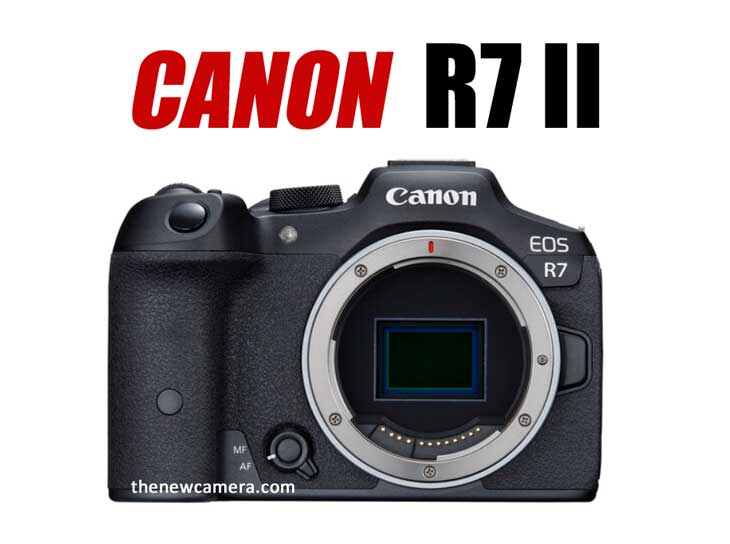
Canon R7 Mark II Arrival Time and Price
Canon R7 Mark II camera coming in the 4th week of Aug 2025. But, the big issue is that the Canon R7 Mark II is expected to hit a higher price tag compared to its predecessor, the R7. The Canon R7 camera is now available at $1499 (with $100 discount on MSRP). The Canon R7 Mark II will have a price tag of $2000 at the time of announcement.
We will post an update soon as we get new information – Stay tuned – More updates coming
ollow us on our social pages FACEBOOK | TWITTER | INSTAGRAM to get live Camera News + Canon Rumors 24X7.
Source – canonrumor.com
See more – Canon R6 Mark III Actual Specification by Jan Wegener
By admin, on July 5th, 2025
 Canon G7X Mark IV Creative Image According to the latest rumor coming from the rumor mill, Canon is working on its G series compact camera. So maybe in between March to September of 2026, we will have a revived G series of compact cameras from Canon.
The Canon PowerShot G series was one of the most popular premium compact camera series of all time. Still, due to the low demand for compact cameras back in 2020-2021, Canon decided to shut down the entire series. But recently, the market trend has again shifted towards compact cameras, and now they are in again in demand again. Although Canon has announced V series compact cameras in 2024 and in 2025. but, they are again planning to revive the G series of compact cameras to gain as much market share as possible.
Why the Canon G7X Mark IV is the Top Contender?
The Canon G7X series was the vlogging icon, and it was one of the most loved series in Canon. Still, there is high demand for the G7X Mark III, although the camera was announced back on July 9, 2019. But due to its high demand, it is almost out of stock everywhere even today. Now let’s discuss what we can expect from the upcoming Canon G7X Mark IV 2025 vlogging camera.
Canon G7X Mark IV – Expected Core Specifications
- Sensor: 1-inch 20.1MP stacked CMOS with DIGIC X.
- Lens: 24-120mm f/1.8-2.8, 5-stop stabilization.
- Video: 4K60 (no crop), 10-bit HDR, Canon Log 3.
- Autofocus: Dual Pixel CMOS AF II with AI tracking.
- Features: Flip-up touchscreen, Wi-Fi 6, USB-C PD, microphone input, flash.
- Design: Compact, recycled-material body, dust-resistant.
As we can very clearly see, PRO compact cameras like the Ricoh GR / GR III HDF, also the Fuji X100 VI series, are also is in very high demand and rarely in stock. To compete with these high-end mirrorless compact cameras, Canon may also introduce their ultra-popular G1 X series once again ( the fourth variant), which has all the capabilities that we have already seen in the recently announced Canon V1 Pro compact camera for bloggers.
Canon G1 X Mark IV camera with a 1.4-inch upgraded sensor and DIGIC X image processor may arrive to target professional photographers seeking mirrorless quality in a very compact body.
Canon G1 X Mark IV – Expected Core Specifications
- Sensor: 1.4-inch 24.2MP CMOS with DIGIC X.
- Lens: 24-100mm f/2-2.8, 5-stop stabilization.
- Video: 4K60 (no crop), 10-bit HDR, Canon Log 3.
- Autofocus: Dual Pixel CMOS AF II with AI detection.
- Viewfinder: 2.36M-dot OLED EVF.
- Features: Articulated touchscreen, Wi-Fi 6, microphone input, flash, hot shoe.
- Design: Weather-sealed, modular accessory support.
what we do believe is that Canon will first introduce the G7X Mark IV camera since it was one of the most popular Canon compact cameras of all time and stillthe G7X Mk III in very, very high demand. And later on, maybe in 2026, we may see the arrival of the G1 X Mark IV.
Which is your pick – G7X Mark IV or the G1 X Mark IV? Share below!
Follow us on our social pages FACEBOOK | TWITTER | INSTAGRAM to get live Camera News + Canon Rumors 24X7.
source / news / rumor credit: Canonrumor.com

By admin, on June 30th, 2025
To be very clear, these Canon patents are not new, but one of our team members sent me real-life-like images inspired by those patents, so I have decided to post. In the world of content creation, Canon is pushing the boundaries with its very advanced patent technology. Now, spied from those patent designs for vlogging cameras, we have showcased some of the futuristic designs that will revolutionize the vlogging experience. We have showcased two different designs — one is very powerful and compact, and the other is a stylish camera with a 16mm lens. Let’s explore those two.
Exploring the Canon patent-inspired designs

In the first design, you can see — a handheld kind of vlogging camera which is being attached with a 16mm f/2.8 lens, and the gimbal-type structure will ensure stability while we are shooting handheld videos with the camera. It will be very lightweight. Let’s hope this design may come true soon.

In the second design, you can see we have a compact camera with refined aesthetics. It features a large hybrid screen which helps you to shoot vertical or horizontal videos with Canon’s advanced camera module that can rotate and track you while you’re moving, and the room to make the entire vlogging experience hands-free and easy. So it will be a very advanced, futuristic camera if Canon makes it a real-world product.
These designs were inspired by the following patent images / Post below


At TheNewCamera.com, we’re dedicated to keeping you informed about the latest camera news. The article “The Vlogging Camera of the Future? These Canon Patent Real Life Images Will Shock You!” was first published on 8:37 am, Monday, 30 June 2025, Greenwich Mean Time (GMT)) by thenewcamera.com team | Follow us on our social pages FACEBOOK | TWITTER | INSTAGRAM to get live Camera News + Canon Rumors 24X7.

By admin, on June 25th, 2025

Canon has announced its own V series of cameras, starting from the Canon V1 compact camera. Recently, Canon announced the R50 V camera on March 26, 2025. So they are slowly expanding their V series to compete against Sony.
Now what’s next? We are expecting the arrival of the Canon R8 V camera as part of their expansion to its V series. The Canon R8 is expected to have the same image sensor and image processor, but it will surpass the video capabilities of the R6 Mark II camera.
So let’s discuss the possible specifications, arrival date, and the price of the upcoming Canon R8 V camera. It will be a game-changer camera for professional content creators and beginner filmmakers.
Canon R8V Specifications [Expected]
- Sensor: 24.2MP full-frame CMOS (same as EOS R8/R6 II) with fast ~1/68s readout to minimise rolling shutter.
- Processor: DIGIC X for advanced autofocus and high-quality video output.
Video Capabilities:
- 4K/60p uncropped, oversampled from 6K – sharp, detailed footage.
- 4K/120p (1.2x crop) – better slow motion than R6 II’s Full HD/120p.
- Canon Log 3, 10-bit 4:2:2 (H.265), HDR PQ, and 2.35:1 aspect ratio for professional colour grading
- Four-channel 24-bit audio – cinema-level sound, inherited from R50V.
- Unlimited 4K recording thanks to better cooling, unlike R8’s 2-hour cap.
Stabilization:
- IBIS (5–6 stops), combined with lens IS for up to 7.5 stops – a big upgrade over R8’s lack of stabilisation.
Autofocus:
- Dual Pixel CMOS AF II with deep-learning subject tracking (people, animals, vehicles).
- No Eye Control AF to stay below R6 III’s premium tier.
Body & Design:
- Cube-style, EVF-free, ~498g [Approx] lightweight design based on R50V.
- 3″ vari-angle touchscreen (1.62M dots) with tap-to-cycle subject detection.
- Front record button, vertical tripod mount, livestream shortcut, simplified video controls.
- No joystick or top LCD screen.
- Single UHS-II SD card slot, no weather sealing – trimmed for creators, not hybrid pros.
Connectivity:
- USB-C 3.2 (plug-and-play 4K/60p webcam), micro-HDMI, mic/headphone jacks, Wi-Fi, Bluetooth, Canon Live Switcher support.
Shutter & Performance:
- Electronic first curtain shutter, up to 1/8000s.
- 6fps stills burst – fine for casual use, not suited for fast action.
Power:
- LP-E17 / LP-E6NH battery. We are expecting enhanced battery life
- No grip support – a key difference from R6 II.
Lens Mount:
- RF mount – works with budget RF lenses and premium L-series optics.

Why Canon R8V is better than the R6 Mark II in video specifications
Since Canon R8 V falls into a different zone, it will not cannibalise the sales of the Canon R6 Mark II camera, even if it has improved video core specifications. People who are interested in content creation and photography will buy the R8 V camera. Otherwise, for photographers and hybrid users, the R6 Mark II will remain a perfect choice.
- The cube-style design will protect Canon R6 Mark II camera sales: The R8 V cube-style, EVF-free design, completely inspired by the previously announced R50 V camera, ensures it targets professional video creators and content makers.
- No electronic viewfinder: It will surely push photographers and hybrid shooters away from this camera, since most of them love to have an EVF so they can compose their shot even in daylight scenarios very precisely.
- Simplified controls: No joystick or top LCD display screen like we have in the Canon R6 Mark II. With limited physical controls, specifically made for video workflow, and having the entire menu design very similar to Canon USA cinema-style cameras.
- Limited still capture: Canon will cap the continuous capture cycle to 6 frames per second, preserving all possible advantages of a hybrid camera inside the Canon R6 Mark II.
Canon R8V arrival date
Canon’s 2025 roadmap was already packed with Canon R50 V and PowerShot V1 announcements. We also have a list of rumoured cameras like the Canon R6 Mark III, which will arrive in the 4th quarter of 2025. For details, you must look at the list of Canon’s upcoming cameras in 2025.
Q2 / Q3 of 2026 — somewhere between April to September of 2026 — is the perfect timeline, and it also aligns with Canon R8’s 3-year refresh cycle, which was launched back in April 2023. So, introducing an R8 V in mid-2026 is the best possible timing.
If Canon prioritises the creator market, they may launch it sooner.
Canon R8V Price
The Canon R8 was launched at $1,499 (body only), and the R50V is priced at $649.99, ~$300 below the R10’s $979. If Canon follow the same pricing pattern, the Canon R8V price would be
-
Body Only: $1,799 [Approx], a $300 premium over the R8 for IBIS, 4K/120p, and creator tools.
-
Kit Options:
Canon R8V with such core specifications and price can directly compete against cameras like Sony ZV-E1 ($2,199, 4K/120p, IBIS) at a higher price range. But, Canon still have to focus in their full-frame RF Mirrorless lineup since people are waiting for more affordable options from third-party lens makers.
At TheNewCamera.com, we’re dedicated to keeping you informed about the latest camera news. The article “Canon R8V: Specification, Arrival Date, and Price Expectations” was first published on 4:53 pm, Wednesday, 25 June 2025, Greenwich Mean Time (GMT) by thenewcamera.com team | Follow us on our social pages FACEBOOK | TWITTER | INSTAGRAM to get live Camera News + Canon Rumors 24X7.
By admin, on June 25th, 2025
 Canon’s new patent for slow-shutter bracketing, aka Live ND Filter powered by AI, could make long-exposure photography a breeze. Instead of tweaking your shutter speed, for each shot, the camera would automatically fire off a series of images at different slow-speed settings in one go. Think light trails streaming behind cars or water flowing silky-smooth over rocks, this feature would handle the adjustments behind the scenes—so you get a variety of creative effects in a single burst, automatically saved in your camera. We can expect the arrival of the feature in Canon’s future cameras. Canon’s new patent for slow-shutter bracketing, aka Live ND Filter powered by AI, could make long-exposure photography a breeze. Instead of tweaking your shutter speed, for each shot, the camera would automatically fire off a series of images at different slow-speed settings in one go. Think light trails streaming behind cars or water flowing silky-smooth over rocks, this feature would handle the adjustments behind the scenes—so you get a variety of creative effects in a single burst, automatically saved in your camera. We can expect the arrival of the feature in Canon’s future cameras.
Patent overview
- [Publication number] P2025093064
- [Release date] 2025-06-23
- [Title of Invention] Imaging device and its control method and program
- [Application date] 2023-12-11
- [Applicant]
[Identification number] 000001007
[Name or company name] Canon Inc.
- An imaging device capable of obtaining a plurality of images with different slow shutter expressions in response to a single shooting instruction, and a control method and program for the same are provided.
- [Background technology]
[0002]
As a photography technique using long exposure, there is slow shutter photography, which captures the movement of a moving subject such as a waterfall or water flowing in a river. In slow shutter photography, the expression and impression of the photograph that can be taken changes depending on the length of the exposure time, so it is necessary to repeatedly shoot until a photo that is satisfactory to the user is captured. However, when repeatedly shooting while changing the exposure time, it is not possible to record images with different slow shutter expressions for the same scene.
- [0003]
On the other hand, there are conventional techniques that realize pseudo long-second exposure. For example, Patent Document 1 discloses a method of synthesizing images taken repeatedly at specific intervals to achieve a specific brightness. Patent Document 2 discloses a method of recording images with different exposures of the same scene as bracket images by repeatedly aligning and additively synthesizing multiple taken images and storing the images.
- [0005]
However, in the prior art of Patent Document 1, the brightness of the image changes, so images with different slow shutter expressions cannot be recorded. Also, in the prior art of Patent Document 2, the positioning is performed between the captured images, so images with slow shutter expressions that capture the movement of a moving subject cannot be recorded.
- [Patent Document 1] JP 2022-125117 A (OM Digital)
- [0006]
The present invention has been made in consideration of the above-mentioned problems, and aims to provide an imaging device and a control method and program thereof that can obtain multiple images with different slow shutter expressions with a single shooting instruction.
- EFFECTS OF THE PRESENT EMBODIMENTS
[0008]
According to the present invention, a single shooting instruction can obtain a plurality of images with different slow shutter expressions.
See more Canon Patent

Get LIVE RUMORS –> FACEBOOK | TWITTER | INSTAGRAM to get live Camera News + Canon Patent 24X7
source – asobinet.com
By admin, on June 12th, 2025
According to the latest news on the web via rumor mills, the Canon R7 Mark II camera is coming without a mechanical shutter. The successor to the Canon R7 camera will arrive in Q4 of 2025. Canon R7 series is always called as trend setter of the prosumer market, it always sets a new standard in terms of performance, usability, and practicality
A Shutterless Future for Canon APS-C Cameras?
See, the idea of ditching the mechanical shutter is not entirely new. If you have been following, then Nikon made headlines years ago by dropping the mechanical shutter in the Nikon Z8 and the Nikon Z9 camera. It did raise the eyebrows of professional photographers—those who have been using mechanical shutters for ages— but none of them have any performance quality issues.
A mechanical shutter is required when your sensor readout speed is slow. Typically, all the traditional non-stacked CMOS sensors had slow readout speed, and with the help of a mechanical shutter, the traditional readout speed gets overridden; hence, the mechanical shutter was a very essential thing, till the stacked CMOS sensors arrived in the mirrorless game.
Do Stacked CMOS Sensors Need a Mechanical Shutter?
Now, with the faster readout speed, new age sensors, technically, the stacked CMOS sensors don’t need a mechanical shutter. With faster readout speeds, these sensors minimize rolling shutter distortion, which was a key limitation of electronic shutters in the past. For example, the latest Nikon cameras, the Z8 and Z9, feature stacked CMOS sensors with a readout speed of approximately 3.73ms (1/268 second) for full-resolution RAW stills, among the fastest for HIGH RES. full-frame cameras. This speed significantly reduces rolling shutter artefacts, making mechanical shutters largely redundant for most shooting scenarios.
The Sony Alpha 9 III takes this further with its full-frame global shutter sensor, which captures all pixels simultaneously, effectively eliminating rolling shutter distortion (rendering traditional readout speed measurements irrelevant). This allows distortion-free capture at 120fps for stills and in high-speed video modes like 4K/120p, without the need for a mechanical shutter.
Mechanical shutters are no longer critical for exposure control in these cameras; they still have some use, however, and can serve a secondary purpose: protecting the sensor from dust and debris when the camera is powered off or during lens changes. For example, the Nikon Z8 and Z9 incorporate a sensor shield that closes when the camera is off, addressing this concern without requiring a traditional mechanical shutter.
List of Shutterless Mirrorless Cameras 2025
| Brand |
Model |
Sensor |
Resolution |
Burst Rate (Electronic Shutter) |
Release Status |
| Nikon |
Z9 |
Full-Frame Stacked CMOS |
45.7MP |
20fps (RAW), 120fps (11MP JPEG) |
Released (2021) |
| Nikon |
Z8 |
Full-Frame Stacked CMOS |
45.7MP |
20fps (RAW), 120fps (11MP JPEG) |
Released (2023) |
| Sony |
Alpha 9 III |
Full-Frame Global Shutter CMOS |
24.6MP |
120fps |
Released (2023) |
| Canon |
EOS R7 Mark II (Rumored) |
APS-C Stacked BSI CMOS |
32.5MP (Speculated) |
40fps (Speculated) |
Expected Q3/Q4 2025 |
Take a look at the updated list of Canon R7 Mark II expected core specifications below
- 32.5MP Stacked APS-C CMOS Sensor
- Dual Pixel CMOS AF II
- 4K 120p 10-Bit Video, HDR-PQ & C-Log 3
- External 6K ProRes RAW Recording
- 40 fps E. Shutter,
15 fps Mech. Shutter
- Sensor-Shift 5-Axis Image Stabilization
- 3.69 m-Dot OLED EVF
- 1.6m-Dot Vari-Angle Touchscreen LCD
- Sensor-Shift 5-Axis Image Stabilization
- Dual UHS-II Memory Card Slots
- Multi-Function Shoe, Wi-Fi and Bluetooth
Our Take
Mechanical shutters are expensive to produce, add complexity to camera bodies, and have a finite lifespan due to their moving parts. By going fully electronic, Canon could streamline production and potentially pass savings on to consumers. While using a STACKED CMOS sensor, Electronic shutters can also offer distinct advantages without worrying about the rolling shutter issue. Some Advantages include silent operation, faster burst rates, and higher shutter speeds (up to 1/16,000 sec on the current R7). It’s a welcome and very innovative step by Canon if the information is true.
What do you think about a shutterless R7 Mark II? Would you embrace the change, or do you prefer the reliability of a mechanical shutter? Let us know in the comments below!
At TheNewCamera.com, we’re dedicated to keeping you informed about the latest camera news. The article “Canon R7 Mark II Coming without Mechanical Shutter” was published on 8:40 am, Thursday, 12 June 2025, Greenwich Mean Time (GMT) by thenewcamera.com team | Follow us on our social pages FACEBOOK | TWITTER | INSTAGRAM to get live Camera News + Canon Rumors 24X7.
source credit of the news canonrumor.com
Canon Registers Two New Cameras May 2025 Update
When Are Third-Party Lenses Coming for Canon RF Full-Frame Mount?

Canon Upcoming Cameras 2025
|
KEEP THIS BLOG ALIVE - Support New Camera Buy Canon Lenses, Buy Music CD or Digital Camera at amazon it helps this site, and you do not pay anything extra, it is just a way to help support this site.

|