Nikon today announced Nikon D3200, The new Nikon D3200 features 24 MP sensor developed by Nikon, new image processing engine, better standard ISO range up to 6400 and now you get 60fps / 50fps speed during HD recording and 3 selectable frame rates 30,25, 24fps during Full HD recording with manual control over ISO and shutter speed.
Many website members / visitors are sending theses question in our email box (below) 1. Which camera should I buy? Nikon D3100 or Nikon D3200… and the 2nd Question 2. Should I upgrade my entry level DSLR Nikon D3100 to D3200?
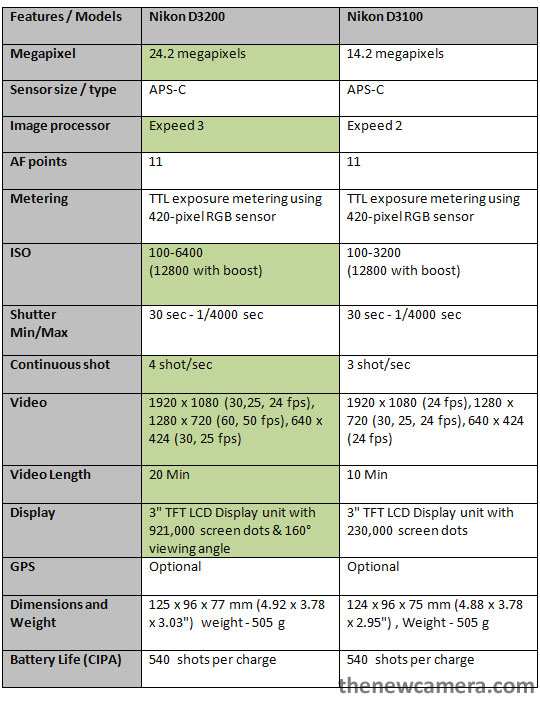
Before you get your answer, read the specification comparison review of Nikon D3200
Senor:Nikon D3200 features new sensor developed by Nikon, you get more megapixel and standard ISO range.
Image Processor: The Nikon D3200 comes with the new Expeed 3 image processor, same image processor used in Nikon 1 system, D800 and D4 DSLR, with the help of new image processor you get 4fps speed @ 24.2 Megapixel compared to old Expeed 2 image processor where you get 3fps speed @ 14.2 Megapixel, improved frame rates during video recording and less noise in JPEGs that come straight out of the camera.
Auto Focus: Both Nikon D3200 and D3100 shares same AF engine, Nikon Multi-CAM 1000 autofocus sensor module with TTL phase detection, 11 focus points (including one cross-type sensor).
Metering: No change here, Both uses same metering method & sensor, TTL exposure metering using 420-pixel RGB sensor.
ISO range: Nikon D3200 offers better ISO range compared to Nikon D3100, you get standard ISO range up to 100 to 6400 and expandable up to 12800.
Continuous shot: 4 fps shooting mode, better than the Nikon D3100.
Video: Nikon D3200 features improved video mode, you get Full HD recording @ 30,25, 24 fps and HD recording @ 60, 50 fps. Nikon D3200 also offer manual control over shutter speed and ISO sensitivity before starting recording. The Video length / record time is also improved, you get Continuous capture / shooting time of 20min, 10 extra minutes compared to D3100.
Display: Nikon D3200 have 3″ High resolution(921,000 screen dots) display with 160° viewing angle.
Battery life, weight and dimension of Nikon D3200 is almost same as Nikon D3100.
Price: You have to pay $150 more for buying Nikon D3200, Nikon D3200 available at $699 at Amazon (see buying details at the end) and Nikon D3100 available at $549 at Amazon.
NEW FEATURE: WU-1a Wireless Mobile Adapter, for remote shooting and sharing files.
with the help of new WU-1a Wireless Mobile Adapter you can share your images with your android Smartphone and Tablet, the WU-1a features remote shooting function with live-view display, It helps you to capture your image from a distance.Compatible OSs: Android 2.3 series (smartphone); Android 3.x series (tablet)
Conclusion: we highly suggest that you purchase Nikon D3200, Nikon D3200 is an excellent entry level DSLR available under $700.
for current D3100 users, you should upgrade your DSLR if you want more megapixel, fast image processor, improved ISO range, better video mode and wireless sharing and shooting option.
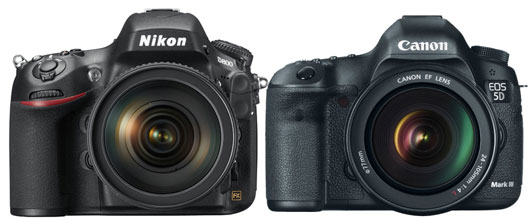
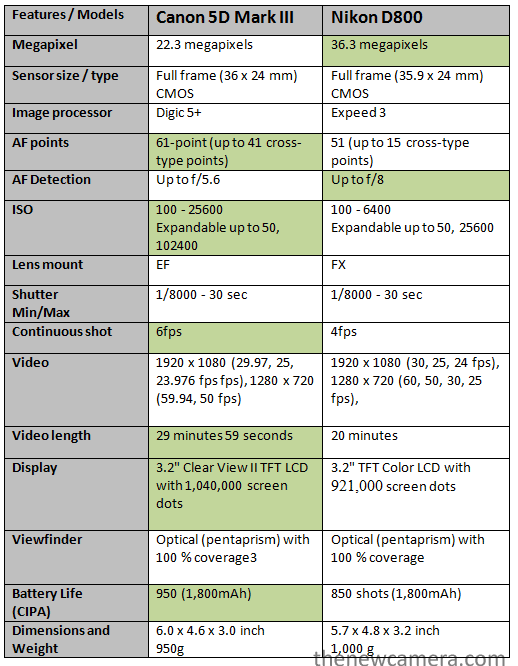
Canon 5D mark III comes with new sensor, improved 61 point AF system same as 1D-X and better video mode. Nikon D800 is a megapixel monster with limited ISO range and slow burst mode compared to new 5D mark II.
Megapixel: Both have same Fullframe sensor but Nikon D800 features 36.3 Megapixel sensor and 5D mark III comes with 22.3 Megapixel sensor, with large individual 6.25 µm pixels and canon 5D mark III has a much-improved S/N ratio resulting in better images from the base ISO.
AF system: Canon 5D mark III features better AF system with 61 point AF (up to 41 cross-type points) but limited up to f/5.6, the Nikon D800 has working AF at f/8 and comes with 51 point AF system .
ISO range: Nikon D800 you get limited standard ISO range up to 6400 only, canon 5D mark III offers standard ISO range up to 25600.
Continuous shooting: The canon new DIGIC+ image processor Working with two 4-channel A/D converter front-end processing circuits, and delivering speeds of up to 6.0 fps, Nikon D800 Continuous shooting speed is limited to 4 fps only.
Video: Canon offers both All-I and IPB compression, supports H.264/MPEG-4 AVC High Profile, and automatically splits files greater than 4GB (FAT specifications) for extended recording without interruption, No details available about Nikon D800 uncompressed HDMI output, Nikon D800 Max Video length is limited to 20 minutes only.
Conclusion:
Canon 5D Mark III recommended for videographers, professional action and sports photographers, photojournalist, Studio, commercial and still life photographers.
Nikon D800 is recommended for Studio, commercial and still life photographers.
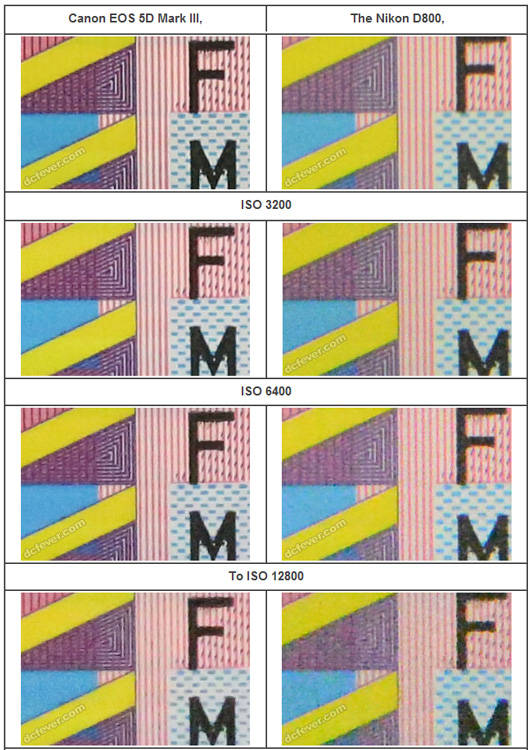
Update @ March 24, 2012 High ISO Sensitivity test done at dcfever.com (chines website)
settings – Canon EOS 5D Mark III: EF 100mm f/2.8L Macro IS USM, f/8.0, AWB (Jpeg), the default of NR, the IS Off,
the Nikon D800, tripod shooting : AF-S VR Micro-Nikkor 105mm f/2.8 G IF-ED,, f/8.0, AWB (Jpeg), the default of NR, the VR Off tripod shooting
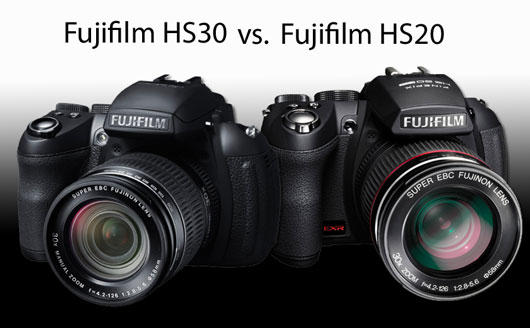
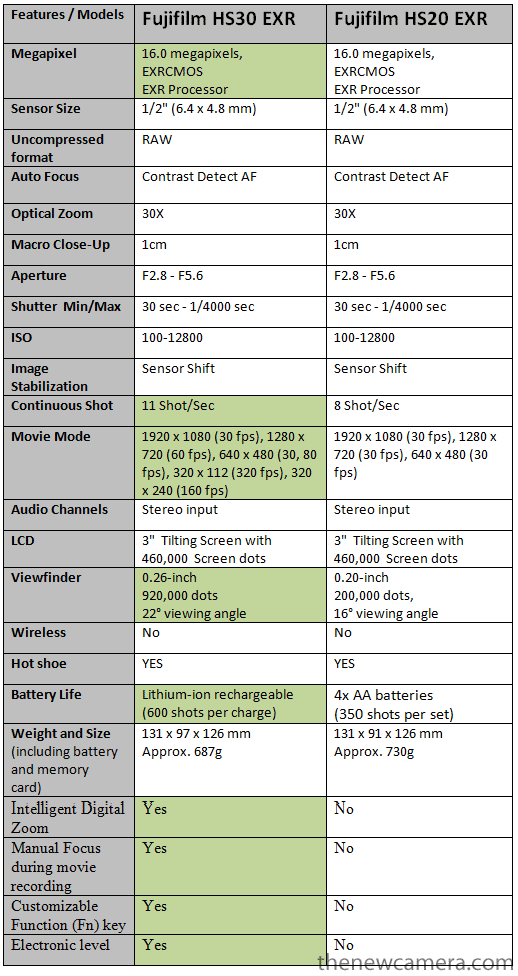
Fujifilm HS30 EXR vs Fujifilm HS20 EXR, fujifilm HS30EXR includes a number of key specification improvements over the HS20EXR model it replaces. Read the specification comparison review below and share your thoughts with us
FinePix HS30EXR features an improved EXR-CMOS sensor, By redesigning the shape of the photo diodes used in the EXR-CMOS sensor, the images display 30% less digital noise at higher ISO settings, which results in smoother tones and better low light images.
The Electronic Viewfinder (EVF) has been greatly improved.
New Lithium-ion rechargeable battery delivers up to 600 pictures per charge.
New EVF : Fujifilm HS30 EXR features same EVF as Fujifilm X S1, FinePix HS30EXR’s EVF have large display unit of 0.26-inche and features 920,000 dots, compared to only 200,000 dots on the HS20EXR, making for a far clearer viewing image.
Writing Speed: The writing period after continuous shooting has also been dramatically cut to approximately 2 seconds (compared to 20 seconds on the HS20EXR).
New Intelligent Digital Zoom function: This doubles the focal range, delivering a massive 60x zoom (30XDigital + 30XOptical) with a maximum telephoto setting of 1440mm.
In the new Fujifilm HS30 EXR you get customisable Function (Fn) key to assign shortcut and New HS30 EXR supports manual focus during movie recording.
Conclusion: Upgrade is recommended, Fujifilm HS30EXR comes same 30X optical zoom but features new sensor, faster processing power and better battery life..
Support New Camera Buy Music CD or Digital Camera at amazon it helps this site, and you do not pay anything extra, it is just a way to help support this site.
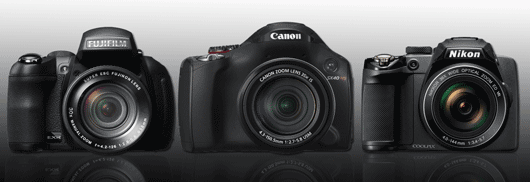
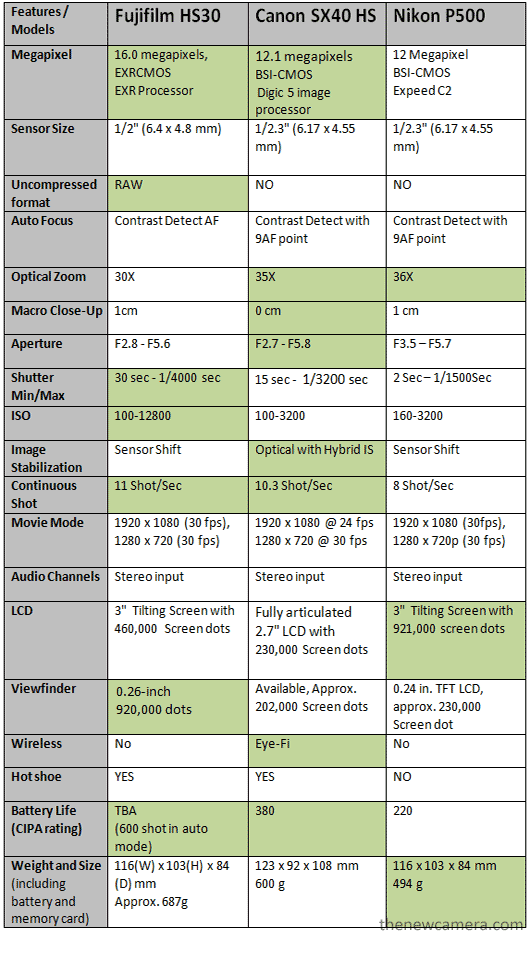
Fujifilm HS30 vs. Canon SX40 HS vs. Nikon P500 specification comparison review, read the review below and select your best megazoom camera.
Buy Fujifilm HS30 from Amazon
Buy Canon SX40 HS from Amazon
Buy Nikon P500 from Amazon
Sensor and image processor:
Fujifilm claims that HS30 uses new sensor, by redesigning the shape of the photo diodes used in the EXR-CMOS sensor, the images display 30% less digital noise at higher ISO settings (compared to HS20 @ ISO 3200), which results in smoother tones and better low light images.
Canon SX 40 HS uses newly developed BSI CMOS sensor and DIGIC 5 image processor, the Digic 5 image processor creates 75% less noise and 6X faster compared to Digic 4 image processor, Due to new sensor and image processor you get more details and less noise in high ISO settings.
Multi-area White Balance in SX 40 HS: The Canon SX40 HS features advanced Multi-area White Balance optimizing color tones of both subject and background under multiple light sources.
Nikon P500 comes with a BSI CMOS sensor but uses old expeed 2 image processor.
Image Processor: Image processor of both Canon and Fuji are very fast, both can capture approx 10.3 / 11 shot/sec in high speed shooting mode, Nikon P500 is limited to 8 shot/sec only.
RAW: Fuji is a clear winner on RAW mode, Only Fujifilm HS30 features RAW format capture.
IS Image Stabilization
Fujifilm HS30 EXR
Canon SX 40 HS
Nikon P500
Image Stabilization
Sensor Shift + High ISO
Optical
Sensor Shift and VR
IS Modes(Hybrid IS)
Not Available
Available (Normal, Macro, Panning, Dynamic, Powered, Tripod)
Not Available
Fuji (CMOS shift + High ISO) Fuji HS30 uses sensor shift and High ISO modes to prevent camera shake.
Canon SX 40HS features 6 IS Modes and Optical IS The new Hybrid System of Canon SX 40 HS features Six Intelligent IS Modes, Canon SX 40 HS automatically chooses from six different modes (Normal, Macro, Panning, Dynamic, Powered, Tripod) to optimize image stabilization and help achieve crisp, blur-free images for various shooting conditions
Nikon features Image sensor shift(not optical) + electronic vibration reduction (VR) function
Images captured with image sensor shift vibration reduction enabled are further processed with electronic VR for images that are sharper and exhibit less blur.
Lens and Aperture Range
Camera / Specification
Fujifilm HS30 EXR
Canon SX 40 HS
Nikon P500
Optical Zoom
30X
35X
36X
Macro
1cm
0 cm
1 cm
Aperture
F2.8 – F5.6
F2.7 – F5.8
F3.5 – F5.7
Based on lens quality, aperture and optical zoom range canon SX 40 HS is a clear winner,
Canon features UD glass, double-sided aspherical glass-molded and ultra-high-refraction-index glass lens elements to effectively suppress chromatic aberration while maintaining a remarkably compact size. The camera uses a VCM (Voice Coil Motor) for high-speed, quiet, energy-efficient lens movement with precise control.
Similarly as canon, Fuji features high optical performance glass lens elements (aspherical, high refractive index, and ED glass lenses) make the exceptional brightness of F2.8 at wide angle and F5.6 at telephoto possible.
Nikon P500 features 36x Zoom and NIKKOR ED glass.
Shutter Speed
You get more range in shutter speed in Fujifilm HS30 compared to SX 40 HS or Nikon P500.
Shutter Speed
Fujifilm HS30 EXR
Canon SX 40 HS
Nikon P500
Max
4000 Sec
3200 Sec
1/1500 Sec
Min
30 Sec
15 Sec
2 Sec
Continuous Shot
11 Shot/Sec
10.3 Shot/Sec
8 Shot/Sec
Movie Mode
All the three Megazoom camera offers Full HD Video recording and AF during Video mode. Fuji offers Full HD at 30 fps, Canon Full HS at 24 fps and Nikon Full HD at 30 fps.
Display:
Practically I like Canon vari-angle display, but Nikon Wins here, Nikon P500 features 3″ Tilting Screen with 921,000 screen dots and Fully articulated 2.7″ LCD with 230,000 Screen dots.
Viewfinder:
Fuji features a 0.26-inch superb high resolution viewfinder (approx. 920,000 screen dots) with eye sensor.
Batter Life
No CIPA rating currently available for Fuji HS30, but Fuji claims you can take 600 shots at auto with the new Lithium-ion rechargeable battery, Canon SX 40HS CIPA rating is 380 and Nikon P500 CIPA rating is 220.
Price
Camera Models
Fujifilm HS30 EXR
Canon SX 40 HS
Nikon P500
Price (List Price)
$499
$399
$320
Overall Conclusion: Nikon P500 is the most affordable megazoom camera, however according to specification, both canon and Fuji are better than the Nikon P500, Fuji HS30 zoom lens is limited to 30X but features RAW format and ISO range up to 12800, whereas canon SX 40 HS features 35X Zoom Lens with excellent optics and Hybrid IS.
Buy Fujifilm HS30 from Amazon Buy Canon SX40 HS from Amazon Buy Nikon P500 from Amazon
Support New Camera Buy Music CD or Digital Camera at amazon it helps this site, and you do not pay anything extra, it is just a way to help support this site.
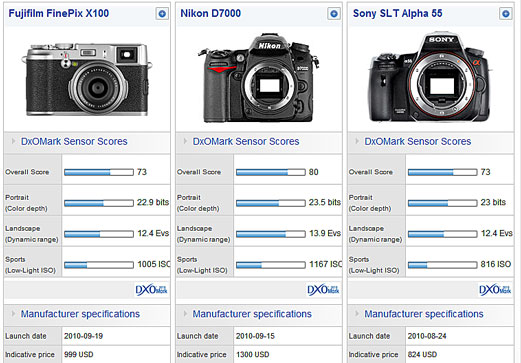
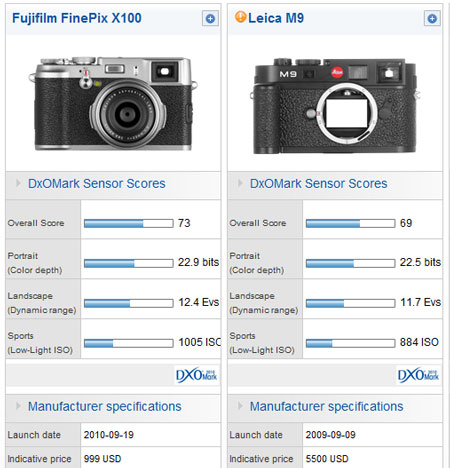
Fuji X100 outperforms 4/3 sensors (see the comparison: Fuji X100 vs Olympus PEN EP2 vs Panasonic Lumix DMC GH2).
APS-C sensor, 23mm non-movable fixed focal, great “Leica-like” design… here are the measurements for one the most anticipated cameras this spring – the Fuji X100.
Its sensor behaves similarly to the best APS-C sensors (see the comparison: Fuji X100 vs Nikon D7000 vs Sony SLT Alpha 55).
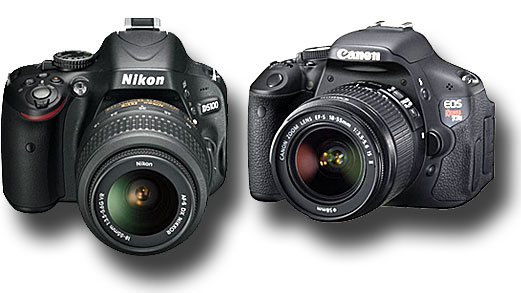
Though it doesn’t rank first based on any individual aspect of the camera, the Nikon D5100 delivers a solid combination of image quality, performance, features, and design that puts it out in front if you’re looking for a well-rounded option under $1,000.
The camera is 10% smaller than its predecessor, with a new curvier design. It looks almost like a bridge camera, with the kit lens attached and despite the plastic body, still feels solid in the hand. The grip uses an elastic rubber material, which also helps to maintain a solid hold of the camera
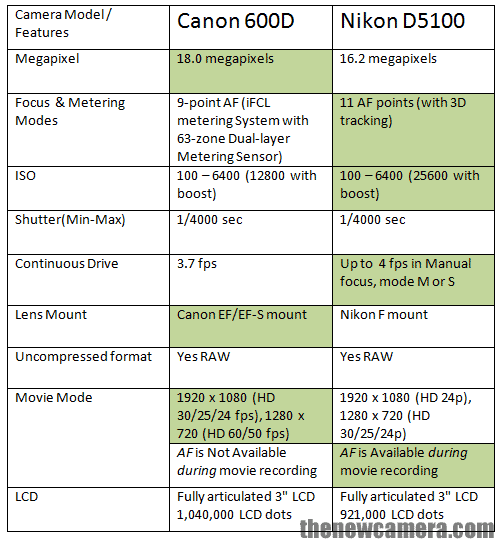
Nikon D5100 vs Canon 600D, Which one you should buy? Read the comparison review below
Canon Features 18MP and Nikon D5100 features 16MP sensor, Nikon have better Focusing system than canon and ISO range is almost same if we ignore the boost mode.
Lens mount – Canon 600D supports both EF and EF-S Lenses.
Nikon D5100– AF series of lens is not compatible with the D5100, Lenses without the AF-S (silent wave motor) designation will not focus on bodies without an in-body motor.
Movie Mode – Nikon D5100 Supports AF(Auto-Focus) during movie recording but in canon 600D AF is not available. Canon 600D offers Full HD recording at 30fps and 720p recording at 60fps, Nikon limited to 30fps only.
Nikon D5100 have better Movie mode but limited to Nikon F mount lenses and Canon 600D support EF & EF-S lenses , so if you are interested in shooting movies with your DSLR buy Nikon D5100, otherwise go for canon 600D (Recommended Lenses for Canon 600D)
Buy Canon Lenses, Buy Music CD or Digital Camera at amazon it helps this site, and you do not pay anything extra, it is just a way to help support this site.
New Camera Website, we list all type of new camera information, price review and all type camera rumors, subscribe us or follow us via twitter or facebook.
Disclaimer: We have attempted to select useful information to include on New Camera, and to ensure that the resources we have included on the site -- as well as the way we have described them -- are accurate, fair, and balanced. However, we make no claims, warranties, or other representations concerning the accuracy, completeness, or utility of the information provided, or concerning the abilities or performance of the organizations, agencies, companies, and other resources presented through New Camera

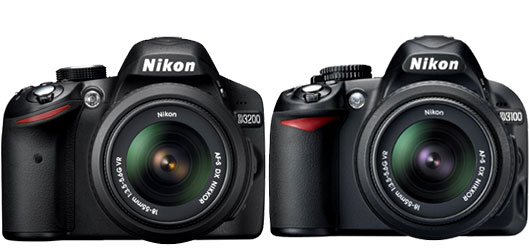 Nikon today announced Nikon D3200, The new Nikon D3200 features 24 MP sensor developed by Nikon, new image processing engine, better standard ISO range up to 6400 and now you get 60fps / 50fps speed during HD recording and 3 selectable frame rates 30,25, 24fps during Full HD recording with manual control over ISO and shutter speed.
 Senor: Nikon D3200 features new sensor developed by Nikon, you get more megapixel and standard ISO range.