Join More Than 50,000+ Subscribers and get latest camera news and rumors
NEW CAMERA VIDEOS ON YOUTUBE
|
By admin, on February 7th, 2015
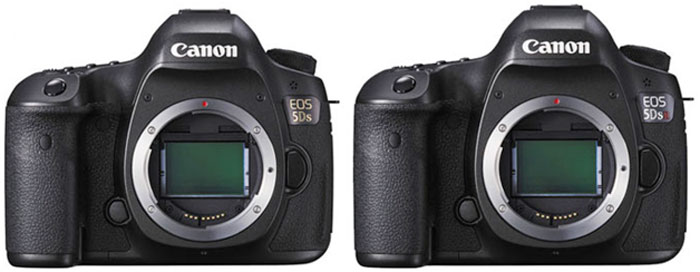
Take a look at the specification comparison of both the camera, the 5DS and 5DS R are identical from inside out, the only visible difference we can spot is the absence of low-pass filter in the 5DS R camera.
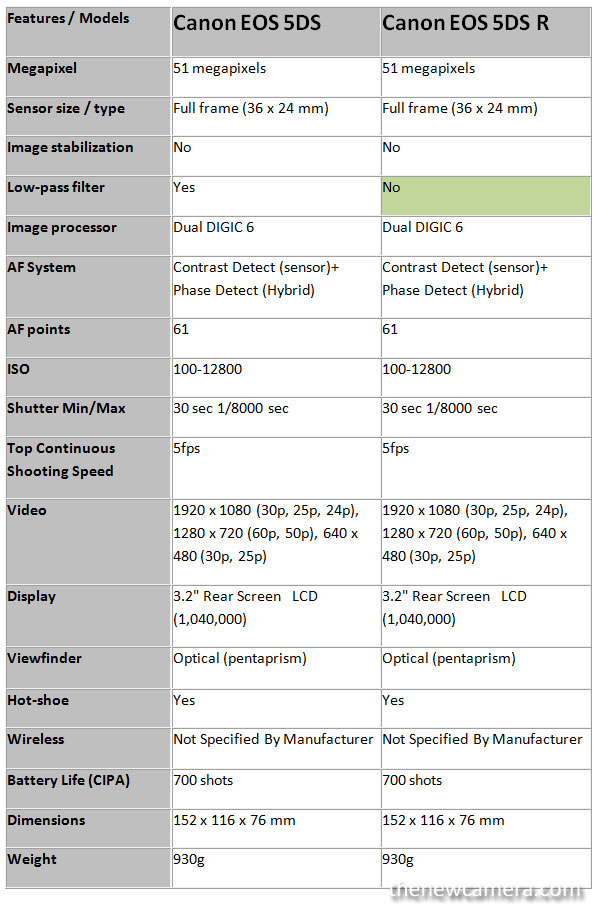 Both the two cameras are of high resolution full frame models. The specifications of both the two cameras are like shadow of each other and the only difference is in the optical low pass filter. Both the two cameras are of high resolution full frame models. The specifications of both the two cameras are like shadow of each other and the only difference is in the optical low pass filter.
Yes both canon 5ds and Canon 5dsr is all about its superior specifications where resolution is of 50MP with CMOS sensor that don’t allow you to complain about its image quality with providing a even much more sharper and magnified images and you can capture all the actions of the desired subjects with 5FPS . One and the other are employing 64oo range of ISO and can be capitalized upto 12800 that helps you in giving the effortless try in freezed the subjects. Having the gorgeous 61 AF points that included 41 are cross type and 5 are double cross type will focus much of the subjects.
Difference
Canon 5DS R doesn’t have any low-pass filter
Optical low pass filter the only difference between the two cameras. You know why we can say 5DSR is more advanced than its sibling 5DS because it doesn’t rig with optical low pass filter and the absence of this equipment massively help you to get the more details of the images as well as smartly help you to overcome from the problem of false colour or ‘moire’ what we call in our scientific term.
So Maximizing the potential of the new 50.6 megapixel sensor – The cancellation of the low-pass filter helps deliver sharp images, squeezing the most out of every pixel.
Common New features
Canon also re-designed the mirror vibration control system to help reduce mirror bounce and camera shake.
To maximize stability and minimize vibrations, Canon added a new Arbitrary Release Time Lag Setting in Mirror Lock mode in both models. In addition to the standard setting (press the shutter button once to lock the mirror, then again to release the shutter), the EOS 5DS and EOS 5DS R cameras offer new setting intervals of 1/8, 1/4, 1/2, one and two seconds, releasing the shutter after the selected preset delay, allowing potential camera vibration to dissipate before shutter release.
A new Picture Style called “Fine Detail” has been added to enhance the sharpness of JPEGs and EOS Movies with three new settings: Strength, Fineness and Threshold.
Price Difference – the Canon 5DS camera will cost you $200 less than 5DS R
Amazon Canon 5DS/5DR available for pre-order
Canon 5DS is also available for B&H
Cabib 5DS R is also available for B&H
By admin, on December 11th, 2014

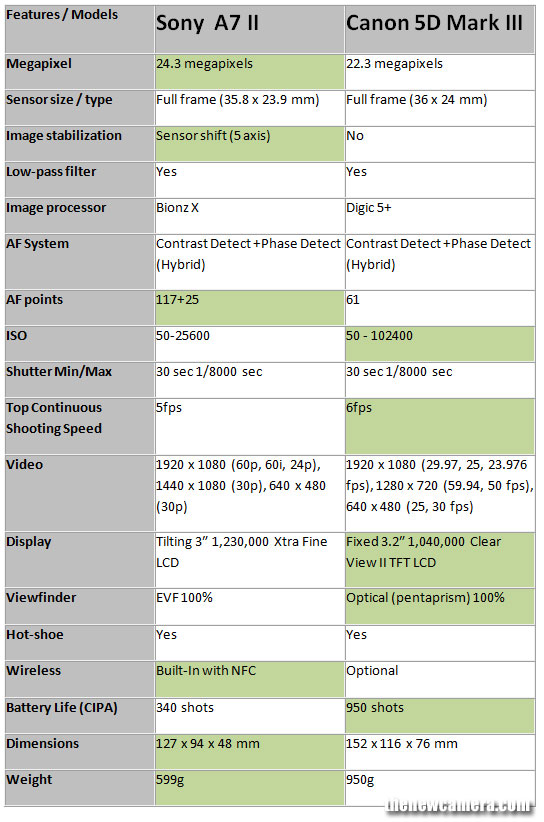
Take a look at the comparison between recently announce Sony A7 II Mirrorless camera and waiting to be updated Canon 5D Mark III DSLR.
Sensor
The recently announced Sony uses a Hybrid AF CMOS sensor that fabricated with 117 Phase AF points inside it, the camera also features additional 25 contrast based AF points, on the other hand the Canon 5D Mark II uses a additional AF sensor with 61-point autofocus points and 41 cross-type AF points (with f/4 lens support) and 5 dual diagonal AF points (with f/2.8 sensitivity).
AF System
The 5D Mark III phase AF system is active only when you are using viewfinder, when you are recording videos or using live view display unit the contrast AF system gets activated and phase AF system gets deactivated.
Sony A7 II HYBRID AF system is always active weather you are using a viewfinder, display unit for shooting your fav composition or when you are recording videos.
We recommend you to get Sony A7II is you are a sports shooter.
Best Camera for low-light or available light
The Low light sensitivity of Sony A7 II is limited to -1EV and Canon 5D Mark III supports lowlight sensitivity upto -2EV, the other major advantage of Canon 5D Mark III is High ISO range compared to (25600 vs 102400), so best camera for available / low-light is Canon 5D Mark III.
Image Stabilization
The 5-Axis SteadyShot INSIDE Stabilization, This compensates for five types of camera shake encountered during handheld shooting of still images and video, No sensor shift IS available in 5D Mark III.
Video
Both the camera records Full HD videos, but the Canon 5D Mark III Full HD is limited to 30fps and Sony A7 II can record Full HD videos at 60 fps.
Other
The Canon 5D Mark III offers more battery life but the Sony A7 II is light-weight and easy to carry, the Sony A7 II features wireless connectivity
Verdict:
The Sony A7 II offers advance AF system and built in image stabilization compared to the 5D Mark III, so we recommend you to go with Sony A7 II based on specification comparison review.
Buy at Amazon A7 II camera [Body only] A7 II camera [28-70mm]
Buy Canon 5D Mark III From Amazon
By admin, on December 4th, 2014
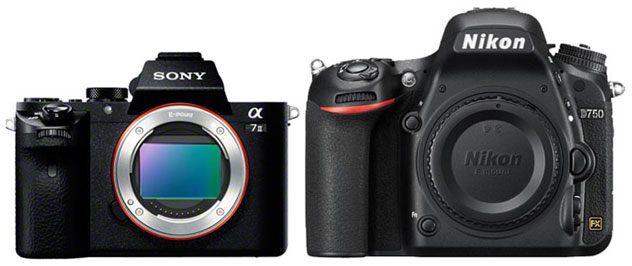 Take a look at the core specification comparison of the Sony A7 II and the Nikon D750 camera, In the first look we see the Sony A7 is more compact and easy to carry machine compared to the big and bulky Nikon D750 camera… take a look inside for more difference between… Take a look at the core specification comparison of the Sony A7 II and the Nikon D750 camera, In the first look we see the Sony A7 is more compact and easy to carry machine compared to the big and bulky Nikon D750 camera… take a look inside for more difference between…
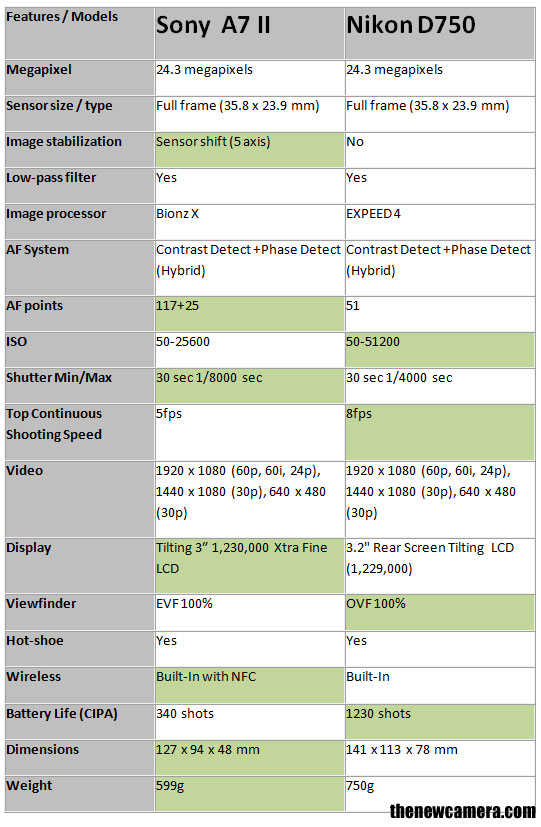 Before we start we we must assure that both camera is n0t using the same sensor, since Nikon does have a habit of using Sony sensor but the internal architecture of both the sensor is completely different. Before we start we we must assure that both camera is n0t using the same sensor, since Nikon does have a habit of using Sony sensor but the internal architecture of both the sensor is completely different.
Sensor
The Sony A7 II sensor is built with active phase AF points inside, the A7 II sensor features Enhanced Fast Hybrid AF that includes 117 phase detect AF and 25 contrast detection points.
The Nikon D750 sensor is a traditional one and features no active phase AF pixels inside, the camera have a different AF module (Multi-CAM 3500FX II) having 51 AF points and works only when you are using Viewfinder. The Contrast AF system is active while you are using display screen and recording videos.
Image Stabilization:
The Sony A7 II is world first fullframe mirrorless camera features Sony made 5 axis image stabilization system, if you are using long focal length lenses it will correct pitch and yaw adjustments, if you are using macro lenses it will correct horizontal and vertical shift compensation, the 5 axis will work in almost all types of lenses (including the third party lenses), also you can see the image stabilization system preview when you press the shutter button halfway.
Native ISO vs Expendable ISO
The Native ISO range of Nikon D750 is limited to 100-12800 and the expandable range of Nikon is 50-51200, Sony A7 II native ISO range is 100-25600 and expendable ISO range is 50-25600, so theoretically Sony should perform better.
Shutter
The continuous shooting speed of Sony A7 II is limited to 5 fps at full resolution, the Nikon D750 offers continuous shooting speed upto 8fps at full resolution.
OVF
I always orefer optical viewfinder over the EVF, it delivers realistic image to eye .. however its my choice.
Connectivity
The Sony A7 II offers built-in WiFi and NFC connectivity, it allows you to wireless transfer you files among remote devices and also allow you to use your smartphone to operate camera from distance aka remote shooting.
Verdict:
Based on specification comparison review we highly recommend you to buy Sony A7 II camera, however if you are Nikon system user then you may go with Nikon D750.
Buy at Amazon A7 II camera [Body only] A7 II camera [28-70mm]
Buy Nikon D750 at B&H Store || Amazon|
By admin, on October 15th, 2014
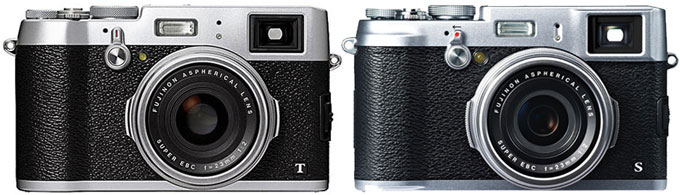
Both camera look similar form outside but do they differ from inside or almost have same core specification, take a look at the core difference below…
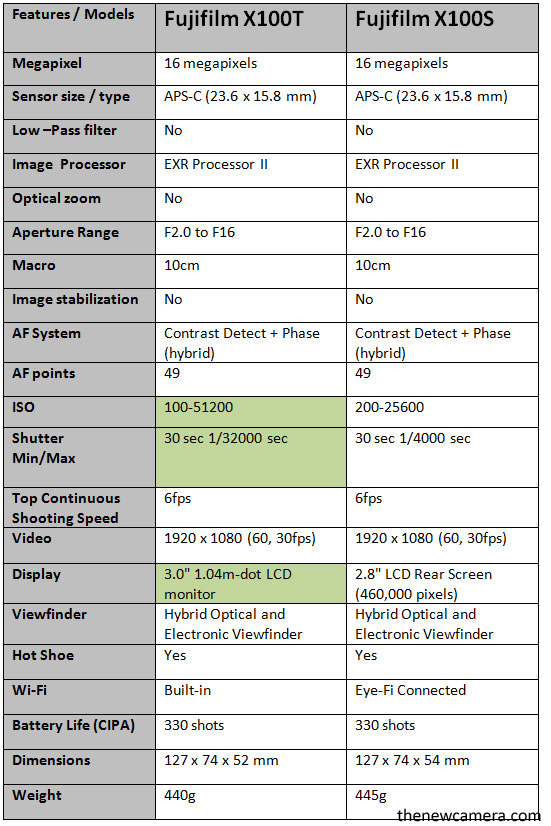 Unfortunately both camera are using 16 Mp APS-C X-Trans CMOS II Sensor and EXR II image processor, hence the image quality will remains same from both the camera. Unfortunately both camera are using 16 Mp APS-C X-Trans CMOS II Sensor and EXR II image processor, hence the image quality will remains same from both the camera.
Both camera share same Fujinon 23mm f/2 Fixed Focal Length Lens,
Again in AF system there is no change, Both the camera shares same Hybrid AF system and AF points, so again no change here.
Since the sensor is same and image processor is also same, by implementing new image processing algorithm, Fuji is able to get ISO upto 51200. But it doesn’t mean you will see significant difference in the image quality of both the camera.
A redesigned shutter mechanism, which is now entirely electronic, also delivers quickened shutter speeds up to 1/32,000 sec.
Built-in WIFi to share your files easily without any physical pain.
Verdict: If you are a owner of X100S than wait for Fuji X200, since there is no change in the sensor, image processor and lens of both the camera.
Buy Fuji X100T from Amazon
By admin, on October 15th, 2014
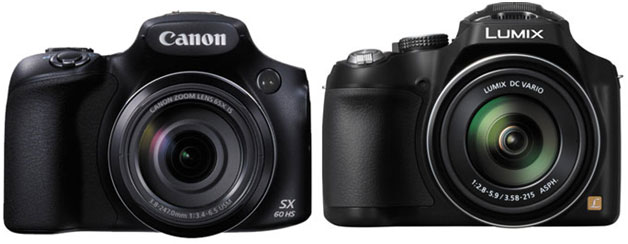 Take a look between the comparison of Panasonic FZ70 vs Canon SX60 HS, however the FZ70 is old now and waiting for an update… Take a look between the comparison of Panasonic FZ70 vs Canon SX60 HS, however the FZ70 is old now and waiting for an update…
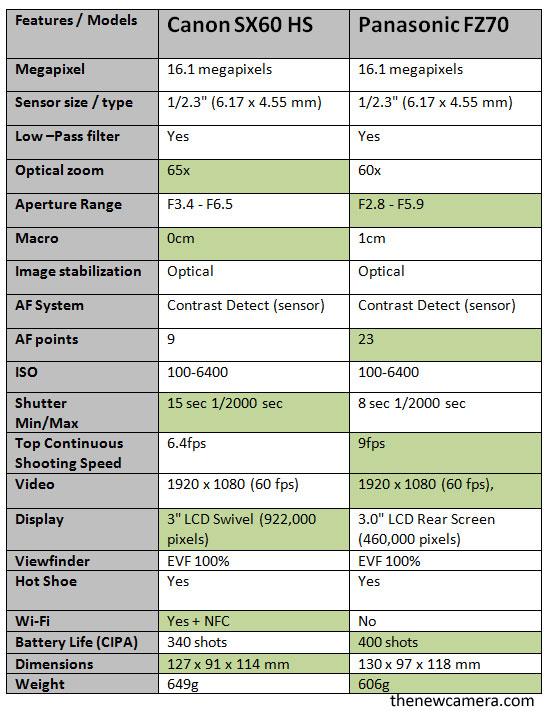 Optical Zoom: Canon PowerShot SX60 HS has 5x more optical Zoom than Panasonic Lumix DMC-FZ70. Optical Zoom: Canon PowerShot SX60 HS has 5x more optical Zoom than Panasonic Lumix DMC-FZ70.
Aperture Range: Panasonic Lumix DMC-FZ70 aperture Range is better than Canon PowerShot SX60 HS, the bright aperture lenses capture more incoming light to the sensor, create more DOF, you get more better color and contrast output and it also create less noise during low-light situation.
Macro: Canon PowerShot SX60 HS has more close-up macro range than Panasonic Lumix DMC-FZ70 .
More AF Points: The Panasonic FZ70 features 23 point AF system; on the other hand the Canon PowerShot SX60 HS is limited to 9 AF points only. With more AF point you get more area under AF points under screen, more AF points helps your camera to quickly acquire AF on your subject.
Shutter Canon PowerShot SX60 HS features better shutter range compared to Panasonic Lumix DMC-FZ70, but the Panasonic Lumix DMC-FZ70 features fast shooting speed compared to Canon PowerShot SX60 HS.
Video Mode: Canon PowerShot SX60 HS features full HD video recording @ 30fps frame rate , Panasonic FZ70 features full HD video recording @ 60fps frame rate and HD video recoding@60fps.
Display: Canon PowerShot SX60 HS features bigger and high resolution display compared to Panasonic Lumix DMC-FZ70.
Battery Life (CIPA): Panasonic Lumix DMC-FZ70 battery rating is 400 shots and other hand Canon PowerShot SX60 HS 340 shots. According to CIPA.
Dimensions: Canon PowerShot SX60 HS is smaller than Panasonic Lumix DMC-FZ70.
Weight: Panasonic Lumix DMC-FZ70 light-weight than Canon PowerShot SX60 HS.
Verdict: The Panasonic FZ70 will cost you less and features a decent core specification on the other hand the Canon SX60 HS will cost you more also offers high end specification.
Buy Canon SX60 HS camera from Amazon and B&H Store || The Panasonic FZ70 Available at Amazon and B&H store.
By admin, on October 12th, 2014
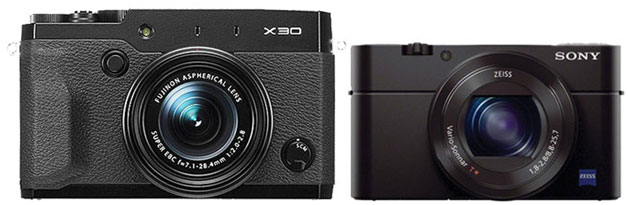 The Fujifilm X30 is a clone of X20 camera, since it features same small sensor and image processor as of X20 camera, on the other side we have Sony RX100 M3 camera that features 1 inch large sensor and very small and compact body design… take a look at the core specification below…. The Fujifilm X30 is a clone of X20 camera, since it features same small sensor and image processor as of X20 camera, on the other side we have Sony RX100 M3 camera that features 1 inch large sensor and very small and compact body design… take a look at the core specification below….
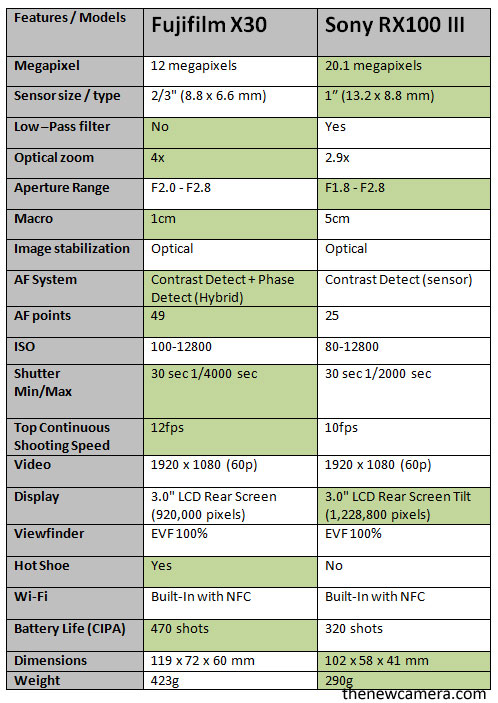 Sensor Tech: The fujifilm features 2/3″ CMOS image sensor and built with X-Trans bespoke pixel array, the pixel pattern literally reduce the need of optical low pass filter above the sensor, the other major advantage of the X-Trans sensor is the presence of active phase AF pixels inside the sensor, so you get HYBRID AF system that uses contrast and phase AF method with the X30 camera to acquire AF. Sensor Tech: The fujifilm features 2/3″ CMOS image sensor and built with X-Trans bespoke pixel array, the pixel pattern literally reduce the need of optical low pass filter above the sensor, the other major advantage of the X-Trans sensor is the presence of active phase AF pixels inside the sensor, so you get HYBRID AF system that uses contrast and phase AF method with the X30 camera to acquire AF.
the Sony RX100 M3 comes with large 20.1 megapixel 1″ Exmor R CMOS sensor features backside-illuminated technology, due to the large sensor size and bright optical lens the sensor get more light compared to Fuji X30 sensor and the difference is clearly visible… the RX100 M3 does produces excellent level of details in the images by maintaining the minimum amount of noise.
Lens: As we have already said that the lens used in the RX100 M3 camera delivers more light compared to the X30 camera not only due to the difference in the aperture range but also due to the difference in the size of lens elements, the RX100 M3 lens elements are designed for large sensor by and they also feature low aperture range… so the RX100M3 will provide more shallow DOF and noise less low-light images when compared to the X30.
Being small the Fuji lens is able to focus as close as 1cm, the Sony RX100 M3 macro range is limited to 5 cm, you also get 1X more optical zoom lens with Fuji X30.
AF System: We have no doubt that the Fuji X30 will do faster AF since it features advance AF sensor that utilizes Phase and Contrast based methods, on the other side we have Sony RX100 M3 uses traditional contrast detect AF system.
Top continuous speed: Fujifilm x30 can take up to 12 continuous shots whereas Sony RX100 III can take up to 10 shots continuously.
Display: Both the cameras support the same 3” tilting LCD but their pixels varies. Sony RX100 III has a pixel density of 1,228,800 pixels whereas Fujifilm x30 has a pixel density of 920000 pixels.
Hot Shoe: Fujifilm x30 has a hot shoe on its body to attach an external flash for better lightning conditions when required.
Battery life: Fujifilm X30 can take 470 shots in one cycle but Sony RX100 III can take 320 shots only.
Dimensions: Sony RX100 III is smaller than Fujifilm X30.
Weight: Sony RX100 III is lighter than Fujifilm X30.
Verdict: We highly recommend you to buy the Sony RX100 M3 camera.
Buy Fuji X30 from – Amazon and B&H || Buy Pre-order RX100 M3 at Amazon | B&H
By admin, on October 8th, 2014
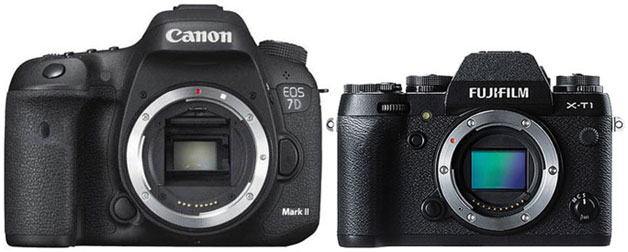 Canon 7D Mk II is one of the best DSLR available in the market today where as X-T1 is a class leading mirrorless system with exceptional features, take a look at the detailed specification comparison review Canon 7D Mk II is one of the best DSLR available in the market today where as X-T1 is a class leading mirrorless system with exceptional features, take a look at the detailed specification comparison review
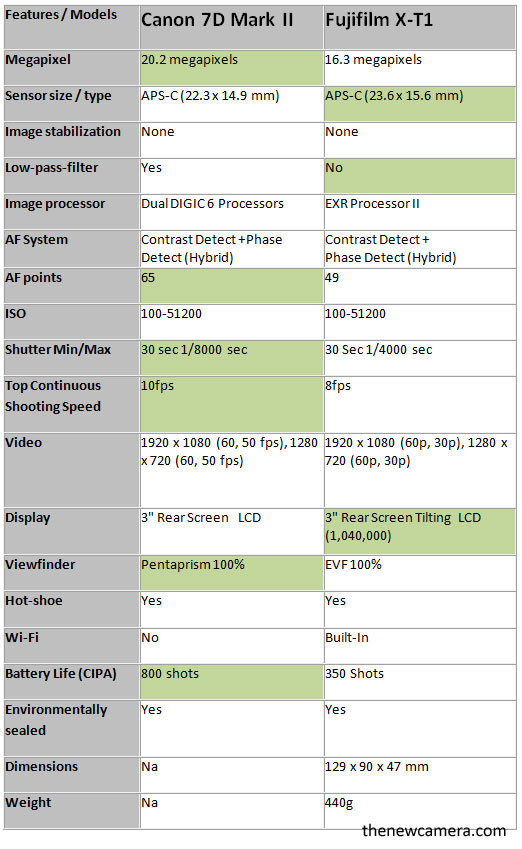 Megapixel: The Canon EOS 7D Mark II is built with more megapixel as compared to Fujifilm X-T1, so the 7D Mark II is capable of producing high-resolution, well-detailed still imagery and HD videos. Megapixel: The Canon EOS 7D Mark II is built with more megapixel as compared to Fujifilm X-T1, so the 7D Mark II is capable of producing high-resolution, well-detailed still imagery and HD videos.
Bigger Sensor Size: The BIT large sensor size of Fujifilm X-T1 makes it capable to acquire more light while shooting images, But does the result will show significant difference compared to 7D Mk II is still a question until we see image comparison.
The NO-OLPF benefit – The Fujifilm X-T1 is designed with a randomized pixel pattern to eliminate the need of an optical low-pass filter whereas Canon EOS 7D Mark II includes an optical low-pass filter. Due to the absence of low pass filter Theoretically the images produced by Fujifilm X-T1 will be more clear and will have a better depth of color when compared with the images produced by Canon EOS 7D Mark II at 100%.
More AF Points: Canon EOS 7D Mark II Fast Hybrid AF system utilizes altogether 65 AF points but Fujifilm X-T1 offers just 49 AF points. So, it is clear that Canon EOS 7D Mark II will do fast and accurate focusing than Fujifilm X-T1.
Better Shutter Range: Canon EOS 7D Mark II features a shutter range of 30 – 1/8000 whereas Fujifilm X-T1 features shutter range of 30- 1/400. With a better shutter range Canon EOS 7D Mark II delivers incredibly sharp and crisp images in comparison to Fujifilm X-T1.
Top Continuous shooting speed: Canon EOS 7D Mark II features fast shooting speed of 10fps and Fujifilm X-T1 offers the top continuous speed of 8fps.
Video Mode – Almost same in both with Full HD @ 60fps
Battery Life (CIPA): With Canon EOS 7D Mark II 800 shots can be taken in one battery cycle and on the other hand Fujifilm X-T1 battery rating is 350 shots. (According to CIPA).
Dimensions: Fujifilm X-T1 is smaller Canon EOS 7D Mark II so it is more handy to use.
Weight: Fujifilm X-T1 is almost half in weight as compared to Canon EOS 7D Mark II.
High ISO TEST
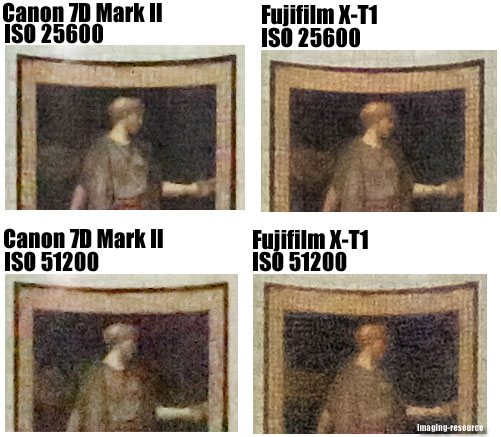 Image analysis – We are not able to notice any major difference in the image quality of both the camera. But yes Canon is showing bit better images with less noise. Image analysis – We are not able to notice any major difference in the image quality of both the camera. But yes Canon is showing bit better images with less noise.
Verdict: Based on specification comparison review, image analysis and Lens support we highly recommend you to buy Canon 7D Mark II
Buy Canon 7D Mark II body at Amazon || B&H
|
KEEP THIS BLOG ALIVE - Support New Camera Buy Canon Lenses, Buy Music CD or Digital Camera at amazon it helps this site, and you do not pay anything extra, it is just a way to help support this site.

|