Join More Than 50,000+ Subscribers and get latest camera news and rumors

NEW CAMERA VIDEOS ON YOUTUBE

NEW CAMERA LINKS
NEWS News about new camera
Hot at New Camera Hot Picks by New Camera

Camera Rumors List of all latest Camera Rumors on Web.
Canon Rumors Latest Canon Rumors.
Nikon Rumors Latest Nikon Rumors.
Sony Rumors Latest Sony Rumors.

Sample Images Click here to see New Camera Sample Images.
Sample Video Click here to see New Camera Sample Video.
Firmware Update

Sony developed next-generation BSI sensor

Now Cell phone and small compact camera can capture HDR Video with the help of new Sensor developed by Sony, Sony’s unique “RGBW Coding” function which allows you to capture better low light images with less noise. Sony has also developed a model with built-in signal processing functionality, an element that usually requires external embedment.

Sony has successfully developed new stacked CMOS image sensor technology that realizes higher image quality and superior functionality in a more compact size. The three newly developed next-generation back-illuminated CMOS image sensor models will be the first to utilize this technology. Samples will begin to successively ship starting March 2012.

Features of stacked CMOS image sensor

  • Large-scale signal processing circuits required for higher image quality and better functionality are built-in
  • More compact image sensor chip size
  • Even higher image quality of the pixel section by adopting manufacturing processes specialized for superior image quality
  • Faster speeds and lower power consumption by adopting the leading process for the circuit section
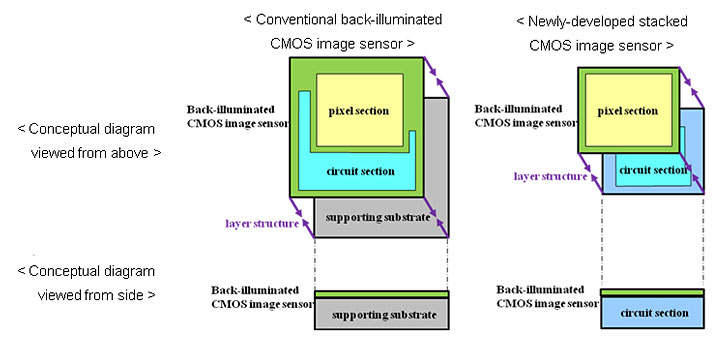
stacked-CMOS-image-sensor

Click in the image to enlarge

About stacked CMOS image sensors
Conventional CMOS image sensors mount the pixel section and analog logic circuit on top of the same chip, which require numerous constraints when wishing to mount the large-scale circuits such as measures to counter the circuit scale and chip size, measures to suppress noise caused by the layout of the pixel and circuit sections, and optimizing the characteristics of pixels and circuit transistors.
Sony has succeeded in establishing a structure that layers the pixel section containing formations of back-illuminated structure pixels over the chip affixed with mounted circuits for signal processing, which is in place of supporting substrates used for conventional back-illuminated CMOS image sensors. By this stacked structure, large-scale circuits can now be mounted keeping small chip size. Furthermore, as the pixel section and circuit section are formed as independent chips, a manufacturing process can be adopted, enabling the pixel section to be specialized for higher image quality while the circuit section can be specialized for higher functionality, thus simultaneously achieving higher image quality, superior functionality and a more compact size. In addition, faster signal processing and lower power consumption can also be achieved through the use of leading process for the chip containing the circuits.

Press Release
Tkyo, Japan – January 23, 2012 – Sony Corporation (“Sony”) today announced the development of two CMOS image sensor models designed for use in smartphones and other devices. They are equipped with Sony’s unique “RGBW Coding” function which allows images to be captured with low noise and high picture quality even in low-light conditions. They also contain Sony’s “HDR (High Dynamic Range) Movie” function which allows brilliant color to be captured even in bright settings. Sony has also developed a model with built-in signal processing functionality, an element that usually requires external embedment.
Sony has successfully developed new stacked CMOS image sensor technology that realizes higher image quality and superior functionality in a more compact size. The three newly developed next-generation back-illuminated CMOS image sensor models will be the first to utilize this technology. Samples will begin to successively ship starting March 2012.

Background of development (new functions)
The recent proliferation of smartphones and other devices has increased casual shooting opportunities and there is demand for the evolution of cameras to be able to shoot in a diverse range of settings. In particular, consumers want to easily take pictures in low light conditions or those with both low and bright lights. Sony has incorporated its two newly developed models with its unique “RGBW Coding” function which enables high-sensitivity shooting even in low-light conditions and its “HDR Movie” function which can capture images or video across a broad dynamic range of low-light to bright-light conditions.

About the key functions incorporated in the new CMOS image sensors
1. Sony’s unique “RGBW Coding” function enabling clear shooting in dark rooms or at night

The built-in “RGBW Coding” function which adds W (White) pixels to the conventional range of RGB (Red-Green-Blue) pixels has realized higher sensitivity, enabling high-quality shooting with low noise even in dark indoor or night settings.
While the addition of W (White) pixels improves sensitivity, it has the problem of degrading image quality. However, Sony’s own device technology and signal processing realizes superior sensitivity without hurting image quality. Furthermore, while the individual pixels of the newly developed models are extremely minute at 1.12μm, the incorporation of the “RBGW Coding” function has realized a SN ratio (signal-to-noise ratio) equivalent to that of a unit pixel size of 1.4μm under conventional methods, which in turn has enables the image sensors to achieve a higher resolution at a more compact size.
The new models are also able to output signals through the conventional RGB method, thus there is no need to change the signal processing adopted in existing devices.
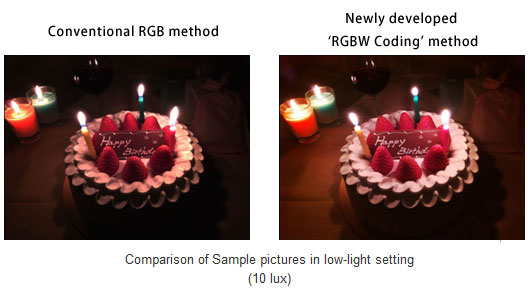
2. “HDR (High Dynamic Range) Movie” function which enables brilliant colors to be captured even in bright settings
The built-in “HDR Movie” function enables brilliant colors to be captured even in settings with a wide range of light including bright light.
Typically, when shooting with differing light levels, such as an indoor setting against a bright outdoor background, there can easily be blocked up shadows for dark areas or blown out highlights for bright areas. Such phenomena are a result of the combination of low-light and bright-light which have different optimal exposure conditions in the same shot. This function reduces this by setting two different exposure conditions within a single screen shooting and conducts the appropriate signal processing for the captured image information under each optimal exposure condition. This process generates an image with a broad dynamic range and enables shooting of both the background and subject matter with brilliant colors even in a bright environment.

Upcoming product launches (plan)

・ Type 1/4 Stacked CMOS Image Sensor with approx. 8.0 effective megapixels
(equipped with camera signal processing function*1)
Sample shipments planned for March, 2012

・ Type 1/3.06 Stacked CMOS Image Sensor with approx. 13.0 effective megapixels
(equipped with “RGBW Coding” and “HDR Movie” functions)
Sample shipments planned for June, 2012

・ Type 1/4 Stacked CMOS Image Sensor with approx. 8.0 effective megapixels
(equipped with “RGBW Coding” and “HDR Movie” functions)
Sample shipments planned for August, 2012

*1 Not equipped with “RGBW Coding” or “HDR Movie” functions

Two New Leica Cameras Coming Soon?

leica M10 and Mirrorless coming soon
Few days ago on Leica Experience Day Dr. Kaufmann promised more than one surprise for next year (at photokina year 2012), Now DSLR magazine posted on Twitter that Leica is working on two new cameras and one of them is economical model ( according to Leica’s).

According to informed sources, Leica would be working simultaneously on two new models, one of them a more “economical” … for Leica

So with Lecia M10 we may see a new Pro compact camera or Mirrorless System from Lecia on photokina 2012.

News src – www.fotoactualidad.com

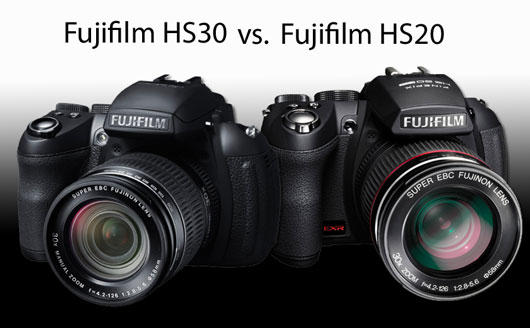
Fujifilm HS30 vs Fujifilm HS20

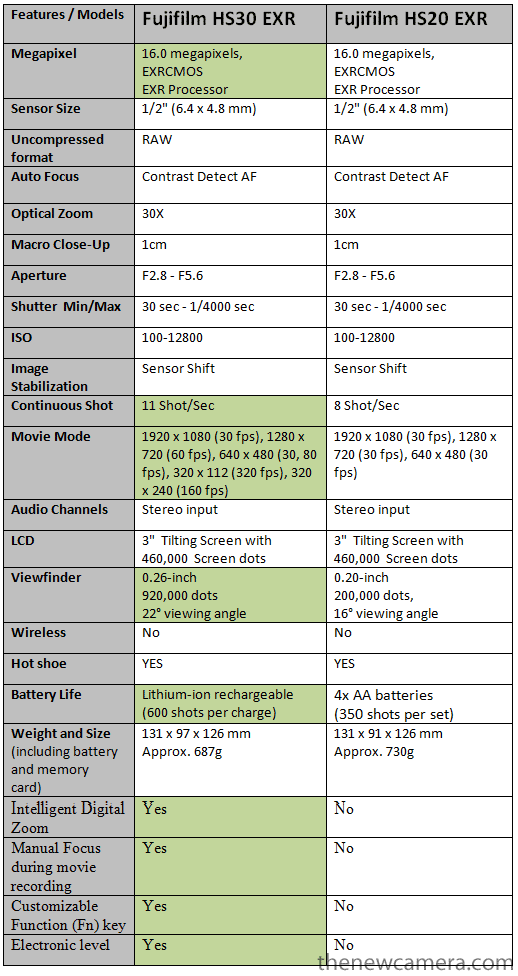
Fujifilm HS30 EXR vs Fujifilm HS20 EXR, fujifilm HS30EXR includes a number of key specification improvements over the HS20EXR model it replaces. Read the specification comparison review below and share your thoughts with us

Buy Fujifilm HS30 from Amazon
Buy Fujifilm HS20 from Amazon

Fujifilm HS30 vs Fujifilm HS20

FinePix HS30EXR features an improved EXR-CMOS sensor, By redesigning the shape of the photo diodes used in the EXR-CMOS sensor, the images display 30% less digital noise at higher ISO settings, which results in smoother tones and better low light images.

The Electronic Viewfinder (EVF) has been greatly improved.

New Lithium-ion rechargeable battery delivers up to 600 pictures per charge.

New EVF : Fujifilm HS30 EXR features same EVF as Fujifilm X S1, FinePix HS30EXR’s EVF  have large display unit of 0.26-inche and features 920,000 dots, compared to only 200,000 dots on the HS20EXR, making for a far clearer viewing image.

Writing Speed: The writing period after continuous shooting has also been dramatically cut to approximately 2 seconds (compared to 20 seconds on the HS20EXR).

New Intelligent Digital Zoom function: This doubles the focal range, delivering a massive 60x zoom (30XDigital + 30XOptical) with a maximum telephoto setting of 1440mm.

In the new Fujifilm HS30 EXR you get customisable Function (Fn) key to assign shortcut and New HS30 EXR supports manual focus during movie recording.

Conclusion: Upgrade is recommended, Fujifilm HS30EXR comes same 30X optical zoom but features new sensor, faster processing power and better battery life..

Buy Fujifilm HS30 from Amazon
Buy Fujifilm HS20 from Amazon

Support New Camera Buy Music CD or Digital Camera at amazon it helps this site, and you do not pay anything extra, it is just a way to help support this site.

Canon 5D Mark III Coming in March 2012?

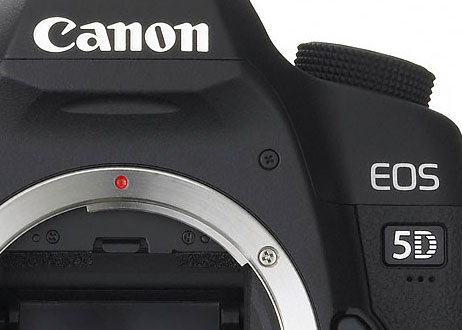
canon 5D mark II coming in march 2011According to canon rumors (CR2), Canon 5D Mk III expected announcement date is March 2012 and it will feature a 20 Megapixel sensor, GPS, DIGIC 5 processor, 19 AF points, 5fps continuous shooting and  eye-controlled autofocus.

Nikon D800 and D800E?

Nikon D800 is coming with and without low-pass filter according to Digicam.info, Both the model will have same core specification, the model with low-pass filter name is Nikon D800 and model without low-pass filter name is Nikon D800E.

Translated from google

Readers, courtesy of information on the Nikon D800.

  • Nikon’s new digital SLR model with a low-pass filter is a D800, which called for models with non-D800E.
  • D800 and D800E are different and only the presence of low-pass filter, and other specifications are exactly the same.

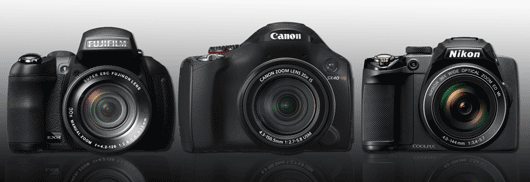
Fujifilm HS30 vs. Canon SX40 HS vs. Nikon P500

Fuji HS30 vs Canon SX 40HS vs Nikon P500
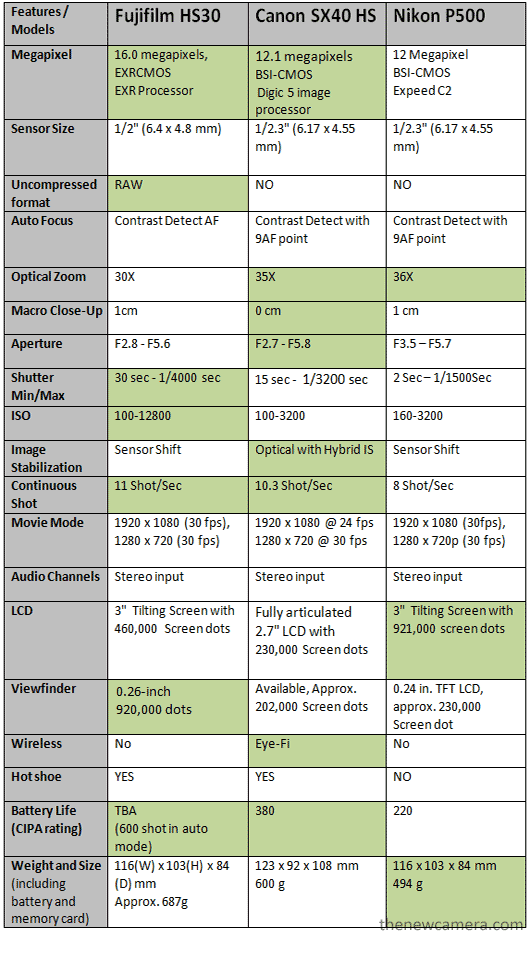
Fujifilm HS30 vs. Canon SX40 HS vs. Nikon P500 specification comparison review, read the review below and select your best megazoom camera.

Buy Fujifilm HS30 from Amazon
Buy Canon SX40 HS from Amazon
Buy Nikon P500 from Amazon

Fujifilm HS30 Comparison review

Sensor and image processor:

Fujifilm claims that HS30 uses new sensor, by redesigning the shape of the photo diodes used in the EXR-CMOS sensor, the images display 30% less digital noise at higher ISO settings (compared to HS20 @ ISO 3200), which results in smoother tones and better low light images.

Canon SX 40 HS uses newly developed BSI CMOS sensor and DIGIC 5 image processor, the Digic 5 image processor creates 75% less noise and 6X faster compared to Digic 4 image processor,  Due to new sensor and image processor you get more details and less noise in high ISO settings.

Multi-area White Balance in SX 40 HS: The Canon SX40 HS features advanced Multi-area White Balance optimizing color tones of both subject and background under multiple light sources.

Nikon P500 comes with a BSI CMOS sensor but uses old expeed 2 image processor.


Image Processor:  Image processor of both Canon and Fuji are very fast, both can capture approx 10.3 / 11  shot/sec in high speed shooting mode, Nikon P500 is limited to 8 shot/sec only.

RAW: Fuji is a clear winner on RAW mode, Only Fujifilm HS30 features RAW format capture.


IS Image Stabilization

  Fujifilm HS30 EXR Canon SX 40 HS Nikon P500
Image Stabilization Sensor Shift + High ISO Optical Sensor Shift and VR
IS Modes(Hybrid IS) Not Available Available (Normal, Macro, Panning, Dynamic, Powered, Tripod) Not Available


Fuji (CMOS shift + High ISO) Fuji HS30 uses sensor shift and High ISO modes to prevent camera shake.

Canon SX 40HS features 6 IS Modes and Optical IS The new Hybrid System of Canon SX 40 HS features Six  Intelligent IS Modes, Canon SX 40 HS automatically chooses from six different modes (Normal, Macro, Panning, Dynamic, Powered, Tripod) to optimize image stabilization and help achieve crisp, blur-free images for various shooting conditions

Nikon features Image sensor shift(not optical) + electronic vibration reduction (VR) function

Images captured with image sensor shift vibration reduction enabled are further processed with electronic VR for images that are sharper and exhibit less blur.


Lens and Aperture Range

Camera / Specification Fujifilm HS30 EXR Canon SX 40 HS Nikon P500
Optical Zoom 30X 35X 36X
Macro 1cm 0 cm 1 cm
Aperture F2.8 – F5.6 F2.7 – F5.8 F3.5 – F5.7


Based on lens quality, aperture and optical zoom range canon SX 40 HS is a clear winner,

Canon features UD glass, double-sided aspherical glass-molded and ultra-high-refraction-index glass lens elements to effectively suppress chromatic aberration while maintaining a remarkably compact size. The camera uses a VCM (Voice Coil Motor) for high-speed, quiet, energy-efficient lens movement with precise control.

Similarly as canon, Fuji features high optical performance glass lens elements (aspherical, high refractive index, and ED glass lenses) make the exceptional brightness of F2.8 at wide angle and F5.6 at telephoto possible.

Nikon P500 features 36x Zoom and NIKKOR ED glass.


Shutter Speed

You get more range in shutter speed in Fujifilm HS30 compared to SX 40 HS or Nikon P500.

Shutter Speed Fujifilm HS30 EXR Canon SX 40 HS Nikon P500
Max 4000 Sec 3200 Sec 1/1500 Sec
Min 30 Sec 15 Sec 2 Sec
Continuous Shot 11 Shot/Sec 10.3 Shot/Sec 8 Shot/Sec


Movie Mode

All the three Megazoom camera offers Full HD Video recording and AF during Video mode. Fuji offers Full HD at 30 fps, Canon Full HS at 24 fps and Nikon Full HD at 30 fps.

 Display:

Practically I like Canon vari-angle display, but Nikon Wins here, Nikon P500 features 3″  Tilting Screen with  921,000 screen dots and Fully articulated 2.7″ LCD with  230,000 Screen dots.


Viewfinder:

Fuji features a 0.26-inch superb high resolution viewfinder (approx. 920,000 screen dots)  with eye sensor.


Batter Life

No CIPA rating currently available for Fuji HS30, but Fuji claims you can take 600 shots at auto with the new Lithium-ion rechargeable battery, Canon SX 40HS CIPA rating is 380 and Nikon P500 CIPA rating is 220.

Price

Camera Models Fujifilm HS30 EXR Canon SX 40 HS Nikon P500
Price (List Price) $499 $399 $320


Overall Conclusion: Nikon P500 is the most affordable megazoom camera, however according to specification, both canon and Fuji are better than the Nikon P500, Fuji HS30 zoom lens is limited to 30X but features RAW format and ISO range up to 12800, whereas canon SX 40 HS features 35X Zoom Lens with excellent optics and Hybrid IS.

Buy Fujifilm HS30 from Amazon
Buy Canon SX40 HS from Amazon
Buy Nikon P500 from Amazon

Support New Camera Buy Music CD or Digital Camera at amazon it helps this site, and you do not pay anything extra, it is just a way to help support this site.

Nikon D3 vs D4 - ISO Test

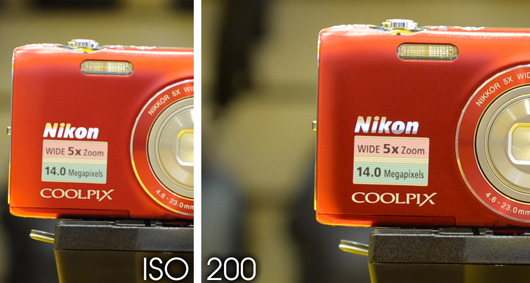
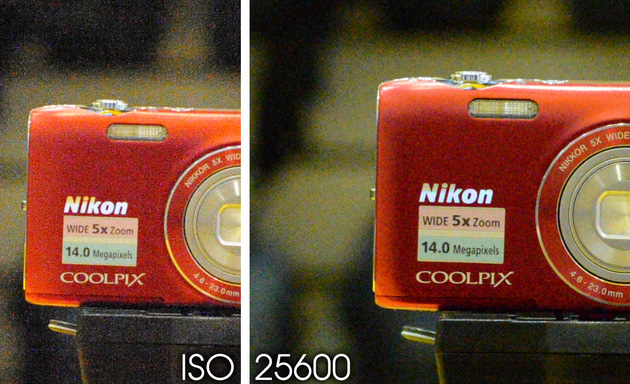
The first High ISO test of Nikon D4 with D3 published at mgphotographer, Before you jump to any decision please note that the D4 used in the comparison is loaded with a BETA firmware, so final firmware version of Nikon D4 may have some better performance, the images taken with the D3 (12 Mp) are in the left side and the crop is somehow “smaller” because of the resolution difference between the 2 cameras.

Nikon D3 vs Nikon D4 High ISO test

Nikon D4 at ISO 25600

Nikon D3 vs D4 High ISO test, performance of D4 look similar to Nikon D3 DSLR.