Join More Than 50,000+ Subscribers and get latest camera news and rumors
NEW CAMERA VIDEOS ON YOUTUBE
|
By admin, on July 20th, 2025

Let’s compare the two prime compact cameras and find out the best one for you. Of course, there is a price difference between them — the Leica Q3 comes at a bit heavier price, and the RX1R Mark 3 is available at a lower price range. But if it is the comparison of the two, then which one is more suitable for you? Find out.
First of all, we will compare the design of both cameras. Then we will talk about the photographic core specifications, which will be the main part of both the cameras, and later on, the video core specs comparison. So let’s start with the design part.
Both cameras come with fixed lenses, so we are including the lenses also in the design comparison.
| Feature |
Sony RX1R Mark 3 |
Leica Q3 |
| Price Range |
Lower |
Higher |
| Lens |
Fixed 35mm f/2 (non-stabilized) |
Fixed 28mm f/1.7 with Optical Image Stabilisation (OIS) |
| Lens Light Capability |
Captures less light (F2) |
Captures 1 stop more light (F1.7) |
| Stabilisation |
Digital Video IS only (crop-based) |
Optical Image Stabilisation (approx. 4.5 stops) |
| Low-Light Performance |
Moderate (f/2, no OIS) |
Better (f/1.7 + OIS for slower shutter) |
| Electronic Viewfinder (EVF) |
2.36M-dot EVF (same as RX1R Mark II, 9 yrs old tech) |
5.76M-dot high-resolution EVF |
| Weather Sealing |
Yes, but no official certification |
IP52 Certified Weather Sealing |
| Build Quality |
Well-built and compact |
Well-built with robust weather sealing |
| Portability |
More compact and lightweight |
Slightly bulkier and heavier |
Sony RX1R Mark 3 versus Leica Q3 Design Comparison
As we can see, both of them are very well-built — it can even be easily visible from the images that you have seen side by side. However, one thing to note is that the Leica Q3’s 28mm lens is optically stabilised, providing approximately 4.5 stops of OIS with the Leica Q3 camera. The Sony RX1R Mark 3 camera features only digital video image stabilisation, which reduces shakiness by applying a crop to the video.
Again, we have one more thing left in the lens quality — the 28mm f/1.7 lens captures a stop more light compared to the 35mm f/2 lens. So specifically for low-light photography, when you are using the Leica camera, the 28mm f/1.7 lens is more helpful for delivering a bit more light, and the optical image stabilisation of the lens helps you to use a slower shutter speed.
Now, in the same design part, we also have viewfinders in both the cameras. The Sony RX1R Mark 3 has the same viewfinder that was being used in the RX1R Mark 2 camera approximately 9 years ago — a 2.36 million-dot EVF — compared to the Leica Q3, where we have a high-resolution 5.76 million-dot electronic viewfinder.
The Leica Q3 body has IP52 weather sealing certification that ensures durability. On the other hand, the Sony RX1R Mark 3 camera does have a weather-sealed body, but we do not have any weather-sealing certification.
The good thing about Sony is that it is a bit more lightweight and compact compared to the Leica camera. So for the portability factor, I will give preference to the Sony RX1R Mark 3.
High ISO Test Comparison Between Leica and Sony

The Left side image is of the Sony A7CR using the same 61MP sensor and an 85mm Gmaster F1.2 Lens used at F5.6 Aperture to capture the shot
On the Right Side, we have Leica Q3 43 ( The 43 uses a 43mm f/2.0 APO-Summicron ASPH lens). Both Q3 and Q3 43 models are the same, only the lenses are different. During the test, the 40mm F2.0 Lens was kept at F6.3 Aperture

Leica Image processing isn’t adding any extra layers of smoothness in the JPEG files, the words are visible and clear even when shot at ISO 25600 / ISO 25000

Even when the ISO was raised to 51200 / 51000, you can see how visibly Leica is keeping the color blocks intact, unlike the Sony A7CR sample, where everything looks like a hot mess.
Big Surprise – Leica RAW Files have less color noise

Even when we are comparing Leica RAW files at higher ISO levels, these RAW files have significantly less noise than Sony A7CR files.
Image Comparison Conclusion – Leica is a clear winner
We don’t want to add any extra creamy layers on this thing, even though I use Sony cameras in all my studio and I am a big Sony FAN. But, the fact is a fact, and Leica is visibly capturing less noise than of Sony A7CR sensor.
Respect for Leica Camera has been raised after looking at the test
Both cameras are using the same sensor, but the Leica Q3 enhances the photography experience with 15 FPS of continuous shooting versus 5 FPS of Sony. At the very same time, the buffer is also larger — 63 versus 52 RAW photos.
As you know, the Leica Q3 also has an optical image stabilization system. So, with a faster aperture, more ISO range, and having an optical image stabilization system, the Leica Q3 will give you the ability to capture still images in even more low-light scenarios while using a slower shutter speed. So, if we talk about an overall package, the Leica Q3 stands out in the competition.
And finally, images from both cameras, the Leica Q3 is a clear winner in terms of image quality
Which Camera Should You Choose?
- Choose the Leica Q3 if you need:
- Better Image Quality: Leica cameras showing off better images during the test
- Advanced video capabilities (8K, ProRes, high frame rates) for professional filmmaking.
- Optical stabilization for steady photos and videos.
- Weather sealing for outdoor shooting.
- Faster shooting (15 fps) for action photography.
- A 28mm f/1.7 lens for low-light and wide-angle shots, ideal for street or landscape photography.
- Choose the Sony RX1R II if you prioritize:
- Compact size for portability, perfect for travel or discreet street photography.
- HEIF support for smaller file sizes.
- No video time limit for extended recording.
- A 35mm f/2 lens for classic portrait or tighter compositions.
Sony RX1R III: Available from July 25, 2025, via retailers like B&H Photo and Amazon.com
Leica Q3 43 Edition at B&H Store and Amaozn.com | leica Q3 28mm Lens Edition on B&H Store and Amazon.com
Detailed specification comparison table for the still and video parts
Sony RX1R II vs Leica Q3: Still Image Capture Comparison
| Feature |
Sony RX1R II |
Leica Q3 |
| Effective Resolution |
61 MP (9504 x 6336) |
60.3 MP (9520 x 6336) |
| Aspect Ratio |
1:1, 3:2, 4:3, 16:9 |
1:1, 3:2, 4:3, 16:9 |
| Image File Format |
HEIF, JPEG, Raw |
DNG, JPEG |
| Bit Depth |
14-Bit |
14-Bit |
| ISO Sensitivity |
Native: 100 to 32,000 (Extended: 50 to 102,400) |
Native: 50 to 100,000 (Manual), 100 to 100,000 (Auto) |
| Shutter Speed |
Mechanical: 1/4000 to 30s, Electronic: 1/8000 to 30s, Bulb Mode |
Mechanical: 1/2000 to 120s, Electronic: 1/16000 to 1s |
| Continuous Shooting |
Up to 5 fps for 52 Frames (Raw) / 40 Frames (Raw, JPEG) / 1000 Frames (JPEG) |
Up to 15 fps for 63 Frames (Raw) / 67 Frames (JPEG) |
| Focus Range |
Normal: 11.8″ to Infinity / 30 cm to Infinity, Macro: 7.9″ to 13.8″ / 20 to 35 cm |
Normal: 11.8″ to Infinity / 30 cm to Infinity, Macro: 6.7″ to Infinity / 17 cm |
| Metering Method |
Average, Center-Weighted Average, Highlight Weighted, Multi, Spot |
Center-Weighted Average, Highlight Weighted, Multi, Spot |
| Exposure Compensation |
-5 to +5 EV (1/3, 1/2 EV Steps) |
-3 to +3 EV (1/3 EV Steps) |
| White Balance |
2500 to 9900K, Presets: ATW, AWB, Auto, Cloudy, Custom, Daylight, Flash, etc. |
2000 to 11,500K, Presets: Auto, Cloudy, Daylight, Flash, Manual, Shade, etc. |
| Self-Timer |
2/5/10-Second Delay |
2/12-Second Delay |
| Interval Recording |
Yes |
Yes |
Sony RX1R II vs Leica Q3: Video Capture Comparison
| Feature |
Sony RX1R II |
Leica Q3 |
| Internal Recording |
XAVC S 4:2:2/4:2:0 8/10-Bit: UHD 4K (3840 x 2160) at 23.98/25/29.97 fps [60-140 Mb/s], 1920 x 1080 at 23.98/25/29.97/50/59.94/100/120 fps [16-100 Mb/s]; XAVC S-I 4:2:2 10-Bit: DCI 4K (3840 x 2160) at 23.98/25/29.97 fps [240-300 Mb/s], 1920 x 1080 at 23.98/25/29.97/50/59.94 fps [89-222 Mb/s] |
H.264 ALL-Intra/MOV 4:2:2 10-Bit: DCI/UHD 4K at 23.98/24/25/29.97/47.95/48/50/59.94 fps [400-600 Mb/s]; H.264 Long GOP/MP4 4:2:0 8-Bit: UHD 4K at 23.98/25/29.97 fps [100 Mb/s], 1920 x 1080 at 23.98/25/29.97/50/59.94 fps [20-28 Mb/s]; H.265 Long GOP/MOV 4:2:0 10-Bit: DCI 8K/UHD 8K at 23.98/24/25/29.97 fps [300 Mb/s], 1920 x 1080 at 100/120 fps [100 Mb/s]; ProRes 422 HQ: 1920 x 1080 at 23.98/24/25/29.97/50/59.94 fps [181-454 Mb/s] |
| Video Output |
4:2:2 8/10-Bit via HDMI: UHD 4K at 23.98/25/29.97 fps, 1920 x 1080i at 50/59.94 fps, 1920 x 1080 at 23.98/50/59.94 fps |
4:2:0 8-Bit via HDMI: DCI/UHD 8K at 23.98/24/25/29.97 fps; 4:2:2 10-Bit via HDMI: DCI/UHD 4K at 23.98/24/25/29.97/50/59.94 fps, 1920 x 1080 at 23.98/24/25/29.97/50/59.94/100/120 fps |
| Recording Limit |
No |
30-Minute Maximum |
| Audio Recording |
2-Channel 24-Bit 48 kHz LPCM, 2-Channel 16-Bit 48 kHz LPCM |
MP4: 48-Bit 16 kHz AAC, MOV: 28-Bit 24 kHz LPCM |
| Built-In Microphone |
Stereo |
Stereo |
Image credits dpreviewimagecomparions
By admin, on July 20th, 2025

Canon has introduced their 410-megapixel ( LI8030SA) sensor, a kind of groundbreaking technology in terms of full-frame sensors, since no one has ever introduced that much resolution ever in a 35mm format. The sensor was exhibited at the Shanghai International Photography, Cricket, and Digital Imaging Exhibition from July 16 to 18. The most notable feature of this sensor is its high resolution. With the help of 410 megapixels, the sensor creates an image resolution of 24,592 × 16,704 pixels, which is somehow equivalent to 24K resolution. Practically, it is 198 times sharper than Full HD, and if you put more calculation into it, it is 12 times more intense and clear than existing 8K cameras.
Capabilities of Canon 410 Megapixel Full Frame Sensor
The 410 Mp LI8030SA sensor comes in two variations — Available in RGB (LI8030SAC) and monochrome (LI8030SAM), In simple words, one is the colour and the other is black and white. Both of the sensors are designed with the help of BSI CMOS technology, which helps them perform better in low-light scenarios. With such high-resolution pixels onboard, the biggest challenge is the readout speed, which is 3,280 megapixels per second, equivalent to 8 frames per second while maintaining the full resolution of the sensor.
The monochrome version (LI8030SAM), or better to say the black and white version, also allows the pixel binning feature that scales down the sensor resolution to 100Mp megapixels with improved dynamic range and low-light performance. With the 410-megapixel sensor, you can also record 100-megapixel videos at 24 frames per second.
Canon 410 Megapixel Sensor Area of Application
At this very moment, with this set of technologies we have, the sensor has a very limited area of application.
- Industrial Inspection: Identifies microscopic defects in semiconductor wafers
- Aerial Mapping: ultra-detailed maps for urban planning
- Medical Imaging: high-resolution scans
- Scientific Research: Supports microscopy, astronomy, and material science
- Surveillance and Security: Use in Intelligent Traffic Systems
Technical Strengths and Challenges of the 410 Megapixel Sensor
The biggest problem faced by Canon itself while testing the prototypes of the 410-megapixel sensor is that they had to use lenses with apertures wider than f/2.2 to avoid the diffraction generated by the sensor. While using the sensor, they concluded that no lens is able to resolve the sensor’s resolution when having an aperture narrower than f/2.2.
The other biggest challenge faced by Canon’s research and development team is data handling. Once the image is clicked, the sensor generates 717 MB of data in a single shot, which roughly generates or requires a 5.74 Gbps high-speed data transfer interface.

Why the 410-Megapixel Sensor Isn’t for Consumer Cameras but Could Shape the Canon R5 Mark III
The sensor itself is not made for consumer-level cameras, specifically if we think about the Canon R5 series, which is a perfect balance of speed, versatility, and resolution made for professional photographers and videographers. Even if they want to use it in a consumer-level camera, they have to overcome data overload, lens limitations, as well as cost and practicality.
But at the very same time, be assured — the 410-megapixel sensor will go on to save Canon’s future consumer-grade sensors, specifically, we are talking about the Canon R5 series, which is now using a 45-megapixel stacked CMOS sensor.
The 410-megapixel sensor’s pixel miniaturisation technique will help higher-resolution cameras potentially achieve resolutions up to 60 to 80 megapixels easily, while maintaining manageable data size, improving moire reduction, as well as low-light performance and dynamic range.
As well as the efficient data readout methods that have been discovered to overcome the challenges faced by the 410-megapixel sensor will help consumer-level Canon R5 Mark III cameras to capture 8K video resolution at higher frame rates.
As we all know, the Canon super-resolution sensor is too extreme or difficult for consumer-level use, but its technology will surely help to innovate new features inside the upcoming Canon R5 Mark III camera.
Canon’s 410 megapixel sensor technology is a big jump in terms of technical achievement for Canon itself. It not only pushes technological boundaries of sensor development, it will help to save the future full-frame imaging division of consumer release-grade cameras. Technological advancement achieved by Canon by developing this sensor, such as pixel miniaturization, readout speed improvement, as well as low light performance, will potentially help the development of upcoming Canon R5 Mark 3 camera with more higher resolution sensor and upscaled core specification.
Stay Updated with TheNewCamera.com
At TheNewCamera.com, we’re dedicated to keeping you informed about the latest camera news. The article “Canon 410MP Sensor to Power R5 Mark III Tech?” by thenewcamera.com team on 6:41 pm, Sunday, 20 July 2025, Greenwich Mean Time (GMT) | Follow us on our social pages FACEBOOK | TWITTER | INSTAGRAM to get live Camera News + Canon Rumors 24X7.
By admin, on July 19th, 2025

The Canon SX740 HS is a massive pocket superzoom camera that gives the ability to do 40x massive optical zoom even while recording 4K video or capturing still shots. The Canon SX740 HS features a 20.3-megapixel CMOS sensor paired with a Canon DIGIC 8 image processor. Canon has officially discontinued the SX740 HS camera in May 2025. The camera is now in very limited stock, but it’s still somehow available at Amazon.com. If you’re thinking of having a one-pocket superzoom camera, don’t think twice and grab the deal while the stock lasts.
Why the Canon PowerShot SX740 HS is in high demand
The Canon SX740 HS was announced back in 2018, and it continued to dominate the compact zoom camera market with its features, specifically the 40x optical zoom in a tiny, compact, pocketable body. The camera discontinuation news has spiked its demand in the market, and the camera price is going up everywhere.
The SX740 HS has become one of the favourite tools for travel and social media content creation. The additional advantage with these types of compact cameras is the privacy – you always have full control over your images and the images that you wish to share. You can easily upload to your smartphone or social network via Wi-Fi connectivity with the camera.
1. Let’s explore the key features of the Canon SX740 HS camera
The Canon SX740 HS features a massive 40x optical zoom in a very compact body. And let’s talk about the competitors — we have the Lumix ZS80 camera that features approximately 30x optical zoom, and the Sony HX99 with again 30x zoom. Framing Assist and 5-axis optical image stabilization help you to capture crisp and clear pictures and 4K videos even at extended 40x optical zoom.
2. Is the Canon PowerShot SX740 HS Discontinued?
Yes, it’s now official and confirmed by Canon and other websites that the Canon SX740 HS camera has now been discontinued by Canon itself. Canon is suspending its orders from March 2025 in most of its stores.
Canon is now focusing on their vlogging compact cameras, so it wants to put all its attention on the V-series cameras. So, after the announcement of Canon PowerShot V10, they have officially ended the production of SX740 HS to clear up the production lines and make space for V-series cameras.
3. Where to buy the Canon SX740 HS camera?
The Canon PowerShot SX740 HS camera is in stock on Amazon.com. The camera is getting a lot of praise all over social media — specifically, you can check all of its online reviews, including YouTube reviews. It is one of the best cameras for casual and travel photographers, and also social media content creators — those who love to have higher zoom quality images or video compared to their smartphone. However, since the sensor is small, you are getting lower dynamic range compared to DSLR or mirrorless cameras, larger sensors, and RAW video or RAW images capability.
| Product Title |
Price |
Buy from Amazon.com |
| Canon PowerShot SX740 HS Digital Camera (Black) (2955C001) + 64GB Memory Card + Card Reader + Deluxe Soft Bag + Flex Tripod + Hand Strap + Memory Wallet + Cleaning Kit |
$1,009.95 |
Buy from Amazon.com |
| Canon Powershot SX740 HS Digital Camera (Black) |
$910.00
List: $999.00 |
Buy from Amazon.com |
| Canon Cameras US Point and Shoot Digital Camera with 3.0″ LCD, Silver |
$769.00 |
Buy from Amazon.com |
| Canon PowerShot SX740 HS Digital Camera – Black (International Version) |
$849.00
Typical: $894.95
($530.63/in) |
Buy from Amazon.com |
Page Update September 25, 2026
We have updated the page on September 25, 205, with the latest price and listings available.
So, here is the list we can find related to the current stock of the Canon SX70 HS camera
Get LIVE RUMORS –> FACEBOOK | TWITTER | INSTAGRAM to get live Camera News + Canon rumors 24X7


By admin, on July 19th, 2025
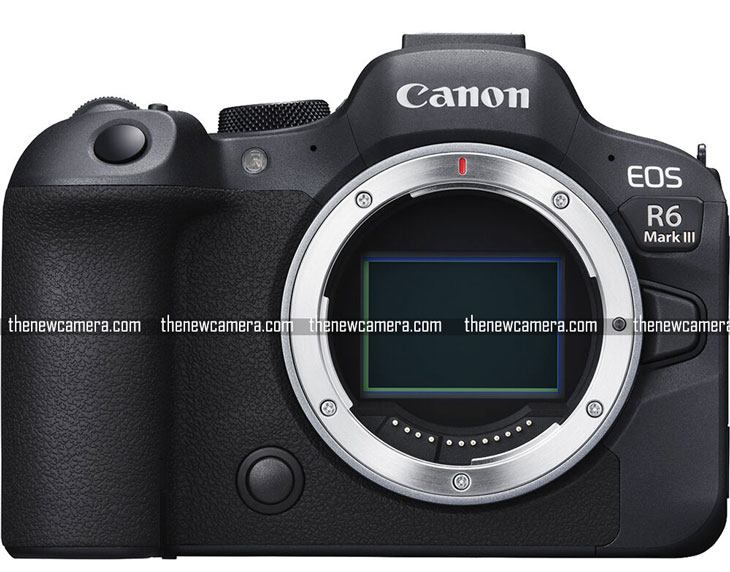
The Canon R6 Mark III camera price has now been announced, and all of us are waiting for its official announcement. But we can make a highly accurate estimate based on the pricing of previous models of the Canon R6 series camera, comparable offerings, and higher-end model prices right now.

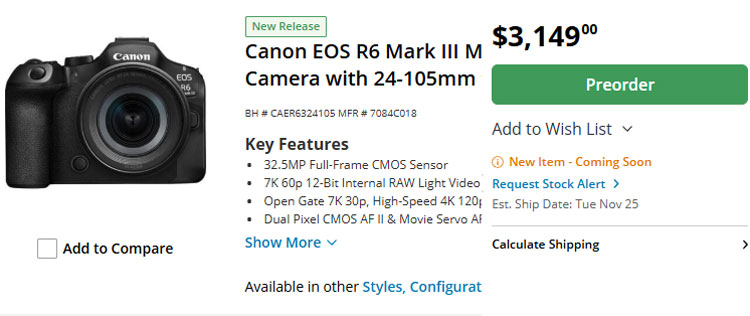
Pricing between the Canon R5 and the Canon R6 II
- Canon R6 Mark II was announced in November 2022 with a price tag of $2499 for the body only, confirmed by Canon USA. And the Canon R5 right now is being sold at $3199. Although the Canon R5 Mark II camera arrived at a much higher price range, that doesn’t matter here.
- The Canon R6 Mark III camera is coming with an approximately 30MP sensor, and its a big upgrade in the core specifications of the camera. But if Canon keeps its price above $3100 or even at $3000, then people will prefer getting a Canon R5 body with a much higher resolution sensor and a more premium body.
Canon Price increase pattern between models
If you look at the recent price increase pattern of Canon, then from the model Canon R5 to the Canon R5 Mark II, we have seen a $400 price increase between the models, and the R5 Mark II camera carries a stacked CMOS sensor and a massive update over its predecessor.
And if we Look at the competition right now: the Nikon Z6 Mark III camera arrived at a $2497 price tag, which features a 24.5 megapixel partially stacked CMOS sensor and 6K 60 FPS N-RAW recording capability. Similarly, the price of the Sony A7V is expected to be around $ 2,799-$ 3,000.
Canon R6 Mark II Price
Considering all these factors, we can confidently conclude that if the Canon R6 Mark III camera arrives with a 30- to 32-MP full-frame BSI sensor and professional-grade features, the expected price of the camera is $ 2,799 to $ 2,899.
That’s what we are expecting: a $400 price increase, which we have seen from the Canon R5 to the Canon R5 Mark II, keeping the market price of the Canon R6 Mark III camera competitive according to the competitors.
Canon R6 III Estimated Prices in USA, UK, EU, Japan, Canada, and India (2025)
Based on the updated U.S. price range of $2,799 to $2,899 and historical pricing trends for Canon cameras in various markets, we can estimate the R6 Mark III’s price in other countries. These estimates account for regional taxes, import duties, and currency exchange rates as of July 19, 2025, with the exchange rate for India specifically calculated using 1 USD = 86.19 INR. Note that actual prices may vary due to local market conditions and retailer pricing strategies.
| Country |
Estimated Price Range |
Notes |
| United States |
$2,799 – $2,899 |
Body only, excluding taxes, which vary by state |
| United Kingdom |
£2,750 – £2,850 |
Includes 20% VAT; based on R6 Mark II’s launch price of £2,499.99. |
| European Union |
€2,950 – €3,050 |
Includes 19-21% VAT; based on R6 Mark II’s launch price of ~€2,799.99. |
| Canada |
CAD 3,800 – CAD 3,950 |
Includes 5-13% taxes; based on R6 Mark II’s launch price of CAD 3,399.99. |
| Australia |
AUD 4,200 – AUD 4,350 |
Includes 10% GST; based on R6 Mark II’s launch price of ~AUD 3,999. |
| Japan |
¥390,000 – ¥405,000 |
Includes 10% consumption tax; based on R6 Mark II’s launch price of ~¥343,000. |
| India |
₹2,41,066 – ₹2,49,687 |
Includes 18% GST; calculated using 1 USD = 86.19 INR, based based on R6 Mark II’s launch price of ~₹2,25,999. |
Let us know your thoughts about the Canon R6 Mark 3 camera if it arrives at an approximate price. price of $7899, or would you prefer a different model or a camera from a different brand?
See More Posts Related to Canon R6 Mark III
Get LIVE RUMORS –> FACEBOOK | TWITTER | INSTAGRAM to get live Camera News + Canon rumors 24X7
By admin, on July 19th, 2025

BCN has published the best-selling cameras, lenses, and all the photography/videography-related stuff — brand names that topped the selling list in the first half of 2025. Before moving on to more details, let me explain what BCN is. BCN is the real sales data, which comes from around 40% of Japanese retailers that are part of the BCN chain of retail stores.
There is no big surprise that Sony returns to the number one spot in mirrorless cameras.
It’s nothing new — Sony was number one before in the mirrorless zone, as evidenced by previous records. And even this time, Sony is covering approximately 30.4% of the entire market share in the first half of 2025, which is not as good as it was in 2024, when it was approximately 35.8%, resulting in a visible drop of around 5%.
The top-selling Sony cameras in the first half of 2025 were:
Sony A7 IV, Sony ZV-E10, and Sony A7C Mark II in the Japanese market. Btw, we have created a guide of the TOP 20 Mirrorless Cameras of 2025, explore them to know our personal favorites camera.
Here is a simple and clear table showing the market share of Canon, Sony, and Tamron in their respective categories based on the BCN Awards 2025 (First Half):
| Brand |
Category |
Market Share (%) |
2024 Market Share (%) |
Change |
| Sony |
Mirrorless Cameras (Interchangeable) |
30.4% |
35.8% |
▼ 5.4% |
| Canon |
DSLR Cameras |
46.8% |
69.4% |
▼ 22.6% |
| Tamron |
Interchangeable Lenses |
21.8% |
17.5% |
▲ 4.3% |
Why are Japanese users preferring Sony mirrorless cameras over others?
Let’s conclude why they think Sony is better compared to others:
-
- Superior Autofocus – Real-time autofocus with outstanding eye-detection is extremely good in Sony cameras. That’s the number one reason why people prefer them over other brands.
- Versatile Lens Ecosystem – There are no limitations or locks. You’re free to use any lens. Sony’s E-mount is completely open since 2012.
- Compact & Powerful – Sony generally makes compact, powerful cameras, especially good for vlogging and cinematography. A big plus is their dedicated vlogging series (ZV series) — something other brands have failed to bring out effectively and are still lagging behind.
Canon Maintains DSLR Market Leadership
It’s a big surprise that Canon has officially declared they have stopped research and development of DSLRs, and most of their EF lens manufacturing units have stopped producing DSLR lenses.
Despite all these efforts to shift focus to mirrorless and intentionally reduce DSLR sales, Canon remains the number one DSLR brand in the first half of 2025 — covering approximately 46.8% of the market share.
However, that’s a sharp decline compared to 2024, when they had about 69.4% market share.
This is my personal note to Canon:
You should at least announce a proper successor to your most popular and reliable mid-range and flexible DSLR cameras. Cameras like Canon 200D Mark II, Canon 90D, and even the Canon 5D series badly need updates. People are still buying the older versions — especially photographers.
Tamron Surges as the Number One Interchangeable Lens Brand
That’s a big surprise — I’m personally a Sigma lover, and most of the lenses I own for my mirrorless system cameras are either native or made by Sigma. But let’s talk about the Tamron lenses that are the most popular:
- Tamron 35-150mm f/2-2.8
- Tamron 28-200mm f/2.8-5.6 Di III RXD
These two lenses are driving major sales for Tamron. Their market share jumped from 17.5% to 21.8%. Also, rebranded Tamron lenses made for Z-mount system cameras — like the 28-75mm f/2.8 — are also contributing heavily to their sales.
Kodak Leading in the Fixed-Lens Camera Market
This is a big setback for Canon. Canon was holding around 21.7% market share in the compact camera segment. But current stats say Kodak is now the most sold compact camera brand. Other popular fixed-lens cameras in Japan include the Fujifilm X100VI and the Leica D-Lux 8.
If you’re exploring the best superzoom cameras, we have already created a dedicated list of the best superzoom cameras of 2025 — you can check them now.
DJI Dominates Action and Video Camera Market
According to the same stats, DJI is the leading brand in the video camera market, covering around 45.2% of total sales. In the action camera category, they’re leading with 35.3% market share. GoPro was once the dominant player in action cameras, but now no one talks about them. Key products like the DJI Osmo Action 4 and DJI Pocket 3 are among the most popular in the first half of 2025.
Final Words
The BCN Awards 2025 (First Half) give us a clear snapshot of the most popular brands and what products people are actually buying right now.
I was also looking for Nikon’s sales stats, but unfortunately, I couldn’t find how much market share they captured in the first half of 2025.
If you have any information, feel free to comment below.
Upgrade your photography gear with TheNewCamera.com
We’ve created dedicated guides for the best mirrorless cameras, lenses, and all that you need to upgrade your gear — all based on deep analysis and years of experience.


By admin, on July 17th, 2025

So finally, we have some sample images of the Sony RX1R III camera. These are not the higher resolution images we are waiting for, but these images do give us a glimpse of the Sony RX1R III camera’s capability, where you can see the zoomed-in details at 100% level.
Although a 61-megapixel sensor is not new inside Sony, the sensor is already being used inside the Sony A7CR camera and the Sony A7R IVA camera. We already know the level of detail the sensor is able to produce, but again, since the Sony RX1R III camera uses ZEISS 35mm T* lens, expectations rise a bit more that we may see more detail and higher quality lens performance compared to the others.
We will update this post soon as we get sample images of the Sony RX1R III camera.


Follow us on our social pages FACEBOOK | TWITTER | INSTAGRAM, –>If you have time, see more Sony Alpha Rumor Latest Camera News
Sony RX1R III Price in USA, UK, Japan, Canada, India & Shipping Dates

By admin, on July 17th, 2025

Sony A7V, the successor of the Sony A7 IV camera, has a higher price tag compared to the A7IV? Why so? Since Sony follows a pattern, and you can even see it very clearly, this is a pattern of price increase every time a new model is announced by the camera maker. The Sony A7 Mark III was announced back in 2018 with a price tag of $1999, just after that, the Sony A7 IV in 2021 with a price tag of $2499. Now let’s explore the price of the Sony A7V camera based on your location
Sony A7V Price
The Price of the Sony A7V camera varies from country to country, as well as now even the USA has added some extra tax, and in Asian countries like India, there is Customs charges + VAT, so overall the selling price goes way higher
| Region |
Expected Price |
Equivalent USD |
Notes |
| United States |
~$2,799 |
$2,799 |
Base price for body only [other source suggested $2999, we have selected the lower value] |
| Europe |
~€3,400 |
~$3,500 |
Includes VAT and regional adjustments |
| Japan |
~400,000 yen |
~$2,500 |
May be adjusted with local taxes |
| Canada |
~C$4,000* |
~$2,900* |
Estimated based on currency conversion |
| India |
~₹2,40,000* |
~$2,799* |
Estimated based on market trends |
*Estimated based on currency conversion
Key Features of the Sony A7V
We have gathered a lot of information about the Sony A7 V camera in the past [check all updates here Sony A7 V], and the latest set of details suggests that the camera may feature a 44-megapixel sensor. However, in the past, webio (Chinese sources) suggested that there is also the possibility of a 33-megapixel stacked CMOS sensor. So, if we concentrate on all the information received over the past year, it creates two possibilities: either the camera will come with a 44 MP BSI CMOS sensor or a 33 MP stacked CMOS sensor.
- 33 MP / 42 MP Resolution (Unconfirmed)
- BIONZ XR & AI Processing Unit
- AI-Based Real-Time Tracking AF System
- 4K 16-Bit Raw Output; S-Log3/S-Cinetone
- 8-Stop 5-Axis Image Stabilization
- Dual CFexpress Type A/SD Card Slots
The Sony RX1R Mark 3 offers a higher resolution sensor and strong competition to the existing Leica Q3 camera.

The Sony A7V Announcement is about to happen soon. Earlier, we were the first website to let you know that the Sony A7V is coming on or before September 2025. Now, today, from a highly trusted source, E88_8888, we got confirmation that the model code WW084220 is a Sony A7V camera. E88_8888 is Next to Nokoshita in terms of model code accuracy and model code updates/information details.
Updated Sony Camera Model Codes Table – July 2025
Below is an updated table of Sony’s registered and confirmed camera model codes as of July 2025, including the newly clarified WW084220 as Sony A7V camera
| Model Number |
Model Correspondence |
Connectivity |
Registration Date |
Manufacturing |
| WW295750 |
ILME-FX2 (Single-band wireless version) |
Unknown |
2025.06.19 |
Thailand |
| WW084220 |
Sony A7 V (confirmed) |
5.1/2.4 Bluetooth |
2025.05.23 |
Wuxi, China |
| WW697160 |
Sony RX1R III |
5.1/2.4 Bluetooth |
2025.05.09 |
Japan |
| WW934774 |
Sony FX2 (ILME-FX2) |
5.1/2.4 Bluetooth |
2025.04.21 |
Shanghai, China |
| WW030588 |
Microphone? |
2.4GHz |
2025.01.10 |
Unknown |
| WW277226 |
ILME-FX3A |
5.1/2.4 Bluetooth |
2024.12.04 |
Japan |
| WW912257 |
Sony α1 II |
5.1/2.4 Bluetooth |
Unknown |
Japan |
| WW293541 |
Sony ZV-E10 II |
5.1/2.4 Bluetooth |
2024.03.25 |
Wuxi, China |
| WW773396 |
FX3A |
5.1/2.4 Bluetooth |
2024.12.04 |
Japan |
| WW279317 |
Cinealta B MPC-2610 (Sony BURANO) |
5.1/2.4 Bluetooth |
2023.09.20 |
Shanghai, China |
For more details on these developments, you can also revisit our previous article, which very clearly mentions their registration and other details related to the Sony A7 V and the FX3 Mark II camera.
The article “Sony A7V Price | What We Know So Far” was first published on thenecamera.com website at 6:24 am, Thursday, 17 July 2025, Greenwich Mean Time (GMT), by the new camera team. Follow us on our social pages FACEBOOK | TWITTER | INSTAGRAM, If you have time –>see more Sony Alpha Rumor
source E88_8888
|
KEEP THIS BLOG ALIVE - Support New Camera Buy Canon Lenses, Buy Music CD or Digital Camera at amazon it helps this site, and you do not pay anything extra, it is just a way to help support this site.

|