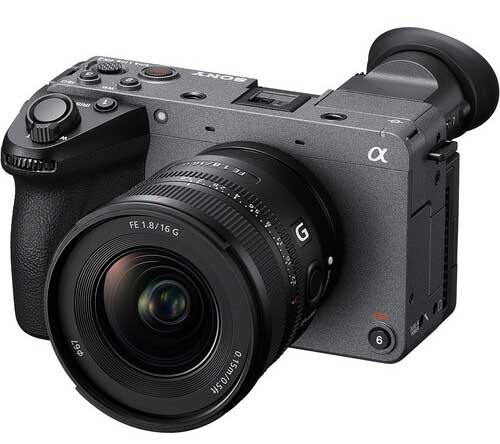
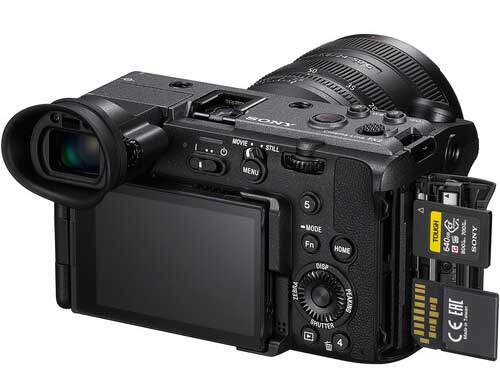
Sony announced the Sony FX2 camera. The camera is a mixture of the Sony A7 IV 33MP sensor and FX3 body. Now we have an AI chip inside the camera. The autofocus speed has been increased by up to 30%, and the tracking has been improved dramatically compared to the Sony Camera AIV. We have lots of new modes that include auto framing, framing stabilizer, and AI tracker that make the entire camera a kind of powerhouse Swiss Army knife.
Video capabilities also extend its boundaries to the maximum extent. Now we have certain angle DCI 4K and true 24fps recording. For professionals and videographers, we have an anamorphic recording mode in-camera, discreetly, as well as 24-bit audio recording capability with the help of XLR input.
Sony FX2 Specification
Sensor: 33MP full-frame BSI CMOS (from a7 IV)
Video:
4K up to 30p (7K full-width oversampled)
4K up to 60p (1.5x APS-C crop)
DCI 4K with true 24p
Autofocus: AI-based, 30% better recognition, auto-framing, AI tracker
Storage: 1x CFexpress Type A/SD, 1x SD (redundant recording)
ISO: Dual native (800, 4000), clean up to 25,600, usable at 51,200
Extended Features:
Shutter angle
4K30 UVC streaming (USB-C)
Focus breathing compensation
Dynamic active stabilization
S-Log Photo mode
4K JPEG shot mark grabs
Active cooling (unlimited recording)
HDMI Type A, headphone/mic jacks
Dual 1/4-20 tripod holes
FX3/FX30 XLR handle compatible
Focus breathing compensation as well as dynamic active image stabilization also help this camera to explore a new dimension of usability and portability. However, the FX2 retains the Sony A7 IV 4K 60fps crop limitation. That’s really disappointing. Sony can add a line-skipping 4K 60 APS-C mode in their camera so users can have the uncropped version of 4K 60p recording by having a bit of loss in quality.
The price of the camera is expected to be somewhere around $2698. B&H Store
Sony Electronics Introduces the FX2 Compact Camera, Expanding Cinema Line’s Versatility for Creatives
The new FX2 has the look and operability of Cinema Line cameras with the ability to shoot high-resolution photos and comes equipped with an articulating eyepiece
Sony Electronics Inc. is proud to announce today the latest addition to its established Cinema Line family, the FX2. The FX2 will offer a seamless entry point into the broader Cinema Line range, giving greater cinematic expression to independent creators or small crews needing a versatile camera.
“The hybrid cinema camera was created based on user feedback and is engineered with unique features to support filmmaking, a new eyepiece, and enhancements for versatile production needs. The FX2 is intended to continue the Cinema Line’s goal of preserving authentic emotion in every shot and empower creators across all areas of content production,” says Theresa Alesso, President, Imaging Products and Solutions Americas, Sony Electronics Inc.
FX2 Features: Full-frame Photo and Video Capabilities
The FX2 comes with a full-frame sensor that delivers stunning imagery and beautiful bokeh effects. Equipped with a 33.0 effective megapixel1 back-illuminated Exmor R™ sensor with up to 15+ stops of wide latitude using S-Log3, it captures impressive detail in both highlights and shadows.
Designed for versatile shooting environments, the FX2 offers Dual Base ISO at 800 and 4000, ensuring optimal performance in both bright and low-light conditions. Its ISO sensitivity for video can be extended up to 102400, making it ideal for challenging lighting scenarios. The camera supports a wide range of recording formats—including 4:2:2 10-bit All-Intra—and records in high-quality options, such as XAVC S-I DCI 4K at 24.00p, providing professionals with the tools needed for flexible, high-end production workflows.
The FX2 can also continuously record for up to 13 hours in 4K 60p2 thanks to its internal cooling fan and effective heat dissipation structure. The FX2 offers variable frame rate settings, allowing up to 60 fps in 4K (for a maximum 2.5x slow-motion effect) and up to 120 fps in Full HD (for up to 5x slow motion). It supports Log shooting in Cine EI, Cine EI Quick, and Flexible ISO modes, offering versatile workflows for different production needs. To further the cinematic expression of the camera, creators can import up to 16 user LUTs for on-camera preview, enabling precise color monitoring on set.
Filmmakers can also easily and quickly create in-camera cinematic looks, with S-Cinetone™ set as the default, along with a range of Picture Profile and Creative Look presets. A de-squeeze display function is available, supporting both 1.3x and 2.0x anamorphic lenses for accurate framing.
Improved Usability for Comfortable Solo Operation
The FX2 features the same compact, flat-top design as Sony’s Cinema Line FX3 and FX30 cameras, ensuring familiarity and compatibility across setups. Built-in mounting points (UNC 1/4-20 x3) support a cageless configuration, offering greater flexibility for rigging. An optional top handle (ILME-FX2) enhances mobility and control, especially during handheld or dynamic shooting. Its lightweight, portable build—measuring approximately 5 1/8 x 3 1/8 x 4 1/8 in and weighing approximately 1 lb 8.0 oz—makes it ideal for solo operators or small crew productions.
The camera offers advanced focus features designed for precision and creativity. Its new Real-time Recognition AF (auto focus) delivers fast and reliable performance with improved accuracy for human subjects, although its intelligent subject recognition extends to animals, birds, vehicles, and insects, with an Auto mode available for effortless detection. For even more control, tools like focus breathing compensation, AF Assist, and customizable autofocus transition speed and sensitivity give creators the flexibility to fine-tune focus for expressive, cinematic imagery. The FX2 comes with Active Mode and Dynamic active Mode, which is new to the Cinema Line, and are both designed to ensure smooth and steady handheld shooting.
The Auto Framing feature automatically crops and tracks a subject to keep them in a prominent position when the camera is mounted on a tripod, producing footage that looks like it was shot by an experienced operator. The Framing Stabilizer function automatically keeps the subject in the same position within the frame, which can be useful, for example, when the camera operator is moving alongside the subject.
From a still image perspective, the camera features an additional log shooting option with a newly added ‘Log shooting’ menu. This feature allows creators to shoot high-resolution 33MP stills, optimized for color grading in post-production. The FX2 also offers smooth operation with a MOVIE/STILL mode lever, allowing for a quick switchover between still and movie shooting. Depending on the selected mode, the displayed menu items will automatically adjust. Additionally, mode selection is made easy with a long press of the Fn button, which recalls and changes the shooting mode.
FX2 Features: Improved but Familiar Hardware Inherited From Sony’s Cinema Cameras
The FX2 is equipped with a new high-resolution 3.68-million-dot tiltable EVF3 (electronic view finder) designed specifically for video production, offering a wide viewing angle and enhanced immersion thanks to its included deep eyepiece. Complementing the EVF is a 3.0-type vari-angle touchscreen LCD, making it easy to frame shots from virtually any angle. Intuitively arranged controls on the top panel and grip, along with tally lamps for clear recording status, support efficient on-set operation. The camera also introduces a customizable “BIG6” home screen that provides quick access to essential shooting parameters, such as FPS, ISO, shutter speed (angle or speed), Look presets, white balance, iris, and neutral-density (ND) filter settings. Addressing the growing demand for vertical content creation, the FX2 supports vertical menu display during shooting—ideal for social media formats. The handle-equipped model further enhances professional usability with two XLR/TRS terminals and a 3.5mm stereo mic jack, enabling 4-channel, 24-bit digital audio capture.
The camera offers extensive expandability and connectivity options, including an HDMI Type-A terminal capable of outputting up to 4K 60p 4:2:2 10-bit video and 16-bit RAW4 for high-end recording and monitoring. For seamless data transfer and remote control, it supports dual-band Wi-Fi (2.4 GHz and 5 GHz5) as well as wired LAN via a compatible adapter6. Additionally, the USB Type-C port enables SuperSpeed USB up to 10Gbps data transfers and supports USB Power Delivery (PD)7, while built-in USB and network streaming support enables live broadcasting and remote production workflows.
Social Responsibility
Aligned with Sony’s global environment plan, ‘Road to Zero’, this product supports the company’s vision for achieving a zero environmental footprint by 2050. The manufacturing process reflects this commitment through facilities powered entirely by renewable energy sources8.
The camera system incorporates comprehensive accessibility options, including a Screen Reader function9 and Display Magnification, to support visually impaired users across an expanded range of menu items. Additional intuitive controls enhance usability for all shooters, featuring:
Real-time recognition autofocus that reduces manual adjustments
Streamlined touch interface operations for direct menu navigation
Tactile button design with clear differentiation
These inclusive design elements ensure professional imaging tools remain accessible to creators of all abilities while maintaining full operational capability
The FX2 will be available early August for a suggested retail price of $2,699.99 USD and $3,499.99 CAD body only or $3,099.99 USD and $3,999.99 CAD with XLR handle. It will be sold directly through Sony and at a variety of Sony’s authorized dealers throughout North America.
Fuji Registers New Cameras for 2025 Launch – Fuji registers a new camera in the wireless certification agency, so it has become a total of 3 cameras which are in the announcement pipeline. One of them is almost confirmed, which is coming on June 11 — the Fuji XE5 camera. The rest of the two cameras are still unknown, can be a GFX camera or maybe an X-Pro 5.
Fuji Unreleased and Registered Camera Models May 2025
The following table summarizes Fujifilm’s unreleased camera models and their known registered models, providing context for the new registrations:
Model Code
Camera Model
Registration Date
Wireless Type
Status
FF250001
Likely X-E5
Not specified (spotted early 2025)
Multi-band wireless
Unreleased
FF250003
Unknown (possibly X-M5 Range Camera)
Not specified (spotted May 2025)
Single-band wireless
Unreleased
FF250002
Unknown (possibly GFX Eterna)
Not specified (spotted May 2025)
Not specified
Unreleased
FF210002
X-H2S
2021-11-09
Not specified
Released
FF210003
X-H2
2022-06-20
Not specified
Released
FF220001
X-T5
2022-08-24
Not specified
Released
FF230001
GFX100 II
2023-01-13
Not specified
Released
FF220002
X-S20
2023-02-03
Not specified
Released
FF230002
GFX100S II
2023-06-19
Not specified
Released
FF230003
X100 VI
2023-11-24
Not specified
Released
FF240001
X-T50
2023-12-08
Not specified
Released
FF240002
X-M5
2023-06-28
Single-band wireless
Released
FF240004
GFX100RF
2024-12-04
Not specified
Released
FF240003
X-Half
Not registered with CMIIT
Not specified
Released
Notes:
Although three models are mentioned, FF250001 and FF250003 have already been registered. The model registered this time is “FF250002”.
While the FF250003 only supports 2.4GHz, the FF250003 and FF250002 also support 5.1GHz. Most recent models, except for small and lightweight models, support 5.1GHz Wi-Fi, so it is not possible to predict the price range of the camera based on this information alone. It is interesting to see whether it will be an X series model or a new model in the GFX series.
It is rumored that the “X-E5” will on June 11, 2025. More details here
Follow us for more updates and Get LIVE RUMORS –> FACEBOOK | TWITTER | INSTAGRAM to get live news — > get live news + –> See More Fuji Rumors
Is Petapixel host Jordan shooting with a Sony FX2 camera? First spotted by E88_8888, and then many people raised eyebrows by looking at the big body grip of the camera, almost no detail is noticeable.
The fact is that we can visibly see a deep hand grip in the Cinema camera, which is not present in any of the FX line of cameras. This is quite a big & deep, one more thing that hints to us its the new FX2 — whenever they start the NEW episodes, they generally write before the beginning of the video, which camera and lenses they are using to record the particular episode, but specifically on that particular episode Fuji X-Half Review, they have missed that thing. So it can be a coincidence or a conscious decision.
Sony FX2 Specification
– Same 33MP sensor as the α7IV and α7CII
– AI chip
– Equipped with a tilting EVF (resolution unknown)
– EVF is completely different from the LUMIX GX9 and is larger like the GFX100
– Mechanical shutter
– AI AF
– 4K60p in Super35
– 32-bit floating point audio
– The body is thicker than the FX3
– Active cooling system
– Same ports and storage as the FX3
– Vertical battery grip available
– Price is around $3500
But it’s strange that the FX2, a video camera, has a vertical grip. Since the FX2 has a mechanical shutter, perhaps Sony wants it to be used as a still camera as well. Look at the updated set of specifications Sony FX2 camera, which is about to arrive in a few days.
The article “Sony FX2 Leaked Image and Specification” was published at 4:24 pm, Tuesday, 27 May 2025, Greenwich Mean Time (GMT). By thenewcamera.com Team. You can follow us on our social pages FACEBOOK | TWITTER | INSTAGRAM, –>If you have time –>see moreSony Alpha Rumor Latest Camera News
Nikon Z5 II is an entry-level camera, and Sony A7 IV is a semi-professional full-frame camera. The Sony A7 IV camera was announced on October 21, 2021. And if you compare with the Nikon Z5 II, it has been almost 3.5 years of gap between the two cameras, so despite of being an entry-level camera, the Nikon Z5 II has arrived with really advanced core specifications and it looks very competitive.
Price Difference Between the Sony A7 IV and the Nikon Z5 II
The other good thing that we generally see at first is the price difference, even before the specification, current status of both the cameras by applying all the possible discounts:
Sony A7 IV Price – $2498 Nikon Z5 II Price – $1696
So, we do have a good price difference between the two cameras.
And the amount of money we are saving in the Nikon Z5 II body, we can get lenses like Nikkor 50 mm 1.8, Nikkor 28 mm f/2.8 or Viltrox 85mm f/1.8 Z.
Now let’s talk about the design difference, the difference we have in the photographic features of both cameras and finally the video core specs difference.
Best camera design-wise:
Nikon has been creating their DSLR for decades, and their mirrorlessZ5 II is very easy to hold. At the very same time, we now have a 3000-nits brightness-based electronic viewfinder which helps us to shoot even in harsh light conditions.
Sony is in its 4th generation of A7 series camera, and overall design of the camera is really very good, and the good thing is that the old menu system of the Sony has been upgraded in the A7 IV so now you don’t have to fight with the old menus in the Sony camera. So overall, the A7 IV camera design is also very appealing and usable, although about EVF screen brightness information remains uncertain. Sony hasn’t disclosed how many nits of brightness does the A7 IV EVF has.
Why do We Need a CF Express card SLot in the Sony A7 IV?
For storage purposes, the Sony A7 IV camera also features an additional CFexpress card slot inside it, but we don’t know the exact requirement of the CF card type A existence inside the Sony body since the continuous shooting speed of the A7 IV camera is limited to 10 frames per second. Even in that, the specific scenario doesn’t require that CFexpress card. And when we talk about 4K 30 APS-C crop 60fps recording, in both of these scenarios the recording resolution and bitrates match with the Nikon Z5 II, which does the everything same or even better by recording complete N-RAW video internally and providing continuous shooting speed in high resolution up to 30 frames per second in the SD card slot.
Yes, we do have a slight resolution difference between the 24 MP and 33 MP sensor, and we are going to compare both sensors here in this article and let’s find out the best sensor for you. Image credit to all tests goes to dpreview.com
Which Camera Captures the Best Images?
Yes, we do have a slight resolution difference between the 24 MP and 33 MP sensor, and we are going to compare both sensors here in this article and let’s find out the best sensor for you.
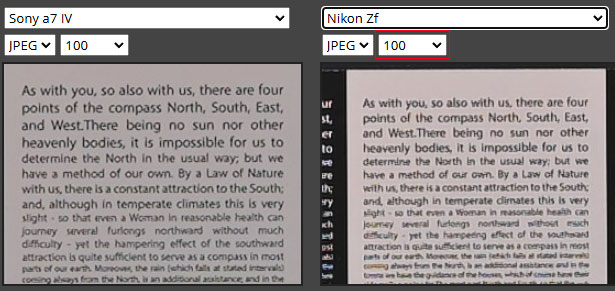
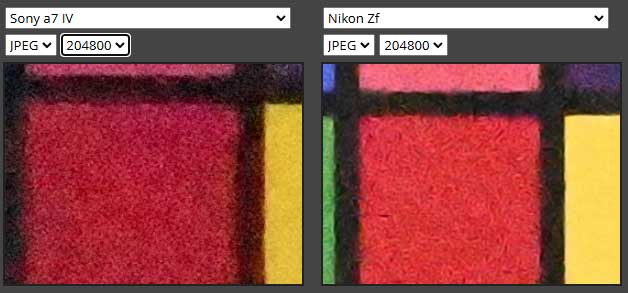
Now we have picked up the Nikon Zf camera since the Nikon Z5 Mark II uses the same sensor as the Nikon Zf, so we are comparing the Nikon sensor against the Sony A7 IV in this comparison.
A comparison is very clear the Sony A7 IV camera is able to pick a bit more detail due to a slightly higher-resolution sensor, so if you are into commercial photography or need large prints,
But this is not always the case. In some of the specific spots of the image, we have witnessed that the Nikon Zf / Z5 Mark II camera sensor is able to grab a bit more detail. As you can see, the pencil shading and the fine lines are more clearly visible in the samples below.
Best Camera for LOW LIGHT Photography?
The Nikon Z5 II is more suitable for low-light photography. We have to consider several factors before we judge the best camera for low-light photography. As in the comparison table, you can see that the Nikon Z5 Mark II autofocus sensitivity can go down up to -10EV, which is exceptional in this price range. At the very same time, the Nikon Z5 Mark II camera features 7.5 stops of sensor image stabilisation system, and that can be linked to the autofocus point of the camera, resulting in a highly stabilised video or still output. And at the very end, we have a 24MP BSI sensor that helps us reach the maximum potential of the camera. Combining all three factors makes the Nikon Z5 ideal in terms of low-light photography.
Best camera for wildlife photographers and sports shooters?
Nikon Z5 II is the best camera, again, and it depends on several factors. Starting from the continuous shooting speed, the Nikon Z5 Mark II camera excels. It has a maximum continuous shooting speed of up to 30 frames per second. The Sony A7 IV camera remains limited to 10fps. But that’s not the only limitation — we have again the autofocus sensitivity of the Sony A7 IV is limited, and the sensor image stabilisation of the Nikon Z5 II has become increasingly advanced. You can link the entire IBIS unit with your moving autofocus points. And at the end, if you are worried about the autofocus performance, then the Z5 II, paired up with the Expeed 7 image processor, features 9 different types of subject detection algorithms inside it. And even if you love to capture birds, the camera can do bird-eye autofocus with the latest updates.
Best camera for video?
Both of the cameras record 10-bit footage, RRS video, and 4K 60FPS video with a 1.5X crop. At the very same time, both of them can record Full HD videos at 120 frames per second. The big difference can be seen when the new Nikon Z5 Mark II camera can deliver complete RAW footage of 12-bit in your internal SD card, and the cherry-on-top thing is when you are shooting in N-Log, then you have a different set of RED LUTs available to you, which will make your entire footage more and more professional. And apart from all these, we also have vectorscope, waveforms, and timecode functionality. The Nikon Z5 Mark II camera is recommended for professional use. If you are a professional wedding cinematographer or someone who loves to capture short stories in a professional way, then the Nikon Z5 Mark II is best for you.
Sony A7 IV doesn’t support complete RAW video recording. At the very same time, the picture profiles are limited. But it does support high-quality 4K recording and S-Log, HLG support. At the very same time, the gyro-based image stabilization system helps to stabilize the footage to the maximum extent. So if you’re shooting handheld, like creating your own personal vlog, then instead of having the Nikon Z5 Mark II camera, the A7 IV will be a bit more suitable.
Best camera for longer recording
If you have to shoot podcasts, then the initial specification says the Sony A7 IV can record unlimited videos, whereas the Nikon Z5 Mark II has a 2-hour 5-minute limit, and after that, you have to start it again. Now, the concern with the Sony A7 Mark IV camera is that you have to use it in controlled weather environments and with fast V90 or CFexpress cards if you wish to record 10-bit videos for more than 1+ hour. But that’s not the case with the Nikon Z5 Mark II camera — the body is heat-resistant and supports uninterrupted recording for long periods. So you have to decide whether you want an overheating-free camera (but again, you have to restart at the 2 hour 5 minute mark), or you can deal with the Sony A7 IV if you are sitting in a controlled weather environment with air conditioners.
Specification Comparison Table Nikon Z5 II vs Sony A7 IV
Feature
Nikon Z5 II
Sony A7 IV
Design
Lens Mount
Nikon Z
Sony E
Dimensions (W x H x D)
5.3 x 4 x 2.8″ / 134 x 100.5 x 72 mm
5.2 x 3.8 x 3.1″ / 131.3 x 96.4 x 79.8 mm
Weight (With Battery, Media)
1.5 lb / 700 g
1.4 lb / 658 g
Material of Construction
Magnesium alloy/polycarbonate
Magnesium Alloy
Operating Conditions
32 to 104°F / 0 to 40°C, up to 85% humidity
32 to 104°F / 0 to 40°C
Display Size
3.2″
3.0″
Display Resolution
2,100,000 Dot
1,036,800 Dot
Display Type
3-Way Tilting Touchscreen LCD
Free-Angle Tilting Touchscreen LCD
Viewfinder Type
Electronic (OLED)
Electronic (OLED)
Viewfinder Size
0.5″
0.5″
Viewfinder Resolution
3,690,000 Dot
3,680,000 Dot
Viewfinder Magnification
Approx. 0.8x
Approx. 0.78x
Viewfinder Eye Point
21 mm
23 mm
Viewfinder Diopter Adjustment
-4 to +2
-4 to +3
Media/Memory Card Slot
Dual Slot: SD/SDHC/SDXC (UHS-II)
Slot 1: CFexpress Type A / SD (UHS-II), Slot 2: SD/SDHC/SDXC (UHS-II)
Video I/O
1x Micro-HDMI Output
1x HDMI Output
Audio I/O
1x 3.5 mm TRS Stereo Headphone Output, 1x 3.5 mm TRS Stereo Microphone Input
1x 3.5 mm TRS Stereo Headphone Output, 1x 3.5 mm TRS Stereo Microphone Input
Other I/O
1x 3.5 mm Remote Input, 1x USB-C (USB 3.2 / 3.1 Gen 1) Data Input/Output
1x Sony Multi/Micro-USB Remote Input, 1x USB-C (USB 3.2 / 3.1 Gen 1) Data Input/Output
Wireless
Bluetooth 5.0, 2.4 / 5 GHz Wi-Fi 5 (802.11ac)
Wi-Fi 4 (802.11n), Bluetooth 4.1
Mobile App Compatibility
Yes: SnapBridge (Android & iOS) for file access, firmware updates, and remote control
Yes: Creators’ App (Android & iOS) for file access, settings, remote control, and setup
H.264/MOV/MP4:
UHD 4K (3840 x 2160) at 23.98/25/29.97/50/59.94 fps
1920 x 1080p at 23.98/25/29.97/50/59.94/100/120 fps
H.264/XAVC S-I 4:2:2 10-Bit:
UHD 4K (3840 x 2160) at 23.98/25/29.97/50/59.94 fps [240 to 600 Mb/s]
1920 x 1080p at 23.98/25/29.97/50/59.94 fps [89 to 222 Mb/s]
H.265/XAVC HS 4:2:2 10-Bit:
Video IS
IBIS + EVR
Yes, Gyro
External Recording Modes
8-Bit via HDMI:
UHD 4K (3840 x 2160) up to 29.97 fps
4:2:0 8-Bit via HDMI:
UHD 4K (3840 x 2160) at 23.98/25/29.97/50/59.94 fps
Fast-/Slow-Motion Support
No
Yes
Overheating issues, if any
No
Requires V60 above the card, Fixed with the recent firmware updates
In a recent patent spotted by Rumor Mill, the Viltrox is working on a 2x teleconverter for the Nikon Z Mount camera. It is very clearly visible from their patent images the lens mount has been designed for the Z Mount. Although the E-mount does not allow third-party teleconverters, the fact that Viltrox is preparing a Z-mount teleconverter suggests that Nikon may be considering allowing third-party teleconverters.
The pins’ location and numbers exactly match with Z Mount. For the first time that a third-party manufacturer is also free to create teleconverters, which was not possible earlier. So it will help the photographers to buy it at an affordable cost. This step may also indicate one thing very clearly, that Viltrox is also planning to bring Telephoto lenses Z mount soon.
Canon mirrorless cameras have become a perfect choice for professional photographers and beginners in 2025. The camera offers cutting-edge autofocus technology, high-resolution sensors, as well as a wide range of native lenses, along with a huge range of DSLR lenses that are fully adaptable with the new RF system cameras. And now Canon has started to open up to third-party leading lens manufacturers like Sigma and Tamron, for the APS-C RF mount cameras.
Why choose a Canon mirrorless camera in 2025?
Cameras are a combination of portability, advanced technology, and versatility. Canon’s Dual Pixel Autofocus system does seamless focus and never misses any subject since the entire sensor pixels are involved in autofocusing and none of the pixels are dead, unlike in hybrid CMOS or contrast-detect focus sensors where the fabricated autofocus points are actually dead pixels and don’t contribute anything to the image quality. And that’s why the Canon sensors are able to achieve the industry’s best tonal quality for capturing human portraits with advanced accuracy in their new AI Auto White Balance mode.
Canon isn’t dependent on any other third-party sensor maker or lens makers for their system cameras. They design everything indigenously and that’s why their RF system is so perfect.
Top 6 mirrorless cameras for photography in 2025
Let’s dive into the details, the best Canon mirrorless cameras for 2025. Each camera is handpicked for different photographic needs. Either you are a professional photographer, an action or sports lover, or an entry-level buddy photographer, we are starting from pros and going down to budget-friendly options.
1. Canon EOS R5 Mark II – the professional’s dream machine
What’s inside: We have a 45-megapixel STACKED full-frame CMOS sensor. The readout speed of the sensor is 6.3 milliseconds. The camera is able to record 8K videos up to 60 frames per second and features 5,850 autofocus points. You are getting 8.5 stops of sensor-shift image stabilization and continuous shooting speed up to 30 RAW frames per second.
Why it rocks: I think Canon should get the flagship camera award for the Canon R5 II. Canon R5 Mark II camera is said to be the Swiss Army knife of cameras. The 45-megapixel full-frame CMOS sensor gives highly detailed images, perfect for landscape photography. Since Canon is known for its skin tonal quality, and the Canon R5 Mark II is also highly suitable for portrait photography, it is the best mirrorless camera for professional photography in 2025. The autofocus tracks everything from bird eyes to bride’s eyes with laser precision, and the stabilization gives you the ability to shoot at slow shutter speed without worrying about blur. If you are a habit shooter, then 8K video is the cherry on top.
Perfect for: The camera is perfect for wedding photographers as well as professional portrait photographers. Anybody who loves to have highly detailed images from their camera, the R5 Mark II is the best option.
What’s inside: 24.2-megapixel full-frame stacked CMOS sensor, 2.7 milliseconds of readout speed, 40 FPS RAW capture, 1/64000s shutter, dual CFexpress card slots, 7.5 stops of IBIS.
Why it rocks: The Canon R1 was announced back in July 2024, and it is Canon’s fastest mirrorless camera yet. Canon R1 is the best camera for sports photography in 2025. It freezes the action like no other without any trace of rolling shutter effect, as well as the low-light performance is excellent. The autofocus of this camera does magic in reality—it sticks to fast-moving subjects, and you have to just compose the image and capture the frame, and nothing else you have to do. The Canon R1 camera features a rugged and completely rainproof design, a perfect mirrorless camera for wildlife photography in 2025.
Perfect for: Sports photography and wildlife photography
What’s inside: We have a 24.2 MP full-frame sensor able to capture 40 frames per second with electronic shutter and also records uncropped 4K 60fps video with advanced autofocus support and approximately 7.5 stops of IBIS.
Why it rocks: The Canon R6 Mark II camera actually captures the best sweet spot in Canon lineup, for those who love to have professional features in their camera without breaking the bank. Yes, we are waiting for Canon R6 Mark III, and possibly in the fourth quarter of 2025 we may have it. Meanwhile, the R6 Mark II is available at a very reasonable price, and if you love to have a professional feel in your hand, then the R6 Mark II is the perfect choice. The ISO ranges up to 204800, making it ideal for professional portrait photography with Canon mirrorless cameras in 2025. A lot of wedding photographers out there also use the Canon R6 Mark II camera bod,y pairing it up with the Canon 28-70 f/2.8 lens. Whether you are shooting candid events or fast-moving kids, the autofocus speed always catches you, and the stabilisation makes everything so perfect. For now, the Canon R6 Mark II camera at its price is the best option.
What’s inside: The camera features a 24.2 megapixel full-frame CMOS sensor and continuous shooting speed up to 40 frames per second. Canon R8 also records uncropped 4K 60fps video with advanced autofocus and excellent tonal quality.
Why it rocks: Canon R8 is one of the best budget-friendly Canon mirrorless cameras for photography in 2025. The camera arrives at a super budget price and is able to offer you a full-frame sensor with 4K 60fps uncropped recording and continuous shooting speed up to 40 frames per second which no one else is able to offer. The body doesn’t have IBIS so you need to keep OIS lenses to get the perfect shot.
Perfect for budget-conscious shooters waiting for full-frame performance.
What’s inside: The Canon R10 features a 24.1-megapixel APS-C CMOS sensor with maximum mechanical continuous shooting speed up to 15fps, and records 4K 30fps APS-C video.
Why it rocks: The Canon R10 is one of the best cameras for new photographers. If you’re a beginner and looking for an all-rounder camera, then the Canon R10 is definitely a perfect choice for you. The Canon R10 is actually fast enough for action and sports photography, and pairs up flawlessly with native and third-party RF-S lenses, making it the best Canon mirrorless camera for beginners in 2025.
What’s inside: 24.2 APS-C sensor, records 4K 60fps video without any crop, in-body LUTs, false color, and vertical tripod support.
Why it rocks: The Canon R50V camera is a recent announcement from Canon. The Canon R50V is a compact powerhouse for cinematography on a budget. The camera features extensive videographic features that make you feel like you are using a professional cinema tool in your hand. The box-like body design and compatibility with RF-S dual fisheye lenses to create VR content make you feel it’s a professional cinema camera available at only $649.
Perfect for vloggers: Bloggers, YouTubers, and beginner cinematographers.
If you are not sure which one is right for you, we have made a quick guide that will help you pick the best Canon camera for you.
Budget: Budget-wise, Canon R50V, Canon R10, and Canon R8 keep the overall cost low. In the higher price range, we have the Canon R5 Mark II and Canon R1 — these are the premium professional mirrorless cameras.
Photography versus cinematography: Canon R1 camera has been recommended for sports and wildlife photographers. The Canon R5 Mark II camera is a multipurpose camera but is usually being recommended for landscape photography, wedding photography, and professional portrait photography. At the very same time, Canon R6 Mark II camera is known for its versatility, and Canon R50V is for budget cinematography and video.
Sensor size: We have full-frame cameras — the Canon R5 Mark II, the Canon R1, Canon R6 Mark II, and the Canon R8 — all these nail low light very well. On the other side, we have the APS-C — the Canon R10 and R50V — which saves a lot of money.
Portability: When you are in travel mode and portability is an important factor to you, then having Canon R50V, Canon R10, and Canon R8 are the best options as these are super lightweight. Cameras like Canon R1 or even the R5 Mark II are built like a tank and are a bit bulkier.
Lenses: All these cameras mentioned in the list work flawlessly with RF lenses, and if you have some budget issues, then you can buy the DSLR lenses with the adapter — even those will work flawlessly in most cases. In APS-C range, we do have third-party lens maker support from Sigma and Tamron, so you have more options in the APS-C range compared to full-frame.
Recommended Lenses to Pair with Your Canon Mirrorless Camera We have listed some of the most popular lenses among our subscribers.
FAQ: Best Canon Mirrorless Cameras for Photography and Cinematography in 2025
What is the best Canon mirrorless camera for professional photography in 2025? The Canon R5 Mark II camera is the top pick for professional photographers. It should be termed as Canon’s flagship camera without a doubt. If you look at the set of features of the Canon R5 Mark II — featuring a 45-megapixel full-frame stacked CMOS sensor, ability to record 8K video, and unbeatable autofocus — for professional photography with Canon’s cameras in 2025, the Canon R5 Mark II is the best option.
Which Canon mirrorless camera is best for beginners in 2025? We have two different types in this. The first one is Canon R50 V, which is best for beginner videographers in 2025, and the next is Canon R10, which is perfect for beginners.
What is the best Canon camera for sports photography? The Canon R1 is a speed monster camera, with 40FPS shooting mode and shutter speed up to 1/64000 of a second. Perfect for sports photography with Canon mirrorless camera in 2025. Although if you’re a beginner and looking for a budget-friendly option, then you can start with Canon R10 with 14 FPS mech shutter speed or Canon R50 with 40 FPS continuous shooting speed.
Which Canon camera is best for low-light photography in 2025? The Canon R8 or 6 Mark II camera—both are excellent tools for low light photography, featuring a full frame CMOS sensor of 24 MP and sensitivity up to 204800. They are able to grab excellent low-light images. So these two are perfect for low-light photography with a Canon camera in 2025.
Can I use my old EF lenses with a Canon RF camera in 2025? Absolutely yes, you can use your old EF lenses with the Canon EF to EOS R adapter. It will allow you to use all of your EF lenses with no loss in quality.
What is the cheapest Canon mirrorless camera for video in 2025? The Canon R50 V, which is available at 64,900 only, is the most budget-friendly Canon camera for cinematography in 2025. It gives you all the possible professional video features like 4K 60 FPS, uncropped and false color recording in a compact body under budget.
The Canon mirrorless cameras will give you creative superpower—whether you talk about the recently announced Canon R50 V or the professional Canon R5 Mark II camera, or even the Canon R1. All the cameras now pack professional tech, and Canon is now very aggressive with its core specification, and they are testing limits literally with whatever they are giving in the price range. Shahid Afridi wants to create a cinematic camera on a budget for you—want to capture every fine detail? They have it all. Use this guide to find out the best Canon mirrorless camera for photography and cinematography in 2025 for you, and you can also check the Canon official website for the latest details on cameras and lenses. Thanks very much for reading this article—let me know if you have any questions.
If you believe the latest rumors published on the web, the Fuji X-E5 camera will be available in the summer of 2025. Summer months in the USA are June, July, and August, so we will most probably have our camera on or before August 2025.
The Fuji X-E5 was overdue for an update, The Fuji X-E4 camera was announced back in March 2021, and the Fuji X-E3 camera was announced in September 2017. The gap between the Fuji X-E3 and X-E4 announcements is approximately 3.5 years. But, this time Fuji took +1 year of time to bring the update of Fuji X-E series camera.
Fuji X-E5 Expected core specification
40MP APS-C X-Trans CMOS 5 HR Sensor
4K Video Recording at 60p, 6.2K at 30p (4:2:2 10-Bit)
Post Update: Fuji X-E5 Coming in June 2025 [Confirmed]
We are updating the post with the latest information. It is now almost confirmed that the Fuji X-E5 Camera will be available in June 2025. The camera’s core specification is expected to remain the same as mentioned above, with some added perks.
Fuji X-E5 Announced – Updated Content (2025-10-07T15:21:00Z)
The article “Fuji X-E5 Camera Announcement on or Before August 2025” written and updated by thenewcamera.com team on Dec 13, 2024 at 19:07 2025, Greenwich Mean Time (GMT) and Updated on 4:47 am, Wednesday, 21 May 2025 Greenwich Mean Time (GMT) and This post was last updated on October 7, 2025, at 3:21 PM GMT (2025-10-07T15:21:00Z) | Follow us for more updates and Get LIVE RUMORS –> FACEBOOK | TWITTER | INSTAGRAM to get live news — > get live news + –> See More Fuji Rumors
Buy Canon Lenses, Buy Music CD or Digital Camera at amazon it helps this site, and you do not pay anything extra, it is just a way to help support this site.
New Camera Website, we list all type of new camera information, price review and all type camera rumors, subscribe us or follow us via twitter or facebook.
Disclaimer: We have attempted to select useful information to include on New Camera, and to ensure that the resources we have included on the site -- as well as the way we have described them -- are accurate, fair, and balanced. However, we make no claims, warranties, or other representations concerning the accuracy, completeness, or utility of the information provided, or concerning the abilities or performance of the organizations, agencies, companies, and other resources presented through New Camera