

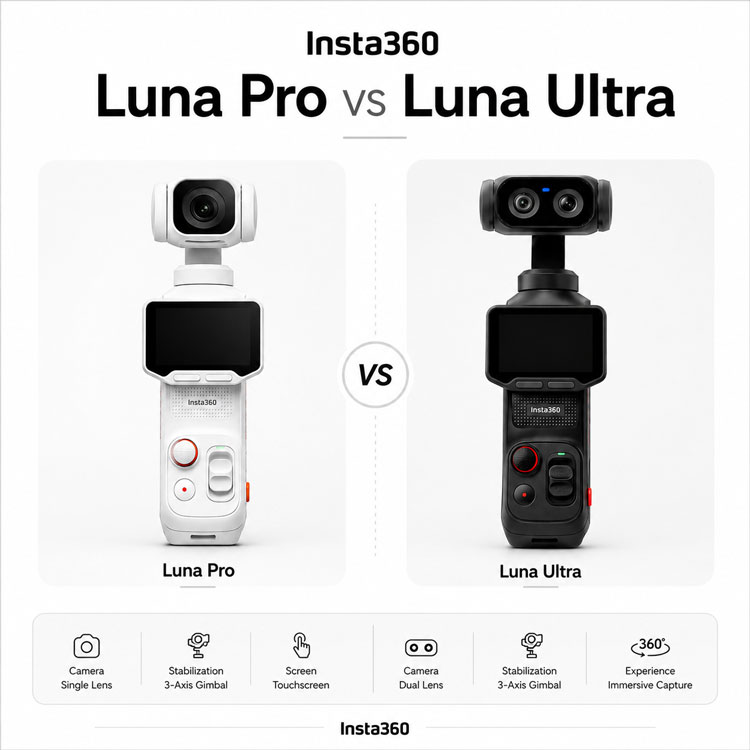
We do have confirmed specifications for the Insta360 Luna Pro, but how does it stack up against the Luna Ultra? So, we are going to compare them head-to-head in this article with a detailed specification comparison review, so you will have a better understanding of what sort of camera module the Insta360 Luna Pro is and why the Luna Ultra remains the best despite the Luna Pro’s arrival. It is said that the Luna Pro will be a bit lighter on your pocket, as it is more affordable than the Luna Ultra model we pay for.
The comparison becomes more important since we do not have the DJI Pocket 4 Pro or the DJI Pocket 4 camera in the United States of America. The only latest gimbal cameras right now are the Insta360 Luna Ultra and Insta360 Luna Pro, so let’s compare the two in a quick comparison table, and then we are going to analyse the core differences between the two. Depending upon your requirements and budget, we have our camera recommendation.
Insta360 Luna Pro vs Luna Ultra – Insta360 Luna Pro vs Luna Ultra Quick Comparison Table
| Feature | Insta360 Luna Pro | Insta360 Luna Ultra |
| Status (July 2026) | Upcoming (FCC certified, expected Aug–Oct) | Released (June 10, 2026) – Available now |
| Camera Setup | Single-lens (wide) | Dual-lens (wide + telephoto) |
| Main Sensor | 1-inch CMOS | 1-inch CMOS |
| Main Lens | Leica Summicron f/1.8 (20mm) | Leica Summicron f/1.8 (20mm) |
| Telephoto Lens | None (digital/hybrid zoom only) | 1/1.3″ Leica f/2.0 (60mm) + 6x lossless / 12x hybrid |
| Max Video | 4K high frame rates (8K unconfirmed) | 8K30 Dolby Vision + 4K120 + 1080p240 |
| Color Profile | 10-bit I-Log + Leica profiles | 10-bit I-Log + Dolby Vision + Leica profiles |
| Dynamic Range | ~14 stops | ~14 stops |
| Stabilization | 3-axis mechanical + FlowState | 3-axis mechanical + FlowState |
| Screen | Detachable 2″ OLED (wireless remote) | Detachable 2″ OLED (wireless remote) |
| Weight | ~150g (expected) | 233–235g |
| Battery | 1550mAh | 1550mAh main + 210mAh screen |
| Internal Storage | Expected microSD focused | 47GB + microSD up to 2TB |
| Audio | Multi-mic + Mic Pro support | 4 mics + native Mic Pro/Air support |
| US Price (approx) | $600–720 (expected body) | $769.99 (Standard Bundle) |
| India Price (approx) | ₹55,000–72,000 (expected) | ₹85,990 (official store) |
| Best For | Everyday vlogging, travel, light carry | Portraits, events, zoom, maximum versatility |
Lets summarize everything before we jump into details
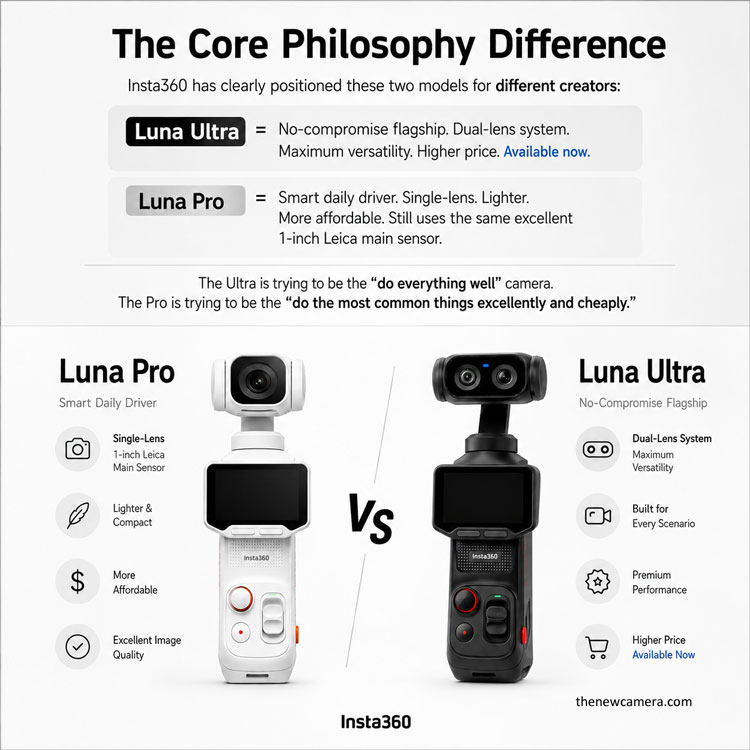
The Core Philosophy Difference
Insta360 has clearly positioned these two models for different creators:
- Luna Ultra = No-compromise flagship. Dual-lens system. Maximum versatility. Higher price. Available now.
- Luna Pro = Smart daily driver. Single-lens. Lighter. More affordable. Still uses the same excellent 1-inch Leica main sensor.
The Ultra is trying to be the “do everything well” camera. The Pro is trying to be the “do the most common things excellently and cheaply.”
Image Quality & Optics (The Most Important Section)
The best part is both cameras share the same main camera module: a 1-inch CMOS sensor paired with a Leica Summicron f/1.8 lens (20mm equivalent) to capture everything on the go. The large sensor helps in capturing extended dynamic range and enhanced low-light performance. But as we know, the Luna Ultra has an extended camera module specifically for capturing distant shots
Where they diverge is the second lens.
The Luna Ultra adds a dedicated 1/1.3-inch telephoto camera with a Leica Summicron f/2.0 lens (60mm equivalent). This gives it:
- True optical zoom
- Up to 6x lossless zoom
- Up to 12x hybrid zoom (reaching roughly 240mm equivalent)
- Better subject isolation and compression for portraits
- Cleaner telephoto macro performance
The Luna Pro has only digital/hybrid zoom on its single wide lens. Obviously, the quality of zoomed-in images or videos will not be as good as that of the Luna Ultra Pro model. Digital zoom on a high-quality 1-inch sensor is usable up to about 2x, but quality falls off after that. For pure talking-head vlogging or wide environmental shots, this limitation barely matters. For interviews, events, street portraits, or any situation where you want to reframe without walking, it becomes a real restriction.
Analytical take: Read this before you make any decision about the camera
The dual-lens system on the Ultra is not a marketing gimmick. It fundamentally changes how you shoot. Once you get used to having clean 60–120mm options on a pocket camera, going back to digital zoom feels limiting. This is the single biggest reason to choose the Ultra over the Pro.
Video Specs & Performance
Luna Ultra (Confirmed):
- 8K30fps with Dolby Vision
- 4K120fps
- 1080p240fps
- PureVideo AI mode for low light
- 10-bit I-Log
- H.265 up to 120 Mbps
- Excellent dynamic range and colour science (Leica Natural / Vivid / Chrome)
Luna Pro (Based on official teases + FCC + NAB previews):
- Same main 1-inch sensor and f/1.8 lens
- 10-bit I-Log confirmed
- High frame rate 4K expected
- Full 8K is not confirmed and may be reserved for the Ultra
- Same 3-axis mechanical gimbal + FlowState stabilisation
In real-world testing of the Ultra (from multiple independent reviewers), the 1-inch sensor delivers noticeably cleaner low-light footage and better highlight recovery than previous generation pocket gimbals.
The reason is not only due to the hardware we have, its also due to the software – image/video decoding algo and Leica colour science
The Leica colour science is more natural and gradeable than pure Insta360 or DJI colour profiles for many users.
Stabilisation on both is excellent. The Ultra has a slight edge in intelligent tracking (Active Zoom Tracking and Group Tracking) because it can use data from both lenses.
Design, Weight & Handling
- Luna Ultra: 233–235g. Feels premium and solid. The dual-lens head adds a bit of bulk at the top.
- Luna Pro: Expected around 150g. Significantly lighter and more pocketable for all-day carrying.
Both use the same clever detachable 2-inch OLED touchscreen that works as a wireless remote (up to 20m). This is one of the best features in the entire category. You can mount the camera high or low and still control and preview from a distance.
For creators who shoot long vlogs or travel light, the weight difference of ~80–85g is more significant than it looks on paper.
Battery, Storage & Audio
Both use a 1550mAh main battery and claim up to 4 hours of recording in light conditions (1080p24, screen off). Real 4K shooting typically delivers 90–150 minutes depending on resolution, frame rate, and temperature.
The Ultra has a small extra 210mAh battery in the detachable screen and 47GB of internal storage. The Pro is expected to rely more heavily on microSD.
Audio is strong on both. Multi-mic arrays with wind reduction and full native support for Insta360 Mic Pro / Mic Air. The Ultra has four mics (three on body + one on screen).
Price Reality Check (July 2026)
Luna Ultra (Available now):
- US: $769.99 (Standard Bundle)
Luna Pro (Not yet released):
- Expected body price: $600–720
- Launch window: Expected August–October 2026 (FCC certification already completed)
The price gap is meaningful. The Ultra costs more, but you are paying for a second high-quality lens system and confirmed 8K/Dolby Vision.
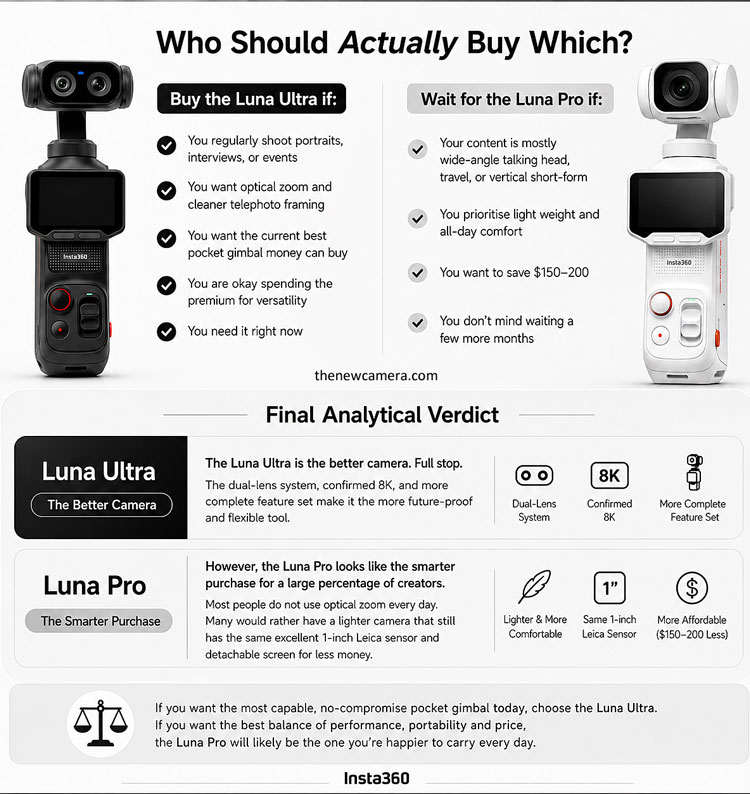
Who Should Actually Buy Which?
Buy the Luna Ultra if:
- You regularly shoot portraits, interviews, or events
- You want optical zoom and cleaner telephoto framing
- You want the current best pocket gimbal money can buy
- You are okay spending the premium for versatility
- You need it right now
Wait for the Luna Pro if:
- Your content is mostly wide-angle talking head, travel, or vertical short-form
- You prioritise light weight and all-day comfort
- You want to save $150–200
- You don’t mind waiting a few more months
Final Analytical Verdict
The Luna Ultra is the better camera. Full stop. The dual-lens system, confirmed 8K, and more complete feature set make it the more future-proof and flexible tool.
However, the Luna Pro looks like the smarter purchase for a large percentage of creators. Most people do not use optical zoom every day. Many would rather have a lighter camera that still has the same excellent 1-inch Leica sensor and detachable screen for less money.
Right now (mid-July 2026):
If you need a high-end pocket gimbal today → buy the Luna Ultra.
If your shooting style is mostly wide and you can wait → keep a close eye on the Luna Pro.
Insta360 has done something smart here. Instead of releasing one expensive camera, they created a proper product ladder. That benefits creators more than another “one size fits all” flagship.
The real winner is the person who chooses the right tool for their actual shooting style — not the one who buys the more expensive camera by default.
The article “Insta360 Luna Pro vs Luna Ultra: The Real Difference (In-Depth Analysis)” was written by thenewcamera.com team on 5:07 pm, Wednesday, 15 July 2026, Greenwich Mean Time (GMT)| You can also follow us on Our Official Social Media Handles FACEBOOK | TWITTER | INSTAGRAM > get live news — > DJI Rumors
Insta360 Luna Pro Launch Likely Before November 2026

























Would the Pro have the remote microphone that comes on the remote screeen?
Yes