

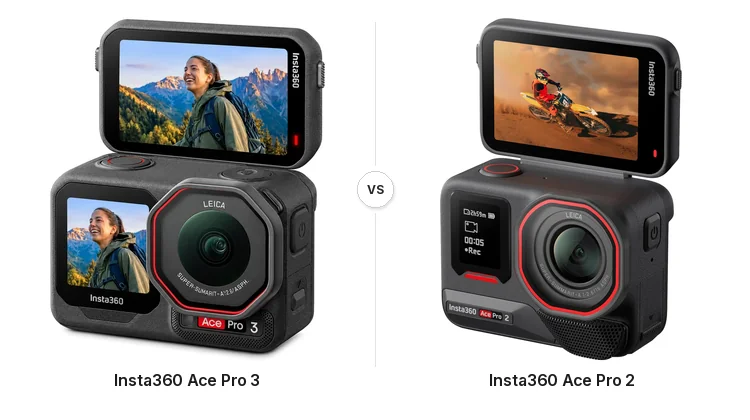
The Insta360 Ace Pro 3 looks like a huge leap over the Ace Pro 2. Based on leaked marketing slides and spec sheets shared by Igor Bogdanov (@Quadro_News), the new model brings a Sony co-customized square sensor, a variable aperture, intelligent autofocus, 2x lossless zoom with 1–4x sliding zoom, and a full interchangeable lens system.
Below is a side-by-side comparison, followed by a clear breakdown of the biggest changes and what they mean in real use.
Ace Pro 3 vs Ace Pro 2 Comparison
| Feature | Ace Pro 3 (Leaked) | Ace Pro 2 (Official) |
|---|---|---|
| Sensor | 1/1.1-inch 8K Square Sensor (jointly customized with Sony, 30% larger area, 14.5 stops dynamic range) | 1/1.3-inch 8K Sensor |
| Aperture | F1.77–F4.0 Auto Variable (supported on main, 14 mm wide, 50 mm tele & cinematic widescreen lenses) | F2.6 Fixed |
| Lens System | Interchangeable (10 mm–100 mm eq. coverage) • Main: Leica Summicron 22 mm (90°) • Wide: 14 mm (156°) • Optional: 10 mm ultra-wide (190°), 50 mm tele, cinematic widescreen (anamorphic), filters & vintage street grip |
Fixed Leica Summarit ~13 mm (~157°) |
| Zoom | 2x Lossless Zoom in 4K (2.5x lossless video on wide lens) + 1–4x Sliding Zoom | Standard (no 1–4x sliding zoom) |
| Focus | Intelligent Autofocus + Smart Tracking (humans, pets: cats & dogs) | Fixed focus (closest ~0.37 m) |
| Max Video | 8K 30 fps 4K 120 fps Dolby Vision |
8K 30 fps 4K 120 fps |
| Night Video | 4K 60 fps | PureVideo mode |
| Color / Profiles | Dolby Vision + 10-bit I-Log + Leica Color Styles | Active HDR + I-Log + Leica styles |
| FreeFrame | Upgraded 4K FreeFrame (1:1 capture to 4K horizontal 16:9, vertical 9:16 & 4:3) | Standard FreeFrame |
| Photo | 50 MP | 50 MP |
| Battery | 2250 mAh (up to ~5 hours*) | 1800 mAh (~180 min endurance) |
| Waterproof | 20 m without case / 60 m with dive case | 12 m without case / 60 m with dive case |
| Screens | 2.5″ OLED flip + 1.46″ color OLED front | 2.5″ flip touchscreen |
| Internal Storage | 50 GB | None (microSD only) |
| Weight | ~161 g (without wide lens) / ~185 g | ~177–182 g |
| Chipset | All-new Flagship AI Chip + Pro Image Processing Module | Pro Imaging Chip + 5 nm AI Chip |
| Other | NFC Quick Start, wet-hand touch, vintage street grip | PureVideo, AI features |
Biggest Upgrades: What Changed and What You Gain
1. Larger Sony-Customized Square Sensor (1/1.1-inch vs 1/1.3-inch)
What changed: Ace Pro 3 moves to an exclusive 1/1.1-inch 8K square sensor jointly customized with Sony, delivering a 30% larger sensor area than the Ace Pro 2 and 14.5 stops of dynamic range.
Benefit: You get cleaner low-light footage, better highlight and shadow detail, and more room for reframing. The square sensor also powers upgraded 4K FreeFrame video, letting you shoot once in 1:1 without worrying about camera orientation and export full 4K in 16:9, 9:16, or 4:3.
2. Auto Variable Aperture (F1.77–F4.0) vs Fixed F2.6
What changed: Ace Pro 3 adds a mechanical variable aperture that automatically adapts to ambient light and your shooting needs. The F1.77–F4.0 range works on the main lens and 14 mm wide lens, with F1.77 max aperture also supported on the 50 mm telephoto and cinematic widescreen lenses.
Benefit: Open up to F1.77 for cleaner nightscapes and softer background blur in daytime portraits, or stop down to F4.0 for sharper multi-person group shots and clean starburst effects in bright light.
3. Interchangeable Lens System and “Three Forms” Design
What changed: Instead of the Ace Pro 2’s fixed ~13 mm lens, the Ace Pro 3 introduces a multi-focal Leica lens system with 10 mm to 100 mm equivalent coverage. It includes a 22 mm (90°) Leica Summicron main lens pitched as a “Golden Vlog” focal length, a 14 mm (156°) wide-angle lens for cycling, skiing, and diving, plus optional 10 mm ultra-wide (190° FOV), 50 mm telephoto, cinematic widescreen (anamorphic) lenses, filters, and a vintage street grip. The 100 mm reach comes from pairing the 50 mm telephoto with 2x lossless zoom.
Benefit: One camera can cover three distinct setups: daily vlogging with natural perspective and minimal distortion, wide-angle action shooting, and a compact mirrorless-style street camera with real optical flexibility.
4. 2x Lossless Zoom and 1–4x Sliding Zoom
What changed: Ace Pro 3 adds 2x lossless zoom that keeps 4K resolution, along with smooth 1–4x sliding zoom. On the main lens, lossless zoom reaches 2x in both photo and video; on the wide-angle lens, it reaches 2x in photo and 2.5x in video.
Benefit: You can tighten your framing mid-shot without the mushy look of heavy digital cropping, making it much easier to film travel, street scenes, and events with a single camera.
5. Intelligent Autofocus and Smart Tracking vs Fixed Focus
What changed: Ace Pro 3 replaces the Ace Pro 2’s fixed focus (roughly 0.37 m minimum distance) with intelligent autofocus and subject tracking that recognizes humans, pets (cats and dogs), and other subjects during dynamic follow shots.
Benefit: No more soft close-ups on food, gear, or portraits. Paired with the F1.77 aperture, it gives a natural background blur that looks much closer to a small mirrorless camera than a traditional action cam.
6. Bigger Battery (2250 mAh vs 1800 mAh)
What changed: Battery capacity rises by about 25%, with Insta360 claiming up to around 5 hours of runtime in lab-tested modes.
Benefit: Longer recording stretches and fewer battery swaps during travel days or long shoots.
7. Better Waterproofing (20 m vs 12 m Without Case)
What changed: Bare-camera water resistance jumps from 12 m to 20 m, while the dive case remains rated to 60 m.
Benefit: More peace of mind for swimming, snorkeling, and water sports without always strapping on a dive housing.
8. Dual OLED Screens (2.5″ Flip + 1.46″ Color Front)
What changed: The rear flip display moves to OLED and is joined by a 1.46-inch color OLED front screen.
Benefit: Better visibility outdoors, easier selfie and vlog framing from the front, and a sharper overall look.
9. 50 GB Internal Storage vs None
What changed: Ace Pro 3 builds in 50 GB of onboard storage, whereas the Ace Pro 2 depended entirely on microSD cards.
Benefit: You can still start filming if you forget your memory card, or use the built-in space as an instant backup.
10. 4K 120 fps Dolby Vision and Stronger Color Profiles
What changed: Ace Pro 3 adds 4K 120 fps Dolby Vision support alongside stronger 10-bit I-Log and Leica color styles.
Benefit: Richer highlight and shadow roll-off straight out of camera, plus more latitude if you color-grade for YouTube, Instagram, or vertical video.
Summary
The Insta360 Ace Pro 3 is not a minor spec bump. It shifts from a fixed-lens action camera into a much more flexible hybrid camera with a Sony-customized square sensor, variable aperture, intelligent autofocus, 2x lossless zoom, interchangeable Leica lenses, longer battery life, and deeper bare-body waterproofing.
For most buyers, the standout upgrades are the larger 14.5-stop sensor, F1.77–F4.0 variable aperture, interchangeable lens ecosystem, autofocus with human and pet tracking, and 2x lossless zoom.
Note: All Insta360 Ace Pro 3 specifications are based on leaked marketing materials shared by Igor Bogdanov (@Quadro_News). Final official specs may change before launch (expected around December 1, 2026).
The article “Insta360 Ace Pro 3 vs Ace Pro 2: Full Comparison and Biggest Upgrades” was written by thenewcamera.com team on 7:56:25 pm, Thursday, 26 November 2026, Greenwich Mean Time | You can also follow us on Our Official Social Media Handles FACEBOOK | TWITTER | INSTAGRAM to get live news — > get live get live Camera News + Insta360 Drone Rumors 24X7
























Leave a Reply