
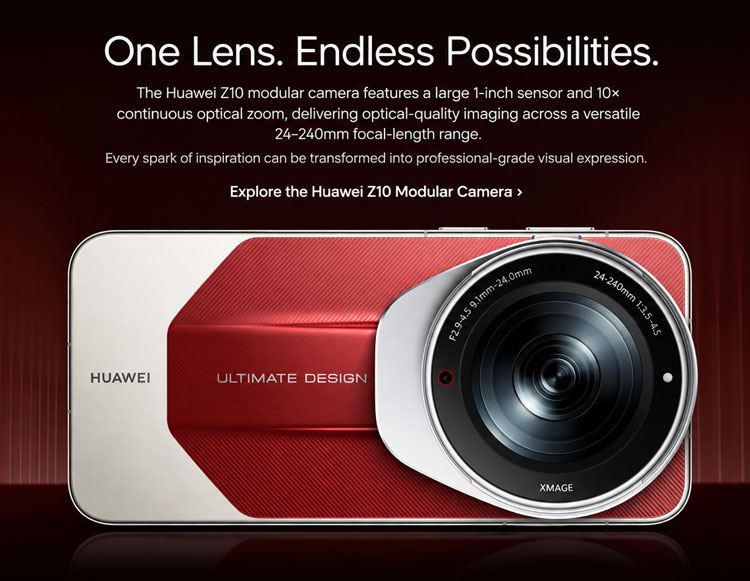
Huawei is trying to do something that Sony did a few years back, but this is said to be one of the finest QX series-style cameras ever made, so we should look at the Z10. Then they have solved the biggest problem of the external cameras that eventually makes it unusable, and the biggest issue is the lack of connectivity. The Sony QX series, with 1-inch/APS-C sensors, was very good, but due to the slow data transmission, a single image capture would take 5 to 15 seconds of time to complete the entire process.
Today, the released camera connects to a smartphone in a DSLR-style, and while mounting it, it connects to the power supply contact points as well as the data supply contact points of the smartphone. So while you are using the Z10 camera module with a 1-inch sensor, it seamlessly acts as a camera lens module without any visible lag, and with that, you can do wonders since, according to the claims made by Huawei, it surpasses the image quality of today’s APS-C sensor-based cameras. One of the most important parts, the image processing, is done by the Huawei smartphone itself, and with the help of AI engines, it upscales the overall image/video quality captured by the lens.
Huawei launched it on 1 October 2026 as the 睿影 Z10 modular camera for the Mate 90 Pro Max Collector’s Edition and Mate 90 RS Ultimate Design only. It is not a teleconverter sitting in front of the phone’s own sensor. It is a self-contained camera: lens, sensor, motors and focus system in one module, with the phone used for power, ISP, storage and the camera UI.
What it actually is
- 50MP 1-inch RYYB sensor (larger than the phone’s own main camera)
- Continuous optical zoom, 24–240 mm equivalent (physical 9.1–91 mm), f/2.0–4.5 variable aperture
- 19 elements in 6 groups, including ultra-low-dispersion and aspherical glass, plus OIS and autofocus
- Laser AF, anti-flicker sensor, third-generation Red Maple colour sensor, control ring
- HyperClick mount: mechanical lock plus metal contacts for power and data, no Wi-Fi
- About 346 g, ¥5,999 in China (roughly $850–900). Global availability is not confirmed
The Verge’s description is accurate: this is almost a camera that happens to use the phone for processing and the screen.
What it actually is
- 50MP 1-inch RYYB sensor (larger than the phone’s own main camera)
- Continuous optical zoom, 24–240 mm equivalent (physical 9.1–91 mm), f/2.0–4.5 variable aperture
- 19 elements in 6 groups, including ultra-low-dispersion and aspherical glass, plus OIS and autofocus
- Laser AF, anti-flicker sensor, third-generation Red Maple colour sensor, control ring
- HyperClick mount: mechanical lock plus metal contacts for power and data, no Wi-Fi
- About 346 g, ¥5,999 in China (roughly $850–900). Global availability is not confirmed
The Verge’s description is accurate: this is almost a camera that happens to use the phone for processing and the screen.
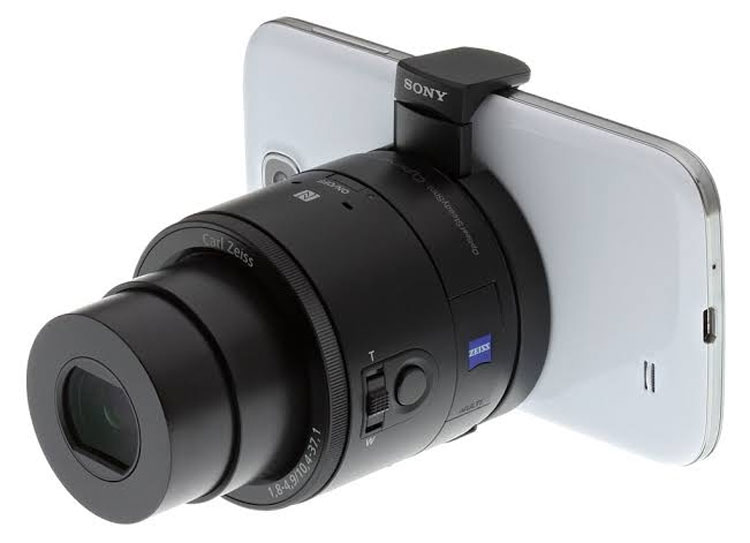
Why the Sony QX series failed
Sony’s lens-style cameras (QX10, QX100, QX30, and the APS-C QX1) launched in 2013–14. The QX100 was the closest ancestor: 1-inch 20MP sensor, Zeiss 28–100 mm f/1.8–4.9, its own battery, clipped to the phone.
They died for reasons reviewers documented at the time, not because the sensor was bad.
- Connection was Wi-Fi plus NFC. Pairing took 5–20 seconds, and you often had to do it again after leaving the app.
- Live view lagged. Fast movement froze the feed or crashed PlayMemories Mobile. Crowded Wi-Fi made it worse.
- The phone was locked to Sony’s app. No native camera, limited manual control, no RAW on the early models, and both batteries drained fast because of the constant stream.
- Image quality was fine for 2013, but phones improved every year while the QX stayed a second device you had to charge, pair and carry.
CNET called shooting with the QX10 “extremely frustrating” because of lag and reconnects. That UX, not the Zeiss glass, is what the category could not survive.
Where the Z10 is actually better
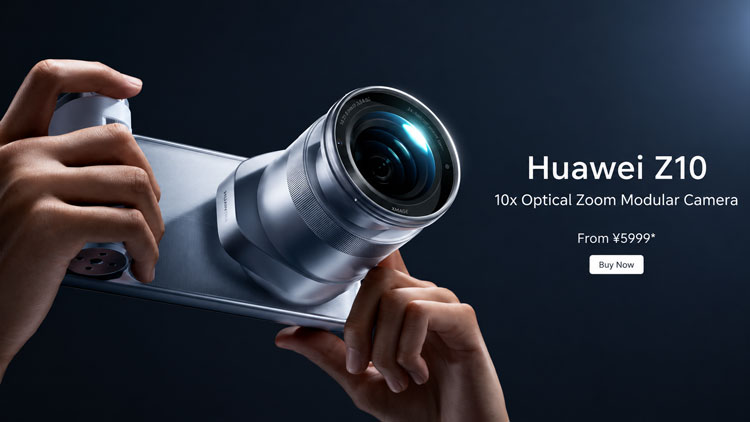
The hard-contact mount is the real difference. Data and power go over pins, so the preview lag and pairing ritual that defined the QX do not apply. Chinese coverage describes the module taking over the phone’s native camera app, with the same UI and third-party apps able to call it through the system interface.
Optically it also outranges the QX100: 10× continuous zoom to 240 mm instead of 3.6× to 100 mm, with a larger entrance pupil at the long end than Sony’s RX100 VII class 1-inch zooms. Because every focal length uses the same 1-inch sensor, there is no jump when the phone would normally switch from main to periscope to crop. Huawei’s ISP and XMAGE processing sit on top of real optical data instead of a tiny phone sensor plus a clip-on converter.
That is a cleaner architecture than vivo/OPPO teleconverters, which only add glass in front of the phone’s existing telephoto.
Why it is still not “the future”
Three limits keep it a niche tool.
It only fits two collector-level Mate 90 variants. Everyone else is locked out, and the phones themselves are China-market for now. At roughly $900 on top of an already expensive flagship, it costs as much as a used RX100 VII or an APS-C kit lens.
At 346 g the module alone is heavier than many compact cameras. Collapsed it is about the size of a 50 mm prime; extended it is a small cannon. You are no longer carrying a phone. You are carrying a phone with a camera bolted to it, which is fine for concerts, sport and travel days, and pointless for pocket use.
Independent image tests are still thin – it launched today. Huawei’s own MTF claims against 18–200 mm lenses should be treated as marketing until side-by-side files exist. A dedicated 1-inch superzoom or a small mirrorless still wins on battery life, viewfinder, grip and file flexibility.
So the Z10 is the first external phone camera that does not repeat Sony’s connectivity mistake. For Mate 90 owners in China who want 24–240 mm optical reach without a second body, it is a real tool. For photography as a whole, the future is still better sensors and lenses inside devices people already carry — or a proper camera when the shot needs one.
TNC Take: Huawei’s Ruiying Z10 is a real camera bolted to a phone, not a clip-on lens: 50MP 1-inch sensor, 24–240 mm continuous optical zoom, f/2.0–4.5, about 346 g. It connects by metal contacts, so it avoids the Wi-Fi lag that killed Sony’s QX series. It only fits the Mate 90 Pro Max Collector’s Edition and Mate 90 RS, costs ¥5,999 (about $895), and went on sale in China on 1 October 2026.
There is no US date. Huawei has not announced a global or US launch for the Z10 or the Mate 90 phones it needs. An official US release is unlikely: these phones use Kirin chips and HarmonyOS under ongoing US restrictions, and recent Mate flagships have stayed out of the American market. Grey-import units may show up later, but that is not a launch.
The article “Huawei just built the camera Sony QX lenses failed to be” was written by thenewcamera.com team on 6:35 pm, Thursday, 1 October 2026, Greenwich Mean Time | You can also follow us on Our Official Social Media Handles FACEBOOK | TWITTER | INSTAGRAM > get live news — > DJI Rumors | Insta360 News
DJI Matrice 5TD and Dock 4: October Arrival, Price and More