
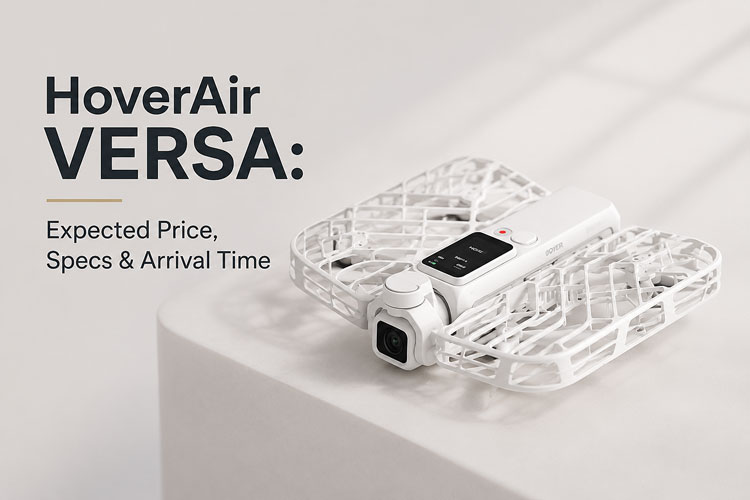
So finally, we have a pocket gimbal camera that can fly, and it’s not a fantasy concept. We have literally seen an official teaser video from HoverAir.
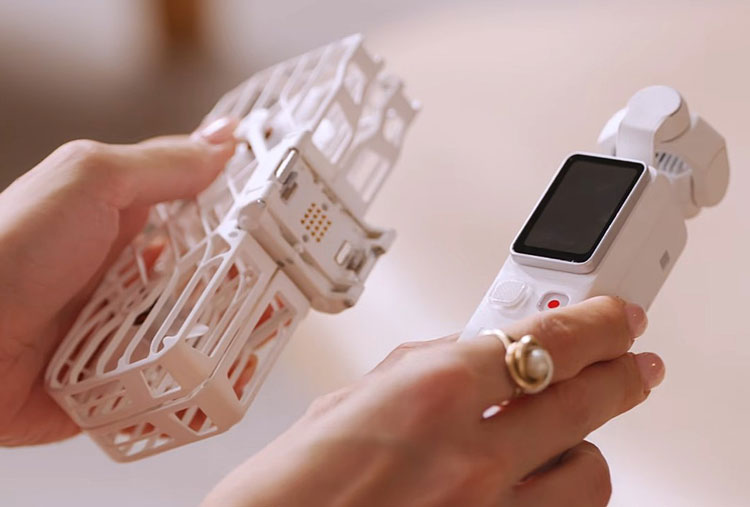
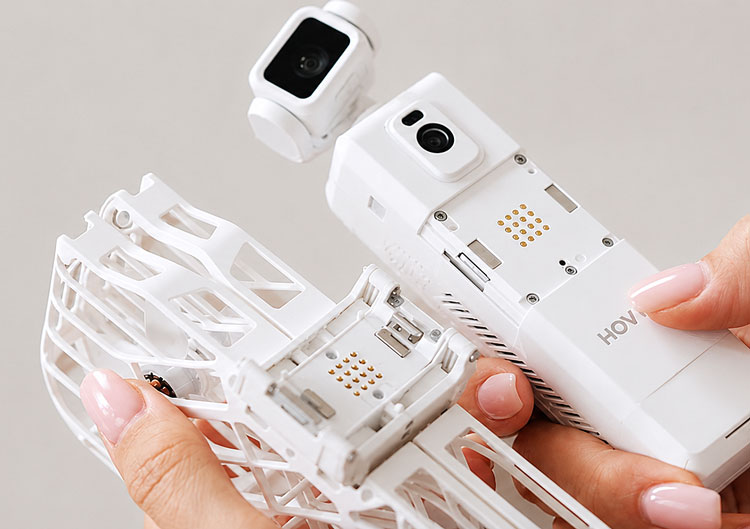
The most important part of the teaser video, it’s not an AI-generated video. It’s a real video showcasing a gimbal-style camera that can be attached to and detached from the drone module. So you can either use it purely as a pocket gimbal camera, or make it a compact flying drone that always follows you, captures you like a professional cinematographer, and finally lands in your palm.
In the teaser video, we can clearly see a pocket-sized 3-axis gimbal camera that snaps into a protected propeller cage and becomes a self-flying AI camera. Palm takeoff, palm landing, AI tracking, auto-framing, and a “3D Worlds” mode. No controller required.
Expected Price
Most realistic base price range: $599 – $699
Breakdown of the logic: HoverAir X1 PRO starts at $499. X1 PROMAX starts around $594–$699. VERSA adds a proper 3-axis mechanical gimbal + screen for handheld use plus a modular snap-on flight system. That is meaningfully more hardware than a pure X1-style flying camera
- Competitor benchmark: DJI Osmo Pocket 3 (proper pocket gimbal) sits around $429–$499. DJI Neo (tiny self-flying camera) is $169–$199. Buying both separately costs roughly $600–$700.
- HoverAir needs the VERSA priced high enough to justify the dual hardware and avoid heavily cannibalising its own X1 PRO/PROMAX line, but low enough that the “one device instead of two” argument still holds.
Most probable full retail price for the standard version: $649 or $699.
Early-bird or launch pricing could open at $549–$599. Creator/combo kits with extra batteries and case will likely land in the $749–$849 range.
Anything significantly below $599 would undercut their own higher-end models. Anything starting much above $749 base makes the value proposition weak against simply buying a Pocket 3 and a Neo.
Specifications – What Is Confirmed vs What Is Missing
Confirmed from the teaser and marketing:
- Modular design: handheld 3-axis gimbal camera that attaches to a closed propeller cage
- Palm takeoff and palm landing
- AI subject tracking and auto-composition/framing
- “3D Worlds” mode (360° flight path for 3D scene reconstruction)
- No traditional controller required
- Aimed at everyday/travel/creator use rather than pure high-speed action
Still completely unknown (and critical):
- Image sensor size and type
- Maximum video resolution and frame rates
- Photo resolution
- Battery capacity and real-world flight time
- Exact weight of the handheld module and the full flying configuration
- Obstacle sensing capability
- Wind resistance rating
- Storage options
- App features and any manual control options
Without these numbers, any serious comparison to the Osmo Pocket 3, DJI Neo, or HoverAir’s own X1 PROMAX is incomplete. The concept is interesting. The execution quality will be decided by the missing hardware details.
Arrival Timeline – Realistic Expectations
HoverAir’s past behaviour is consistent: strong teaser → follow-up with pricing and details within a few months → shipping later than the optimistic language suggests.
AQUA is the clearest recent example. Crowdfunding started in 2025 with ambitious shipping targets. Official retail availability only arrived in May 2026 after delays.
For VERSA:
- Full announcement (price + detailed specs + pre-order) is most likely in Q4 2026, specifically October–November.
- First customer shipments are more realistically Q1 2027.
Late 2026 deliveries are possible only if production tooling and certification are already well advanced. For a new modular mechanical design, that is optimistic. Q1 2027 is the safer planning window.
Bottom Line
The VERSA concept is genuine and the video looks like a real prototype, not pure CGI. HoverAir has a track record of eventually shipping the products they tease.
The product will succeed or fail based on sensor performance, flight time, and how well the handheld gimbal mode actually competes with a dedicated pocket camera. Those answers are still missing.
We will update this analysis the moment official specifications and pricing are released.
The article “ HoverAir VERSA: Expected Price, Specs & Arrival Time – Clear Analysis” was written by thenewcamera.com team on 1:23 pm, Thursday, 30 July 2026, Greenwich Mean Time (GMT) | You can also follow us on Our Official Social Media Handles FACEBOOK | TWITTER | INSTAGRAM > get live news — > DJI Rumors
Insta360 Luna Pro Product Shots Leak